
.svg)
.avif)
If you advise on acquisitions, train a team of associates, or are building toward a role in deal execution, the M&A credential you choose signals something to your clients and colleagues before you say a word. The question is not just which program is rigorous. It is which one solves the right problem for where you are right now.
This guide covers ten programs available in 2026, structured by use case rather than prestige alone. The right program depends entirely on what you need to do with the knowledge: broadcast a credential, build technical modeling skills, train a team fast, or develop the operating judgment that only comes from practitioners who have actually run deals.
Before You Choose: Decide What You Are Actually Buying
Not all M&A programs solve the same problem. Before comparing options, identify which category fits your situation.
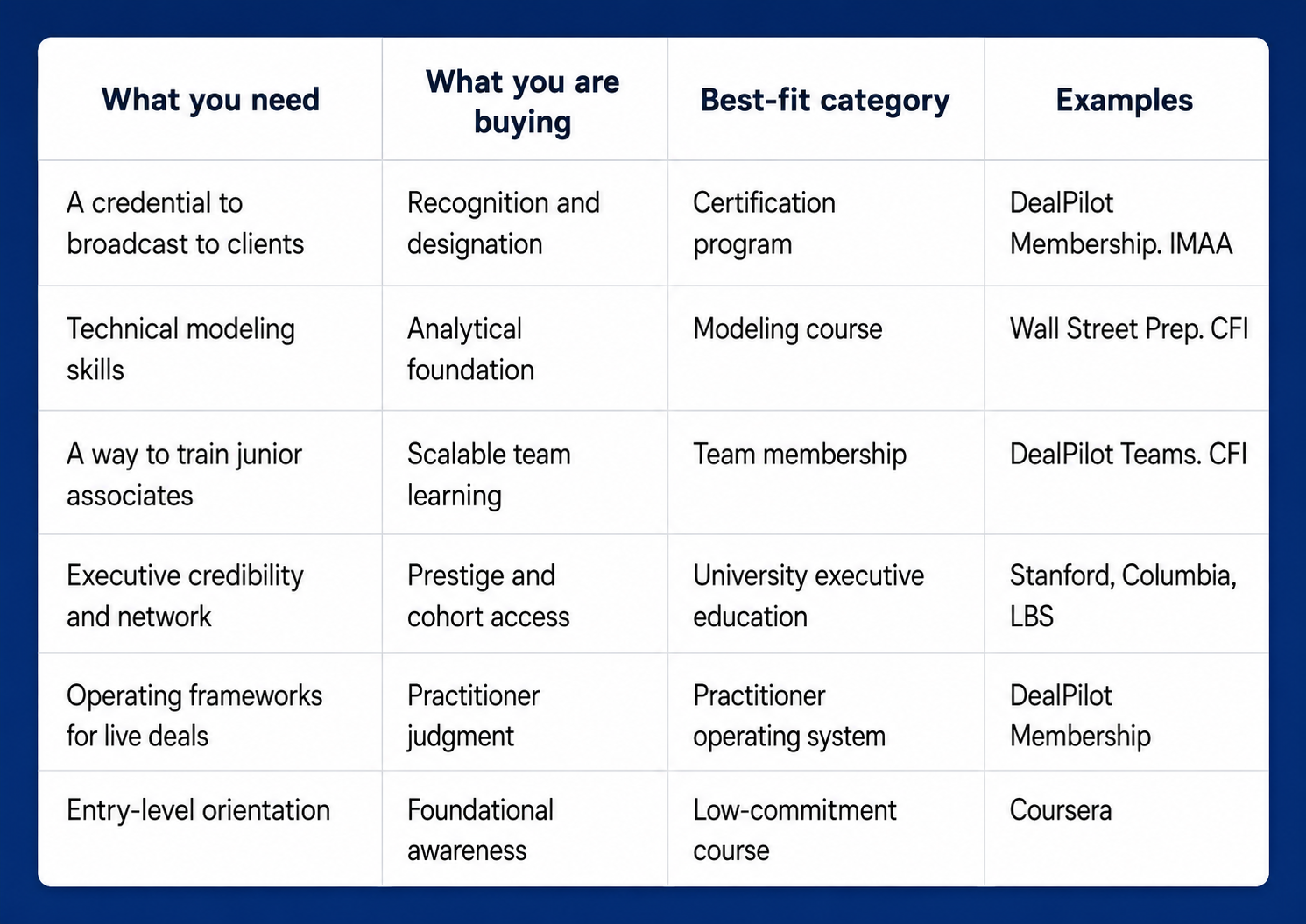
Quick Comparison: Best M&A Courses and Certifications for 2026
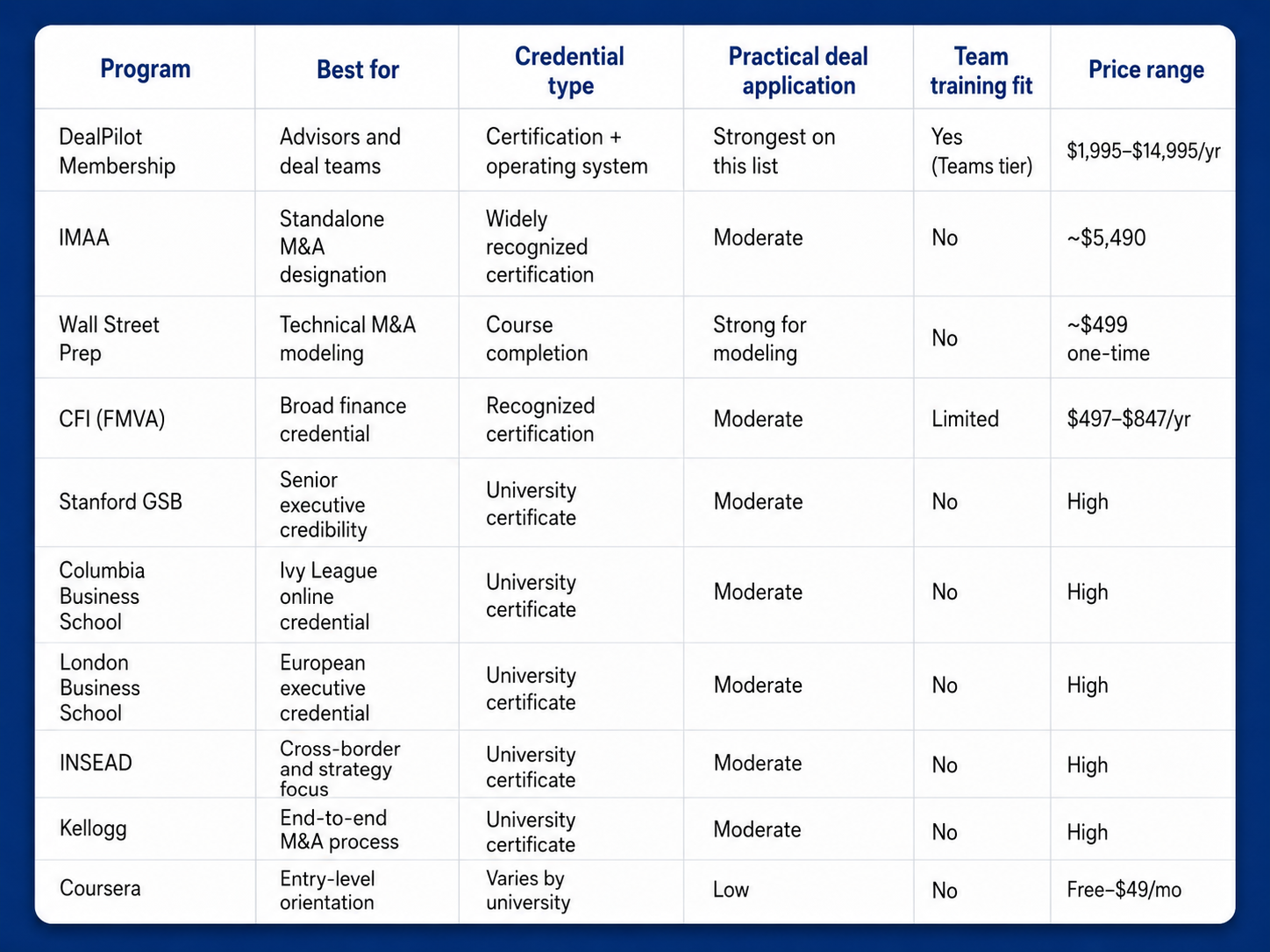
Tier I: Best M&A Certifications and Memberships for Advisors and Deal Teams
High signal, real-world focus, strong value for the investment.
1. DealPilot Membership — Editor's Pick
Format: Online | URL: mascience.com/membership
DealPilot Membership, powered by M&A Science, is the only program on this list built around practitioner-sourced operating guidance rather than academic frameworks. The M&A Fundamentals Certification covers the full acquisition lifecycle: target identification, due diligence, deal structuring, negotiation, and post-merger integration, all through the lens of Buyer-Led M&A™, the operating methodology developed from 400+ interviews with corporate development leaders, integration practitioners, and PE operators.
Every other program on this list draws on faculty research or case studies. DealPilot draws on primary source material from practitioners who ran the deals. The platform's searchable archive surfaces specific frameworks, decision models, and playbooks tied to real scenarios. Live Labs let members work through current deal challenges alongside practitioners. For advisors building credentials, the Buyer-Led M&A™ Certification path leads to a listing in the Buyer-Led M&A™ Certified Advisor Directory, a public-facing credential tied to a specific operating standard, not a course completion badge.
For boutique firms and advisory practices, the Teams tier gives up to 20 users full platform access, certification seats, and M&A Competency Assessment credits. No curriculum to build from scratch; the practitioner frameworks are already there.
If you need broad finance credentialing or want an MBA-adjacent experience, this is not the right fit. If you advise buyers, train deal teams, or need frameworks that translate directly to active work, DealPilot Membership is the most operationally grounded option on this list.
Best for: Advisors building credentials, boutique investment banks and advisory firms training associates, individual operators and career changers who need practical M&A frameworks over conceptual ones.
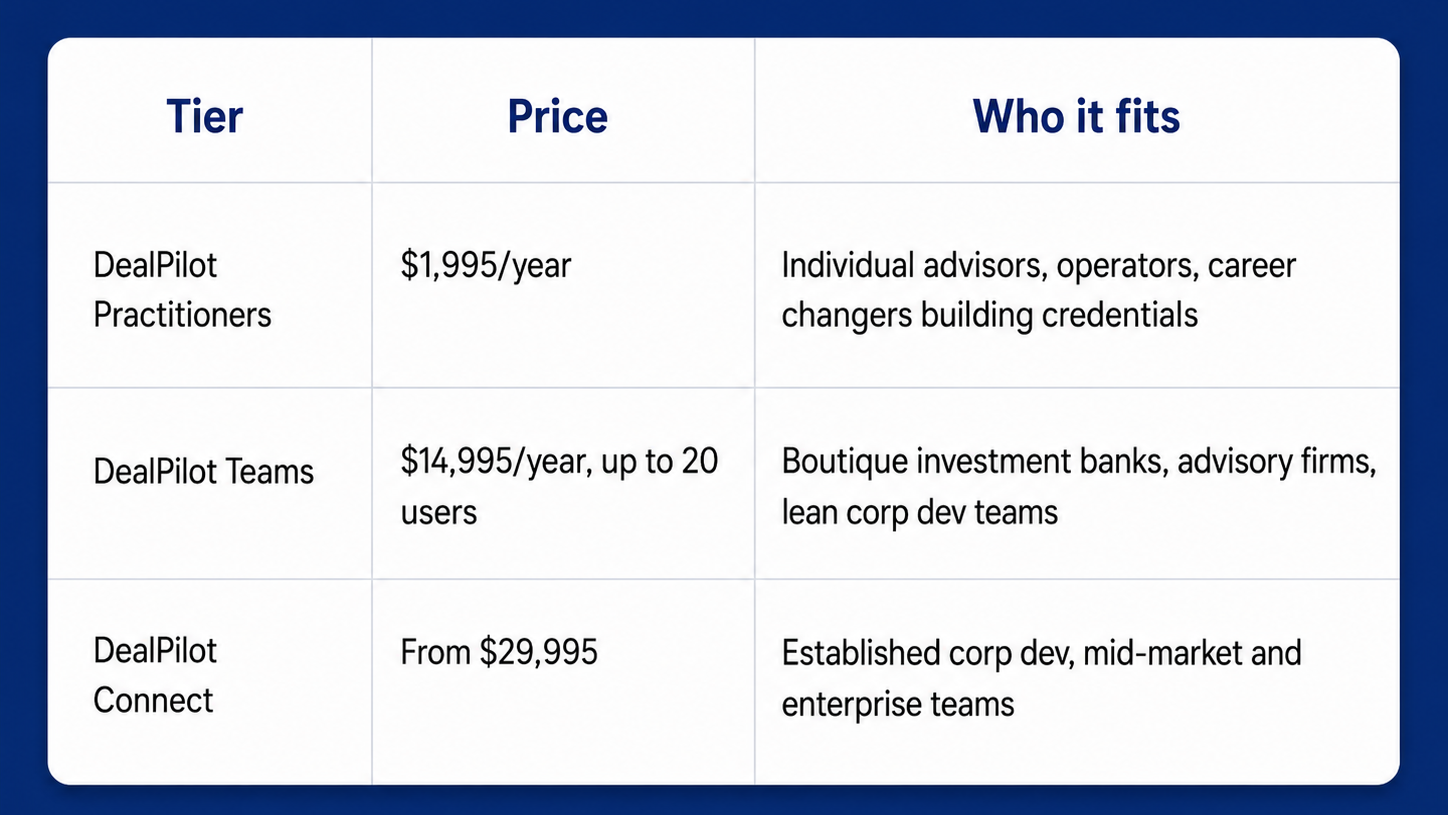
Want the credential and the operating system? DealPilot Membership gives you Flights & Certifications, practitioner playbooks, Live Labs, Off Mandate access, and deal guidance built from primary source intelligence, in one membership. [Explore DealPilot Membership → mascience.com/membership
2. IMAA — International M&A Expert Program
Format: Online and in-person (NYC, May 2026) | Price: ~$5,490 | imaa-institute.org
The Institute for Mergers, Acquisitions and Alliances has spent over two decades building what is widely regarded as the most recognized standalone M&A credential outside of a top MBA program. The curriculum covers the full deal spectrum: strategy and target screening, financial valuation, deal execution, legal and tax structuring, and post-merger integration.
Beyond the core International M&A Expert certification, IMAA offers dedicated programs for post-merger integration (CPMI), M&A advisory, legal aspects across multiple jurisdictions, HR in M&A, and divestiture management. That depth means you can build a credential stack that matches your specific function rather than taking a single generalist path.
The global alumni network is one of the strongest in the M&A space, and if you attend in person in New York, the cohort alone is worth a significant portion of the fee.
Best for: Seasoned professionals and advisors seeking the most widely recognized standalone M&A designation, particularly those who want a credential they can broadcast to clients across geographies.
3. Wall Street Prep — M&A Modeling (Premium Package)
Format: Online, self-paced | Price: ~$499 one-time | wallstreetprep.com
Wall Street Prep is the training firm banks use for analyst and associate onboarding, so the self-study version of its curriculum reflects what you would encounter on day one at a bulge-bracket bank.
The M&A modeling module covers acquisition structuring, deal financing, accretion/dilution modeling, and the impact of deal structure on earnings and valuation. You build models from scratch using the same Excel conventions and analytical frameworks you would encounter in a live deal environment. One-time pricing means lifetime access with no subscription pressure.
Best for: Aspiring investment bankers, current analysts, and anyone preparing for technical M&A interviews.
4. Corporate Finance Institute (CFI) — FMVA + M&A Courses
Format: Online | Price: ~$497–$847/year | corporatefinanceinstitute.com
CFI's M&A content covers strategic rationale, financial and valuation modeling, deal structuring, due diligence processes, post-merger integration, and the impact of transactions on financial statements. The FMVA certification wraps all of it into a structured credential path recognized by 20 global finance bodies.
The subscription model gives access to a broad library of adjacent courses: Excel, accounting, corporate strategy, and sector-specific modeling, which helps build a well-rounded finance foundation. The trade-off is breadth over depth. This suits professionals who want a comprehensive, credentialed finance education with M&A as a core pillar, rather than those who need to go deep on deal operations specifically.
Best for: Finance professionals who want a broad, credentialed program covering M&A alongside the full corporate finance toolkit. Advisory firms that need a scalable, affordable option for junior associate training on finance fundamentals.
Tier II: Prestigious Executive and University Programs
For senior professionals and executives who want brand-name credentials and strong networks.
5. London Business School — Mergers and Acquisitions
Format: 5-day intensive, London or online | Runs approximately 5x per year | london.edu
LBS's M&A program is one of the most prestigious short-format executive courses available in Europe. The typical participant is a financial manager whose company is beginning to explore acquisitions, a legal professional working on transactions for the first time, or a senior executive who needs to engage meaningfully with deal teams without running them directly.
The curriculum covers deal origination and target assessment, valuation approaches, deal financing, due diligence, negotiation, and post-merger value creation. Attendees consistently report that the in-person experience delivers significantly more on the networking dimension than the online format.
Best for: Senior professionals new to M&A who want a prestigious, fast-track credential with strong European brand recognition.
6. Columbia Business School — M&A Online Program
Format: 9-week online with live faculty sessions | Ivy League certificate | online1.gsb.columbia.edu
Columbia's nine-week online M&A program is one of the most thorough university-backed options for executives who cannot take a full week away. Live sessions with Columbia faculty are paired with case studies, assignments, and structured peer discussion, creating a learning experience that approximates the rigor of an in-person program.
The program uses the Mittal Steel/Arcelor hostile takeover as its central case study, which is particularly effective at illustrating how mechanics differ between friendly and hostile transactions and how diligence shapes deal outcomes.
Best for: Executives and senior managers who want Ivy League credibility in a flexible online format.
7. Stanford Graduate School of Business — Mergers and Acquisitions
Format: 1-week intensive, in-person (California) | gsb.stanford.edu
Stanford's M&A course is one of the most intellectually rigorous short-format programs available. The curriculum draws on Stanford's combined expertise in strategy, corporate finance, accounting, and organizational behavior, giving participants a view that covers more than financial mechanics.
Each day ends with a live simulated deal under realistic time pressure, with immediate feedback. By week's end, participants have worked through a full acquisition from term sheet to integration planning. Cohort composition skews to the C-suite and VP level.
Best for: Senior executives seeking one of the most intensive, intellectually rigorous M&A experiences available.
8. INSEAD — M&As and Corporate Strategy
Format: 4.5-day intensive | Fontainebleau or Singapore | insead.edu
INSEAD's M&A program is grounded in corporate strategy rather than pure financial execution, and the case studies reflect it. They span manufacturing, pharmaceuticals, financial services, and technology, drawn from multiple geographies, making them more directly relevant for professionals working on cross-border transactions than most programs on this list.
The teaching methodology is participatory throughout: interactive case discussions, small group project work, and experience-sharing sessions where peer learning carries as much weight as faculty instruction. The choice between Fontainebleau and Singapore campuses is a practical advantage for Asia-based practitioners.
Best for: Strategy-focused executives with international or cross-border M&A responsibilities.
9. Kellogg School of Management — Merger Week
Format: Intensive, in-person | Northwestern University, Chicago | kellogg.northwestern.edu
Kellogg's Merger Week has been running continuously for more than 40 years, an extraordinary track record in the world of corporate training. The program delivers end-to-end understanding of the full M&A process, from target identification and economic valuation through negotiation mechanics, transaction documentation, and post-merger integration planning.
Kellogg integrates hard financial skills with the organizational dynamics and cultural complexity of combining two companies particularly well, and the alumni network from four-plus decades of Merger Week graduates is formidable.
Best for: Executives who want a deeply structured, end-to-end M&A experience with one of the longest track records in executive education.
Tier III: Accessible Entry-Level Option
10. Coursera — M&A Specialization (Various Universities)
Format: Online, self-paced | Free to audit; ~$49/month for certificates | coursera.org
Coursera is the right starting point if you are brand new to M&A and not yet ready to commit to a more structured program. The platform hosts M&A courses from a range of universities covering foundational topics: the M&A lifecycle, valuation techniques, deal structuring, financial modeling basics, and due diligence processes. The audit option lets you access most course content for free, and for someone exploring whether M&A is the right direction before investing in a more intensive program, that is a sensible place to start.
Best for: Beginners, career explorers, and anyone who wants to build foundational M&A knowledge before committing to a more intensive program.
Which M&A Program Is Right for You?
If you are an advisor trying to differentiate with clients: Choose DealPilot Membership or IMAA. DealPilot is the stronger choice if you want a credential tied to a specific operating methodology, ongoing access to practitioner frameworks, and visibility through the Buyer-Led M&A™ Certified Advisor path. IMAA is the stronger choice if you want the most widely recognized standalone designation in the market.
If you are a boutique firm or advisory practice training junior associates: Choose DealPilot Teams or CFI. DealPilot Teams is stronger for firms that need associates to develop M&A-specific operating judgment alongside their credentials. CFI is a better fit if the primary need is finance fundamentals coverage at lower cost.
If you are preparing for investment banking interviews or an analyst role: Choose Wall Street Prep. It is the most direct path to the technical modeling skills banks expect on day one.
If you are a senior executive building credibility and network access: Choose Stanford, Columbia, LBS, INSEAD, or Kellogg. The decision between them comes down to geography, format preference, and which alumni network matters most for where you work.
If you are just starting to explore M&A as a career direction: Start with Coursera. Audit the content for free, build a baseline, and then make a more considered investment once you know where you want to go.
How to Choose
For investment banking preparation, Wall Street Prep gives you the technical foundation banks expect. For the most recognized standalone M&A credential, IMAA is the clear answer. For advisors and deal teams who need credentials tied to practical operating frameworks, DealPilot Membership is the strongest option on this list. And for the prestige and network of a top business school program, Columbia, LBS, Stanford, or INSEAD all deliver, assuming the time and budget work.
The M&A market in 2026 is competitive. Advisors who win client trust and practitioners who lead well-run deals are the ones who built their operating frameworks before walking into the room.
Training junior associates or building a repeatable advisory bench? DealPilot Teams gives advisory firms access for up to 20 users: Flights & Certifications, M&A Competency Assessment credits, and practitioner-built deal guidance in one membership. Built for firms that need practical M&A training without sending everyone through a scattered course library.
.svg)