.svg)

Quick Answer: Lower-middle-market private equity firms improve operations by consolidating shared functions, divesting non-core divisions, cross-selling adjacent products or services, and building management teams that can operate beyond the founder.
Private equity has gone from being an upstart industry to (close to) a household name over the past 40 years. But it’s still rare for those outside the financial services industry to know what private equity is, what private equity investors do, how they get paid, and what the benefits and risks are for the companies they invest in.
At Raincatcher, our primary work is representing business owners who want to sell to, raise capital from, or partner with private equity groups. This vantage point gives us the unique ability to see how companies operate while the founder is in charge, and to observe the changes private equity groups make once they close.
In this blog, we’ll explore private equity, how it drives growth, and most importantly, how these strategies can be applied to boost your own business’s growth.
What Is a Private Equity Firm?
Private equity firms are professional investment firms that use their clients' money to invest in or buy privately held companies, with support from professional M&A advisors. They aim to generate returns for their investors by strategically managing and growing these businesses.
Unlike public companies traded on stock exchanges, private equity firms acquire ownership stakes in non-public firms, often with the goal of improving operational efficiency, expanding market reach, or growing through acquisitions to move up-market and increase a company's value.
Who Invests in Private Equity Funds?
Private equity firms typically raise capital from institutional investors such as pension funds and high-net-worth individuals to finance these acquisitions. They then use their expertise to add value to their portfolio companies through various means (more on that later).
Private equity firms play a crucial role in the economy by fostering growth and innovation in various industries through their hands-on management and long-term investment strategies.
How Private Equity Firms Get Paid
Private equity firms are paid through two primary mechanisms: asset management fees and performance fees (AKA carried interest). Management fees are paid annually and used by the private equity firm to cover operating expenses, primarily salaries. Typically, this fee amounts to 2% of the total committed capital.
Performance fees, also called "promote" or "carried" interest, are a share of the profits, typically around 20%, earned after returning the initial capital to investors and achieving a minimum return threshold, usually around 8%. This payment structure motivates the firm to maximize investment returns. If private equity investors generate returns below average for their clients, the fee will be less than 20%, while those who produce higher returns will receive performance fees exceeding the standard 20%.
The Primary Growth Initiatives for Private Equity Investors
There are several initiatives that private equity investors employ to drive strong returns for their investors. Some of the more common ones include:
- Digital Transformation and Technology Upgrades: Implementing new technologies to improve the companies' efficiency, drive innovation, and stay competitive in the market. This can include upgrading IT infrastructure and adopting or creating new software solutions.
- Revenue Growth Initiatives: Developing new sales strategies, expanding distribution channels, enhancing marketing efforts, and improving customer engagement and retention.
- Operational Improvement: PE groups will work to enhance the efficiency and effectiveness of a company's operations.
At Raincatcher, we believe that improving operations and making the company more efficient is the single best growth initiative private equity firms can pursue. This is because it does not rely on new products or additional capital. The average business owner can learn the PE growth tactic and implement it in their own business.
3 Ways Private Equity Firms Streamline Portfolio Company Operations
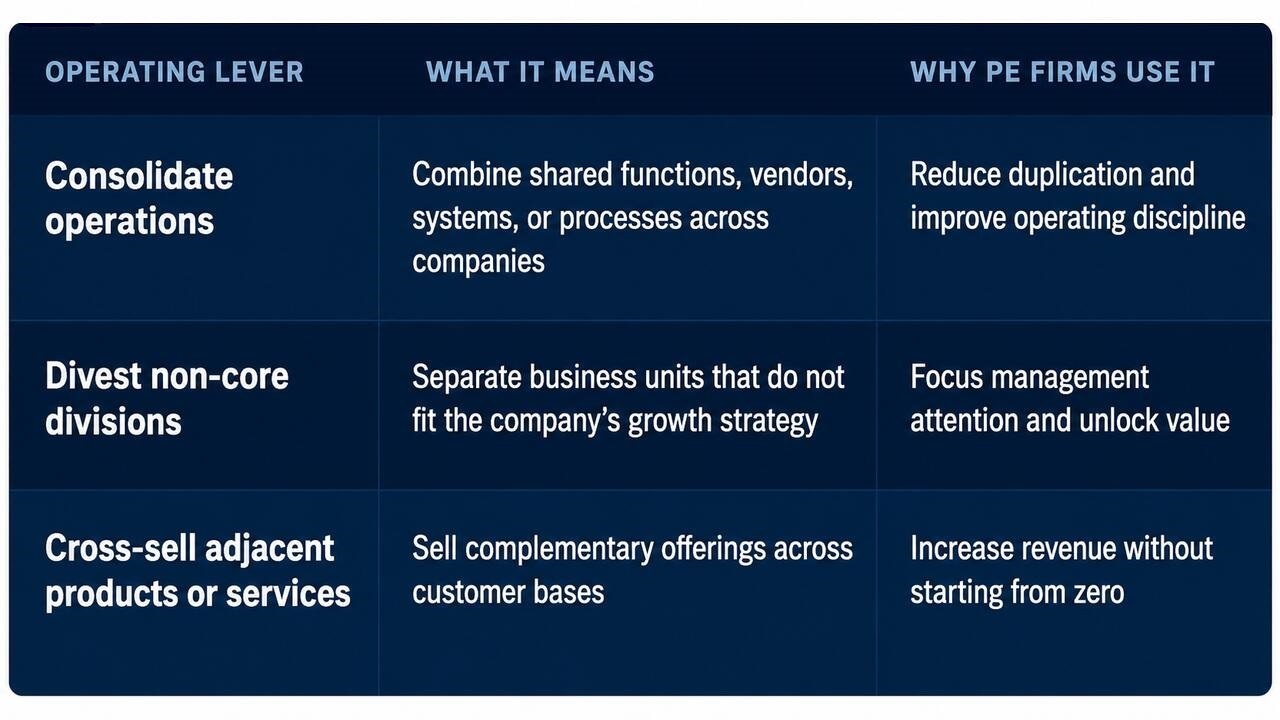
1. Consolidate Operations Across Portfolio Companies
Many private equity firms will look to grow their portfolio companies through acquisition (roll-up strategy) and/or strategic partnerships with companies offering adjacent products and services. In pursuing either of these growth strategies, including scaling roll-up strategies, there are often opportunities to consolidate operations and thereby save costs.
For instance, if each company has an outsourced CFO working 30 hours per week, the new company could probably benefit from a full-time CFO working 40 hours per week.
2. Divest or Carve Off Non-Core Divisions
Some companies have less desirable lines of business that may be an undue burden on the management team and the company's financial structure. In this case, the company would likely be better off spinning off (selling) that portion of the business so that they can double down and focus their capital and expertise on the areas where they believe there is value. This kind of portfolio rebalancing is one of the more reliable ways PE firms improve returns after acquisition.
3. Cross-Sell Adjacent Products and Services Across the Portfolio
One of the most common action items that PE groups take after acquiring a company is to identify adjacent products and services they can cross-sell to their existing clientele.
This could be other products or services that could be offered by the company, or, the sales team can sell other companies' products for a commission. Doing this provides a quick way for the business to more fully monetize their strong client relationships. However, for one reason or another, companies that are not private equity-backed rarely come up with the idea of pursuing this.

Implementing Effective Growth Strategies to Further the Success of Your Business
If you're a small business owner, you know your business is only as good as your team.
That's why we strongly advocate building a rock-star management team and learning to delegate effectively before pursuing other growth initiatives. Increasing revenue without the ability to delegate or consistently deliver your service is like trying to fill a leaky bucket. You may bring in more business, but you'll struggle to sustain that growth.
Once you have the right team, strong processes, and the ability to step away from day-to-day operations, you're ready to implement operational improvement strategies that have traditionally been reserved for private equity firms.
Think Like a Shareholder
Get in the habit of viewing your business from an outsider's perspective. Doing so will help you see opportunities that you were previously blinded to. It might mean seeing that your company is spending too much time with the bottom 10% of customers, that there’s another product or service that you should be offering, or that your best sales reps are stuck behind a keyboard instead of doing their thing.
By thinking like a shareholder, you'll develop the ability to see these opportunities rather than being myopically focused on the small tasks in front of you. For a framework for measuring value creation in M&A, the equity value creation framework is a useful reference.
Growth Through Acquisition
While growing through acquisition may seem like a growth plan only available to private equity groups with deep pockets, the fact is that, thanks to the SBA, there are better acquisition financing options for Main Street businesses than for larger, private equity-owned ones.
While growth through acquisition is not suggested until your current business is proving to be operationally sound and you have disposable income that you can invest, the fact is that you can buy a competitor's company or a company offering an adjacent product or service to your own with as little as 10% down and finance the 90% for 10 years. If you pursue this path, managing multiple acquisitions without losing focus becomes the operational challenge to plan for.
Create Recurring Product and Service Offerings
Many business owners focus solely on creating products and services that they believe their customers will buy. While this is a great way to test the market and build a profitable business, there is often an opportunity to turn these products or services into recurring revenue streams that not only your customers will love but will also drive significant value for your business.
The fact of the matter is that not all cash flow is equivalent. If you can prove to potential buyers that your business can endure a recession due to its sticky, recurring cash flow and that any new customers they bring to the company will mean parabolic growth due to its sticky, recurring revenue business model, there will be a feverish investor market for your business, which will cause it to trade at a much higher business valuation.
While there are countless ways to grow any given company, reviewing the past performance of private equity-backed companies with the 80/20 principle in mind will lead you to realize that the bulk of the positive results have come from hiring a capable management team and enacting one or more of the above operational improvement initiatives.
It is our hope that you will develop the habit of viewing your business as a shareholder rather than an operator. By stepping back and viewing your business from this new perspective, you'll develop the ability to spot opportunities you had been blind to before.
Frequently Asked Questions
How do private equity firms improve portfolio company operations?
Private equity firms improve portfolio company operations by consolidating shared functions, divesting non-core divisions, cross-selling adjacent products or services, and strengthening the management team so the business can scale beyond the founder.
Why do lower-middle-market PE firms focus on operations?
Lower-middle-market companies often have growth potential but less mature systems, reporting, or management infrastructure. Operational improvement helps the company scale beyond founder-led processes.
What is portfolio company operational improvement?
Portfolio company operational improvement is the process of improving how an acquired company runs after the deal closes. It can include process changes, leadership upgrades, cost controls, revenue expansion, and better performance tracking.
What can founders learn from private equity firms?
Founders can learn to think like shareholders. That means building a management team, reducing dependency on the owner, focusing on measurable growth, and making the company easier to scale or eventually exit.
.svg)