.svg)
.avif)
An M&A analyst is an entry-level professional who supports the evaluation, execution, and reporting of merger and acquisition transactions. The role sits at the intersection of financial analysis, research, and deal strategy — and for most people, it's where an M&A career begins.
Breaking into M&A isn't easy. The industry is competitive, dedicated college programs are rare, and most people don't know where to start. But the path is clearer than it looks once you understand what the role actually requires — not just the credentials, but the skills, the mindset, and the realities of the job.
This guide covers everything you need to know: what M&A analysts actually do, the hard and soft skills that matter, how long it takes to get there, what it pays, and how to find your first role.
Table of Contents
- What Is an M&A Analyst?
- What Does an M&A Analyst Do?
- Skills Required for M&A Analysts
- How to Become an M&A Analyst
- M&A Analyst Salary
- A Day in the Life of an M&A Analyst
- Common M&A Analyst Interview Questions
- How to Find a Job as an M&A Analyst
- Frequently Asked Questions
What Is an M&A Analyst?
An M&A analyst is the engine behind early-stage deal work. They help companies evaluate potential acquisitions, assess financial reports, analyze competitive positioning, and build the models that inform whether a deal makes sense.
Most analysts sit in one of two places: investment banks, where they work on transactions for clients, or corporate development teams inside companies, where they support internal M&A activity. The work is similar in both environments — rigorous, detail-oriented, and high-stakes — but the context and deal flow are different.
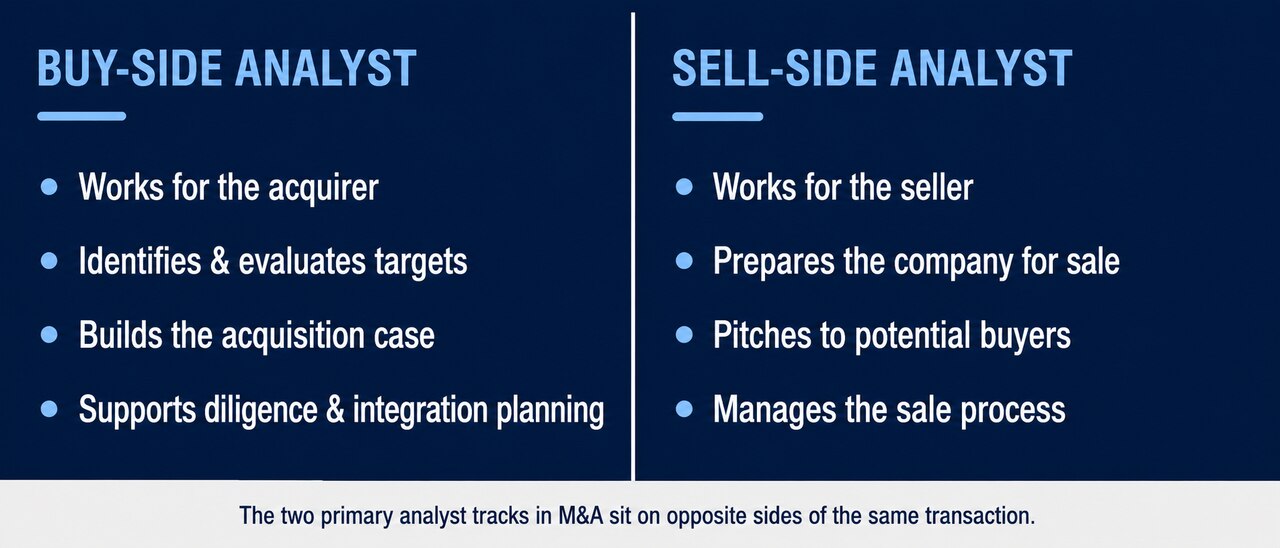
There are also two sides to the market:
Buy-side analysts identify and evaluate companies that could be acquisition targets. They're building the case for why a particular company is worth pursuing.
Sell-side analysts work on behalf of companies that are looking to be acquired. They pitch the business to potential buyers, build materials that make the case for the company's value, and help manage the process.
Regardless of which side you're on, the analyst role is where the foundational work of any deal gets done.
What Does an M&A Analyst Do?
The analyst role breaks down into three core responsibilities:
Research and Target Analysis Analysts do the preliminary legwork on potential deals. That means researching target companies, mapping the competitive landscape, tracking market trends, and identifying opportunities that fit the acquirer's strategy. This isn't passive research — analysts are often the first point of contact with potential targets, gathering information that will eventually drive high-stakes decisions.
Financial Modeling and Valuation At the core of the analyst role is the ability to build financial models. Analysts create valuation models for target companies, run scenario analyses, and help determine what a business is actually worth — and what premium might be justified. This work directly informs what senior leadership decides to offer, pursue, or walk away from.
Reporting and Presentations Analysts translate complex analysis into clear, executive-ready presentations and deal summaries. The quality of that communication has a real impact — the better senior management understands the analysis, the better their decisions. Analysts also prepare reports during diligence, documenting findings and flagging risks as the deal progresses.
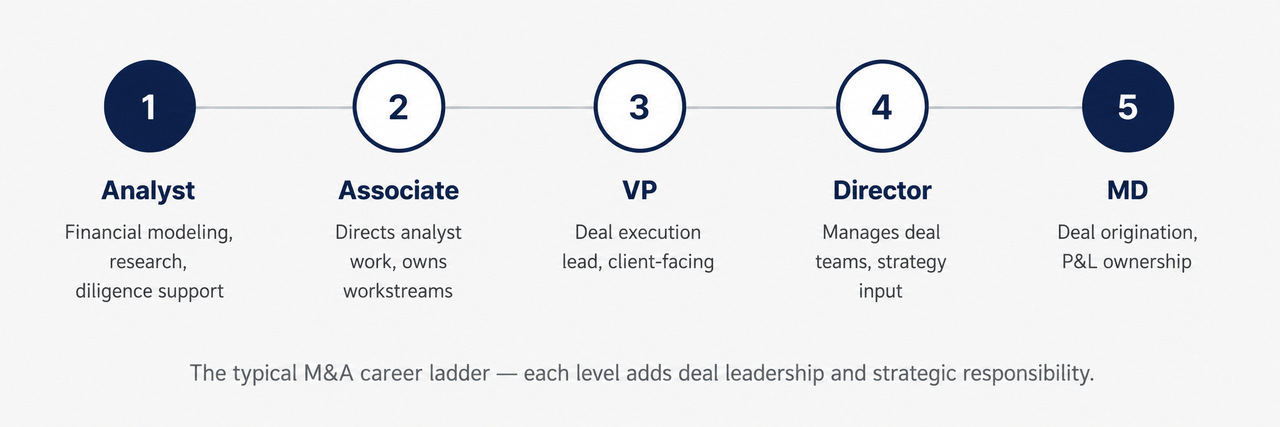
One level up from the analyst is the M&A Associate, who typically directs and reviews the analyst's work. Most career paths in M&A move from Analyst → Associate → VP → Director → Managing Director, with each level taking on more deal leadership and client responsibility.
Skills Required for M&A Analysts
The M&A analyst role demands a specific combination of technical capability and professional maturity. Here's what actually matters:
Hard Skills
Financial Modeling This is non-negotiable. M&A analysts build models that assess the combined value of two companies post-merger, project synergies, and stress-test assumptions. You need to be comfortable building from scratch, not just populating templates — and your assumptions need to hold up under scrutiny.
Valuation Closely related to modeling, but its own discipline. Analysts need to be fluent in multiple valuation methodologies — discounted cash flow (DCF), comparable company analysis, precedent transactions, multiples of earnings — and know when to use each. The valuation you produce influences what gets paid for a business.
Financial Statement Analysis During diligence, analysts review and assess the target company's financial statements in detail. You need to know what healthy looks like, what concerning looks like, and how to spot the difference quickly.
Technology Proficiency Excel and PowerPoint are table stakes. Most deal teams also use M&A pipeline management and deal management software to manage deal flow and data. Being tech-adaptable matters more than knowing any single tool.
Basic Knowledge of Corporate Law M&A involves complex legal documents — NDAs, letters of intent, purchase agreements, representations and warranties. You don't need to be a lawyer, but you need to understand the structure of deals, what these documents are doing, and what the regulatory implications are.
Industry Expertise The best analysts aren't generalists — they know a specific industry deeply. That means staying current on market developments, tracking relevant transactions, understanding what drives valuation in the sector, and being aware of cross-border dynamics. In a globalized deal environment, domestic knowledge alone isn't enough.
Soft Skills
Communication Analysts write reports, build presentations, and communicate findings to senior leaders who are making significant decisions based on that work. Clarity — written and verbal — is not a nice-to-have. If your analysis is sound but your communication is unclear, the value of the work is lost.
Stamina and Work Ethic This one deserves an honest mention. When a deal is live, M&A analysts routinely work 15–18 hour days for weeks at a stretch. That's not hyperbole — it's the reality of how deals get done on deadline. If that kind of sustained intensity doesn't appeal to you, it's worth knowing before you pursue the role.
Collaboration M&A is a team sport. Analysts work alongside associates, VPs, legal counsel, advisors, and cross-functional partners — often under pressure and on tight timelines. The ability to work well with others, take direction, and contribute without friction is as important as your technical skill.
How to Become an M&A Analyst
Education A bachelor's degree in finance, accounting, economics, or business is the standard starting point. Some firms — particularly investment banks — prefer candidates with a master's degree in finance or an MBA, especially for more senior analyst roles. The degree matters, but it's the foundation, not the differentiator.
Experience Most investment banks and corporate development teams hiring analysts want to see relevant experience — internships, finance roles, accounting positions, or any work that demonstrates you understand how businesses are evaluated and how deals come together. An M&A internship is one of the most direct ways to build that experience and signal genuine interest in the field.
Timeline
Remember: The path isn't always linear. Some people come from investment banking while others come from accounting, consulting, or corporate finance. What most hiring managers are looking for, beyond credentials, is someone who can do the analytical work and who understands what M&A is actually trying to accomplish.
M&A Analyst Salary
M&A is one of the more financially rewarding career paths in finance — and the analyst level is no exception.
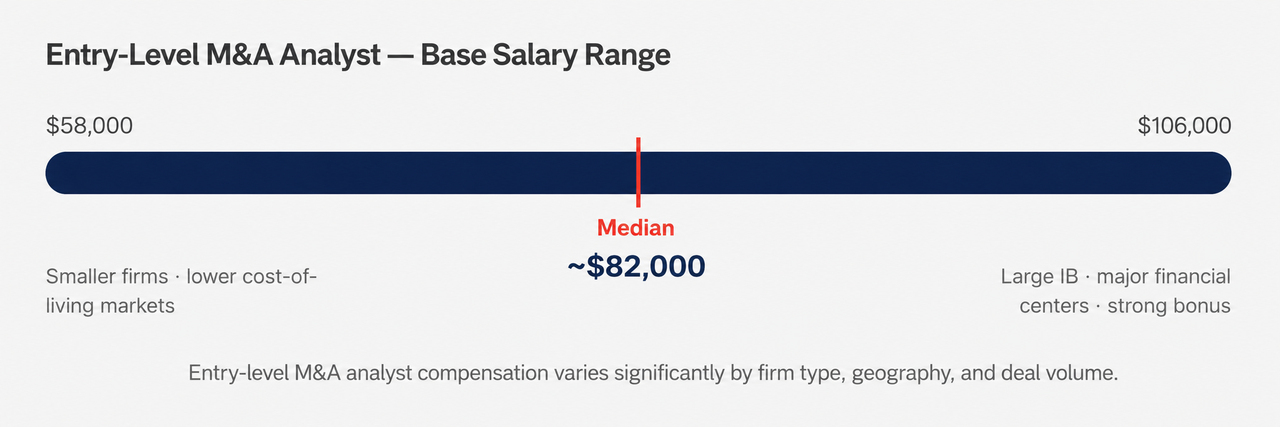
The median base salary for an entry-level M&A analyst is approximately $82,684, with total compensation ranging from $58,223 to $106,063 depending on location, firm size, industry sector, and bonus structure. Analysts at large investment banks in major financial centers typically land at the higher end of that range.
Compensation reflects the hours. M&A analyst roles are demanding, and the pay acknowledges that. As you move up — from analyst to associate to VP — both the compensation and the complexity of the work increase significantly.
A Day in the Life of an M&A Analyst
There's no such thing as a fully typical day in M&A — it depends heavily on whether a deal is active. But here's what the rhythm generally looks like:
Morning: The day usually starts with market scanning — reading financial news, tracking developments in relevant sectors, and checking emails before you even get to the office. In M&A, being the last person to know something is a professional liability.
During the day: When there's no active deal, analysts spend most of their time on pipeline work — researching potential targets, updating models, preparing deal summaries, and supporting the corporate development team's ongoing evaluation process.
When a deal is live: Everything accelerates. Analysts attend deal team meetings, work through diligence materials, update financial models as new information comes in, and prepare presentations for executive decision-makers. Meetings with VPs and associates to review merger models are a regular part of the day.
After hours: During live deals, the workday doesn't end at 5pm. Late nights are common, and the workload can be relentless for weeks at a time. That's the reality of the role — and the people who thrive in it are generally energized by the pace rather than worn down by it.
Common M&A Analyst Interview Questions
M&A analyst interviews test both your technical knowledge and your ability to think through deal scenarios. Here are the questions you're most likely to encounter:
- What experience do you have in an M&A role?
- How has your education prepared you for working in finance?
- Can you walk me through how you would value a company?
- What valuation methodologies are you most comfortable with, and when would you use each?
- Can you describe a situation where you used your analytical skills to solve a complex problem?
- What was the most significant deal or project you worked on?
- What's your experience with financial modeling?
- How would you approach building an M&A model from scratch?
- Can you describe a time a project didn't go as planned — and how you handled it?
- What's your experience with sourcing and evaluating deal opportunities?
- How do you stay current on market developments in your sector?
The through-line in all of these is the same: interviewers want to know that you understand M&A — not just as a concept, but as a practice. The more you can ground your answers in real work and real examples, the better.
For a deeper look at how to prepare, check out the M&A Science guide to passing an M&A interview.
How to Find a Job as an M&A Analyst
The most practical starting point is to identify industries where M&A activity is consistently high — technology, healthcare, financial services, and industrials are perennially active. Within those sectors, look at both investment banks and the corporate development teams of larger companies.
A few things that improve your odds significantly:
Niche down. Employers value analysts who know a specific industry deeply. Generalist interest in M&A is common — specific expertise in how a particular sector works is rarer and more valuable.
Build relevant experience early. Internships, finance rotations, and accounting roles all count. The goal is to demonstrate that you understand how businesses are evaluated financially.
Pay attention to M&A cycles. M&A activity ebbs and flows with economic conditions. The most active periods are the best times to be searching — there's more deal flow, more hiring, and more opportunity to get in front of real transactions quickly.
Frequently Asked Questions
How long does it take to become an M&A analyst?
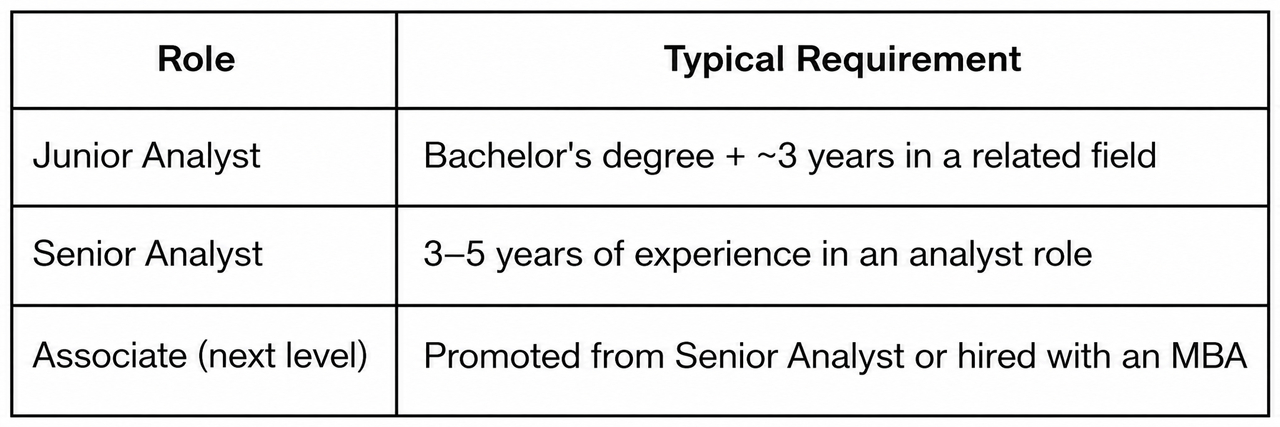
For an entry-level junior analyst role, most companies expect a relevant bachelor's degree plus approximately 3 years of experience in a related field. A senior analyst position typically requires 3–5 years in an analyst role.
Do you need an MBA to become an M&A analyst?
Not necessarily, though some firms — particularly large investment banks — prefer candidates with an MBA or master's degree in finance for certain roles. A bachelor's degree in finance, economics, or accounting is the standard baseline.
Is M&A analyst a good career?
For the right person, yes — it's intellectually demanding, financially rewarding, and gives you exposure to complex, high-stakes business decisions early in your career. The tradeoff is the hours. During active deals, 15–18 hour days are common. People who thrive in this role tend to be genuinely energized by that environment.
What's the difference between a buy-side and sell-side M&A analyst?
Buy-side analysts work on behalf of acquirers — identifying targets and evaluating whether a deal makes sense. Sell-side analysts work on behalf of companies looking to be sold — building materials and pitching the business to potential buyers.
What's the career path after M&A analyst?
The typical progression is Analyst → Associate → VP → Director → Managing Director. Each step involves greater deal leadership, client responsibility, and strategic decision-making. Some analysts also move laterally into corporate development, private equity, or venture capital.
How much does an M&A analyst make?
The median base salary for an entry-level M&A analyst is approximately $82,684, with total compensation ranging from roughly $58,000 to $106,000 depending on location, firm, and bonuses. Senior analysts and those at larger institutions typically earn toward the higher end of that range.
.svg)