
.svg)
.avif)
A scope control guardrail that keeps diligence tied to the decision
Diligence expands fast before LOI, which is to be expected.
What causes deals to drift is diligence sprawl: a growing backlog of requests and parallel workstreams that are increasingly disconnected from the decision at hand.
In auctions, you’ll feel this earlier. In bilateral deals, it shows up the same way. Once diligence ramps and the LOI decision gets closer, the scope starts expanding faster than clarity.
The symptoms are easy to recognize:
- Requests keep coming because it feels safer to ask than to decide.
- Workstreams are active, but leadership can’t tell what’s been proven.
- The recommendation keeps getting delayed because there’s still more to check.
At this stage, the goal isn’t to know everything. It’s answering the handful of questions that could alter the LOI decision, then sequencing the rest without losing control.
Below, we’ll outline a practical scope-control method and explain why, when it comes to diligence, decision clarity trumps exhaustive coverage every time.
What is diligence sprawl?
Sprawl occurs when diligence becomes an inventory of possible questions rather than a sequence of decision-critical proof points.
This isn’t an incompetence thing. It’s an incentives thing.
Understandably, each function wants to protect the business. Likewise, each stakeholder wants to avoid being blamed for missing something. The easiest way to look responsible? Add more diligence.
But without guardrails, diligence becomes an open intake funnel. Every new risk, thought, and “we should also check”… enters scope. Over time, the team loses the ability to distinguish between:
- what must be answered to proceed, and
- what is useful to know eventually.
So the diligence list grows, but the decision gets harder.
Why pre-LOI diligence needs a guardrail
Pre-LOI is the highest-risk phase for sprawl because it sits at the worst intersection of constraints:
- Limited time
- Incomplete access
- High uncertainty
- High internal anxiety (we can’t get this wrong)
That mix creates a dynamic where people compensate for uncertainty by requesting breadth. But breadth doesn’t automatically create clarity.
The bottom line? If the team can’t produce a clean answer to proceed or punt, the diligence effort is not doing its job.
The scope control method
This method is built around four operating components:
- Lock a deal thesis before scope expands
- Define decision drivers (what diligence must prove)
- Split work into Fail Fast vs Hold the Keys
- Publish a leadership-ready decision checkpoint
The intent is simple: protect the team from doing work that doesn’t change the decision, and protect leadership from getting activity updates when what they need is a recommendation.
1) Lock the deal thesis before scope expands
Scope control starts with one requirement:
Diligence does not expand until the deal thesis exists.
The thesis should answer two questions in plain language:
- Why are we doing this deal?
- What must be true for this to be a win?
This isn’t another branding exercise. It’s an essential prioritization tool.
When the thesis is missing, each workstream defines its own priorities, driving scope creep. When the thesis is clear, diligence requests can be evaluated against what must be proven.
Practical enforcement: treat unknowns as owned work
Unknowns are normal, but unowned unknowns add fuel to the scope creep fire.
If an item is unknown, it must be logged as TBD with:
- an owner
- a due date
If those aren’t present, the unknown becomes a late-stage escalation driver. It returns at the worst possible time and forces a last-minute scope expansion to appease leadership anxiety.
A thesis plus an owned TBD list gives the team a baseline: the known, the unknown, and what must be proven within the decision timeline.
2) Define decision drivers (what diligence must prove)
Once the thesis exists, you’re ready to define a small set of decision drivers. These are the handful of categories that can realistically change whether the team should proceed.
Unfortunately, this is where many diligence efforts drift. Requests enter scope because they’re reasonable, not because they’re decision-critical.
So, scope control needs a rule.
The filter rule
Every diligence task must have a primary decision driver. If it doesn’t, it’s deferred.
This turns scope control into a system instead of a debate.
The 60-second test for any new diligence request
When a new request is proposed, run it through three questions:
- Which decision driver does this support?
- If it’s unanswered by LOI, could the team still proceed?
- If it matters, is it an answer now or an answer post-close item?
If the request can’t pass this test, it doesn’t enter the pre-LOI scope.
Keep in mind: This isn’t about ignoring risk. It’s about forcing risk work into the right sequence: decision-critical first, everything else later (with ownership).
3) Split scope into Fail Fast vs Hold the Keys
This split prevents diligence from turning into an everything-now scramble.
Fail Fast
Fail Fast items should be prioritized early so the team can punt cleanly if needed. Since the decision to proceed hinges on these items, they must be addressed prior to approval.
Hold the Keys
Hold-the-keys items matter, but can be finalized post-close without losing control of the deal. They still have owners and due dates, but they can’t consume pre-LOI bandwidth.
How the split stops sprawl in real time
When a request is added, categorization is mandatory:
- Fail Fast
- Hold-the-Keys
If it can’t be categorized, it’s not ready to enter scope.
This is one of the highest-leverage moves in diligence because it replaces vague arguments (we should be thorough) with an operational decision:
Does this change the proceed/punt decision now?
Or is it part of post-close execution control?
4) Workstreams don’t proceed without a tie to decision drivers
A scope-controlled diligence process requires that each workstream:
- has a single owner
- ties to a primary decision driver
- produces one deliverable leadership can read
If a workstream can’t explain what decision driver it supports, it doesn’t proceed. This rule prevents parallel mini-projects from forming and expanding independently.
Minimum viable workstream mapping (example)
You don’t need a complex tracker to enforce this. You just need a simple structure:
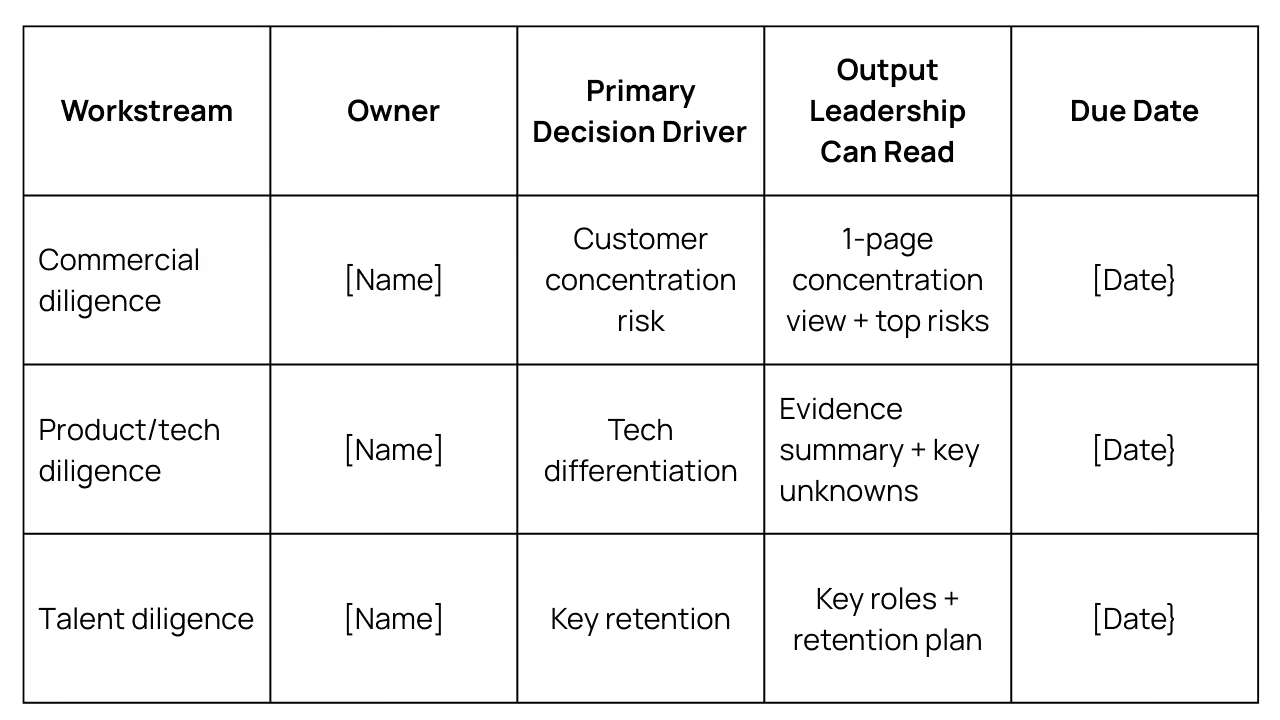
The format isn’t important. Just make sure leadership can see:
- what each workstream is proving,
- who owns it,
- and when the proof will exist.
A note on ethics violations
Some diligence findings require tradeoffs.
Ethics violations are not among them.
If an ethics violation is identified, it should trigger a stop rule: punt. And this shouldn’t be buried inside a tracker or diluted into “we’ll evaluate later.” It’s a non-negotiable decision trigger, not another workstream detail.
Publish a decision checkpoint, not a status update
Diligence creates information. Leadership needs recommendation.
Most diligence reporting fails because it tells leadership what happened rather than what it means. Status updates don’t increase confidence, but proof does.
A successful scope-controlled diligence process produces a repeatable checkpoint that answers:
- What decision drivers matter?
- What is your confidence level today?
- What would change confidence?
- How does this impact proceed vs punt?
- What must still be proven, by when?
Micro-template: one-screen decision checkpoint
Use this structure in weekly updates:
Decision driver: ________
Confidence: High / Med / Low
What would change it: ________
Decision impact: Proceed / Punt / Needs proof by [date]
Run this for each decision driver, then publish:
- top risks that matter
- what is known with high confidence
- what must still be proven by a specific date
- the recommendation (proceed or punt) with a short rationale
This shifts the team from busy diligence to decision diligence.
Common mistakes that create sprawl
At the root of sprawl, you won’t usually find bad intent. But you will find predictable mistakes.
Mistake 1: Starting diligence before the thesis exists.
Without a thesis, there is no way to reject requests. Everything becomes important.
Mistake 2: Treating every request as urgent.
If everything is Fail Fast, nothing is. The team burns time and still misses what matters.
Mistake 3: Allowing workstreams to define their own scope.
Independent scope definitions create parallel diligence universes. A shared filter prevents drift.
Mistake 4: Reporting activity instead of confidence.
Leadership does not need more updates. Leadership needs a decision view that is honest about proof and remaining unknowns.
You don’t need a new tool to avoid these mistakes. You need a guardrail and enforcement.
Example scenario: stopping scope creep without starting a fight
A deal team is in pre-LOI diligence, workstreams are active, and a new request enters the thread: Finance wants 12 additional diligence items to be safe.
Without a guardrail, this request could quickly devolve into a debate about thoroughness and risk posture. With scope control, it becomes a strategic sequence:
- Tie to a decision driver
Which decision driver do these 12 items support? - Categorize: Fail Fast or Hold the Keys
Which items must be answered to proceed? Which items can be finalized post-close? - Require an output
What is the one deliverable leadership will read, and when will it be delivered? - Update the decision checkpoint
Does this work change confidence in a decision-critical question? If not, it does not enter pre-LOI scope.
The sequence keeps the conversation factual and reduces politics. And it’s not about rejecting diligence. Rather, the team is asking critical questions to inform next steps.
What good looks like by the end of pre-LOI diligence
When scope control works, teams can produce a clean decision view without a meeting:
- A short deal thesis (why + what must be true)
- Decision drivers defined and owned
- Workstreams mapped to decision drivers with single owners and deliverables
- A scope split (Fail Fast vs Hold the Keys)
- A one-screen checkpoint view supporting a proceed/punt recommendation
- Clear punt triggers for ethics issues
This prevents teams from performing diligence work without building decision clarity.
Remember: Pre-LOI diligence is less about being exhaustive and more about being decisive.
Want to run this on a live deal?
The M&A Science Membership gives you access to the Intelligence Hub and the Four-Question Diligence Filter template. It includes:
- A deal snapshot
- A deal thesis worksheet
- A question tracker
- A workstream map
- A scope split (Fail Fast vs Hold-the-Keys)
- A leadership-ready decision checkpoint view
Use it to control scope, keep workstreams tied to decision-critical questions, and publish a clear proceed/punt recommendation without drowning in diligence requests.
FAQ
What is diligence scope creep?
Diligence scope creep is the gradual expansion of diligence requests and workstreams beyond what is necessary to support the decision at hand. It typically happens when new requests enter scope without being tied to a decision driver or a decision deadline.
What is the difference between pre-LOI diligence and later-stage diligence?
Pre-LOI diligence is primarily about proving decision-critical questions early enough to justify moving forward or punting. Later-stage diligence often expands to confirm details and reduce execution risk, but it still benefits from a decision-driven filter to avoid sprawl.
How do you prioritize diligence requests before LOI?
Prioritize by requiring each request to tie to a primary decision-critical question, then categorizing it as Fail Fast or Hold the Keys. If the request does not change the proceed/punt decision or cannot be categorized, defer it.
What does Fail Fast mean in diligence?
Fail Fast refers to diligence items that must be answered before final approval because they can change the decision to proceed. These items should be addressed early enough to punt cleanly if necessary.
What does Hold the Keys mean in diligence?
Hold the Keys refers to items that are important but can be finalized post-close without losing control of the deal. These items should still have owners and due dates, but they should not consume IOI-to-LOI time unless they change the decision.
What should be included in a leadership-ready diligence checkpoint?
A leadership-ready checkpoint should list decision drivers, confidence levels (High/Med/Low), what would change confidence, decision impact (proceed/punt), top risks that matter, what must still be proven by a specific date, and the recommendation with a short rationale.
How do you stop workstreams from running independently during diligence?
Require every workstream to tie to a primary decision driver, assign a single owner, and produce one leadership-readable deliverable on a deadline. If a workstream cannot name its decision driver or deliverable, it should not proceed in IOI-to-LOI scope.
.svg)