.svg)
.avif)
Most M&A deals don't fail in diligence. They fail in the space between diligence and close — where decisions stall, issues get buried, and no one has the authority to unblock the team. A steering committee is the governance structure that prevents that. Get it right before the term sheet, and the deal has a spine. Build it after close, and you're already behind.
What Is an M&A Steering Committee?
An M&A steering committee is a senior cross-functional body that provides governance, decision authority, and escalation support across the deal lifecycle. It sets direction, allocates resources, resolves conflicts, and holds both the deal team and the integration team accountable to outcomes — from pre-term sheet through post-close integration.
It operates at two levels simultaneously: at the project level, it ensures delivery of outputs and achievement of deal outcomes; at the organizational level, it maintains alignment on scope, budget, timeline, and strategic direction.
A steering committee is less formal than a board. It functions within whatever governance practices work for the specific company and deal — but it carries real decision-making authority. That authority is what separates a steering committee from an advisory group.
How Does a Steering Committee Work in M&A?
The steering committee exists to make decisions, remove obstacles, and provide resources when the deal team hits a wall. Members who show up to listen and leave without acting aren't steering — they're attending.
At the deal level, the committee:
- Provides guidance on resource utilization, staffing, and timelines
- Reviews and approves project plans, budgets, and scope changes
- Monitors progress against integration KPIs
- Escalates and resolves issues the deal team cannot resolve independently
At the organizational level, the committee:
- Maintains alignment between the deal and the company's strategic direction
- Coordinates across business units and functions
- Communicates deal progress to senior leadership, investors, and key stakeholders
- Defines how project success will be measured — and holds the team accountable to those definitions
One principle that separates effective steering committees from ineffective ones: the project manager manages the project. The steering committee steers. When the committee starts managing the deal instead of steering it, the project manager loses authority and the committee loses credibility. Both problems are hard to fix mid-deal.
Who Should Be on an M&A Steering Committee?
The most common mistake is putting the wrong people in the room. If you acquire a development-stage company and there's no development lead on the committee, every decision gets filtered through someone who has to translate it to another group. Information degrades. Decisions slow down.
The committee only works if every member has direct accountability for something being integrated.
Core seats to consider:
- Corporate Development Lead — responsible for executing the deal and coordinating across functions
- Acquisition Executive Sponsor — oversees the business unit, owns accountability for meeting deal milestones, keeps the deal aligned with organizational strategy
- Head of Integration — ensures coordination of all interacting systems and workstreams across the enterprise
- Functional Leads — representation from the functions with the most at stake in this specific deal (HR, Finance, IT, Legal, Product, Operations — based on diligence findings)
- Acquired Company Management — joint representation from the target is required; this is a problem-solving structure, not a monitoring body
The composition isn't fixed. Diligence findings drive it. A finding in a specific function means that function needs a seat at the table. A deal with regulatory exposure needs legal in the room. A deal built on product integration needs the product lead present.
Steering committee vs. advisory committee: A steering committee is composed of people inside and closely associated with the company or deal. An advisory committee is constructed entirely of external people — former board members, prospective board members, or subject-matter experts. They are different structures with different authority.
How Do You Size an M&A Steering Committee?
Size is a function of deal complexity, not preference. The parameters that determine the right committee size and composition:
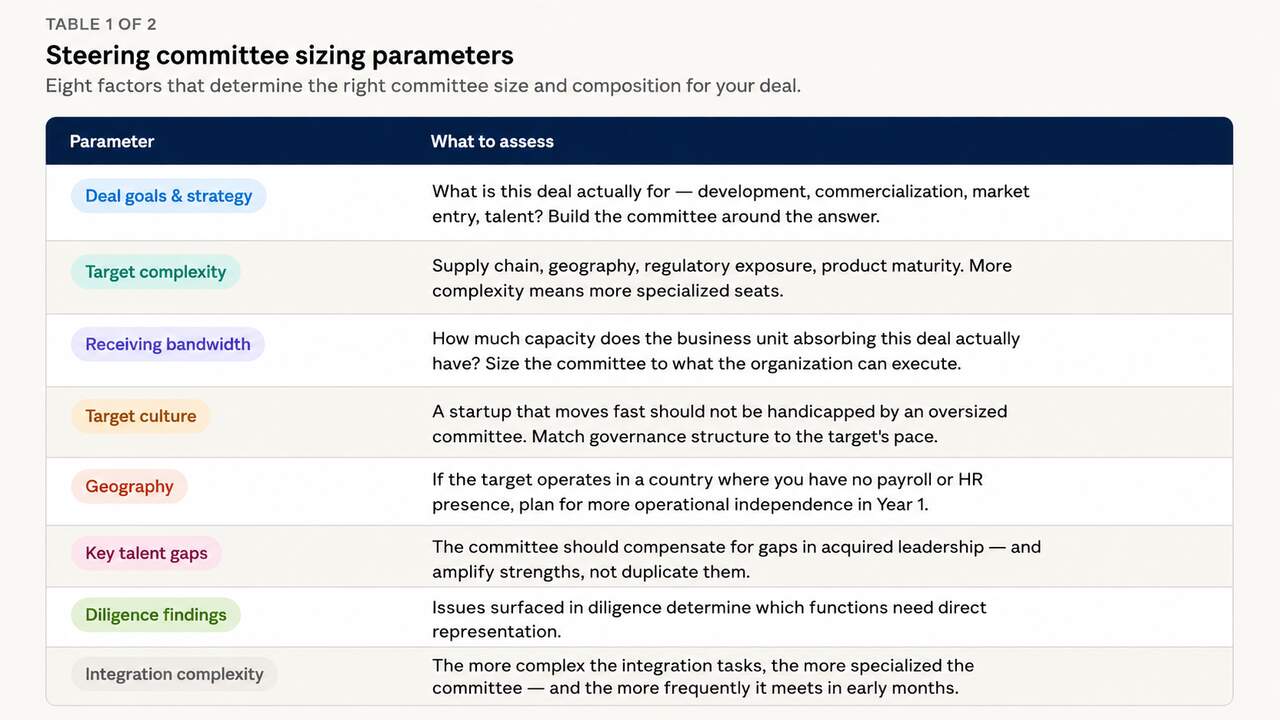
As a general baseline: a committee of six allows for diverse perspectives and fast decision-making. Too small and it reads as a dictatorship; too large and deliberation slows every decision down. Adjust based on the parameters above — but keep the default lean.
What Should a Steering Committee Meeting Cover?
A steering committee meeting is where the deal team and senior leadership align on what's working, what's blocked, and what decisions need to be made. It is not a status update call.
Recommended meeting frequency:
- Monthly for the first six months of integration
- Quarterly once integration reaches steady state
- Additional sessions after each major deal phase: initiation, concept, implementation, and closure
Agenda structure:
For the organizer: Prepare materials in advance covering progress against KPIs, cost versus plan, major milestones achieved, work in progress, and issues requiring a decision. Send materials before the meeting — committee members need time to review, discuss, and come prepared to decide. If a decision is on the table, include the options, implications, and your recommendation.
For members: Read the materials. Come with questions. Come prepared to decide.
How to run the meeting:
- One person runs the meeting — starts with introductions if needed, then moves through the prepared materials
- Progress and cost get the most airtime — that's what the committee cares most about
- Time is allocated for questions; answers should be clear, not exhaustive
- Every meeting ends with a stated conclusion — if a decision was the goal, the committee states it before leaving the room
- After the meeting, follow up in writing with decisions made and next steps
Present everything with honesty. If there's a problem, surface it while there's still time to fix it. The steering committee's trust in the deal team depends on it.
How Do You Build a Steering Committee That Actually Works?
Structure alone doesn't make a steering committee effective. These are the principles that separate functional committees from ones that slow deals down.
Set it up before the term sheet, not after close. By the time the deal closes, you've already lost runway. Reach out to likely steering committee members before LOI. Set expectations on time required. Map out integration stages early — the committee composition may shift by stage, and you need to know that in advance.
Get real time commitments — with named backups. Tell each member exactly what you need: "20% of your time over the next three months." Get an explicit yes. Require each person to name a backup before diligence starts. Availability problems are predictable. Plan for them before they happen.
Define roles before diligence kicks off. Every member should know what they own — in diligence and in integration. A Team Charter (one per function, across all functional leads) makes each team's work visible to the entire deal team. Everyone knows what everyone else is doing.
Use an issue tracker, not the meeting itself, for escalation. A live, shared issue tracker — accessible to the whole deal team — keeps problems visible and owned. Anyone can log an issue and assign an owner. Open items get reviewed on every weekly deal call. If both a lead and their backup are unavailable, the escalation path goes through the tracker — not the middle of a diligence sprint.
Focus the committee on decisions, not reports. Committees that spend their meetings listening to status updates are wasting senior leadership's time. The meeting exists to make decisions. Reports are pre-reads. If the committee reads them in advance, the meeting can focus on what it's actually there for.
Don't overlook resistance. The people most resistant to a decision often have the clearest view of what can go wrong. Listening to them before the vote surfaces risks while there's still time to act on them.
How Does the Steering Committee Change Across Integration Stages?
Integration doesn't end at 90 days. The steering committee evolves as the deal moves through stages — and if you don't map that evolution in advance, the committee loses relevance and the integration loses its finish line.
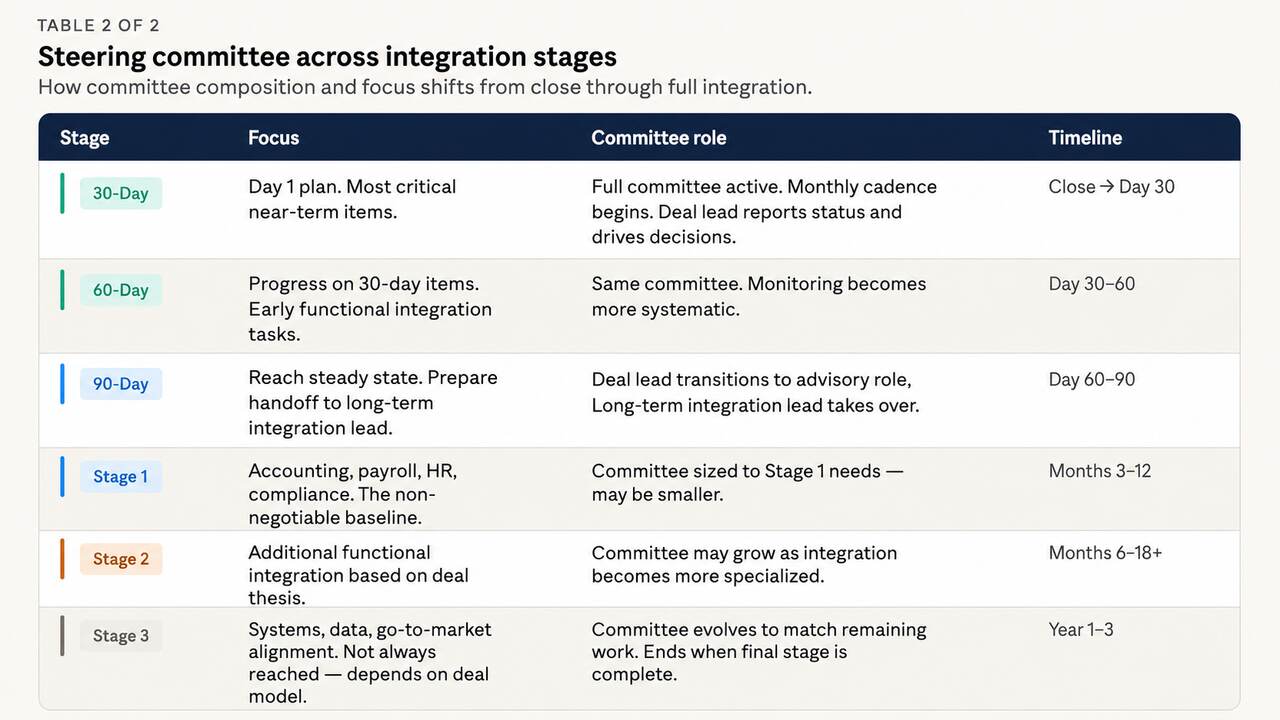
The committee serves the deal. When integration reaches steady state, the committee's role changes — and eventually, it closes out.
Frequently Asked Questions
What is the purpose of a steering committee in M&A?
An M&A steering committee provides governance, decision authority, and escalation support across the deal lifecycle. It keeps projects on track, budgets in check, risks mitigated, and conflicts resolved — at both the deal level and the organizational level.
Who should be on an M&A steering committee?
Core members typically include the Corporate Development Lead, the Acquisition Executive Sponsor, the Head of Integration, relevant functional leads (determined by diligence findings), and representation from the acquired company's management. Composition should reflect the specific deal — not a default org chart.
How is a steering committee different from a board?
A board has formal legal and fiduciary authority over an organization. A steering committee is a deal- or project-specific governance body — less formal, more operational, and structured around a specific transaction or initiative rather than the organization as a whole.
How often should an M&A steering committee meet?
Monthly for the first six months of integration, then quarterly once integration reaches steady state. Additional sessions are recommended after each major deal phase.
How do you size an M&A steering committee?
Size is determined by deal complexity, target company culture, receiving business bandwidth, and integration task complexity. A committee of six is a useful baseline for most deals. Scale up for complex, multi-function integrations; keep it lean for straightforward or development-stage acquisitions.
When should you set up the steering committee?
Before the term sheet — not after close. Reach out to likely members before LOI, set time expectations early, and have the committee structure mapped before diligence kicks off. Waiting until close means you've already lost your setup runway.
What is the difference between a steering committee and an advisory committee?
A steering committee is composed of people directly inside or closely associated with the deal — with real decision-making authority. An advisory committee is made up entirely of external people (former board members, outside experts) who provide opinions but do not hold decision authority.
What makes a steering committee ineffective?
The most common failure modes: wrong people in the room (no direct accountability for what's being integrated), no pre-read discipline (meetings become status updates), and blurred lines between the committee's role and the project manager's role. When the committee starts managing the deal instead of steering it, execution slows and accountability breaks down.
.svg)