
.svg)
.avif)
An M&A career path runs across three distinct functions: investment banking and advisory, corporate development, and integration. Each has its own role progression, hiring patterns, and day-to-day demands. Understanding which track you're targeting — and what each level within it actually requires — is the preparation most candidates skip before they start applying.
If you're still weighing which path into M&A is right for you, start with How to Get Into M&A: A Practitioner's Guide to Breaking In. That post covers entry points and transferable skills in detail. This one picks up where it leaves off.
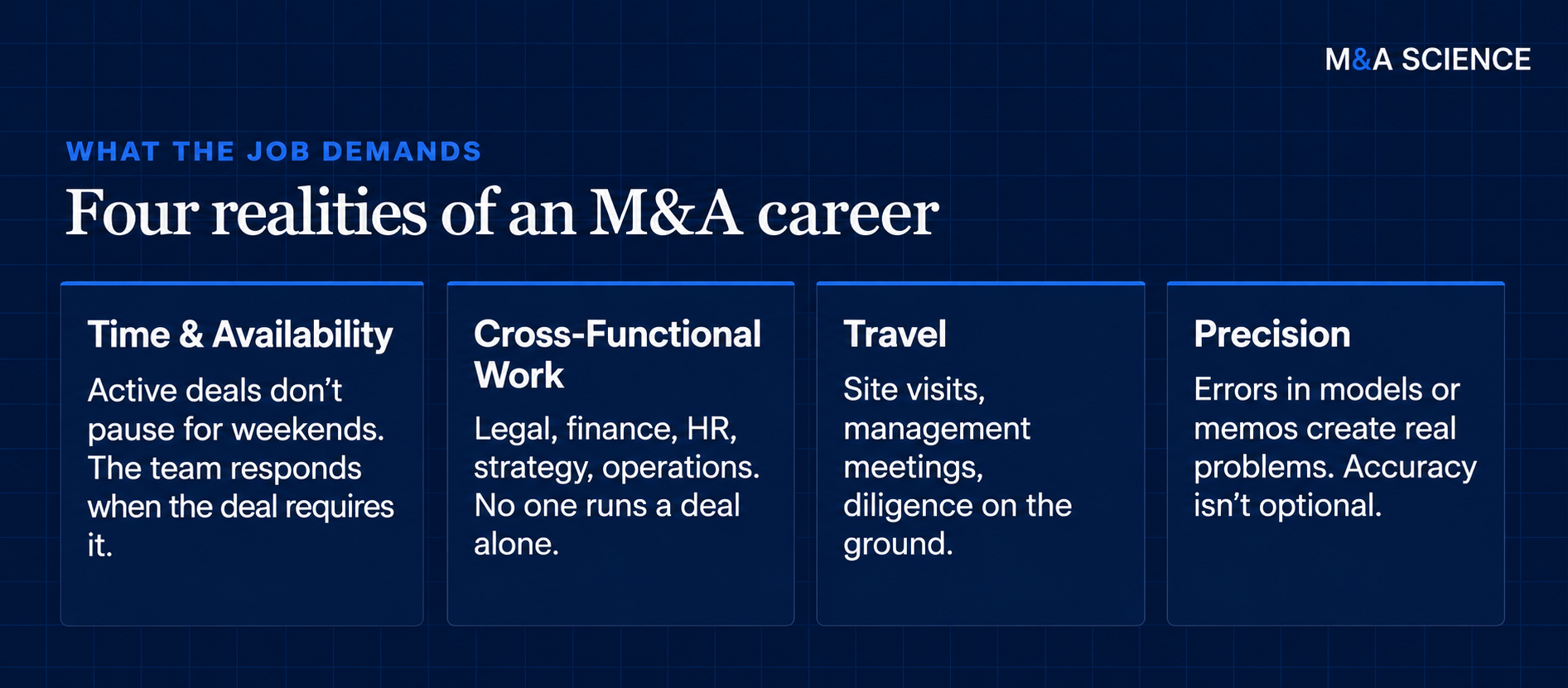
What Does an M&A Career Actually Involve?
M&A is not a nine-to-five. A single transaction can make or break a company, and everyone on the deal team knows it. Deals run on tight timelines with shifting variables, and the expectation at every level is that you keep up.
A few realities that filter out candidates who aren't ready:
Time and availability. Active deals don't pause for weekends. If a management meeting needs to happen or a data room issue surfaces, the team responds. New entrants are usually the ones building the models, running the analysis, and cleaning up the materials at midnight.
Cross-functional collaboration. No one runs a deal alone. You'll work alongside legal, finance, HR, strategy, and operations, often with people who have been in the business far longer than you. The ability to communicate clearly and earn trust quickly matters from day one.
Travel. If your target company is in another region or country, expect site visits. Diligence involves meeting management, walking operations, and forming independent views on the business, not just reviewing documents.
Precision. Errors in a pitch book, financial model, or information memorandum create real problems. Data gathering, financial analysis, and written deliverables require a standard of accuracy that many other roles don't enforce at the same level.
If you know what you're walking into, none of this is a reason to hesitate. It's the job.
What Are the Different M&A Career Tracks?
M&A isn't a single function. The roles you're competing for depend on which part of the deal process you're targeting. Investment banking and advisory, corporate development, and integration each have their own progression, their own skill requirements, and their own hiring patterns.
The M&A Fundamentals Track, part of DealPilot powered by M&A Science, covers all three tracks across 5 courses and roughly 5 hours — built from 400+ practitioner interviews. It's a useful foundation before you start targeting specific roles.
Investment Banking and Advisory: Role Progression
Banking is the most structured career ladder in M&A, with defined levels and predictable timelines at larger firms.
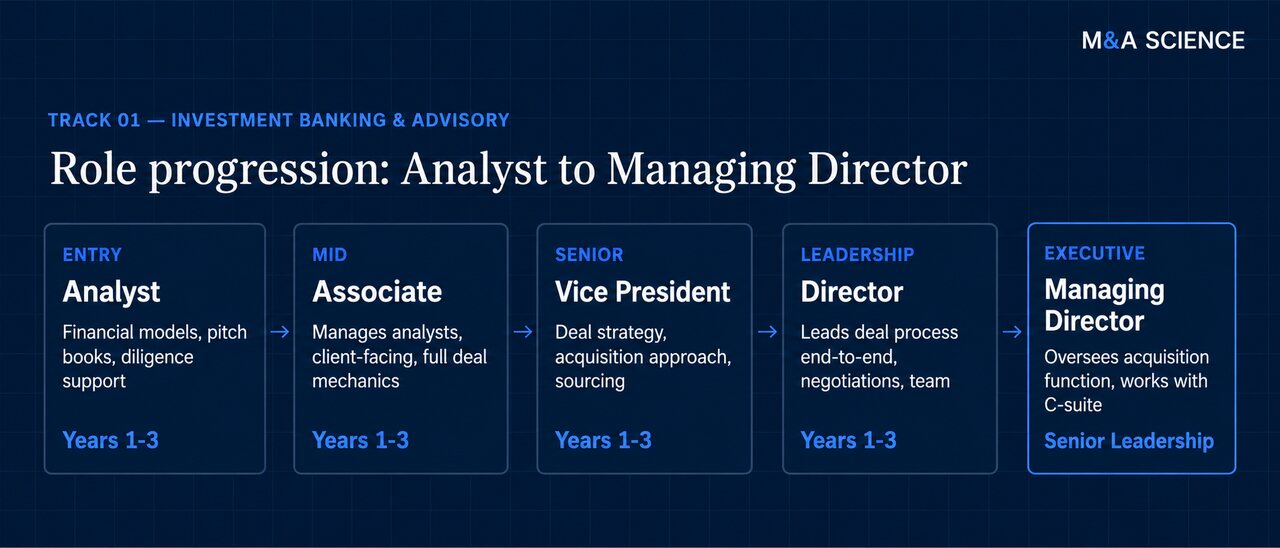
Analyst — The entry point. Analysts build financial models, run analysis, support due diligence, and produce the pitch books and memos that drive deal conversations. The work is detailed and demanding, and the standard for accuracy is high. Doing it well builds the technical foundation every level above assumes you have.
Associate — After roughly three years as an analyst, the progression is associate. Associates manage the analyst layer, take on more client-facing responsibilities, and are expected to have a working command of deal mechanics from sourcing through close.
Vice President — VPs assess how transactions affect the company strategically and financially, and they develop and execute the acquisition approach. Deal sourcing and stakeholder management come into scope at this level.
Director — Directors run the deal process. They lead client meetings, negotiate terms, manage the team, and build relationships with acquisition targets and advisors. Operational judgment and execution experience have to work together consistently at this level.
Managing Director — MDs work directly with executive leadership (CEO, CFO, COO) and oversee the acquisition function. In many firms, MDs and directors are the primary originators. Getting there typically takes a decade or more of deal experience across the levels below it.
Corporate Development: Role Progression
Corp dev sits inside the acquiring company. The function owns strategy, sourcing, and execution on behalf of the business, which means the role is closer to operations than advisory. It's also where Buyer-Led M&A™, the operating methodology that puts the buyer's value-capture strategy at the center of every deal, is built and sustained.
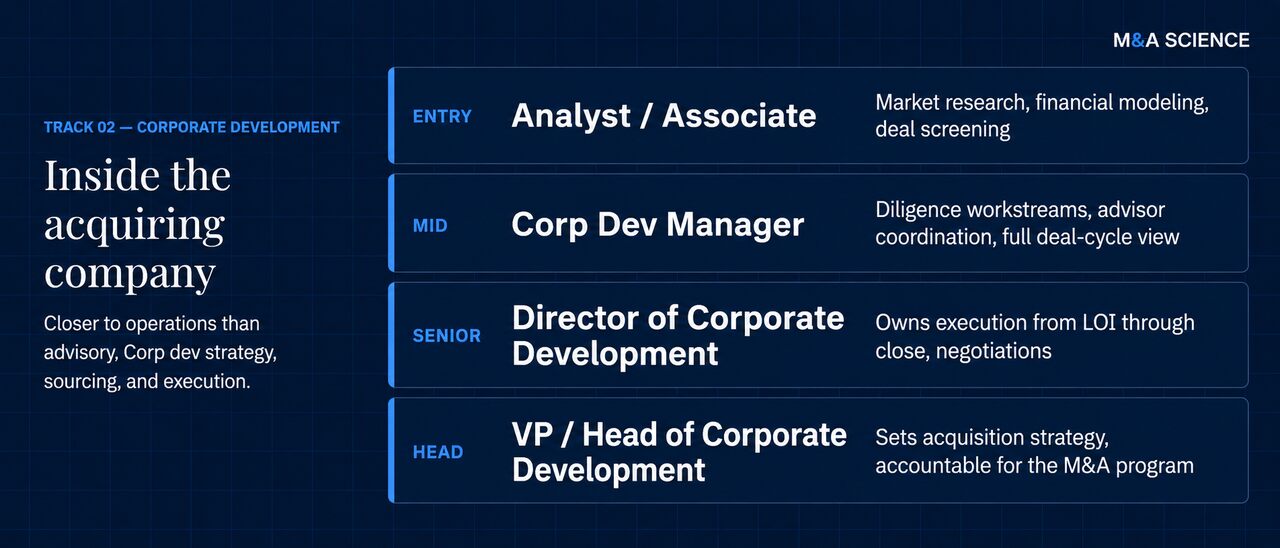
Corp Dev Analyst / Associate — The entry level in corp dev focuses on market research, financial modeling, and deal screening. Analysts and associates support the evaluation process and help build the business case for acquisitions. For a detailed breakdown of what the analyst role involves across all tracks, see How to Become an M&A Analyst.
Corp Dev Manager — Managers take on deal execution responsibilities: managing diligence workstreams, coordinating with external advisors, and keeping internal stakeholders aligned. This is often where practitioners develop a full deal-cycle view for the first time.
Director of Corporate Development — Directors own deal execution from LOI through close. They manage cross-functional teams, lead negotiations, and interface directly with leadership on deal strategy. In leaner corp dev functions, directors also carry sourcing responsibilities.
VP / Head of Corporate Development — Senior corp dev leaders set the acquisition strategy, define target criteria, and run the function. They report to the CFO or CEO and are accountable for the company's M&A program and its outcomes.
For practitioner perspectives on building a corp dev career — including paths that didn't start in investment banking — the M&A Science Podcast episodes Career Paths in M&A and Career Development in M&A are worth your time.
Integration: Role Progression
Integration is its own career track, and one that's grown considerably as companies recognize that execution after close determines whether a deal delivers value. Integration professionals work across the full post-close lifecycle, from day-one planning through value realization. For a full breakdown of what M&A integration involves, that post covers scope, approach types, and what practitioners get wrong.
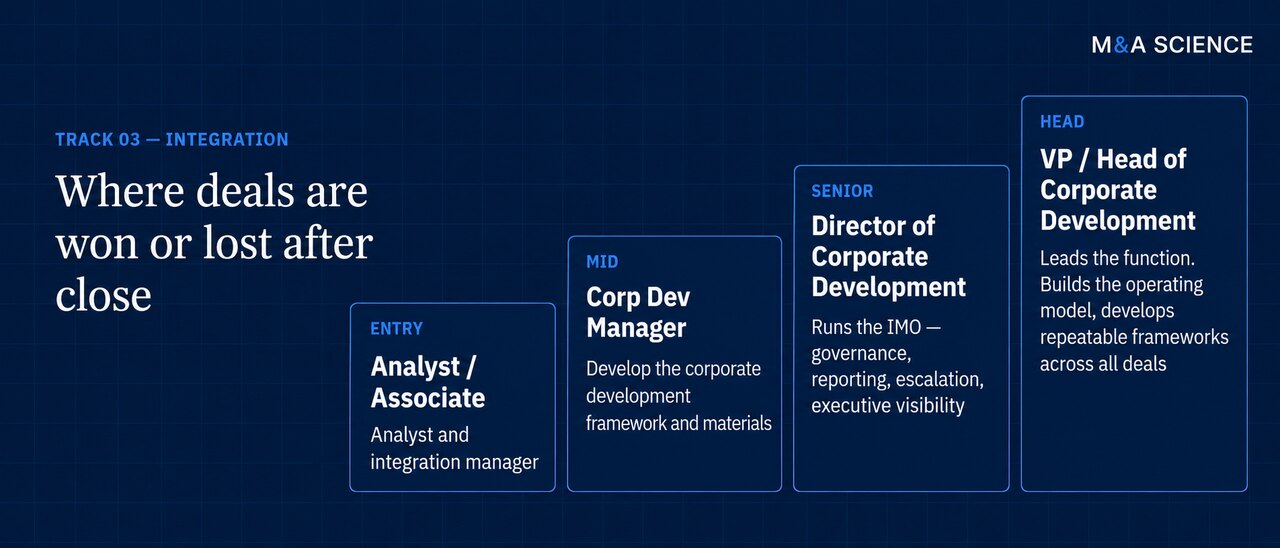
Integration Manager — The entry point in integration. Integration managers coordinate workstreams, track dependencies, and keep functional teams moving against the integration plan. The role requires strong project management skills and the ability to work across functions under time pressure.
Integration Lead — Integration leads own specific workstreams or, in smaller programs, the full integration for a deal. They manage cross-functional teams, surface risks early, and maintain the connection between the integration plan and the original deal thesis.
IMO Director — The IMO (Integration Management Office) Director runs the integration program for a deal or portfolio of deals. They are responsible for governance, reporting cadence, issue escalation, and keeping the executive team informed. This is a senior execution role that requires both operational depth and stakeholder management.
Head of Integration — The Head of Integration leads the function. They build the integration operating model, develop repeatable frameworks across deals, and serve as the internal authority on how the company executes post-close. In active acquirers, this is a strategic role that sits close to corp dev and reports to senior leadership.
The M&A Science Podcast episodes Build a Career in M&A: Lessons from Intel's Todd Manley and How to Break Into M&A: Lessons from Todd Manley Part 2 cover what an integration career actually looks like at a company running deals at scale, including how practitioners enter the field from non-traditional backgrounds.
How Does M&A Recruiting Work?
Recruiting into M&A varies by entry track. Banking has the most structured pipeline, with major firms running formal analyst programs tied to specific school relationships. Corporate development and private equity are less formulaic. Hires come through referrals, operating backgrounds, and lateral moves from adjacent functions as often as they come through traditional recruiting.
A few things that hold across all tracks:
Relevant experience accelerates everything. Smaller firms will sometimes hire without prior M&A experience; larger firms generally won't. Internships in corporate finance, strategy, or operations add credibility and demonstrate you can do the work.
Certifications build signal. They're not required, but a structured program built around how deals actually work shows a level of preparation that differentiates serious candidates from those still exploring.
School pedigree matters differently depending on the track. Banking has historically prioritized a short list of schools. Corporate development and PE are more varied. Network and demonstrated capability often outweigh pedigree outside bulge-bracket banking.
Networking is a legitimate path in. Former colleagues, professors, alumni connections, and practitioner communities are real channels for learning about openings and getting introductions. M&A Science is one of the communities where practitioners at every level are accessible and willing to share how they built their careers.
What Does the M&A Interview Process Look Like?
M&A interviews go beyond standard background and culture conversations. Expect a technical evaluation at every level.
At the analyst and associate levels, this often takes the form of a take-home case study. You're given a business to evaluate and a deadline, sometimes as tight as 10 days, to build an analysis and present your findings. The timeline is intentional. The firm wants to see how you perform under pressure, what your work looks like when you've had to make judgment calls, and how you structure a recommendation.
Senior-level interviews shift toward situation-based questions: how did you approach a specific deal, what went wrong, what would you do differently. Technical fluency is assumed at that point. The evaluation is whether you have the judgment to lead a process.
Preparation matters. Know your financial modeling basics cold, be ready to walk through valuation frameworks, and have a clear view of what's happening in M&A markets at the time of your interview. For a grounding in how the M&A process actually works end to end, that context will show in how you talk about deals.
Four Things to Do Before You Apply
1. Build your academic and credential profile
Strong academic performance in a relevant field opens doors, especially at larger firms. M&A-specific certifications signal that you understand how deals actually operate, which matters to hiring managers who will be putting you in front of clients or management teams.
2. Network with people already doing the job
People who have built M&A careers are often willing to talk about how they did it. Reach out early. Ask specific questions about their path rather than generic advice requests. Alumni networks, LinkedIn, and practitioner communities like M&A Science are all legitimate channels.
3. Prepare for the full interview process
Understand the role you're targeting well enough to know what a typical day looks like, what tools the team uses, and what the firm has acquired recently. Generic interview prep doesn't hold up in a field where precision signals capability.
4. Build operational fluency before you're in the room
Coursework gives you the theory. What separates candidates at the interview stage is whether they can talk about M&A the way practitioners do, with a working grasp of deal stages, diligence priorities, and integration realities. The M&A Fundamentals Track covers the buy-side lifecycle, the sell-side lifecycle, the deal execution toolkit, and an introduction to the Buyer-Led M&A™ framework across 5 courses and 61 artifacts, all drawn from practitioner experience. It's built for people entering the field, not people already running it.
If you're preparing to break into M&A, DealPilot has the M&A Fundamentals Track: 5 courses, 61 artifacts, built from 400+ practitioner interviews, to give you the operational fluency that resumes alone can't show. Access it at mascience.com/membership.
Recap
Getting into M&A takes groundwork. The role progressions across banking, corp dev, and integration are well-defined; what varies is the depth of preparation you bring to the recruiting process and the interviews that follow. Identify your track, understand what each level requires, and start building toward it now.
For a full breakdown of entry paths, career branches, and transferable skills, read How to Get Into M&A: A Practitioner's Guide to Breaking In.
The M&A Fundamentals Track on DealPilot, powered by M&A Science, covers the buy-side lifecycle, sell-side lifecycle, deal execution toolkit, and Buyer-Led M&A™ foundations across 5 courses and 61 artifacts, built from 400+ practitioner interviews. The on-ramp for anyone entering M&A.
.svg)