
.svg)
.avif)
Every year, league tables rank the top M&A consulting firms by deal value. Goldman Sachs advises on the most dollars. Houlihan Lokey closes the most deals. McKinsey remains shorthand for enterprise strategy work. Those facts are accurate and almost entirely useless if you're trying to figure out what kind of help your team actually needs.
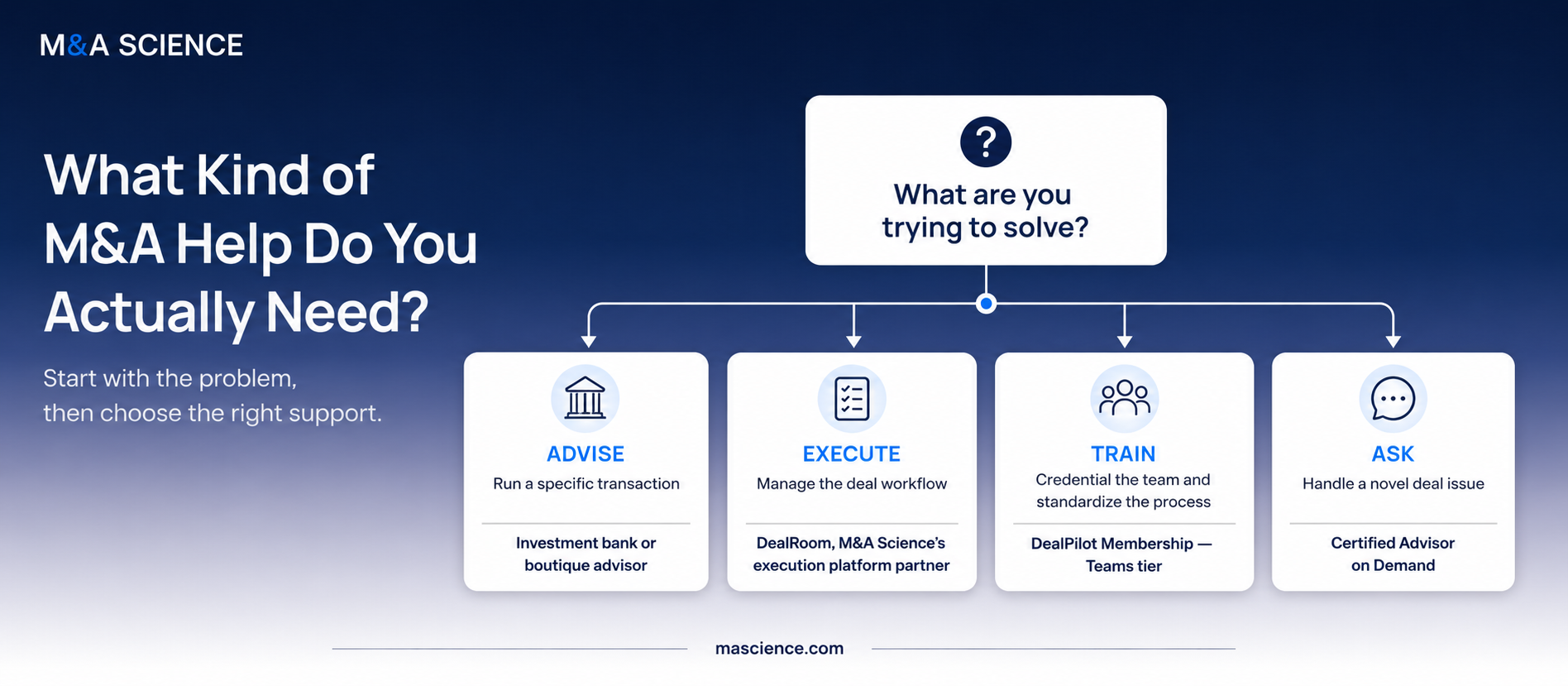
The question isn't which firm is the biggest. It's what problem you're trying to solve. Before you evaluate a single firm, name the problem:
- You need someone to advise on a specific transaction
- You need legal or financial diligence support
- You need software to manage deal execution
- You need your team credentialed and working from a more consistent deal process
- You need specialist help for a deal situation your team has never seen before
These are different problems, and they point to different kinds of support. An investment bank won't solve problem four. A certification program won't solve problem one. Matching the firm to the actual need is the decision most teams skip. Most end up paying for expertise they didn't need and missing the support they did.
This guide walks through every major category of M&A support, names the firms doing the best work in each, and gives you a clear framework for choosing based on your actual situation.
What M&A Consulting Firms Actually Do
The term "M&A consulting firm" covers a wide range of services that operate very differently in practice. Investment banks originate and structure deals. Strategy firms help companies decide whether and what to acquire. Transaction advisory teams dig into financials and diligence. Law firms handle structure, negotiation, and legal risk. Boutique advisors do much of the above at smaller deal sizes with more senior attention per mandate. A newer category, execution platforms and certification providers, helps buy-side teams build the internal capability to run deals without leaning as heavily on outside help for every transaction.
Each category serves a different buyer at a different stage. None of them substitute for the others. The mistake most teams make is hiring the wrong category for the problem they actually have.
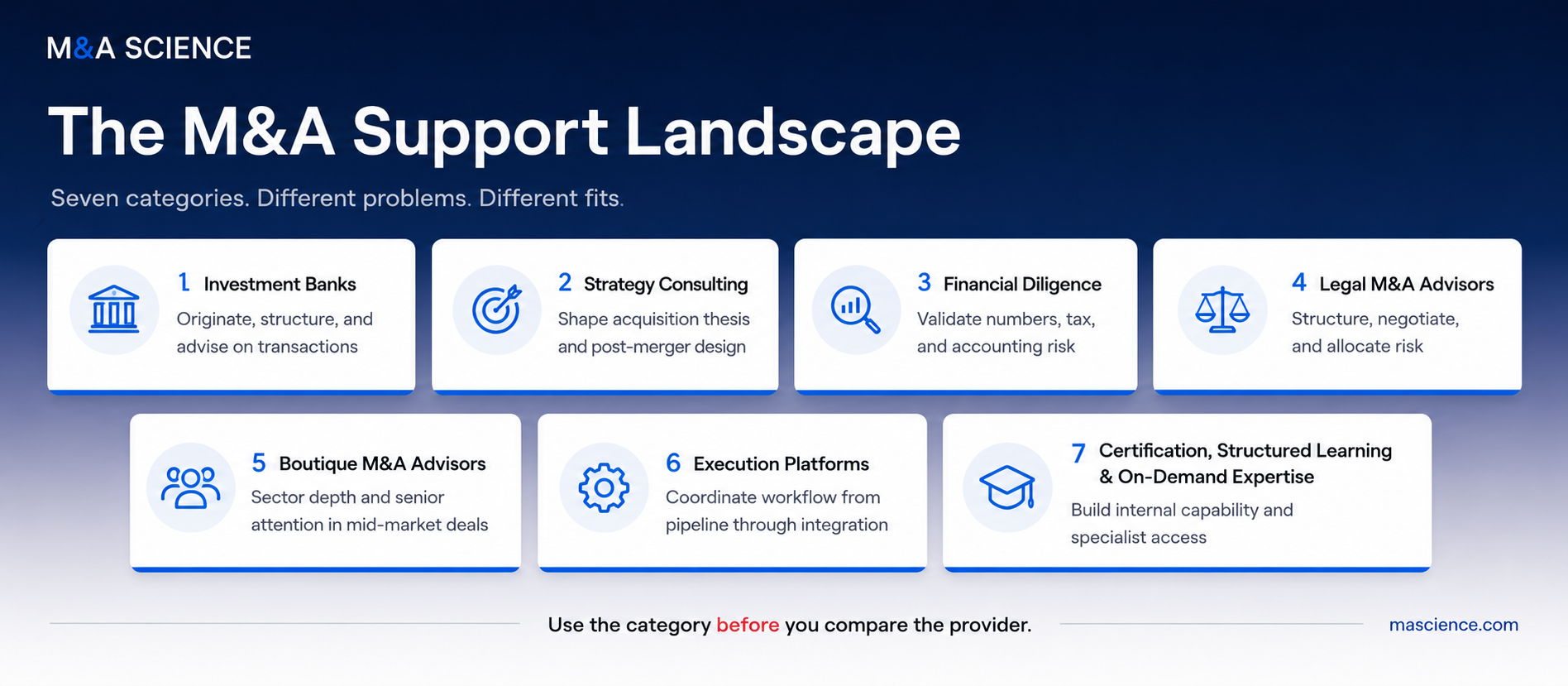
The Seven Types of M&A Support
Understanding these categories is the prerequisite for every evaluation that follows.
Investment banks originate, structure, and advise on transactions. They bring valuation expertise, buyer networks, and process management for sell-side and buy-side mandates. Most dominant in deals above $100M.
Strategy consulting firms help companies build acquisition strategies, evaluate targets, and design post-merger organizations. Useful when the question is "what should we buy and why" rather than "how do we close this deal."
Transaction advisory and financial diligence firms provide financial, tax, and accounting diligence. The Big Four accounting firms are the main players here, alongside specialist boutiques. Essential for cross-border transactions and complex financial structures.
Legal M&A advisors handle deal structure, contract negotiation, regulatory compliance, and risk allocation. Selection here is sector-specific. A media deal and a healthcare deal require different legal expertise.
Boutique M&A advisory firms operate across sell-side, buy-side, and sometimes both: smaller teams, deeper sector focus, and more senior partner involvement than bulge brackets. Often the right choice for deals in the $20M to $200M range.
M&A execution platforms provide the software infrastructure for managing deal workflow: pipeline tracking, diligence management, integration planning, and post-close value tracking. DealRoom, M&A Science's execution platform partner, operates in this category.
Certification, structured learning, and on-demand expertise providers help buy-side teams build internal M&A capability: structured learning tracks, practitioner certification, and access to advisors matched by deal type and sector. This is where M&A Science operates.
Building an advisory team? DealPilot Membership, powered by M&A Science experiential data, gives boutique firms and lean M&A teams access to Flights & Certifications, practitioner-built playbooks, and deal guidance built from 400+ practitioner interviews. Explore the Teams tier at mascience.com/membership.
Top Firms by Category
The term "M&A consulting firm" covers a wide range of services that operate very differently in practice. Investment banks originate and structure deals. Strategy firms help companies decide whether and what to acquire. Transaction advisory teams dig into financials and diligence. Law firms handle structure, negotiation, and legal risk. Boutique advisors do much of the above at smaller deal sizes with more senior attention per mandate. A newer category, execution platforms and certification providers, helps buy-side teams build the internal capability to run deals without leaning as heavily on outside help for every transaction.
Each category serves a different buyer at a different stage. None of them substitute for the others. The mistake most teams make is hiring the wrong category for the problem they actually have.
The Seven Types of M&A Support
Understanding these categories is the prerequisite for every evaluation that follows.
Investment banks originate, structure, and advise on transactions. They bring valuation expertise, buyer networks, and process management for sell-side and buy-side mandates. Most dominant in deals above $100M.
Strategy consulting firms help companies build acquisition strategies, evaluate targets, and design post-merger organizations. Useful when the question is "what should we buy and why" rather than "how do we close this deal."
Transaction advisory and financial diligence firms provide financial, tax, and accounting diligence. The Big Four accounting firms are the main players here, alongside specialist boutiques. Essential for cross-border transactions and complex financial structures.
Legal M&A advisors handle deal structure, contract negotiation, regulatory compliance, and risk allocation. Selection here is sector-specific. A media deal and a healthcare deal require different legal expertise.
Boutique M&A advisory firms operate across sell-side, buy-side, and sometimes both: smaller teams, deeper sector focus, and more senior partner involvement than bulge brackets. Often the right choice for deals in the $20M to $200M range.
M&A execution platforms provide the software infrastructure for managing deal workflow: pipeline tracking, diligence management, integration planning, and post-close value tracking. DealRoom, M&A Science's execution platform partner, operates in this category.
Certification, structured learning, and on-demand expertise providers help buy-side teams build internal M&A capability: structured learning tracks, practitioner certification, and access to advisors matched by deal type and sector. This is where M&A Science operates.
Building an advisory team? DealPilot Membership, powered by M&A Science experiential data, gives boutique firms and lean M&A teams access to Flights & Certifications, practitioner-built playbooks, and deal guidance built from 400+ practitioner interviews. Explore the Teams tier at mascience.com/membership.
Top Firms by Category
How to Choose the Right M&A Support
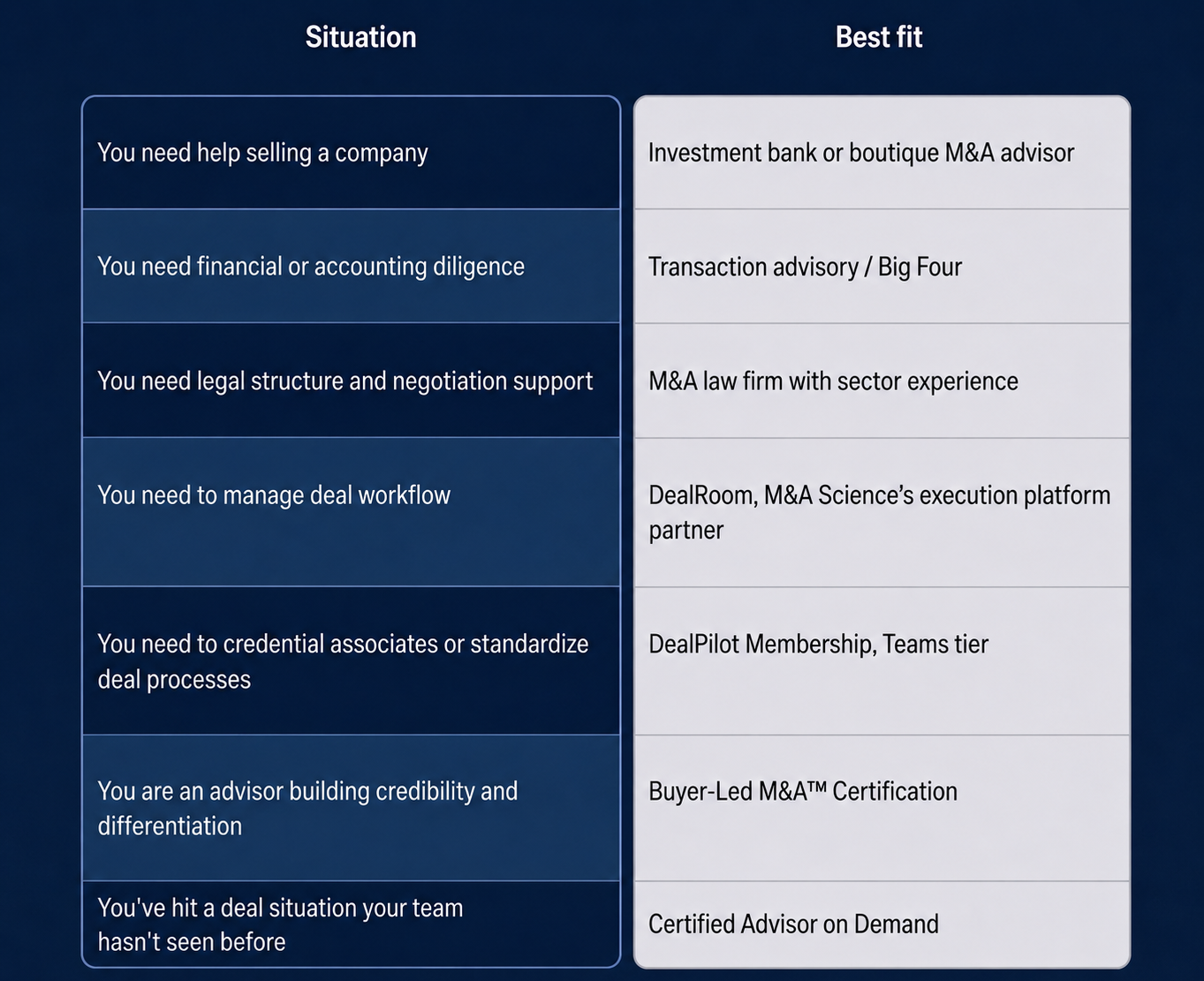
Most teams need more than one of these simultaneously. A boutique advisory firm running a mid-market sell-side process still needs legal support, may need diligence support, and benefits from having associates trained to the same standard so the senior partner isn't backfilling junior work. The question is sequencing and budget allocation: not which single provider to choose.
Frequently Asked Questions
What are the top M&A consulting firms in 2026?
By deal value, Goldman Sachs led 2025's global M&A market, advising on approximately $1.48 trillion in transactions. Morgan Stanley ranked first by deal value per GlobalData. Houlihan Lokey led by deal volume at 318 transactions. Among strategy firms, McKinsey, BCG, and Bain remain the standard for enterprise-level M&A strategy. For middle-market transactions, boutique advisory firms including Sica Fletcher, Harris Williams, and Lincoln International are often more relevant than bulge-bracket banks.
What's the difference between an investment bank and a boutique M&A advisor?
Investment banks; particularly bulge brackets like Goldman Sachs, JPMorgan, and Morgan Stanley, are designed for large, complex transactions where financing access and global buyer networks matter. Boutique advisory firms focus exclusively on M&A advisory, often with deeper sector expertise and significantly more senior partner involvement per mandate. For deals below $500M, boutiques typically outperform bulge brackets on the metrics that matter most to clients: quality of buyer targeting, senior attention, and close rate.
When should a company hire an M&A advisor?
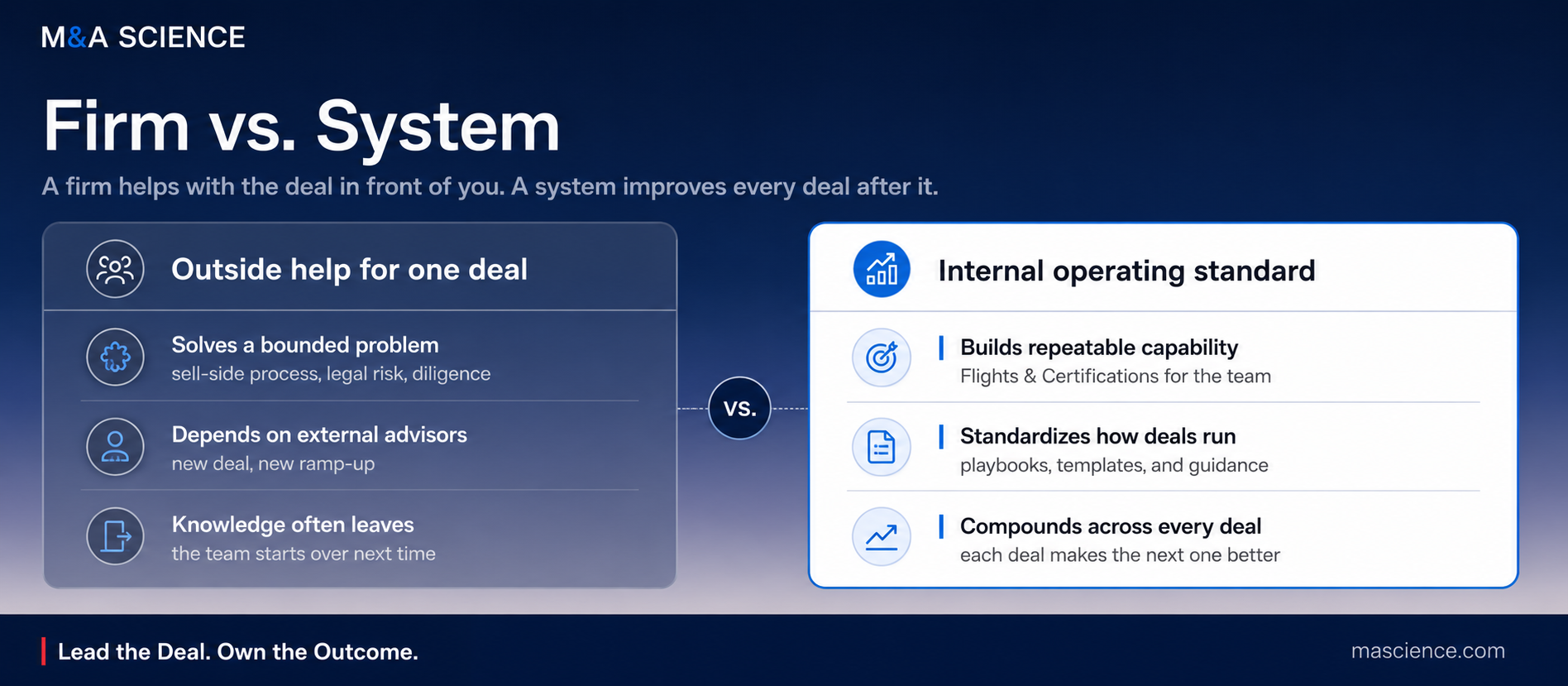
When the problem is transaction-specific: you're running a sell-side process, evaluating a specific acquisition target, or navigating a deal structure you haven't handled before. If the underlying problem is that your team lacks a repeatable process for evaluating and integrating acquisitions, a single advisor engagement won't solve it. That's a capability gap, and it requires a different kind of investment.
How do boutique advisory firms compete with larger banks?
On sector depth, senior attention, and deal economics. Boutiques don't have trading desks or balance sheets to cross-sell. Their entire business model is transaction advisory, which means principals stay close to deals and develop pattern recognition in specific sectors that generalist bankers can't match. In the lower and middle market, that specialization is often worth more than a brand name.
How can M&A advisors build credibility and differentiate their practice?
The most durable differentiation for advisors comes from demonstrated methodology, not just deal experience. Clients can't evaluate deal experience easily; they can evaluate whether an advisor has a structured, verified approach to buy-side execution. The Buyer-Led M&A™ Certification gives advisors a practitioner-built credential to broadcast and a listing in the Buyer-Led M&A™ Certified Advisor Directory; searchable by region, sector, function, and deal stage; it drives qualified deal leads directly back to the advisor.
If you're comparing outside help because your team keeps running into the same deal problems, the gap usually isn't the advisor. It's the operating standard behind every deal. DealPilot Membership, powered by M&A Science experiential data, gives buy-side teams the certifications, playbooks, and practitioner intelligence to build that standard. Explore DealPilot Membership at mascience.com/membership.
.svg)