

The implementation playbook for running buy-side M&A
Six courses plus a capstone. The 6-stage lifecycle, the 5 Pillars, and the Three Interconnected Levers — taught by the practitioners who built them, applied to your real deals.

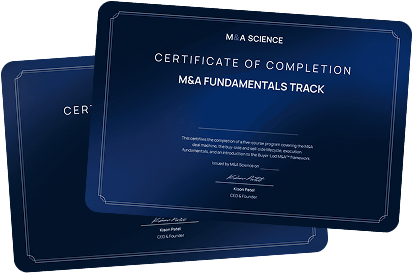
Buyer-Led M&A™ Certified
Your Name Here
Three pillars. One read on where you stand
Each pillar maps to a phase of the deal where practitioners told us they see the most expensive mistakes.
Thesis & sourcing
Whether your team can articulate value-capture before they touch a target, not after.
- Strategic fit framing
- Value driver identification
- Synergy realism (vs. banker math)
- Walkaway discipline
Diligence & decision
Whether your team converts diligence findings into a sharpened thesis — or just collects them in a folder.
- Commercial vs. financial signal
- Integration-readiness check
- Findings that change the thesis
- LOI confidence and discipline
Integration & value capture
Whether the operating standard survives close — or whether the deal becomes a stranded asset.
- Day-1 readiness
- Operating model decisions
- Synergy tracking and accountability
- Talent and culture continuity
Five Pillars. Three Levers. Six lifecycle stages
Two frameworks run through every course. The Pillars are the operating principles. The Levers are the decision framework. The lifecycle is where they live.
Strategic Discipline
Fit filters, kill criteria, investment thesis. The deal you don't do matters as much as the one you do.
Unified Execution
Single operating rhythm across deal team and functional partners. No more silos.
Synchronized Diligence & Integration
Parallel workstreams from Day 1. Integration leads in the data room.
Built for Scalability
Retrospectives that update playbooks. Every deal makes the next one better.
Win-Win Execution
Negotiate hard on what matters. Preserve the relationships needed for post-close execution.
The Three Interconnected Levers
Every deal decision pulls on one of three levers. Change one — the others have to absorb it. Shaky revenue forecast? Adjust structure (earn-out), then absorb that in integration (phased rollout).
This framework is introduced in Course 1 and recurs in every subsequent course. The capstone evaluates how well you analyze lever trade-offs across all 6 stages.
Deal Structure
Diligence Scope
Integration Strategy
Six courses, one for each lifecycle stage
A legal-instruments throughline runs across every stage. You learn each instrument (NDA, IOI, LOI, PA, TSA) in the deal context where you'll actually encounter it.
Foundations of Buyer-Led M&A™
From awareness to operating framework. The fit filter, the Deal NorthStar, and the lever framework you'll use through every other course.
SMEs: Gwen Pope + Kison Patel
Launching May 29
Buyer-Led Sourcing
From reactive deal flow to proactive pipeline. CRM-style target tracking, controlled narratives, first contact to NDA.
SME: Sabeeh Khan. Launching June 05
Buyer-Led Valuation
Valuation isn't modeling. It's testing what you can realistically execute post-close. Synergy math meets integration cost.
SMEs: Adam Smith + Alex Fries
Launching June 12
Buyer-Led Diligence
Run diligence and integration planning in parallel. By close, you're executing a plan — not writing one.
SMEs: Gwen Pope + Klint Kendrick, PhD
Launching June 19
Buyer-Led Contract & Negotiation
Translate diligence findings into contract protections. Reps & warranties, indemnification, earn-outs, MAC clauses, retention agreements.
SME: Anand Gandhi. Launching June 26
Integration & Value Capture
Integration begins at first contact, not after signing. 100-day planning, culture assessment, retrospectives that update your playbook.
SMEs: Gwen Pope + Klint Kendrick, PhD.
Launching July 03
Apply it. Prove it. Earn it.
The capstone is where the credential earns its weight. Apply the full Buyer-Led M&A™ framework to a series of final questions. A passing score awards you the certification.
The instructors are operators
Every course is led by someone who's run the work. Plus a legal SME threaded across the entire program at every document touchpoint.


.avif)







.avif)
A credential. A directory listing. A capstone artifact you can show your CEO
Each pillar maps to a phase of the deal where practitioners told us they see the most expensive mistakes.
Buyer-Led M&A™ Certified designation
Verified by M&A Science. Goes on LinkedIn, email signature, firm website, and your transcript. Renewable.
Profile in the Certified Advisor Directory
Filterable by region, sector, firm type, and deal size focus. For advisors who want inbound; corp dev gets the badge but not a public listing.
Common questions
Do I need to complete Fundamentals first?
The certification assumes fluency with the M&A lifecycle, deal vocabulary, and an awareness-level understanding of Buyer-Led principles. Concepts from Fundamentals are referenced but not re-taught. If you've been in deals for 3+ years you can challenge Fundamentals via a short assessment.
How is this different from a generic M&A certification?
This is the only certification built specifically for the buy-side. Every other M&A credential treats the buyer and seller as interchangeable participants in a transaction. Buyer-Led teaches you to lead — controlling narrative, sequencing diligence, and structuring deals from the buyer's seat.
How long does it take?
~10–12 hours of course content plus the capstone. Cohorts are available; most learners finish in 4–6 weeks alongside their day job.
What if I fail the capstone?
You can re-take the capstone as needed, right in DealPilot.
Earn the credential the buy-side asked for
The Buyer-Led M&A™ Certification is included in every membership tier above Solo. Cohorts run quarterly. Capstone review by M&A Science faculty.
Prerequisite: M&A fundamentals track or equivalent experience
.svg)
.svg)