.avif)

The best corporate development courses do more than teach M&A theory. They help you think more clearly about deals, communicate better across functions, and build repeatable judgment under pressure. Whether you’re moving into corp dev for the first time, sharpening your technical skills, or creating a shared operating framework across a team, the right program can meaningfully improve how you operate inside live transactions.
This guide compares the best corporate development courses, M&A certifications, and executive education programs for professionals, and evaluates how to build practical acquisition capabilities in 2026.
What Should Corporate Development Training Actually Give You?
Most corporate development courses teach the language of M&A, which is certainly essential. But the programs that stand out also help you develop the judgment to run the work.
For example, there’s a big difference between knowing that diligence covers financial, legal, and commercial dimensions and knowing how to scope it, sequence it against a live timeline, and flag the findings that change the deal case. The same applies to integration. Most courses cover it as a concept, but not many help you build the planning cadence and communication rhythm that determine whether Day 1 goes smoothly.
For advisors and individual operators, the other question is credential value. A credential you can broadcast to buyers (one tied to a recognized operating standard) carries more weight than a certificate of completion from a six-week online course. Both have their place, sure. But they serve different purposes, and the distinction matters when deciding where to spend your time and money.
Corporate development training covers sourcing judgment, diligence discipline, valuation fluency, integration readiness, stakeholder alignment, and post-close execution. The right program depends on where you are on that path, the role you occupy, and what you need to execute next.
How to Compare Corporate Development Courses and M&A Certifications
There are six dimensions worth evaluating before choosing a program.
Career stage fit. Is the program built for someone learning M&A for the first time, moving into a corporate development or advisory role, or already leading acquisitions at a public company or PE-backed platform?
Credential value. Does the credential help you signal capability externally? For advisors, a credential tied to a recognized operating standard, one that includes a public directory listing as part of the program, carries more weight than a university certificate of completion.
Application. Does the course give you frameworks, templates, and decision points you can use in live deal work, or does it stay conceptual?
Team scalability. Can it train one person, or help a boutique firm or deal team build shared language and shared execution standards across functions?
Deal-stage coverage. Does the training help with sourcing, diligence, LOI, close, and integration, or does it stop before the work that actually determines whether a deal delivers value?
Fit for live deal work. Does it help when the deal gets complicated, or only explain the theory?
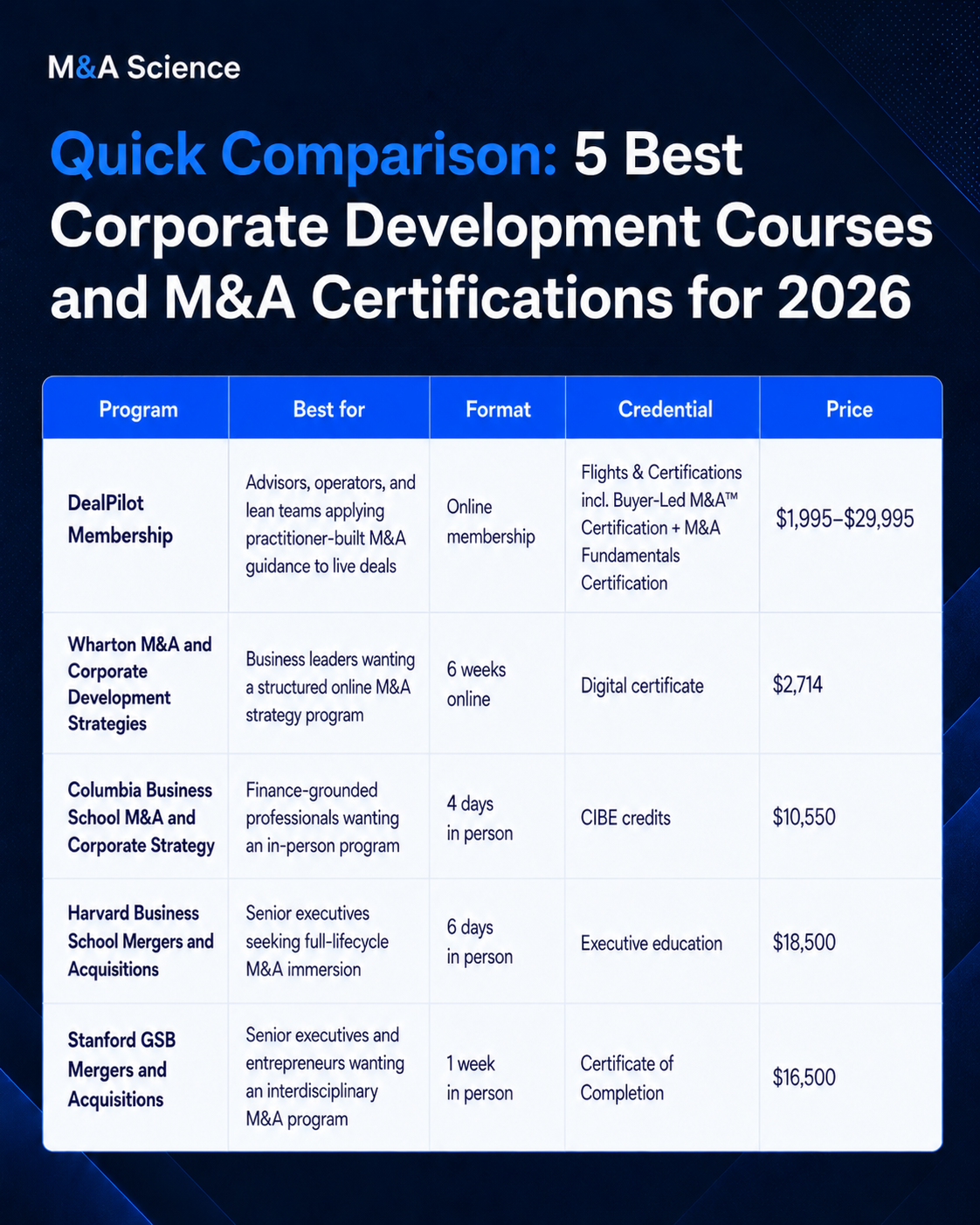
If you want a university executive education experience, Wharton, Columbia, Harvard, and Stanford are strong options. I
f you want practitioner-built guidance, Flights & Certifications, and a credential tied to a recognized operating standard, DealPilot Membership is the stronger fit for practitioners who need applied guidance, certification, and reusable deal tools.
Want the practitioner-built path? Explore DealPilot Membership →
Comparing M&A certifications as an advisor? Start with the Buyer-Led M&A™ Certification inside DealPilot Membership.
The 5 Best Corporate Development and M&A Programs for 2026
1. DealPilot Membership, powered by M&A Science experiential data
Best for: Advisors, independent operators, and lean teams who want practitioner-built M&A guidance, Flights & Certifications, templates, and live operator sessions they can apply to real deals, all with a credential that signals capability to buyers.
A corp dev lead preparing for diligence, an integration leader planning Day 1, an independent advisor building credentials to broadcast to sellers, and a boutique firm training a junior associate cohort do not need the same learning path. DealPilot adapts to where you sit in the deal and what you need to execute next.
For individual practitioners and advisors, DealPilot Membership includes guided learning paths organized by role and deal stage, deal-stage playbooks built from practitioner experience, templates from real deals, the M&A Fundamentals Certification, and the Buyer-Led M&A™ Certification.
Advisors who complete the Buyer-Led M&A™ Certification are listed in the Buyer-Led M&A™ Certified Advisor Directory — a searchable directory, launching in 2026, that connects buyers seeking advisor support with certified advisors by region, function, and sector. The M&A Competency Assessment is included in the Practitioners tier and can be used to benchmark deal-thinking ability before entering a program or joining a deal.
New content is added monthly. Live practitioner sessions run weekly.
Credential: Flights & Certifications included with membership, including the Buyer-Led M&A™ Certification and M&A Fundamentals Certification
Format: Online membership with guided learning paths, certifications, templates, and live operator sessions
Pricing: Practitioners $1,995/year · Teams $14,995/year, up to 20 users · Connect from $29,995
Why it stands out: Adapts to role, deal stage, and timeline; the Buyer-Led M&A™ Certification connects to a searchable advisor directory launching in 2026; built for every function at the deal table, not just corporate development
2. Wharton M&A and Corporate Development Strategies
Best for: Business leaders and finance professionals who want a structured six-week online program covering M&A and corporate development strategy.
Wharton's program covers corporate development strategy, M&A decisions, diligence, deal structuring and negotiation, post-merger integration, and divestitures. It is designed for business leaders and business unit heads involved in corporate finance, investment, and growth strategy.
The program is delivered in partnership with Emeritus and is structured across six modules. Participants earn a digital certificate of completion from the Wharton School.
Credential: Digital certificate of completion from the Wharton School Format: Online, 6 weeks
Pricing: $2,714
Why it stands out: Strong fit for professionals who want a structured, conceptual grounding in M&A strategy in an accessible online format
3. Columbia Business School M&A and Corporate Strategy
Best for: Professionals who want a four-day in-person M&A and corporate strategy program with a finance-heavy lens.
Columbia's program is designed for professionals with a foundation in finance, valuation, corporate strategy, and M&A terminology. The curriculum covers deal sourcing and closure, valuation methods, communication in negotiations, risk mitigation, and how debt influences deal structure.
Upcoming dates: October 19–22, 2026. In-person in Manhattanville, NYC.
Credential: Credits toward Columbia's Certificate in Business Excellence (CIBE)
Format: In-person, 4 days
Pricing: $10,550
Why it stands out: Strong academic and practitioner mix for professionals who already have a finance and M&A foundation and want intensive in-person instruction
4. Harvard Business School Mergers and Acquisitions
Best for: Senior executives who want an intensive, full-lifecycle M&A program.
HBS's Mergers and Acquisitions program covers the full acquisition process from strategy and valuation through execution and post-merger management. It is built for C-suite and senior executives across industries, including founders, directors, PE investors, and transactional lawyers who want a cross-functional view of how acquisitions come together.
The program runs on the HBS campus and includes accommodations and most meals. Next available dates: January 17–22, 2027. Applications due January 7, 2027.
Credential: Executive education program
Format: In-person, 6 days (HBS campus, Boston)
Pricing: $18,500
Why it stands out: Strong fit for senior leaders who need an executive-level view of the full M&A lifecycle, including post-merger management, in a residential cohort setting
5. Stanford GSB Mergers and Acquisitions
Best for: Senior executives and entrepreneurs who want an interdisciplinary M&A program with a strategic and organizational lens.
Stanford's program covers the strategic, financial, legal, organizational, and cultural factors involved in executing acquisitions. It is designed for senior executives and entrepreneurs with at least ten years of management experience. The program includes a team simulation spanning the full week, giving participants hands-on experience with target selection, valuation, deal design, negotiation, and integration planning.
The program fee includes tuition, private accommodations, all meals, and course materials. The next session starts July 12, 2026. Applications due May 29, 2026.
Credential: Certificate of Completion from Stanford GSB
Format: In-person, one week
Pricing: $16,500
Why it stands out: Interdisciplinary approach covering strategy, finance, accounting, legal, and organizational behavior; strong fit for leaders who need to understand the full deal context, not just the financial mechanics
Which Program Is Right for Your Career Stage?
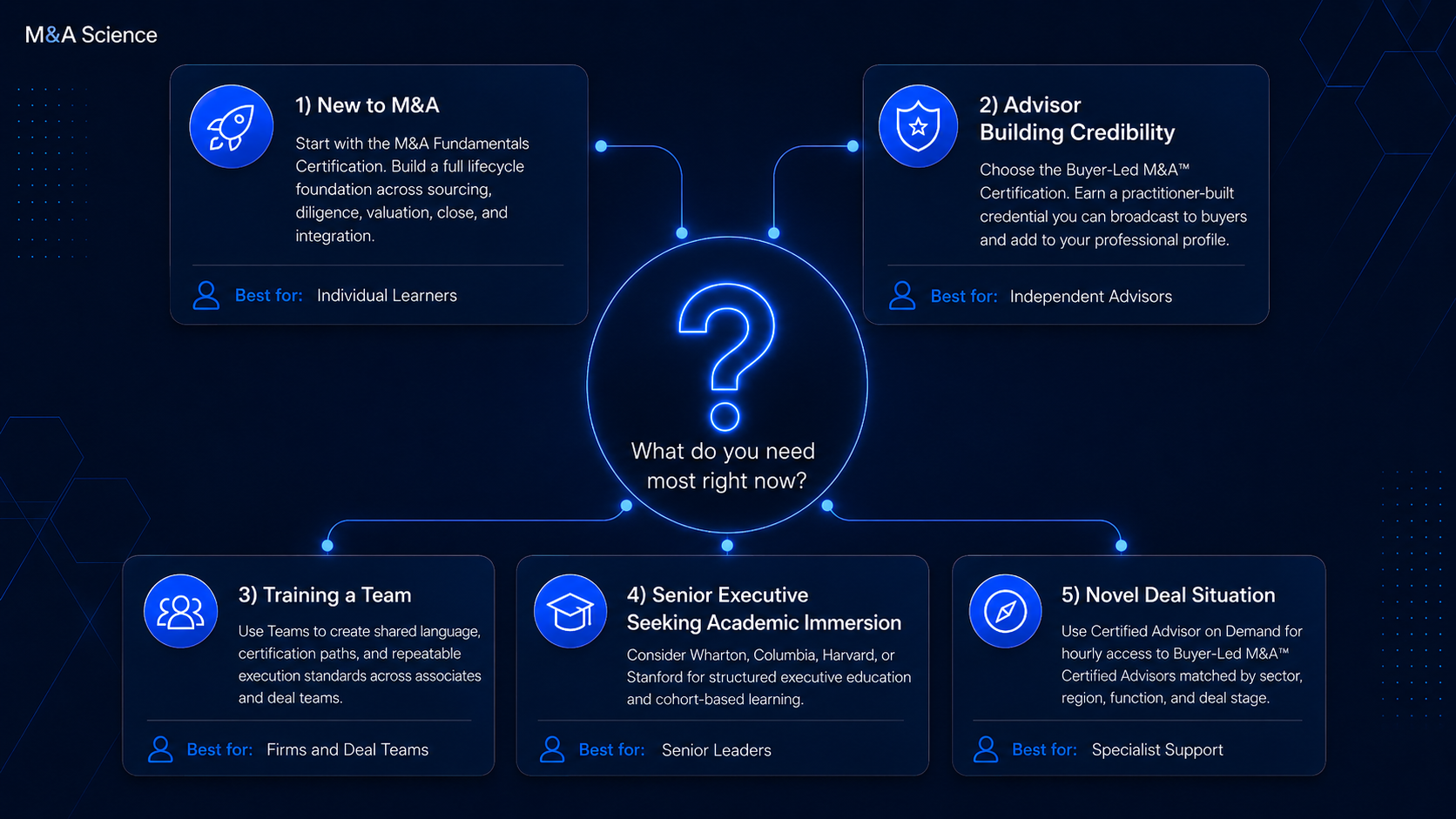
If you’re new to M&A
Start with a program that covers the full deal lifecycle, including sourcing, diligence, valuation, negotiation, closing, and integration. Understanding how these phases connect is important before you can run any of them well.
The M&A Fundamentals Certification inside DealPilot is built specifically for this stage, structured to move at your pace, and grounded in practitioner experience rather than academic frameworks.
If you’re moving into corporate development
Choose training that helps you think beyond individual transactions. Corporate development requires target screening, stakeholder management, decision discipline, and the ability to connect acquisition activity to strategy. A course that stays at the theoretical level will not get you there.
If you’re an independent advisor or work at a boutique advisory firm
Prioritize a program that gives you a credential you can broadcast, not just a certificate of completion. The Buyer-Led M&A™ Certification is built from practitioner-grade deal experience and includes a listing in the Buyer-Led M&A™ Certified Advisor Directory, launching in 2026, searchable by region, function, and sector. Academic programs build knowledge. A directory listing that connects you to buyers searching for certified advisors is a different kind of asset.
If you’re already leading deals
You need fewer definitions and more operating rhythm. Look for training that helps you build repeatable processes, sharper decision points, cleaner diligence, and stronger post-close execution. DealPilot is built for this stage; HBS and Stanford also serve senior practitioners well through residential cohort formats.
If you sit outside corporate development but support M&A
Finance, legal, HR, integration, operations, and strategy teams need role-specific guidance. A general M&A course provides useful context, but the stronger fit is training that maps to what your function actually owns in the deal. DealPilot's role-based guided learning paths are organized by function and deal stage.
If you are training an associate cohort
Skip the individual executive program. The goal is shared language and shared execution standards across the team. See the next section.
What Is the Best M&A Certification for Advisors?
For advisors, whether independent, at a boutique investment bank, or in an advisory practice, the credential question differs from that of a corporate development professional.
Corp dev professionals need to run acquisitions well. Advisors need to run acquisitions well and demonstrate to buyers that they can. A certificate of completion from a six-week online program or a residential executive education week tells a buyer you attended a program. A credential tied to a recognized operating standard, one that includes a searchable directory presence designed to connect buyers with certified advisors, tells a buyer something more useful.
The Buyer-Led M&A™ Certification is the practitioner-built credential for advisors who want both. It is built from M&A Science's experiential data across 400+ practitioner conversations and is aligned with the Buyer-Led M&A™ operating standard. Advisors who earn the certification are listed in the Buyer-Led M&A™ Certified Advisor Directory, launching soon, searchable by region, function, and sector. Most university programs are not designed to provide this kind of practitioner-to-buyer visibility; the directory is built specifically for that purpose.
For advisors earlier in their M&A journey, the M&A Fundamentals Certification covers the full deal lifecycle from sourcing through integration, and is included in the DealPilot Practitioners tier. Both certifications are included with a single DealPilot Membership. No separate enrollment required.
For boutique advisory firms building credentials across an associate cohort, the Teams tier includes certification seats and M&A Competency Assessment credits for up to 20 users, which makes it possible to onboard new hires into a shared credential standard rather than sending each person through a different program.
What Is the Best Option for Training an M&A Team?
A single executive attending an in-person program at HBS or Stanford builds individual capability. A team using a shared platform builds a shared M&A operating standard, and that distinction matters when multiple people are running workstreams on the same deal.
The DealPilot Teams tier is built for boutique investment banks, advisory practices, and lean deal teams that need to standardize deal execution across functions. It includes certification seats for up to 20 users, organization-wide platform access, bulk M&A Competency Assessment credits for onboarding and benchmarking, quarterly peer benchmarking, and a DealRoom partner discount. Price: $14,995/year for up to 20 users.
The M&A Competency Assessment is the recommended entry point for teams that want to benchmark deal-thinking ability before deploying a training program or adding a new associate to a deal. It measures how practitioners approach acquisition decisions throughout the deal lifecycle. Bulk pricing starts at $100 per test for 20 or more users.
For teams that hit a novel deal situation and need specialist support (a cross-border structure, an unfamiliar sector, or an integration challenge outside the team's experience) Certified Advisor on Demand provides hourly access to Buyer-Led M&A™ Certified Advisors matched by region, function, and deal stage. No retainer. Hour block packages of 10, 25, or 50 hours.
Conclusion
Choosing the “right” corporate development course or M&A certification depends on what comes next for you.
If you’re learning M&A for the first time, a structured program covering the full deal lifecycle is the right starting point. If you’re moving into a corporate development or advisory role, you need training that goes beyond theory to connect strategy, sourcing, diligence, and execution. If you’re already leading deals, the bigger need is repeatability: better decision points, cleaner handoffs, and stronger execution across the team.
For advisors, the critical question is the value of credentials. A program that gives you knowledge is different from a program that gives you a credential you can broadcast to buyers and a directory presence that positions you to be found by buyers.
That’s where DealPilot Membership differs from every other program on this list. The Buyer-Led M&A™ Certification is the only credential here linked to the Buyer-Led M&A™ Certified Advisor Directory (launching in 2026), which connects buyers with certified advisors by region, function, and sector.
The M&A Fundamentals Certification covers the full deal lifecycle with practitioner-built frameworks. Both are included in a single membership that adapts to your role, deal stage, and timeline.
Go Deeper
The right starting point depends on where you sit. Compare plans and pricing at the link below.
Explore DealPilot Membership →
FAQ: Corporate Development Courses and M&A Certifications
What is the best corporate development course in 2026? The best corporate development course depends on your career stage, role, and what you need to do next. For advisors and individual operators who want practitioner-built guidance, Flights & Certifications, and a credential connected to a public advisor directory launching in 2026, DealPilot Membership is the strongest fit. For senior executives who want an intensive residential program, Harvard Business School and Stanford GSB are well-regarded options. For a six-week online program, Wharton's M&A and Corporate Development Strategies is a strong choice.
What is the best M&A certification for advisors? The Buyer-Led M&A™ Certification is the practitioner-built credential for advisors seeking a recognized operating credential and a listing in the Buyer-Led M&A™ Certified Advisor Directory, a searchable directory launching in 2026, organized by region, function, and sector. It is included in DealPilot Membership at the Practitioners tier. For advisors earlier in their M&A journey, the M&A Fundamentals Certification covers the full deal lifecycle and is also included in the same membership.
Is DealPilot a course or a membership? DealPilot is an online membership, not a course. It includes guided learning paths organized by role and deal stage, practitioner-built Flights & Certifications (including the Buyer-Led M&A™ Certification and M&A Fundamentals Certification), deal-stage playbooks, templates from real deals, live operator sessions, and community access. It is built for practitioners applying M&A guidance to live deal work, not for professionals completing a fixed curriculum.
Are corporate development courses worth it? Yes, for professionals who choose a program that matches their actual role and deal work. Generic M&A courses provide useful context, but the programs that deliver the most value are tied to specific deal stages, functions, and execution challenges. For advisors, the additional dimension is credential value: a credential you can broadcast to buyers, backed by a directory presence that positions you to be found by buyers searching for certified advisors, is worth more than a certificate of completion from a program buyers have no way to evaluate.
What is the difference between corporate development training and M&A certification? Corporate development training focuses on building acquisition capability: how to source, evaluate, execute, and integrate deals. M&A certification is a credential that signals that capability externally, tied to a recognized standard that others can verify. For operators inside a company, training is the primary need. For advisors who need to signal capability to buyers, certification is the higher-leverage investment.
How should boutique advisory firms train junior associates? The most effective approach is to establish a shared language and execution standards across the firm before associates join live deal teams. The DealPilot Teams tier is built for this. It includes certification seats for up to 20 users, M&A Competency Assessment credits for benchmarking and onboarding, and role-based learning paths organized by function and deal stage. The M&A Competency Assessment is the recommended starting point for understanding where associates currently stand before deploying a training program.
Do you need a certification to work in corporate development? No formal certification is required. Most practitioners enter through finance, strategy, investment banking, or consulting backgrounds. Structured M&A training and certifications help practitioners build operational discipline and develop faster. For advisors specifically, a recognized certification linked to a public directory presence (launching in 2026) is a material advantage in how buyers find and evaluate them.
What skills do corporate development professionals need? Core skills include target identification and screening, financial modeling and valuation, diligence scoping and management, deal structuring, stakeholder alignment, negotiation, and integration readiness. Senior practitioners also need repeatable acquisition cadences and decision frameworks that hold across deal types and sizes. For advisors, the additional skill set includes a buyer-side orientation and an understanding of how acquisitions run from the buyer's seat, not just the financial mechanics.