

.avif)

When a venture-backed company's last-round valuation no longer matches its current revenue, most acquirers treat the gap as a negotiation problem. It isn't. The gap is structural, rooted in how VC rounds are priced, who holds exit control, and what the cap table requires investors to accept before they can say yes. Acquirers who close these deals understand all three before the first conversation starts.
Why Are Venture-Backed Companies Priced So Far Above Their Current Revenue?
VC investors and strategic acquirers are not pricing the same thing. That is the root cause of most valuation standoffs in venture-backed acquisitions, and recognizing it changes the nature of the conversation before it begins.
When a venture investor leads a Series B at a $100M valuation, that number is not a reflection of the company's current revenue. It is a projection of the revenue the company is expected to reach if the round thesis plays out across a three-to-five year horizon. The current $4M ARR is the starting line, not the basis for the number. Investors are buying exposure to the future state: the company at scale, not the company today.
Strategic buyers price differently. They anchor to current performance, apply a risk discount for the probability that growth continues at the projected rate, and arrive at a figure grounded in what the business is producing now. Both frameworks are internally consistent. On the same company at the same moment, they produce valuations that can differ by 5x or more, and neither side is mathematically wrong.
The gap widens when growth slows. The investor base still holds equity priced at the future state. The founder is anchored to the last-round number. The acquirer is looking at a deceleration curve and applying a discount for execution risk. Three rational frames produce three different numbers, and the deal conversation fails when it tries to negotiate between the numbers rather than working through why they are different.
In software, AI has made this gap sharper. Some AI-native targets still command aggressive future-state pricing. Others, especially thin product layers built on top of broader AI tools, are losing defensibility faster than their last-round valuation reflects. The acquirer's first job is to know which market the target is actually in.

What Does the Liquidation Preference Math Actually Say?
Before any deal conversation, experienced acquirers read the cap table. Not the pitch deck. Not the investor update. The cap table, and specifically the liquidation preference stack.
A liquidation preference is the contractual right that determines what preferred shareholders (investors) receive before common shareholders (founders, employees, option holders) in an exit event. In a standard 1x non-participating structure, investors get their invested capital back first. If the company raised $30M across multiple rounds with 1x non-participating preferences, investors collect $30M before anyone else sees proceeds. In a participating preferred structure, investors receive their money back and then participate in remaining proceeds alongside common shareholders. A 2x preference doubles the threshold investors must see before common shareholders receive anything.
When a company raises multiple rounds, these preferences stack. A Series A investor with a 1x participating preferred, a Series B investor with a 1x non-participating preferred, and a Series C investor with a 2x non-participating preferred each carry different economic requirements at exit. The founder's $100M headline valuation sits above all of them, but the amount of exit value that actually reaches the founder depends on what each layer of the stack requires first.
Matt Arsenault, VP of Corporate Development and Strategic Alliances at Jamf, describes this calculation as the prerequisite for any productive deal conversation in venture-backed acquisitions. Until both parties are working from the same understanding of what the preference stack requires, the headline valuation number is a distraction from the actual negotiation.
His point is not that a lower exit today is always better than a larger one later. It is that the founder's real outcome depends on the preference stack, dilution, timing, and the probability of actually reaching the larger number. An acquirer who models that math before the first conversation, and who can walk a seller through it without wielding it as a lever, is doing something most counterparties do not.
The implication is concrete: go into the first conversation having already modeled the preference stack. Know what each investor class receives at various exit prices. Know which investors have the most to gain from an exit now versus waiting. That preparation determines whether the conversation is about price or about structure. Structure is where these deals get done.
What Deal Structures Close the Gap, and What Are the Conditions for Each?
There is no single instrument that bridges a VC valuation gap. There is a toolkit, and each instrument has a specific condition for when it works. Using the wrong one, or applying the right one without accounting for cap table dynamics, either kills the deal or creates post-close disputes that cost more than the gap itself.
Earnouts
Earnouts are appropriate when there is genuine, good-faith disagreement about future performance: when both parties believe the company has meaningful upside, but the acquirer is unwilling to pay for it before it materializes. Earnouts do not work as a mechanism for paying a number neither party actually believes the business will produce. John Blair, Partner at K&L Gates and one of the M&A Science Podcast's most-referenced legal voices on deal structure, is direct on this: the earnout is the most litigated deal structure in M&A, and most of that litigation comes from milestones set aspirationally rather than analytically. An earnout built on projections the acquirer's team privately considers unreachable is not a bridge. It's deferred litigation.
Restricted Stock Units (RSUs) and Retention Bonuses
RSUs and retention bonuses address the people gap, not the valuation gap. In a venture-backed acquisition where key engineers, product leaders, or revenue-generating employees hold equity that will be underwater at the acquisition price, structured retention packages can close what those employees would have received in a higher-exit scenario. These packages matter because talent is often the core asset in early-stage venture acquisitions. If the people who built the product leave within 12 months of close, the acquisition value erodes. RSUs and retention bonuses run in parallel with the valuation bridge. They don't substitute for it.
Deferred Payments
Deferred payments split the acquirer's financial commitment across time. They work when the acquirer needs to manage cash flow across fiscal periods, or when specific investors benefit from recognizing proceeds in a structured timeline. The condition: the seller must have enough confidence in the acquirer's ability and willingness to pay that they accept future payment as part of the structure. Deferred arrangements require a level of operational trust that usually comes from a prior commercial relationship or a visible strategic integration rationale.
Evaluating a VC-backed target right now? DealPilot gives your team practitioner-sourced guiance on cap table analysis, deal structuring, and stakeholder sequencing. Built from over a decade of practitioner interviews and 10,000+ deals. Start a free trial today →
Carve-Outs
Carve-outs separate specific assets, liabilities, product lines, or employee classes from the deal when including them in the transaction creates structural problems. A product unit with its own equity economics, a team with retention expectations that do not fit the acquisition model, or a segment of IP with unclear ownership can each be handled through a carve-out rather than forcing the entire deal to accommodate them. Carve-outs require clean, documented agreement on what is and is not included, along with a clear accounting of separation costs before the structure is proposed.
Investor Relationship Management
Investor relationship management is less a financial instrument than a process discipline, but practitioners who close venture-backed acquisitions consistently name it as the variable that determines whether the other instruments can be applied at all. Understanding which investors are driving the process, which are passive, and what each investor's fund dynamics look like allows the acquirer to engage with the capital structure directly, not just through the founder. Investors facing fund maturity, LP pressure to return capital, or reduced conviction in the company's growth trajectory are often more constructive deal partners than the headline price implies. The VC Deal Structure episode of the M&A Science Podcast covers the mechanics of how cap table structure (participating preferred, anti-dilution provisions, blocking rights) constrains which instruments are available in the first place.
The sequencing discipline: read the cap table first. Map the stakeholders second. Then determine which combination of instruments fits the specific structure and the specific investor dynamics you are working with.
Who Actually Has to Say Yes, and in What Order?
In an acquisition of a founder-led company with a clean cap table, deal approval follows a clear path: founder's agreement, board approval, standard conditions to close. In a venture-backed company with multiple investor rounds, participating preferred shareholders, board seats representing competing economic interests, and minority holders with their own rights, the approval structure is more complex, and acquirers who underestimate it lose deals they should have won.
Practitioners consistently identify multiple stakeholder groups whose alignment is required, and the sequence in which those conversations happen determines whether the deal survives. The founder's yes opens the door, but the lead investors' position determines whether it can stay open. Preferred shareholders in venture-backed companies may hold consent or blocking rights on acquisition transactions, depending on the charter, investor rights agreement, and voting thresholds. Where those rights exist, a preferred holder can effectively veto a deal if the exit price does not meet their threshold, regardless of the founder's or the board's preference.
Investor-directors may bring different economic incentives into the room, even when their formal duties sit with the company and its stockholders. A Series A investor-director and a Series C investor-director can face very different outcomes at the same exit price, and those differences shape how each one advises on the deal. Those positions are not always aligned with each other, and they are not always aligned with the founder.
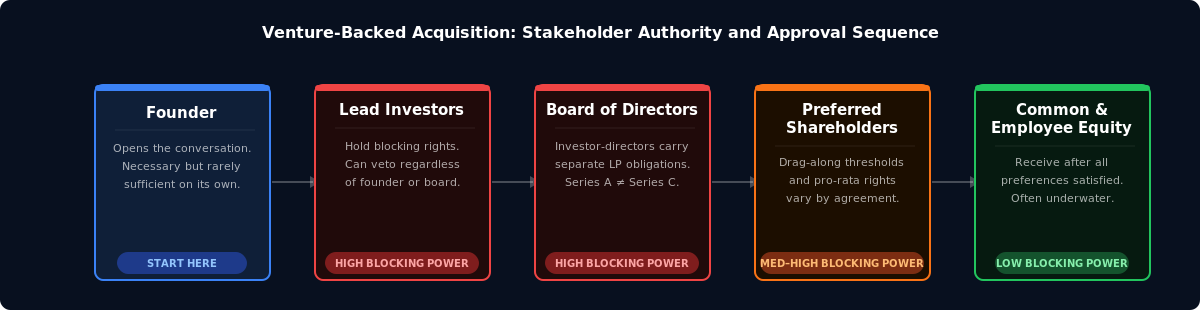
Below the board, minority shareholders, employee equity holders, and strategic investors with pro-rata rights or right-of-first-refusal provisions each have standing in the outcome. Drag-along rights, which can compel minority shareholders to accept a deal approved by a supermajority, have thresholds and conditions that vary by the company's shareholder agreement. John Blair notes that the enforceability of drag-along provisions, and the specific voting thresholds that trigger them, are frequently misunderstood by acquirers who have not reviewed the shareholder documents before entering a deal conversation.
The practical discipline: build the stakeholder map before opening any deal conversation. Know who holds blocking rights. Know what each investor class receives at the proposed price. Know whose relationship with the founder is strong enough to bring them into the conversation constructively. That map, and the sequence it implies, determines whether the deal reaches close.
What Does the Founder Actually Need to Hear?
The valuation conversation fails when it is framed as a correction. Founders who have spent years building toward a number their investors set, and who have used that number to hire, to close partnerships, and to tell a story internally, do not respond to being told the number is wrong. The conversation works when it is framed as a risk-adjusted decision the founder can actually evaluate.
The distinction is practical. A founder anchored to $100M needs to understand two things before any productive conversation can happen: what the preference stack actually produces at various exit prices, and what the risk profile of waiting looks like for both the company and its investors. Most founders, particularly those who closed rounds in a more favorable fundraising environment, have not stress-tested their own cap table in the current conditions. The liquidation structure that seemed workable at the time of signing can look very different when growth has stalled and the next institutional round is uncertain.
Russ Heddleston, co-founder and former CEO of DocSend, describes this dynamic from the sell side. When DocSend was acquired by Dropbox, Heddleston had deliberately structured DocSend's funding rounds with clean 1x non-participating liquidation preferences. He went into the acquisition conversation knowing exactly what his investors needed and what he would receive at various price points. That cap table clarity, he notes in the M&A Science Podcast, is rare. Most founders have not done the analysis, and they find it difficult to engage openly with buyers when they do not understand their own cap table economics. The acquirer who can walk a founder through that analysis, without using it as a negotiating lever, is doing something most counterparties do not.
Walk through three numbers with the founder: what investors receive now, what the company needs to deliver for the future payout to be worth more, and the probability the founder actually assigns to each path. That reframes the question from valuation to risk. Founders who can evaluate those two paths clearly, rather than defending a number they have not examined critically, make better decisions. And they are more likely to reach a conclusion the deal can survive.
Frequently Asked Questions
What causes the valuation gap when acquiring a VC-backed company?
VC investors price based on the future revenue a funding round is designed to enable, not current performance. Strategic buyers price based on current revenue and a risk-adjusted projection of future growth. When growth slows after a VC round, those two frames produce significantly different numbers. The gap is structural: it reflects how each party is pricing risk and time, not a disagreement about facts.
How do liquidation preferences affect an acquisition price?
Liquidation preferences determine the order and amount in which investors receive proceeds before common shareholders at exit. A company that has raised $30M in venture funding with 1x non-participating liquidation preferences means investors collect $30M before founders or employees see any exit proceeds. When preferences stack across multiple rounds, the threshold investors need before common shareholders receive anything rises accordingly. Understanding the full preference stack determines what investors actually need from an exit, which is often different from what the founder's headline valuation implies.
What deal structures are used to close a VC valuation gap?
The main instruments are earnouts, RSUs and retention bonuses, deferred payments, carve-outs, and targeted investor relationship management. Each has a specific condition: earnouts work when there is genuine disagreement about future performance; RSUs address talent retention where equity is underwater; deferred payments split the acquirer's commitment over time; carve-outs separate assets or liabilities that create structural problems for the deal. Most closed deals use a combination, sequenced against the specific cap table and stakeholder dynamics of the target.
How do you negotiate with a founder anchored to their last VC round valuation?
Reframe the conversation from valuation to risk-adjusted decision. Walk the founder through three numbers: what investors receive now, what the company needs to deliver for the larger payout to be worth the wait, and the probability the founder actually assigns to that outcome. Present it as a decision tool, not a negotiating floor. Founders who understand their own cap table can engage openly with the structure. The acquirer who gives the founder that clarity tends to get a conversation about structure rather than one about defending a number.
What happens to investors when a VC-backed startup is acquired below its last valuation?
Investors with liquidation preferences receive their preferences first. In a 1x non-participating structure, they recover their invested capital before common shareholders receive anything. In a participating structure, they recover their capital and participate in remaining proceeds. If the acquisition price is below the total preference stack, common shareholders, including founders and employees with options or equity, may receive little to nothing. This is why the preference stack analysis is essential before entering any acquisition conversation: it determines who has the most to gain from a deal at a given price, and who has reason to block it.


