



M&A law is the branch of corporate law governing how companies are bought, sold, merged, and restructured. It covers the legal documents, risk assessments, regulatory filings, and contractual protections that govern every stage of a transaction. From the first NDA through antitrust review to the definitive agreement, M&A lawyers are involved at every phase.
In this guide:
M&A law is the branch of corporate law governing how companies are bought, sold, merged and restructured. It covers the legal documents, risk assessments, regulatory filings and contractual protections that govern every stage of a transaction. From the first NDA through antitrust review to the definitive agreement, M&A lawyers are involved at every phase.
What Is M&A Law?
M&A law is not a single body of law. It’s the point where six of them meet on one transaction:
- Contract law governs the agreement.
- Securities law governs disclosure when stock is the consideration.
- Antitrust law governs whether the combination is allowed.
- Tax law governs how it’s structured.
- Employment law governs what happens to people.
- State corporation law governs the mechanics of the merger itself.
Most deals implicate all six at once, which is why M&A practice is organized around deal stages rather than areas of law.
M&A transactions aren't limited to outright acquisitions. Joint ventures, minority investments, divestitures and carve-outs all fall within the scope of M&A law. For a broader overview of how these transaction types differ, see our guide to mergers and acquisitions.
M&A lawyers work on the buy and sell sides. Buy-side lawyers protect the acquirer from undisclosed liabilities and structure the deal to minimize risk. Sell-side lawyers protect the seller's interests in negotiations, maximize deal value and manage the exposure arising from the representations and warranties the seller must make.
The Three Legal Frameworks That Govern a Deal
Three bodies of law govern most US M&A transactions, and they answer three different questions: can we do this, how do we do it and what must we tell people.
State corporation law governs the internal mechanics of a merger: board approval, the shareholder vote threshold, appraisal and dissenters' rights and the certificate of merger that makes the combination legally effective. Delaware General Corporation Law is the controlling statute for most large US transactions because a majority of public companies are incorporated in Delaware. Section 251 governs the standard merger, while Section 253 governs short-form mergers where a parent owns 90% or more of a subsidiary.
Federal securities law governs disclosure. It applies whenever a public company is involved or stock is being used as consideration, and it drives proxy solicitation for shareholder votes, tender offer rules where a buyer goes directly to shareholders and registration requirements when new shares are issued in the deal.
Antitrust regulation determines whether the combination is permitted at all. It is enforced by the FTC and the Department of Justice, and it’s the framework most likely to change a deal's timeline or its shape.
What Legal Documents and Activities Appear at Each Deal Stage?
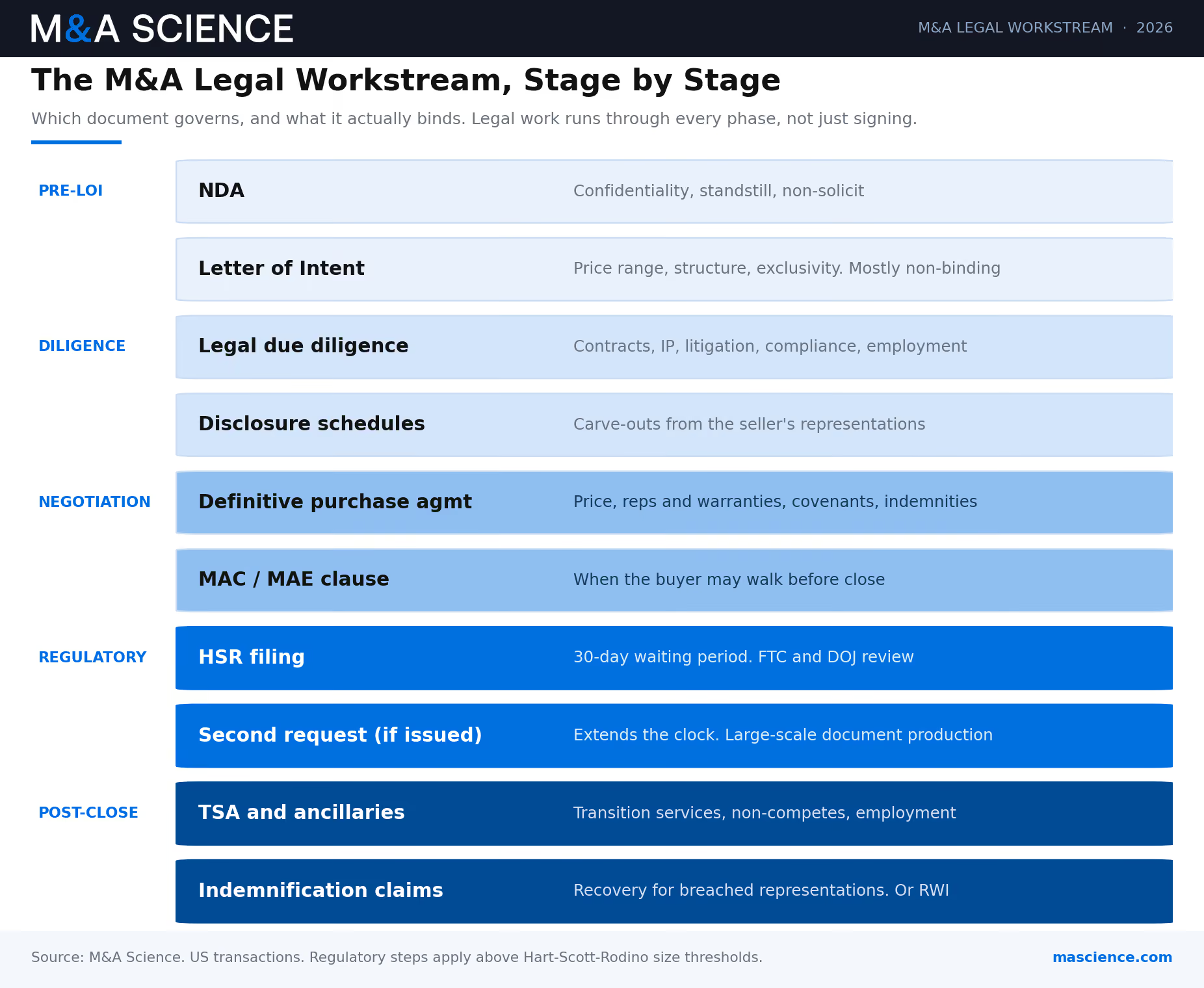
The M&A process moves through a recognized sequence, and legal activity runs through every stage.
Non-Disclosure Agreement (NDA)
The NDA is typically the first legal document executed in a transaction. It establishes a confidentiality framework, letting both parties share sensitive information prior to a commitment. A well-drafted NDA includes standstill provisions (preventing the buyer from acquiring shares while in discussions) and restrictions on soliciting the target's employees.
See our M&A terminology guide for key legal terms you'll encounter throughout a deal, along with their definitions.
Letter of Intent (LOI)
The LOI is the buyer's formal, mostly non-binding offer. It establishes the proposed price range, deal structure, exclusivity period and diligence timeline. While most of the LOI is non-binding, certain provisions, like exclusivity and confidentiality, are binding. Lawyers on both sides closely track what’s binding (and what isn’t), because the LOI’s terms anchor the ensuing agreement.
Due Diligence
Due diligence is the most document-intensive phase for M&A lawyers. Legal due diligence covers the target's contracts, IP ownership, litigation exposure, regulatory compliance, employee obligations, real estate and any pending or threatened legal claims. The goal is to uncover any legal barriers to the acquisition and identify risks that must be priced in or addressed through reps, warranties and indemnities.
Deal Structure
The legal structure of a transaction determines its tax treatment, liability exposure and regulatory requirements. A stock purchase means the buyer acquires all of the target's assets and liabilities, even if undisclosed. An asset purchase lets the buyer select which assets to acquire and which liabilities to assume, but requires individual transfers of contracts and licenses that may need third-party consent.
The decision on the deal structure belongs jointly to legal and finance. It has significant consequences for both parties' tax positions and should be decided well before drafting the definitive agreement.
Representations and Warranties
Reps and warranties are the factual statements each party makes to the other in the definitive agreement. The seller represents the accuracy of the financial statements, the completeness of the disclosure of liabilities, IP ownership and the absence of undisclosed litigation, among other things. These statements survive post-close. If they prove inaccurate, the affected party can seek indemnification.
Representations and warranties insurance (RWI) has become increasingly common in mid-market transactions, meaning buyers can make claims against an insurance policy rather than the seller. This reduces post-close friction and can enable cleaner deal exits for sellers.
Definitive Purchase Agreement
The definitive purchase agreement (DPA) is the binding contract that governs the transaction. It supersedes the LOI and all prior agreements. The DPA contains the final purchase price (including any post-close adjustments), all reps and warranties, covenants governing the period between signing and close, conditions to closing, indemnification provisions and termination rights. Negotiating the DPA is typically the most time-intensive legal work in a deal.
"Competing bids, rising shareholder pressure, geopolitical risk and valuation scrutiny have made execution risk as important as identifying the right deal opportunity."
- Saso Kraner, M&A Partner, White & Case. Deal Watch: Paul Weiss Lands Two of the Largest Deals of the Week; Dealmakers Eye 'Execution Risk', The American Lawyer, July 2026.
Material Adverse Change (MAC) Clause
A MAC clause, sometimes called a material adverse effect (MAE) clause, defines the conditions under which a buyer can exit a signed deal before closing without paying the breakup fee. Courts have set a high bar for what qualifies as a MAC, but the clause matters significantly when markets deteriorate or a target's business conditions change materially between signing and closing.
Regulatory and Antitrust Review
Antitrust review determines whether regulators will permit the combination. In the US, deals above the Hart-Scott-Rodino size thresholds require an HSR filing and an initial 30-day waiting period before closing, during which the FTC and the DOJ assess competitive effects. If the agencies want more, they issue a second request, which extends the timeline substantially and triggers large-scale document production.
Clearance can be conditioned on remedies, most often divesting overlapping business lines. Cross-border deals may also require filings in the EU and other jurisdictions, each with its own thresholds and review timeline.

What Does an M&A Lawyer Do?
M&A lawyers manage legal risk at every phase of a transaction, from structuring how a deal is approached to ensuring the transfer of ownership is clean and defensible after close. The role is transactional rather than adversarial. The output is a set of documents that allocate risk between two parties who both want the deal to happen.
In practice, the M&A lawyer's role includes:
Transaction structuring. Advising on asset vs. stock purchase, earn-out design, escrow structures and the legal implications of different deal architectures.
Diligence management. Running the legal workstream: reviewing target contracts, employment agreements, IP assignments, litigation history and regulatory compliance records.
Drafting and negotiating key documents. NDAs, LOIs, merger agreements, purchase agreements, disclosure schedules and ancillary agreements (TSAs, employment arrangements, non-competes).
Regulatory coordination. Managing antitrust filings, sector-specific regulatory approvals and government contracting compliance requirements.
Post-close obligations. Overseeing the transition of contracts, managing indemnification claims and resolving disputes arising from reps and warranties breaches.
M&A lawyers should be involved from the earliest stage of a transaction, not brought in at signing. Legal issues discovered late in a process are either ignored under time pressure or become deal-breakers. Early involvement allows the legal team to shape how the deal thesis is structured, not just document what's been agreed.
Working With M&A Attorneys: Pay, Path and Picking a Firm
What do M&A lawyers earn?
M&A lawyer compensation follows the standard Big Law scale for associates, commonly known as the Cravath scale, while compensation diverges sharply at the partner level. The scale sets base salaries by associate seniority, starting with first-year associates, with bonuses paid on top of base compensation. M&A partners at top firms are among the highest paid in the profession because M&A deal work bills at premium rates and origination credit compounds. In-house M&A counsel earn less in cash than firm partners but work materially fewer hours and often hold equity.
How do you become an M&A lawyer?
Becoming an M&A lawyer follows a defined route: earning a law degree, passing the bar and joining the corporate or transactional group of a firm with an active deal practice. Associates typically spend their first two years on due diligence review, disclosure schedules and closing checklists before drafting substantive provisions. There is no bar specialization for M&A. Expertise is built through deal experience rather than certification, which is why lateral hiring in M&A tracks the number and size of transactions an associate has closed.
How do you choose M&A counsel?
Choosing M&A counsel comes down to four questions:
- Has the firm closed deals of your size and structure, not just deals in general?
- Who is actually doing the work, the partner in the pitch or a second-year associate?
- Is the fee arrangement fixed, capped or hourly, and what triggers a re-quote?
- Does the firm have the regulatory bench your deal needs (meaning antitrust if you are buying a competitor and sector counsel if you are in a regulated industry)?
Large firms bring deeper specialist teams, while boutiques often put more of the work directly in the hands of partners.
What Are the Main Legal Risks M&A Lawyers Watch For?
According to practitioners who have run hundreds of transactions, the legal risks most likely to derail or damage a deal fall into four categories.
Diligence risks. Undisclosed liabilities, inaccurate financial representations, IP ownership gaps or regulatory violations that surface during legal due diligence. These can be addressed through price adjustments, escrow provisions or specific indemnities, or they can be sufficient reason to walk away. The M&A steering committee typically makes the go/no-go call when material legal risks surface mid-diligence.
Financing risks. When a buyer is using debt financing, the lender often requires access to the target and imposes covenants on the seller's cooperation. M&A lawyers draft provisions ensuring seller cooperation while protecting the seller’s interests. Deals contingent on financing carry additional closing risk if credit markets shift between signing and close.
Antitrust and regulatory risks. Strategic acquirers buying competitors face the most scrutiny. M&A lawyers assess antitrust exposure early (before the LOI is signed) to determine whether a deal is likely to clear review and whether remedies (such as divesting overlapping business lines) will be required. Unexpected second requests or foreign regulatory complications are among the most common causes of deal delays in cross-border transactions.
Gun jumping. A legal prohibition that prevents the buyer and seller from coordinating operations or decision-making before the deal formally closes. Gun jumping violations can result in regulatory penalties and, in some cases, jeopardize the deal itself. Legal teams on both sides must actively monitor pre-close integration planning to ensure it remains within legal boundaries.
Frequently Asked Questions
What is M&A law?
M&A law is the branch of corporate law that governs how companies are acquired, merged, divested or restructured. It draws on contract law, securities regulation, antitrust law, tax law and employment law, because most M&A transactions implicate all of these simultaneously.
What does an M&A lawyer do?
M&A lawyers structure transactions, run legal due diligence, draft and negotiate key deal documents (NDAs, LOIs, purchase agreements), manage regulatory filings and protect their clients from undisclosed liability. They should be involved from the earliest stage of a deal, not just at signing.
When should you involve legal counsel in an M&A deal?
Before the LOI is signed, ideally at the point the deal is being structured. Legal issues identified late in a process are either ignored under time pressure or become deal-killers. Early legal involvement allows risk to be addressed through deal structure, not disclosed as a problem after exclusivity is in place.
What is legal due diligence in M&A?
Legal due diligence is the systematic review of a target company's legal position, covering contracts, IP ownership, litigation history, regulatory compliance, employment obligations and real estate. The goal is to verify the seller's representations, surface undisclosed liabilities, and identify risks that need to be addressed before or at close.
What are representations and warranties in M&A?
Representations and warranties are statements in the purchase agreement about facts concerning the parties and the business being sold. For example, the seller may represent that the target’s financial statements are accurate, disclosed liabilities are complete, it owns or has rights to its intellectual property and it complies with applicable laws. If a representation or warranty proves inaccurate, the buyer may have a contractual claim against the seller, subject to the agreement’s indemnification provisions and other limitations. Representations and warranties insurance (RWI) can cover certain losses resulting from breaches.
What is a MAC clause in M&A?
A material adverse change (MAC) clause, sometimes called a material adverse effect (MAE) clause, defines when a buyer can exit a signed deal before closing without penalty. Courts have set a high bar for what qualifies as a MAC, but the clause is critical when a target's business deteriorates significantly between signing and closing.
What is antitrust review in M&A?
Antitrust review is the regulatory process through which government authorities evaluate whether a proposed deal would reduce competition. In the US, large transactions require Hart-Scott-Rodino filings and a waiting period. The FTC or DOJ may require divestitures or impose conditions. Deals in regulated industries also require sector-specific regulatory approvals.
What is gun jumping in M&A?
Gun jumping is the illegal coordination of operations or decision-making between a buyer and seller before a deal officially closes. It violates antitrust laws that require the parties to remain independent until regulatory approval is received and the transaction closes.
Do M&A lawyers go to court?
M&A lawyers are transactional lawyers, not litigators, so they rarely appear in court. The work is drafting, negotiating and structuring rather than advocacy. Deal disputes that do reach court, such as a buyer invoking a material adverse change clause or an indemnification claim after close, are usually handed to litigation colleagues, most often in the Delaware Court of Chancery. M&A lawyers support that work as subject matter experts on what the agreement was meant to do.
What are the Big 4 M&A firms?
In an M&A context "Big 4" usually means Deloitte, PwC, EY and KPMG, which dominate transaction services: financial and tax due diligence, Quality of Earnings reports and integration consulting. They are not law firms. Legal work on large deals goes to firms with dedicated M&A practices, and the two are engaged separately: a mid-market deal often uses a Big 4 firm for financial diligence and a law firm for the agreement.


