Sonoma Brands Capital is a private equity firm focused on the growth sectors of the consumer economy. We aim to partner with bold, innovative founders on their way to building the world’s next enduring brands across the physical and digital landscape.
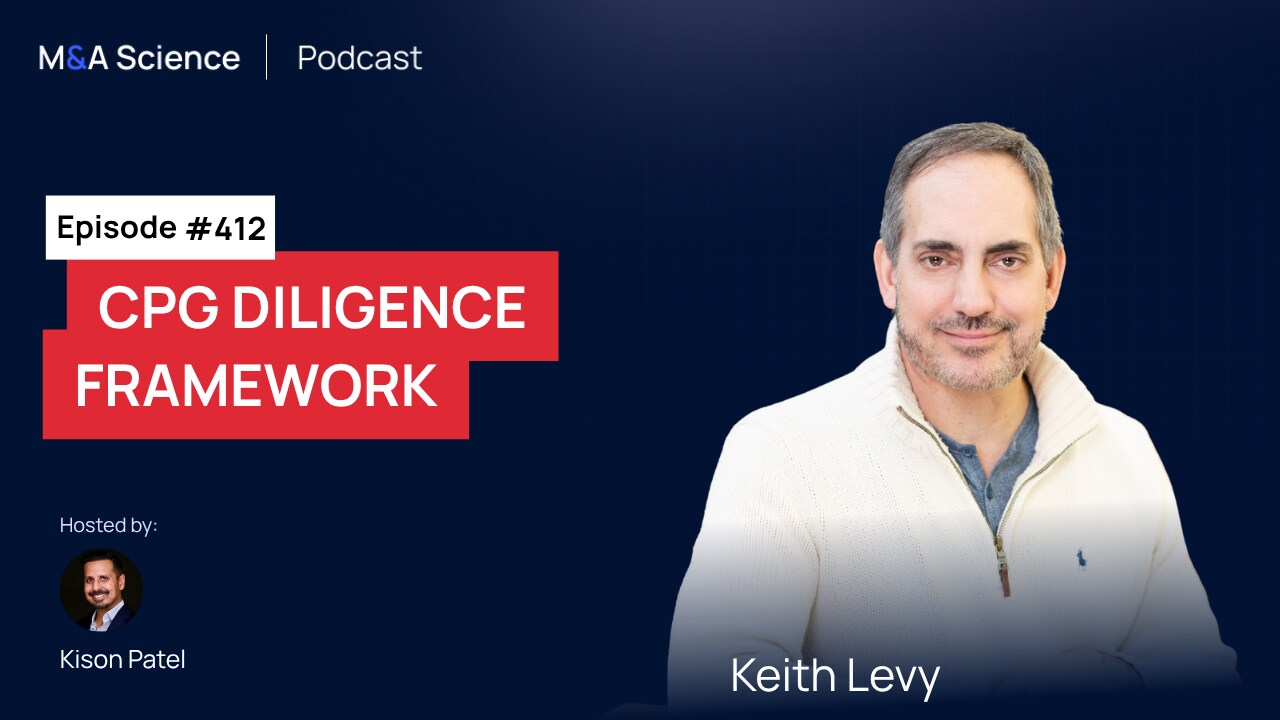
Keith Levy
Keith Levy is a seasoned M&A specialist and Operating Partner at Sonoma Brands. With nearly 35 years in the consumer goods industry, he has held key roles at Gallo, Anheuser-Busch, and Mars Incorporated. Notably, Keith was involved in the $53 billion integration of InBev and Anheuser-Busch. He later led global business development and M&A for Mars Wrigley. At Sonoma Brands, Keith focuses on consumer products, health, and beauty, leveraging his extensive experience to drive growth and integration in these sectors.
Episode Transcript
Evolution of Sonoma Brands
When I was in the global business development role at Mars, I was meeting a lot of people — entrepreneurs, VCs, private equity. I was looking for brands and products we could bring into the Mars Wrigley portfolio. John Sebastiani was one of those people. He had some things in his portfolio I was looking at for Mars. I had difficulty getting Mars to look at anything that wasn't a multi-billion dollar acquisition — they're a $70 billion company, so a $25 or $50 million top-line business doesn't move the needle. My thesis was that you might have to make smaller acquisitions and build a portfolio, a kind of rollup strategy, and then use Mars's scale in manufacturing, purchasing synergy, and global distribution to grow those businesses.
When I left Mars, John asked if I'd be interested in being an operating partner on their next fund. I didn't really know what that meant at the time — everybody's definition is a little different. His answer was good. He said: we've got smart people around us and we think we're making good investments, but the stronger we make the team, the more value we create, and the more value we create, the bigger the pie we all share in. And for me, when you retire from big corporate, life is about finding balance — mind, body, spirit. If you can't keep your mind occupied and leverage the 35-plus years of experience you've built, you're not keeping your mind alive the way you need to.
I've found a lot of energy in this. From a guy who spent many years in big machines, it sounds crazy, but if I were to do it over, I'd probably go into smaller businesses. Everything you spend your time on matters. There's no bureaucracy, no pointless meetings — it just matters. Entrepreneurs know it. They don't know how to do it any other way.
John Sebastiani is the managing partner and founder of the firm — and a phenomenal entrepreneur himself. He had a quarter-billion-dollar-plus exit with Crave Jerky. He knows how to do it. When John started out, it was much more of a venture capital mindset — smaller checks, bigger upside, bigger risk. In a venture model, maybe you make 20 bets, 15 go to zero, two return capital, and two moonshots return the whole fund. In a growth capital world, the numbers look different. Same 20 bets — maybe eight go to zero, six or seven return capital, and the rest are your moonshots. You minimize risk by writing a larger check, coming in at a later stage — Series A, B, maybe C — and taking a bigger percentage of the business. We're no longer doing seed or pre-revenue. The businesses we back now have real revenue, real EBITDA, or a very short path to getting there.
Growth equity over buyout
I'd take growth equity. Buyouts often come with the belief that there's still hidden value to uncover — which usually means you're looking at a lot more turnarounds. Whereas adding fuel to a flame that's already burning hot is a much easier equation.
When you go into a deal, you're not investing unless you believe it's a moonshot. And the number one thing on your criteria list is the founder. You're betting on them. If that one doesn't pass the sniff test, you don't even get to the product, the margin structure, the P&L — none of it. A bad founder can tank everything, no matter how good the idea.
The deals that went bad? We probably bet on the wrong founder. We had a vision of who that person was, and once we got in and started working closely together, reality was something different. The other thing — when you're doing early-stage, pre-revenue investment, there are no real financials to look at. Only pro formas. Over time, we've learned to bet on companies that have recurring revenue, real EBITDA, real cash flow, or a very short and credible path to those things. Companies used to get bought on insane multiples of revenue with no EBITDA, no free cash flow, not even operating breakeven. Those are mistakes, and we've learned from them.
Deal Evaluation
What determines whether an opportunity even gets evaluated is quite straightforward. If a role comes from Sonoma Brands, there is usually a clear reason it is directed my way. It typically aligns with prior experience—whether that is in beverages, alcoholic beverages, snacks and treats, pet food, or the broader pet ecosystem. If it falls outside those areas, it goes to someone else. There is little value in forcing relevance where there is none.
Once it does fit, the evaluation begins with the founder. The question is simple: what does he or she bring that is genuinely special? From there, the focus shifts to product-market fit. Is the company addressing a real need or a clear consumer want that is currently underserved?
The next layer is the route to market and whether the strategic choices make sense given the product’s stage of development. In consumer products, having a strong product is not enough. There must be a brand behind it—something that resonates, engages, and gives consumers a reason to lean in.
Equally important is understanding how the product is made. Are they outsourcing production? Manufacturing in-house? Still operating in a highly informal setup? That operational foundation matters more than most people initially assume.
If those elements are compelling—a strong founder, a real market need, a clear path to production, and a thoughtful go-to-market strategy—then attention turns to the financials. Gross margins are critical. A great product with weak margins is difficult to justify. Profitability follows closely behind. If the business is not yet profitable, there needs to be a clear and credible path toward it, along with an understanding of what investments are being made today to drive that outcome.
In growth capital, private equity, or venture capital, the objective is always value creation. Every investment is made with an eventual exit in mind. The question is not just whether the business works today, but what it can become and what it can ultimately be sold for. There is, however, a long journey between initial concept and exit, and many variables come into play along the way.
That is the framework in practice: start with the founder, move to product-market fit, then go-to-market strategy, followed by how the product is made, and ultimately tie everything back to the financials. This is where operating partners and due diligence converge.
Evaluating Founders
From an operator’s perspective, assessing a founder goes far beyond surface-level traits or rehearsed narratives. Leadership, while often overused as a term, remains the central variable. It ultimately determines whether a founder can build not just a product, but an enduring organization.
At its core, leadership is about execution through people. It is the ability to define a vision that others genuinely believe in, provide the necessary resources to execute, hold individuals accountable, and reward outcomes appropriately. These are not abstract concepts—they are the daily mechanics of building a business.
When evaluating founders, the question becomes: can they do this consistently?
The strongest founders demonstrate an ability to build teams that are aligned and motivated. They communicate a clear vision and ensure that everyone is pulling in the same direction. More importantly, they operate alongside their teams. There is a level of proximity—being in the trenches, sleeves rolled up—that creates credibility and trust within the organization.
Another defining trait is self-awareness. The most effective founders understand both their strengths and their limitations. There is no illusion of being exceptional at everything. Instead, there is a willingness to acknowledge gaps and actively fill them with people who are better suited for those roles. That humility is not a weakness; it is a structural advantage.
This is where many founders diverge. A red flag emerges when there is a “god-like” mentality—an inability to recognize shortcomings or a reluctance to bring in complementary talent. In contrast, strong founders demonstrate vulnerability. They can articulate what is working, what is not, and where they need help.
Importantly, building a successful leadership team is not about hiring in one’s own image. Diversity of thought is often more valuable than uniformity. High-performing teams are rarely composed of identical personalities or perspectives. In practice, this means being comfortable working with individuals who think differently, challenge assumptions, and, at times, may even be difficult—so long as they are highly capable in areas that matter.
In reality, organizations are not built on idealized teams of perfectly aligned individuals. They are built on complementary strengths. The founder’s role is to assemble that “jigsaw puzzle”—bringing together the right mix of skills, perspectives, and capabilities to compensate for what they themselves do not possess.
From an M&A standpoint, this becomes critical. A business is only as scalable as its leadership. Identifying founders who can evolve, build teams, and sustain execution through others is often the difference between a good investment and a great one.
I do not try to hire in my own image. I am completely comfortable bringing in people who think differently. In fact, I value diversity of thought. People see the world in different ways, and that is a strength.
There have been individuals I have worked with who were difficult personalities, but they were exceptional at what they did—especially in areas where I was not strong. That worked, because I knew they would deliver. And I was comfortable having them as part of the leadership team because they complemented my gaps.
In an ideal world, teams would be made up of like-minded individuals—people who are humble, intelligent, energetic, and naturally curious. The kind who enjoy solving problems and can take apart a Rubik’s Cube and put it back together. But that is not reality.
The reality is that effective leaders need to be comfortable with differences. People will think differently, approach problems differently, and operate differently. As long as they bring the right capabilities—particularly in areas where you are weak—that combination becomes the foundation of a successful team.
That is ultimately the goal: building a leadership team that fits together like a jigsaw puzzle, where each piece strengthens the whole.
There is certainly an element of gut feel in evaluating founders, but it is not arbitrary. It is grounded in pattern recognition. Over time, demonstrated success creates a track record, and that history becomes a useful indicator of how someone is likely to perform in the future.
A founder’s past behavior—how they have built teams, navigated challenges, and delivered outcomes—provides signals. Equally important is who they choose to surround themselves with. The quality of people around them often reflects their judgment and their standards.
The more difficult assessment is understanding how they behave under pressure. What are they like when the stakes are high—when “the bullets are flying,” so to speak? How do they operate when the business is under stress and decisions carry real consequences? That is the equivalent of being in a foxhole together, and it is not something that can be easily evaluated through a standard diligence process.
This is where investing becomes less precise. There is an inherent need to make judgment calls and take calculated leaps. One forms a view on how a founder might respond in situations that have not yet occurred.
Experience sharpens this instinct. After reviewing hundreds, even thousands of opportunities, it becomes easier to identify when someone lacks those critical traits. The more nuanced challenge is the opposite case—when a founder appears to possess all the right attributes. Even then, there remains uncertainty. No matter how strong the signals are, there is always a degree of risk in underwriting people.
A meaningful part of founder evaluation happens during the diligence process itself. It is not just about reviewing numbers or analyzing a data room. Time spent with the people behind the business is equally important. The qualitative dimension—how founders think, communicate, and engage—carries as much weight as the financials.
That said, the numbers still matter. Transparency in financials, clarity on performance, and identifying potential risks or “landmines” remain fundamental. But what often differentiates strong founders is how they communicate those risks.
Consider a simple example. A founder openly acknowledges, “A significant portion of revenue comes from Costco, and that relationship is at risk—but here is the plan to replace it.” That level of candor builds trust. It signals awareness, preparedness, and a willingness to confront reality directly.
Contrast that with a founder who presents an overly optimistic narrative—“We have Costco, and we will soon add Kroger, Walmart, and others.” That is where skepticism naturally increases. It suggests a lack of grounding in execution or an underestimation of the challenges ahead.
This is where instinct begins to play a role. The evaluation shifts from what is being said to what lies beneath the surface. It becomes less about the headline and more about judgment, realism, and credibility.
Importantly, no founder will disclose everything—and they should not. Holding some cards is part of the process. The objective is not complete transparency, but sufficient candor to establish trust.
When there is a strong working relationship, clear visibility into the business, and open communication, the need to “read between the lines” diminishes. Alignment becomes easier, and the probability of a successful partnership increases.
Product Market Fit
Product-market fit, at its core, comes from a classic marketing mindset: working backwards from the consumer. It starts with a simple set of questions—what does the market want, what does it currently have, and more importantly, what is missing? The real opportunity lies in identifying latent or emerging demand that has not yet been fully addressed.
When a product clearly fills that gap—whether it is a better-for-you snack, a more effective nutraceutical, or a differentiated cosmetic solution—that is when it becomes compelling. It signals that the market is already searching for an answer, and this product delivers it in a way others have not. That is when attention sharpens. It is an indication that something meaningful has been unlocked.
A strong example of this is Touchland. The underlying need—hand sanitizer—was already well established, particularly in a post-COVID environment where hygiene awareness increased significantly. However, the category itself was commoditized. What Touchland did was reimagine the product entirely. Through design, packaging, fragrance, and brand positioning, it transformed a functional item into something aspirational, particularly for a younger demographic shopping in environments like Sephora or Ulta Beauty.
That differentiation created pull from the market. Consumers were not just buying sanitizer—they were buying into a brand experience. With that came pricing power, and ultimately, stronger margins. The result was a rapid value creation cycle, culminating in a substantial exit in a relatively short period. It is a clear illustration of how product-market fit, when executed with insight and brand intelligence, can drive outsized returns.
Another example is Boon Sauce. Rooted in a personal story and inspired by family recipes, the product extended beyond its initial positioning as a “Japanese barbecue sauce.” It became a versatile condiment—used across a wide range of foods—which significantly expanded its market appeal. The simplicity of the product line, combined with strong branding and exceptional margins, made it highly attractive to strategic buyers, including players like McCormick & Company.
In both cases, the pattern is consistent. A clear, unmet need in the market. A differentiated product that solves it in a unique way. A strong founder with insight and conviction. And a business model that supports premium pricing and margin expansion.
From an M&A perspective, this is where value creation becomes tangible. When the market is effectively “pulling” the product, growth becomes more efficient, and exit opportunities expand. Strategic buyers recognize this dynamic quickly, particularly when the brand, margins, and scalability are already in place.
More broadly, the market environment is beginning to shift. After a period of reduced activity, there are signs that strategic acquirers are re-engaging. Capital is being deployed again, and high-quality assets are attracting significant interest. For firms that have built portfolios around strong product-market fit, this creates a favorable window for exits.
In some cases, a single breakout investment—like Touchland—has the potential to return an entire fund. That is the power of identifying product-market fit early and aligning it with the right execution strategy.
Go-to-Market Strategy
A lot of products in our portfolio are better-for-you or occupy a niche that isn't broadly distributed yet. Founders need to be smart about their route to market. If you've got a high-end cat food, do you go straight to Walmart, or do you go to PetSmart, Petco, and pet specialty first — build momentum there, and then earn your way into Kroger or Publix or Walmart? You need a strategic understanding of your roadmap and a methodical, patient approach to execution.
I prefer a growth curve that's a steady, measured climb — not a spike, then a crash, then another spike. A steady build means a thoughtful sequence: where am I going first, where am I going second, where am I going third? How do I penetrate all the accounts I want in a way that my supply chain and team can actually support?
Manufacturing and Supply Chain Control
This has become a very relevant conversation. When I stepped in to run one of our portfolio companies, I discovered we made very little of our own product. When you're in a co-manufacturing environment as a small business, a lot can go wrong. A bigger player the co-man works with decides to step on the gas — Walmart needs more production time — and suddenly your line gets bumped. Or your 3PL warehouse says, we committed this space to you, but someone bigger came in and is paying more, so you need to find another partner. You're constantly at the mercy of other people.
What I'm looking at now in diligence is what do they own. It used to be the conventional wisdom: stay asset-light, build the brand, don't put money in the ground — it's more attractive to strategic acquirers. I'm starting to believe the opposite. If a founder invests their first dollar in their own manufacturing environment, they control how much they make, they control quality and food safety, they control their payment terms. And from a strategic acquirer's perspective — if Mondelez wants to buy that snack business and the company already has its own manufacturing, that's attractive. The acquirer doesn't have to disrupt their own production lines, which are running at massive speed and efficiency with managers who are compensated on not screwing that up.
There's also the innovation angle. When I was at Mars and I'd go to one of my plant managers and say, I need some line time to experiment with a chickpea-and-chocolate concept, the answer was essentially no — you're going to screw up my metrics and I'm compensated on efficiency. If you own your own manufacturing environment, you have the flexibility to innovate without that conflict. It's just stuff you learn from being on both sides of it.
Financial Due Diligence
The founder tells you whether you can trust the numbers you're looking at. Product-market fit tells you whether the revenue is durable or fragile. Go-to-market tells you whether the growth curve is real or manufactured. And manufacturing control tells you what's actually sitting inside those gross margins — whether the business is exposed to supply chain risk, pricing risk, or whether they've built something defensible. Once you've worked through all four, the financials either confirm the story or they don't. What are your gross margins? Are you profitable? If not, why not, and what's the path? A deal can fall apart at any one of those steps.
The Operating Partner Role
People bring in operating partners for different reasons. Some are great for fundraising — they know a lot of people with money in family office circles. That's not the value I bring. What I bring is that I've sat in the seat of the strategic acquirer. I wore the Mars hat. I've gone out to buy companies. I know what I'm looking for, what pisses me off, what gets me excited. So when Sonoma is evaluating a business and thinking about a potential exit, I can say: I know you think you can sell this to McCormick, but here's what McCormick is actually going to ask you. Here's what they won't like and here's what they're going to love. How do you shine a light on the right things?
The second value is credibility. I've run companies, run divisions, had big jobs with big budgets. When my name and resume are on Sonoma's website, people checking out the firm see they have someone who lived in the world of big corporate America — someone who wore an M&A hat and actually acquired companies. That adds a level of credibility. And when it comes down to the brass tacks of whether a particular business will be attractive to a strategic acquirer, I can answer some of those questions.
On the portfolio side, if we're evaluating a pet business, every other person on our team has minimal pet experience. I ran a very successful pet food company for five and a half years. I worked with veterinarians, retailers, suppliers. I was on the board of the Pet Food Association. I can walk in and quickly say, I know you're looking at this pet food company — and here's why it's a piece of shit, or here's why I love it and here's what nobody else is seeing. Those insights are what growth capital businesses, PE firms, and VCs need. The good ones know they can't do it all themselves. They recognize that if they're going to create real wealth together, they need people around the table who see the world through different lenses.
M&A Software for optimizing the M&A lifecycle- pipeline to diligence to integration
Explore dealroom

Want to wear your M&A expertise?
Check out the M&A Science store.
.avif)