M&A Science Podcast
 / 
Listen Now:

400 Acquisitions and a Failed Process: What Happens When You Don't Integrate

Buyers scrutinize roll-up platforms and ask very different questions than they did five years ago. Organic growth, cross-sell execution, data cleanliness, integration depth: the proof points that once felt optional are now the difference between a clean sale process and a broken one. 

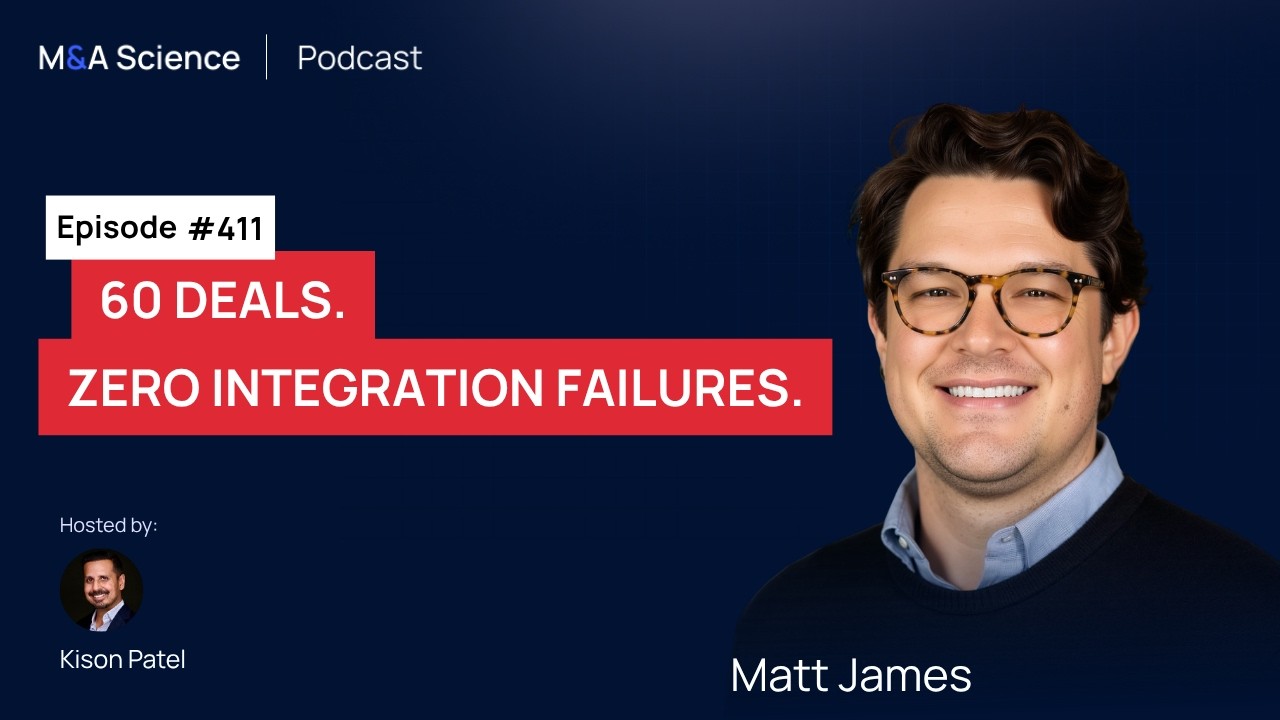
Matt James co-founded Oak Bridge Insurance in 2020 and has since closed more than 60 acquisitions. He has watched well-capitalized competitors fail their sales processes because they couldn’t disaggregate organic from inorganic growth or produce updated financials in under a week. It didn’t help that they’d spent years calling aggregation integration. This conversation covers how Matt built the system that produces those proof points, what he learned the hard way, and what he fixes first when he walks into a broken roll-up.

 What You'll Learn

  • Why multiple arbitrage is gone, and what buyers are scrutinizing instead
  • How Oak Bridge evaluates cultural fit before any financial criteria
  • What a failed billion-dollar roll-up sale process looks like from the inside
  • Building integration continuity from LOI through 90 days post-close
  • How distributed equity drives buy-in across an acquired organization 

If you're evaluating targets and want to know if they're integration-ready pre-LOI, the Intelligence Hub can help you score cultural fit, data readiness, and technology maturity.. Join the professional membership at mascience.com/membership.

Oakbridge Insurance is a PE-backed insurance distribution platform based in the southeast U.S. Founded in 2020, the company has closed 60+ acquisitions across eight states and is approaching $200 million in revenue. Over 50% employee-owned, Oak Bridge integrates 100% of its acquisitions starting from the day of close, with a 90-day target for full workstream completion.

Industry
Insurance
Founded

Matt James

Matt James is EVP, CFO & Chief Acquisition Officer at Oak Bridge Insurance, which he co-founded in 2020. He has closed more than 100 deals across his career, 60+ at Oak Bridge alone, and has spent roughly half of that time in insurance brokerage M&A, both as a banker and as an operator.

Episode Transcript

The Evolution of the M&A Market

The market has evolved. What used to be a simple question—can you grow?—has now become far more nuanced: how exactly is that growth happening, and what has been done with the businesses acquired?

That level of scrutiny may sound obvious, but the reality is that it only began to meaningfully intensify about five years ago, around the time we formed Oakbridge. In the last 12 to 18 months, that diligence has accelerated even further.

Today, diligence processes are far more rigorous. In some cases, transactions have broken down simply because sellers could not clearly separate organic growth from inorganic growth. That distinction has become critical.

Buyers—including ourselves when evaluating add-ons—are now far more focused on the components of organic growth than on the ability to execute a roll-up strategy.

The reasoning is straightforward. Within the sponsored investor community, M&A execution is a capability that can be built. Capital, process, and repetition can develop that muscle over time.

Organic growth, however, is fundamentally different. It is significantly harder to achieve, particularly for high-growth acquirers. It requires the right culture, infrastructure, and operating discipline—elements that cannot be easily replicated.

Because of this, breaking down organic growth into clear, measurable dimensions is essential to building conviction in a transaction—especially when paying top-of-market multiples.

A single growth number is no longer sufficient. The expectation today is to deconstruct growth into its underlying drivers.

In practice, this means analyzing performance across:

  • Line of business

  • Recurring versus non-recurring revenue

  • Programs and product segments

  • Regions and geographies

  • Individual producers or salespeople

This level of detail is critical in proving that the growth engine is real, repeatable, and sustainable—whether acting as a buyer or preparing for a recapitalization event.

Beyond segmentation, buyers are also placing greater emphasis on operational KPIs. Metrics such as sales velocity, lost revenue versus lost client count, and external market factors—like rate increases passed through by insurance carriers—are increasingly central to the diligence process.

As roll-up strategies mature and move up-market, these analyses are no longer optional; they are expected.

Another major area of focus is what happens after the acquisition.

Buyers are looking closely at how effectively platforms are leveraging their acquisitions—particularly through cross-selling.

In a business that spans multiple lines and geographies, the ability to drive cross-sell is a key indicator of value creation. It demonstrates that the platform is more than just a collection of assets.

Executing this well requires several elements:

  • Clearly defined and measurable cross-sell KPIs

  • Incentive compensation structures that reward collaboration, often combining cash and equity

  • Broad-based equity participation to align stakeholders

  • Company-wide training and communication to support execution

  • Deployment of specialized expertise and differentiated capabilities

Ultimately, this comes down to proving a credible “right to win” across the platform.

The shift is clear. Growth is no longer taken at face value.

It must be explained in detail, broken down into its components, and supported by data. More importantly, it must demonstrate durability beyond acquisition-driven expansion.

For practitioners, this raises the bar. It is no longer enough to show that a platform can acquire and scale. The expectation is to prove that it can grow organically—and extract real value from what it has already built.

That is what defines quality in today’s market.

The Importance of Revenue Synergies

There has been a clear evolution in how the market evaluates growth.

The first layer is the increasing scrutiny on organic versus inorganic performance. That much is now understood. Buyers expect clarity, supported by KPIs, that demonstrate how a business is truly growing beyond acquisitions.

But the more important shift—the one that has defined the last five years—is this:

It is no longer enough to assemble businesses and show top-line growth. The expectation now is to demonstrate real synergies.

Simply consolidating companies, showing rising revenue, and declaring success is no longer credible in today’s market.

Historically, value creation in M&A leaned heavily on cost reduction, operational efficiencies, and multiple expansion. But that playbook has changed.

Cost synergies are still relevant, but they are no longer sufficient. Buyers today are far more focused on revenue synergies, particularly those that contribute to organic growth.

This shift is directly tied to changes in the market environment.

In the past, sponsors could rely on multiple arbitrage—acquiring businesses at lower multiples and exiting at significantly higher ones. That spread has narrowed considerably. The opportunity to create value through multiple expansions alone has largely diminished. As a result, the burden of value creation has shifted. It now sits squarely on the ability to grow the business organically over the hold period.

The power of Cross-Selling

Within that context, cross-sell has emerged as one of the most important drivers of organic growth.

Once an acquired business is integrated, the expectation is that its capabilities, relationships, and expertise are leveraged across the broader platform. This is where real value is created.

In practice, this means:

  • Producers from acquired firms working across a wider sales organization

  • Subject matter expertise being deployed across geographies

  • Product specializations being introduced into new client segments

For example, a firm with deep expertise in sectors such as agribusiness, tourism, or hospitality can extend those capabilities beyond its original geography. By doing so, it unlocks new revenue opportunities across the entire platform.

This is not viewed as inorganic growth. On the contrary, once the business is integrated, these revenue synergies are considered organic growth because they are generated from within the combined organization.

The New Standard for Value Creation

This shift has significant implications for how buyers underwrite transactions.

Cross-sell is no longer a “nice to have” or a theoretical upside case. It is a core assumption in many investment theses.

Buyers are asking:

  • Is there a credible mechanism to drive cross-sell?

  • Are there incentives in place to support it?

  • Does the organization have the structure and expertise to execute?

Without clear answers, it becomes difficult to justify premium valuations.

The message from the market is clear.  Value is no longer created by simply buying well and exiting well. It is created by what happens in between.

And increasingly, that comes down to:

  • The strength of the organic growth engine

  • The ability to execute on revenue synergies

  • The discipline to turn cross-sell from theory into measurable performance

For practitioners, this represents a fundamental shift in mindset.

M&A is no longer just about accumulation. It is about activation—taking what has been acquired and making it work together in a way that drives sustained, organic growth.

Integration vs Aggregation

Another area where scrutiny has intensified is integration.

At a surface level, integration has always been part of the M&A narrative—cost synergies, efficiencies, and some level of coordination across acquired businesses. But today, the market is asking a far more fundamental question:

Is this business truly integrated, or is it simply a collection of assets? There is a meaningful difference between the two.

In earlier cycles, particularly over a decade ago, many roll-up strategies were built on a straightforward premise:

Acquire as many businesses as possible, aggregate revenue, and benefit from multiple arbitrage on exit.

That model required less emphasis on deep integration. The value was created through scale and financial engineering.

That environment no longer exists.

With multiple expansions largely compressed, simply aggregating revenue is not enough. The market now requires evidence that the platform operates as a cohesive, unified business.

Integration is no longer a vague concept. Buyers expect tangible proof. At a minimum, this includes the realization of cost synergies and operational alignment across the platform

But increasingly, that is only the baseline. True integration is demonstrated through:

  • Revenue synergies that show businesses are working together
  • Shared capabilities deployed across the organization
  • Consistent operating models that enable scalability
  • Clear internal levers that drive organic growth beyond external market tailwinds

The emphasis is on whether the organization has moved beyond coordination and into full operational unity.

Advantages of New Platforms

There is a structural advantage for newer platforms. Being built more recently allows for integration to be embedded from day one—systems, processes, incentives, and culture can all be designed with a unified model in mind.

In contrast, more mature roll-ups that began under the old playbook often face greater challenges. Retrofitting integration into a loosely connected group of businesses is significantly more complex.

This is precisely why buyers are probing deeper.

They are not just asking whether integration exists—they are evaluating how real and how durable it is.

Another important shift is the expectation that growth must be driven by internal capabilities, not just favorable market conditions.

It is no longer sufficient to point to macro factors—such as industry pricing increases or general market expansion—as the primary drivers of performance.

Buyers want to see proprietary growth levers, evidence of execution, and repeatable processes that can sustain performance regardless of market conditions

This ties directly back to integration. A truly integrated platform can activate these internal levers consistently across the business.

Integration today is not a checkbox. It is a core component of the investment thesis. It must be visible, measurable, and proven through both cost and revenue outcomes

Ultimately, the question is simple: Does the platform function as a single, scaled enterprise—or merely as a portfolio of acquisitions?  In the current market, only the former commands premium valuation.

How to Evaluate Deals

Before getting into strategy, structure, or even valuation, the starting point is far more fundamental: what is the framework for evaluating whether a deal should even happen?

There is a common structure—strategic, financial, operational, and data readiness. But in practice, one dimension sits above all of them. It’s culture. Cultural alignment comes first, or nothing else matters. 

Cultural alignment is not just another box to check. It is binary.

If there is no cultural fit, the process stops. There is no progression into deeper evaluation. In a people-driven business, misalignment at the cultural level will ultimately surface in every part of the organization—execution, integration, and growth.

This is why culture is assessed first, before any detailed underwriting begins.

Next is integration. One of the more important shifts in sophisticated M&A programs is that integration is no longer a post-close consideration.

It starts pre-LOI.

Integration leaders and functional heads are involved early in the evaluation process. They are actively assessing: operational compatibility, strategic alignment, and data readiness. Not as abstract concepts—but in terms of how difficult the business will be to integrate.

This is a critical evolution. It ensures that deals are not just underwritten for acquisition—but for successful assimilation into the platform.

Full Integration model

Every acquisition is integrated from day one. The majority of integration workstreams are completed within the first 90 days. It is an aggressive timeline, but it reflects a clear philosophy: prolonged integration creates friction, and friction delays value creation.

The objective is to move quickly through that disruption phase so the acquired business can resume growth, leverage the broader platform, and access shared resources and capabilities.

Integration, in this sense, is not just about alignment—it is about acceleration.

As the platform scales, integration capacity becomes a real constraint.

With a relatively lean integration team and a growing revenue base, every deal must be evaluated not only on its standalone merits—but also on its impact on the organization post-close.

This leads to a critical discipline: walking away from deals that are too difficult to integrate.

Even in the early stages of building a platform—when the pressure to deploy capital is highest—there is recognition that a poorly integrated deal carries both direct and indirect costs:

  • Operational disruption
  • Cultural friction
  • Delayed synergy realization
  • Management distraction

These costs can outweigh the perceived upside of the transaction. While people and culture remain central, two of the most consistent deal breakers are: Outdated or incompatible technology and weak data standards

Data readiness, in particular, has become non-negotiable.

A platform operating on a unified system—such as a single ERP instance with a robust data model—depends on consistency. If a target is unwilling or unable to align with those standards, it signals deeper integration challenges.

In many cases, resistance to data standardization is not just a technical issue—it reflects a broader unwillingness to integrate.

And that becomes a red flag. What becomes clear is that integration is not a separate phase. It is a lens through which the entire deal is evaluated.

  • Strategy must align with the platform
  • Operations must be compatible
  • Data must be standardized
  • Culture must fit

If any of these elements break down, integration becomes difficult—and value creation becomes uncertain.

The most disciplined acquirers are no longer just asking, “Is this a good business?” They are asking, “Can this business become part of our system—quickly, cleanly, and completely?” That distinction is subtle, but it changes everything. 

Because in today’s market, the success of a deal is not defined at signing. It is defined by how well it integrates.

Validating Culture

Our process tends to frustrate investment bankers, and the reason is simple—we spend a significant amount of time validating culture.

That starts with multiple meetings with the principals. One conversation is never enough. The goal is to engage repeatedly, over time, and ideally to meet other key individuals in the organization as well—those who will actually drive the business after the transaction closes.

Whenever possible, those meetings happen in person. Sitting across the table changes the dynamic. It allows for a more natural understanding of how people think, how they operate, and whether there is real alignment. That level of comfort does not happen instantly. It develops gradually through repeated interaction.

This approach does extend the timeline of a deal, but it is intentional.

A large part of that is tied to how transactions are sourced. Roughly 75% of deals are proprietary, meaning they are built through direct relationships rather than through a banker-led process. That creates space to get to know the business in a more organic way, outside the pressure of an auction. It allows conviction around cultural fit to form well before even getting to the point of signing an LOI.

There is an appreciation for structured processes and the role advisors play, but when it comes to culture, those environments can limit how deeply one can really understand the people behind the business.

Even with an active pipeline, the approach remains highly selective. A large number of opportunities are reviewed, but only a small portion move forward. That filtering begins with culture. If the alignment is not there, the process simply does not progress.

Culture cannot be evaluated in a data room. It does not show up cleanly in financials or presentations. It reveals itself through conversations, through exposure to different people across the organization, and through observing consistency over time.

Taking longer upfront creates a different outcome. It leads to stronger conviction, fewer surprises, and ultimately a better foundation for integration. In a market where integration determines success, validating culture this way is not a delay in the process.

It is the process. We signed NDAs for about 100 opportunities. From there, 28 LOIs were submitted, and 12 of those were ultimately signed and closed.

Once we reach the LOI stage, we are very committed. Historically, we have closed 100% of the deals where an LOI has been signed. That reflects the level of conviction we build before getting to that point.

Last year had slightly more banked processes in the mix, but over a longer period, about 75% of deals have been proprietary.

These are sourced directly—through internal efforts led by myself, our CEO, and increasingly through our partners as they join the platform. There is a strong network effect. New partnerships often lead to additional opportunities, which speaks to how those relationships are built and maintained, particularly through the integration process and early cultural alignment.

We are not targeting businesses where the principals are looking to exit entirely.

The focus is on partners who want to continue building. The average shareholder age is in the high forties, which reflects that orientation. This is structured as a buy-in model rather than a sell-out.

That alignment is important. It ensures that as partners come into the platform, they are motivated to grow the business and take advantage of the broader resources available to them.

Deal Structure

It is a combination of cash and equity. There is a strong conviction around having at least 20% of the upfront consideration in equity. In practice, over the past five years, that has averaged closer to 25% equity and 75% cash.

All deals also include an earnout component. These typically run over three years and are based on organic top-line growth post-closing. The earnouts are structured on revenue and paid in both cash and equity.

During the earnout period, there is a deliberate effort to expand equity ownership beyond just the principals.

The focus is on bringing more individuals into the equity pool—particularly those who are driving value after the transaction. The idea is to ensure that the people responsible for growth are participating in the upside.

This shifts the mindset of the business. It is no longer just about income or compensation. It becomes a broader wealth creation opportunity, especially for individuals who may not have had that exposure in a traditional privately owned business.

Today, the business is over 50% employee-owned. That ownership is distributed across roughly 250 out of 600 employees.

Importantly, this is not limited to former owners or senior leadership. Equity participation extends across the organization—from back-office functions like accounting, to service teams, to middle and front office roles.

This broad distribution of ownership is a key part of the model. It reinforces alignment, supports long-term growth, and helps sustain the business across future generations of shareholders.

On average, about 25% of the deal is structured as rollover equity, and there is a deliberate effort to expand that ownership to a broader group of employees.

In some cases, every employee coming over in the transaction has been included as an equity shareholder. That is not always the case, but it has been done on several occasions.

In many privately held businesses, it is difficult to distribute equity in a tax-efficient way to employees who are not owners. Structurally, it can be challenging to implement outside of a transaction.

The transaction itself creates a unique opportunity to do this. It becomes a natural point to share ownership more broadly and allow employees to participate in that event.

The same philosophy extends into the earnout structure.

While the principals are obviously involved, participation typically goes much deeper. In many cases, there is near სრული participation from employees beyond just the selling shareholders during the three-year earnout period.

This reinforces alignment across the organization. The individuals contributing to growth post-closing are not just compensated—they are directly participating in the value they help create.

Earnouts Structure

When looking at the overall structure, about 80% of the value is paid upfront, with roughly 20% tied to the earnout. So it is weighted more heavily toward the upfront consideration.

That said, the earnouts are uncapped.

Because of that, there have been instances—particularly with smaller add-on deals—where the earnout ultimately exceeded the upfront payment. In those cases, the businesses significantly outperformed, sometimes tripling or quadrupling over the three-year post-close period.

That level of growth naturally drives a much larger earnout payout.

And those are outcomes that are welcomed.

Deal Stories

Without naming specific situations, there have been cases involving very large platforms—billion-dollar revenue businesses built over 10 to 15 years—where processes ultimately failed during diligence.

A common issue is the lack of true integration.

On the surface, these businesses present themselves as integrated platforms. But when you look more closely, the reality is different. Many are operating multiple ERPs, different payroll systems, and relying on a centralized data warehouse to aggregate everything at the corporate level. That is not true integration by today’s standards.

Another major factor is the inability to support the claims made during the marketing phase.

These processes often involve extensive diligence—90 to 120 days for large transactions. As buyers go deeper, they expect the proof points to align with how the business was positioned.

When those claims do not hold up, confidence erodes quickly. That is often what leads to a breakdown in the process and, ultimately, a weaker financial outcome for shareholders.

The dynamic during diligence is cumulative.

As issues are uncovered—especially those that challenge valuation—buyers begin to scrutinize everything else more closely. Each concern adds to the overall risk profile, and the diligence list grows.

In some cases, particularly with larger platforms where valuation expectations are high, that growing list of issues becomes too significant. At that point, buyers may step away entirely.

A recurring theme in failed processes is over-positioning the business.

This can take several forms. Organic growth may be overstated or not clearly supported. Capabilities—such as specialization within the business—may be presented more aggressively than they actually exist.

These are often strong businesses that have achieved meaningful scale. The issue is not quality, but rather the gap between expectation and reality.

When that gap becomes apparent during diligence, it creates friction that is difficult to recover from.

As diligence drags on and inconsistencies emerge, the process itself becomes a risk.

Lengthy timelines, combined with increasing uncertainty, are often what ultimately derail transactions. The deeper buyers go without finding what they expected, the less likely the deal is to close.

At that point, even strong businesses can see processes collapse—not because they lack value, but because they were positioned in a way that could not be substantiated under scrutiny.

Red Flags During Diligence

For us, it always comes back to the core criteria—particularly data readiness. And this is something that has become increasingly important, not just for us, but across the broader sponsor community as the market has matured.

This industry generates a significant amount of valuable data. When used properly, it can drive cross-sell, improve negotiations with carrier partners, and help define and expand specialty areas that lead to revenue growth.

But when you dig into some businesses, the issue becomes clear—they do not actually have control over their data.

That lack of control creates a cascade of problems.

During diligence, it starts to show up quickly. The business cannot produce timely monthly results after close. Data used in marketing materials cannot be easily refreshed or validated. Exhibits prepared for the data room cannot be rolled forward with confidence.

In some cases, even basic financial reporting is fragmented—built across multiple spreadsheets at the individual acquisition level, rather than within a unified system.

That approach may have worked in the early days of roll-ups, when the focus was on aggregating revenue and benefiting from multiple arbitrage. But in today’s market, that is no longer sufficient.

For larger, more mature platforms, this becomes a structural challenge.

Many of these businesses were built on a model that emphasized autonomy. Early partners were told they could continue running their businesses independently—keeping their systems, their brands, and their processes intact.

At the time, that made sense. It supported growth and made acquisitions easier.

But over time, it creates a fragmented organization that is difficult to unify.

The challenge now is that the market demands full integration.

But shifting from a decentralized model to a fully integrated one is not just a technical exercise. It is a cultural one.

If partners were originally promised independence, introducing standardization—systems, data, processes—can create significant friction. It changes the original value proposition and can disrupt the culture that was built early on.

That is why catching up on integration at scale is such an uphill battle.

Ultimately, data issues are rarely isolated.

They are usually a symptom of a broader lack of integration. And in today’s market, that raises concerns not just about reporting, but about the ability to drive organic growth, execute on synergies, and scale effectively.

For buyers, this becomes a critical signal.

If the data is not controlled, the business is not fully integrated. And if it is not integrated, the path to value creation becomes significantly more uncertain.

Those are the easy red flags.

If a business cannot roll forward the basic analyses that should already be used to run the company, that is a major issue. At that scale—especially for a billion-dollar revenue organization—there should be tight accounting, reporting, and management KPIs in place.

These are not advanced capabilities. They are foundational. They should be part of the day-to-day operation of the business.

That is what makes these situations difficult.

On one hand, these are large, established organizations with strong underlying businesses and high-quality people. On the other hand, the infrastructure does not reflect that scale.

When the reporting, data, and operational discipline are not there, it becomes clear that the business is not functioning as a fully integrated platform.

Ultimately, that is what it comes down to.

Despite the size and the quality of the underlying assets, the lack of integration prevents the business from operating as a cohesive unit. It feels more like a collection of parts rather than a true platform.

And in today’s market, that distinction matters.

Building the Integration System

In the beginning, it was just us and a checkbook. But over time, we started to build more structure into the process, especially around the people side. In an insurance brokerage business, about 90% of the value sits with the people and the customer relationships they bring.

One of the biggest improvements came from an early acquisition. It was a proprietary deal with no banker involved, and after closing, someone from the acquired team came to us and said we could have run the process much better. There had been a lot of friction, especially since it was a relatively large deal for us at the time. We took that seriously, and he essentially raised his hand to help fix it. Today, he leads that function as our VP of New Partner Operations.

He quarterbacks the entire process from pre-LOI diligence through the first 90 days post-closing. He is involved early, sits in on diligence calls, tracks workstreams, and stays close to everything throughout. A big part of his role is managing me out of the process as quickly as possible so that our functional leaders and internal experts can take ownership of integration even before closing.

He also focuses heavily on seller education, which is especially important in proprietary deals where there is no intermediary guiding the process. For many of these owners, this is a once-in-a-lifetime transaction, and they are doing it while still running their business. He acts as a quarterback and, in many ways, a seller advocate as we move toward closing.

That continuity is critical. All the knowledge built during diligence—the data, the workstreams, and the nuances—carries directly into integration because he has been involved from the start. When the broader integration team steps in, there is no gap.

On the systems side, we moved away from Excel trackers and implemented a centralized platform as the source of truth for the hard data. At the same time, we think of this role as the source of truth for everything qualitative—the people dynamics and cultural nuances that do not show up in a spreadsheet.

That combination has made a significant difference. It has helped us onboard deals faster, but more importantly, it has improved the experience for new partners. They come into the business with less friction and more confidence in the decision they made to partner with us.

Educating the Seller Through Integration

It is definitely part of the process for us. In many cases, even during the first meeting with a prospective partner, we share our integration guide. It is a detailed document—over 50 pages—that outlines each component of the integration process and identifies the key people internally who are responsible for those areas.

The goal is to give full visibility into what the seller should expect once they move through the transaction. That level of transparency and consistent communication is critical to making the process smoother. When there are no surprises, even the more difficult parts—like technology conversion—become easier to manage. People may not enjoy that part of the process, but they understand it upfront and know what it will look like.

In some cases, this level of detail may make us appear more heavy-handed on integration. But that is intentional. When looking at processes that have failed in the market, a common issue is the disconnect between what sellers expect and what the reality is post-closing.

We try to eliminate that gap entirely. The objective is to be clear and transparent from the beginning, so that when partners come into the business, they know exactly what to expect as part of the platform.

Bridging Diligence and Integration

In the first year, I was completely heads down on getting transactions closed. The focus was on growth. Once a deal closed, I would essentially throw it over the wall to our functional leaders—HR, accounting, marketing—and ask them to figure it out.

That approach created a very inefficient process. There were constant questions coming back, and even though we were acquiring similar types of businesses, each deal had its own nuances that made it different. That led to a lot of rework, especially in translating key diligence information to the broader team.

Too much of that critical knowledge—the context built during diligence—was sitting with me and not being effectively shared across the organization. That became a real bottleneck.

Evolving the process was essential. Moving away from being the sole owner of that information and distributing it more effectively across the team made a significant difference. Now, at our current scale, there are enough people involved in the process day to day that everyone has a clear understanding of what is happening, and we no longer see that breakdown after closing.

So it really is about building continuity across the entire process. It cannot feel like something is just handed off and then becomes disconnected.

We have built a relatively consistent process around that. The integration guide, combined with having a clear source of truth in our system, allows us to manage everything in one place. We also use it as a project management tool for our functional leaders so they can stay aligned throughout the process.

What is interesting is that none of our team came from an M&A background. Most of them came from acquired partner businesses, where they were in roles like HR or accounting. They have been through the process themselves, so they understand it at a fundamental level.

Because of that, they are constantly thinking about how to improve it—not just for execution, but for the next partner coming into the business.

DealRoom

DealRoom is a platform we use across the entire M&A process.

Before implementing it, everything was managed through folders and Excel trackers. There would be multiple versions—an internal tracker, one from accounting diligence, another from legal—and it became fragmented very quickly.

We consolidated all of that into DealRoom and made it a real-time, centralized system.

It now serves as the source of truth from the very beginning of the pipeline all the way through post-closing. It covers prospect tracking, diligence, and extends into integration through project management and checklists.

A big advantage is the ability to build dependencies within the workflow. That has been critical for us, especially since we operate with a relatively small team while managing multiple integrations at the same time—often three to five deals concurrently if we are doing 10 to 12 transactions a year.

It keeps everything organized and reduces the need to revisit deal terms or track down information across different systems. But more importantly, it connects the process.

Instead of having delays between teams—like waiting on one group to complete a task before another can begin—the system creates a more seamless flow. Those dependencies are visible, managed, and coordinated in one place.

Combined with the role of our new partner operations lead, who quarterbacks the process, it has helped eliminate the disconnected and drawn-out nature of how we used to operate.

We moved away from having multiple trackers and consolidated everything into a single system that acts as our source of truth. It allows us to track dependencies, stay organized, and manage the entire process end to end—including integration.

The integration workstreams themselves are largely completed within the first 90 days, but the system continues to play an important role beyond that. We maintain the full history of what we acquired so we can track how each business evolves over time.

That becomes especially valuable a few years down the line, particularly after the earnout period. It gives us the ability to go back and compare actual performance against what we originally underwrote.

Early on, when we had fewer deals, that context was easier to keep in mind. But as the number of transactions grows—once you get to 50 or 60 deals—it becomes much harder to remember the original thesis for each one. Having that centralized system allows us to revisit those assumptions and understand how the business has performed over time.

How to Scale the Business

The technology piece was a big shift for us. Moving away from email and spreadsheets being passed around was critical. That had been a weak point in our process, and centralizing everything into one system made a significant difference.

The other piece is more qualitative, but just as important. It is the level of transparency we maintain with the seller throughout the process. In proprietary deals, we have the advantage of effectively guiding them through the transaction while also being the buyer. That makes clear communication even more important.

We focus heavily on being transparent about timing, key milestones, and what needs to happen at each stage. There is a strong emphasis on project management and maintaining consistent communication throughout.

About 18 months ago, we introduced weekly calls for all deals that are in progress after signing an LOI. These can be short or longer depending on where we are in the process, but the consistency is what matters. The seller sees the same people each week and has a regular forum to ask questions.

That level of visibility into the team and the process has helped build trust and goodwill with partners as they come into the business.

Overcommunicating, building relationships, and making sure it is a good experience for incoming partners is a key part of it. On the technology side, the data piece has been just as important.

As part of integration, everyone is moved onto a single instance of our ERP. Even if they are already using the same system, they are migrated into our instance. Before that happens, our database team scrubs the data to make sure it is clean.

We use a system called Applied Epic, which is common in the insurance brokerage industry. It functions as a core system of record for customers, revenue, and commissions. It is built on an older architecture, so we extract that data and push it into a more modern stack.

On the back end, we use Databricks to build out the data warehouse, and then surface everything through Microsoft Power BI, since we operate within a Microsoft ecosystem.

This initiative really accelerated about two years ago when Audax Group came in as a sponsor. We already had the foundation in place—because we had been integrating from day one and standardizing on a single ERP—but this was about taking the data to the next level.

We started layering in additional dimensions beyond just core operating data. That included payroll, market data, and inputs from carrier partners around pricing. The result has been a shift from being reactive to much more proactive in how we run the business.

Leaders across the organization can now self-serve. Regional leaders can access their own P&Ls, understand employee metrics, productivity, and organic growth, all the way down to the branch level. We are now pushing that visibility further down to the individual producer level.

That level of granularity makes it much easier to identify opportunities and address issues quickly. When something changes in the business, we can immediately go into the data and understand where to focus.

The investment is not insignificant, especially in a sponsor-backed environment. But the risk of not doing it—particularly in terms of future valuation—is much greater than the upfront cost.

People Adaptation

I think a big part of it comes back to having the right cultural alignment from day one. When that is in place, the buy-in becomes much easier.

We also benefit from being majority employee-owned. That includes ownership across key leaders—at the regional level, corporate level, and within functional teams in the field. That distributed equity model creates real alignment.

We often ask our leaders to think like shareholders. When they are making decisions—especially the difficult ones—they are looking at it not just from an operating or P&L perspective, but also through the lens of ownership.

That mindset drives stronger engagement. It also creates a healthy level of competition across regions to improve performance and hit key metrics.

This model is fundamental to how we operate. It reinforces alignment across the organization and shifts decision-making away from a top-down approach. Instead of pushing targets from the corporate level without context, there is shared ownership and accountability in how the business is run.

Most Valuable KPI

For us, the key metric is revenue per employee.

It is a strong indicator of efficiency, but it also speaks to scalability. When you look at how that metric has trended over time—especially over the last five years—you can see whether the business has been able to grow without proportionally increasing headcount.

It also gives insight into how the business is operating. Whether they are leveraging technology effectively, how they are managing costs, and how disciplined they are in scaling the organization.

That is the headline KPI we focus on, particularly in situations where the data is not yet fully integrated. From there, we go much deeper into a more granular breakdown across revenue, expenses, and people metrics.

But at a high level, revenue per employee is a critical starting point for us.

Lessons Learned from Surprises

There is always a wide range of things that come up where you think, we should have caught that in diligence. But some of it is simply macro.

For example, in our business right now, there were no major hurricanes or catastrophic events last year. That is good news from a consumer standpoint, but it leads to softer pricing in the insurance market. That, in turn, creates pressure on revenue. It shifts the focus even more toward new business generation and organic growth. That is just part of the cycle, but it reinforces the need to understand how different parts of the business respond to those dynamics.

What is often more surprising is the level of buy-in from non-equity holders when a new partner comes on board.

There is real friction for those employees. Their day-to-day becomes more complex. They have to learn new systems, operate under higher data standards, and adjust to a different way of working. In the short term, that can be challenging, and they are not directly participating in the economics of the transaction.

But when there is clear communication around what this leads to, and what it means to be part of a larger platform, the response over time is very positive. Six months down the line, many of them recognize the benefits—better career paths, more professional development, and the opportunity to work across a broader organization.

That tends to translate into stronger cultural alignment and, ultimately, a more cohesive business.

Building the Pipeline

It comes back to the employee experience and the experience we create for sellers, especially in proprietary deals. We want them to feel confident early on that they made the right decision to partner with us.

In a market with 50 to 60 active buyers, anyone can sell their business and achieve a market-clearing price. That is not the differentiator. What matters is the quality of the experience and whether they truly buy into what we are building from day one.

A big factor in that has been bringing in our VP of New Partner Operations. That role has significantly improved the process over the past couple of years. It gives sellers more confidence in how we run transactions, and the transparency and communication throughout the process make a real difference. It also creates a level of trust where they are comfortable referring us to others, even in different geographies.

That transparency—being clear about what will happen, including the parts that are going to change—has helped build strong relationships. Treating new partners and their employees with respect is equally important. These are the core assets of the business, and we take a very high-touch approach to onboarding. That includes onsite visits, often involving the full executive team, and being highly responsive throughout the process.

It does put pressure on the team, but it leads to faster adoption and stronger buy-in. Sellers feel confident that they chose the right partner.

There are also economic incentives tied to referrals. Typically, that is structured as a percentage of acquired revenue, up to around 2%. It can be meaningful, especially on larger deals, although in this market, transactions above a certain size are often intermediated, which makes them harder to source directly.

Role of CFO and Chief Acquisition Officer

I would say in the early days, it was very different. It was really just a question of whether we wanted to invest in building something new while wearing multiple hats. That is the reality in a startup environment.

As the business has evolved, the role has become more complex. The CFO seat today is much more strategic than it used to be, especially in the context of M&A. While I am not an accountant by trade, the role is closely tied to corporate development, and that connection has only strengthened over time.

It naturally puts a strong focus on the financial and economic aspects of underwriting, but it also brings a broader perspective when engaging with sellers. I am often involved from the very first meeting alongside our CEO. On the surface, having a CFO in that initial conversation may seem unusual, but in the context of M&A, it makes sense.

There is also the advantage of having been with the business since the beginning. As the first employee, I have a deep understanding of how the company was built, the challenges we have faced, and the operational issues we have worked through. That perspective allows me to speak more directly and credibly with potential partners.

It also helps in being transparent about where the business still needs to improve, which is important as sellers conduct their own diligence on us. There is value in being able to represent both the financial discipline and the operational reality of the business.

At the current stage, holding both roles still works and provides certain advantages. But as the company scales, it requires building out a strong team underneath. Today, we have a full accounting function in place to handle reporting and execution, which allows the role to remain focused on the more strategic aspects of the business.

I would say in the early days, it was very different. It was really just a question of whether we wanted to invest in building something new while wearing multiple hats. That is the reality in a startup environment.

As the business evolved, the role became more complex. The CFO seat today is much more strategic, especially in the context of M&A. I am not an accountant by trade, but the role is closely tied to corporate development, and that connection has only strengthened over time.

It naturally puts a strong focus on the financial and economic aspects of underwriting, but it also brings a broader perspective when engaging with sellers. I am often involved from the very first meeting alongside our CEO. On the surface, having a CFO in that initial conversation may seem unusual, but in the context of M&A, it makes sense.

There is also the advantage of having been with the business since the beginning. As the first employee, I have a deep understanding of how the company was built, the challenges we have faced, and the operational issues we have worked through. That perspective allows me to speak more directly and credibly with potential partners.

It also helps to be transparent about where the business still needs to improve, which is important as sellers conduct their own diligence on us. There is value in representing both the financial discipline and the operational reality of the business.

At this stage, holding both roles still works and provides certain advantages. But as the company scales, it requires building out a strong team underneath. Today, we have a full accounting function in place to handle reporting and execution, which allows the role to stay focused on the more strategic aspects of the business.

Show Full Transcript
Collapse Transcript

Recent M&A Science Podcast Episodes

M&A Roll-Up Playbook: How Zayo Did 45 Acquisitions and Sold for $14B | Dan Caruso (Part 1)
Cross-Border M&A: Doing Deals in Latin America
Partnering Before Purchasing: How Booz Allen Wins Proprietary Deals Early
M&A SCIENCE IS SPONSORED BY

M&A Software for optimizing the M&A lifecycle- pipeline to diligence to integration

Explore dealroom

Want to wear your M&A expertise?

Check out the M&A Science store.