
M&A Science Podcast
 / 
Listen Now:

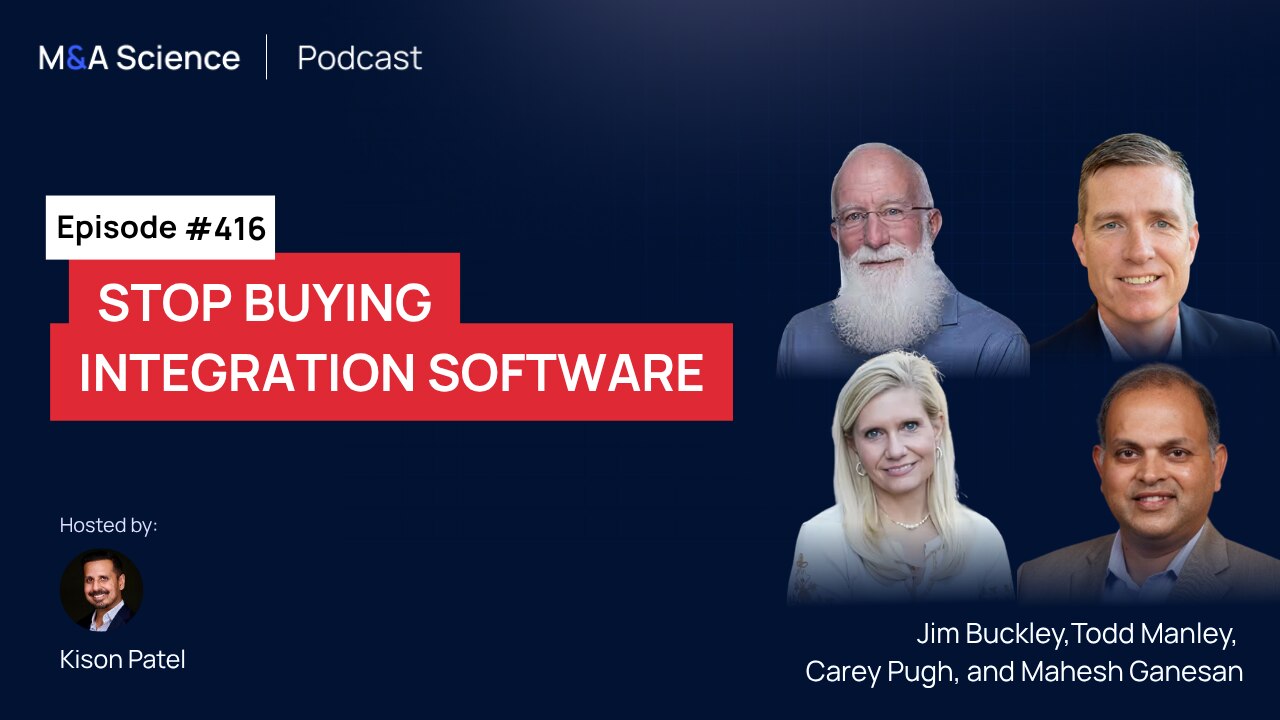
What Actually Works in M&A Integration | Intel, Coursera, Ansys & UKG

Jim Buckley, VP M&A Integration at Coursera | Todd Manley, VP of Corp Dev Integration at Intel | Carey Pugh is Sr. Director, M&A Corporate Integration at Ansys | Mahesh Ganesan, Sr. Director, M&A Integration at UKG

Don’t think of this as a product demo or a framework presentation. It’s just four operators who’ve run some of the most complex integrations in enterprise tech getting real about tools, AI, knowledge loss, and the discipline most integration teams skip.

 What You'll Learn

  • Why the diligence-to-integration handoff keeps failing and what actually fixes it
  • How to evaluate integration technology without getting sold on complexity
  • Where AI is genuinely useful in integration today and where it is not
  • How to right-size your integration effort across multiple simultaneous deals
  • Why knowledge loss is the biggest value leak in M&A and what to do about it
  • How to handle post-close direction shifts when the acquired team changes course
  • Why post-mortems matter and why most integration teams never run them

If you're running integration without a clear line between your workstreams and the original deal thesis, DealPilot has a structured integration planning frameworks built on how practitioners at Intel, Microsoft, and UKG actually run it, so you stop rebuilding from scratch every deal.

Coursera (NYSE: COUR) is an online learning platform serving enterprise, higher education, and individual learners globally. The company is currently integrating its acquisition of Udemy.

Industry
E-Learning Providers
Founded
2012

Intel (Integrated Electronics) is a global technology leader that designs and manufactures semiconductors powering computers, data centers, AI systems, and connected devices worldwide. Founded on innovation, Intel drives advances in processing, memory, and platform technologies that enable faster, smarter, and more secure digital experiences.

Industry
Semiconductor Manufacturing
Founded
1968

For more than 50 years, Ansys software has enabled innovators across industries to push boundaries with the predictive power of simulation. From sustainable transportation and advanced semiconductors, to satellite systems and life-saving medical devices, the next great leaps in human advancement will be powered by Ansys.

Industry
Software Development
Founded
1970

UKG is a human capital management and workforce management company formed through the 2020 merger of Ultimate Software and Kronos Incorporated.

Industry
Software Development
Founded
2020

Jim Buckley

Jim Buckley is VP of Strategy, Planning, and Operations at Omnissa, with deep M&A integration experience across enterprise technology. He previously served as VP of M&A Integration at VMware, where he led major integrations including Pivotal and Carbon Black, and has also held roles at Microsoft, PayPal, and Mentor Graphics. He has appeared on M&A Science to discuss integration-led diligence, keeping integration plans simple, and measuring success after close.

Todd Manley

Todd Manley is Vice President of Corporate Development Integration at Intel (NASDAQ: INTC), where he leads M&A integration work across complex technology deals. He brings 20+ years of experience across corporate development, post-merger integration, enterprise transformation, and business operations, with prior experience across companies including Cisco, HP, Symantec, and Marvell. He has appeared on M&A Science to discuss building a career in M&A, integration leadership, team dynamics, and the nontraditional path from IT and organizational behavior into corporate development.

Carey Pugh

Carey Pugh is the Sr. Director of M&A Corporate Integration at Ansys, where she leads strategic integration efforts for acquisitions. With over 15 years of experience, including leadership roles at Avalara and Cisco, Carey has successfully driven large-scale integrations, developed scalable frameworks, and implemented compliance programs for global portfolios. Known for her strategic vision and cross-functional collaboration, Carey continues to deliver impactful results in M&A.

Mahesh Ganesan

Mahesh Ganesan is Sr. Director, M&A Integration at UKG, a company formed through the merger of Ultimate Software and Kronos. He has been with UKG for 7 years and manages a steady acquisition cadence across a range of deal sizes. He uses enterprise ChatGPT for risk identification and integration planning.

Episode Transcript

Integration Philosophy and What Drives Deals

T.M.: I like to look at integration from the back forward. What does success look like, and then bring that forward into how the deal is being constructed and how people are thinking about the strategy. Doing that, you can quickly pick up on signals where there is either misalignment between how the business is thinking about the target, or how the target thinks they are going to come in and do great things. For me, the route to get there could be a circular journey or a straight line, but keeping the end in mind has always been the most interesting part. I approach it with an operator's eye, not a deal maker's eye.

M.G.: For me, it is all about the value drivers. I will say it is all about the people and culture, which is true, but at the end of the day, the value drivers are what really articulate why we are doing something, how we are tracking against it, and how we execute it. If you think you know people and culture in one part of the world, try doing a deal in another part of the world and you will learn so much. Value drivers connected to people and culture — that is the philosophy.

J.B.: Integration work has to create value. Everything you do in integration has to hang off the value chain somewhere. If it does not, it is wasted effort and probably wasted money. The other thing  and I have said this many times, is that it has to be simple. It is really hard to keep things simple, but if you do not, it self-complicates over time and you end up in a muddy pit where you no longer know where to go. You have to revert back to simple.

C.P.: Culture is paramount. The value drivers are critical, I agree, but if you do not have those cultural connections, you start losing the people who are enabling those value drivers. All of those value drivers can fall apart very quickly if you are not keeping a close watch on culture and how you are integrating your people.

Culture in Practice: Definition and Execution

T.M.: What is really harmful is when leadership talks about culture being important, but you realize it does not carry the same weight or responsibility you would hope for. They will say the right things, but are they walking the walk? In those situations you have to find someone else — either in the business or affiliated with the deal who may not show up on an org chart, but who is actually carrying the culture. Those are the people that need to be put on a pedestal for everyone to attain.

J.B.: Culture is always an interesting one. When I was at Microsoft, we did 99 deals in six years. Everybody worried about culture, everybody talked about it, and nobody did anything about it. Basically, the message was: we acquired you, your culture is lost, welcome to the board. It was kind of brutal. But it was also kind of true. How do you actually define culture? In almost every deal I have worked on, the definition seems to be different between the acquirer and the acquired.

M.G.: I try to break culture down into smaller chunks. What are the specific practices this organization does that keeps them together? Can we duplicate any of those? Not the entire culture in its entirety, but are there things they do periodically, specific events they host, ways they give back to the community, things that are very unique to them? We try to capture some of that as part of due diligence and then commit to executing on at least half of them. Instead of trying to boil the ocean and define culture completely, we implement some of these practices to maintain a feeling of continuity post-close.

T.M.: When I was at Cisco, we acquired Tandberg, a technology firm in Norway with about 4,000 people. They actually had a C-suite leader who was the Chief Cultural Officer. The business started in the 1930s or 40s around radio technology and, over time, made a major strategic pivot every 15 to 20 years. There was a lot of gravitational pull to honor where they had come from. This cultural leader stayed on through the first year of the acquisition to help settle things, and when she rolled off, she did a road show to everyone who had touched the deal or integration. It was a genuinely introspective story. They used a framework, something like a culture chasm curve, that mapped the emotional journey from deal announcement through Maslow's hierarchy of needs: do I have a job, am I getting paid, will there be food on the table? It was remarkable that they had someone dedicated to that inside the company.

C.P.: The size of the acquisition relative to the parent company obviously affects some of these cultural dynamics. But we are buying these companies for a reason. They clearly have something to offer. It is always imperative that we examine their cultural aspects and determine what we can learn from them. Are there areas where they could actually improve our own culture? That kind of thinking has to come from the top down, because going bottom up is very challenging. You have to get your leaders genuinely invested in it.

Execution Fundamentals: What Separates Good Teams

J.B.: My first deal was in 1999. I was the controller of a large division. It was remote, it was international, nobody told me what to do. My boss at the time said, figure it out, and just do not mess anything up. That mantra has stayed with me ever since. There was no documentation, no integration plan. I just dove in and tried not to screw anything up. I still have not lost that instinct. I know there is great technology out there right now, and I embrace some of it, but not all of it. I still look at everything through the lens of: is this going to add value over time, make us smarter, faster, and more efficient — or is this just going to be a $15,000 license that people may or may not use?

M.G.: The single biggest challenge I have had in the past is that many of the people involved in due diligence do not carry forward into integration. Yes, I am part of the same team across both phases, but a lot of people move on after due diligence, and the people who need to pick up on execution post-close are left without context. I used to make assumptions that due diligence leads would share what they had learned with their functional areas. That is inconsistent at best. Now I do not make assumptions. About midway through due diligence, when we know the deal is more likely to close than not, I go to half a dozen functional areas and sit down with their key leaders. I take the due diligence findings to that point and walk them through the why, the what, and what is coming, not to ask them for anything yet, but to set them up. I do this in leadership staff meetings, not just one-on-ones. The result is that when I go back to tap those teams for integration support, I already have the buy-in. And the leaders feel like they have been part of the process, not just asked at the last minute to give me two people.

T.M.: I have always been a firm believer that your deal will be better if you get integration listening in as early as possible in due diligence. For a long time, there was a false narrative around keeping the integration team out of the room because they might stop the deal. My job is not to stop the deal. My job is to make the deal better, to arm the team with the right questions and the right ways to think through things so we get to a better outcome. There is nothing worse than having the deal get done, thrown over the fence, and then discovering something fundamental that was never considered because integration was not in the room. The connective tissue between deal teams and functional leaders is critical. More organizations are putting this into practice, which is good.

C.P.: Having some of the same individuals involved from pre-close through integration has brought us a lot of success. So much information gets lost when you flip to a new team at close. But the other element that really stands out is working with the incoming leaders, preparing them for this new environment, the parent company culture, and the way things work. I have done a lot of coaching with leaders on how to approach certain situations, projects, and how to work with their employees during this transition. You can build repeatable frameworks, but there are always other human elements that have to be layered on top of them.

Technology, AI, and the Limits of Integration Tools

T.M.: I used a product 15 years ago that was too tech-heavy. It had too many knobs and dials  like sitting in front of a 64-channel mixing board. The constant complaint was that people spent too much time updating the tool instead of actually doing the work. The balance you have to strike is: where does the tool help keep you organized, keep cross-functional teams aligned, and highlight risks that are not getting enough attention? But do not approach it with a shiny new tool that pulls you away from what actually matters. I work with a deal professional who still uses a yellow pad and a pencil because sometimes someone will say something, and he needs to erase it and change it. I take a very critical eye now at any tool and ask: Does it actually help? The AI use cases that make sense are specific — contract review, customer go-to-market work. But how do you bring a whole integration program together, manage the messiness, and align cross-functional stakeholders? I do not think AI is past the early innings there yet.

M.G.: Tools and technology are supposed to support us. Trust but verify — that philosophy has not changed, and it is still valid in the AI world. I have embraced AI, but specifically in ways that give me time back. I take due diligence findings, recordings, and inputs from our sessions and run them through our enterprise ChatGPT. From there, I can generate serious risk logs, compare against prior deal theses, and get a sense of what to watch for in a specific transaction. The time I save on synthesis, I reinvest into the stakeholder conversations that require a human touch. I personally use AI for at least two or three things every day.

T.M.: One question worth raising — does your organization have a policy or level of trust around the AI tools you can actually use? At my organization, it is very tightly controlled. Even in exploring what is possible, I pay for personal licenses on some services just to stay educated.

M.G.: We do have a policy, and it has ramped up extensively. Developers have more access than I do, but through our Microsoft license I have Copilot and access to enterprise ChatGPT, which has been a window open on my computer every day for the past six months. It helps me as a coach and counsel  even just crafting presentations and it has genuinely given me time back.

C.P.: I use Copilot day to day. It is one of the approved tools we can use internally. Beyond that, I have been hesitant because of confidentiality concerns. But there is also a frustration I have had with integration tools more broadly: you put a lot of data in, and then you still end up in PowerPoint because you cannot get it out in the format you need. It became a cycle of not wanting to input more because you could not extract it usefully. Maybe AI tools can help resolve that eventually being able to generate outputs in whatever format you need — but that was a barrier I kept running into.

T.M.: We may be referring to the same tool. It would be interesting to hand that tool over to an LLM and ask it: " Tell me everything I could have learned or should have known from all the information sitting in here.”

J.B.: Way back at a conference board meeting, the Microsoft general manager I worked with was asked what platform Microsoft used to manage their integrations. He deadpanned completely not a smirk — and said: we use Word and PowerPoint. You would have thought someone dropped a rock through the ceiling. But that gets at the thread we are all talking about. What I am looking for, and what I currently use, is a single pane of glass: one place where all the due diligence information, all the workstream information, all the preliminary integration data, and the final integration plan are, with the ability to track everything. The challenge is gathering it all, because it gets randomized across sources. My rule is that if something exists somewhere other than that single source of truth, it does not exist in our world. I think there is a lot of great tech out there, but especially with AI, I do not think it is quite there yet.

Simplicity as a Strategic Discipline

J.B.:The CFO at Microsoft who started two weeks after I did — a New Zealander, former head of the New Zealand Rugby Union, so he had an edge to him — we presented our first deal to him with a 50-page deck, four-color, micro font. He said: I never want to see a deck from you that is more than five slides, five bullets per slide, five words per bullet. If you cannot do that, we are not talking about the deal. We were stunned, because simple is genuinely hard. But I still live by that. If you start with 20 slides, 20 bullets, 20 words per bullet, no executive is going to read it. People get confused and do not know what to do next.

T.M.: Jim is right. If you cannot articulate something concisely and pointedly, you are going to lose people. But it is also a great tool for stakeholder alignment. When you are building consensus across leaders, being able to distill the message down to what is in it for them — quickly, clearly — is as useful going sideways and downward as it is going up. Practitioners should spend real time on effective communication and getting to the heart of things.

M.G.: I am very careful to frame these conversations as: here is information for you to be aware of. I am not asking for permission, because if I do that I will never close a deal. It is a delicate balance between sharing enough to get buy-in at the appropriate level and, most importantly, securing the resources to support integration activities.

Right-Sizing Due Diligence Across Multiple Deals

T.M.: I look at it like a sales pipeline. You have deals at different stages, and you have to map where the right people need to be at each stage. If you are overwhelmed in integration and thinly staffed at the front end, you need someone in that leadership chain to unhitch from the current train and get involved earlier. It is the lifecycle management of where people are. It is a good problem to have, but you have to keep your finger on the pulse to make sure people are not burning out. When you do not have dedicated full-time teams and you are running a National Guard model — people doing their day job and integration work simultaneously, you have to be very protective of them.

C.P.: For core functional areas: HR, go-to-market, finance — it is critical to have dedicated resources. If people are rotating in and out, you lose tribal knowledge, and that is hard to get back. Spending that time getting new people up to speed takes away from the actual integration work. We have always made a point to protect those core areas. Others may flex depending on deal volume, but having those dedicated resources in the right places has made a real difference.

M.G.: Many organizations ask themselves: do I really want to invest in those resources? But if you have an inorganic growth strategy and you know you are going to be doing deals at a steady clip, you absolutely want to invest in those three, four, or five core functions with dedicated people. Otherwise, you will spend far more time trying to integrate, and you will lose efficiencies from deal to deal. You cannot have 20 percent of the organization in integration full time, but protecting the key functions Carey described is a strong starting point.

J.B.: At Microsoft, integration leads ran confirmatory due diligence and technical due diligence, so they carried all that knowledge through to integration planning and then into operationalizing the business within Microsoft. That philosophy is not widely held. Corp dev typically runs due diligence, and integration runs integration. But you do not need to know everything to do something. People in due diligence think they need to know everything about the company being acquired. You do not. What you need to know is what is relevant to the strategy and the value drivers. Everything else can be discovered later.

T.M.: There is nothing worse than running a diligence call, bringing someone in, and then watching them go down a rabbit hole on something that is not critical. You have to step on their toes sometimes and bring the conversation back. You have to manage their feelings afterward and pull them aside to explain why. But it has to be done, because time is limited and the focus matters.

J.B.: I have had that exact conversation. Someone will say 'I feel like we should...' and I will say: what you feel is not relevant to the work we are doing right now. It is a nice-to-have somewhere else, but not in this process.

Managing Post-Close Autonomy and Integration Shifts

T.M.: If you are going through a situation where a target initially does not want any part of the integration and then flips to wanting it — that is better than the reverse. But at the end of the day, you have to be flexible. There will be efficiencies in bringing the business together, and you have to identify them. Some things will be unique, maybe something in engineering or product that is genuinely a crown jewel, and you are not going to touch it. But you cannot tell me that the way they run payroll is a key differentiator. Payroll is payroll. You have to call it as you see it and have the courage to do that. If you do not, you will end up in a meandering integration with no clear endpoint.

M.G.: For sales integration specifically, the thing we have learned the hard way is to make absolutely sure you have an executive sponsor and sales leader buy-in on the fundamentals: What is the quota structure? What is the budget? What is the model? That clarity trickles down into how you expect sales leaders to drive behavior post-close. Rules of engagement, territory ownership, double-call policies, overlay versus direct roles — all of it follows from what you have aligned at the top. Getting that sign-off from the executive sponsor and sales leaders early allows you to translate everything into a specific sales integration plan. Yes, the seller still has to sell, but having that structure in place from the start is critical.

Responding to Sudden Changes in Integration Direction

M.G.: The first question is always: why did the change happen? Was it something discovered post-close? Was it a miss in due diligence? Is there a dramatic shift in market conditions? Each of those requires a different response. If there is a specific financial impact, then how does that ripple into the integration plan? Were we planning to launch an integrated product in nine months, and now do we have supplemental resources to do it in three? Understanding the cause of the change is step one. Reacting to it correctly is step two, and that means figuring out whether you need a faster go-to-market, a change in seller incentives, or a defensive competitive play.

C.P.: Most of the shifts I have seen happen because we uncovered something we did not anticipate, or we are not tracking to our financial goals. It always comes back to change management. That is a genuine passion of mine alongside culture. We have a lot of emphasis on it, especially in our ongoing integration between ANSYS and Synopsys. The work is constantly about determining whether the needle has moved, how we move with it, how we adjust people's perceptions, and how we communicate effectively. A lot of it comes down to making sure people are informed about why the change is occurring and getting everyone realigned to the new direction.

J.B.: In my experience, if something changes in integration planning or direction, it is usually because something changed in the strategy that was not well vetted to begin with. A change in strategy almost always leads to an outcome that is less than desired.

Where Value Actually Leaks in M&A Integration

T.M.: Tribal knowledge. If you are not capturing it and keeping it within the organization, you miss a huge opportunity. People will come and go, but if you can write things down and leave some institutional memory behind, it pays off. I was at a conference where someone was describing a technical problem they were trying to solve. I had worked at that company a decade earlier, and I was pretty sure we had already solved it. I talked to them afterward and said: we figured that out 10 years ago, but it sounds like the knowledge has been lost. Here is who you need to go talk to. That kind of knowledge — the bubble gum and duct tape stuff — does not always get written down or pulled out of people's heads, and that is a serious leak.

M.G.: For me it is about the acquired company's people. You need to know who the key players are, and not just retain them with a bonus plan. You need to genuinely understand whether they feel like they have a path ahead. If they do not feel that way, they will leave, and a lot of the value you were counting on leaves with them. There are real dependencies on acquired company leadership and key team members, and if those people are not engaged and motivated to stay, you are leaking value from day one.

J.B.: We have lost the art of the post-mortem. Capturing what happened and how it relates to execution against the integration plan matters enormously. The integration plan is built in support of the value drivers. The value drivers are built in support of the strategy. As long as that linkage stays intact and consistent, you are in good shape. When it gets fragmented, you have lost the secret sauce for the deal.

T.M.: I would add the pre-mortem to that. Bring the teams and leaders together before the deal closes and ask: what are all the things that could go wrong? It gets everyone mentally prepared for integration strategy changes, red flags from diligence, things that surface post-close. It is not always an easy conversation to have, but it is far better to go in with eyes wide open than to assume it is going to be smooth sailing.

C.P.: On post-mortems: one thing we have done is run them in shorter intervals rather than waiting until everything is complete. We address specific recurring events as they happen. That has worked really well for us.

Show Full Transcript
Collapse Transcript

Recent M&A Science Podcast Episodes

How Strong Partnerships Lay the Groundwork for Successful Acquisitions
How M&A Turns a Chemical Company Into a Tech Business
CPG Exit Strategy: How to Build a Consumer Brand That Strategics Will Actually Buy | Keith Levy Part 2
M&A SCIENCE IS SPONSORED BY

M&A Software for optimizing the M&A lifecycle- pipeline to diligence to integration

Explore dealroom

Want to wear your M&A expertise?

Check out the M&A Science store.