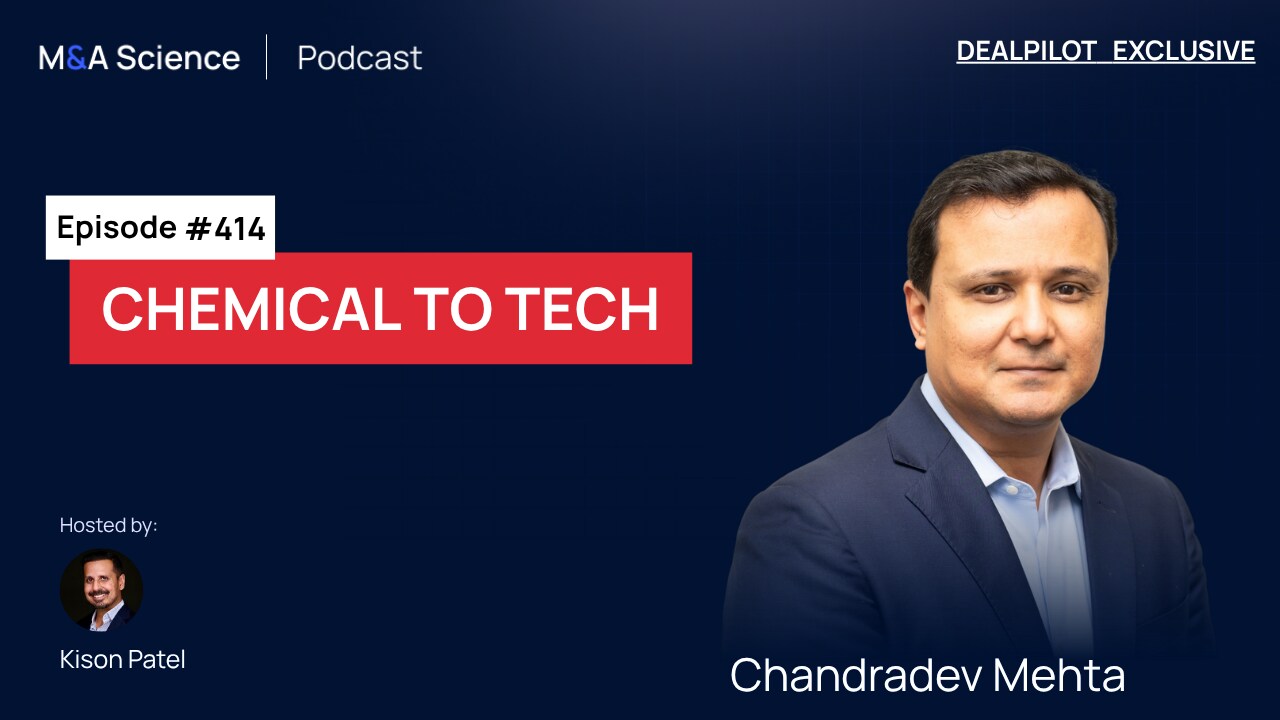
Hexion Inc. is a global chemical company specializing in thermoset resins used in building and construction, wood, and industrial markets. The company is expanding into technology-enabled services, including a recent acquisition in the AI and MarTech space, as part of a strategy to move from product-only sales toward a chemistry-as-a-service model

Chandradev Mehta
Chandradev Mehta is Senior Vice President of Strategy and Business Development at Hexion Inc., a global specialty chemicals company, where he leads the M&A function as a core driver of business model transformation. He spent years leading corporate development and strategy at Honeywell, one of the most active industrial acquirers in the world, before bringing that operating experience to Hexion's transformation agenda. What makes Chandradev's perspective distinct is that he's not just executing deals but he's using M&A to answer a harder question: how does a company built on chemistry become a company driven by technology? That question is sitting on the desk of every industrial CEO right now, and Chandradev has real experience navigating it.
Episode Transcript
From Investment Banking to the Principal Side
My background is split pretty evenly. I spent about 10 years in investment banking, working with clients on their capital needs — but more importantly, on M&A and strategic advisory. I worked in New York and in Asia, so I got exposure to cross-border M&A and the full range of strategic drivers that push companies toward deals.
For the last 10 years I've been on the corporate development side, running strategy and corporate development at companies like LyondellBasell, Honeywell, and now Hexion, where M&A has become a tool to accelerate our strategic focus and shape the portfolio.
Being on both sides gives you a certain perspective. In banking, you are an advisor — you're guiding and supporting clients. On the principal side, you are making things happen. And the big realization I had moving to the principal side is that you can execute a really strong deal, get a really good price, but unless you integrate that transaction well and create the synergies you built into your thesis, everything else is irrelevant. So the focus shifts to strategy, value creation levers, and how you accelerate them to achieve the outcomes you want. That's what excites me about this role.
Using M&A to Transform a Chemical Business
At Hexion, we are a chemicals company — but we are transitioning toward a technology-focused, chemistry-as-a-service model. About a year and a half ago, we acquired a business in the AI and MarTech space. We are now in the process of integrating it and figuring out how we bring the world of chemicals together with the world of technology to create more value — not just for us, but more importantly for our customers.
That acquisition is the clearest example of what I mean when I say M&A is a tool to accelerate strategy. The goal is chemistry as a service, and the deal is the mechanism to get there faster than we could on our own.
Building the Deal Thesis From the Ground Up
The commodity chemical sector is challenging. You are always a price taker. You can differentiate on product, and we continue to do that, but there is a ceiling to how far that takes you. When we started thinking about M&A as a strategic tool, the question became: what does a technology-enabled chemicals business actually look like, and how do we get there?
The answer came from two directions. The first was customer conversations. Our customers in building and construction are focused on efficiency, throughput, and cost management. When we looked at our current portfolio, we could only do so much. But if you layer in technology — predictive analytics, agent-based AI tools — suddenly the offering becomes something much more meaningful to them.
The second direction was internal. We looked at what we could build ourselves, what we could acquire, and what we could accomplish through a partnership. It became a genuine build versus buy versus partner analysis. Building from scratch takes time, carries commercialization risk, and delays your go-to-market. Buying a business that is already commercialized, or close to it, de-risks a significant part of the equation and gets you further, faster. When we found a company that aligned with what we were trying to do, that had already penetrated the space, and where combining our domain knowledge with their technology toolkit would accelerate both sides, the case for acquisition became clear. One plus one equals four, not just two.
Build Versus Buy Versus Partner
Every opportunity has to be evaluated on its own merits. There are situations where building makes more sense — when you have the core capabilities, when there is no actionable acquisition that truly fits, or when time is not the critical variable. The easiest answer is often to build it yourself because you control the outcome from the ground up. But it takes time, and there is always a risk of not reaching commercialization.
Buying a business that is already developed, or nearly so, changes that risk profile significantly. You are already more than halfway to market. For us, speed to market was important, and when we found an opportunity that met most of our requirements, we knew we could enhance their product and be a better owner of that business than if we had built it ourselves.
Partnerships are valuable in a different way. We have actually put several partnerships in place with customers to drive adoption and co-development. For a product that is relatively new in the marketplace, that kind of joint learning is the right model. You can test each other, grow together, and co-develop something that is genuinely attuned to customer needs — rather than selling them a solution and hoping it lands. We are also partnering with OEMs, system integrators, and sensor-space players, because the ecosystem is multifaceted. Reaching the end user is only one part of the equation.
What Chemistry as a Service Actually Means
Traditionally, all we do is sell resins into the marketplace. Chemistry as a service is a fundamentally different model. You are not just providing a product — you are helping customers make their operations more efficient, grow their top line, and manage costs more effectively. You become a partner in their operations rather than a supplier to their procurement team.
That shift creates an aftermarket tail with the customer. It allows us to monetize our installed base better, engage more consistently, and build a much deeper relationship. And because we are one of the largest players in the sector, we understand the customer set in ways that a pure technology provider cannot. That is our edge. A pure tech company can bring tools but lacks the domain knowledge. Our competition can bring domain knowledge but lacks the technology. We can bring both, and that combination is genuinely difficult to replicate.
The business model implications are real. Customers are not used to paying for a service today — they are used to paying for a product. Part of the work is demonstrating that value clearly enough that they are willing to make that shift. That is exactly why the partnership model matters during adoption. You are not walking in and saying, "This is what the service costs, take it." You are working with customers to jointly develop a model that creates value for both sides. That kind of co-development builds trust and makes the pricing conversation much more grounded in actual outcomes.
Sourcing Deals With a Push and Pull Model
Our deal sourcing has a multi-pronged approach. On the pull side, we go directly to customers and show them what we can bring to the table. They have to feel the pull — they have to want this. On the push side, we work with OEMs and partners to say that enabling this service alongside their products will differentiate them in the marketplace when they compete for contracts. Both sides are necessary. Working only one angle is not enough.
Regional dynamics also come into play. In Asia, the market is crowded with local and smaller players, so the approach has to be more localized. In Europe, you are dealing more with larger, family-owned businesses, where partnerships are often the entry point. In the US, end users are more likely to drive decisions directly. Those differences shape how you source and approach deals in each market.
We also get inbound flow from bankers on two tracks. The first is add-on services or software that could attach to what we are already building. The second is core portfolio additions — chemical businesses that can be further enabled by AI and software down the road. Both are worth evaluating. The former accelerates our service layer. The latter expands the foundation that the service layer runs on.
What Makes a Banker Actually Useful
Having been on both sides, I have seen a wide range of how bankers approach a pitch. The thing that separates the good ones from the rest is not the size of the deck — it is the depth of the thinking.
Some bankers come in with 50-page presentations listing 20 targets. That is just throwing everything at the wall. The best bankers come in with three ideas, and those three ideas actually make sense for your business. They have thought through why those targets fit your strategy. More importantly, they have an angle into those ideas. Everyone knows the same companies. What differentiates you is whether you understand how the management team thinks, whether the board has an openness to a deal, what the timing dynamics actually are. Without that, it is hard to stand out.
The best bankers I have worked with also push back. They challenge your thinking in a constructive way — pointing out something you have not considered, or framing a risk you have been too comfortable dismissing. That is valuable. I am open to being challenged, and a good banker knows that. If I were going back to banking, I would pick eight to ten companies and go extremely deep on them. Not because they are on a list, but because I have a genuine understanding of their business, their leadership, and the space they are operating in. You cannot be a trusted advisor to twenty companies. It is not possible. So you make bets, and you make them count.
Valuation Discipline and Knowing When to Walk
When I evaluate an opportunity, I anchor on what I call must-believes — the convictions that have to hold for the deal to make sense. After the IOI, you test those. Can I still get there? Can I mitigate the risks I identified? Are my value creation assumptions still intact? If the answers keep moving toward yes, that is a deal worth continuing. If they are still uncertain or the risks are not manageable, that is a deal to pass on.
From LOI to close, you are validating execution. You are not just confirming the thesis — you are proving that you can actually deliver on it. Integration planning should start right after the IOI, during diligence. By the time you get to a binding bid, you should have a clear integration model, defined value creation drivers, a path to achieving them, and a realistic timeline. If you are not there by that point, you are already behind.
In a competitive process, the conviction has to be even stronger. You need to know that this is an asset you can genuinely make a difference on — one where your synergies are real and your ability to capture them is credible. Discipline matters enormously in those situations. I have seen deals where people get too close, too emotional — they do not want to lose the deal over one or two terms, and that is when you overpay or take on risk you cannot manage. Having clear walkaway points and sticking to them is not a weakness. It is the discipline that protects the value of the deal.
At the end of the day, all of it comes down to risk allocation. Getting to a win-win means both parties feel the value is fair and the risk is appropriately distributed. If that balance is not achievable, the deal should not happen.
Environmental Risk in Chemical Deals
In chemical deals, environmental liability is always near the top of my checklist. You need to understand what you are buying, and in many cases, some of the risk is known, some is not. There are situations where the target has not done full environmental testing, so there is genuine uncertainty about what is there. The question becomes: do you want to know? And if you find something, who bears that risk?
There are different structures that work. You can do a sliding scale, you can cap exposure, you can negotiate indemnification. The right answer depends on the deal, but what matters most is getting that question answered early. Who is best positioned to manage this risk going forward? In some cases, only the buyer can actually mitigate it — the seller cannot. When that is true, the buyer has to price that reality in, not discover it after close.
Small Deals Are Harder Than They Look
People often assume that smaller deals are simpler. In my experience, they are frequently harder to execute than larger ones. In a large deal, everyone is focused. Everyone is trying to find a solution. In a small deal, especially at a large company, the transaction is essentially a rounding error from a portfolio standpoint — but for the buyer, it may be one of the biggest deals they have ever done.
I worked on a transaction where we were selling a small business out of our portfolio. For us, the priority was getting it done and managing our risk exposure. For the buyer, every single dollar counted. They knew our business better than we did, which immediately put us at a disadvantage in the negotiation. I had to quickly get up to speed, understand the dynamics, and reprioritize. We ultimately decided that risk management was more important than maximizing value, and we structured the deal accordingly. It still took about six months, which is a significant resource drain for what was, on our end, a relatively small transaction.
The broader lesson is that when a deal is small relative to your total portfolio, it is hard to get the attention and focus it deserves. People mentally deprioritize it. But if you do not pay attention, you either leave value on the table or take on risk you did not intend to carry. Someone has to own it, and they have to treat it with the same rigor as any other deal.
Joint Ventures Require a Different Mindset
JVs are their own category. One thing I have learned is that when you are doing a joint venture, you often need to negotiate the divorce before you negotiate the marriage. It sounds counterintuitive, but it is equally important — how you unwind the structure if things do not go as planned is something you need to have resolved before you sign anything.
Governance becomes the central negotiating point. Who does what, how decisions get made, who has veto rights, what happens when the parties disagree — these all need to be defined clearly. Funding is another major variable. What if one party wants to fund additional growth and the other does not? What happens to equity ownership in that scenario? What each party brings to the table, what their long-term motivations are, whether they are looking for cash generation or operational involvement — all of that shapes how governance gets structured. There is no single JV structure that works universally. But the governance terms are always among the most keenly negotiated points in the entire transaction.
Execution Principles and Stakeholder Alignment
My core principles for executing M&A come down to three things. First, the deal has to fit the strategy. You need clarity on your must-believes, your key considerations, and your reasons for doing the deal or not. Second, you have to stay disciplined on execution — paying the right price, negotiating the right terms, and having a well-defined integration plan. Third, integration itself needs to be treated as a first-class workstream, not something you figure out after close.
Alignment is the execution challenge most people underestimate. This is not a process you run in isolation and then present to the team at the end. You have to bring people along continuously — commercial, supply chain, procurement, finance, functional leaders. You test your thesis with them. You push each other. You pressure-test the value drivers and the timeline together. In larger transactions, the board becomes part of that conversation too. If the board only hears about the deal at the final approval stage, you have already created unnecessary risk. By the time you are asking for sign-off, they should already be mostly there.
Naming an integration leader early is critical. They need to understand the deal, believe in the thesis, and own the integration plan — not receive it as a handoff after close. When someone owns it from the beginning, they are accountable for delivering on it. That accountability is what drives execution after the deal is done.
IT and systems integration deserves specific attention. I have seen companies that had acquired dozens of businesses and never fully integrated their systems — ending up with multiple versions of SAP running in parallel. That kind of technical debt compounds over time and eats into your ROI. You need to identify what investment the IT integration will require early in diligence, not after you have already committed to a price.
Getting Deals Actionable
A lot of deal sourcing comes down to timing and cultivation. You can have all the right thesis elements in place and still not be able to move forward because the seller is not ready. What you can control is how consistently you show up.
Regular engagement with potential targets is a core part of corporate development work. You share your thinking, your thesis, how combining the businesses would create value, and — especially important for family-owned businesses — how you plan to maintain their legacy. Then you show them the progress you are making. You keep coming back. When they decide the time is right, you want to be the first call they make.
Trust is the foundation of all of it. Sellers, especially at family-owned businesses, often assume that a large acquirer is going to come in and tear everything apart. Overcoming that assumption takes time. The best proof is track record — showing examples of acquisitions you have handled well. If you do not have that, you are asking them to take your word for it, which takes longer to earn. You have to break bread with people, engage seriously, and demonstrate through your behavior over time that you mean what you say. Cross-cultural deals make this even more complex. In Germany, some counterparts simply want to deal with Germans. In China, you need Mandarin speakers at the table. You have to be willing to adapt your approach to the people you are trying to reach.
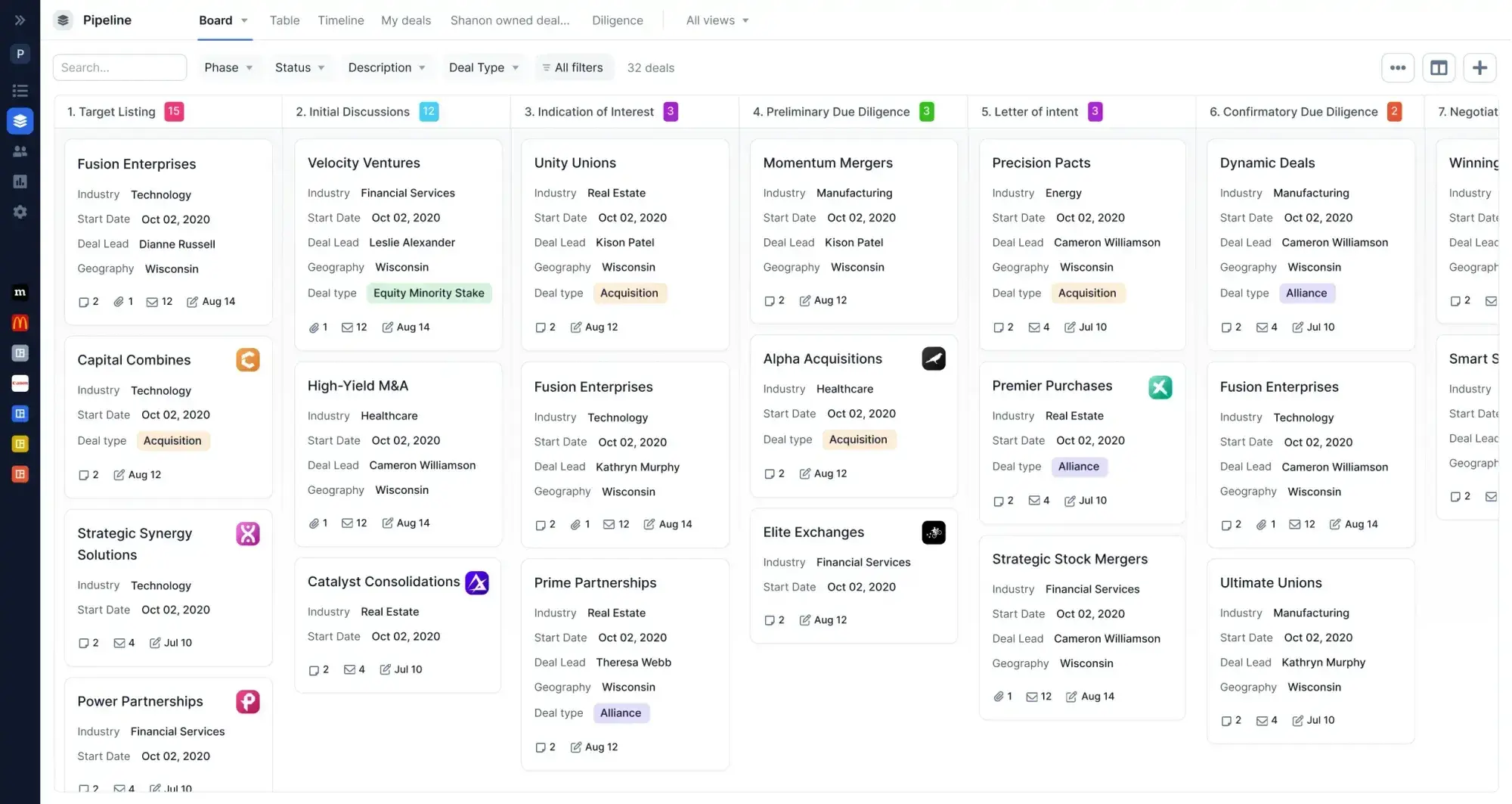
M&A Software for optimizing the M&A lifecycle- pipeline to diligence to integration
Explore dealroom

Want to wear your M&A expertise?
Check out the M&A Science store.