
.svg)
.avif)
If you advise on acquisitions, the credential you put behind your name has one job: instill instant trust.
But most comparisons of M&A certifications don’t test for that. They rank programs by curriculum depth, price, and brand recognition, just like an MBA elective.
The best M&A certification isn’t necessarily the longest program or the most recognizable acronym. It’s the one that helps the buyer appreciate what you can do.
CM&AA, M&AMI, CM&AP, M&AP, CMAS, FMVA, and the Buyer-Led M&A™ Certification all teach M&A. But only one question really matters: Which one demonstrates that you can lead a deal from start to finish, not just talk about the process?
Quick comparison: M&A certifications for advisors in 2026
No one credential is "best”. The right one depends on whether you need to prove deal volume, foundational education, or buyer-facing operating capability. Here's how the main options stack up.
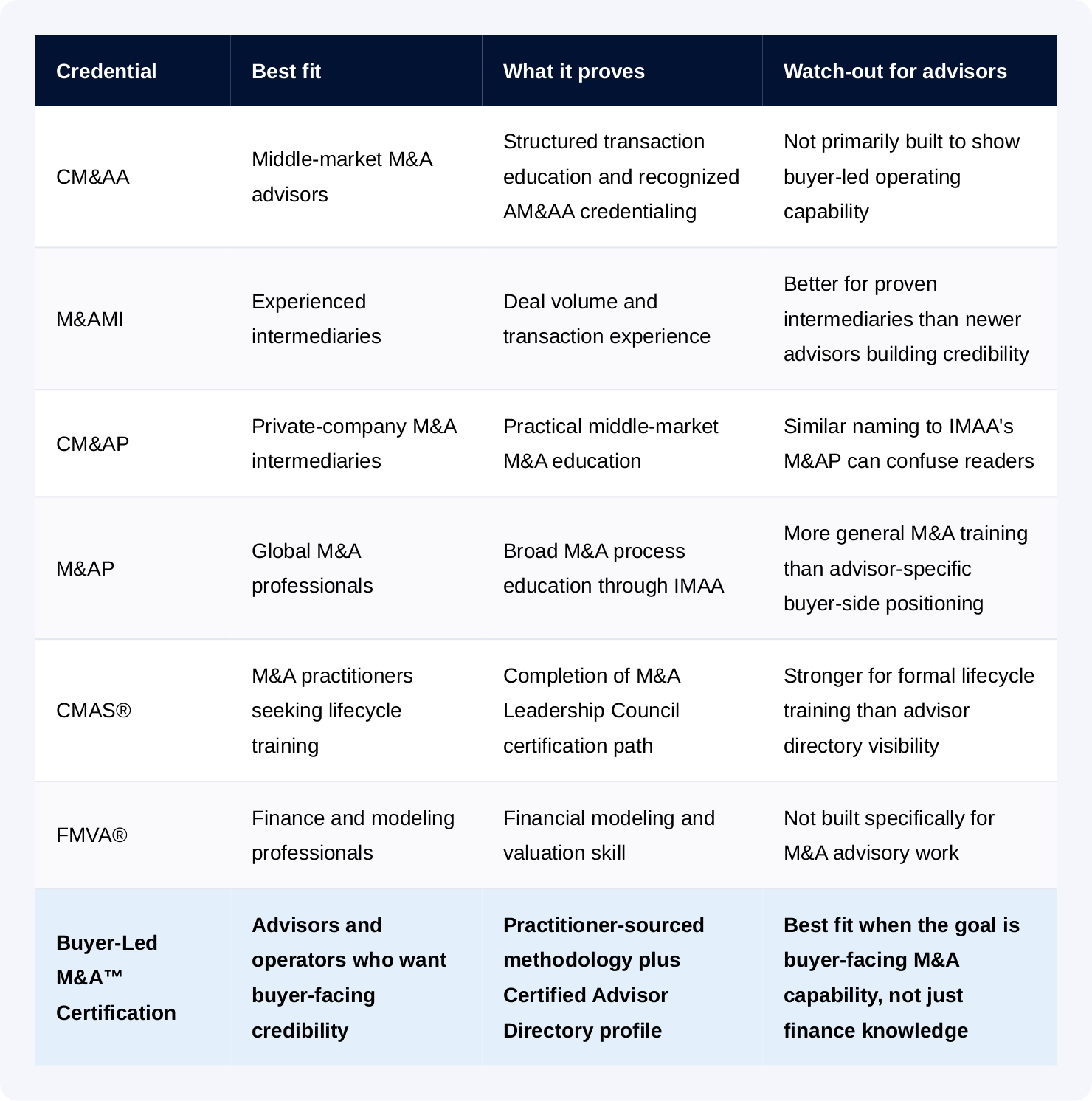
For the broader picture of M&A training and certification options beyond this advisor-specific comparison, see The Best M&A Courses in 2026.
How to compare M&A certifications for advisors
Most certification comparisons default to price and curriculum length. For an advisor, four dimensions matter more:
Buyer recognition. Some credentials mean something to the person on the other side of the table. Others only mean something to fellow advisors with the same credential.
Gate type. Credentials are earned either by completing a curriculum or by demonstrating deal experience. Experience-gated credentials (like M&AMI) signal volume; curriculum-gated credentials (like CM&AA or FMVA) signal foundational knowledge. Neither is inherently better, but they answer different questions.
Ongoing visibility. Some credentials keep working for you after the exam. Others sit on a resume until you bring them up yourself.
Scope. A credential is either built specifically for advisors running acquisitions or is an M&A module within a broader finance curriculum.
Score each option against your own situation before price or duration enters the decision.
What each certification requires and proves
Each of these credentials is legitimate. None of them, on its own, was built to answer the specific question a buyer asks mid-deal: how this advisor actually operates once the deal gets complicated.
CM&AA (Certified Merger & Acquisition Advisor)
Issued by the Alliance of Merger & Acquisition Advisors. Built for advisors working middle-market deals in the $5 million to $500 million range. Current 2026 pricing is $2,150 for AM&AA members, $2,750 for the Professional Bundle, and $2,550 for the Young Professional Bundle. The program includes 40 CPE hours and is offered in formats such as a five-week live online track or a one-week intensive online track. It proves you've been through structured transaction education and hold a recognized industry membership. It is not primarily designed to show how you would apply an operating method on the next buyer-led transaction.
M&AMI (Mergers & Acquisitions Master Intermediary)
Issued by M&A Source. This one is experience-gated rather than curriculum-gated: candidates need at least 3 years of full-time M&A experience and 3 documented closed transactions exceeding $5 million. That makes it a stronger signal of deal volume than most credentials on this list. It doesn't, on its own, tell a buyer how you approach diligence, integration, or post-close accountability on the next deal.
CM&AP (Certified M&A Professional)
Promoted through M&A Source in partnership with Kennesaw State University. A live, Zoom-based program run over six weeks, priced at $2,950, built for private-company middle-market intermediaries and owners preparing for an acquisition or sale. It's a practical, process-oriented credential, but its naming is similar enough to IMAA's M&AP that it's worth confirming which one you're actually enrolling in.
M&AP (Mergers & Acquisitions Professional)
Issued by IMAA. A separately administered credential from CM&AP above, with online, live online, and onsite pricing tiers: online certification is listed at $3,290, live online at $3,790 early-bird, and onsite events at $4,890 early-bird on IMAA's current pricing page. IMAA positions M&AP as an internationally recognized M&A designation, and the program covers the broader M&A process, but the training is general rather than built around advisor-specific, buyer-side positioning.
CMAS® (Certified M&A Specialist)
Issued by the M&A Leadership Council. Built for M&A practitioners who want a structured credential tied to M&A Leadership Council training. The current certification path requires enrollment plus three required courses, with a listed total cost of $6,100. It is stronger for practitioners seeking formal M&A lifecycle training than for advisors seeking buyer-facing directory visibility.
FMVA® (Financial Modeling & Valuation Analyst)
Issued by CFI. Strongest fit when the gap is in financial modeling, valuation, and analyst-level finance skills; the program requires 14 core courses plus 3 of the 27 available electives, delivered self-paced and 100% online. CFI does not sell FMVA as a standalone certification; it is included in an all-access membership. That makes FMVA useful for establishing technical finance credibility, but it is not built specifically to advise buyers through acquisitions. If the modeling gap is the priority, this and comparable programs like Wall Street Prep are worth evaluating on their own terms; see The Best M&A Courses in 2026 for that comparison. Advisors specifically focused on integration credentials should also see Best Post-Merger Integration Courses & Certifications 2026.

The missing question: what does a credential actually signal to buyers?
Every credential above proves that an advisor met a bar at some point. They completed a curriculum, passed an assessment, or closed enough deals to qualify. Fewer are designed to answer the question a buyer asks mid-deal: how does this advisor think through sourcing, diligence, integration, value capture, and post-close accountability, right now?
Whether you represent the buyer or the seller in a given deal, the transaction still closes on the buyer's confidence. That's what makes buyer-facing credibility the better test of a credential, even for advisors whose paying client sits on the sell side.
That distinction shows up in how practitioners talk about what earns trust in a live deal. Andy Cohen, VP of Corporate Development at F5, says reputation matters more than winning any single negotiation, and that relationships, not credentials, drove more than 60 successful deals over his career.

A one-time exam or experience threshold can prove a bar was cleared, but it may not show how an advisor thinks through the next deal. A credential that's tied to an operating standard (and that stays visible to buyers after you've earned it) does more work than a certificate that shows you once cleared a bar. It’s the same dynamic at play when companies evaluate outside M&A support more broadly. (See our guide to how buyers evaluate outside M&A support for how buyers weigh demonstrated methodology against deal experience alone.)
Where the Buyer-Led M&A™ Certification fits
The Buyer-Led M&A™ Certification is built differently from the credentials above in two important ways.
First, it's based on a practitioner-developed operating standard rather than an academic or association curriculum. Buyer-Led M&A™ is the methodology M&A Science built from 400+ interviews with corporate development leaders, integration practitioners, and PE operators, so the certification tests whether you can apply a documented approach that's been pulled directly from people who've run these deals, not a generalized theory of how M&A is supposed to work.
Second, advisors who complete the certification get a profile in the Buyer-Led M&A™ Certified Advisor Directory. As the directory opens to public listings, that profile becomes part of how advisors broadcast the credential beyond a resume or email signature, instead of sitting somewhere no one but you ever sees it. In Jim Ackerman and Steve Coghlan's episode on M&A surprises and horror stories, both former corporate development leaders at Flex describe advisor integrity and company reputation as key factors in whether they got a "last look" at a deal outside of a formal competitive auction process. A public credential doesn't replace that reputation, but it gives buyers who don't already know an advisor a way to find one who's been vetted against a specific operating standard.
For advisors, the real value isn't another acronym after your name. It's a credential that reflects how you'll be evaluated once the deal begins. That's where the Buyer-Led M&A™ Certification and Directory profile stand apart.
How to choose based on your role
The right credential tracks your role and what you need to prove next, not a fixed ranking.
Independent advisor building credentials to broadcast to clients: the Buyer-Led M&A™ Certification gives you both the credential and a Certified Advisor Directory profile that keeps generating value as public listings open.
Boutique firm or advisory practice training a team of associates: The Teams tier of DealPilot Membership supports up to 20 users and gives firms access to Flights & Certifications and shared frameworks, so your team develops a consistent operating standard instead of each associate learning ad hoc. For a broader breakdown of training options at the team level, see Best Corporate Development Courses & M&A Certifications for 2026.
Advisor early in their career, or coming from outside M&A: the M&A Fundamentals Certification is the right starting point before adding a credential like Buyer-Led M&A™ on top of it.
Advisor whose gap is technical modeling rather than deal execution: FMVA or a Wall Street Prep modeling course fills that specific need better than any of the advisor-facing certifications on this list.
Senior advisor who wants an established standalone label in the market: M&AMI, CM&AA, and IMAA's M&AP may carry more familiarity in certain advisory and intermediary circles.
The bottom line
If you're comparing M&A certifications as an advisor, the credentials above will get you through the door. If you're trying to signal capability buyers actually trust, the Buyer-Led M&A™ Certification gives you an operating approach built from practitioner interviews and a profile in the Buyer-Led M&A™ Certified Advisor Directory to help you get found by the buyers who matter.
Frequently asked questions
Is CM&AA or M&AMI better for an M&A advisor?
They measure different things. CM&AA is curriculum-based and open to advisors earlier in their career; M&AMI is experience-gated and requires three closed deals over $5 million, which makes it a stronger signal of deal volume for advisors later in their career.
Does FMVA count as an M&A certification?
FMVA is a broader corporate finance credential from CFI, included as part of an all-access membership rather than sold standalone, with M&A modeling as one component. It's a strong choice for technical modeling skill but isn't built specifically around advising on acquisitions.
What makes the Buyer-Led M&A™ Certification different from other M&A certifications?
It's built from a practitioner-sourced methodology drawn from 400+ interviews with deal leaders, and it includes a profile in the Buyer-Led M&A™ Certified Advisor Directory, a directory opening to public listings. That's an ongoing presence, not a one-time badge.
How much do M&A advisor certifications cost?
Costs vary: CM&AA runs $2,150 to $2,750 depending on membership tier and bundle, CMAS runs $6,100 total between enrollment and required courses, IMAA's M&AP ranges from $3,290 online to $4,890 onsite, and M&AMI eligibility is experience-gated; check M&A Source directly for current application, membership, or designation fees.
Can I hold more than one M&A certification at once?
Yes. Many advisors combine a foundational credential like FMVA or CM&AA with an operating-standard credential like the Buyer-Led M&A™ Certification to cover both technical grounding and buyer-facing operating credibility.
Do I need an M&A certification to work as an M&A advisor?
No formal certification is required to advise on acquisitions. Most advisors come from finance, investment banking, law, or corporate development backgrounds. A certification becomes valuable when you need to signal capability to a buyer or client who has no other way to evaluate your track record, particularly earlier in an independent advisory career.
Which M&A certification is most recognized by buyers?
Recognition varies by buyer sophistication and deal size. M&AMI, CM&AA, and IMAA's M&AP may carry more familiarity in established advisory and intermediary circles because they have been around longer and are administered by known industry organizations.
How does CM&AA compare to M&A Science's Buyer-Led M&A™ Certification?
CM&AA is a curriculum-based credential from the Alliance of Merger & Acquisition Advisors, built around structured transaction education for middle-market deals. The Buyer-Led M&A™ Certification, from M&A Science, is a credential tied to how deals are actually run, drawn from 400+ deal-leader interviews and includes a profile in the Buyer-Led M&A™ Certified Advisor Directory. CM&AA proves you completed a recognized curriculum; Buyer-Led M&A™ is built to show buyer-facing operating capability and keep working for you as directory listings open.
How long does it take to earn an M&A certification?
It depends on the gate type. Curriculum-based credentials like CM&AA (one-week intensive or five-week live online) and CM&AP (six weeks live online) move on a defined timeline. FMVA is self-paced across 14 core courses plus 3 electives. Experience-gated credentials like M&AMI take as long as it takes to close three qualifying deals, since the requirement is deal volume, not study time.
.svg)