Wpromote x Giant Spoon is one of the largest independent digital and creative agencies in the United States, formed through the strategic combination of leading performance marketing agency Wpromote and award-winning creative shop Giant Spoon. The combined entity serves major brands across digital marketing, creative strategy, and media innovation.
Christian Hassold
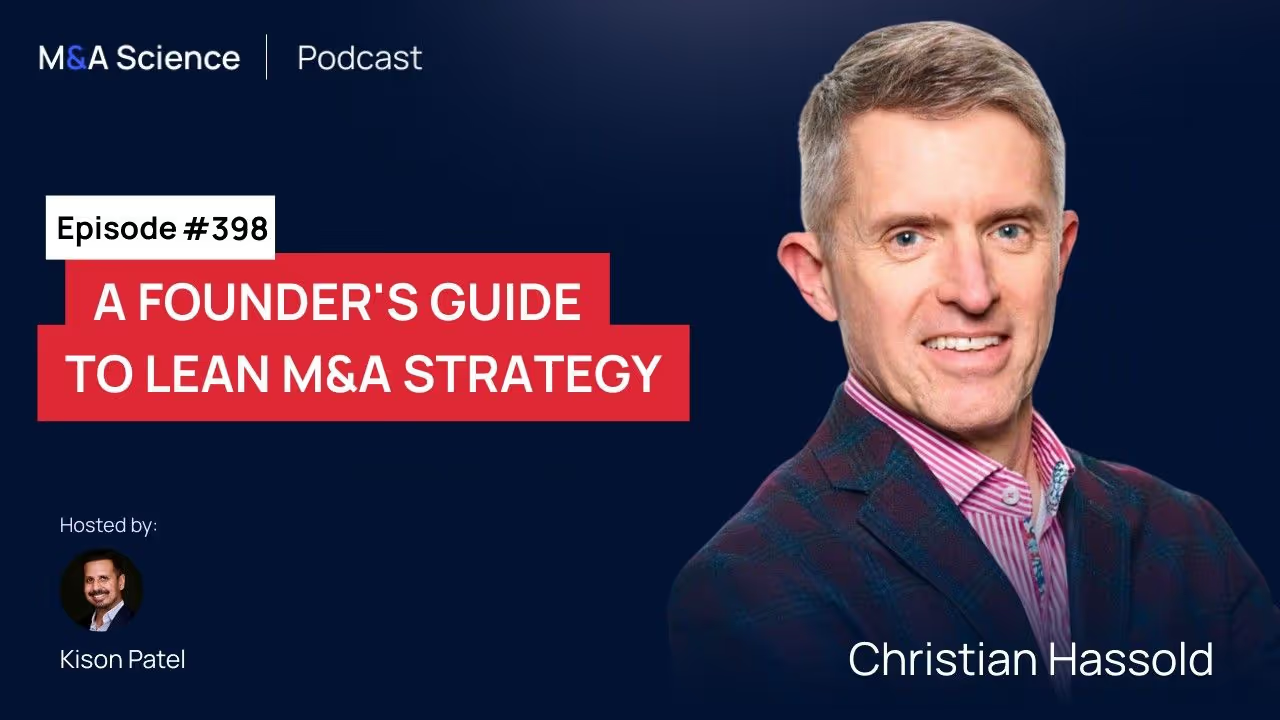
Christian Hassold is a recovering founder and CEO who built and sold three companies over two decades before transitioning into corporate development. His unique perspective—having experienced M&A from both the seller and buyer side—gives him keen insight into the cultural dynamics that make or break deals. He's built corporate development functions from scratch at ChannelAdvisor, CommerceIQ, Salsify, and Wpromote x Giant Spoon, where he led the strategic combination creating one of America's largest independent agencies. Christian specializes in lean M&A strategy with an emphasis on culture fit as a non-negotiable element of successful transactions.
Episode Transcript
A Founder's Guide to Lean M&A Strategy
Kison Patel: [00:00:00] I am Kison Patel, and you are listening to M&A Science where we talk with deal professionals and learn valuable lessons from their experience. This podcast focuses on stories, strategies and what actually happened during M&A deals.
Kison Patel: Hello, MA scientist. Welcome to the M&A Science podcast. [00:00:30] This show is part of our mission to rethink how M&A has done and build the operating standard for buy-side M&A. That old school settle led approach. That era is over. Fire lead M&A is about strategy, alignment and execution. Putting value creation at the center of every deal.
Kison Patel: And let's be real. It's not just about closing the deal, it's about making it successful. And we get there by learning directly from the best. You want to go deeper into the framework. Grab my book, fire Lead M&A. If you want the full system. Frameworks, [00:01:00] templates, exclusive content expert q and a sessions, access to me and the AI powered Intelligence hub, join the M&A science membership@mascience.com.
Kison Patel: It's the home of bio led M&A. While you're there, make sure you sign up for a free newsletter. Lead the deal, own the outcome. Let's jump in. I'm your host, Kison Patel. Today I'm joined by Christian Hassel, senior Vice President of Corporate Development and Strategic Partnerships at Wpromote X Giant Spoon, [00:01:30] a leading independent digital and creative agency.
Kison Patel: Christian's path to corporate development is a bit different than most. He's a recovering founder and CEO who built and sold three companies over the past two decades in both enterprise software and tech enabled services serving digital commerce and media. His experience as an operator provides a unique lens on M&A strategy.
Kison Patel: Especially when it comes to tying corporate strategy to inorganic Growth. Creation has a track record of building [00:02:00] corporate development functions from scratch at companies like Channel Advisor, where we created their first corporate development function as a public company. Tech unicorns, commerce iq, Salsify, and now Wpromote X Giant Spoon.
Kison Patel: Most recently, he led the acquisition of Giant Spoon by Wpromote to create one of the largest digital and creative agencies in the US and has some fascinating perspectives on what actually works when you're doing M&A at companies under a thousand employees. Christian, how you doing today? I'm [00:02:30] doing fantastic.
Kison Patel: Hey, thanks for making the trip to actually one, take a break from doing Deals two, come here to Boston, our headquarters of Deal Room to have a conversation with me.
Christian Hassold: I love that you're here every time we meet. We're in New York City, so I assume your gang affiliation is New York, but here's your entire.
Christian Hassold: Team here in Boston, Massachusetts. So excited to be here and excited to be with you.
Kison Patel: You got like a good day. Middle week. The office is buzzing today. Can we kick things off a little bit about your background?
Christian Hassold: First thing that I should share is my [00:03:00] roots are in entrepreneurship. If you go back in my lineage, my dad was an entrepreneur, my uncles were entrepreneurs.
Christian Hassold: And before that, my great grandparents, they were all entrepreneurs. They've all owned and operated their own businesses over the years, and that is deeply in my blood. So I am very much at the foundations. Someone who likes to challenge traditional thinking, think outside the box and looks at pretty much everything as is this a business opportunity?
Christian Hassold: Could this be a business? How can we [00:03:30] take this and make it bigger and better? And that's, I think, foundationally who I am. I'm a little bit non-traditional in that way, in that I incorporated my first business when I was 15 years old. I built that business up into, you know, sizable for something at that age.
Christian Hassold: I then transitioned into the music business. I failed terribly at it. My dad made me go to work for Circuit City stores and learn the roots of operations management and running a business and working for someone else, which [00:04:00] gave me a lot of foundational skills around leading teams. Thinking about how traditional management styles and operating modes are translatable to building businesses from scratch.
Christian Hassold: From there, I was very fortunate to build several different startups, get my education later than most people would get their education. We can talk about that a little bit later, and then ultimately build two more companies and sell them before I transited into corporate development.
Kison Patel: There's a lot to unpack there.
Kison Patel: I like when you started at 15. The one thing I actually [00:04:30] really appreciate is your dad. He can go to Circuit City to learn business operations.
Christian Hassold: When I failed at that second business, he came into the living room and he said, you're going down to that store and you're gonna apply for a job. You're gonna work for someone else.
Christian Hassold: That was a tough conversation, but it was the right thing to do and I wouldn't go back and do it a different way.
Kison Patel: And it's something I find a gap in my own background. I never saw like a lot of the operational scale. I've always just built something from scratch to the next thing, the next thing.
Christian Hassold: Yeah.
Kison Patel: Well there's that part that was interesting. [00:05:00] Transition to corp dev. What prompted that?
Christian Hassold: The way I got started in corporate development was completely by accident. I don't think I knew what corporate development was when this happened. As you mentioned at the top, I built and sold three companies. The first company was a complete luck shot.
Christian Hassold: I met a guy named Tony Aquila, who is a very well known, successful founder and inventor. He's built billion dollar enterprises at this point. But when I met him, he hadn't done other than started a small business and he came up to me one day and said, Hey, do you wanna start a company with [00:05:30] me? And on that day, I became an employee founder of a company.
Christian Hassold: And I went on this journey whereby from scratch, we built a business that from day one was basically built through a lot of inorganic means. What I mean by that was in 1999 when this company started, capital was really easy to come by. Ideas were really easily funded, but we had really big ideas about the amount of money we wanted to raise and the business that we wanted to create.
Christian Hassold: And one of the conditions that our [00:06:00] investors at the time, which was CMGI and Juan Partners, they conditioned that as a part of starting the company, we would take over the employees and the infrastructure of a company that wasn't working out. So on day one, we were literally aqua hiring employees from another startup, taking over their balance sheet and a lot of their cash and their people, and interviewing them for jobs in a company that they didn't apply for.
Christian Hassold: And that was really like an inorganic way of starting a business. So on day one, after [00:06:30] getting funding, we had 30 employees. It had just come from another company that was doing something peripherally or similar, but quite different. And that company went on to do three more acquisitions. And I was not really a part of the deal process.
Christian Hassold: I was more of the identify the opportunities, vet them out and help get them integrated into the business. And that really started my interest in what is corporate development, but I didn't really know what corporate development was at the time. And as my career evolved, I became a little bit more [00:07:00] keen to it, and it just became this muscle that was natural.
Christian Hassold: I didn't have a label on. It was more like inorganic was the natural way that I enjoyed building businesses.
Kison Patel: That's fascinating. Given that background, how do you think that influences your approach to corporate development today? Because that's very non-typical.
Christian Hassold: You could look at it one of two ways. You could look at it as a blind spot or a superpower.
Christian Hassold: I like to think it's a superpower when I meet CEOs that say, I'm have a vision for this business. I'm going to build it [00:07:30] completely organically. No one can build this product. No one can build this business better than I can organically. I'll be the one person in the room who will raise their hand and show them five companies that they could acquire that would accelerate the speed with which they grow and give them capabilities that they didn't have, that they would spend a lot more money and time making mistakes, going and figuring out what to do rather than going acquiring them inorganically.
Christian Hassold: If a CEO says, I don't want that kind of thinking in my building, I'm probably not the right person for them. But most [00:08:00] CEOs want someone who is thinking outside the box around them and thinking of ways to accelerate, to grow and to create defensibility for a business, and what is a very fast moving environment.
Christian Hassold: Growth really matters. Profitable growth really matters, and there's so many ways that you can go about. Building a successful business, but one of them is having really smart people and people who really have a passion to build whatever it is you're building, whether it's, I [00:08:30] wanna build the best deal room software that's out there, so M&A practitioners don't have to spend time.
Christian Hassold: Trying to find their way through clunky deal rooms, or I'm in commerce. What's the most efficient way to enable commerce and get to every single human being and make commerce frictionless? Whatever those problem sets are. If you assume that you're the only person that can solve those problems, and no one else is thinking about it, then you're counting out [00:09:00] that there are a lot of smart people in the world.
Christian Hassold: I'll just give you one quick example. Let's put this into modern day thinking. The founder of OpenAI, Sam Altman, this business has been built from scratch, but to date, I think they've done something like 40 M&A transactions and one transaction at time. They're getting best in class talent, best in class ideas, and that company is moving fast.
Christian Hassold: It is accelerating fast, it is evolving faster. Can you imagine a universe where OpenAI said, we're gonna hire a hundred people? We think that the people that we hire are the only things [00:09:30] that contribute to growth and to this company being highly defensible. It'd be a different company than it was today.
Christian Hassold: And so we sometimes discount the magic that M&A can do in a business. And that's probably my blind spot is if someone hands me an organic growth plan, I'll always be thinking about what are the inorganic ways that you can grow it.
Kison Patel: That's interesting. So you have this like operator executive lens on just business operation.
Kison Patel: You've seen how you can supplement with M&A.
Christian Hassold: Yeah.
Kison Patel: That's how it gives you the appetite for it. But [00:10:00] you go back to bringing that full picture executive thinking,
Christian Hassold: yeah. To
Kison Patel: the deal.
Christian Hassold: Absolutely.
Kison Patel: What's something you wish you knew before your first M&A deal?
Christian Hassold: There's three things that I wish I knew before my first deal.
Christian Hassold: One is assume nothing. You really have to take time to deeply understand. One, the motivations and goals. Of the business that is doing the acquiring. And you can really never spend enough time with not just your [00:10:30] executive team, but other key leaders in the business who are going to make inorganic strategy successful.
Christian Hassold: Don't make assumptions about what their motivations are. Don't make assumptions about what they do or don't know or what they understand inorganic strategy to be. The second thing is committing to your craft. And by that I mean this is a world where there is so much knowledge out there and you really need to be a lifelong learner, a sponge [00:11:00] absorbing the different ways of going about running an inorganic strategy.
Christian Hassold: And one of the things I've been incredibly grateful for is this podcast, and I really mean it, Keon, because when I started corporate development function at Challenge Advisor. I was reading books and I was studying materials that were available to me. I wasn't really listening to podcasts. The one thing that really helps you become better at your craft is [00:11:30] listening to other practitioners, understanding the hard things and how they navigate the hard things, and also having a perspective of what a corporate development leader in a 10,000 person company is doing versus a 1000 person company.
Christian Hassold: The way you go about it in different size companies, it has to be different naturally, but you really wanna study and understand the different ways of doing deals. Committing to your craft is, uh, really important, and that really ties to also being a sponge. It's just being willing to take input, [00:12:00] take insights, and take feedback from others, and use that to make whatever you're doing better.
Kison Patel: Good principles, assume nothing. Use sponge, keep learning. Be committed to the craft. One of the things you mentioned was tying company strategy. Company strategy to M&A. That's your sweet spot. Can you walk me through that?
Christian Hassold: Yeah, I mean, I think one of the things I've established at the top is there are two kinds of practitioners in corporate development.
Christian Hassold: Some come with a [00:12:30] consulting or finance background, and there is a particular way in which those practitioners approach looking at M&A. I think it's somewhat academic and incredibly financial model oriented. And there's another way which is I have real world business experience in building a company from scratch.
Christian Hassold: Knowing what it's like to build a product function, build a go-to market function, build one in the us, build them in Europe and other theaters. One of the things that is a [00:13:00] superpower that I run with is I have the context of building and running a business and being a CEO, and I also have all of the shared knowledge that I've gathered from other corporate development practitioners.
Christian Hassold: And one of the things that I observed consistently is misalignment around strategy. Strategy can be a very broad term that can be so broad as to be meaningless. Companies sometimes over-engineer strategy. So one of the things I do [00:13:30] well is I work with leadership teams to really get inputs from all points on what are the common points of agreement about where the company should invest in organically.
Christian Hassold: What evidence do we have underlying the business, either in our sales calls and feedback from clients and feedbacks from internal team? Can we synergize put all together and say, okay, these are the things that are really common beliefs. Let's go at working at solving those common beliefs and running with it.
Christian Hassold: And one of the things you have to be willing to do in building strategy is [00:14:00] one, being firm on, we are going to build this company in organically, and we have some clarity on the specific things that we're solving for, but flexibility on the details, given that. The business is in amoeba. It's a moving mechanism and you don't wanna shift strategy every 12 to 18 months erratically.
Christian Hassold: But you also wanna be flexible enough to understand that some information you didn't have has now come to light. In the companies that I work in, which are typically companies with a thousand or less [00:14:30] employees, have found a moat there where my business experience and generally my strategic sense is able to tie those things together and communicate a strategy, a team that everyone can say, yes, we're behind that and go run with it.
Kison Patel: You teach me how to do this,
Christian Hassold: I love to do that. I've got some pillars I can walk you through. This is kind of deep diving into a framework for what I would call lean M&A strategy. I differentiate this from playbook, my CEO, Andrea [00:15:00] Benzi at Wpromote X Giant spoon, and I were just talking about it. A framework is something that is firm but flexible.
Christian Hassold: Versus a playbook, which sort of implies here's exactly what we're gonna do at each step of the way. I really like the idea of emphasizing that this is a framework. So the framework has five fundamental steps. Deep dive, the business, define and battle test the strategy. That is what is the problem you are solving?
Christian Hassold: Communicate the strategy, run [00:15:30] the funnel, and commit to close. So lemme walk you through that framework. The first thing is, as I was just mentioning earlier, which is deep dive the business, when you come on as a corporate development leader, especially in a company that's ever had one before, the first thing that happens is people come to you with a million deal ideas and the footfall of this function is to immediately start running at those deals that are sitting right in front of you because you want to hit the goal.
Christian Hassold: It's always great to be a corporate development leader that gets a deal over the line and when [00:16:00] teams are already aligned around one or two specific targets, it's easy to go running after those. I like to pump the brakes and say, okay, what is it the problem that we are trying to solve here? So I like to really go into the business, talk to sales, talk to cover customer success, talk to the leaders, but more importantly, talk to the clients.
Christian Hassold: And you really wanna spend time doing, whether it's a third party consulting or doing your own work, to really understand what is it that the customers want that you can't do for them today, [00:16:30] and what are the things in the business that are less defensible without those capabilities, without that software, without those services.
Christian Hassold: Really deep dive and understand the business. And I like to make the important point of this is a collaborative process. You wanna actually bring people into a room. Let everyone speak and debate in an open forum about the things that they see, and note and understand where people are aligning and where they are not aligning.
Christian Hassold: And use those tensions to creative tensions to find a way to align on the fundamental [00:17:00] strategy. As I mentioned earlier, the next thing that you wanna do is to define and battle test the strategy. And what I mean by that is, is you've defined the problem that you're solving, but you wanna battle test it a little bit and battle test it with investors.
Christian Hassold: You can battle test it with bankers who are observing the industry and say, Hey, we're thinking about doing this. Are my other competitors thinking this way? What do you think is missing from this? You wanna kind of take the time to synthesize the strategy and shop it around, if you will, and get feedback.
Christian Hassold: You're not trying to [00:17:30] completely disrupt what you've created because there should be truth in that strategy that you've developed, but you wanna get outside input to really say, okay, I've thought in a 360 way about this. Once you've got that strategy nailed down, the CEO says this makes great sense. Run at it.
Christian Hassold: The team says, we believe in it, go do it. You then wanna communicate the strategy. When I say communicate the strategy, people will frequently think, communicated internally. Communicated internally is only part of that. Your inorganic [00:18:00] strategy should not be a state secret unless you're building thermonuclear weapons.
Christian Hassold: Or you're building something that is so sensitive that if someone else knows about it, they're somehow going to be able to disrupt your plan. One of the common points that other leaders bring up is ideas are really meaningless unless they're actually executed really well in business. If you have a strategy, you shouldn't be uncomfortable finding friendlies outside the business to shop it around.
Christian Hassold: So one of the things I did in communicating [00:18:30] our strategy, I'm one of the only corporate development leaders, just tooting my horn here for the record. I'm one of the only corporate development leaders in my sector that build a 10 page deck that I shared and communicated with other bankers to help them understand exactly what our company was looking for.
Christian Hassold: These are our three priorities. Here are the tenants on which we are evaluating these priorities. Here's the kinds of deals we will do. Here's the kinds of deals we won't do. We provided an incredible amount of transparency to our banker community, so the [00:19:00] deals that they would bring to us. We'd be well aligned with our interest areas rather than getting a rainfall of sims and inbound deals that were really not interesting that will happen.
Christian Hassold: But you just wanna have a frame for which you are going to be able to evaluate opportunities and also give very direct and specific feedback to your partners, whether it's a banker or whether it's someone who's just giving you a deal idea, giving them feedback. Because you are, as a corporate development leader, one person, and [00:19:30] generally speaking, our functions, whether it's a company of a thousand or 10,000, are very small teams.
Christian Hassold: You are only good as the number of people who understand what you're doing, who can go out and search for those opportunities that might make the most sense for you. I really look at the community to the extent that as many people as possible, that you can trust. Have your strategy in hand and know what you're looking for so you can maximize your funnel, and that leads into running the funnel.
Christian Hassold: You now have a strategy. You now have the filters in place. You [00:20:00] know what you're looking for, running the funnel. There's two parts to the funnel. There's the organic part of the funnel. That is you going out and proactively using AI and other data mechanisms to identify businesses that will be interesting to you.
Christian Hassold: And two, using banker networks to bring you the inbound deals. For a lot of industries, bankers tend to be the most reliable source of actionable deals that [00:20:30] are easier to get done. Proprietary deals are very hard to get done, but that doesn't mean you shouldn't go after proprietary deals, but you wanna make sure that you're balancing running the funnel with banker led opportunities and organic led opportunities.
Christian Hassold: The reason why you wanna be doing both is organic opportunities. Give you a lens of getting directly to the founders and building relationships with founders and talking to them about their businesses and where they are. What is their thinking in the process? You're also learning about the space around you.
Christian Hassold: [00:21:00] When you're working through bankers, you don't have as much access to power. Access to the leaders on the front line lacks that sort of organic context on what's happening around you. So I really like to do both. But running the funnel is the process of at a high rate of speed, getting 100, 200 opportunities into your funnel and you're working your way through them.
Christian Hassold: Because a hundred opportunities in your funnel will likely only materialize one to two actionable opportunities. Experience after experience tells me you need to have at least a hundred opportunities in your [00:21:30] funnel, at least in the industries I've worked in to get the one or two that are potentially actionable.
Christian Hassold: And the last thing is to commit to close. You're gonna identify opportunities that are right for the business. What I mean by commit to close. Is running the process on the assumption that you are going to close this deal until a point where you say we shouldn't do this deal. I'm not saying go blind into the deal and not be skeptical or not be looking for reasons not to do the deal.
Christian Hassold: What I'm saying is, is commit to a process that [00:22:00] ultimately is to close a transaction unless you are given a compelling reason not to close the transaction. And so those are the key pillars.
Kison Patel: You know, just to get clarification, so commit to close. You made a point that people tend to find that looking for red flags to not do the deal, but you got a perspective of more of real alignment, commitment to actually doing the deal and making the deal successful.
Kison Patel: Is that the general gist of it?
Christian Hassold: If you're running the process right and you're looking at a hundred [00:22:30] some odd different opportunities and you've rounded down to one or two. And you're pursuing those two, there's a reason why you got to those two. Don't discount the amount of time and effort and energy that has gone into identifying those two opportunities.
Christian Hassold: If you've run this framework roughly as I've described it, you should have 1, 2, 3 actionable opportunities in front of you. You didn't get there by accident. You got there because the team, as a team said, this is the right opportunity. So [00:23:00] what I mean by commit to close is is that by the time you've gotten to identifying those one or two actionable opportunities, you don't want to be waking up every day with someone saying, oh, this thing happened or that thing happened.
Christian Hassold: The reason why I shouldn't do a deal is not one specific thing. It's usually a collection of things. You're not ignoring those collection of things. What you're doing is you're cataloging them and keeping them in mind. And if it's three times in a row, the founder is saying things that aren't true.
Christian Hassold: They're not owning up to it. [00:23:30] Okay, red flag, we need to pause. If you're going through the financials and you're finding consistent issues with the integrity of the financials, or you're finding a potential of financial fraud, okay, red flags, stop the ship. But short of those big red flags run the deal to a point where you say, we're committing to close this or not.
Kison Patel: So you operate at the level of certainty, but being mindful that if you do collect enough of this,
Christian Hassold: yeah, absolutely. I mean, absolutely. I'm not saying you don't pump the brakes on a deal, but [00:24:00] you as a team be in the mindset that. You are going to close one of these three deals and you're gonna close the one of three deals that makes the most sense to close.
Christian Hassold: And at the point where you get a loud and blaring sort of a flag from the team that says, the culture's not right. We don't trust this founder or CEO, we don't trust the integrity of these financials. Whatever those key red flags are, you wanna surface those things. You wanna make sure there's an environment where that can come up, but you also wanna make sure that one or two people saying, [00:24:30] oh, I don't really know if this fits with our strategy, but let's have a conversation about that.
Christian Hassold: Let's keep moving things along.
Kison Patel: Okay, so the five stages dive deep into the business. This is where you really wanna understand what your customers want, that you currently don't offer defensibility in the marketplace. Two, define and battle test the strategy. This is when you're really taking what you developed as a strategy and socializing it.
Kison Patel: Quick question on this. When you say [00:25:00] socializing and shopping around. Beyond just the company. Who does that include?
Christian Hassold: It's really important to communicate your strategy to as many friendlies as possible. Let me back this up for a second. So communicating the strategy. What is the problem that I'm solving by talking about communicating the strategy?
Christian Hassold: The problem that I'm solving is there's one of me, there are a thousand employees, and there are hundreds if not thousands of bankers and others who are out there sourcing deals [00:25:30] for various parties. Your company included. The problem that I'm trying to solve is there's only one of me. I can only touch so many people in a day.
Christian Hassold: If I can create network effect by effectively communicating what it is we're looking for with banker partners, with other advisors, who I consider to be friendly and are not gonna use that information in a way that is not in my best interest, I wanna be able to communicate that strategy because that is just more people knowing what I'm looking for and bringing opportunities into my funnel.
Christian Hassold: Remember, the funnel [00:26:00] is fundamentally a math problem. You can get a hundred opportunities into the funnel, but you're only gonna be able to action one or two of them that are really gonna fit. And the more that you have coming through your funnel that fit the top of funnel filters, the more you're gonna be able to have your choice of the right opportunities.
Christian Hassold: So it's really just using the network around you to get as much opportunities into your funnel. That makes sense. So you can action like the optimal opportunities that get down to the bottom. You just wanna find the one or two [00:26:30] that you can do that you're really excited about, that are really strong strategic fit, they fit with your strategy.
Christian Hassold: There's a culture fit, there's great financial metrics. It's hard to find those opportunities at thousands. So network effect is really what communicate the strategies about. So
Kison Patel: don't be reserved about it. Get that out there. Communicate it, that your third pillar was communicate the strategy. You had a view of not only doing it internally, really getting it out externally, but this also allows you to clarify the market.
Kison Patel: Very clear [00:27:00] criteria in the businesses that you're looking for. Yeah, thought through and align it through strategy. And then four, run the funnel. You mentioned organic, which is doing your own hunting inorganic, working with the different intermediaries on the market, but put a lot of effort in your organic efforts.
Kison Patel: For every a hundred businesses you look at, maybe one or two are actionable. I like that rule of thumb. And then commit to close. It's like approaching this deal with this level of certainty that you're committed to doing the deal. And then the [00:27:30] skepticism is something you sort of build as your model. If you collect enough evidence, then you can act on that skepticism or red flags that you identify.
Christian Hassold: One thing, as I'm auditing what I'm saying with you here right now is if I'm a another corporate development practitioner or an executive, they're gonna say, wow, he said commit to close. He basically is not willing to pull the brakes on a deal, but for a complete red flag. I wanna say something important about run the funnel.
Christian Hassold: 'cause we're being super technical here. I always say to [00:28:00] my teammates that M&A as a team sport. One of the elements of Run the funnel that I didn't mention that I should mention here is running the funnel includes having regular standups with your deal team, with your key players, usually your chair or exec chair, your CEO, and a couple of other informants within the business and running them through what are the deals that are in funnel, what is interesting and highlighting to them what you are seeing in the funnel and having questions.
Christian Hassold: Is this interesting? Does this [00:28:30] fit? Should we get on a call together with this prospect and talk to them in more depth about what they're doing and make sure that strategic fitment is there and. What I don't wanna leave out is running the funnel is not just the tactics of sourcing and getting things into the funnel.
Christian Hassold: It is also the process of being highly communative and highly collaborative with the team around you to make sure that the opportunities are getting to the bottom of the funnel are ones that everyone at the table says, this should be here. So by the time you're getting to the point where I'm saying commit to close, you've all looked at this [00:29:00] thing five different ways, and now you're going into the business diligence portion where you should already have some conviction around this is the right deal to be doing.
Christian Hassold: The order of magnitude of things that should stop the deal dead in its tracks should be dishonesty, fraud, or just plain culture is not fit, or something broke down in the strategy that wasn't plainly obvious to you earlier. There's always gonna be skeptics of a deal and healthy [00:29:30] skepticism is great. You should have open conversations about things that make you skeptical of deals.
Christian Hassold: But fundamentally, by the time that deal got to that stage, the reasons why you should walk away from a deal process should be things that really are counter to everything that you thought it was by the time it got to that stage.
Kison Patel: You know, one of the other things that I think about when you phrase use the phrase come into close is the integration piece.
Kison Patel: Because a lot of times it gets pushed back where [00:30:00] it's, Hey, we wanna have certainty to close. We wanna like really make sure we're gonna close and then we'll loop in integration. Folks, when I think of approaching a deal, when you have that commitment to close like you, you're really building in how are you gonna actually hit your deal Thesis.
Kison Patel: Yeah. How you gonna integrate the business and bring that in to your process with that level of confidence. We're gonna close.
Christian Hassold: Actually, I love that you brought that up between run the funnel and commit to close. There's an important point where you should [00:30:30] establish a thesis. That's probably another point of clarification, which is there should be a thesis going into the deal when you sign the LOI.
Christian Hassold: Here are the reasons why we believe this is the right thing. Here are the metrics, or here are the strategic changes to the business that we believe will be positively impacted if we do this deal. You should always be testing the thesis against the deal as you are running through the process. That's kind of one of the backboards there, and there's probably more chapters in the book as you go through each one of these steps, but certainly you should have a thesis and you should battle test [00:31:00] that thesis.
Christian Hassold: One of the things that I learned by listening to your podcast, and one of the things that I learned the hard way by listening to others was. Post merger integration should be stood up. The moment that you're signing an IOI or an LOI, the PMI team, the team responsible for integration should have a front row seat on the process.
Christian Hassold: The moment that you have agreed to deal terms, others might say they'll be a part of the process all along the way, and basically they're in the listening room. But you're intentionally standing up that integration [00:31:30] process the minute that you sign that piece of paper. And the reason why you want that team there is they are there to listen in on both the thesis and also to be an audit on culture, to be an audit on how will these things come together practically in the business who will own it post-closing, who will own these metrics post-closing.
Christian Hassold: And it takes a lot of time to learn that. So this podcast and this discussion is not really about IMO, but I don't want to [00:32:00] discount the importance of IMO being a critical part. Of the team. When you get to the point where you identify that that prospect is the one that you want to carry forward and you have deal terms agreed upon.
Kison Patel: Thanks for clarifying. Can we role play this out?
Christian Hassold: Sure, of course. Let's, I wanna, yeah, let's do it.
Kison Patel: Oh, okay. Here's a scenario, and I'm being a little open here. Okay. Yeah. I talked to about 60 growth equity funds in the past year on behalf of Deal Room.
Christian Hassold: Wow.
Kison Patel: I think there's two things that I've realized. One is [00:32:30] you gotta have a strong story about your tam.
Kison Patel: That's gotta be a big piece. That's the number one thing Investors are always skeptical about. Yeah, you got good growth now, but how long is that gonna continue for? I noticed that with Deal Room, it's like, well, today everybody uses software to sell a business, but very few use software to buy a business in the future.
Kison Patel: I see a world where most people are using software to sell a business, and most people are using software to buy a business. That's how I view tam, is that it's gonna change. That's one point [00:33:00] of something that in terms of organic growth, it's a big emphasis on tam. And then inorganic was an area that I struggled where in our space it's not very fragmented.
Kison Patel: There's only a handful of direct competitors. If you have an opportunity to acquire them, it's a one off and there's only one or two really viable targets there. And when you really trying to build a strategy, if you wanna work with top tier equity investor, that's a part of it that help support inorganic growth.
Kison Patel: That was the thing I struggled with is like adjacencies. [00:33:30] I feel like the business at 10 million a r still needs to develop that core central distribution to make it more compelling to start tacking on other products. Until we get that, which I felt, hey, probably another 10, get to 20 million a R. We'd really have that matured.
Kison Patel: We start looking at adjacencies, you look at fp and a software 'cause there are things that relate to M&A around consolidating financials. Yep. And then you have private equity space, but then you start getting into more of the backend like fund administration, which whole different [00:34:00] customer buyer there.
Kison Patel: And then you get into the legal side, which we built a lot of competency with document AI extraction, but again, nice big attractive space, but a different profile together on the law firms. And that's, it was tough for me to have something. I was wholeheartedly confident that this is, to me it's where the buy side, our mission is to change the way buy side M&A has done end to end.
Kison Patel: I'm curious, just kind of what you talked about, like how would you ground somebody like me to [00:34:30] rethink from your business strategy to building the NA. I feel like you're almost to a point when you're doing it backwards. You're just looking for pockets where you could do M&A deals and then tying it to your thesis, which I don't think is the right way to do it.
Kison Patel: And then it goes back to that, are you really gonna get synergies from doing these deals? And it does it wind up at the end of the day?
Christian Hassold: Yeah. The first question that you asked around TAM is a really good one. What is the TAM of buy-side led transactions in the US in a [00:35:00] given year? Do you know?
Kison Patel: We try to hone in on organizations that do two or more acquisitions a year.
Christian Hassold: Got it.
Kison Patel: Because then you can sell 'EM software that makes sense to think of like programmatic M&A. You're gonna have an ongoing subscription, reoccurring revenue. It's, if it's an organization, it's like we're doing one deal, then we're not sure when the next deal's gonna happen. Very one off. That's tough for the profile.
Kison Patel: So when you distill it to that segment, now you start to look at Fortune 2000 [00:35:30] companies. Probably another Fortune 2000, let's say 80%. A lot of them still an organic focus, but I would say 80% have some form of inorganic. Then you'd have another Fortune 2000 that are privately held that sort of operate the similar way, and then that's the corp dev ecosystem that you're very familiar with.
Kison Patel: Yes, you got large public strategics and you got feedback roll-ups. The other segment would be directly the private equity firm, which we have about a dozen private equity firms use. We just don't directly go to market. [00:36:00] Different buyer behavior. People go online and they find deal, room, start engaging.
Kison Patel: They're looking for solutions, private equity. A lot of 'em come from banking and it's like they don't look for solutions. You gotta go knock on their door and show 'em the light, basically.
Christian Hassold: What do highly acquisitive large corporates say to you? I'm sure you've had these conversations, you said a large. A corporate that's using a competitor's product, what do they say to you?
Christian Hassold: What are the reasons why they say no to deal room product?
Kison Patel: Why? If they're using a competitor, they would say [00:36:30] no, they're settled. Like it's hard to get change if they're using a competitor product because if you have a product where you're mapping out your whole entire M&A program into it, it's a lot to move over.
Kison Patel: And we've done it this year, we moved about eight, nine accounts from one competitor. It was so much of a lift, like we're talking about 15 hours of internal time between, I think now they're building automation scripts to do it faster, but they did not, they probably did not make it friendly to export. So there is a little bit of that, like you [00:37:00] sort of standardize something unless you're truly unhappy with it, it's hard to get that change.
Christian Hassold: Yeah. Being a customer of your product and being a strong believer that deal room is a superior platform for running a buy-side process. I definitely think that there is the challenge of entrenchment, which is the other players in the market are deeply entrenched. It's kind of the better mouse trap issue, which is like, yeah, it's a better mouse trap, but why change?
Christian Hassold: What is the pain that we're [00:37:30] experiencing right now? And we could probably go on and deep into customer discovery and understand what that pain is. But every time I look at the deal room product, I'm struck by what an easier to use experience it is. And is it possible to capture potential acquirers earlier in their life cycle so you can cut off the supply to your entrenched competitors?
Christian Hassold: I most compare Deal Room [00:38:00] to Monday and Asana. And I think, you know, I think you did a great podcast with Notion and Notion had talked about using notions infrastructure for their M&A process. I think you're very similar to them, and maybe it's possible that by looking for acquirers that are doing a minimum of two deals a year, you might be limiting opportunity for those who are going through their first acquisition.
Christian Hassold: So thinking about what does it [00:38:30] cost for someone to start using Monday Board tomorrow, what does it cost for someone to use Asana tomorrow? You have a way of developing product strategy, so you have sort of an MVP that any acquiring company can use, because one of the things that I've just been blown away by is the number of startups that are acquiring other startups.
Christian Hassold: A lot of times startups are cost conscious if they have to spend a large upfront sum, and to them it could be [00:39:00] 1000, 2000 threes. And if they have to spend an upfront sum using software that might make them just say, okay, fine, we'll use Google Drive. We'll use spreadsheets, we'll use whatever. But what they don't realize when they're going through that process is just the amount of challenges they're creating by using something that isn't purpose built for running a buy-side M&A process.
Christian Hassold: So one of the things that might be interesting is to do discovery. I can't give you the answer here, but to do discovery on [00:39:30] those small transactions and what is the one product wedge that you can land early on those acquisitive startups on those acquisitive small businesses, that is a pain point that you can remove from the M&A process and get that messaging to that buyer.
Christian Hassold: And then by doing that, you will probably also discover adjacent solutions that are those low lift fits. So I think about one of the hard parts of buy-side M&A is financial analysis and how much [00:40:00] AI is doing to simplify it. So is there a solution for doing financial analysis? On whether it's a RR or tech enabled services or what is that kind of entry point solution that you can acquire or that team you can acquire.
Christian Hassold: They can get you a product wedge inside of one of those smaller businesses that the large side, the Fortune 2000 might be Red Ocean, but what is Blue Ocean is all of the smaller deal activity that's [00:40:30] taking place in market. So that's the hypothesis that I would have going in. If I was leading an organic for deal room, I'd actually probably be looking at the lower market because if I can capture open AI during its first one or two transactions and hold onto them as a client because I'm such an irreplaceable solution, I've just caught off the supply or the competitor product, and as they become more acquisitive, I'm gonna become bigger and better along with them.
Kison Patel: How does that strike you? Well, it's kept me thinking about [00:41:00] hypothesis and what to validate, maybe thesis. So we have a pipeline solution. We always think of that as the entry point. If you're billing a corp dev function, usually start off by building pipeline. So we are pretty aggressive. It's like 12,000 a year and then that's our entry point.
Kison Patel: And then you naturally stack on rooms to get to the next plan and do all the execution stuff. But when you start thinking and reframing it to market segments, smaller deals, it might not be about the pipeline, actually it might be, it's our first deal. And I remember I had a [00:41:30] customer, this was years ago, we had a online flow to go sign up.
Kison Patel: I was so surprised she signed up and spent like $20,000, like never talked to this person. And they literally did a full treatment for $20,000. And I asked her and she said, well, I found this template first acquisition. We ever did this template. I looked at it 'cause we're gonna hire this advisor. When I saw this templates, this is all we need.
Kison Patel: This kind of lays out everything we need to do this transaction. It was way cheaper than an advisor. I went and bought the product with this template [00:42:00] that Preloads, and that's what I used my first deal. The company is making me actually think about that, where I'm like, that was actually the solution for that first time transaction.
Kison Patel: It wasn't the pipeline.
Christian Hassold: If I get back to the problem that you're trying to solve is you wanna capture as much market as possible. Where's the blue ocean? So let's go back to talking about the very active acquirers that are not in plain line of sight, but we know that they're out there. When a startup or an early stage company goes to do m and [00:42:30] a M&A is led by the CEO, the CFO, one of the co-founders, and usually there's a second point person.
Christian Hassold: There's someone who is what I call the walk-on corporate development leader who has never done the work before. What is the IP of your business? The IP may not be the software. The software may just be an enabler. Your IP is that you have a framework. For them to run with. What are the boxes that need to be checked?
Christian Hassold: What are the things that need to happen and in what sequence do [00:43:00] they need to happen? And do I have an easy to follow playbook? You can't get a playbook from your competitors. They just hand you a box with a key on it and say, hand out some passwords and usernames and start dumping materials in there.
Christian Hassold: But what about the process? What about the intellectual property and the pain that goes through running an inefficient buy-side process? So many processes go sideways because you skip steps that you don't know you need to be [00:43:30] crossing about. What should a shared expectations workshop look like when you've decided that you wanna pair up with someone?
Christian Hassold: What is the right way to go about deciding from both perspectives how you want to run the business? Once you're together, what are the conversations that you should be having, the intellectual property of the business that you've built? The software is sort of a workflow layer, but the, the knowledge of actually the process is the, um, the value.
Christian Hassold: You're
Kison Patel: saying we need to build a first [00:44:00] time buyer kit?
Christian Hassold: Yeah, something like that. Something that, you know, maybe it's a, a right size playbook. I go back to my expertise. My expertise is M&A for companies under a thousand people. Why is that My expertise, it's all I've done. So how can I claim expertise for 10,000?
Christian Hassold: I won't. And when you think about hp, Cisco Alphabet meta, they have corporate development teams and functions that are largely staffed by people who've been doing that kind of work forever. And they have their established systems, their tools, playbooks [00:44:30] or frameworks, whatever they may be. They're already built.
Christian Hassold: So it's hard to penetrate that inertia. What you can penetrate is going back to my open eye example, Sam Altman, if you can get to his number two or his number three, who was a person who was put in charge of doing M&A and help them do M&A 10 times better than they could because they didn't have a playbook and they hadn't done it before.
Christian Hassold: What did they learn through their first five transactions that they can extend to the next 10 [00:45:00] transactions to make M&A much more effective? And accretive, we know that 90% of M&A fails you as a player in the market can be someone who can put the odds in favor of the acquirer. That is a superpower.
Kison Patel: I like this. This is a good exercise. We validate this by talking to the customer, right? Absolutely. And then it gives us direction because we got a few different, there's this sort of practice play, you know, maybe the software component. There's things that we always think about too, which is the cost of doing a deal.
Kison Patel: At the end of [00:45:30] the day, you spend a significant amount on diligence between lawyers, consultants, bankers, absolute, et cetera. We always look at like how do we chomp away at that with software? How do we get into that and optimize it and drive efficiency there?
Christian Hassold: I think there's a lot of businesses that are trying to solve that problem, and I think there's a ripe field of inorganic opportunities that with the right financial partner would make a lot of sense.
Christian Hassold: That sort of disruption of the cost of doing a deal. And one of the thing that you said that is an important double click is talking to customers. [00:46:00] Take care to define your customer, the customer you know today, and the customer you desire to have. Be talking to both of them and balance the input from both because the customers you have today, they already love you and they're gonna give you feedback on what they need to be more successful and what they need to stay.
Christian Hassold: But what we're talking about here is the customer that you don't have, that you desire to have. How do you find them and how do you have a conversation with them and get product market fit with that population? And that's something that in strategy gets missed a lot, which is we overindex on the feedback from existing [00:46:30] customers or what we know about the business to be true today.
Christian Hassold: Inorganic growth is about frequently go getting capabilities or talent that you don't already have in the pursuit of getting customers that you don't know already today. I, I
Kison Patel: can a hundred percent see that, that this segment I wanna go after are first time buyers.
Christian Hassold: Yeah.
Kison Patel: And then if I go talk to my existing customers, they're the ones more inclined about, Hey, I wanna reduce the cost of
Christian Hassold: Yeah.
Kison Patel: My legal bill. Yeah. First time buyers. No idea what is legal bill is gonna be.
Christian Hassold: Yeah.
Kison Patel: So you're [00:47:00] absolutely right on that. So let's say we go through this and we start getting some validation. Let's do the, this first time buyer kit. Somehow, I feel like in three, four months from now, you're gonna be co-hosting the buyer kit.
Kison Patel: Seriously. On the first time buyer, we validate it that here is an opportunity to really go to this market once you start going through this and surfacing some validation on your strategy. Yeah. How it could shape the, for example, going into this market, first time buyers, how does it evolve into an [00:47:30] M&A strategy to support it?
Christian Hassold: There's the customer discovery, the prospect discovery, and then mapping out what is it the most effective way to solve the gaps or to address the opportunities that are identified. Some may be very cost effectively and easily solved organically, and some may be best solved inorganically. So let's go back to the deal room example.
Christian Hassold: What can you organically solve? You have the know-how. You have thousands of [00:48:00] interviews with thousands of subject matter experts, and now we have the power of ai. You can turn that into a playbook. It's out there on the open internet. You've got thousands of podcasts out there, so anyone could theoretically do it, but what you have is the know-how of segmenting where those people came from.
Christian Hassold: 10,000 person companies, 1000 person companies. Just thinking about breaking that apart so organically, I believe that you have it within you to build that playbook in your business. And now that you've broken deal [00:48:30] room and M&A science apart, you basically have the intellectual property and M&A science that can be somehow attached organically to the business.
Christian Hassold: Now, what are the things you can't solve? Inorganically. It's very expensive to build new software. It's very expensive to hire people, to get them to build that software. Even in an AI era where maybe what used to take a team of 10, you can now do with a team of three. You still have to have the idea. You still have to have a team that really [00:49:00] understands the problem that they're solving, and then you need to be able to retain those people and get them excited.
Christian Hassold: Sometimes it's easier to acquire them, especially if they have the subject matter expertise and they can run very fast at solving the problem in two quarters rather than doing it in six quarters.
Kison Patel: You know? You got a good point of when it makes sense to organic versus inorganic. That's one thing I noticed that software, when I ran dealer room, some of my best deals were licensed deals.
Kison Patel: You end up licensing some solution that you'd embed in your product, then it [00:49:30] becomes a premium feature, and then you want to give them more money because you're making more money. I'm wondering when you mentioned that, like here we looked at chomping away at the cost of diligence. There's a lot of these point solutions popping up the market that are going after it.
Kison Patel: How do you decipher between, Hey, these are a little company, we can just go acquire them or. Maybe just do a good license deal with them. I guess at that point they could still license with your competitor. We could do a license deal, get that technology and just keep [00:50:00] making our solution more competitive that way.
Christian Hassold: This goes back to the Lean M&A strategy that we talked about earlier in the podcast, and again, the time that we have, I oversimplified. But one of the ingredients of running the funnel is partner first. If you go after an M&A prospect that you just started to get to know in the past few months, building the trust and building the mutual understanding, and building sort of the proof that this will work, it's a higher bar, [00:50:30] and that's why deals sometimes take time is the trust building and the getting to know one another and working through obstacles together.
Christian Hassold: You can de-risk that by partnering first. One of the elements of running the funnel that we're building live here as we talk about this framework, is be open to partnering first. And so I think the licensing example. Is a great example. So what if others have it? The one thing that you should know is that whether you license it on an exclusive basis or not, think about the whole conversation that everyone's having [00:51:00] about the Nvidia chips, whether we should be exporting the Nvidia chips to China or not.
Christian Hassold: The conversation isn't about whether we're exporting our ip. The conversation is about how soon will they figure it out on their own. If we don't let them have it, they're going to figure it out on them. They have, in this world, it's the same thing. Intellectual property at one point or another will be disrupted by a competitor, so go ahead and license it on a non-exclusive basis.
Christian Hassold: If it sticks and it works and that relationship becomes very fruitful, you have a natural opportunity to [00:51:30] acquire if it makes sense. But you also might identify, look, I can just license other tools in here. We can take a cut of the revenue and share it between us. Sometimes partnerships, stay partnerships and that's okay.
Christian Hassold: That's a nuance of these pillars is of running the funnel, which is a part of that funnel is a partner track.
Kison Patel: That could be a thing to focus on now where we are still thinking through what an M&A as a strategy would look like. Think of like where we could just partner in some of the areas that we talked about.
Christian Hassold: Yeah. M&A is incredibly high risk. How [00:52:00] do you de-risk it? There are multiple ways to de-risk it. Partnership is definitely one
Kison Patel: that is good. What about like when you're trying to buy a competitor, you can partner with your direct competitor.
Christian Hassold: Do you believe that by acquiring the competitor, you're solving the problem of defensibility or you're just buying time?
Christian Hassold: I would say a younger version of me thought a lot about buying competitors, but I'm less interested in that because I believe what [00:52:30] happens in most cases is you erode value along the way by buying a direct competitor. You should believe that you can build a business through organic and inorganic means that will ultimately eat up the share or out.
Christian Hassold: When the hearts and minds of clients, and therefore you can take on the market. Now, I wanna be careful about saying I've acquired a competitor in the past. There are pros and cons to acquiring a competitor, but ultimately, if you're just [00:53:00] trying to capture market share and get three or four orders of advantage on other incumbents in the market, and your ultimate goal is on a short timeframe to exit the business as a larger ship than maybe acquiring a competitor is the right thing to do.
Christian Hassold: But you have to take care and and acquiring a competitor because you run the risk that you are just doing more of the same, rather than really innovating the business.
Kison Patel: I look at it as we're participating a market we anticipate to grow, sort of, yeah. [00:53:30] Dam expansion.
Christian Hassold: Yeah.
Kison Patel: And if we can get in and it go from 40%, 60% in terms of market share, that sort of gives us this stronger position.
Kison Patel: I mean the devil's, I'm gonna failing on anti-competitive language here. Yeah. Some lawyers listen to this shaking their heads like, man, this is on record. You screwed that one up, Mr. Patel. Yeah, yeah.
Christian Hassold: Yeah. I mean, the devil's in the details. Speaking academically and in sort of broad strokes, that's my thinking about acquiring competitors, but there's definitely a [00:54:00] devil in the details.
Christian Hassold: If you have two similar kinds of competitors that for various reasons you think strategically you should come together, one for synergies, and two because you're very like-minded and you're going after the same thing, maybe that makes sense. I would take care in acquiring competitors because that doesn't always solve the problem.
Kison Patel: Fair enough. Gotta be the right circumstance. Okay. We've been talking a lot about my deals. I wanna talk about some of your deals. Okay. You told me a really [00:54:30] interesting story about, it's like a company that was gonna shut down and then you ended up taking it over.
Christian Hassold: Oh yeah. It's a great story. This is kind of out in the public venue, but I was running a business between 2007 and 2014.
Christian Hassold: That was essentially a tech enabled agency that did content optimization for automotive and industrial distributors. We had a licensed product that participants used to get data before Google and a lot of other solutions [00:55:00] disrupted that ecosystem. And within that business, I recognized a really interesting pattern, which was the clients I was working with, they generally had 5,000 products on their shelf, but they were asking us to build 50,000 skew digital catalogs so their clients could look at those products, get the specifications, and ultimately buy them.
Christian Hassold: It occurred to me that, well, your warehouse has 5,000 of these products, but. You wanna sell 50,000, where are you gonna get the other 45,000 [00:55:30] products from? And they said, we'll drop ship them from our upstream supplier or what have you. And I said, well, how will you do that? Well, I don't know. I've got someone who sits at a desk and will punch the orders.
Christian Hassold: I created a business called Order Pigeon and Order Pigeon's. Sole purpose was to take a catalog and match it with not only your inventory, but your partner's inventory and availability and pricing. And eventually we built it into an order optimization product. We bootstrapped this software business inside of an agency.
Christian Hassold: I realized that we needed to fork the two out, and I did. So I [00:56:00] successfully sold that business to what is now SPS software and the other business I put out on its own as a bootstrap SaaS business. And for a year we went from a quarter of a million to a half, a million to a million in a RR and we kept running up against this one other competitor Hub Logics.
Christian Hassold: I went to my investor and said, I think we're gonna need to raise money 'cause we're going up against this competitor. They've raised $6 million. All of the clients keep saying, you guys should just get together. You're basically doing the same thing. They have a great user interface, [00:56:30] you have great technology.
Christian Hassold: It's really like the pairing of two things. I wrote that off until one day I got a phone call from one of our customers and they said, Hey, hub Logics is shutting down like they told us we have 30 days to get off of the software. One way to play that game was to just take all those customers and try to onboard them and get 'em onto our product.
Christian Hassold: I very quickly realized that the use cases were slightly different and I would have to build a different product in order to service that customer base. So I [00:57:00] took the time to talk to the CEO and ultimately the investors, and I gave them a proposition. The proposition was is that my investor and I would acquire Hub Logics, but the public facing way we would make it look is as if Hub Logics had acquired us.
Christian Hassold: Really what it was was a merger combination, but what I wanted was their brand and I wanted their customer base, and I wanted the capabilities that I didn't have. We put those two businesses together over the course of 18 months, cleaned out all the things that weren't working, got all the right [00:57:30] customers and aligned ourselves to a couple of strategics, and one of those strategics was channel advisor, and they ultimately acquired that combined business in 2017.
Christian Hassold: Now in that sort of short narrative, I make it sound a lot easier than it actually was, but it was one of the ways that I use the superpower of inorganic to bring two like-minded businesses together to serve a very specific population of customers and to align our product capabilities with the needs of a much larger enterprise [00:58:00] to ultimately drive and exit to a public company, which was a very, very proud moment for me.
Christian Hassold: It took a lot of work. It was very hard to do, and I'm grateful for the team that helped me get there.
Kison Patel: How'd you do it? Like how'd you make that deal actionable?
Christian Hassold: There were a couple of steps. The first thing that I wanted to do is just understand what was going on. The company had laid off a lot of employees and it was based in Atlanta.
Christian Hassold: So the first thing I did was got on a plane and started interviewing the employees. I was interviewing people 'cause I wanted to see if there were any good people to get, but I was also interviewing people for Intel [00:58:30] gathering. What was going on? Why was the business shutting down? What was working? What was not working?
Christian Hassold: Was there dishonesty? Was there a bad product? What was it? And what I found the common denominator was, is the founder of the company was really smart, but hadn't built a business before. And the investors kept putting operators in there who didn't understand the business and were running it sideways.
Christian Hassold: The founder was put in not a great position by too much money, too fast, and trying to grow too quickly, and a lot of bad ideas on top of one another. And probably a lack of commitment to [00:59:00] strategy. It took me about a week to figure that out and then I immediately started talking to the investors. And what I positioned the investors was, you actually have a great business here.
Christian Hassold: I know it's a great business because I'm running something similar to it, but you have a bit of better of a product strategy than I have. You have a better plan than I have. I wanna put those two things together and save you from the pain of having to completely shut this business down. One thing to understand in this scenario is the intrinsic motivat motivations of an investor.
Christian Hassold: It's the [00:59:30] calculus that an investor is gonna invest in 10 companies and only one or two are gonna work out. What they ideally would like is just to soften the blow of a company completely failing and being able to say that there's continuum on this. So if you go and look at the investors of Hub Logics, they still proudly talk about Hub Logics as a business that was successfully acquired by a public company.
Christian Hassold: Behind the scenes are a little bit messy, but I under was able to understand. The motivations of the investors and what they ultimately wanted and set aside my [01:00:00] personal pride of the business that I had created to put them out in front so we could both win together. That was really kind of the steps.
Christian Hassold: Talking to the employees, understanding what was happening, talking to the founder, getting to the investors and convincing them that there was a better way. Bear in mind, I had to put capital on the table. I had to put personal and investor capital on the table to make this happen, but it was highly accretive in what we did.
Kison Patel: Talk to employees, then you kind of understand what's really going on, talk to the founder, then you gotta get the investors on board.
Christian Hassold: Yeah,
Kison Patel: and he probably kept you with the key [01:00:30] investors or how The influence, yeah. In this
Christian Hassold: case it was a small investor pool.
Kison Patel: Okay.
Christian Hassold: So it didn't take a long time to get to those investors
Kison Patel: and that way.
Kison Patel: What was the pitch that got them to go along with it? One, I assume winding a business down comes with some costs, and then here we're gonna take over the business and continue. Did you have to pay significant goodwill to do that? There was their expectation. 'cause for me. There's one deal looking at where they've raised significant amount of capital.
Kison Patel: Yeah. Say like 20 million.
Christian Hassold: Yep.
Kison Patel: And they're realizing they're not gonna get the 20.
Christian Hassold: Yeah.
Kison Patel: [01:01:00] That's been our process. Yep. Nobody's done anything with it. You know, at some point they gotta start thinking about winding it down. But teach me, how do you get that de actionable?
Christian Hassold: The first thing that you need to do is you need to set aside the capital they raised.
Christian Hassold: The capital they raised is their problem. It's not your problem. What is it worth? And what are their intrinsic motivations? What is the problem that they want to solve? Most founders, most investors don't want to completely junk a business. If there is some intrinsic value in the business, they want to get [01:01:30] some value.
Christian Hassold: Some of the value is monetary and some of that value is, I just don't want my LPs to see that one of our portfolio companies failed. So what can you give to them that they want beyond trying to recover money that they're not gonna get back? So the things that I would be looking at is, okay, they raise this money, but how much cash do they have on balance sheet today?
Christian Hassold: What obligations do they have? What debt obligations do they have? How does that venture capital firm or that investor think about the long-term messaging [01:02:00] to their LPs about the success of the businesses that they've backed? Sometimes it's just about people. This is about trust relationships. Can you trust me that I've built a great business deal room, I've been successful at building deal room, I understand this market and I can be a great home for your team.
Christian Hassold: The things that break down in a business are in a startup, are over-investing on things that don't have a good return, whether it's sales and marketing, whether it's engineering or what have you. Those are the things that, among many other things that breakdown, [01:02:30] culture breakdown, leadership breakdown, what are the things that are broken in the business?
Christian Hassold: And I think the question you should ask yourself is what are you getting? What do you value? Are you getting talent? Are you getting tech software team? What are the things that you're getting and value those things and just completely set aside. The money that they raise 'cause that is someone else's problem for you to solve.
Christian Hassold: What is it worth to you?
Kison Patel: Okay. You're absolutely right. And then the messaging to the LPs is interesting. I, I feel like it's, you [01:03:00] start getting a delicate conversation.
Christian Hassold: Yeah, of course it is. You're never gonna say to the investor, don't you wanna look good in front of your LPs? That would be a kind of thing that we get thrown outta the room.
Christian Hassold: But what you wanna do is say, look, I wanna create a success story for you. That's good. And I think the success story looks like deal room acquires such so and such company and we've come together to create a world class. Insert your story. I'm going to take the pain of having to wind down a company off of your hands and give it a next great home.
Christian Hassold: And in exchange for doing that, I'm gonna give you a little [01:03:30] cash. I'm gonna give you a lot of stock and I'm gonna get your employees really excited to being part of the next chapter of something. And if you think about those pieces, investors want to be known for a couple of things. Again, back to intrinsic motivations.
Christian Hassold: One, investors wanna be founder friendly. Founders fail all the time. I was just having this conversation the other day with my executive chair, Steven Power, because I'm constantly fixated on success or failure. Just a intrinsic way that entrepreneurs think is, was I successful or did I fail? [01:04:00] You fail every day.
Christian Hassold: Founders fail all the time, but they come back and they come back in a big way very frequently. No investor wants to be seen as not being founder friendly. So that's the first thing. The second thing is they want their portfolios to tell a good story about the kinds of businesses that they back they invest in.
Christian Hassold: 10, two will be successful, some will exit in different ways that may not necessarily be economically accretive to the fund, but you still wanna have a great story to tell. And the last thing [01:04:30] is you wanna do right by the people on the team, and you preserve the careers of the employees. So when they look back and they say, wow, when we were funded by X Investor, they took care of us.
Christian Hassold: They did the right thing. That's the calculus that I see a lot of investors follow when they're exploring these kinds of opportunities and when financial returns are not gonna be a part of the calculus.
Kison Patel: But if you don't want any of the employees, well then that's not very good.
Christian Hassold: Yeah. If you think that the team is not a part of it, [01:05:00] then I would just go back to what are the things that you value and helping put together a win-win story.
Christian Hassold: That's what I'm,
Kison Patel: I'm, I'm wondering, the fallacy is you're going after revenue. It's like this revenue plus our revenue. We cut a bunch of costs. We blow up the EBITDA margins. That's the private equity. That's
Christian Hassold: financial engineering.
Kison Patel: By the private equity playbook. Let's just call it what it is. You don't think that way.
Christian Hassold: There are a lot of people who are really good at financial engineering. You're like a real strategic, [01:05:30] I'm a financials, I'm not a financial engineer. You're strategic in that way.
Kison Patel: You're looking real synergies.
Christian Hassold: I believe
Kison Patel: in people. I believe
Christian Hassold: in product. I believe in a 50 person company. Look, when I acquired Hub Logics.
Christian Hassold: I gained two employees that were so phenomenal, so transformative to the business. They created three of theM&Along the way, because of my investor relationship, I got a chief product officer, Steve Ette, who was like magic. And I had been [01:06:00] looking for someone like him for so long. I got through that process, that transaction people, the thing I would flag is financial engineering is financial engineering.
Christian Hassold: I always believe that in a stack of 10 or 20 or 50 people, there are three or four superstars. You should not write off that there are superstars there that can five x your business and make everything more valuable because you brought them along. The other one I'd have to say is Kelly Martin, who is now, she's so senior at Rhythm, which is now the the [01:06:30] successor company of ChannelAdvisor.
Christian Hassold: She saved my life a million times. She replicated a lot of my superpowers and also balanced out some of my weaknesses. You gain through these processes, people that really can do magic. So I just say that I believe in the power of great people, and those people are not necessarily on paper super seasoned or super experienced.
Christian Hassold: They're just very passionate and they are really committed to the mission.
Kison Patel: How do you differentiate your [01:07:00] conversation or relationship with the founder versus like the investor when making this deal action?
Christian Hassold: Again, it goes back to intrinsic motivation. What is the intrinsic motivation of anybody that you're talking to?
Christian Hassold: A founder and investor have a little bit in common in that you're, you wanna save face
Kison Patel: the story you want. No one wants to shut
Christian Hassold: a company down. Is it catastrophic failure? I don't know. If you're a brain surgeon and someone dies on your operating table, that's catastrophic failure. That must [01:07:30] feel really terrible.
Christian Hassold: Whether it was inevitable or not, A company failing is not catastrophic failure, but most founders, it feels like catastrophic failure in a way, unless they are sort of written off and don't care. You want be thinking about and wanna understand is that one of their intrinsic motivations? The next thing that you wanna do is get a sense of are they really committed to keep going?
Christian Hassold: You have to suss out whether that founder is [01:08:00] someone that you wanna partner with long term, or whether that founder is more of a transitional character in the narrative of the coming together of the business. And if that founder is not going to stick around, I would encourage any inquirer to look at the next two or three people in the business.
Christian Hassold: Because you do want human continuity. You want that knowledge to exist with the business on an ongoing basis. If you don't, all you're doing is acquiring the customers and the revenue, and you're not acquiring any of the people. At least in this kind of a [01:08:30] scenario. I raise the flag of who has this sort of, in the institutional knowledge of a customer base and the revenue and how the business works.
Christian Hassold: If the founder's not gonna be that person, it needs to be someone else. But you were asking the question about the founder. I just say focus on what is it they care about the most. And what is their level of commitment in the longer term existence of the business?
Kison Patel: Would you work with them to get influence on the investors or it depends.
Kison Patel: Depends. Sometimes you might, if they're
Christian Hassold: a proponent of the deal getting done and you feel [01:09:00] like they are honestly working to help you get the deal done, then you should by all means, partner with them. But if
Kison Patel: they're not, because you're gonna fire them after the deal's done,
Christian Hassold: that's not a card I would advertise.
Christian Hassold: But,
Kison Patel: well, wouldn't you wanna be honest about that?
Christian Hassold: I think you wanna be honest about ultimately what is their motivation and interest. I think if you don't think that they should be a part of the continuing story and they're not really excited anyway, then your interests kind of align in a roundabout [01:09:30] way.
Christian Hassold: If you think that founder is just not a fit and it's not really worth your time to spend time with them, then by all means skip, jump and spend time with the investors. But just remember. Founders exercise, a lot of control and influence on their business. Now, they could be really bad at what they're doing, and they may have alienated their team along the way.
Christian Hassold: You can have to make some airtime calls on that. But I've always found that ultimately, founders who started a business, there are some tentacle ties that they have to the business. So you have to proceed very carefully in terms of how [01:10:00] you treat them. And I just generally believe that you should always endeavor to wanna treat people as you would wanna be treated.
Christian Hassold: So having an honest conversation about where you have alignment, where you don't have alignment is incredibly important, but you just have to be delicate in terms of how you deal with relationships.
Kison Patel: That's the intricacies of these conversations. You really gotta pay attention for the detail and there's no one size fits all.
Christian Hassold: Yeah.
Kison Patel: Hey, I know we're heading close to time here. We only got halfway through our outline. Maybe, maybe they
Christian Hassold: don't need to be a [01:10:30] part two. I don't know. I was
Kison Patel: gonna say, I'm staging it up. I'll stage up for a part two where we can talk. 'cause after this role, you got acquired by channel advisor. Yeah. Where you stood up the corp debt function.
Christian Hassold: Yes, I did.
Kison Patel: So that's a topic of its own. Yep. Is how do you stand up a corp debt function. Yep. And then we didn't talk a lot about the whole, how do you actually drive the success post close and integration and teeing that up, understand the culture to shape integration planning forth. So that could be another topic we tack on.
Christian Hassold: Absolutely. And I mean, [01:11:00] again, the framework I ran through in this episode, full disclosure, I was oversimplifying, given the time constraints, but there's a lot more details to it. And in the, I would say to anybody who's listening to the podcast and said, wow, commit to close. That's like you're putting on blinders.
Christian Hassold: There's a lot of details to committing to close. And maybe committing to close is a whole episode in of itself.
Kison Patel: You know, before I let you go, I gotta ask, what's the craziest thing you've seen in M&A?
Christian Hassold: Oh my goodness. I was at the KPMG Tech M&A conference a few weeks ago, and just [01:11:30] the size of deals that are happening.
Christian Hassold: So we're here in Boston. CNT, just two days ago, announced the acquisition of Gold Cast for something like $300 million. That company raised roughly $38 million. The crazy thing to me, the new exit multiple of companies is not a RR. It's the money raised. There are multiple deals that have happened this year in 2025 where the exit price paid the EV of the business was [01:12:00] 10 x the money raised not 10 x to a RR.
Christian Hassold: It's wild. I think that this AI craze has created a whole different metric for what is the right EV for an AI company that's breathing life into what are otherwise sleepy businesses.
Kison Patel: Wow. I know that company, we use their product and I know they found it pretty well, so That's so crazy. Yeah, because I, I know too.
Kison Patel: It's a company that raised it prime time, so
Christian Hassold: [01:12:30] Yeah.
Kison Patel: That's so fascinating to see. Valuation, a
Christian Hassold: series B company exiting for $300 million after four years and raising $38 million. Reportedly they had somewhere between 12 and 15 million in a RR. So just think about the multiple on that. It's wild.
Kison Patel: It's wild.
Christian Hassold: That's the world we're in now
Kison Patel: and I thought we were going backwards. I thought people wanted to take EBITDA to tech companies. Again,
Christian Hassold: the stats are out there. The number of deals is considerably smaller than they have been in the past, but the [01:13:00] valuations are much larger. That's what we're seeing in the data.
Kison Patel: You're giving me some sense of optimism with the tech company I'm involved with, so this has been great. I really appreciate you coming down and taking time and helping me become a better M&A scientist.
Christian Hassold: Thank you so much for having me. I really appreciate it. It's great to be on.
Kison Patel: If you're still listening to this podcast, my true Die hard M&A scientist out there, reach out to me.
Kison Patel: I love hearing from you, especially you're committed to, to listen to content through and through. Lemme know what you thought of this interview. Gimme some feedback, [01:13:30] share with Christian. Lemme know if you want it back, you know, wanna get some indicators. I'll bribe him to come back with sushi or steak or something.
Christian Hassold: It's not gonna be hard.
Kison Patel: And then, uh, feedback if you got other topic ideas, you got some tips for me to improve my interviewing skills here. Love to hear from you. Till next time, here's to the deal.[01:14:00]
Kison Patel: Thank you for taking the time to explore the world of M&A with our podcast. We love hearing feedback. Tag us on a LinkedIn post, add a review on Apple Podcast. We'd love to hear from you. If you need help standing up in M&A function or optimizing one that you already have. We're here to help, and if we can't help you, we probably know someone that can.
Kison Patel: You can reach out to me by email Kison, K-I-S-O-N, at ma science.com, or you can text me directly at 3 1 [01:14:30] 2 8 5 7 3 7 1 1. If you just want to keep learning at your own pace, visit ma science.com for a lot more content and resources. That's where you can also subscribe to our newsletter. Again, that's ma science.com.
Kison Patel: Here's to the deal.
Kison Patel: Views and opinions [01:15:00] expressed on M&A science reflect only those individuals and do not reflect the views of any company or entity mentioned or affiliated with any individual. This podcast is purely educational and is not intended to serve as a basis for any investment or financial decisions.
M&A Software for optimizing the M&A lifecycle- pipeline to diligence to integration
Explore dealroom

Want to wear your M&A expertise?
Check out the M&A Science store.
.jpg)


.jpeg)