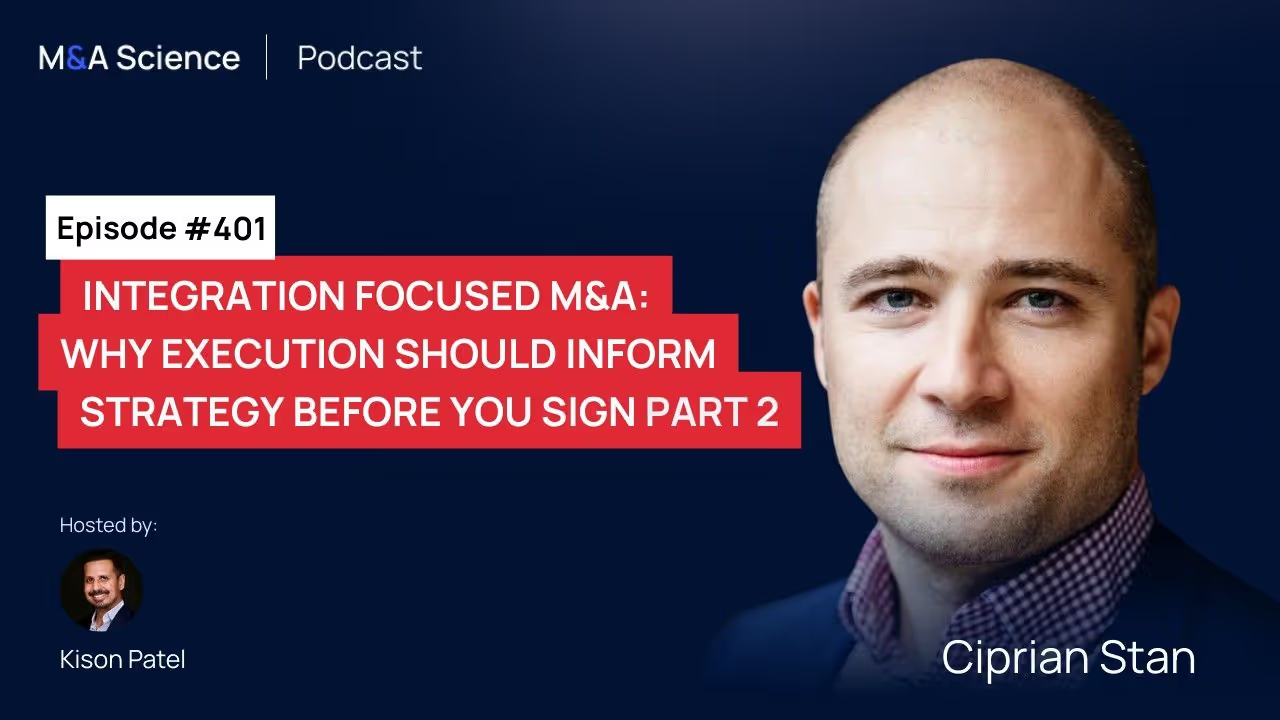
Ciprian Stan leads M&A Integration at SALESIANER Gruppe, an Austrian market leader in textile services across Europe. Spanning tech, banking, and real estate, he specializes in guiding mid-market deals through cultural and operational alignment. His approach: a buyer-led framework designed to protect value long after the deal closes. Connect with Ciprian on LinkedIn.
Ciprian Stan
Ciprian Stan is an M&A Integration Manager at SALESIANER Gruppe, overseeing operational alignment for the 100-year-old Austrian market leader across Europe. With a career spanning tech, banking, and facilities management, he specializes in bridging the gap between deal closure and long-term value retention. He focuses on "cultural fitness" and buyer-led frameworks to navigate the complexities of both corporate and mid-market integrations. Currently, he is a leading practitioner on the intersection of freelance M&A and institutional dealmaking.
Episode Transcript
Non-Negotiables When It Comes to Culture
One non-negotiable is having a red team. This means having somebody you want to brainstorm with. It does not necessarily need to be a decision-maker, but it should be someone you trust to test your hypotheses, play them back to you, and put them into pragmatic words.
Those people are rare, and if you have them, you should keep them close. They make your results better and limit your losses. There are many non-negotiables that only become clear later on. In the early stages, you do not want to take unnecessary risks, but there is often a feeling afterward that more time should have been invested or more questions should have been asked in certain areas.
This is why customizing due diligence is so important. Tailor due diligence to fit the opportunity. The five-question checklist approach is a strong example of this. Due diligence should not be a one-size-fits-all exercise.
I once upset someone by sending them a standard integration plan. Over the course of a couple of months, I kept telling them I had a standard integration plan. It was very comprehensive and covered everything. I asked them to narrow it down to what made sense for their deal. We could not align on that, so I said we would proceed with the standard plan and remove or narrow down anything irrelevant later.
When they finally reviewed it, they saw thousands of actions. They asked whether I expected them to fill everything in. They calculated tens of thousands of Excel cells. I said no. The expectation was that they would look at it and say that 80 percent of the plan was irrelevant for them. That was the exercise—to bring it down and narrow it to what actually fit their situation.
This can be done in two ways: top-down or bottom-up. One approach is to provide the full plan and let people delete what is not relevant. Some prefer this because it helps them realize things they might never have considered. They may say, “I would not have added this, but I see it in the standard plan, so let’s keep it.”
Others prefer a simpler approach. They do not want to overcomplicate things. They start with 10 to 15 actions and build from there, knowing there will be more over time.
Integration professionals need to be wiser about this. I certainly became wiser after that interaction. You cannot throw thousands of Excel cells at people and ask them to fill everything in so you can build an integration plan afterward.
The focus needs to be on asking smart questions. Transaction teams do not have the same integration perspective. Ask the right questions so the right integration plan can be built. Then say, based on what has been shared, this is what integration should look like for this target. From there, debate it, test it, and see how well it holds.
Balance of template
A lot of this is something I have done a couple of times, but it is immensely time-consuming when you fine-tune based on the wealth of knowledge and information available in the industry, combined with the specifics of the deal.
Unless there is a small army of people willing to contribute, this approach does not scale. After the first deal, people get bored, and by the second deal, they start delegating. This is where technology can help significantly.
I have seen a similar tool used for interviewing. I believe it was called performance-based interviewing. It started with a small set of questions, such as whether the person was exposed to engineering or had a specific skill set. Based on those inputs, the tool generated the interview sheet automatically.
The same concept should apply here, and this is something I have been trying to do. It is not fully automated yet, but it is getting there. The goal is to ask the right questions about the target and the right questions about the strategy behind the deal. Why are we buying this company? What is our presence in that region? How much are we spending on the deal itself? What is the integration budget?
Based on those inputs, it should be possible to produce a solid initial integration plan.
One of my non-negotiables related to this is having a preliminary integration plan before signing. We mentioned this earlier, but this plan must be part of the business case. I embedded this requirement directly into the business case template. A preliminary integration plan needs to be included so that once the deal is approved, there is already a defined set of milestones for each workstream.
For example, in the first three months, the expectation might be new branding, new email addresses, new financial reporting, and related changes. By the third month, there may be advertising in the market, billboards, office changes, and similar initiatives. All of this will be customized. Some elements will be scrapped as circumstances change, and others may evolve into standalone side projects.
The key point is having a foundation to start from. The worst situation is not having any plan and trying to build everything on day one.
Having the backbone of the integration plan early makes it much easier to steer execution and build upon it over time.
Building Trust with The Target Company
Trust is absolutely critical. Deals do get done between people who do not see eye to eye, often for financial, pragmatic, or strategic corporate reasons. That is not an ideal outcome, and it is not the kind of deal anyone enjoys being part of. These situations often involve corrosive interactions, where pragmatic arguments push the deal forward before there is time to establish a real relationship.
Sometimes those deals still need to happen. When the arguments are strong enough, you have to find a way to work through it and get the deal done. The ideal approach, however, is to build trust by meeting counterparts in their own environment. It requires understanding what they deal with every day and showing how similar problems are handled on the buyer’s side.
It is important not to claim that all their problems will be solved. Overselling should be avoided unless there is a realistic plan to overachieve. In most cases, sellers are more pragmatic than the average business operator. Many deals involve companies in the single- or double-digit millions that were built from inception by a single founder and bootstrapped aggressively.
These founders are highly pragmatic. They understand how they built the business, how they secured stability, revenue, and profitability, and what they are willing to sell for. Trust must be both inspired and earned.
Trust is not a one-way road. There is pragmatism on both the seller and buyer sides. I once had a conversation with a friend who had sold his business. We were exchanging perspectives. I explained how things looked from my side, and he explained how they looked from his. At one point, I said, “This person told us this, and that became the foundation of our planning.” He asked why we took that statement at face value.
He pointed out that sellers, without ill intent, will often tell buyers what they believe will help close the deal. It is not about deception. Sellers want the deal to close as well. On a human level, they may say what they think the buyer wants to hear.
That reality requires preparation. It is necessary to understand the seller’s perspective from different angles and to play back what was heard to confirm understanding. That process is how trust is built. I have seen senior leaders admit they were completely misguided and say that they now understood the situation much better. Those moments often lead to reframing the discussion and reconsidering priorities.
In some cases, buyers discover they underestimated how important certain elements were to the seller. For example, one request we encountered was that the engineering department should not be taken over by another function. A specific requirement was that programmers would continue using their Mac machines. They did not want to be forced into the buyer’s industry-standard setup. They were open to security controls and management tools, but they wanted to keep their existing environment.
This had not been considered at all. As a result, the integration plan had to be adjusted to allow for that setup. There had been no policy for managing those machines within the existing infrastructure. Without recognizing and addressing these differences, it is impossible to demonstrate that you are listening and building trust.
Listening means taking requests seriously, addressing them, and explaining how they will be handled. One major threat to trust is making promises early on and failing to follow through with actions later.
One particularly painful example is earnout structures. A seller is told the business will be acquired for a certain upfront amount, with an additional payout tied to performance two years later. During that period, the seller is expected to hit specific targets. This kind of structure requires significant long-term management, focus, and attention.
Problems arise when, six months or a year later, the buyer acquires another company that overlaps with the original business. This may be in the same geography, serve the same clients, or directly cannibalize growth. From the seller’s perspective, this feels like a broken promise. They were asked to grow the business in a specific area, only to see another acquisition undermine that objective.
Situations like this severely damage trust and highlight the importance of aligning actions with early commitments.
Dealing with Cultural Differences
It is very difficult to make hard judgments early on and say that a deal must meet a specific percentage of criteria in order to move forward.
Some risks and opportunities cannot be easily weighed or measured. If there are issues on both the operational outlook and the cultural side, which is often the underlying factor, then the deal should not proceed.
If the issue is limited to one area, however, and this depends on the implications and overall impact, there may still be a path forward. In those cases, the worst probable scenario should be built directly into the business case.
Redo the math and see if it still holds. Assume that those risks materialize and factor in the required investment or potential downside. If the outcome remains positive even under that scenario, then proceeding with the deal can be justified.
The key is to be realistic about the level of investment, the potential losses, or both, if those risks surface later on.
Future of M&A
Technology is always going to play a bigger and bigger role. We can debate how much of a bubble AI represents, as with any emerging technology. There is always a bubble element built in.
That said, there is a difference between calling something a bubble and calling it a hype cycle. I tend to refer to it as a hype cycle. I prefer a term that is not derogatory, because this pattern exists in every emerging technology we have ever seen.
There have always been critics saying things will never work. Industrialization would never work. Diesel engines would never work. Electric engines would never work. AI is called a failure or a bubble. What we are really seeing is a hype cycle, with strong support behind it, which is completely normal.
By the time we strip things down and crystallize AI, there will still be a lot of value left. Because of that, I am not concerned that this is a bubble. Will there be a correction? Likely.
Everybody is on the wave right now. There are so many people caught up in the AI boom, as we might call it. When things settle down, there will still be a lot left behind—really good tools that can actually be used in a meaningful way.
The interesting thing about this moment in time is that my son reminds me I have already spent more than my shelf life dealing with certain technologies. He is far more accustomed to them. When we compete on the same terms, he clearly outpaces my knowledge. But beyond that, the generation that will carry this forward will not find it awkward at all, while many of us still feel uneasy around certain concepts.
There is a relatable parallel from the early days of mobile phones. I remember seeing someone walking down the street talking on a phone and laughing, and it looked like they were talking to themselves. At the time, it felt like something out of a science fiction movie. Today, it could not feel more natural.
This pattern repeats with every technology we invent. Each one changes how we behave around technology. AI and related tools will have a massive impact on how we consume and process information. For example, having a tool that can parse hundreds of hours of podcast content and extract exactly the information needed is incredibly useful. The fact that it works across both video and audio content is remarkable.
For today’s kids, who will eventually become professionals, this will not feel awkward or impressive. It will simply feel normal. For me, there is still a sense of wonder when I type in a question and receive answers pulled from different episodes, different sources, complete with references. I often think that if I had access to this kind of technology during my university years, the experience would have been completely different.
Technology will increasingly become a helping tool. The challenge is settling down from the hype of inventing everything and focusing instead on inventing the right things. That process cannot happen without experimentation. Many ideas will be tested, some will not fit, and others will emerge as unexpected winners.
This reminds me of the old saying about financial crises: out of the last ten financial crises, experts have accurately predicted hundreds of them. The same applies when debating the future of AI, technology, and M&A. I recently discussed this with a good friend, Keith Poner, while talking about what leadership will look like ten years from now.
We concluded that whatever we say today, it is unlikely to be definitively wrong, because all outcomes remain possible. That was our way of avoiding irrelevance. The real skill is predicting based on what is known today and doing so with a pragmatic voice.
That leads to two important questions: what should be used from the technology available today, and what should technology look like if it is truly meant to help in the future? Both of those discussions need to happen.
Freelancing in M&A
Freelancing is a natural element of the M&A ecosystem, just as it is in any consultancy-related field. There will continue to be a healthy level of freelancing in this space.
There are several strong aggregators in the industry that I have spoken with over recent years. This model is particularly well suited for companies that do not see enough value in building a fully internal M&A function. Instead, they can outsource specific needs, bringing in experts to step in quickly and resolve targeted issues. This is especially useful when a transaction is taking longer than expected and an additional pair of hands is needed.
The key challenge is getting the balance right, particularly in reducing the learning curve. If a company completes an acquisition every two years, it makes sense to return to the same external experts. That way, there is no need to repeatedly onboard new people or reintroduce the company each time.
Ideally, there should be a credible freelancing hub from which support can be contracted, preferably engaging the same individuals whenever possible. This allows both sides to benefit from accumulated knowledge. The external experts understand the company, its context, and how it operates, while the company avoids the cost of maintaining a full-time, in-house team when the workload does not justify it.
AI in M&A
What I like about bringing reasoning power into AI is the ability to use accumulated industry knowledge. That knowledge was already accessible through mobile phones, but now there is a reasoning layer wrapped around it. This layer goes through the information, synthesizes it, and says, based on what most people who faced a similar problem experienced after making this decision, these are the things to consider.
What I find particularly valuable is the ability to ask follow-up questions. You can ask, why are you giving me this answer? This is one of the things I appreciate most about AI chat tools and brainstorming with AI. The system has to produce arguments. Sometimes I agree with them, sometimes I disagree, but either way, it expands my understanding of background information that I may not be deeply familiar with and would not be able to absorb in fifteen minutes, even if I had the time.
I am optimistic about the future, given all the moving pieces that are coming together. I strongly support using these tools responsibly, both from an ethical standpoint and with realistic expectations. They should not be expected to be perfect from the beginning. It is important to remain mindful and to review the underlying information to ensure there are no hallucinations or inaccuracies.
That said, once everything settles, I am confident we will be left with some very strong and genuinely useful tools.
There is a real concern that AI-driven tools can break or make mistakes, and I agree with that. That is a risk we need to think seriously about. Sometimes we give these tools access to more than we should, or more than we feel comfortable with, such as credit cards or sensitive information.
This reminds me of an experience from when I started my first job. I was given a lot of trust, largely due to the generosity and forward-looking optimism of a childhood friend of mine, Valentino. He was part of the department where I started working after university. Today, he is a Managing Director for IT Services at Accenture, covering the Americas and EMEA. His CV seems to update every fifteen minutes. He keeps getting promoted and taking on more responsibility. He is a brilliant individual.
Two weeks into my job, I deleted his hard drive. That was the level of trust he placed in me. We both recovered from the experience, but it was a strong lesson.
Because of that, I do not trust AI with that level of power right now.
Learning from that experience, I am very cautious about what I trust automated tools with, and I believe everyone should be. There will be errors, and we need to be mindful of the margins of error.
The key questions are how much risk we are willing to accept and how these tools should be tested in a sandbox environment before going live. At some point, that discipline will be required.
M&A Software for optimizing the M&A lifecycle- pipeline to diligence to integration
Explore dealroom

Help shape the M&A Science Podcast!
Take a quick survey to share what you enjoy, areas for improvement, and topics you’d like us to feature. Here’s to to the Deal!
.png)

.jpeg)