
M&A Science Podcast
 / 
Listen Now:

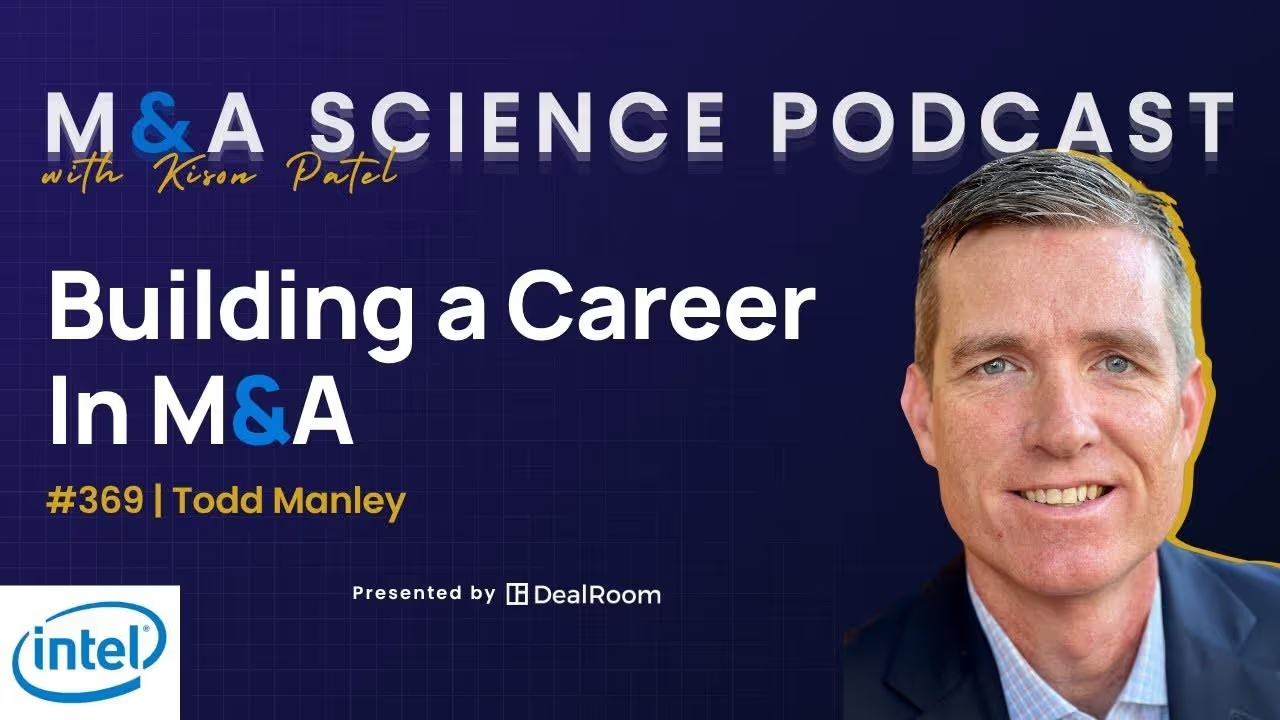
Build a Career in M&A: Lessons from Intel's Todd Manley

Todd Manley, VP of Corporate Development Integration at Intel

In this episode, Todd Manley joins Kison Patel to share his non-traditional path into the world of M&A. Starting his career in IT and organizational behavior, Todd brings a unique lens to integration and leadership in corporate development. From his early consulting days to overseeing integrations at Cisco, Symantec, and now Intel, Todd has seen it all. He opens up about what it really takes to thrive in M&A—from career pivots and networking to managing divestitures and leading with empathy.
This episode is packed with career insight, integration best practices, and practical leadership advice for anyone navigating—or trying to break into—the fast-paced world of M&A.

Things you will learn:

  • How to break into M&A without a finance or banking background
  • The critical leadership traits that matter in integration roles
  • Why networking and curiosity matter more than job titles

Intel (Integrated Electronics) is a global technology leader that designs and manufactures semiconductors powering computers, data centers, AI systems, and connected devices worldwide. Founded on innovation, Intel drives advances in processing, memory, and platform technologies that enable faster, smarter, and more secure digital experiences.

Industry
Semiconductor Manufacturing
Founded
1968

Todd Manley

Todd Manley is a corporate development and transformation leader with 20+ years of experience across M&A, post-merger integration, and enterprise change. He has led ~$70B in deals delivering $7B+ in synergies, built scalable integration and operating playbooks, and driven large-scale transformations spanning ERP, GTM acceleration, and privacy readiness. A former acquired executive and Santa Clara University leadership instructor, Todd brings a pragmatic, team-first style shaped on the Stanford basketball court.

Episode Transcript

PART 1-Build a Career in M&A: Lessons from Intel’s Todd Manley

Kison: [00:00:00] I am Kison Patel, and you are listening to M&A Science where we talk with deal professionals and learn valuable lessons from their experience. This podcast focuses on stories, strategies and what actually happened during M&A deals.

Kison: Hello and welcome to the M&A Science podcast. This [00:00:30] podcast is part of a mission to rethink how M&A is done. The old school settle led approach, it's dead fire led M&A is all about strategy, alignment, and efficiency. Putting value creation at the center of every deal. Let's be real. It's not just about closing the deal, it's about making it successful.

Kison: We uncover what truly works in M&A by learning directly from the best. I'm your host, Kison Patel, founder and CEO at deal room and Chief Scientist at M&A Science. Today I'm sitting [00:01:00] down with Todd Manley, VP of Corporate Development Integration at Intel. You're not familiar with Intel. They're an American multinational corporation and technology company headquartered in Santa Clara, California.

Kison: They design, manufacture, and sell computer components such as CPUs and related products for business and consumer markets traded on Nasdaq under INTC. Todd's been in the M&A game for a long time, but what really stands out about [00:01:30] him is how much he's learned and shared along the way. He didn't take the traditional path into corp dev.

Kison: That's exactly what we're diving into today, how people from all kinds of backgrounds, finance, legal ops, you name it, can break into M&A and actually thrive. We'll also get into some tips for interviewing both as a candidate and hiring manager and how to build a strong network in the M&A world.

Kison: Todd, how you doing? Good, man. We're finally doing this. It's taking a long time. You know, that was the first thing I was gonna make a point of. Probably the first lesson to [00:02:00] this podcast is persistence trumps everything.

Todd Manley: How you get good deals done, you persist. We first started talking, oh, it feels like five, six years.

Todd Manley: People in my network, people, I know there was one point where Jim Buckley was talking and maybe it was more of a like a live webcast or something, and I'm getting on and I'm like chatting in, Hey Jim, mention this or mention that. And then next thing you know, like we got this [00:02:30] three-way tangential conversation happening on the side, which might have lost a few people, but it was fun in the moment.

Todd Manley: Come up for a little air. Had a lot of work here at Intel doing a divesture and a spin out of our Alterra business. Um, it's one of those stories where 10 years ago from Alter, uh, came into the Intel family and we, uh, strategically looked at what the portfolio was and made the choice, you know, divesting them, bringing in and outside investor to help it grow.

Todd Manley: It was gonna be the right decision to make. So, yeah, I didn't mean to be a bad friend for the last two years, but I was pretty heads down. I [00:03:00] understand. I forgive you.

Kison: You know, after what, maybe 15, 20 requests to come on the podcast. We finally got you here live in the Bay Area at Intel. This is global headquarters.

Todd Manley: This is the global headquarters. World

Kison: headquarters

Todd Manley: for Intel. Yes, exactly.

Kison: Can we start with your background? How'd you find your way into M&A?

Todd Manley: My journey in M&A was interesting. I came down to the Bay area, grew up in the northwest, came down this way. Played basketball at Stanford. Um, can't tell at tall AM from sitting down, which is perfectly fine, but Kison can share that.

Todd Manley: I banged my knees into [00:03:30] the bottom of the table, which didn't feel very good, but came down here and was just thoroughly entranced by tech in my studies. I did not have the computer science chops to be someone who's just gonna dive straight into tech. There was an aspect that really intrigued me. I actually was a sociology major with a focus on organizational studies and behavior.

Todd Manley: The interesting play on that was a lot of those professors actually taught at the business school, and so I was like a way to get some aspect of a business flavored education. Even though Stanford was a [00:04:00] and is continues to be a liberal arts school outside of like the technical stuff that they teach coming out of Stanford and playing basketball.

Todd Manley: Didn't try to go play professionally anywhere else. I reached my ceiling and I was happy about that. I wanted to go back up to the northwest. I was from Portland. Thought Nike would be a good fit. Happened that it didn't work out there. I came back down this way, crashed on some couches. Ended up taking my first opportunity with a IT consulting company, if anyone remembers the old name, EDS, electronic Data Systems.

Todd Manley: Funny enough, precursor, [00:04:30] maybe some foreshadowing on M&A. They were acquired and became hp, or what now is HPE. It became their service arm, their consulting arm. Came into their program and joked to the hiring manager, I said, what about my background makes you think I'm gonna be a good fit for your organization?

Todd Manley: And they said, we've got the software engineer development program and we look to bring people in with diverse backgrounds. And you've shown some proficiency in being tech curious. You've done some web programming, and this is back in like 1995 and just some HTML, some [00:05:00] JavaScript, what have you. And they're like, we can teach you everything you need to know.

Todd Manley: What would you like to focus on? I knew I always wanted to go back to business school and the young 22-year-old just said, I'd like to focus on business applications and understand technology that actually helps businesses do their business. Promptly got put into doing ERP work, all things under the sun, Oracle.

Todd Manley: So I got trained up on being a programmer, a DVA, a, CIS admin and implementer, you name it. I, I started out in kind of the order management vertical and then spread my wings. A little bit upstream into CRM [00:05:30] downstream into financials, a little bit to the left, into HR and HR analytics, business reporting and all that.

Todd Manley: That was my first 10 years of my career was I was really deep into, I. IT and business applications. And at one point thought, Hey, maybe I'll be a CIO. But what was interesting, during that whole time, I still had this closet passion around startups, VC, community, private equity, M&A, acquisitions, dive union, that whole thing.

Todd Manley: But I, I was like, I don't have an immediate skillset that plugs into what would be the standard that everyone [00:06:00] thought. Gets you into high flying startups, or I'm the product guy that's got this great idea and I'm gonna build it from zero to a billion. I knew I wasn't that guy. I always joke to my wife that I'm kind of like the series C, series D come in when they, they need to prop up the business and, and put a little more structure and formality.

Todd Manley: And funny enough, I did find myself joining WebEx way back in the day. I joined them about four months before they went public, and it was right as the.com crash was happening. We were one of the last companies that [00:06:30] kind of got out the door. It was a fun ride, helping to build that business. You could play Monday morning quarterback and go.

Todd Manley: We were doing things that were in the cloud before the cloud was the cloud. The product had moved from being a hosted kind of client server model that delivered web conferencing capabilities to a solution that was actually hosted in dedicated data centers. Where customers would go into their WebEx product just via the browser.

Todd Manley: It was pretty cutting edge back then and a precursor to a lot of things. And it's been really interesting that you hear about these different [00:07:00] transformational startups that have spun off different founders or inventions or leaders or what have you. And people talk about PayPal Mafia and the PayPal leaders that have have moved on from their early beginnings.

Todd Manley: There stories is. Leaders that came outta WebEx. You had the subscription company Zuora come outta that. They had gone public and are now under private equity ownership. You had some strong engineering leadership with the folks that started Zoom more of the common tools that we see now. There was a strong I.

Todd Manley: [00:07:30] Proliferation of talented people that did some amazing things back then and have continued to do that going forward. And during that time, I, I found an opportunity for my wife to join a different startup. I kind of used the extended reach of the family to be on the front lines of what was my closet passion, and I wasn't on the front lines of doing M&A.

Todd Manley: Enjoyed the time there. Moved on to a different startup and then eventually landed at Cisco. It was when I was at Cisco. I'd been there for about a year. They actually went out and acquired WebEx. I remember the day that the deal happened. [00:08:00] We were doing skip level leadership conversations. I was like a senior program manager and a bunch of my peers came in and there was a VP who was facilitating this leadership conversation.

Todd Manley: So we sit in a big room like this and he goes, Hey, big news, we're acquiring WebEx. And at that point, Cisco had been averaging, I don't know, eight to 10 deals a year. Typically a little more tech talent, tuck in kind of stuff, nothing super big. This was actually a second largest transaction they had done in 2005.

Todd Manley: They did scientific Atlanta, which was some set top [00:08:30] boxes and for like cable technology, television, what have you. And then WebEx was like 2006. So the second big one. You know these big ones, everyone in the room's a little fired up, excited, and people had used WebEx. So this was one where it was like, we know what it is, we've used it.

Todd Manley: Okay, now it's gonna be ours. The VP goes around the table getting everyone's opinion. I'm the last person to give the opinion. I was still relatively new in the organization and no one really knew my background. I got on the proverbial soapbox and I said, it's a good acquisition. It should have been done probably nine to [00:09:00] 12 months ago.

Todd Manley: It was unfortunate that Cisco bought the number. It was like the number three or the number four player in the market 12 months earlier. That was the wrong acquisition to go do. They should have gone after the market leader, which they finally did, but they probably had to pay a premium. Everyone's looking at me like, how does this guy know so much about the inner workings of WebEx?

Todd Manley: Now, no one knew that I'd worked there. As I'm talking, I'm figuring out, okay, what's my punchline? So I say my piece and I go, oh, and by the way, I worked there for four years. So, and then you see this kind of relief in the room go, oh, [00:09:30] okay. But what got me into M&A was the conversation that happened after that leadership skip level meeting.

Todd Manley: I walk outta the room. VP pulls me aside and says, Hey, sounds like you know a lot about WebEx. I go, yeah, I still have a lot of friends that are over there and still stay in touch. Small Valley. He goes, look, we got our integration team going over there next week. If you're open to it, I can get you in touch with the IT director who runs the team.

Todd Manley: You might really be viable and and seeing if there's some percent of your time you can carve off and just go work with them. And I said, yeah, [00:10:00] I'd love to. In the moment. I was excited about just the opportunity to be part of it. I remember walking down the hallway going, oh man, this could be like kind of the, the opportunity of my career to pivot out of doing just strictly IT work and taking that background and saying, how do I apply it into, I.

Todd Manley: Some aspect that is M&A related. I landed into doing it integration work, and that's where I first cut my teeth over 20 years ago. It was interesting being part of a organization that was doing so many deals, add a vast number of [00:10:30] experts across all parts of their business, and it was a well-oiled machine.

Todd Manley: We can look back and play Monday morning quarterback on whether deals were successful, whether they hit the value that people were trying to do, and. I'd say there was always learnings from every deal. Some of the bigger deals were a little more difficult 'cause the organizations and the way that we worked really tuned to the small things and churning through them real quick.

Todd Manley: But it was an environment where I had a ton of growth. I saw a lot of different ways of how things were working, and it was there when I saw that there was probably. An [00:11:00] opportunity somewhere in my future to continue to grow to try to bridge the divide or the gap. That was evident when I first started.

Todd Manley: That was around doing the deal and then the integration guys doing the integration work. I'd say as a practice, and you've had other presenters talk about this and I'm excited to talk to you today 'cause we're gonna talk on some topics that, that are different than when we first reached out and we're talking about, you know, how do we get an integration management office up in our name?

Todd Manley: What are some of the things that need to be there? There's a lot of best practices that as practitioners, we've been [00:11:30] open with each other, we've shared, it's like there's no secret sauce. I get a lot of. Joy out of seeing other people do this work well, whether it's a friend at a competing chip company or someone at a software company, if they're gonna do a deal.

Todd Manley: One I commiserate 'cause I know it's a lot of work. And two, I really hope that they do it well. It's great when practitioners get together and we commiserate, we share what works, what didn't work. This was a thought that started to come together way back in like 2007, 2008, was there were some instances where deals would get done and [00:12:00] the proverbial deal's done, let's throw it over the fence to the integration guys, and we'd be on the other side of the fence just, okay, are we gonna catch it?

Todd Manley: Where's it gonna land? When you talk to people who are trying to hold themselves to the best practice standards, they're really trying to narrow that gap, how the deal needs to get done. How the acquisition needs to be a natural kind of flow out of that deal and not having some sort of chasm in between where there's, you're ripe for delays or misinformation or just a lack of [00:12:30] knowledge.

Todd Manley: Being on that continuum of progressing the work forward for me. I actually then pivoted to a couple other roles. I left Cisco on consulting. My actual goal was to, I wanted to be a one man shop and be able to do both deals and integration. I applaud anyone who is doing both today. I did it for a while and I realize how hard it's not only are you burning the candle on both ends on the deal, you're also having to partition part of your brain to start thinking [00:13:00] about, okay, how's this all gonna come together, integration wise and long term?

Todd Manley: How the business is gonna run. If you are in that seat, people can reach out to me. I'm happy to commiserate on LinkedIn and share any insights that I have, but it feels like you've run a marathon just to get the deal done. Oh, by the way, it's a one way marathon, so you ran 26 miles in one direction. Now you sign the deal, okay, the deal's closed.

Todd Manley: Now you gotta run 26 miles back home, which is, let's get the integration done. It's just a large body of work. There's [00:13:30] different skill sets that thrive in different areas, and I knew that there were blind spots or areas of weakness that I had in being a deal lead, not having investment banking background.

Todd Manley: And that's where I lean more heavily on experts who had deeper expertise in certain areas than I did. I enjoyed it, but I also recognized that it probably would've taken some years off my life if I continued to do that. I've continued to focus on integration work, and if there's spare time that I can apply my skillset to, I find myself getting pulled into a lot of broad cross enterprise [00:14:00] level kind of transformational programs.

Todd Manley: There's a lot of transferability of skillset of what we see in integration and some aspects of deal work that can be applied and show up real well. When you're looking at big, large programs that require cross-functional coordination across a lot of different people and organizations, high criticality of, you gotta hit this and here's what we're trying to accomplish, and.

Todd Manley: I've thoroughly enjoyed the career. I love doing it. There's aspects of acquisitions which are fun. There's aspects of [00:14:30] divestitures, which are a completely different beast. Anyone who says that they're the same as acquisitions, don't believe 'em. They definitely are harder. You're trying to extract a business, trying to have it land.

Todd Manley: If you're landing with the strategic, you've got certain aspects where there's a landing zone for it to go with people. The operations business process, what have you. If you're landing it with financial buyer. Then you've got a different set of problems that you gotta solve for, which is standing up certain aspects of how the business is running.

Todd Manley: They are different, timelines are different. [00:15:00] Some of the headwinds that you hit are gonna be different. But in totality, when you step back and you look at what do you get to do when you are. Doing M&A work wouldn't change it for the world.

Kison: Love it. Just on the career, you mentioned going from Cisco Consulting, not to just drop some logos and names here, but I know you had run at Symantec.

Kison: Yeah. Marvel, Intel. Am I missing anybody else? The interesting

Todd Manley: one was from consulting. I went to a small cybersecurity company that was private equity owned. It was Blue Coat Systems, [00:15:30] and what was interesting with Blue Coat was we were acquired by Symantec and. As a practitioner, you, when you're doing acquisitions, if you've got that rapport with people you're acquiring, you'll hear the inside baseball of some of the headwinds and the difficulties that they had as they came on board.

Todd Manley: It was really informative for me to sit in that seat and myself being acquired, and this was after doing this kind of work for 10 years, I was like, okay, now the tables have been churned. I'm actually going through an experience [00:16:00] where I'm being acquired. I did not make the choice of who acquired me.

Todd Manley: What's this change journey feel like? It was interesting to almost feel like I had the InBody experience of being, being present in the moment of how that was happening and then that kind of out of body of what might have been a misstep or something that bothered me, oh my. I've done that to people.

Todd Manley: Okay. I'm learning from that. That was really important to go through that so I can, with authenticity, be able to talk with people. I remember I joined Marvell the [00:16:30] week I joined. We were actually closing a deal and I remember closed the deal and I was up front of probably 50 engineers. I said, I'm on the same journey as you for a couple of reasons.

Todd Manley: One, I just joined Marvell and you just joined Marvell two. I've been acquired and I know what you're going through, and I wanted to let them know that there, I had empathy for what was going on, and it was one of those situations where it was kinda like when I said it, you could just see this reaction in the room, like a, ah, I get it.

Todd Manley: He's been through this [00:17:00] too. That was important for that audience to understand that I'd gone through an experience like this before. This is quite the story

Kison: starting off from Stanford basketball. Sociology, going to consulting, ending up in a whole series of IT roles at Oracle. Well, it wasn't

Todd Manley: at Oracle, it was doing Oracle work for different companies.

Todd Manley: So I was doing Oracle ERP implementations at Hitachi when I was doing consulting Hitachi data systems. Then when I was full-time over at WebEx and another small startup. Then also doing Oracle [00:17:30] work at Cisco. So it was very, IT focused the first

Kison: 10 years, bunch of IT roles related to Oracle and. Start a bug and you ended up at WebEx.

Kison: And then from WebEx you went to Cisco, where you got first exposure to M&A. Acquiring WebEx. Acquiring WebEx, yeah. And then from there, moving into consulting, that got you to Blue Coat another startup and being on the receiving side. Then to Symantec and then Marvel, and then now Intel.

Todd Manley: The one thing I didn't mention was I had [00:18:00] a brief stint at HP as it was going through the split.

Todd Manley: I remember coming into the organization and plans had been announced that they were going to split the company into HP Enterprise and HP Inc. And that was interesting to land into, partly just because of the sheer magnitude of the size of the company and the amount of change it was gonna go through and splitting itself apart, and then trying to come in and do integrations and deals knowing that [00:18:30] there was just so much change in the air.

Todd Manley: It was unique to see how that played out. I wasn't there to see it get to the finish line. It was super informative to give me some points of view that have informed me in how I look at certain aspects of divestitures. Just the amount of change that people in the business go through and just some aspects of how difficult that can be.

Kison: What in your background, even starting from basketball till now, that you really felt has [00:19:00] attributed to. Your success and just the skills that you apply today. I'm a big

Todd Manley: team player. I really grew out of playing a lot of basketball. As I look back on my career and what I think highly, most, it's, it's those teams that I was part of that were like tackling hard problems there for each other.

Todd Manley: Different people showed leadership at different times. You had expertise around the room that each knew how to contribute. Knowing how to come together as a team. Like those instances that I look back, whether it was something athletically or [00:19:30] something in the business world, that I can go back and I can recall certain areas of adversity that we overcame or things that we accomplished that we never thought we could, and really like to fall into creating a safe environment or the teams that I create and the people that I bring into my teams.

Todd Manley: I remember. There was a program that I had that had multiple big four consultancies contributing to our end goal, and I pulled in the consultants and I had the partners there. And it was an [00:20:00] interesting conversation because typically you don't have competing big four people in the room working on the same thing.

Todd Manley: I was very clear on the vision that I wanted this program to have the goals, and I looked at each of them and I was like, you were part of my team and we are going to successfully come together and accomplish a lot. I need you to leave your allegiances to your own firms outside the room. 'cause when you come in the room, you're my team and my team needs to work well together.

Todd Manley: And if I find that there's infighting, [00:20:30] there's only one thing we're gonna do. You're gonna get called into the principal's office. IE, you're coming in with me. We're gonna have this conversation once. And if behaviors don't change, there's consequences. It set the tone. But I also wanted people something that we were trying to go and accomplish together.

Todd Manley: Our collective success was more important than one group saying, I did this, and they didn't do that. It's the sum of all the parts.

Kison: If you look now through your journey, you've worked with folks from all different [00:21:00] disciplines, backgrounds, coming from different functions, do you see any other themes?

Kison: Obviously the teamwork component being collaborative, that make folks successful in M&A?

Todd Manley: There's a couple interesting components that make people successful. Coming into it without any prior business experience or an area of knowledge can be maybe a little overwhelming or difficult. If we focus specifically on integration and integration related roles.

Todd Manley: Coming through consulting, you get exposure to a lot of different clients, [00:21:30] and there's great frameworks for bringing in younger talent, younger hires, having them learn. That's one avenue. Another avenue is joining companies that are actually doing M&A, and you may not be. Part of the M&A ecosystem, but you're working in an organization, in a company that does it.

Todd Manley: So you're getting exposed to it, and at a certain point it's valuable that if you're interested in it, you can find ways to get closer to the gravitational pole of the work and you can express interest in. I'm [00:22:00] curious about doing this. I'd like to learn more. I'd like to get into it. And at that point you've probably had some experience within your own organization and business and built up, hopefully some internal expertise that can contribute to what that deal is looking to accomplish.

Todd Manley: I just think it's really hard to just show up and knock on someone's door and say, I wanna do M&A and not have some aspect of what do you bring to the table that helps us do this well

Kison: and build upon it. I like that point of view on how to break into the industry. Just look for companies that are generally in acquisitive, [00:22:30] get into the company and then migrate your way towards where the MA activities happening.

Kison: If you're looking at that profile, going back to what really makes someone successful.

Yeah,

Kison: because I feel like I get a bunch of people reaching out. They're trying to break into the industry. Hopefully I can tell 'em to listen to this podcast from here on out. One is like, can you qualify yourself? This is the thing I found really interesting working with corporates is that sheer diversity of backgrounds, you meet folks whether c dev integration, they come up through any function.

Kison: Yeah, it doesn't really matter. There's no consistent [00:23:00] theme versus private equities. Nearly everybody's coming through an investment bank. See a little bit of that in some of the corp dev roles as well, but. There's a certain profile that you see with somebody like, Hey, being really Type A makes you really suitable for an integration role, or is it just purely adversity counts as part of assembling a team together?

Kison: There's a couple key components.

Todd Manley: One, it helps just to be naturally inquisitive because at least coming from the integration side of the house, you have a general baseline of I know what my company does. How does the target do it? [00:23:30] How do they process payroll? How do they work with customers? How do they strategize and think about their business?

Todd Manley: It helps to just have an inquisitive nature and just this thirst of wanting to learn. I remember when I was doing some consultant work, I had worked with a client after my period of time with them. We had done four deals in one year. We took some of our lessons from the first two deals and said, okay, let's approach deal number three a little differently.

Todd Manley: What was interesting was we did an offsite with some of their key leadership, some of their [00:24:00] operational folks, and I remember pulling aside my client and saying, we're gonna structure this differently, and it was a two day event. Instead of us doing all the talking on day one, we're gonna do all the listening and we're gonna have the target tell us how they run their business and we'll have structure, we'll have an agenda, we'll make it valuable to people in the room, and we'll give 'em some guidance there.

Todd Manley: Day two, instead of us coming in and us telling them, this is how we do it, you're gonna listen to what on [00:24:30] day's, all things. Integration super easy, but here are like two or three big rocks that we gotta go solve for, and that was really interesting to see that play out when we flipped the script because you saw some really attentive listening by the acquirer.

Todd Manley: You actually had the target company. Taking a lot of initiative and really opening up about what they did, how they did it, the problems they had. They actually were already starting to [00:25:00] think about, we've dealt with this problem, but if you guys have solved for it, we're happy to change. We'll do whatever.

Todd Manley: In hearing that openness on that day one, and then having the acquirer come back and is almost like active listening, I heard what you said and I'm playing back to you what you said, but I'm playing it back now through my filter of additional information that I know and I can apply to the problem at hand.

Todd Manley: It was pretty cool to see how we were able to accelerate and move things a bit more forward to how they worked, and that actually hits like the second point I made here was some new ways of [00:25:30] working and thinking, and that's one reason I'm like our M&A community, regardless of whether you're upfront sourcing deals, working in diligence, doing integration, you name it.

Todd Manley: I put a big net around the whole community. I just love learning from other experts and I thoroughly enjoy going to conferences. I love hearing about M&A that happens. In other industries. I was fascinated a couple years ago, someone from oil and gas was talking about M&A. They mentioned something integration related that was like it was gonna take years.

Todd Manley: And I was like, that's interesting. [00:26:00] 'cause in the time it might take for years, like I didn't know enough to understand the context of why it would take that long. So I was curious to learn more juxtaposed against maybe some of the speed that you can do a quick little 50 person engineering team tuck in, boom, boom, boom.

Todd Manley: They're integrated within, you know, four months. Interesting to just pick up that expertise from other practitioners. It's cliche. Everyone says it. I'll say it. Every deal is different. Every person who does M&A work should have that tattooed on their wrist. That, and maybe I don't comment on rumor and speculation.

Todd Manley: True. Those might be true. Two, two good [00:26:30] tattoos to have and then some other common traits. You've gotta be comfortable with ambiguity at your core. You gotta be able to walk into a room and leave at the door. Sometimes your expertise. Some sense of, I know how this is gonna go. You need to be really open and you, you also need to know that ambiguity in many people, that creates a sense of maybe anxiety or discomfort.

Todd Manley: If you can recognize that's gonna be there and be understanding and thoughtful that that's just part of it. How do I deal with it? [00:27:00] Do I deal with it through having the right kind of conversations to flush out more information and narrow down that ambiguity or put some frameworks around the way I think about it or how I need to put a body of work together to deliver X or Y.

Todd Manley: You can't be afraid of that. I put it that way because you'll get people who are very maybe oriented, like my job is I put this box on the shelf and then I go do this, and I do that. Like they're comfortable with the process. I come in, I do my job, and I go home. Back to like every deal's different. You're not gonna be the expert on everything.

Todd Manley: You're gonna come into these [00:27:30] situations where ambiguity is the biggest elephant in the room, but you gotta be comfortable with working through that. And at the end of the day, sometimes it could be just as basic as saying, look, here's our guiding principles for what we're trying to accomplish. Let's anchor back to those and not get overwhelmed by fraught and anxiousness.

Todd Manley: And I also think the ability to lead is really important. I like to see leadership across every level of. The deal and the integration leading shows up many different ways. It doesn't mean you're the person at the top of the governance chart leading the deal and accountable for it. It [00:28:00] spans the whole, the breadth of you may be organized around functions, and that's how you integrate.

Todd Manley: You're showing leadership within your function. Or you may be a subject matter expertise deep in the organization, but your knowledge shows up as leadership when you're able to step into a room and really convey some aspects of how the business needs to run or operate or get integrated. I don't think leadership is just something that people at certain levels in the organization need to show.

Todd Manley: It needs to show up everywhere. And one of the hard dynamics, and this actually goes back to. Something I learned back in [00:28:30] my sociology days was the difference between formal and informal authority. Formal authority. I'm your manager, I'm your boss, I'm whatever. Okay. Formal org chart kind of stuff versus the informal of I'm the expert in the room, but I have no association with you, and how do I somehow show up and lead or attempt to lead based on my ability to contribute to problem at hand and helping to develop a solution to get us where we need to go.

Todd Manley: Leadership shows up a lot of different ways.

Mm.

Todd Manley: That's always something that with younger people who I [00:29:00] either talk with or mentor or have been part of my teams, it's something that I try to instill and really say, look, you're always gonna learn to be better leaders. I am always on a journey to be a better leader, but it's something that you shouldn't shy away from.

Todd Manley: And in fact, it's something that in many cases, people are gonna be like, Hey, thank you for stepping up, or Thank you for saying that, or Thank you for leading. Sometimes it's just the little things. I remember telling a junior person a long time ago, I was like, look. If you just raise your hand and say, Hey, I've got that action item, I'll take that.

Todd Manley: That's a step in the right direction. Absolutely. You know, dude, and you can [00:29:30] build upon that. You gotta have to be a strong communicator. Communications also, when I say communications, it highly leveraged on listening. I like to joke that we were born with two ears and one mouth and let's use 'em in that proportion.

Todd Manley: There's a lot of power in being able to listen, to understand and think through what are the, the difficulties of deal, work and integration work, and then playing that back and being able to synthesize what you heard versus what you know, and how does that come together. Some of those interpersonal skills that come along with that.

Todd Manley: I learned a lot about myself over the [00:30:00] years, taking like Myers-Briggs tests at different companies and it's been an interesting journey. 'cause at one point I actually tested out as a pretty strong introvert and now if I test out, I. I wouldn't say a full extrovert, but I've crossed the line and it was interesting 'cause I remember it was probably about 15 years ago, I remember feeling like, okay, the pendulum's switching a little bit from being an introvert to get an extrovert.

Todd Manley: And it was interesting 'cause I, I read some materials. There was a book that Susan Kane wrote, it was something, it might have been like the Power of Quiet. And she was an [00:30:30] introvert. And I remember watching a Ted Talk and she starts her Ted talk off articulating that as a youth, her family would go on vacation and they'd all get to their location, bust out a book.

Todd Manley: And that's what they did. They just went full introvert reading and they all enjoyed that. And her research and writings actually were very interesting to me because it highlighted some dynamics of how do you take what is perceived as maybe weaknesses of an introvert, but really our strengths. You flip that on its head and benefit from that.

Todd Manley: So that was really interesting for me and understanding a little bit of the the introvert side of me. And then [00:31:00] more lately it's been okay, how does the extrovert side of me grow and continue on that journey? I like to think I can take an introvert and make them feel comfortable, pull 'em aside, have a one-on-one conversation.

Todd Manley: 'cause introverts are really good at making personal connections and diving deep in the topics versus the extrovert who wants to be in the room full of energy and it's just soaking all that up. Some of those interpersonal skills and dynamics are really important because you're gonna come across people doing deal work that are across the whole gamut.

Todd Manley: Especially coming [00:31:30] into this work, you have to understand that there is an intersection of strategic and tactical views that come together at different points in time over different aspects of where the deal is, and being able to think about strategy. How does that maybe play out three or four steps down the line that might land in integration, or is there something in integration that you know of?

Todd Manley: Is going to go upstream and impact the strategy. [00:32:00] Being aware that you can't just come into this kind of work and be like, it's, it's highly strategic and it's this, and it's this. There's a bit of rolling your sleeves up and you've gotta really understand how the business works. If you don't have that appreciation for both different lenses that get applied, you'll find yourself tripping up on things that in hindsight, you're like,

ah,

Todd Manley: we see that we should have done that.

Todd Manley: Or, oh, we didn't see that. I sometimes use the analogy of, you gotta be a helicopter pilot. You gotta be able to fly up to, I don't know if a helicopter can get up to 10,000 feet, maybe I'm [00:32:30] exaggerating, but it's gotta be able to get, you know, high. Right. But then you gotta like, Hey, I'm gonna go be a crop duster.

Todd Manley: I'm getting in the weeds. Yeah. Yeah. Zoom, zoom.

Kison: Being inquisitive. Big part of that is listening, highly agree with, and then identifying new ways to do things. Being comfortable with ambiguity. Let me poke on

Todd Manley: something. New ways to do things. The reason I poke on this is I routinely see new people coming into this and almost coming in it with so fresh of an eye, which I don't mind, but saying, what's the new metric [00:33:00] or what's the new this and what's new that.

Todd Manley: Maybe Jim Buckley and I had a deep conversation on this once or twice, but it's kinda like, look like there's some basic metrics that are just routine to running a business. There's no new analytic, like I'm thinking about, I don't know baseball real well, and I don't know like the, maybe you're a bigger baseball fan than me.

Todd Manley: No, there's some acronym, maybe it's War or opia. I know there's something out there that. That is synonymous with success. It might be like combination of how many times did you strike versus hit the ball versus take a walk more or less an [00:33:30] algorithm to give you a a metric batting average, even more complex than that.

Todd Manley: Oh, okay. Batting average on steroids, batting average is good enough. We don't need to boil the ocean on something else. But I do pay attention to look at. But is there someone else who's maybe looking at it a little differently? Usually when they're looking at it a little differently, it's maybe something specific to their industry, something specific to their peers, but nothing that I walk away going, oh my dear, I have to write an Excel macro or do some database scripting to actually gain insights.

Todd Manley: It's pretty basic business fundamentals. I agree. [00:34:00] That's like a, a good way to look at a caveat.

Kison: Just don't just throw new ways on everything. The wheel is a wheel for a good reason. It's round and it works. We talked about leadership. We talked about having good communication skills, which a big part of leadership.

Kison: I liked how you mentioned essentially taking like strategy through execution. Sort of that gap in between being able to zoom in, zoom out,

Todd Manley: you

Kison: know,

Todd Manley: and there's no wrong way in approaching it. And I say that because if one has this thirst for learning and really loving getting into the weeds of M&A, they're gonna come at [00:34:30] it probably with some sort of disposition that either puts some.

Todd Manley: More so on the side of strategy and strategic on-ramps into the work, or they're gonna come up very tactical. I came through a very tactical mechanism of business applications and understanding data and how it all came together. My area of growth was more pointed towards I need to understand more aspects of go to market product strategy, product.

Todd Manley: Customer fit, things like that. It was fun to go explore those. It wasn't fun when maybe I thought I knew too much and I [00:35:00] espoused to be an expert in something and quickly got my hand slapped. Be like, and realize, okay, there's still more learning you need to go do. There's a good mix to have, being able to kind of look at the body of work

Kison: through multiple lenses.

Kison: We talked about breaking into the industry. You mentioned, just start off by getting to organizations that are generally acquisitive and then make your way into where the M&A happens, or anything else around breaking into the industry, because this one comes up a lot from folks, especially if you're not coming up through investment banking.

Todd Manley: There was a point where I [00:35:30] remember I'd have been like a sophomore or junior in college and I thought I wanted to be an investment banker. I did a summer internship with Smith Barney and it was the farthest thing from investment banking. They actually threw me the white pages and said, start cold calling 'cause you're selling pg e preferred bonds.

Todd Manley: I wasn't even registered to go sell. I was just like finding warm leads. I know that's not investment banking. Investment banking has a lot of great skill sets that that come to bear. Getting into this body of work is. From the outside, it [00:36:00] looks interesting. It's dynamic, it's different. There's a bit of sexiness to it.

Todd Manley: There's a bit of intrigue. I can't tell you what I'm working on, but I'm working on something big that kind of mystique. People break in and they're gonna know within one or two deals, whether it's for them or not. I agree. Hey, you're gonna be pulling 80 hour work weeks on the work days, and oh, by the way, you're gonna be doing another 20 hours on the weekend.

Todd Manley: You wanna sign up for some of, there's peaks. My first manager doing it [00:36:30] integration work, said, look, Todd, there's peaks and valleys when we're climbing the mountain, going to the peak, you gotta be all in. But when we're coming down into the valley, I know you need to recharge your batteries. I may not wanna see you in the office for the week.

Todd Manley: You gotta do that. He was also the same person who said, rip the bandaid off. Let the healing begin. You gotta a few sayings. That stuck with me. But sometimes the hardest thing is just getting your foot in the door. There's a lot of competition to doing that. That's why getting exposure consulting is a great way to check it out.

Todd Manley: If you can [00:37:00] get into a consulting firm that has a practice that you can learn. A lot of firms have done a lot of different work, but you get a lot of corporations that maybe don't wanna make the investment in having a full-time corporate dev organization and they're looking to consultancies to come in and help.

Todd Manley: When a deal needs to be done, bring 'em in. Okay, thank you for your service deal's done. Let's move on. But there's other companies who've made the investment into having full-time corporate development teams and. Interestingly enough, you'll see a couple different structures in how those teams are set up.

Todd Manley: So some will have a dedicated corp dev organization and then have dedicated [00:37:30] corp dev and M&A integration folks in functions around the table. And that's pretty formal. You'll have other organizations that are a bit more dynamic who might just say, Hey, look. We're gonna do the National Guard model when a deal's about to happen, we're gonna blow the horn and pull everyone together.

Todd Manley: 'cause you're kind of informally part of the deal team. Those are some dynamics to think about as you're looking at what kind of organization might give you the best entry point into being affiliated or adjacent to the work that's being done. I would say in larger organizations where perhaps there's more formal [00:38:00] alignment of like a finance team and within finance they've got their MA integration team two.

Todd Manley: They've got some sort of formality in those larger organizations. If you're interested in M&A, and if you're coming at it, let's say from the integration side and you've got some sort of expertise in some part of the business, you could probably within a couple phone calls or connections within your own network of your company probably identify, Hey, who does that?

Todd Manley: Now, it may not be always obvious because there may not be a deal in flight and maybe the company hasn't done a deal in in a year, [00:38:30] but when the call is made, someone's probably gonna be there. Going to have coffee, getting to know people, asking around, and you'll find that displaying a desire to get into it, it's always helpful.

Todd Manley: There's obvious external signs where it's like, I'm applying to this job and it's M&A related, but if let's say you're not, you're on that journey to, you're in a large organization, you don't know if that capability is there or not, but just exploring it and having those conversations, someone's gonna be like, wow, you know what?

Todd Manley: We actually have someone who [00:39:00] is shown some interest in this, and they might be the right person that we pull in the next time we do a deal. I would rather have someone who is excited and passionate and wants to learn and do this kind of stuff versus someone who's just, uh, I another do another deal.

Todd Manley: There's a bit of mindset around that I think is also super helpful.

Kison: Let's rip apart networking because I feel like it is such an important thing. We talked about it before. This has been pretty instrumental to your success and I, time after time, just see. Kids coming outta undergrad, even grad programs that just [00:39:30] lack this skill.

Kison: And I, for me, can credit a lot of my success from it. So I got to know you. Yeah. I mean, we networked. Exactly. And I, I feel like let's talk through maybe a playbook for those that maybe aren't strong in this area. 'cause I think first and foremost, you gotta get good at this. Especially like getting the M&A.

Kison: I always joke around and probably not that much of a joke, but like in the Bay Area, none of the jobs get posted in M&A. It's all who, you know, that's how it is. I get texts from people I know and it's just. Hey, I got this role open. Do you know anybody like it is interesting.

Todd Manley: I would say the [00:40:00] MA community is pretty tight in that regard.

Todd Manley: Once you start networking, you're like, I've networked with some people. I've got a bit of peer group and. You realize there's like even more out there. I was at a, an event earlier this week where I recognized some names of folks at companies where I was like, Hey, I thought like I, I had known people who had been there before.

Todd Manley: There was turnover and such, and I was like, oh, there's a new name I have not met. I made the effort to go introduce myself and we were there for a common topic about some AI tools and it just led to some natural [00:40:30] conversations and I'm gonna go have coffee with these people and learn a little bit more about what they do.

Todd Manley: Networking in and of itself needs to be bi-directional. It can't be. Hey, Kean, I, I'm gonna network with you because I want something from you. Okay. This is good. How not to network. How this is. Yeah. This is how not to network. Imagine

Kison: the person that can in conference, you always see at least one person that will go around, give you an elevator pitch and your business card and go to the next person.

Kison: And they literally just trying to work the whole room. Room. Oh my dear.

Todd Manley: I remember seeing those people and you could see 'em coming from a mile [00:41:00] away. Oh yeah. And you're just like, oh my dear, here they come. You're like, let's watch this train wreck. You just see how they elbow into a conversation where like, where'd you come from?

Todd Manley: And then they're doing their pitch, leaving their business card and then just hightailing it to the next person. You can see it. 'cause they walk into a conversation like this and the reason they're doing that is they're trying to read your name and, and in smaller letters they're trying to read the name of your company or qualifying your Yeah, which is funny 'cause sometimes like I'll go to an [00:41:30] event and they'll give you like a name card.

Todd Manley: It's a little magnet and such. I'll just slip it in my pocket. Try to be as inconspicuous as I can best. So that's how not to network. That's how not to network good networking. You need to know a little bit about who you want to network and why you want to network with them. You don't want to come across as being too salesy and, and not genuine.

Todd Manley: A lot of ones. Own success can be attributed to how genuine are they to who they are, you know, of people who you're just like, they're one version [00:42:00] of themselves in one setting, in a different version, in a different setting. And I've always tried to live by, look. I just wanna be the genuine to who I am.

Todd Manley: That gives me peace, removes anxiety from my life. It feels authentic and sure, maybe it doesn't click with certain people, and that's okay. It allows me to network and talk with different people and feel good about what I'm saying and how I'm talking and how I'm representing things, my interests in these people.

Todd Manley: You can't show up and, and network and think, okay, I, I need to memorize where [00:42:30] they went to school, what they did, the deals, they did all these things like ask some good inquisitive questions and do a lot of listening. I always enjoy asking questions where I barely have to say anything and I just learn a lot about people.

Todd Manley: And you do a good job of this in your interviews. You're writing down notes, I'm saying things and you're like. You mentioned this. Let's come back to that. The ratio of me talking versus you is about 98% me. 2% you. But the 2% that you're contributing is really diving into hearing more about my background and experiences.

Todd Manley: So I'm gonna start asking you [00:43:00] more questions.

Kison: I, well, I think that that's the thing is like coming with that intention of just really listening and learning. Yeah. Being inquisitive

Todd Manley: sometimes when you, when maybe you put it in the frame of mentoring. Sometimes mentoring gets a bad knack because people think of it as like just a one-way exchange, and I think the two-way exchange of understanding how you can network is really valuable.

Todd Manley: I have a large network on LinkedIn. I like staying in touch with people who are out there. I like seeing their successes. I like helping them if [00:43:30] they're putting their hand out, and I need some help on with this for that. But what I don't appreciate is just those blind requests that show up in your inbox and you're like.

Todd Manley: Who is this person and why are they reaching out to me? I have a couple sentences that I've saved on my phone and I just cut and paste it into some of these, because there's some outreaches that like make sense. You're like, oh, I can see a fit. They might know 10 other people that I know. Okay, there might be some sort of fit there.

Todd Manley: Usually in those cases I'll say, Hey, thanks for the outreach. Good to get introduced to you. It looks like we might have some [00:44:00] common people that we know. Love to learn a little bit more about how we could learn a bit more about each other and see if it's worth connecting. I've fallen into wanting to have a conversation with somebody before blindly accepting an invite.

Todd Manley: Sometimes I send those emails out and I'll get a response and someone will say, oh, sorry, didn't mean to send it to you, or, oh, I accidentally clicked on your name and sent an invite. Sometimes those actually do churn out to be very interesting, but yeah, more often than not, it's interesting to just see the human nature reaction to [00:44:30] some of these invite requests that come over from time to time.

Kison: Yeah, that's so true. The best practices. We got a good point about just being genuine, about connecting with people, learning from them. That's always a good point of view. Just, Hey, I wanna in interested in your background. Yeah. I wanna learn from your experience. Yeah. You know, I actually have one, a funny story.

Kison: I'll hijack for a bit, hijack it. I had, and

Todd Manley: I'll start asking the questions table.

Kison: I had this intern and how did that make you feel? I didn't plan to have the intern. It was reporting up to another leader in the organization, but they were [00:45:00] like, Hey, this person's just super excited and I. I thought it'd be good just for him to work with you a little bit or just for you to spend some time with him.

Kison: And I'm like, sure. I didn't have a plan in place. It wasn't, yeah, a time when I'm working on something and I have an interim specific reason, so I wasn't really sure what to do with them, but I said, Hey, super green, super motivated. I said, this is what I want you to do. I want you to go on LinkedIn. I want you to have five conversations with people in our space.

Kison: Go network. And I gave the playbook. I said, go connect with people. Tell 'em how you're interested in [00:45:30] whatever career path they are and because he was interested in finance. Yeah. So think about where you wanna be five, 10 years out. Find people in the, not like

Todd Manley: the old E-Trade ad where I,

Kison: I wanna be in middle management.

Kison: Know, maybe find those people, reach out, connect with 'em, say, Hey, really interested in get in career path that you're in. Ought be great to learn from your experience. I told you'd be surprised of the people will connect with you and say nothing.

Kison: Thanks for connecting. Thought it'd be great to grab [00:46:00] an intro call and learn from your experience. Open a 15 minute, something like that. Yeah, and you'd be surprised. Then you get a really high response rate. They already connected with you and then you're following up and you're just generally trying to learn.

Kison: And it was so interesting. It came back to me the next week. I. I had those fine conversations. He was so excited. He was like, oh my God, I talked to this person. This person told me to stay in touch. He'll gimme a job when I graduate this. And he is just had all these great insights and it was just so much of an eye-opener for him.

Kison: I'm like, that's the one thing I want you to [00:46:30] learn. I don't think your school is teaching you.

Todd Manley: Mm. Yeah. And

Kison: it's just, that was it. That was like done. I felt like accomplished. I got, I served the value

Todd Manley: for the internship here. It's interesting you mentioned how perhaps that wasn't being taught in school. I taught a course at Santa Clara University for a long number of years, and it was interesting because it was a leadership curriculum that gave you like a little asterisk on your degree when you graduated, but it was noted there.

Todd Manley: But the curriculum was interesting because the first class, or the first two classes were deep [00:47:00] into some leadership practices. At that point. Barry Posner was the dean. He had written the book with his research partner. It was the leadership practice. Things like inspire a shared vision model away, challenge the process, those kind of things.

Todd Manley: The students had a little bit of a framework around around leadership, and then as I came in, what I taught were more of like, how do you actually take some of those principles, put them into practice? We talked about things like networking, how to work in teams, how to have difficult conversations and such, and so there's aspects of.

Todd Manley: How do you [00:47:30] take some of these nuggets that excite kids and interns and younger people in the workplace, and if they're still on their undergraduate journey, how do you plug that in and highlight that is really important to you? You can learn from it, and it sounds like the story you just said, this guy was just completely jazzed up, excited about every conversation he had and just.

Todd Manley: Where things went.

Kison: That's where we'll pause the conversation for now. We covered a lot of ground in the next episode. We'll pick it up right where we left off and keep digging in. Thanks for [00:48:00] listening. We'll see you in part two.

Kison: Thank you for taking the time to explore the world of M&A with our podcast. We love hearing feedback. Tag us on a LinkedIn post, add a review on Apple Podcast. We'd love to hear from you. If you need help standing up an M&A function or optimizing one that you already have. [00:48:30] We're here to help, and if we can't help you, we probably know someone that can.

Kison: You can reach out to me by email Kison, K-I-S-O-N, at ma science.com, or you can text me directly at 3 1 2 8 5 7 3 7 1 1. If you just want to keep learning at your own pace, visit ma science.com for a lot more content and resources. That's where you can also subscribe to our newsletter. Again, that's [00:49:00] ma science.com.

Kison: Here's to the deal.

Kison: Views and opinions expressed on M&A science reflect only those individuals and do not reflect the views of any company or entity mentioned or affiliated with any individual. This podcast is purely educational and is not intended to serve as a basis for any investment or [00:49:30] financial decisions.

Show Full Transcript
Collapse Transcript

Recent M&A Science Podcast Episodes

The Next Chapter After 400 Episodes
Integration Focused M&A: Why Execution Should Inform Strategy Before You Sign Part 2
Integration Focused M&A: Why Execution Should Inform Strategy Before You Sign
M&A SCIENCE IS SPONSORED BY

M&A Software for optimizing the M&A lifecycle- pipeline to diligence to integration

Explore dealroom

Want to wear your M&A expertise?

Check out the M&A Science store.