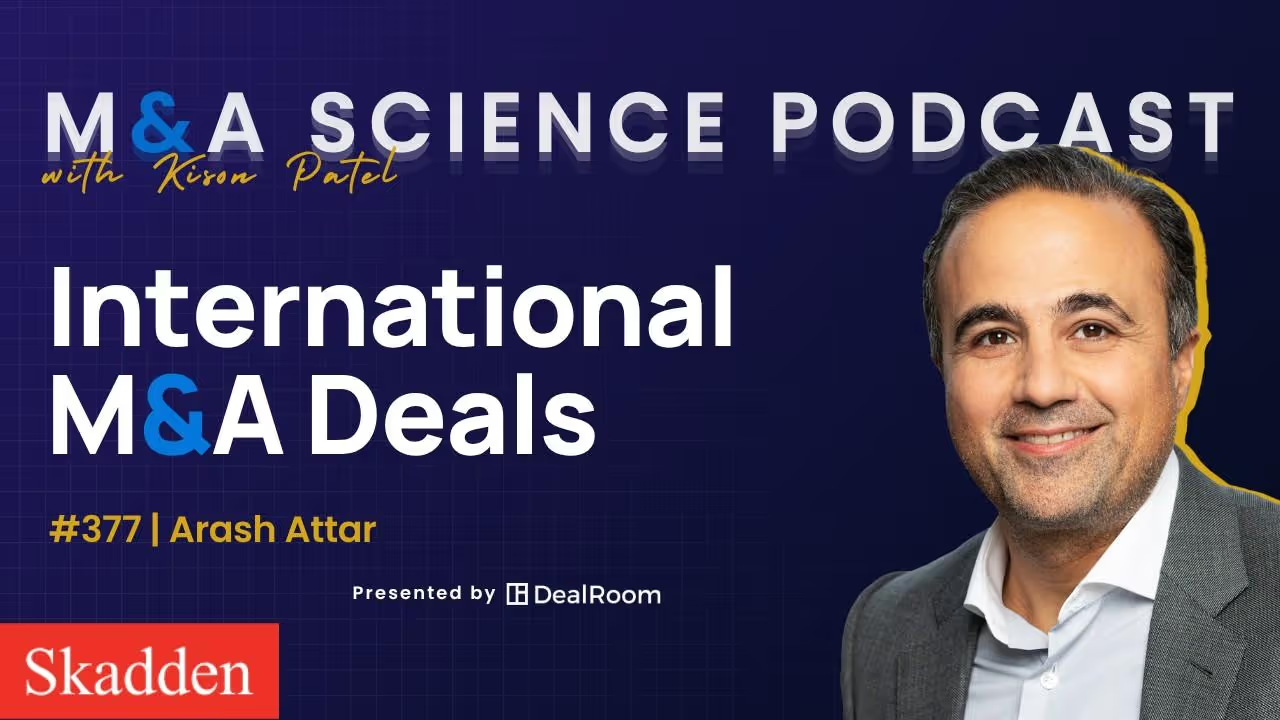
M&A Science Podcast
 / 
Listen Now:

Cross-Border M&A Strategy: Navigating Complex International Deals

Arash Attar-Rezvani - M&A Partner, Skadden, Arps, Slate, Meagher & Flom LLP

Arash Attar-Rezvani, M&A Partner at Skadden based in Paris, brings over two decades of cross-border M&A strategy experience to this in-depth conversation. From billion-dollar telecom deals across Latin America to luxury brand acquisitions spanning multiple jurisdictions, Arash reveals the hidden complexities that make international M&A uniquely challenging. M&A professionals will learn how to structure deals across incompatible legal systems, navigate emerging regulatory landscapes, and build the trust essential for successful cross-border transactions.


Things you will learn:

  • How to identify and manage multiple antitrust and national security clearances across jurisdictions with varying sophistication levels
  • Why smaller transactions often require more innovation than billion-dollar deals, and how to build structures when no legal playbook exists
  • The psychology behind cross-border deal-making and why trust trumps even the most ironclad contracts

Skadden, Arps, Slate, Meagher & Flom LLP is a multinational law firm headquartered in New York City, founded in 1948. With 22 offices worldwide, Skadden is renowned for handling complex, high-stakes M&A transactions across multiple jurisdictions and industries.

Industry
Law Practice
Founded
1948

Arash Attar-Rezvani

Arash Attar-Rezvani has spent 25 years at Skadden advising on complex cross-border M&A transactions spanning telecom, technology, and luxury sectors. Based in Paris, he has led multi-billion dollar deals including the Millicom takeover and Luxottica take-private, developing innovative structures for transactions that cross incompatible legal systems. His multicultural background and fluency in five languages enable him to navigate the cultural complexities inherent in international deal-making.

Episode Transcript

M&A Science - Cross-Border M&A Strategy 

Kison: [00:00:00] I am Kisan Patel, and you are listening to m and a Science where we talk with deal professionals and learn valuable lessons from their experience. This podcast focuses on stories, strategies and what actually happened during m and a deals.

Kison: Hello and welcome to the M and a Science podcast. [00:00:30] This podcast is part of a mission to rethink how m and a is done. That old school seller led approach, it's dead buyer led m and a, is all about strategy, alignment, and efficiency. Putting value creation at the center of every deal. And let's be real. It's not just about closing the deal, it's about making it successful.

Kison: We uncover what truly works in m and a by learning directly from the best. I'm your host, Kisan Patel, founder and CEO of deal, room, and Chief Scientist at m [00:01:00] and a Science. Today I'm joined by Arash Atar, Reni m and a partner at Skadden. Based in Paris. Arash has spent over two decades advising on some of the most complex cross-border m and a transactions in the world.

Kison: From telecom to tech to luxury. His deals span multiple jurisdictions, legal systems and cultures. In this conversation, we unpack how to structure international m and a deals, navigate regulatory landmines, and build [00:01:30] creative legal structures when no playbook exists. Ra, how are you doing today? Hey, ki great.

Kison: I'm delighted to be here. Bonjour, thanks for hosting me here. Live in Paris, Skadden's office. Bonti,

Arash Attar-Rezvani: it's

Kison: my pleasure. I would love to kick things off just to. Brief on your background.

Arash Attar-Rezvani: I'm French and Persian. My name is a Persian name, ATAR. Vani actually means the perfume cellar of paradise. I was born here.

Arash Attar-Rezvani: My parents are both from Iran met in Paris 10 years before the Revolution. My father [00:02:00] was a world renowned photographer, a war photographer. What you see behind me is photography of Muhammad Ali during this fight in 1974 in Zaire called The Rumble in the Jungle against George Foreman. The reason I'm mentioning this is because a lot of my background has to do with an international context, and I think if I now work in international law, a lot of it probably comes from my family background.

Arash Attar-Rezvani: I have English Jamaican brothers. And in my family, close family, [00:02:30] there's Venezuelans, Colombians, Singaporean, British, Persians, and French, and this is just my father and my brothers and so on. Coming from this kind of a background, it was natural for me to study international law, which I was very fortunate to be able to do both at the Sorbonne here in France.

Arash Attar-Rezvani: And then I went to Oxford University in England to study for a master's degree. Came to Skadden, worked for a few years, and then went to Columbia Law School in New York where I could further my education, and spent a year [00:03:00] in Skadden's, New York office in oh 6, 0 7, just before the financial crisis, before coming back full-time in Paris in 2007 when I've been doing m and a and basically going up the echelons of the promotions here at Skadden.

Arash Attar-Rezvani: I've spent all my career almost 25 years in September at this

Kison: great firm, 25 years at Skadden. I can imagine you worked on all types of deals, but what keeps you engaged and locked in over here at Skadden?

Arash Attar-Rezvani: First and foremost, I'd say the people. I was recruited by [00:03:30] somebody who became my mentor and friend Pier, who was the managing partner here for the first 15 years of my career at Skadden in Paris, and he was just a great guy in the office.

Arash Attar-Rezvani: He has this mug that says, uh, world's best boss. I, I had the world's best boss. It wasn't just a joke. The people and not just Pierre, everybody you know from Armos, our managing partner today to generations upon generations of lawyers who have come and now I'm by presence, the oldest lawyer in the office, and [00:04:00] it is just the people.

Arash Attar-Rezvani: Of course, the deals were amazing. The firm is amazing, the collegiality of the firm, but great deals you have in lots of places. People of that quality that justified it. I've been here since the beginning and always saw myself at

Kison: can. Can you tell me a little bit about just your journey or the types of deals that you've worked on?

Arash Attar-Rezvani: I started the first few years doing capital markets work, IPOs, privatizations of air fronts, telecom, these kinds of deals. Just before going to New York, I switched to [00:04:30] m and a. My practice basically has been public and private m and a. And today I work mainly with clients that we developed here in Paris, in telecom and tech.

Arash Attar-Rezvani: One of them is Xavier. Xavier is a French entrepreneur and billionaire who has built the sixth largest, fifth largest, uh, European Telco with his team at ID and NJJ is. We've been doing a lot of telecom work. I'd say one of the highlights was last year when we worked on this multi-jurisdictional takeover and the offer of [00:05:00] Millicom, which is very unique, but at the same time, for some reason this is, most of the groups that I represent these days are a little, like this very multi-jurisdictional millicom.

Arash Attar-Rezvani: A group that is incorporated in Luxembourg was listed in New York, NASDAQ, and in Stockholm, and has all these operations exclusively Latin America. They used to have them in Africa with another client. By the way, we bought operators from Millicom in Senegal and Tanzania, but when we did the tender offer, they were based in nine or [00:05:30] 10 Latin American countries.

Arash Attar-Rezvani: So it presents unique challenges. You have to be quite agile to tackle LXi, the premier skincare brand. Also a client we've been advising for about 10 years on all this acquisition, including solution, which most people will know by now. Yeah. I've been working on a wide array of public-private transactions, JVs, energy work, renewable energy, battery cells, photovoltaic, et cetera.

Kison: You ever worked on a deal that just fundamentally changed the way you think about m and a? [00:06:00]

Arash Attar-Rezvani: I would say probably my first one. The one I did in 2004. It was Quicksilver's acquisition of Rosino Quicksilver. As you may know, Kisan is this Appel brand that sells. Yeah. Surfing, you know, and back then Quicksilver was actually led by a French CEO ette, double digit growth.

Arash Attar-Rezvani: This is early 2000. Brand was exploding and Rosino was, was the opposite. They called it actually the term did the Alliance of the Sea and the [00:06:30] Mountain Rossignol is this international base in France, but international ski brand. And they at the time sold a lot of hardware, the skis, and they had these unique partnerships with world champions, Olympic Pink Champions.

Arash Attar-Rezvani: That's the first, I mean, I mean, talk about being fortunate. I had never done any m and a I told Pierre, least after four years of captain markets, I really to do some m and a 'cause it sounded interesting. And Pierre, against all, you know, logic, a lot of people would've said, no, why don't you stay and do capital markets?

Arash Attar-Rezvani: You're doing well. You know all the players, [00:07:00] you've done all these deals for so many years. He said, alright, let's do it. And we did this takeover of Ross by Quicksilver. We worked extremely hard. It made me fall in love with m and a because of the creativity. Because unlike capital markets where it's really a lot about precedent, there's a documentary piece of it, but it's basically really creative subject to negotiations and the sky is the limit.

Arash Attar-Rezvani: So I really enjoy that. The collegiality, the creativity of it. It's like a Swiss clock. Everyone in the team has a very [00:07:30] particular function and we all work together. And if one aspect of the team or one part of the clock falls down, the whole team can fall apart. I really like that and high stakes. And a couple of weeks ago, after 20 years, I came across Bernard Marette, the former CEO at Paris birthday party.

Arash Attar-Rezvani: And it was just so great to reminisce these deals. They forge friendships with your clients because you are in the trenches with them for such a long time, working really hard to reach a common objective. And even though. [00:08:00] The merger itself, the acquisition didn't quite work out. Two years later, we actually were hired by il.

Arash Attar-Rezvani: We advised them to sell Rossio because there were too much debt and for other reasons it did remain for me, very impacting as a transaction both professionally and the personal relationships I made on it.

Kison: I like that Swiss clock analogy. Yeah. And then the relationships you build is really important.

Kison: You know, couple things that came to mind. One was size of deals. You kind of mentioned this example transaction, like two major brands. Are there any patterns [00:08:30] or just lessons learned around the size of transactions, right? You could do this acquisition merger of equals. You could have a company, maybe it's a billion revenue, acquiring a business doing 500 million, which is pretty transformative.

Kison: And then you got roll-ups doing a series of small acquisitions, tuck-ins and so forth. What have you learned from that?

Arash Attar-Rezvani: I've been lucky at SKA and I've been working on major transactions. I can cite two lvm H's. Acquisition of Tiffany's or no case acquisition of Alcatel, both in the 15 [00:09:00] billion Euro range.

Arash Attar-Rezvani: Last year we did a combined $11 billion between the takeover of Millicom and the take private of Lexington being the lead partner on both of them. But one thing I've learned is huge doesn't necessarily mean more complex. Actually, counterintuitively quite the opposite. In a huge transaction, there's dozens of lawyers involved.

Arash Attar-Rezvani: Usually you are working with quite sophisticated companies where things fall in order. It's well organized. So there's a [00:09:30] lot of coordination of course to do. We routinely coordinate teams of 20, 30, 4000 lawyers across 10 firms. We, the two transactions I mentioned to you from last year was the case. We had teams and teams of lawyers, not just asca, but we had the lead role.

Arash Attar-Rezvani: But in a way, the smaller acquisitions, they're the ones that present the most challenges because they tend to be, especially founder led enterprises. They have been built in a very organic way. There's less, let's say, discipline in some of them, you [00:10:00] encounter much more array of issues that you have to solve.

Arash Attar-Rezvani: Two of the most complex transactions I've done are probably the two smallest I worked on. I can give you an example. It has to do also with my father's. He was a member at the Magnum Photos. Magnum Photos is this agency that was founded in the forties just after the Second World War by Robert Kappa or Carreon.

Arash Attar-Rezvani: Those guys are legendary photographers. All the photos you've seen from D-Day in particular, the Spanish Civil War, Sarah, from those guys. I've been advising [00:10:30] them in an informal capacity for many years now. But in 2017, they hired us as a firm to work on an 8 million investment, which sounds simple enough, but because there were unique challenges of protecting the photographer's brand, their artistic process, we had to create a different entity.

Arash Attar-Rezvani: We had to have the, the states or the actual photographers, Elliot IC Barn, legendary, nev Kudelka, Martin Par, legendary names of photography, a adhere to [00:11:00] a plan, explain to them what this corporate deal was. It's extremely complex, and the signing was probably the most challenging signing I've had ever because I had to send documents to people.

Arash Attar-Rezvani: Some of them, I remember one of them wrote an email to me saying, listen, you want my signature on this contract? I'm in Iraq on the front. I'm going to the front. Now I might, he knew he might not come back tonight, so is that okay if I can just send you a photo of my signature, would that be a valid for the contract?

Arash Attar-Rezvani: Of course you have these types of issues. You have to, is that legally [00:11:30] binding? Does it work when somebody's actually risking their lives? Am I really gonna insist that? No, you should print it somewhere and PDF me a signature. It was, uh, actually very funny because one of the estates, Marilyn Silverstone, she had given, uh, the estate to a Buddhist monastery in Nepal.

Arash Attar-Rezvani: The person basically who was going to sign the contract was a Buddhist nun who would go down the ministry to the local village, had internet connection maybe once or every three weeks. I said, okay, please sign. And you have to have a witness. You know, this was a British [00:12:00] deed and when the signature came back, the witness was Makar, who's basically the most famous French companion of the Dai Lama is almost if the Dai Lama had signed as a witness.

Arash Attar-Rezvani: The agreement. Some stories like this. I mean, I could go on. You know, so the smaller deals, often they present the most challenges and you have to work around the, the fact that it's a small size, but it's way more complex than you would expect in a large company. You expect it to be complex and there's a specialist army of people dealing with those issues.

Arash Attar-Rezvani: It's

Kison: larger company, more mature [00:12:30] finances and things kept in order just working with the working professionals. Is there a sweet spot if I say companies like a hundred million ev? Yeah. Is there like a sweet spot in terms of, okay, a 1 million EV companies like buying one of those small businesses, but then you buy another a hundred million EV company, is there like 20, 30% of your enterprise value?

Kison: Like what, is there like a sweet spot you've seen?

Arash Attar-Rezvani: Can I be frank? Because of Skadden's business model, we don't deal with a lot of this smaller. Okay, let's add a zero to it then. Uh, and so, so 1 billion and the example I gave you is because this [00:13:00] was very special. It was something so that's why we did it.

Arash Attar-Rezvani: But I, there's a sweet spot in a way. Every situation is, it ends up being quite unique. I know it's a little cliche to say this. I've learned to not pay too much attention to size. What size does the difference is the exposure to media and publicity, and there's some form of pressure this way. We represented Air France in, in, in 2009.

Arash Attar-Rezvani: It was eight and nine in, its the largest aviation of civil aviation, jv, air France, and KLM, which were our clients. [00:13:30] Were doing this JV with Delta Northwest, and Delta was acquiring Northwest in the middle of it. So of course. I remember vividly, we had very little time to negotiate because there was a lot of pressure because of who the clients were.

Arash Attar-Rezvani: It was, uh, valued at $10 billion at the time. So it was one weekend in New York, one weekend in Amsterdam, one weekend in Paris, one weekend in et cetera. Very fast paced to negotiate day and night because we had a, and when we were negotiating the final stages of the agreement, we had all the journalists, all the [00:14:00] TV stations Cetera, were waiting in the hotel where the deal was going to be presented.

Arash Attar-Rezvani: And there was no question we had to sign that agreement by then. So it comes with a kind of pressure, but it doesn't necessarily, I don't think of it as any different. My job is the same, so less

Kison: about the size. What about strategy? Is there sort of certain, uh, strategies, whether you're buying for capabilities, buying for revenue or geographic expansion, anything that you've seen like play out well from all the deals you worked on?

Arash Attar-Rezvani: Yeah. I actually, you see the wide range of why [00:14:30] people do m and a. It's either because you work to acquire. Market shares or geographical footprint, as you said, or very often a technology or some people, especially when you work in tech and it, the people and the tech are really essential to what you're doing.

Arash Attar-Rezvani: In some cases, you're buying A, B, D, A, you are buying profitability or you might be buying revenue. So you see the full range. And again, it really has nothing to do with the size of the deal. It really has to do with the vision that the buyer may have. Entrepreneurs. We work with [00:15:00] all kinds of companies. I represent quite a few founders and families, and what I appreciate with them is that more often than not, there is a strategic vision and there's this concern of a transmission across generations.

Arash Attar-Rezvani: Some of them have built it on their own and want to pass it on to their next generation. Others have received it from the previous generation and want to grow it to pass something even. More stable to the next generation. Definitely. Those are really interesting because these are people also in the way that take risks.[00:15:30]

Arash Attar-Rezvani: A 14, 500 companies will approach risk in a very different way than a founder or a billionaire or a family office.

Kison: Interesting. So it is about the strategy, but more about on this vision that you have and executing a strategy against that vision. And then the founder ones can be a little bit more of the personal touch, the relationship you've worked with clients over years and years.

Kison: What is the value of using the same law firm or relationship? You get the sense of like, Hey, me as a founder, you sort of establish rapport, maybe even built that friendship. [00:16:00] Hey, I like where Ki Son's got the big vision and wants to build a billion dollar business in the next 10 years. But is there things outside of that of just that relationship that really is accretive for me to continue working with you as we work on a series of acquisitions?

Arash Attar-Rezvani: When you're locking this business, you are not just somebody's lawyer, you end up being what we call the trusted advisor, the conciliary. If we take a Godfather analogy, the idea is someone that you know and trust. Trust is, it's basically our parent in [00:16:30] this business is trust. The value of having the same council over and over is that your council knows you, he or she knows what you want, where your soft spots are when your hotline in the sand are after a while.

Arash Attar-Rezvani: With a lot of my clients, I don't have to ask them. I know what they want. They know I will represent them, of course, to the best of my abilities. It becomes this kind of organic situation where when it has to do with m and a, there is a lot of efficiency because I understand their vision. [00:17:00] I know what it is they want to accomplish.

Arash Attar-Rezvani: I know what kind of risk they're willing to take. You know, as lawyers, as we advise, yes on structures, on strategy, but we advise a lot on risk, there is not one way of approaching risk. Our job, I think, is to create options to tell them, listen, you have three options behind door. Number one, there's something super safe.

Arash Attar-Rezvani: The cost of reaching it may cost you in terms of money or in terms of the quality of the relationship with the other side, or in terms of efficiency. A door B has maybe more risks, but more [00:17:30] rewards. And door three is, you know, extremely risky, but maybe it has other advantages. You advise them what their options are, and if they ask you a recommendation, I firmly believe I'm part of the lawyers who believes you have to be able to give a recommendation, but your client is making the decision the value of a long term.

Arash Attar-Rezvani: That's why we're in this game case, and I mean, I'll be honest, I'd love a multi-billion deal, but if I don't hear from the client again, I'd rather have a 10 year as I have 10 year, 15 year, 20 year relationship that we have here at Skadden Paris [00:18:00] with clients that have been trusting us over that amount of.

Arash Attar-Rezvani: Yes, because they know we understand them. And basically at the end of the day, what Plan wants is they want you to think about them. Even by the way, if you don't work with them and that's what you bring. And after a while it branches out into, yeah, some of them. They become your friends, your families know their families.

Arash Attar-Rezvani: They give you work that have to do with their own family work or personal issues. And it's part of what you do. Because at the end of the day, I think you want the best result for your client and [00:18:30] you're happy when you get that. And you don't have to get a thank you note, by the way. The satisfaction comes in the job well done

Kison: building trust.

Kison: Let's talk about cross-border deals. What are the real complexities of doing cross-border deals that no term sheet captures?

Arash Attar-Rezvani: So the first thing it captures is the trust. I always tell my clients, you can have the most ironclad contract, whatever. If there is no trust in a relationship, trust all around you.

Arash Attar-Rezvani: Be challenging. Trust. Yeah. Trust all around relationship with

Kison: attorney. But then your counterparty. Yes. You have to have a level of trust. That's right. Exactly.

Arash Attar-Rezvani: Trust all around. Because let's say you're doing [00:19:00] a jv, very high stakes joint venture, A 50 50, this is somebody that's gonna be your partner. For a number of years I've been on JVs where the principles fully trusted each other and their vision and we, it got done very quickly.

Arash Attar-Rezvani: Even though the terms and condition, contractual terms were probably not perfect, but they were the best and the most balanced and they've had very fruitful collaboration and relationship after years and years of it. And I've been involved in situations where we were doing these JVs [00:19:30] and there was no trust and it took us years to just be able to reach an agreement and, but basically in an agreement we were negotiating the conditions of the divorce before we, or much more than we were the conditions of the, the marriage.

Arash Attar-Rezvani: And that has to do with trust. So that's a lot of the difficulty. The other one I would say is the cultural element of it. The cultural friction. When you work cross-border motor jurisdictional, you need to be agile. You need to respect other jurisdictions that may not have the level of sophistication that yours has, [00:20:00] and you have to keep an open mind.

Arash Attar-Rezvani: That's what makes it more challenging. I'm lucky enough, I speak five languages, so I can really relate to a lot of people in their own language. And language is a real barrier to negotiation in a multi jurisdictional context. If you can speak Spanish or Portuguese, for example, to negotiate a deal with people from that area, it's always a plus.

Arash Attar-Rezvani: And if anything, it helps create a rapport. It helps create. Some form of solidarity or connection then you can always rely on, because [00:20:30] negotiations, it's a lot of psychology. What we do is the people's business. At the end of the day, you deal with people. As long as we're not dealing with machines, maybe that time will come.

Arash Attar-Rezvani: We, we may talk about it later, but as long as you deal with people, the negotiation is

Kison: extremely psychological and subjective. These fundamentals don't change trust, culture and psychology. I wanna unpack that. There's some key things I really wanna learn from you today, but the thing that we do see that is outside of those is around regulations and those nuances.

Kison: I know one of the things we talked about before is [00:21:00] global data laws. We have cloud Act, GDPR. Love to hear about like your view on that in terms of how do you manage those aspects when doing these kind of cross-border deals. Yeah,

Arash Attar-Rezvani: there's everything that has to do with data and GDPR and then separately it has to do with regulatory antitrust for indirect investment.

Arash Attar-Rezvani: I'll start with data and, and GDP. So definitely the role that these issues have in m and a deals has been increasing tenfold in [00:21:30] the last few years. 'cause those regulations were adopted with the advent of technology off the bat. What we can see is they're not applied the same way or have the same importance depending on where you are.

Arash Attar-Rezvani: Obviously GDPR was adopted early and even though a lot of countries are catching up, we were confronted with those a lot more and first in Europe than we were elsewhere. Basically what happened was it started with some due diligence. We needed to be done on those aspects to such issues as, where's that information going?[00:22:00]

Arash Attar-Rezvani: How is it processed? So it's become major, let's say terms of of deals with Cloud Act. What is interesting is these days we're spending a lot of time structuring contracts and transactions in a way that deserves basically the data of, uh, client's. Clients their own. Customers for example, because of the far reach of those regulations, which are extraterritorial by nature.

Arash Attar-Rezvani: Cloud Act means that US authorities can gain access [00:22:30] to data that is not stored in the us, not held by US companies, just because there is a nexus with the us and it could be something as simple as your European company using Gmail. Now you have this connection to Google, which is a US company. A law enforcement or public authority in the US can go to Google and get your data in Europe.

Arash Attar-Rezvani: So you have to be very cognizant of this and structure in a way that guarantees the safety and protection of your client's data. [00:23:00] Definitely something to pay attention of. And if we mention the regulatory. Even more so in that space where we can see mushrooming legislations and regulations around the world.

Kison: I'd love to hear that because I, it sounds like there's like two big components. There's this sort of data regulation, data laws, and then a big piece is just doing diligence, how companies are currently complying and where there may be gaps, and then we have this broader regulatory environment. Yeah, we talk about anti competitive, but then there's just general like politics and national security and by nature of [00:23:30] these

Arash Attar-Rezvani: national security and regulatory are game changers.

Arash Attar-Rezvani: In terms of the way I can see this evolving in the last 10 years. No need to go further back certainly 20, 25 years ago, but if anything in the last 10, 12 years have dramatically impacted, I'd say the way we do m and a, because let's start with antitrust. We used to have 2, 3, 4 jurisdictions where if you wanted to close a deal that had antitrust impacts on the markets in Europe or the US for example, you had to go and seek [00:24:00] an approval.

Arash Attar-Rezvani: Or in the US you just let time go by. Before you could close your deal, it was what we call a worldwide bar on closing your transaction. You could not close it before you had some form of approval. If it did create that merger. Consolidation did create any trust issues. You had to go through whole process of remedies.

Arash Attar-Rezvani: You knew more or less what to expect. There were have been some surprises, but you knew more or less what to expect. What's happened in the antitrust field in the last 10 years is that you've had more and more jurisdictions that have [00:24:30] set up their antitrust regimes in a way that has global impact as a tool for geopolitics.

Arash Attar-Rezvani: By the way. It's not just protecting a local market. It is also, of course to play in the global arena. So I remember I was in Brazil in May 28th, 2012. When the Brazilian andrus regime went into effect, and of course, as you might expect, it was a race for everybody to sign their deals before the law would change, so they would not fall under it.

Arash Attar-Rezvani: But then Brazil, they did China and they did, [00:25:00] Russia did it. And these are major countries that were emerging at that time as bricks. This was when we were still mentioning the bricks. And over the years what's happened is you've had the second layer and third layer of countries that had adopted those regime.

Arash Attar-Rezvani: The problems. What are the problems? A, the way these rules are drafted, it's either extremely strict and stringent. You can have to file transactions with a very low threshold, lowest 5%. Currently, I'm, I have a transaction. In a country in Africa, [00:25:30] we have a notion of control, which is referred by reference to a 10% ownership stake plus one board seat.

Arash Attar-Rezvani: In any normal legal regime, 10% does not give you control. One board seat out of 10 does not give you control. But they've defined very stringent rules to give them access to those deals, even though the impact in the market is minimal. B, some of these laws are very vague that have been recently in some, in Latin America, for example, where they're drafting a way that you don't know if they [00:26:00] apply to an indirect change of control.

Arash Attar-Rezvani: It's not specified. So there's uncertainty or you don't know if it should apply to a listed company that has a fragmented ownership as opposed to a privately held company where there's clearly, you can identify who the owners are, or it should draft in a way that creates a lot of certainty. B is, it's vague.

Arash Attar-Rezvani: C, there is no case law. There is no established caseload for, at least in the us in Europe, you have decades of it. By no means am I saying that other countries should not protect their markets [00:26:30] and customers the way Western Europe and the US are doing? Absolutely. They should do it. What I'm saying is it does create new challenges because we don't have the depth of practice.

Arash Attar-Rezvani: They have not been tested. I've had to do it even in Europe. I've had to deal with new legislations in terms of antitrust, for example, or other regulatory regimes where we just didn't know what the authority was going to do because of what I said. It's either too stringent or too vague, or not enough perspective and testing or some of the above.

Arash Attar-Rezvani: If I [00:27:00] talk about national security is the same national security everywhere, we have now regimes of control, which are modeled after what CFIs is doing in the US and every European country now has adopted them. Even though they're trying to give a framework. You are dealing with something highly subjective on national security.

Arash Attar-Rezvani: You can have, some legislations will be extremely wide, some will be more constrained. What it means in terms of the m and a is a, the first question, one of the first questions you ask yourself and a client comes and sees you is to see if there's a [00:27:30] regulatory angle. Is there any national security or indirect investment component B, is there any antitrust C?

Arash Attar-Rezvani: Is there any some other regulatory banking, telecom, insurance, et cetera? Because basically what it creates is the interference or the, to be more positive, the role of an outside party inside of an m and a transaction, which normally is relatively cont contained. So now. You have to deal with some authorities, some of them in foreign jurisdictions, where you really don't know how they're going to approach this.

Arash Attar-Rezvani: There's gonna be a political element [00:28:00] on top of it. What's been the impact on m and a basically is it's impacted the timeline of those transactions you have to take into account. Sometimes months and months. 'cause that's the other thing. The legislation may say you have 30 days or you have three months to clear, but very often the caseload is too important or they have some questions, they will suspend the timing and delay and the registration says three months.

Arash Attar-Rezvani: But the local council will tell you, listen, in practice is more six to nine months than three months. And that has a huge impact on the transaction. So as a M and a lawyer, you have to learn to [00:28:30] recognize them. And when you can, you have to find a creative solution. One of the things I've done with some success recently is to see if we can maybe carve out a local aspect, make some undertaking to authority or the local government.

Arash Attar-Rezvani: And if you can carve it out from a global transaction where that country is a small piece of it, relatively speaking, then I can proceed with my global transaction. Otherwise, it may mainly, basically can kill it. You can kill a global transaction because two or three smaller, I mean smaller by geographies, but the importance of those.

Arash Attar-Rezvani: Of the market in those countries are smaller, can [00:29:00] derail a whole transaction that has very little impact there. So you have to take into account the timing, the complexity, and educate your client through it.

Kison: So early, my deal process, I wanna identify all these third parties because every country's popping up with the regulations around anti competitiveness and they have different bearing views on it.

Kison: Some may start regulating you even if having a small percentage ownership of the transaction. Some just have really big definition of what these regulations involve. Some have much more extended history of case [00:29:30] law and some very little, if none, just knowing what you're dealing with early on is gonna be key.

Kison: That way you can start thinking of these solutions where, hey, maybe you have less than 1% in this market. It's gonna be easier just to carve it out instead of having your whole deal hinged around their approval.

Arash Attar-Rezvani: When should we, uh, recruit you? This is a perfect summary. Well,

Kison: I just wanna make sure I learn.

Arash Attar-Rezvani: No, but also what it means is your choice of local council. When you work in all these different jurisdictions, you cannot have an office everywhere. We have 22 offices around the world, but we are not gonna have it in all these countries. It [00:30:00] means that the choice of local council is key because increasingly.

Arash Attar-Rezvani: You not only need somebody that knows the law, you need somebody who knows the players in the government, in the regulatory, because they need to know what their approach is going to be. Often there's just been a change of government. New people are coming in place. We don't know what their philosophy.

Arash Attar-Rezvani: Other times it's been tested a little more, so you have to be very careful also who you work with in those jurisdictions.

Kison: How about doing deals in France? What's like surprisingly easy, uniquely [00:30:30] hard about doing deals here in France? Compare with the US to make it easier, right? No, it might

Arash Attar-Rezvani: surprise you.

Arash Attar-Rezvani: The hardest part, actually, you know what it is, is to convince our American and other clients that it's way easier to do deals in France than they think. That's the hardest part. Okay. There's a psychological barrier and I think France is very bad at selling itself. In the last few years, it's done a little better, but people think of France and of course great for holidays.

Arash Attar-Rezvani: Absolutely. You're gonna absolutely spend, you know, you're gonna see the Eiffel Tower go to down to the Riviera and so on. But when they think in [00:31:00] France, in terms of business, I've noticed more often than not, they think, you know, it's this overly bureaucratic country with very high tax regime, with these labor consultations.

Arash Attar-Rezvani: And why are we consulting the employees when I'm doing m and a? So people are scared by all of this. Part of what we do, part of my job is to explain to them that, look, if you know what you're doing and you know how to navigate the labor consultations, yes you need to go through it. But how many times have we had a problem or a serious problem [00:31:30] or litigation twice, maybe in 25 years?

Arash Attar-Rezvani: The tax. There's a lot of exceptions. There's a lot of ways to structure your deal in a tax efficient way. The bureaucracy. Yes. It's bureaucratic. Is it more bureaucratic than a lot of other European jurisdictions? Based on my experience, no. Not necessarily. We're bad at selling ourselves. There are some challenges, but there's a reason France is always in the top three of the, uh, inbound, foreign, indirect investments, uh, in, in, sometimes even before Germany and some years.

Arash Attar-Rezvani: And the uk there's a reason because also we have a [00:32:00] normally, at least a very stable government, there's infrastructure. We have an amazing, you know, you talk about tech and science, amazing engineering schools and workforce, highly skilled workforce. There's a lot of advantages. The difficulty number one, is the psychological, sometimes prejudice, frankly, that people have that is gonna be way more complicated.

Arash Attar-Rezvani: And very often it's happened to us that the clients, you know, were said, well, it wasn't that difficult. But see, we told you there's exception, of course, but more often than not, it's way [00:32:30] easier than they think with a lot of opportunities, size of the domestic market. The importance of middle class, et cetera.

Arash Attar-Rezvani: And then I'd say the other challenge, yes, you have to deal with the administrations depending on what you're doing. Purely private m and a is never gonna be a concern. If you're dealing with the. Public markets, securities markets, or you're dealing with specific, you know, you might have to deal with the administration, but I'd say more often than not, it's a rational conversation.

Kison: Labor consultation. I was always, the first one I think about doing any deal in Europe is labor laws are a lot more [00:33:00] stringent than they are in us, where this thing called employment at will,

and

Kison: I don't think it's as as simple over here. Can you tell me a little bit more of what, what goes into the,

Arash Attar-Rezvani: you're right, definitely.

Arash Attar-Rezvani: France is a country that protects the workforce probably more than, and it's one of, I believe only two countries worldwide. The Netherlands being the other one that has a law. I'm going to simplify. Okay. But in a change of control situation, if there's a works council at the level of the target or the seller, I'm [00:33:30] talking now about a foreign buyer coming in and buying a French asset.

Arash Attar-Rezvani: If there's a works council at the level of the target or the seller or both, you need to consult them, the works council of the seller and or the target before you can sign a binding SPA. So of course for a, an American buyer that comes in, they're like, this is insane. So I have to ask the employees what they think about this transaction before I can sign a binding SPAA binding contract.

Arash Attar-Rezvani: And it's one of those things, it's the [00:34:00] French way. Yes, you have to consult them, but somehow it doesn't matter if they say yes or no, it just needs to be done. So it's a process and we've structured deals in a sudden way that the practices develop this practice of a put letter. So basically you do sign an agreement, but only the buyer is bound to buy.

Arash Attar-Rezvani: The seller is not bound to sell until you've done the consultation in the last few years. The government has really done a lot of efforts to put a lot of framework around it. So the consultation takes one month, in some cases, maybe two, but mainly it's done in one month. 95% of the cases, [00:34:30] there is no problem at all.

Arash Attar-Rezvani: You just have to go and explain to the employees, listen, that's our project. This is what we're gonna do with the, our plans are our intentions. Of course, it doesn't have to do with employment necessarily because it's way too early at that stage to know any concrete plans in terms of the employment, and often m and a, yes, it could be employment destructive sometimes, but in a lot of cases it saves, you know, because it brings new money.

Arash Attar-Rezvani: Fresh money inside a company could save a lot of jobs as well, although it seems crazy like that. And the problem is if one of the parties is not well advised by people who calmly tell [00:35:00] them, listen, I've done 50 of those. This is how we should do it. This is how we should negotiate the agreements. You'll not have a problem.

Arash Attar-Rezvani: But when the parties, again, back to trust the parties not trusting each other, it probably took more time to negotiate that small employee consultation related agreement than the SPA itself because the parties did not trust what could happen. If you could do this, you could do that. Could the seller instrumentalize the workforce to try and screw me The buyer?

Arash Attar-Rezvani: Pardon my French. It could [00:35:30] create, but this is one out of 10 K. Maybe

Kison: like, let's say I'm looking at a company in France and my plan buying a little tech company is to completely eliminate their management team. This is what we're gonna do purely around the synergies. We have a dominant management team.

Kison: We really don't need their management team at all. There's a handful of people on the tech engineering side, 'cause we're probably gonna end up sunsetting their product and gonna keep it in maintenance mode for the next couple years. Two years out, we're gonna immediately probably reduce the staff 30, 40% and then over two years completely eliminate it.

Kison: Pretty aggressive. [00:36:00] Cost synergies that mm-hmm.

Is

Kison: very much on the employment capital side, which we don't think twice about in the US you just do it. But here, knowing what you just talked me through, how would I work with you on that

Arash Attar-Rezvani: at the philosophical level, which is where you sort of have to start.

Arash Attar-Rezvani: We probably consider the workforce more than you do in the US. 'cause in the US it's maybe a lot of social mobility. When a European thinks of the wild West, that is the US So people lose their jobs, have no social protection, most of them don't have any. So it's either you find another [00:36:30] job, or, I'm not saying that in the gutter, but it's extremely cutthroat type of situation, which is, you know, maybe one of the reasons also your country's very dynamic and very successful, et cetera.

Arash Attar-Rezvani: But so you look at it from the employers, from the business owner's perspective, which is, you know, healthy, that's how capitalism works, et cetera. Most European nations, you know, they're built on this concept of social democracy and so on, where workforce does matter. You're not just endangering them unnecessarily.

Arash Attar-Rezvani: I fully understand. A lot of people will say, well, that's why we're so agile in the US and we're so dynamic and you guys are not. And [00:37:00] probably true as well, except we've had a lot of success in the tech space recently. So in those cases, A, there's not always a works council. You have to have certain conditions, more than 50 employees, et cetera.

Arash Attar-Rezvani: You have a works council. There's not always a works council, but if you have a collective layoffs and more than nine people, yeah, there will be some form of process. In some cases the administration will look into it. It's a risk reward strategy. You look at it, you are well advised as to what the timing and cost will be for your plans to be implemented.

Arash Attar-Rezvani: And then you decide, take an informed decision of [00:37:30] is it worth for me buying it? Maybe you are buying it in your example. Clearly you're not buying it for the people. You might be buying it for the tech. You may be buying it for other reasons. In most cases that I've seen, unless you are in distress m and a and so on, you actually want the people, most of the people sustained.

Arash Attar-Rezvani: Let's say you don't,

Kison: that's why I picked that example. Yeah.

Arash Attar-Rezvani: You don't want them, so you will have a clear plan as to listen, this is how much it's gonna cost you. This is how long it will take you. And then you decide it, take an informed decision as to is it worth for me doing it? So it

Kison: is, that is gonna be the biggest consideration, [00:38:00] is knowing that, hey, at the end, ultimately you have to take care of the people, and that's gonna be some cost attached to that, and there's gonna be timelines around it.

Kison: And you just need to factor that in.

Arash Attar-Rezvani: You factor it in, it may translate into the price you're willing to pay. You may translate into the actual current owner starting the process of dismissing them and having them on their, and often we see that where the, the buyer tells the owner, listen, you are taking care of that.

Arash Attar-Rezvani: And it becomes just a term of the deal and the owner, if they're willing to, again, it's, it's always a, a negotiation and where [00:38:30] your interest lie and what you're ready to do. And sometimes the owner will do it. Sometimes the owner will say, you know. You do it and we'll give you a discount on the price of such.

Arash Attar-Rezvani: So it just becomes another variable in the transaction terms. We, we

Kison: wanna play that scenario out. Do we wanna do that before LOI or after L loi?

Arash Attar-Rezvani: You have to have enough information on the target to be able to assert what it is. So before, after LOI, it depends on the strategy. If it is clear to the seller that it must be done and every buyer they will talk to will insist on nothing being done, there's no reason to [00:39:00] not mentioning upfront and wasting everybody's time, right?

Arash Attar-Rezvani: Often you might be in a auction process, you might be in a competitive auction, maybe not everybody will have the approach that you have. So you might be wise to wait to have more information about the target. And most of situations kissing, to be honest, is very rare that exactly what you're going to be doing.

Arash Attar-Rezvani: The moment you close, as you said, it could play out over the next year, two years and you may change your mind. And I've seen that that a lot of times. So, you know, that kind of situation, probably wiser to wait, get into the L OI process knowing that [00:39:30] you are willing to engage and maybe go to certain.

Arash Attar-Rezvani: Level before you definitely commit the LOI to which is a non-binding document. So the non-binding LOI to binding LOI stage would be where I think you'd be doing that assessment

Kison: in terms of

Arash Attar-Rezvani: working

Kison: with French. Yeah. After this meeting I gotta go around the corner to one of your well established private equity firms and talk to 'em about one of their non-performing assets.

Kison: It's like a good way culturally being mindful here. 'cause in America we tend to be pretty direct. [00:40:00] Yeah. And it's a brush of like, Hey, you got this thing, I'm interested in it really forward. Teach me like so I can actually get this deal. So

Arash Attar-Rezvani: do you, do you speak French? I bonjour. And you can use that. So that's one of the cultural elements I was talking about very because I

Kison: Yeah,

Arash Attar-Rezvani: you

Kison: got a good point.

Kison: I noticed if you just walk up to somebody who's talking English, boom. They're gonna get offended if you start with just Bonjour. Yeah, and then you start talking English, they'll actually respond to you It, it can help.

Arash Attar-Rezvani: It can help. We've seen a lot of different responses. You have people, you speak French to them and they'll still speak [00:40:30] English to you and others.

Arash Attar-Rezvani: You speak English to them and they'll switch to French. It's gotten much better. It used to be that you'd be in a meeting with 20 people, five of whom would not speak French at all, and then all the French being at some point will switch to French. We see that a lot less in France. Yes. You guys are direct because you know I'm plugged into American society and your standup, your culture since we're kids, basically.

Arash Attar-Rezvani: I'm, and I live there. I work in an American law firm. I studied there, so I understand probably the culture a lot more than the average French. [00:41:00] Yeah. You guys like to be direct, but also, interestingly enough, you might not be direct at all communicating what you really want. There could be a lot of, oh, it's great.

Arash Attar-Rezvani: It's such a great idea. In the end, you're just going through the motions of turning everything into a positive everything. And when I speak to my French clients after we've had this kind of negotiations with Americans, sometimes they're like, yes, everything's beautiful, everything's is wonderful, everything is rosy, but we don't know what they think.

Arash Attar-Rezvani: And in a way, the French are sometimes [00:41:30] being criticized for this or you know, for being arrogant and so on. I think I'm just trying to say there's never one color or one aspect to the culture. 'cause the French can go around a little bit and it's good to start with some small talk and so on, but they'll be very direct as well.

Arash Attar-Rezvani: I've seen American counterparts being shocked by how direct the French are, because you guys may be direct, but you like to keep the form of being polite. You know what I mean? Whereas the French will deliver it to you raw sometimes. I've definitely seen both sides of that. [00:42:00] Partly I don't see myself as just French, because I told you I have a lot of that background.

Arash Attar-Rezvani: So I look at it as a observer. Sometimes if you speak your mind in an honest way. You don't take them for fools. You just communicate clearly what it is you want and why you want it, and you respect the other side. France is an old nation. They have, or we have probably a higher opinion of ourselves and our culture and history than the current place of France in world affairs might suggest, and I'm not gonna say more, the French always revere the [00:42:30] times of Louis IV and Napoleon and the Americans are acutely aware.

Arash Attar-Rezvani: That's not the case anymore. If you come what we call your Texan boots on the ground, and it is like you guys are all, ah, it's a second class, but you're all clowns. We know how to do things. We'll explain to you how it works. That's not gonna work in the French context. You need to put a little bit of the decorum and have what in the most sophisticated American, can I pause, you meet that, have the sensitivity to a different culture.

Arash Attar-Rezvani: A little bit of that goes a long way.

Kison: Okay. Start off with some pleasantries. Sounds like just generally being [00:43:00] open-minded, but generally being forward. Yeah. In this case, they have an asset that's underwater. Now there's a mix. 'cause I'm American, but I'm, I'm also Indian. Yeah. I was raised by immigrant parents, so I'm very cheap.

Kison: I like buying things. I'm pennies on the dollar basically. So in this instance, and I know for an investment firm, they have an asset underwater and they want to at the least get their money back. You, but for me, it's like if you've raised X amount, can I get it for, yeah. 50 cents on a dollar less trees.

Arash Attar-Rezvani: Argue your position, respect their culture, and their [00:43:30] position would argue. I think so. Having

Kison: a business case of like y it should be 50 cents on hour. Yeah, that's a concern. I was like, didn't. I guess my view of the French may stereotype here is they're a little more serious. Yeah, we do a little playful bantering in the US and joke around a little bit.

Kison: Yeah. I'm like, I don't know if that's gonna land as well.

Arash Attar-Rezvani: It's tricky. Humor is tricky because humor is not, uh, accepted or taken the same way. Exactly. That

Kison: sounds always universal. There's like different flavors of humor and then some just flat out.

Arash Attar-Rezvani: I can tell you what my approach is. I really, and it sounds super corny, but it's true.[00:44:00]

Arash Attar-Rezvani: And as the years go by, it's even more true. I'm just being myself. I like to use humor. Also to diffuse some situations doesn't mean sometimes it tense and it has to be tense. But most of the times you get a feel for who you have. Of course, if you have a very, I'm gonna take also some cliche, very stuck up French person who's really into themselves and so on, and you start with some dirty humor.

Arash Attar-Rezvani: That might not be their brand of humor, that's str of humor. But by seeing people and seeing what they react to, I've had a very positive experience just [00:44:30] being myself, being approachable, having this light demeanor, but serious on the topics. Always serious on topics. Respect the other position. Listen, listen goes a long way.

Arash Attar-Rezvani: It's 90% of the success of any meaning is listening. Listen to them, look at them. See how they interact between each other. If they use humor, okay, that might be something you know they appreciate from you. If they don't, that might not be the right approach. So you just go through your meeting. But what I've noticed everywhere around the world, I've been from India to to Brazil, to Africa.[00:45:00]

Arash Attar-Rezvani: If you are sincere, you don't take them for fools. You argue your positions and you have to know where to give. You can't always take, if you know difference between what really matters to you, which really you need to get, whether you express it or not. Sometimes you may not want to express it right away, but where to give them things that are important to them and not to you.

Arash Attar-Rezvani: That's the key to getting a successful negotiation over time. And if not in what, even if it fails, you'll get the respect. And I'll tell you one thing [00:45:30] I've gotten probably more clients referred to me by other lawyers who are sat opposite or clients I sat opposite than I've had in any other way. That's the best compliment that anyone can pay you.

Arash Attar-Rezvani: Somebody was telling me the same thing recently is that when another lawyer refers work to you, it means they see you as somebody not only competent, but probably THR worthy. And it's the best compliment that they can pay to you.

Kison: Okay. I'm gonna take your advice. I'm gonna go to this meeting and I'm going to start off with listening.

Kison: I really kind of [00:46:00] understand their point of view. With what I learned from listening, I'm gonna essentially be mirroring right through a little sense of humor. I'm gonna play into that, but stay true

Arash Attar-Rezvani: to yourself and then call me and tell me if it was a huge success or a catastrophic

Kison: failure. And I'm still gonna be myself for sure.

Kison: I'll still be myself, but picking up the room. From that I'll build my business case or my sort of position and see where we can land.

Arash Attar-Rezvani: Absolutely. That's what I do and I'll be honest, it's worked well for me, so hopefully

Kison: if I get next steps, I'm gonna call you because I, I may need representation out here.

Kison: Please, please, please [00:46:30] do. With pleasure. Going broadly back to like cross border deal, 'cause I do respect the fact outside of France, you've worked with so many different jurisdictions. What would you define as like high stakes cross-border situation? When people say this is a high stakes cross-border deal, what does that actually mean?

Arash Attar-Rezvani: I'll be a little cynical. I think people like to hype themselves up. You know, for me, high stakes means there's lives at stake. Okay? Right. So let's be clear, if today I was going to negotiate an agreement between Israel, the US, and Iran, this would be high stakes. High stakes.

Kison: Okay,

Arash Attar-Rezvani: let's go. But let's be clear, [00:47:00] and let's not give ourselves too much importance in what we do.

Arash Attar-Rezvani: And maybe it says MA

Kison: we, we put a dollar figure. It's almost like anything at a billion plus enterprises of high stakes at end.

Arash Attar-Rezvani: Exactly. But at the end of the day, you know what? When it's just about money, come on. You know you, right? Yes. It's high stakes, but it's just about money. Just about money. Yeah, exactly.

Arash Attar-Rezvani: When I think it's high stakes, when people's lives are at stake, where m and a has people's lives at stake, I go back to the employees m and a can be done, and then people losing their jobs, losing their livelihood. And that's why I think even though I'm hardcore pro m and a pro business, pro [00:47:30] capitalist, everything, you want little, those are remembering.

Arash Attar-Rezvani: There's people behind some of those things. That's true. And they may suffer. Is that so crazy that we have to ask them their opinion, which by the way, we don't really care at the end of the day what it is. 'cause it's gonna affect them. They're not just numbers. That goes back to what I was telling you earlier, Kisan, which is when you have entrepreneurs with a strategic vision and industrial vision, they're building, you know, one of my clients is the Axion group.

Arash Attar-Rezvani: There's this French Indian family called the Rigi family based out of Madagascar. They're originally from India, [00:48:00] but established Madagascar for five generations and they all have, since then the French nationality. And I met to their four partners, the two uncles and the two sons of the third uncle, who unfortunately passed away.

Arash Attar-Rezvani: My contact has been one of the sons as a nine year review, who's African C of. He's a very successful person, one of the nicest human beings, one of the smartest people you'll ever meet. And with As and nine and his group over 10, 12 years, we did all their m and a. We went through Togo, Senegal, Tanzania, Uganda, [00:48:30] French Islands of La Mayo, and he's built the sixth largest telecom group in Africa, Accion Telecom.

Arash Attar-Rezvani: We went through all of this hand in hand building on a vision that he had. There. Yeah, there are high stakes because you are negotiating, you know, giving access Telecom these days you cannot do anything without a smartphone and in Africa where there is poverty and all of what you want, but they are more advanced than we are by the way, in terms of money banking and this sort of services you that go through the to the phone, it's crucial because it brings not only [00:49:00] development, it brings financial inclusion.

Arash Attar-Rezvani: 'cause once you have a phone, once you have electricity first, and we've actually, with the group, they have also an energy group and we've helped them bring energy, renewable and so on in a lot of region in Africa. But once you have a phone, you have access to a bank account, you have access to being able to raise money or use money to build a small company and then maybe a larger one.

Arash Attar-Rezvani: It's a whole inclusion socially, financially, and otherwise. That's high stakes to me. What defines high stakes is when there's lives at stake, everything else, [00:49:30] which is building on, yeah, helping a company become bigger and selling more products. It's great. Love it. You know, basically it's what I do, but I would not call that high stakes.

Kison: It's about the people.

Arash Attar-Rezvani: Yeah.

Kison: Some people may have a perspective that it's about the money when you look at that situation, but when you're doing those transactions, what are you anchoring on? Is it sort of those specific things where it's impact that this deal's gonna have?

Arash Attar-Rezvani: So I anchor on this, all these various aspects.

Arash Attar-Rezvani: There's a ethnicity to what we do that has to anchor you [00:50:00] on because it's fun to do. I love what I do and it's super creative and intellectually extremely challenging. So that's a source of motivation for me to. Create something. When you do this job, you have to be creative. You have to want to find solutions.

Arash Attar-Rezvani: When my kids ask me, and it's too difficult to explain to them what I do, I just say basically, I find solutions to my client's problems. That's what we do, so that anchors me. The, as I said before, the psychological, emotional people aspect of it. The human adventures that you live through. [00:50:30] Those transactions also a great source of motivation.

Arash Attar-Rezvani: And then you want your firm, your team to be as efficient and performing as possible so clients are happy and come back. 'cause it's a business at the end of the day that we are building. If I've done a transaction where I have a happy client, we find the way for them to do it that no one else had found or thought of and we made it possible because of our innovation and creativity.

Arash Attar-Rezvani: It doesn't get any better. Tell,

Kison: tell me more, gimme examples. I know you've worked on some sort of first of the kind type of deal structures Yeah. And things that are unique. [00:51:00] Gimme examples of that.

Arash Attar-Rezvani: I'll mention one. Last year we did this take private of Luxe Tan. The National Skincare Luxe is incorporated in Luxembourg, has the its roots in France, of course.

Arash Attar-Rezvani: Headquartered in Switzerland and was listed in Hong Kong. So we had to find a transaction whereby the majority owner of Luxton who owned 72% of the stock, was going to take it private by the remaining minority shareholders listed in Hong Kong and make it back into a privately held company. The problem is [00:51:30] that when you have a company that's incorporated in one country, enlisted in another, there is no legal path to do a tech private because the laws of, in this particular case, Luxembourg and Hong Kong.

Arash Attar-Rezvani: But it is true for France and the us it's true for others. We've done, are not compatible. They don't allow you to do it in the traditional way that each jurisdiction would do it. So let me take an example. In Luxembourg, you would have to do it through a merger. There is no legal regime to merge a Luxembourg entity with a listing in Hong Kong without [00:52:00] having to go through some form of complex procedure.

Arash Attar-Rezvani: So what you would do is a tender offer, except that the tender offer would be subject to a securities laws IE the Hong Kong stock exchange. And in Hong Kong, they would tend to do it by way of other transaction structures, scheme of arrangement, and so on, which Luxembourg does not recognize. We had to find a very original way.

Arash Attar-Rezvani: I think it's the first worldwide of doing a take private. So we did a tender offer subject to govern under Hong Kong laws, but for the final squeeze out of the minority shareholders. [00:52:30] We used the bylaws of the company. We did not use a lower regulation. We used the bylaws of the company, which had the provision that we could build on.

Arash Attar-Rezvani: We had to comply with. Two sets of laws and regulations that were not necessarily compatible, creating basically a race to the most stringent, because if Luxembourg said to be able to squeeze out the minority, which means force them to sell. Once a tender offer is closed in Luxembourg, the threshold is 95% of the SHA capital voting rights of the company.

Arash Attar-Rezvani: If you reach in the tender off for more than 95%, then [00:53:00] you can force the 5% minority to sell to you. But in Hong Kong, it's 90% of the minority that remains so in effect, it was a threshold of 97.2 or 3%. So we had to take the most stringent of the two. So we had to be such a successful offer that at the end there was less than 2.5% outstanding that we could force to sell.

Arash Attar-Rezvani: And we had to convince both sets of authorities that this is something that could work, that it could comply, protect the rights of minority shareholders in both jurisdictions. And that was not subject to [00:53:30] litigation. And I can tell you it was a huge effort. A dozen of the largest law firms were involved for one party or another.

Arash Attar-Rezvani: We were coordinating. The deal. It was a, an effort between our Paris and London and Hong Kong offices. We had 40 lawyers probably working on it and over a hundred lawyers. And to the risk of sounding immo, very few firms would've been able to coordinate something like this.

Kison: That sounds expensive. Take privates aren't cheap, are they?

Arash Attar-Rezvani: They're not. Definitely. They're not. And clients will always complain that they pay their lawyers too much. And that's what I'm saying is [00:54:00] what's the value of finding a way to do something that's impossible. Right. What's the value to you?

Kison: That's true.

Arash Attar-Rezvani: When bankers do it and they charge percentages of.

Arash Attar-Rezvani: Transaction value, they could get paid dozens of millions of dollars. It's worth it at that point. And if you know, yeah, well law firms do it. We bill by the hour. So definitely it's gonna be, you know, legal fees usually, except for maybe one firm worldwide probably that we all know or we suspect has, is has a different billing model.

Arash Attar-Rezvani: When you look at it, the legal fees, the larger the transaction, of course they're between [00:54:30] 0.5 and maybe 1% of the transaction. I'm curious

Kison: you, you brought up wash tail 'cause that's what they're infamously known for is having success fees almost matching the banker's fees in some cases. How do you see like ai, right?

Kison: Obviously AI is like a merging. We built a product last year that does contract extraction and we have a lot of in-house counsels using it. We don't currently sell to the external firms, but maybe they'll change in the coming years. Okay. And what I was curious about, 'cause you see these in-house counsels using it to reduce some of the reliance, especially when it's like [00:55:00] pretty tactical contract review that they're doing.

Kison: They're just looking to extract key clause. How do you see that affecting one, just how you start perceiving, utilizing ai, but like how your business model may change. Because my theory is that firms will start going more towards a mix between a flat rate and success fee model just to stay aligned so that way there is clear incentives of, yeah, let's leverage ai, let's get the best results.

Kison: But then maybe not like matching the banker's fees. Maybe the banker's [00:55:30] fees should be split between everybody else, consultants and lawyers.

Arash Attar-Rezvani: I don't think bankers would like to share their fees. Had to give '

Kison: em a choice, do we?

Arash Attar-Rezvani: That's true. No, I agree with you. Definitely the way we work is impacted by AI and the way we are compensated will ultimately have to change as well.

Arash Attar-Rezvani: To be honest, I've always believed, and in some cases I've been able to do that, it's okay to have part of our, in the form of a success fee. Obviously it's easier to do in litigation or in [00:56:00] some cases where the actual, you can calculate the actual value of what you do when you do m and a. It's hard to put a number to what it is you're doing.

Arash Attar-Rezvani: You can take another example. You said what you need to be working across border, et cetera. It reminds me of this Star Wars code. Master Yoda says, you must learn what you have learned. And what I mean by that is you have to, to keep an open mind to not come with all of your reflexes and prejudices in, in a different jurisdiction.

Arash Attar-Rezvani: And when you do that, you might find a path that no one had seen tying to the [00:56:30] conversation first and then tying it back into AI and the compensation. So when you find a transaction structure that doesn't exist, how do you put a value on this? When you win a litigation win or lose, in most cases, you can calculate how much your client has won or lost, because that's an amount.

Arash Attar-Rezvani: And the judge will allocate to the other party. So if you win and you are in 150 million, let's say, it's easy to see, okay, what was the value of what you did? You won 150 million for your client, or 10 million, whatever. Or when you have tax advice, agree, you've saved that much money. Agree. I agree. When you do m and a, it's much more subjective.

Arash Attar-Rezvani: The successful discussion has [00:57:00] to go back again to trust and good faith that the client will see the value of what you're bringing. You have a open discussion for that. What AI does currently, it saves time. Yes. Contract review is speed, you know, have a bigger scale, the risk flagging and so on. I don't think necessarily it's a bad thing because it does save us time.

Arash Attar-Rezvani: It allows us to focus on the higher value aspects of what we do, because I don't think, at least not in the current state, maybe in five, 10 years, who knows. But we are in this complex human interactions and negotiations, maybe even the contracts when we tell [00:57:30] them, let's do this and that the AI will produce the contract that goes with it.

Arash Attar-Rezvani: But I think in the type of job that we do, and that's what ultimately might differentiate. Maybe a lot of low firms will disappear because everything that's basic to do, that's a low value, can be done by the machine. It's only when you bring the thing that machine cannot do that, that that very bespoke tailor made advice that you can charge top money for it.

Arash Attar-Rezvani: So that raises two questions. One is a question of training. What do we do with our junior associates? That's [00:58:00] a real question because a lot of what they do is research. I was reading an article in New Yorker today or yesterday that actually tackles that issue that the, the time of writing essays in university is gone.

Arash Attar-Rezvani: They're not writing essays anymore and everything comes from a machine. If you translate that into what we do, we have to teach them to do other things. What are they gonna do the first five years that they're on, when NDAs will be drafted automatically, research will be done, due diligence, all this work will be done.

Arash Attar-Rezvani: So it challenges law firm to think, you know, what is we do, and then ultimately, you're right, it is going to have an [00:58:30] impact on the level of compensation we can ask for. Because instead of spending 20 hours doing something, if the machine spends 20 minutes. Of course you're not gonna build out the same way to the client.

Arash Attar-Rezvani: So I think over time we're not there yet. It's gonna come quicker than we might think. Of course, as everything AI related these days, since 2022, at least emergence of Chad GPT facing some hard questions on the training front, on fundamentally what it is we do. What do we bring? 'cause a lot of lawyers are reduced to either pleading in court or scribbling [00:59:00] paper.

Arash Attar-Rezvani: The scribbling paper model is probably will be gone at some point, and maybe it's for our generation, maybe the next one. But that's why I have the weakness of thinking that so far, I don't think a machine can replace what I'm doing. Me and a lot of my peers, and that's what we need to focus on. We need to ask yourself, what's the value that I'm obsessed with that question on every deal, every client, what value do I bring that client, especially when we build them.

Arash Attar-Rezvani: 'cause you see an amount which is reflective of the work you've done and you have this conversation. And I'll be honest, yes, the conversations are not always [00:59:30] easy, but as long as we've been able to demonstrate or they've seen the value that we bring, I've never had a major problem to recover those fees.

Arash Attar-Rezvani: But those

Kison: discussions will become the norm. Well, I have to compare notes. 'cause even from a software person like me, that's the same question. It's like how do we look at our pricing model and align better with the value you deliver? The success fee's interesting because I feel like it's easy to pay people outta your fund to flows.

Kison: Sure. Everyone gets a piece Like your Oprah, you get, you get a prize, you get a prize. Nobody

Arash Attar-Rezvani: wants

Kison: to pay up front. [01:00:00]

Arash Attar-Rezvani: That's true. And we are not actually paid upfront. But I mean it, there's also an industry practice, for example, a lot of people forget, but 30 years ago, billing by the hour was not the model.

Arash Attar-Rezvani: Lawyers will be paid a flat fee or some form of success fee today, for example, in France by our. Constitutional our ethical code, we cannot charge the majority of our fees as a success fee. We cannot have such a risk component is forbidden actually. You can have a small portion of it. So in an industry where billing by the hour has become the norm, yeah, it might take something as us [01:00:30] shattering as AI to reverse the model over time.

Arash Attar-Rezvani: 'cause I've always thought billing by the hour. It's like they say democracy is the least good regime, you know, bar all the others is the same. Billing by the hour is catastrophic because it's not conducive to creating the best relationship with your client. Right. Especially so I always tell my clients, listen, relax.

Arash Attar-Rezvani: We'll have the discussion, et cetera. Don't, some clients are obsessed. They're going to speed through an explanation so that it's less than 30 minutes. You have that type of, yeah, you said they're like,

Kison: [01:01:00] Uhhuh, Uhhuh,

Arash Attar-Rezvani: come on, do this. They brief you half of what you need to know. And it's not conducive to a relationship.

Arash Attar-Rezvani: I never thought it was, but unfortunately time spent is still the best measure of value and I think there's something inherently limiting with that. And we should evolve to something maybe hybrid.

Kison: Looking at trends, uh, deal structure. You gave an example of something super complicated, but I'm just wondering in general, we've seen a couple like dual track processes happen in the market.

Kison: I dunno if that's something that you see as something that's gonna continue or just even broadly of just [01:01:30] structures that you think are gonna actually trend forward in the coming five years. Dual processes.

Arash Attar-Rezvani: We still see them. They create a, I had a friend

Kison: that I don't know if they did a dual, I'll have to ask him.

Kison: I was surprised because I thought they're gonna go do their next round of funding to go raise 'cause it's a growth company. Yeah, but they end up getting acquired and for them, they just on offer, they couldn't refuse.

Arash Attar-Rezvani: I think it's very context dependent. You know, if you talk about the world of PE and so on, when debt was basically cheap and basically free, the capital [01:02:00] markets are doing very well.

Arash Attar-Rezvani: It gives you a lot of unities for an exit. When the debt became super expensive and or capital markets starting to underperform and were not seen as a efficient exit. Then you saw that m and a took the, instead of fundraising, you go to that stage of previously, maybe a year or two prior, you would be going to series C and D and so on.

Arash Attar-Rezvani: Suddenly you're selling the company or going to an IPO, you're selling the company. We saw a lot of that happening in the tech space in Europe and probably also in the US dual track. It works if [01:02:30] there's a real alternative when a real incredible, in two ways. Point one is there's a real capital market. Or a real m and a market.

Arash Attar-Rezvani: Doing an IPO for example is not a viable avenue. It's a fake process. Everybody will know it and they just think you are maneuvering to push them into, you know, higher value. So there has to be good conditions on bond market, and two, you have to be really committed to it. That's how you create a real alternative.

Arash Attar-Rezvani: If you're not fully committed to it, it's not credible, it's not gonna work. I don't know if, currently I'm speaking [01:03:00] for Europe, we are in the kind of space where, and definitely in France where market conditions are such that you can really credibly say someone, a potential buyer at least. And even you either you buy at that price, but I'm confident I can sell at that price.

Arash Attar-Rezvani: In the securities market, I'm not sure. But when you have those conditions are present, of course you're creating tension. It at the end of the day, it's about competition and tension, how much somebody else is willing to pay for that same asset.

Kison: That's interesting. So that would be the circumstance. You do a dual track process.

Kison: Otherwise you may you. Prioritize one, [01:03:30] and let's use others as a backup plan. Basically,

Arash Attar-Rezvani: the ones that I've done always was the same sort of model, which is we are preparing for an IPO, however, because we think we're gonna get a price of X. However, if you make me a good offer, I'll consider your offer over an IPO process.

Arash Attar-Rezvani: But you know what? In the meantime, I'm still continuing my process. And by the way, in the documents you'll see in their room and so on, somehow you'll see that some of them really relate to something that looks like an IPO, and you keep the tension that way.

Kison: Any other deal structures that you sort of see emerging or trending?

Kison: We've seen a lot of earnouts all [01:04:00] over the place now. Yeah.

Arash Attar-Rezvani: But earnouts, it comes and goes. It's like, yeah, earnouts. Of course. It's a way to defer the probability I That's what that capital going up

Kison: now all of a sudden it's pronounced back in flavor. Of course.

Arash Attar-Rezvani: Exactly. Because when it was a seller's market and they knew they had 10 buyers, six of which were these PE funds that were borrowing for free basically, and overpaying assets, which it's not a secret that they have been overpaying assets and a lot of my strategic clients were quite, I don't wanna say happy, but.

Arash Attar-Rezvani: They were not displeased saying when a few years ago, the debt market became as [01:04:30] expensive as they did because they told all their friends in the PE funds, you forced everybody to overpay. And now that you have to pay for the debt, you are basically suited yourselves. I'll do this process. And we saw, you know, I worked with PE funds like Silver Lake for example, but I advised a lot of strategic bias and suddenly we were in these processes where pure, uh, strategic players, that's all you had because the piece for a time.

Arash Attar-Rezvani: And then he's very resilient, very creative. They found ways to structure and find the money to do it. So earnout is one way to pay a cheaper front end price and [01:05:00] have a contingency on the payment of a further deferred price. The problem with Earnout is there's a statistic somewhere, I don't know if it's definitely more than half of them, lead to some form of expertise or dispute or litigation.

Arash Attar-Rezvani: Because of course when you are willing to do a deal, you are willing to agree to the conditions of earnouts. They're extremely complex. There's sort of a, a deal within a deal when you negotiate an earnout and then two years down the line when suddenly you have to. Appreciate, assess whether the amount is payable or not.

Arash Attar-Rezvani: Guess what parties don't agree that it's payable or not in [01:05:30] full and you get into litig all these disputes and it could be litigation or renegotiations of the deal and in the end settling. So yeah, earn out, carve out the last 10 years, I'd say the one of the most surprising trends that came and went just as fast as it went were the SPACs.

Arash Attar-Rezvani: Yeah, definitely came. Yeah. Talking about come and go. It was just, yeah. And SPACs have existed since the nineties when I've talked to some of my partners in Palo Alto. They've been doing it for 30 years and then suddenly there's this high trend of doing them. They four or five years of them, I still have actually, I have a client who's raising one and [01:06:00] we're looking at his SPACs to help him.

Arash Attar-Rezvani: But of course they're much smaller, they're more recent. They have to justify a lot more. But, so that's one of the trends we saw. And now what's gonna come probably more is sort of club deals between maybe between PEs to mutualized funds and And be able to buy some of these assets. Yeah. These kind of structures.

Arash Attar-Rezvani: We see

Kison: Lydia, they introduced us. Yeah. Aspiring to be a partner. And just thinking of a lot of lawyers that are in that role where they're mid-level junior, what advice do [01:06:30] you have for them being a partner at like literally a top three global MA law firm?

Arash Attar-Rezvani: So that's super interesting because I also teach to a lot of students from law schools, business schools.

Arash Attar-Rezvani: It's important to stay in touch with, uh, younger people. And we have interns here. And so it depends. When I have students or interns that ask me that question, I tell them, listen, I don't think you should obsess when you are 22 or 23 and just starting your legal career. Don't obsess how to become a partner at this firm.

Arash Attar-Rezvani: Obsess around how do I get [01:07:00] the best training for the first five years in the best place with people who are truly invested in my professional growth and my training. First of all, it's great that you have the ambition to be a pun it, in French, we have this expression. Don't put the card be, you know, don't put the carriage before the horse, the carriage before the horse.

Arash Attar-Rezvani: Exactly. Let's do the things in right order. Focus on how you can be the most useful to your mid-level senior attorneys. The partners, as I said, it's this clockwork, especially m and a. You are a part of a team because you're an intern doesn't [01:07:30] mean you count, because if what you asked you to do is not done well, it might grip the whole machine and focus on how can I be the best at what I do at that age and maybe year one or two, you're obsessive by being a partner.

Arash Attar-Rezvani: And then when you're a a, a 6, 7, 8 year associate, that's no longer what you want to do. You want to maybe have a different career or change path or something else. So focus on the first five years and then focus on the next five years and then focus on the next five years. And that way you could keep it fresh and fun.

Arash Attar-Rezvani: And you don't take short-term decisions, you know, make [01:08:00] long-term decisions, something that may look like, oh yeah, I'm a 50 year associate. Whether I stay or I go because I have more chances of being a partner at that place. Your chance of being a partner at a 50 year usually is the same anywhere, which is nobody knows focus on do I have the right people around me?

Arash Attar-Rezvani: That you're

Kison: around the right people.

Arash Attar-Rezvani: Yeah, around people who train me, teach me the trade, the right skills, and then there'll be ample time to worry about partnership and becoming the king of the world.

Kison: How about yourself? What would advice you'd give to yourself [01:08:30] before running your first major deal?

Kison: Younger self. If I had to advise my younger self, yeah. Before your first major deal, what would you do Different.

Arash Attar-Rezvani: Interesting. Love. I never really think in in those terms, but if I look at how I was back then, in some ways I say the same thing I tell myself every, to be honest, every day, and I tell every people and I try and practice it.

Arash Attar-Rezvani: It's just tell the truth all the time to yourself, your clients, your colleagues, because even though short term, some people might think it hurts you long term, you always win. I would look at my [01:09:00] 22-year-old when I came here at S scan and say, listen, just do what you do. And in the end, it didn't work out so badly.

Kison: Be genuine. Yeah.

Arash Attar-Rezvani: Yeah. Don't stress too much is maybe that's the other thing is don't stress too much. Things. Work out, be calm, be cool, be the composed one in the room as opposed to being the loudest in the room. And even though you'll have frustrations in terms of. Promotion, satisfaction of your work?

Arash Attar-Rezvani: The way it's perceived in the end of the day, at the end of the day has been my [01:09:30] observation. And is that you stay true to yourself. You state your goals, you say things that you want. If you are lucky, it works out in kiss. And I'm gonna tell you one thing. When you invest 15, 20 years of your life into something and you works out, there's very little professional satisfaction that raises to that level.

Arash Attar-Rezvani: And I really truly wish that everybody can feel that because when it does work out, it's really bliss.

Kison: It's

Arash Attar-Rezvani: not easy every day. It's a way to look at it, but it's really great.

Kison: It's like building equity over long term. Yeah. Like you really feel the ownership. Yeah. [01:10:00]

Arash Attar-Rezvani: You feel that there was a sense of purpose, actually.

Arash Attar-Rezvani: I have my faith. That helps me in that sense that it gives a sense of purpose to your life. It wasn't all for nothing.

Kison: I gotta ask you, what's the craziest thing you've seen in m and a

Arash Attar-Rezvani: craziest thing I've seen? Can I frame it in terms of disappointing and inspiring? Sure. I'd say the most disappointing thing I've seen is how.

Arash Attar-Rezvani: I'm being very open with you is how government interference and sometimes greed and corruption [01:10:30] interferes with what we try to do. That's been the biggest disappointment because there's a lot of, not everything is logical, not everything is rational, not everything is fair, and the disappointment has come from that working in high stakes m and a, where governments were involved and were not deciding in the best interest of their citizens, but in, in some cases really of the governing class.

Arash Attar-Rezvani: So that's been very disappointing and I'd say relatively the most inspiring as Finn to see my clients [01:11:00] react in those situations. In terms of the integrity, the honesty of not yielding to an easy path, but a wrong path. I've been really inspired by some of my clients that in spite of, yeah, they could have cut corners, et cetera, they.

Arash Attar-Rezvani: Remain true to themself. They clearly set what the rules were and with integrity and with honesty, found a way out.

Kison: You got the good and the bad and just one kind of feeds into the other. [01:11:30] That's life. You gotta overcome those situations, but always it goes back to your other point, just staying true to yourself and yeah,

Arash Attar-Rezvani: if you have to summarize it, life, it's about balance.

Arash Attar-Rezvani: Work is about balance. If you find that right balance, ultimately things will go right.

Kison: This has been great. I really appreciate taking the time from doing deals. Thank you. I too, to have this conversation and help me become a better, many scientist.

Arash Attar-Rezvani: Please go to your meeting. You come back and maybe there's something we can do to together and find some solutions to you.

Arash Attar-Rezvani: Opportunity,

Kison: those of you still listening, fellow m and a Scientist, thank you for sticking [01:12:00] all the way through. If you made this far, you are a true MA scientist. I love to hear from you. Reach out to me on LinkedIn. Connect with me. I like getting feedback. The good and bad. What do you like about this? You got topic ideas.

Kison: I haven't touched on criticism. I get it sometimes I'll take it. It's how I get better at doing this till next time. Here's to the deal.[01:12:30]

Kison: Thank you for taking the time to explore the world of m and a with our podcast. We love hearing feedback. Tag us on a LinkedIn post, add a review on Apple podcasts. We'd love to hear from you. If you need help standing up an m and a function or optimizing one that you already have. We're here to help, and if we can't help you, we probably know someone that can.

Kison: You can reach out to me by email Kisan, K-I-S-O-N, at ma science.com, or you can text me directly at 3 [01:13:00] 1 2 8 5 7 3 7 1 1. If you just want to keep learning at your own pace, visit ma science.com for a lot more content and resources. That's where you can also subscribe to our newsletter. Again, that's ma science.com.

Kison: Here's to the deal.

Kison: Views [01:13:30] and opinions expressed on m and a science reflect only those individuals and do not reflect the views of any company or entity mentioned or affiliated with any individual. This podcast is purely educational and is not intended to serve as a basis for any investment or financial decisions.

Show Full Transcript
Collapse Transcript

Recent M&A Science Podcast Episodes

The Next Chapter After 400 Episodes
Integration Focused M&A: Why Execution Should Inform Strategy Before You Sign Part 2
Integration Focused M&A: Why Execution Should Inform Strategy Before You Sign
M&A SCIENCE IS SPONSORED BY

M&A Software for optimizing the M&A lifecycle- pipeline to diligence to integration

Explore dealroom

Want to wear your M&A expertise?

Check out the M&A Science store.