Oshkosh Corporation (NYSE: OSK) is a global leader in mission-critical vehicles and equipment across defense, emergency response, commercial, and access markets. Founded in 1917 and headquartered in Wisconsin, the company operates with a market cap exceeding $8 billion and has maintained its position through strategic innovation and targeted acquisitions.
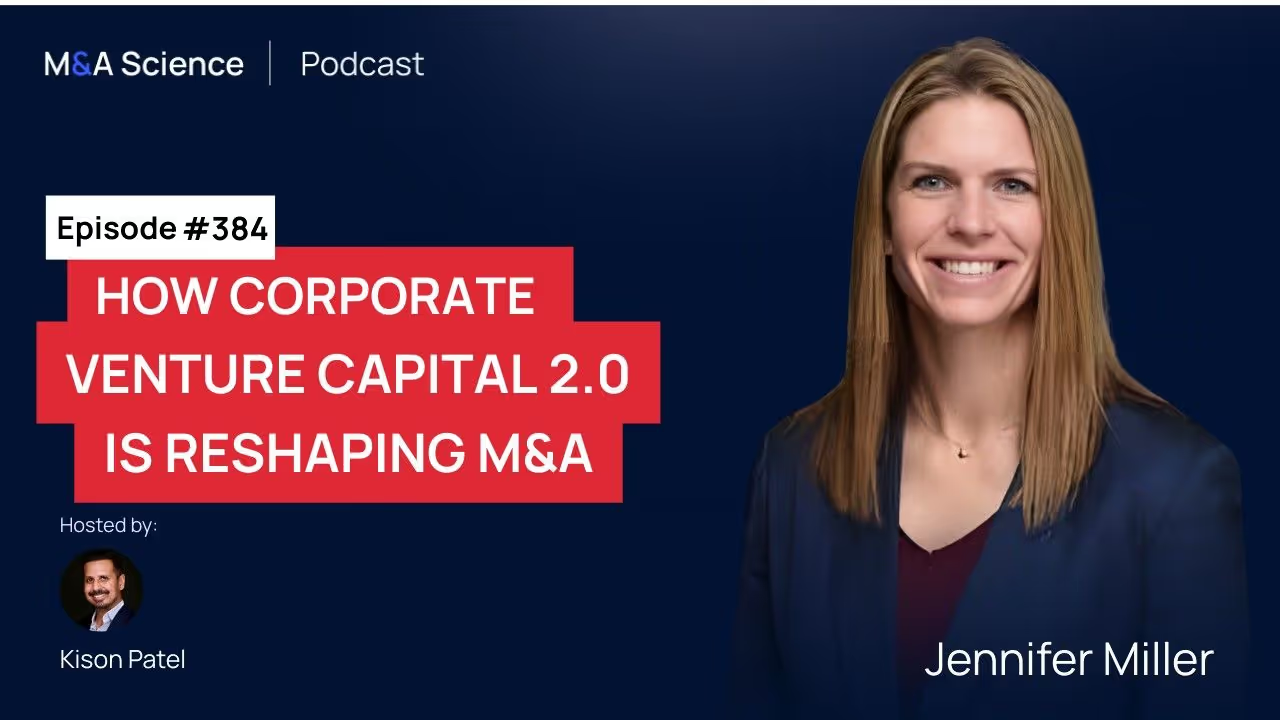
Jennifer Miller
Jennifer Miller brings 24 years of strategic M&A experience, starting at Lehman Brothers' venture capital division before moving through investment banking, boutique advisory at RIF & Company, and corporate development roles at AO Smith and Rioss. At Oshkosh Corporation, she leads the evolution of their corporate venture capital practice, focusing on strategic technology partnerships that complement traditional M&A activities across defense, fire, emergency, and commercial vehicle segments.
Episode Transcript
Measuring Value in Corporate Venture Investing
Kison: [00:00:00] I am Kisan Patel, and you are listening to m and a Science where we talk with deal professionals and learn valuable lessons from their experience. This podcast focuses on stories, strategies and what actually happened during m and a deals.
Kison: I know this sounds familiar. Emails, spreadsheets, random [00:00:30] trackers, and five different tools, all trying to manage one deal. That chaos is why things slip, why diligence drags and why integrations blow up at the buyer LED m and a summit on October 30th. We'll show you how top acquirers have cut through all that noise.
Kison: You'll hear real playbooks from leaders at companies like State Street, SPS, commerce and Quadrant. On how they've streamlined their processes, reduce risks, and move faster. This isn't theory. It's practitioners sharing what works in the real world. [00:01:00] It's free, it's virtual, and it's happening October 30th.
Kison: Register now at deal room.net/summit. We're using the link in the description. Hello and welcome to the M and a Science podcast. This podcast is part of a mission to rethink how m and a is done. Old school sell led approach, it's Dead Buy LED m and a is all about strategy, alignment, and efficiency.
Kison: Putting value creation at the center of every deal. And let's just be real. It's not just about [00:01:30] closing the deal, it's about making it successful. We uncover what truly works in m and a by learning directly from the best. I'm your host, Kisan Patel, founder and CEO of deal room and Chief Scientist at m and a Science.
Kison: Today I'm here with Jennifer Miller, senior Director of Corporate Development at Oshkosh Corporation. Oshkosh is traded on the NYSC, under OSK market cap north of 8 billion. They're a global leader across defense, fire, [00:02:00] emergency, commercial vehicles, and access equipment. Jennifer brings a unique perspective from the front lines of corporate development where she's navigating corporate venture capital and minority investments.
Kison: It's been vital in transforming Oshkosh's approach from purely financial returns to strategic innovation partnerships, and today she'll share insights on how corporate m and a teams are adapting their playbooks and this new reality. Jennifer, how are you doing? Thanks for joining me here, live downtown Milwaukee.
Kison: It's good to be here. I appreciate taking [00:02:30] time from doing deals to have a conversation with me. Could you kick things off, a little intro in your background?
Jennifer Miller: I've been doing m and a for over 24 years. Not all m and a though. I will say I've been in a lot of different strategic roles across my career, starting with Lehman Brothers out of undergrad.
Jennifer Miller: I went there and spent four years doing a lot of different things. Like many, I was part of the investment banking analyst program. That's the typical start. But I actually began in venture capital, so my first year on the job was looking at earlier stage businesses. [00:03:00] Thinking about whether they made sense to invest in.
Jennifer Miller: So it was a lot of strategic thinking and financial analysis and investment thesis development. So learned a lot in that first year. Moved over to the investment banking side for a year and then actually spent some time in strategy for Furman Brothers investment management division. Then I went to business school, wasn't sure I'd ever end up in m and a, but ended up at a boutique called RIF and Company at Los Angeles and.
Jennifer Miller: Spent about four years there, mostly doing sell side m and [00:03:30] a, working with entrepreneurs, so smaller businesses, not the bulge bracket companies that Lehman Brothers typically worked with, but it gave me a lot of opportunity to help those businesses develop their strategies as part of the sale process to really tell their story.
Jennifer Miller: Well. Left there and did corporate development in a lot of different capacities. I've been with AO Smith Rios, and now I landed at Oshkosh just over three years ago. I'm actually doing more venture capital and strategy work and less m and a.
Kison: You've touched all sides of the deal. [00:04:00] From the early stages.
Kison: More mature, uh, than working with the private founder owned type of businesses. Mm-hmm. Working on the strategy side, corporate development, different capacities. How are things evolved since those early days? What do you see changing overall and how deals are getting done?
Jennifer Miller: Big deals are happening. You see market cycles.
Jennifer Miller: Things change as the market changes. Right now, we're seeing a lot of deals getting done. Some of it's based on taxes and you wanna close a deal by the end of the year because of taxes or just timing for. Estate [00:04:30] planning, if they're smaller deals. Right now we're seeing a big shift toward large companies that are pure plays being more attractive in the market.
Jennifer Miller: So that's something we're keeping an eye on at Oshkosh.
Kison: Yeah, it is. I think the big thing that we mentioned when we first talked was you shifted to this focus more. On doing your corporate venture, these kind of like strategic partnerships. Can we talk a little bit about how that's sort of changed and evolved?
Jennifer Miller: We have a corporate venture capital practice that's been around for about six years at [00:05:00] Oshkosh. The idea originally and today is that by having this. Structured group and focus, we will find the best technologies in the market. So it supplements what we're doing in-house. We have a large team of engineers developing the technologies for our business and the future products we wanna deliver.
Jennifer Miller: But any company gets focused on the things that they can do themselves, the products they're thinking about today, not what might be a big disruptor, not what's coming out of universities. Our team is supposed to be [00:05:30] focusing on that. Nothing's changed there. What has changed is the approach. It's evolved.
Jennifer Miller: We call it CBC 2.0 that we've just begun, but we really have been evolving since the beginning. When we started, we worked mostly with funds. Trying to find information on the markets. What are we missing in the market? What trends should we be paying attention to? And by talking to other venture capital funds that are pure financial investors, we can get a better feel for what we might be missing.
Jennifer Miller: So we continue to do that, but I think the [00:06:00] focus has shifted from just that to adding individual companies. So as we've gotten more and more deal flow, people know about us, we start seeing the startups come to us, and then we go out and proactively find them. We're able to make educated decisions on which ones we should invest in as Oshkosh.
Jennifer Miller: It's just pure investment still. And as we've evolved, we realized we have to really establish a partnership upfront too. Lately we've been more focused on the partnership, less on the investment. So using that sale, same deal flow that's coming in, we're [00:06:30] seeing what is the best approach to working with this company and trying to do it more systematically.
Jennifer Miller: So sometimes it might be that the technology's ready today, OSH can deploy it and try it out. So we'll do a proof of concept. If it works within a few months, we can have this. Product or technology rolled out across the company, that's the ideal. Other times we'll find a technology that's even earlier stage, or maybe it's in, or maybe they're working with automotive companies and not commercial equipment.
Jennifer Miller: We can maybe adapt that technology with [00:07:00] a little bit of work. We might co-develop something or offer to work with them to develop it in a new way for our needs, and that would be more of a strategic partnership that might involve an investment. With all of these companies, we're always taking the financial approach too, of do they need money?
Jennifer Miller: Are they a good long-term player? Are they gonna be around in a few years? Can we support them financially? Should we invest in this company and get some opportunity there?
Kison: So one. I will forthcoming admit, I have been stealing your phrase of CVC 2.0 and socializing it. [00:07:30] And people do agree with it too generally, and the way I framed it is here's the first gen, which is very much focused on financial return, and the second generation of it is focused on innovation.
Kison: Fair to say.
Jennifer Miller: That's true. We never forget financial return. We are always going to be measured on the future of financial return, but the innovation is key. And actually as we look at what our goals are, the innovation is definitely primary Now. It was always there in the beginning too. We weren't just making investments in broader [00:08:00] themes, we were looking for the things that we thought would be.
Jennifer Miller: Important to Oshkosh, but now it's more direct the association.
Kison: It sounds like the activation too. It's just very much emphasized of like, how are we gonna utilize this technology and gain from it? How do you see the actual approach to deals? Has that changed at all between sort of 1.0 2.0?
Jennifer Miller: I would say it has changed.
Jennifer Miller: Well, we've always had our legal team deeply involved in dotting all the i's and crossing all the T's and making sure we have a locked [00:08:30] solid agreement on IP ownership. What that partnership is going to look like. We've shifted toward what can we get done quickly and put in a, in an initial agreement, not just a memo of understanding, but a real agreement that says we're going to do X, Y, and Z, but it doesn't have to be all encompassing.
Jennifer Miller: So we're trying to get something done fast, and that means the agreement has to match. So we're trying to understand better what the startup's looking for
Kison: in that plan. It sounds like you're talking about even like just tying in like real outcomes. Like it's more tangible. Yeah. I should have framed it too as like [00:09:00] structure and evaluate deals.
Jennifer Miller: As we structure the deal, it's customized to what the company is going to need to, we're not any one deal is the same as another. Every company's at a slightly different stage. They have different customers, different exit strategies was we look at. What we might do with one company, we would love to lock up that ip, so we might put it in escrow so that if the company fails or is acquired, we'd get access to the ip.
Jennifer Miller: Then, so the source code, we won't lose the software that we've developed with them. That's challenging [00:09:30] because you're dealing with a company that is looking for money from other investors, and when the IP is already spoken for by Oshkosh, it feels limiting. We have to really be cognizant of what. The startup can bear and making it a true partnership and not limiting their future m and a opportunities.
Kison: Yeah, that's actually a great point. Striking that right balance. Yeah. Now your venture investments actually sits within the m and a team at Oshkosh. Yes. How do you do that? Because I feel like they're very different [00:10:00] strategies. You're trying to balance looking at these minority deals versus full acquisitions.
Kison: How do you sort of balance, like which ones do you focus on and other differentiators between the approaches?
Jennifer Miller: We have silos within corporate development, so they're held together by the strategy. Our m and a team is more focused on the larger companies that are either, not necessarily competitors, but companies in the space.
Jennifer Miller: So there's similar adjacencies, profitable businesses that [00:10:30] can be tacked on, integrated, and it's a more traditional approach. Those are a hundred million plus in revenue type businesses, often significantly bigger. There are a small number of those companies out there relative to what we see on the CVC side.
Jennifer Miller: They have more time to do a lot more analysis on each one and understand the timing so that they're tracking deals for years and years. On the CVC side, we see 400 plus companies per year that are a good fit for us that we end up putting in our pipeline. So we see lots more [00:11:00] than 400, but 400 that really go into the pipeline.
Jennifer Miller: Wow, that group of companies, we don't have time to analyze each one. So our approach is more thematic, where we're proactively determining based on our technology priorities, where are to focus. Within each of those groups, we might find 10 companies that we wanna focus on. We leverage the analysts on our team to help support some of the market research and the initial view on which areas might be attractive, where the growth is, if they're good fits for where [00:11:30] Oshkosh should play.
Jennifer Miller: And then pick the winner within that, focused on our technology teams. Sometimes there's overlap where our m and a team says, Hey, there's a company that has some technology. Is this something you're interested in? Even though it might be an m and a opportunity, it could be an early stage company, and sometimes we get companies where we say, this is an interesting investment, but we should actually own it.
Jennifer Miller: It's a technology we need to own in-house, whether we develop it ourselves or buy it. That's the overlap process wise. The M and a team [00:12:00] has an always on meeting every month with our leadership team to go through targets, and we've recently added the venture capital opportunities to that meeting so that the leadership team is seeing what we're seeing early.
Jennifer Miller: The best part about that is that we get quick nos. If there's an area where they say We're we're not interested, we can knock that off the list even before we do significant diligence, or if they say no and we say, we don't really agree with you. Then we know we have to make the case and try to build the investment thesis around why it needs to be [00:12:30] something that they should look at.
Jennifer Miller: And that's our job we're supposed to be as venture capitalists, trying to be provocative and challenging the status quo.
Kison: Who's all in that meeting?
Jennifer Miller: C-E-O-C-F-O-C-T-O. Head of Corporate Development ahead of what most people call it. We call it digital technologies. General counsel,
Kison: so internal executive teams and the
Jennifer Miller: presidents of each of the business segments.
Kison: Oh wow. It's a pretty big group to weigh in. Yeah. Of Hey, is this a good deal to do? But it sounds like it's pretty productive 'cause you're getting quick answers. I'm really [00:13:00] curious about how, and I guess it's almost like as the organization thinks about capital allocation. Because I could see the traditional model being very focused on each business's p and l, but then when you look at the deals you're looking at, like they're not very linear to contributing to p and l.
Kison: These are more of like innovative things where you're thinking years out. How do you manage that? How do you get to the right thinking about the capital allocation and just get the right sort of attention on those things that aren't like. [00:13:30] So direct
Jennifer Miller: from a capital allocation standpoint, we've got a pie that we have to distribute and there's this, a chunk of that that's expected to be an external spend.
Jennifer Miller: So that's m and a and investments and CB. C fits into that. There's an expectation that there will be capital deployed for vestment. So there, there's some
Kison: like already allocation considered of, hey, this is gonna be geared towards some of our more long shot bets.
Jennifer Miller: Yeah, there is, but. Every decision has to be scrutinized.
Jennifer Miller: And when you're looking at most investments, and that's in [00:14:00] CapEx, if we wanna build a new plant or buy some machinery, there's a an ROI calculation that gets done. This sort of investment doesn't lend itself to that same model because we're not going to see the return in three to five years. So it's a bigger challenge.
Jennifer Miller: And so we need to be able to prove that it's going to be implemented on equipment, and if it were not implemented, we might lose market share. That's one approach. The cost to develop this in-house. If we say we would want to do this and it, it would take us three years [00:14:30] and x million dollars, but by investing in this company, we get the same access and it only costs us $1 million and it's an investment, so we get a return on it in the future.
Jennifer Miller: It's a lot harder. There's no one metric and every case is different. We also have to build buy-in. So working with the business unit that's going to use this technology upfront and seeing whether it's something that's on their priority list that they can allocate capital to is also important. It has to be very early, has to be at the senior level in the business.
Jennifer Miller: The finance team has to [00:15:00] understand it and be ready for it. Sometimes it means that they have to cut something else outta the budget to do it. We've learned to just accept that. And if the answer is no and we don't get much traction, and it's probably not. A good fit anyway.
Kison: So a lot of theses on buy-in from the business unit because ultimately they gotta contribute budget.
Kison: There may be some. Hey, here's some allocation towards these types of investments, but ultimately they gotta make that final call of this is what we really wanna do.
Jennifer Miller: We're looking for technologies that cross multiple business segments. That's where the big [00:15:30] opportunity is, and that's even harder because you're asking somebody to just be the first mover and in a big organization with lots of different business segments.
Jennifer Miller: Nobody wants to pay for something themselves. A hundred percent that everyone else will get to use in the future.
Kison: Yeah. Now you added some good complexity. How do you, how do you deal with that? Because that's, that's so interesting. Or even, I'm looking at our company in a small scale. Sometimes we have technology that runs across departments and it's, where do you put it in who's p and l?
Kison: Yeah.
Jennifer Miller: Two things. We have an organization called Pratt Miller, that's an engineering services group with, [00:16:00] within our company. It was actually an acquisition that we made about four or five years ago, and that business is. Looking for these opportunities that they can fold in and develop so they can work on the technology there.
Jennifer Miller: The other piece is we have a small budget for proofs of concept that span the whole business where we can say, we'll sponsor it at the cvc.
Kison: Oh,
Jennifer Miller: interesting. Have one of the business units do the proof of concept at our expense, and then if it works, then they'll have to pay for it eventually. For the beginning, just that first test, we can help
Kison: get things done faster.[00:16:30]
Kison: Wow. That sounds like good move is, that's new. You don't have to really, that's
Jennifer Miller: new. Yep. Something we've been pushing for a while and I think it's already helping.
Kison: When you think of tying this into the actual pipeline development, 'cause you mentioned you have a list of companies, you sort of look for themes that are more what's priority or top of mind for you and you start digging into it.
Kison: What does that look like in terms of just direct outreach to these organizations? It really similar to what you do in m and a where you're just, Hey, I have some ideas. Why don't we sit down and talk and make like that initial introduction? Or is there a different [00:17:00] approach that you take altogether for the sourcing process?
Jennifer Miller: Um, there's a lot of back and forth. It starts with. The customer feedback. So we're doing voice of the customer research at our level. It's talking to our business units and trying to understand from them what did they learn from their customers as their biggest needs. So what will those customers pay for?
Jennifer Miller: If they're going to buy a truck, are they going to pay for this upgrade or not? 'cause that's. Where we should focus. The next step would be, okay, we've looked at those, let's prioritize which of those can we do in-house? Are [00:17:30] we doing in-house? Which can we go buy off the shelf? There's already a product out there that does this, and we help find those sometimes too.
Jennifer Miller: But we have a separate advanced sourcing team that's working with established businesses on most of our technology needs. So we're really looking for the things that are. Not available in the market today. Future ideas that are not on our list to develop in-house, whether it's because we lack the capability today, we don't have a team that does this particular kind of software development, for instance, or it's just not on the list yet, then we [00:18:00] can go find it in the market.
Jennifer Miller: Sometimes we might be trying to develop something in-house and we actually say, maybe you should stop that or have that team work on something else, because there's a bunch of stuff out there that we can bring in from startups that can accelerate what we're doing and cost less. We don't wanna reinvent the wheel, so we're trying to just make everybody aware of the things that already exist to solve those problems.
Kison: So if we're a makeup example, you guys, I forgot, what vehicles do you have? Hummers or We
Jennifer Miller: have defense tactical wheeled vehicles,
Kison: joint tactical vehicles. Mm-hmm. Which sounds really interesting. I'm gonna [00:18:30] look it up. After this interview. You talk to the customers and it's, Hey, what's your appetite on self-driving?
Kison: And they're like, yes, that's something that we're really interested in. And then from there you do this assessment of. Is this something we're gonna feasibly build in house or mm-hmm. Do we start looking at partner licensing deals? Do we look at doing maybe this type of investment or acquisition?
Jennifer Miller: Right.
Jennifer Miller: And most of that is done by the technology teams themselves. They know which pieces they wanna develop in house and where they might have gaps, and they have a whole timeline on how they get from A to Z. [00:19:00] They've told us which pieces they want us to focus on. So that aligned with the customer needs gives us a shortlist
Kison: area of priorities.
Kison: Yeah. So then you got a very clearly defined strategy, right? Taking that strategy into an actual criteria of a business. How do you sort of shape that from? Hey, we're looking at little companies, or we're looking at maybe more m and a, like how do you shape that into a real criteria for you to hone in on which companies you should be talking to?
Jennifer Miller: There's a lot of back and forth, so that's where we go to the technology teams with the list. [00:19:30] So we say, you told us X. We're coming back to you with what we think you were looking for. They look at the list and sometimes they can cross out nine outta 10 and say, maybe there's something here. Look at that one.
Jennifer Miller: And then we can go back to our, to the drawing board and find more companies like the one they liked, or at least we have feedback that tells us, Hey, you're close, but. Find one that has a few more features or it's farther along, and then we can go find more companies. Sometimes they don't exist, and then there may be something where we just can't help right now, but we're looking, we talk to our partners, the other venture capital [00:20:00] funds that we talk to all the time, we talk to other similar kind of corp dev teams or corporate venture capital teams, and mostly with peers.
Jennifer Miller: So they are in similar spaces to us, not necessarily competitors, but companies doing similar things and try to share some of the deal flow that way. That's a big difference with m and a and CVC. Most of the startups are very open to telling you they're looking for money because they're mostly raising money and they wanna talk to all of us.
Jennifer Miller: So until you have an NDA in place, we're able to share pretty broadly. Yeah, m and a. You don't [00:20:30] do that.
Kison: Yeah, you're right. That is so different. So it's more of a little bit of a collaborative or openness in that nature. The back and forth of the tech team, it sounds like that's a process you just go through to really crystallize criteria because there's just things you wanna really learn and then you get the those inputs and learn from it.
Kison: Yeah. And then hopefully find something that's interesting to pursue. And then when you pursue them, it sounds like they're just a little bit more of. Actively out looking for capital. They're more receptive to conversations in general. Absolutely. What does that conversation look like? I'm [00:21:00] curious about the framing part, because usually in m and a deal, in the beginning you're just, Hey, I got some ideas.
Kison: But you tend to get to it pretty quick of, Hey, here's my better together sort of mm-hmm. Vision and. Why don't we talk through what putting a deal looks like or if we're on the same page about doing that. Is there a different approach when you start talking to the these companies or is it in a similar vein?
Jennifer Miller: They're all different, but most of the startups that we talk to are fairly open with what they're trying to do, and they'll give you their pitch varying levels of pitches. Some are just. Couple slides, others have a much more [00:21:30] refined plan. That gives us some information too. Where are they? What stage are they?
Jennifer Miller: How fast are they gonna grow? Are they going to be able to find the partners and work with customers? Do they know what their core differentiation is? What makes their business unique? You hear that pretty quickly. Not much of a technologist, so I'm on the business side. I quickly have to bring in the technical team, but if a company can't explain to me in a language that I can understand after having done this for three years.
Jennifer Miller: What they're doing, then it's usually not going to be a great fit. Some of these things are very hard to describe [00:22:00] software, but ultimately you have to be able to tell me why my company is in business, how it's going to make money, and how it helps your customers. So those are simple things that startups should be ready to do when they talk.
Jennifer Miller: That's true to somebody trying to give them money and it's, some of them can't do it. And then I have to go and get the technology team to verify that it's not clear yet what they're doing or how they differentiate or how they'll help us. So that's the initial conversation. We usually bring in the technical leaders who would actually be working with them early in the process just to get a quick read.
Jennifer Miller: And then we [00:22:30] have a team that's more kind of advisors to us that we bring in regularly to support the process on the technology side and due diligence with the companies. So after an initial meeting, we do technical diligence first. The business side, we're not necessarily going to invest and we're upfront with those companies.
Jennifer Miller: On that note, it's, we're gonna look at the partnership first. Is this a good fit for us? And we'll tell you that. If that's the case, then we'll invest. If not, chances are we're not going to invest. That's not our goal as Oshkosh. I don't think our shareholders expect us to go [00:23:00] invest in companies that.
Jennifer Miller: Could be unicorns. We're looking for the winners, meaning they're gonna be a strategic fit. They'll be in business down the road and they're not gonna lose money
Kison: and, but there's also leverage for your organization to benefit from that technology. Can we talk about structure? I'm curious, I'm gonna play on both angles here from both your organization but also the startup.
Kison: So for your organization, there's clearly the IP that's of interest. I would also assume that there's optionality for acquisitions down the road. I'm curious, it seems like those are the two main things. [00:23:30] Talk me through what's the thinking around that, because there's that balance of how much of this IP you're gonna have exclusive to, you know, and then there's obviously other variables where you're helping to co-develop some of the ip.
Kison: What does that generally look like from your point of view as an investor? When you're sort of looking around expectations for both IP and then optionalities around acquisitions?
Jennifer Miller: Yeah. The simpler one is probably on the future acquisition. Some companies we don't anticipate acquiring. We just wanna know if they're going to be acquired, that it's a partner we're [00:24:00] comfortable with.
Jennifer Miller: So we usually ask for information rights so that we know when they're negotiating. We don't wanna do anything that's gonna hamper their negotiations with the potential acquirer unless it's something we absolutely must don't. So those deals look like we will get information on any kind of future investment partnership or acquisition.
Jennifer Miller: Before you do this, you'll keep us in the loop. We look for board observer seats, sometimes board seats, although most other VCs will tell you they prefer not to sit on the board because [00:24:30] there's a fiduciary responsibility then, whereas an observer has the rights to see the information without the duty to support the company.
Jennifer Miller: So that's the approach we've done both. But most companies prefer not to actually take those board seats. Hmm. So that kind of covers the m and a piece. We don't wanna limit the companies,
Kison: but then it just access information. There's no first start refusal or any,
Jennifer Miller: sometimes we'll put it in. We don't want the last.
Jennifer Miller: Right. Because then any company that comes into negotiate knows that Oshkosh can then take that deal and just pay a dollar [00:25:00] more and get the company. So we don't wanna do that.
Kison: Then that would limit. Startup, so that's kind of nice. You're being a little considerate for the startup. We have
Jennifer Miller: to be, I mean, we want them to grow and we want our money to be valuable.
Jennifer Miller: Most of the time we won't be the right acquirer unless we're very confident that we're going to acquire the business. That's the approach we take, and if we are that confident that we wanna acquire them, we might as well probably do it now before the valuation
Kison: rise. Right? Right. Now, if you get the right to information and you do find out like, Hey, here's a, I don't think this is gonna be a good thing if this company invests.[00:25:30]
Kison: Then do you start pursuing an acquisition or can you Yeah, absolutely. Okay. But there's no like refusal we'd be
Jennifer Miller: negotiating against Exactly. It's
Kison: just competitive process and you, you go for it. Yeah. That's actually pretty interesting. Just get the right to the information so you know, ahead of time that something's cooking.
Kison: Yeah.
Jennifer Miller: Maybe it's too nice, but I think it's a, a fair approach.
Kison: It's, it's something, it's better than nothing. Right. If you didn't have anything at all, then it's, you can get caught off guard. But if you at least have access to know about things that are mm-hmm. Bubbling up. Then great. It allows you to [00:26:00] still play in a fair market.
Kison: You're not limiting their options, so that's good. How about the IP part?
Jennifer Miller: One thing we've learned as a company is co-owned IP is not as easy. It's better if one party owns the intellectual property and the other one licenses it. So as Oshkosh, we have a strong legal team. We have the ability to. Enforce patents and just make sure that we're defending anything that comes our way.
Jennifer Miller: The startup's not really well positioned to do that, so in our [00:26:30] negotiations we tend to say we'd prefer to own the IP that might be developed between us, and then we would license it back to you. And that could be for some license fee, or it could be free for certain use cases. So. Let's say we want exclusivity for our market.
Jennifer Miller: With the IP that we develop together, we would just say, we're gonna own the IP and we get to use it here. To the extent the startup wants to use the ip, they can do that in a group of other markets, but they can't go after ours without permission. And that as a good citizen when things [00:27:00] change, we're open to, to changing those.
Jennifer Miller: But that's kind of the initial position. We actually put that in the NDA, so right away when we start talking. So this is not a surprise to the startup. That's our approach. That's just how we do business because we've seen it. Go bad, fast. Initial discussions. You create ideas all the time. We're always talking, oh, what if we did this here?
Jennifer Miller: It's just conversation. But if the other company goes and takes that knowledge, then we have to be careful. The other thing we have to watch out for is we're often developing the. Competitive IP [00:27:30] internally, limiting who sees the information that we might get from the company in the early stages of diligence is important.
Jennifer Miller: So we limit that to a small group and enforce that we are allowed to go develop our own technology without the use of your ip. So that's very important to a large entity that's doing a lot of development.
Kison: That's in the NDA. Yeah. So isnt that make it tough for the startup though? Yeah.
Jennifer Miller: Startups all have different approaches.
Jennifer Miller: Some sign it without a question, and that actually concerns me [00:28:00] because I wonder if they've actually read it carefully and then others get nervous about it. And we're able to usually explain to them our rationale. And once they get past it, they can see why we would do that. If we don't develop ip, it's not a problem.
Jennifer Miller: And we always say, we're not intending to develop IP under an NDA, but if it happens, we wanna protect ourselves. And you.
Kison: No clawbacks or where they push back and negotiate? Oh they do. They do. They do. Is there like a balance or
Jennifer Miller: Depending on the situation and sometimes we just opt not to partner [00:28:30] because it may not be the right fit.
Kison: That's so interesting. Yeah. I used to be part of diligence. I used to be one of those people that just signed the NDA to get, didn't have patience for it. But now I learned you gotta read those things. You should read it.
Jennifer Miller: Always read agreements you're signing.
Kison: Oh, especially in the context of these deals.
Kison: 'cause it's so much that could come back for you. So that's first and foremost you get that to put out there of, hey, this are the rules that we're playing around. But it's interesting that you mentioned the IP you'll basically shoot to get at least exclusive in the [00:29:00] segment. So you might not be a fully exclusive, but it's like, Hey, we're gonna use this in our all train military self-driving technology in those vehicles.
Kison: That's our application that we wanna protect. Right. So we're exclusive to that. So you just can't go to the direct competitor, sell 'em the same thing.
Jennifer Miller: Yep. That usually works. And that and it, it varies. Some, sometimes we need that, sometimes we don't. Or could be geographical depending on,
Kison: and the hand draw line, it's like maybe just require the technology if it totally makes sense too.
Kison: Yeah. Now from the startup's perspective, play a little devil's advocate here. How do you [00:29:30] sell against. And I'm curious about this as a company that's, we're like 50 people, 10 million a are growing. You're starting to explore m and a, which drives you to go raise some capital. You have a lot of options now in this active market.
Kison: 'cause there's capital everywhere. So you could use, there's VCs out there, there's all these growth equity funds out there. There's very wealthy private individuals as I've learned that are out there, family offices that wanna get into private companies. And then you got the strategics. And I feel like it's just like such an [00:30:00] interesting, if you look at something like a hot startup, they have a lot of options.
Kison: How do you position even for that startup of what's the different or the benefits of working with the strategic over corporate or one of the traditional PE growth funds?
Jennifer Miller: So in most cases, the startups that we're talking to see the value in a strategic partner and believe that having our name on the cap table is helpful to them.
Jennifer Miller: There's always that question of, is that true In the past? You might say no, but CVCs [00:30:30] are involved in a lot more transactions and in the past, and there's some evidence that they tend to be better companies. So we lend proof to help them get investment from traditional investors. So that's one piece. The other is we try to be good citizens.
Jennifer Miller: We're not there to make money. We're there to accept a deal. We often follow. We're looking to the lead investor to set the valuation. We aren't going to negotiate much on those kinds of terms where we negotiate and they might not love it. Is the side agreement on the partnership those [00:31:00] For us, it's at the same time.
Jennifer Miller: We always tell them, we're not your partner because of our money. You can get money from others. We partner because we're gonna help grow the business, and the more we can lay out what that looks like ahead of time, the better. So bringing in the right teams so that they're seeing who they're going to be working with on any co-development.
Jennifer Miller: Is key. So it's not just me and corporate venture capital and corporate development telling 'em a story about what we might do together. It's the initial collaboration is done as part of the diligence. You start putting things on paper, [00:31:30] they can see what the future looks like.
Kison: So there's a team, hey, working together, we can see our revenues growing faster.
Kison: Mm-hmm. Reaching more scale, like getting the solution into more customer's ads. Those are the big ones for the company to look at, like, Hey, maybe this strategic can actually give us more of a stronger lift in the business. That sounds good.
Jennifer Miller: Yeah, they're looking for customers, so if we can just be a customer, that's a great starting point.
Kison: Do you like clarify or detail expectations on revenues that you're targeting in their partnership?
Jennifer Miller: In [00:32:00] some cases, but in most, we don't have enough information at the time we're investing. We might have an indication of what market we're going to take it to and how we'd like to go forward, but we're not great at estimating.
Jennifer Miller: Customer uptake for some of the technology we'd add. And a lot of the time it's just a feature that gets added to our product, so nobody's actually paying for it per se. We'll pay for the hardware, the software on a per unit basis. It's not like our revenue's going to go up. So that's where it's becomes a [00:32:30] challenge.
Jennifer Miller: We might know what we're estimating we're gonna sell for that product, and we can tell them that.
Kison: Yeah, it's curious, the minimums. I've seen some of these deals where they're strategic, doing an investment in a startup. They'll definitely push for the option to acquire it down the road. Just, yeah, an option period.
Kison: And the counter defense on it is saying, Hey, why don't we set up some revenue targets so if we don't achieve some real value from this relationship, we'll call that option off.
Jennifer Miller: We haven't done that yet, but I think that's something we would [00:33:00] like to explore. The other would be, let's say we help the company grow and they meet certain targets.
Jennifer Miller: Rather than just a pure equity investment upfront, it might be something where we could get warrants. So putting in those minimums or expectations on what happens if we achieve them together, then we'd. Get some equity
Kison: later. Yeah. Can we explain warrants? I guess you kinda got the gist of it,
Jennifer Miller: rather than an equity investment in the stock, it's like almost like an option.
Jennifer Miller: You earn stock in the future with [00:33:30] certain metrics that are put in place. So the company's revenue success if they achieve X, Y, and Z with our partnership, then we get that ownership down the road. So it, it allows us to basically invest in the winners without putting a lot of money to work upfront. Other than through the partnership.
Jennifer Miller: So a lot of the time we'll pay for some of the development that we're doing for the company with the expectation that they're going to develop something for us with that money. So we're paying for it. And you can just make that a simple commercial agreement where we're providing
Kison: And then you can still add warrants [00:34:00] to Yeah, but warrants on
Jennifer Miller: top kind of, it's like a sweetener,
Kison: right?
Kison: This ends up being a big commercial success, a sort of win for everybody 'cause we help contribute to it. That's pretty interesting. There's a lot of ways to structure this.
Jennifer Miller: It's creativity more than that.
Kison: Yeah, that's what I was curious. It sounds like it's pretty fluid when you work with these companies.
Kison: 'cause obviously the startups come in all shapes and sizes and it sounds like you're, and that your particular group is pretty flexible about what kind of terms you structure, because there's a lot around the IP part, how you utilize it internally, how do you [00:34:30] segment it off for certain markets for exclusivity, and then what does the future rights look like down the road?
Kison: Then you got the actual ownership of the business. So we got a lot of variables going on here. When you think about some of the things you mentioned around the team and getting them like the startups aligned and driving, because we talk a lot about integration's, a big driver of MA success, it all hinges on how well you integrate the company.
Kison: You do, you'll end up creating a lot of value. You don't, you could destroy a lot of value. How do you see that when it comes to these kind of [00:35:00] investments? When do you think of integration the same way? Or is it completely different? Is it more of like just socializing with people early on and just letting them run off with it?
Kison: Or
Jennifer Miller: Probably a subset of the full integration. You wanna do some of the cultural diligence upfront to make sure your teams are going to jive and then. When you're actually working together, you need to set parameters, goals, plans for who they can talk to, whether you acquire a business or invest in a business.
Jennifer Miller: You don't wanna have 50 people from Oshkosh calling this small company weekly because they're gonna get overwhelmed. Put in place [00:35:30] rules you have, this is your key contact, this is who you're gonna talk to, and then. Over the next three months, we're going to do this much development, and then there's a milestone we're going to evaluate and move from there.
Jennifer Miller: If it's successful, then we move on. We're working on this as part of the CBTC 2.0 process. We don't have a team of people at Oshkosh ready to accept. 10 companies per year. We might, if we find enough different business units to work with, but often it's one business unit is really excited about working with startups and they [00:36:00] would love to do four or five deals, but they don't have enough people to manage it.
Jennifer Miller: So adding a project management layer where just have somebody kind of checking boxes and making sure they're meeting all the milestones is important. We're working on that piece now we do a little bit of diligence upfront, like you would for any integration for an m and a deal where you're trying to understand their systems and cybersecurity.
Jennifer Miller: So if you're putting together two companies and you're building software, you have to make sure it's safe and secure. And if not. We have to have a plan for what we're going to do to upgrade it to our [00:36:30] standards. Same with hardware. So there is a bit of that like diligence process, but we're not integrating, we're not ERP or anything like that through.
Jennifer Miller: Yeah, it
Kison: doesn't go through your integration team, it sounds like, don't. It works directly with the business unit.
Jennifer Miller: It works directly with the business unit and we have a few other people who see a lot of these who look at the same things over and over. So we have a good kind of checklist of the things that might be problematic when we start.
Jennifer Miller: What
Kison: are your biggest risks when doing these kind of investments? I
Jennifer Miller: guess one
Kison: is just that
Jennifer Miller: we stop and we don't pursue what we're supposed to be doing and that can't [00:37:00] happen where we, we'll have a team that kind of takes a look and does a quick evaluation, and we've spent a lot of time upfront we think, getting alignment, and then if they just don't have the time or it's not their priority or where they are told to focus, we can drop it and then not help the startup.
Jennifer Miller: It doesn't help us. The financial returns are gonna be a struggle. And then monitoring that company. So if we do that and then they say, Hey, you have exclusivity, we're not able to go after this market. We have to be at least ready to pivot or allow the company to pivot and change our [00:37:30] agreement and say, oh yeah, sorry we didn't pursue it, but feel free 'cause it wasn't the right fit for us.
Jennifer Miller: After all, it's okay to have a no, like we're, we evaluate, work together and decide it's not the right path. We expect that in venture with enough transactions, anytime you're looking at startups, they're high risk, but we don't wanna. Mismanage it is the key. Other than that risk of the technology kind of causing problems in the market, you you're working with something that's not really ready for market and everybody gets [00:38:00] excited and says, we've gotta get this out in six months, and we don't go through our normal processes of tests.
Jennifer Miller: There could be issues in the field that hurt our reputation. So that's a challenge too. So as much as we're trying to bring the nimble excitement and tech development aspect to this and get the culture of Oshkosh to be faster, and we still have to take care to protect our relationship with our customers,
Kison: hypothetically, if you found out the self-driving technology was fake and uh, take it out.
Kison: Yeah. Not good and bad. No. Those are interesting [00:38:30] stories we've seen. Can you tell me some stories of like winners and losers and these kind of bets you've taken?
Jennifer Miller: I don't think we know yet what the winners will be. This is one of the cautions of CBCs. You're working with early stage startups, so even if they can give you their hockey stick growth, then you push it out three years, chances are it's another three years before you're gonna see real success.
Jennifer Miller: So we're not yet at the point where we're seeing exits, we're seeing some winners actually in the more recent investments because there was a plan upfront on how we'd work [00:39:00] together. So we're starting to see that those will come to fruition. What I would describe as success and how we're measuring it, is there a partnership?
Jennifer Miller: Is there a path to market with the technology where Oshkosh will be putting this technology out either on a product or with a product. So it's a service that goes along with our product, that piece. The other metric is just how many of our business units are interested in this? So that's always been something where, yes, sometimes it's one specific technology for one business, like our [00:39:30] fire trucks, but other times it's something that can cut across all and trying to go from that proof of concept to a lot of people using it.
Jennifer Miller: That's the stage we're at right now. So we have a few companies where we're looking at that level of success. And then the financial pieces. We had a few earlier investments where we kind of took a bet on more hardware or software and a play that we weren't ready to take to market yet we weren't ready, the market wasn't ready.
Jennifer Miller: The company didn't get there because the market didn't develop at the pace they needed [00:40:00] it to, to put their tech on products.
Kison: Uh, I got it.
Jennifer Miller: So when think of autonomy, there's a lot of money that went into that space. If we all invest. Most of it is going to be wasted, but it gets us to the point where maybe the market will be ready in the next 10 years.
Jennifer Miller: And now we've got this leg up of tech that's out there, IP that's developed, and the company's all failed, but the IP is there to take us to the next step. So we look at the hype cycle now. Yeah. Hype curve.
Kison: The ones that panned out really well, what was the nature of them? Was it something that's [00:40:30] just tangible near term or
Jennifer Miller: they were a little bit farther along?
Jennifer Miller: Technologies that were in the market, maybe that other customers are already using,
Kison: proven out
Jennifer Miller: where we just needed to make some tweaks and be ready to leverage it on our products. So as much as we wanna say we're looking at the early stage companies, we are, but where we're actually putting our time is in the ones that are closer.
Jennifer Miller: Getting to market.
Kison: So there's like two factors. There is the maturity of the technology itself, and then there's the hype cycle of the overall sector of Yeah, that technology.
Jennifer Miller: Yeah. So is the tech ready and then is the market ready to take [00:41:00] the tech?
Kison: There you go. That's like a really good way to put it.
Kison: Given you have experience on both buy sell side of m and a and looking at entrepreneurs, smaller companies, myself as an example. We're considering strategic investors versus financial investors. What advice would you give to startups when it comes to like positioning themselves? In market to work with these investors and also understanding the trade-offs.
Jennifer Miller: Wanna be real with where the company is and what, [00:41:30] what goals are there. If you overstate your position and are overly confident in how things are going to turn out, it comes out quickly in the diligence. So any good investor, whether it's a strategic investor or financial investor, asks a lot of questions to verify everything you tell them.
Jennifer Miller: If you don't have good answers to those things. They're probably gonna say no just because they can't evaluate it. They hear one thing from you and then the data they're seeing doesn't match. So just being open and honest is one of the [00:42:00] first piece to success. There are invest investors who look at different stages.
Jennifer Miller: Lots of them are very interested in being the first one. Into that company. They're not expecting you to have revenue. They're not expecting you to have lots of customers lined up at the door. And if you tell them you've got all these pilots going on, they're gonna take that with a grain of salt. It's, it doesn't mean that much, but that's okay.
Jennifer Miller: It's finding the right investor for where you are. If you're much farther along, you might have a different approach. And from the m and a standpoint, when I work with entrepreneurs who maybe they've built the business over [00:42:30] decades and they wanna sell it. One time opportunity there. Take your time. You have to really plan, think about the, who's gonna take it over and what does that mean?
Jennifer Miller: In most cases, and this is for investments too, you're not going away. You're not leaving immediately upon the close of the transaction. In most cases, finding the right partner is going to be important. Are they going to do what you want with that business? Having them tell you the story once the acquisition is done, or once they've done investing, what does it look like to them?
Jennifer Miller: Where do they see the [00:43:00] company in five years? So you're hearing your story told through their eyes, and if it doesn't feel right, then that's not a good fit for you. If they get you excited about what they can do with it, do your diligence on that. What does that look like? If you say, I'm gonna grow by five times, you're gonna make my company so much bigger than it is today.
Jennifer Miller: How? What do you mean? Who are you gonna hire? What markets are you going after? Show me that market data that says you can grow it that big. Maybe they can, and maybe you've just been thinking small, but that's how you know whether the partner's really invested in [00:43:30] helping this business and that they're doing the work.
Jennifer Miller: To be realistic. So spend that time on doing the diligence on your buyer.
Kison: This is really good. First and foremost, no fluff. Yeah. So it's not 10 million a r, it's 8.8. Mm-hmm. On track to hit 10 million for the end of the year.
Jennifer Miller: Yep. Explain it.
Kison: The post-close world, like actually, what does that look like, whether it's a minority investment or m and a.
Kison: Getting a sense of what that relationship's gonna look like, what the company, and I really liked your view of having the buyer tell you in their [00:44:00] eyes. Where do they see your story evolving over the next five years? And then digging into that, like, all right, let's do my diligence. Like, tell me how and, and how are you gonna actually realize that?
Kison: I like that a lot.
Jennifer Miller: So it gives you a lot of, especially if you have competition, if you have multiple people looking at the business and considering investment or buying it, if it's a buyer, it's one buyer. You get, you have to pick one. Who do you believe in and who's gonna pay you? Who can value your business?
Jennifer Miller: At the highest number, and if it's a minority investment, you can potentially bring in [00:44:30] multiple investors, but you don't want them to be fighting. So you wanna have those that see a similar vision for the business and can help you grow it in that direction.
Kison: Great advice. Now I gotta expand it for your peers in the market, folks in corporate development, that may be early in the journey mm-hmm.
Kison: Of building out their CVC or they just are rebooting it. Giving it fresh breath, what's your advice?
Jennifer Miller: Move fairly quickly. Don't be too focused on getting it perfect because you need to find a lot of companies and you [00:45:00] need to invest a decent amount to start seeing results. And as you go, you're gonna learn a lot.
Jennifer Miller: So it's experimental kind of by nature. If you put too many rules in place and too many expectations, it's a lot harder. To do what you said you're going to do and be ready for change. Your business is going to change. If you're a big corporation, the priorities change over time. The people sitting in each role, they change over time.
Jennifer Miller: You have to plan to be nimble, put in place a few key metrics that you're trying to [00:45:30] succeed on, not all financial. Make sure there's measurable so that you can go back and say whether you did it, and then as you put in place structure, figure out what the team looks like. Start developing relationships across the company fast because you need to figure out who the right people are, who are going to understand what you're trying to do and be supportive.
Jennifer Miller: And that's where the rules come in. So it's not about how your fund is structured and you know where the money's coming from, how fast you're gonna return it, how much you're gonna put to work each year. It's. [00:46:00] How do I work with each of my business units? How often do I talk to them? What does that conversation look like?
Jennifer Miller: What are the tools I'm going to use to track the deal flow and those things? Just get on that right away.
Kison: Move quickly. Think agility, how you can be adaptive, and then metrics, make sure they're measurable.
Jennifer Miller: Yeah, only a few, not too many.
Kison: Make sure they're measurable. And then the structure, the team, what that working relationship's gonna look like
Jennifer Miller: and have the right people involved.
Jennifer Miller: I like where we sit. So if you're trying to figure out where do you put these people, is it in the technology team? Is it on the corporate development [00:46:30] team? We're actually a hybrid. We have two people in corporate development ones. Solely focused on venture. He lives in the Bay Area. We have me and we have a counterpart on the technology team part of the Pratt Miller business unit.
Jennifer Miller: So that's engineering, almost like a Skunk Works program. Wow. He's focused there and he sits in Detroit. So none of us are in the same location and we all are trying to work together. So you have a technology lens, you have somebody seeing all the deal flowing. You have somebody sitting at corporate thinking about strategy all day long too.
Kison: Gotta put all those pieces together. Jennifer, [00:47:00] what's the craziest thing you've seen in m and a?
Jennifer Miller: I haven't seen a lot of crazy things happen. I would say the one thing, um, you worked
Kison: in banking, of course I did work in
Jennifer Miller: banking, so I was there early career, it's, it was a long time ago. For me, it's not banking specific, but I worked for Lehman Brothers and two months into my job out of college, nine 11 happened and we lost our offices.
Jennifer Miller: We were downtown, not in the World Trade Center, but the World Financial Center and had to move to Midtown and I worked out of a hotel room for seven months. Tables set up, it's like [00:47:30] folding tables and chairs, and they brought in new computers and we sat in kinda a hotel chair with the beds taken outta the room, and that's where we worked.
Kison: Wow. So
Jennifer Miller: for me that was probably the craziest.
Kison: That is pretty crazy given the times and where you're, it's different. Yeah. Right there in New York, uh, at that time,
Jennifer Miller: set up a trading floor in one of the big ballrooms in the hotel.
Kison: That's crazy.
Jennifer Miller: It was crazy. All over a weekend we were back up in operational very fast.
Kison: Wow. Wow. That is wild. That's interesting. Nine 11 story. I haven't heard of anything like that before. [00:48:00] Jennifer. This has been a great conversation. I appreciate taking the time, helping me become better. MA scientist, it's great to talk. Those of you still listening. Fellow MA science family. If you could get to the end of these podcasts, I love to connect with you and hear from you.
Kison: I'm always open on LinkedIn. Reach out to me, connect with me, like to hear topic, ideas, feedback, criticism. I'll take it all. Don't ask me for crazy favors 'cause it's tough to do sometimes, but try to be helpful when I can. So next time, here's to the deal.[00:48:30]
Kison: Thank you for taking the time to explore the world of m and a with our podcast. We love hearing feedback. Tag us on a LinkedIn post, add a review on Apple Podcast. We'd love to hear from you. If you need help standing up an m and a function or optimizing one that you already have. We're here to help, and if we can't help you, we probably know someone that can.[00:49:00]
Kison: You can reach out to me by email Kisan, K-I-S-O-N, at ma science.com, or you can text me directly at 3 1 2 8 5 7 3 7 1 1. If you just wanna keep learning at your own pace, visit ma science.com for a lot more content and resources. That's where you can also subscribe to our newsletter. Again, that's ma science.com.
Kison: Here's to the deal.[00:49:30]
Kison: Views and opinions expressed on m and a science reflect only those individuals and do not reflect the views of any company or entity mentioned or affiliated with any individual. This podcast is purely educational and is not intended to serve as a basis for any investment or financial decisions.
M&A Software for optimizing the M&A lifecycle- pipeline to diligence to integration
Explore dealroom

Want to wear your M&A expertise?
Check out the M&A Science store.
.jpg)