M&A Science Podcast
 / 
Listen Now:

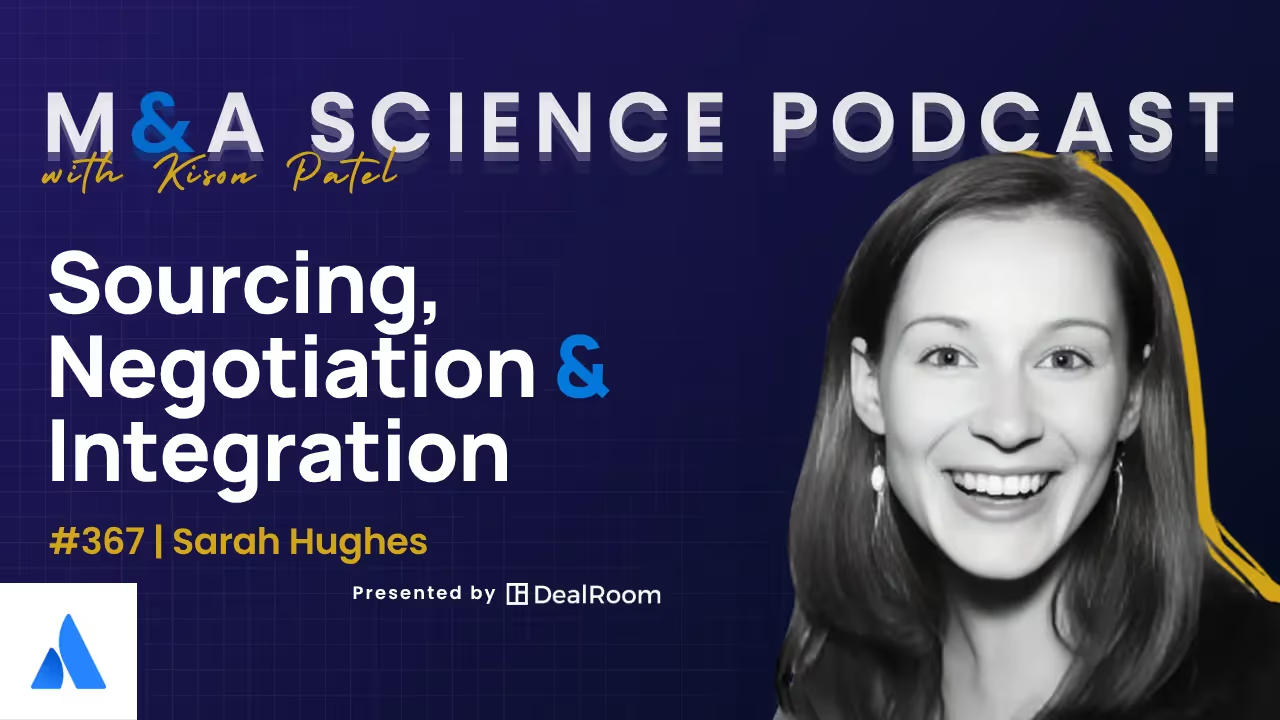
Inside Atlassian’s M&A Strategy: Sourcing, Negotiation & Integration

Sarah Hughes, Head of Corporate Development and Product Partnerships, Atlassian

Uncover the inside workings of Atlassian’s M&A strategy—from how Sarah’s team sources deals and aligns with product to the importance of relationship-building and a structured, founder-first integration approach. With over seven years of experience leading corporate development at Atlassian, Sarah shares practical lessons on building strategic pipelines, cultivating founder trust, and operationalizing successful integrations across Atlassian's global portfolio

Atlassian is a global software company known for building tools that help teams collaborate, plan, and build with greater efficiency. Best known for flagship products like Jira, Confluence, and Trello, Atlassian supports millions of users worldwide—from software developers to business teams. The company is publicly traded (NASDAQ: TEAM) and continues to expand its product ecosystem through strategic acquisitions, partnerships, and innovation.

Industry
Founded
2002

Sarah Hughes

Sarah Hughes is the Head of Corporate Development and Product Partnerships at Atlassian, where she oversees the company’s global M&A, venture investments, and ecosystem partnerships. A former Google Corp Dev leader, Sarah brings strategic vision, strong founder empathy, and operational rigor to every phase of the deal lifecycle. At Atlassian, she has played a central role in high-profile acquisitions including Loom, Trello, and Opsgenie—transforming how the company enters new markets and deepens its product ecosystem.

Episode Transcript

Inside Atlassian’s M&A Strategy: Sourcing, Negotiation & Integration

Kison: [00:00:00] I am Kison Patel, and you are listening to M&A Science, where we talk with deal professionals and learn valuable lessons from their experience. This podcast focuses on stories, strategies, and what actually happened during M&A deals.

Kison: [00:00:30] Hello and welcome to the M&A Science podcast. This podcast is part of a mission to rethink how M&A is done. The old-school seller-led approach, it's dead. Buyer Led M&A™ is all about strategy, alignment, and efficiency—putting value creation at the center of every deal. And let's be real, it's not just about closing the deal, it's about making it successful.

We uncover what truly works in M&A by learning directly from the best. I'm your host, Kison Patel, founder and CEO of DealRoom, and Chief Scientist at M&A Science. Today I'm joined by Sarah Hughes, Head of Corporate Development and Product Partnerships at Atlassian, a global leader in collaboration and productivity software.

Kison: [00:01:00] Sarah's been at the forefront of Atlassian's M&A strategy for over seven years, helping the company scale through strategic acquisitions, investments, and partnerships. Atlassian is traded on Nasdaq under TEAM. Today we're going to explore Atlassian's approach to M&A, how they cultivate relationships with founders, and what they've learned about aligning strategy, culture, and execution to make acquisitions successful.

Kison: Sarah, how you doing today?

Sarah Hughes: [00:01:30] I'm doing great.

Kison: Thanks for hosting me live here in San Francisco at your awesome office.

Sarah Hughes: Yeah, San Francisco or New York—what's your favorite one?

Kison: I gotta be honest here: New York.

Sarah Hughes: Oh yeah. Yeah, it's the best city in the world.

Kison: San Francisco, maybe it’ll rebound back and go back to the good days in the ‘90s era.

Sarah Hughes: I find it's easier to be happy in San Francisco.

Kison: Well, you’ve got good weather all year long.

Sarah Hughes: It's pretty nice.

Kison: Yeah. And then you gotta find your right neighborhoods too.

Sarah Hughes: That's true.

Kison: Like the bottom line.

Sarah Hughes: That is true. Yeah, it is very neighborhood dependent.

Kison: And personality. People know I'm highly impatient, so that tends to be very well accepted in New York.

Kison: We're in California and, uh—

Sarah Hughes: Not quite as much. Although, when I first moved to San Francisco, someone talked to me in the line at the grocery store just as an aside, and I was like, "What is your deal? What is your game? What are you playing at?" And then I just realized that's how people do it here.

Sarah Hughes: They're just friendly.

Kison: So funny.

Sarah Hughes: So now I'm one of those people.

Kison: There you go. Can we kick off with a little bit about your background?

Sarah Hughes: [00:02:30] I actually had sort of a circuitous route to the M&A scene. I was thinking I was going to be a lawyer, so I went to Google to work on the legal team there as basically a paralegal, sort of policy analyst. Met a bunch of lawyers and decided not to go to law school.

And as I was falling off that path, my boss at the time moved over to the Corp Dev team to head it up at Google, and I sort of followed him over there. He took a chance on me, even though I had zero skills except maybe a can-do attitude. So I did Corp Dev and strategy for about four years at Google and then jumped ship to Atlassian about seven years ago.

Kison: Oh, Corp Dev at Google.

Sarah Hughes: So Corp Dev at Google is centralized.

Kison: [00:03:00] So that's the number one requirement—having a can-do attitude.

Sarah Hughes: Honestly, I feel like it's sort of the best skill that you can adopt.

Kison: I've done enough of these interviews. People come from very diversified backgrounds. We've seen it all—even from engineering, legal, sales, marketing—went through a function and ended up in Corp Dev.

Sarah Hughes: Yeah.

Kison: And they tend to perform or even outperform their traditional IB/PE background.

Sarah Hughes: I do think it's really important to be creative in the way that you approach problems, and there's so much that's going to get thrown at you over the course of a deal that you have to do a lot on the fly. Maybe that's why it lends itself more to athletes in that way.

Kison: [00:03:30] Can-do.

So Atlassian’s made a range of acquisitions, very diverse. We even talked about Trello, then Loom. Trello I'm a huge fan of—that was a big inspiration in the early stages of developing DealRoom, because it was just the simplicity. So it was my personal favorite project management tool.

Then just reading about more recent acquisitions—you did Loom, which is a whole different segment. What's the strategic thread that connects them? Like, how do you decide this sort of view on the strategy, and then go through the exercise of build, partner, acquire?

Sarah Hughes: Atlassian's mission is to unleash the potential of every team. When you think about M&A through that kind of aperture, it's actually a pretty broad view that you get on the market and on our place in it.

In the case of Trello, it really was: it's a project management tool. It is focused on business teams, not on technical teams, which is where Atlassian historically was very strong. We saw it as a really good way to get project management and collaboration into the hands of non-technical users. And then users that didn't need the sort of complexity that a Jira offered—over time, they might mature and need it. So we saw it as a top-of-funnel play, but it really was focused on the non-technical segment.

Sarah Hughes: [00:04:30] And then in the case of Loom, this was actually a product that we were power users of internally and really believed in the vision. And particularly with COVID, when everything became Zoom meetings, it was clear that there is a cohort of communication that you need to be doing on a regular basis that can't really be effectively captured in a 30-minute Zoom call—or it doesn't need to be, it's a waste of people's time.

We saw asynchronous communication as the way to bridge that gap into the future of work.

Kison: Which fits well with project management. You have this really short text, and you want to add video in between having long-form meetings.

Sarah Hughes: [00:05:00] Yeah, and we use it in M&A a lot for things like going over our financial models. We make a five-minute Loom for our execs on the P&L that we're putting together and the financial model and valuation, because it just gives them a really good overview of what it is we're doing, what assumptions we're making. And we have situations like that across the business.

Kison: What are other deals—give me your favorite deals or other examples.

Sarah Hughes: Oh, my favorite deals. I mean, I love all of my children.

Kison: I know.

Sarah Hughes: There were deals that felt just drop-dead obvious to us. The OpsGenie deal was an example of that. It's an incident management tool—very important to IT, very important to how teams [00:06:00] function in the case of incidents. That fit right into our strategy and also had a pretty good go-to-market machine that we were spinning up with JSM, with Jira Service Management. That was one that I really enjoyed working on.

Halp—I don't know if you've heard of this company—it was a small company based in Boulder that did basically IT help desk for Slack. It was an area we were looking to get into with Jira Service Management again, but the founder was really bright and just great to work with throughout the process. It was also at the beginning of COVID; after our diligence meetings, we got the last flight back before everything shut down in 2020. So that was a fun one to do because it was just operating in this new world.

Kison: [00:06:30] And was that more for the technical capabilities of that product?

Sarah Hughes: It was, but we kept the brand around because it was actually growing pretty fast. We wanted to continue to help keep the user base happy and growing.

Kison: One of the things that we talked about before is I was really intrigued about how closely you work with product. But it wasn't so much of just, "We're trying to build our strategy by having conversations with product." You're actually taking your efforts in sourcing and giving that information and market intel back into product. Can we talk a little bit about that?

Sarah Hughes: [00:07:00] I view M&A as kind of a push-pull. We have a really good perspective on the market because we spend all of our time in externally-focused meetings, basically. Thought leadership ends up being one of the most important things that we do.

So the three strategic pillars that I generally think of when we look at our M&A strategy are:

  1. Roadmap accelerants. So the team has its roadmap—how do we look at M&A targets that can get us to market faster? And that's really part and parcel with our corporate strategy as it exists today.
  2. The second is really areas where there are vacuums, where we're not looking at things today but that have the potential to be really big in the future. They're not core today. They're on the outskirts of what we care about, but in the future, they will be core. And that's an area where my team really does a lot of work. What does the future of this product look like? How are we going to get upended by things like AI? And then where do we need to play in order to keep ourselves relevant? That's an area we do a lot of proactive research, and it's a push.
  3. And then the third really is these "break glass" targets. It's a list of large transformational opportunities that might not be actionable now, but that we need to build relationships with. We need to understand how they would fit into our business so if and when we have the opportunity in the future, we can transact.

Sarah Hughes: [00:08:00] I see generally our external focus really lending a lot of value to those three pillars.

Kison: Accelerating roadmap—pretty straightforward for a very tech-oriented company. I like the vacuum—that sounds like these are non-core segments that you're looking ahead at and saying, "That segment has a lot of potential to grow, and maybe we should think about getting into it."

And then these larger transformation—I’m thinking these are like billion-cap companies. If our business was like DealRoom—kind of project management-ish, finance-focused—and for a much larger player, that could be transformational because it's something totally different.

Sarah Hughes: [00:08:30] Yeah, that's exactly right. Where we want to go into a new persona or ICP, it makes sense for us to buy a category leader, and that's how we think about it.

Kison: I'm thinking of this relationship with the product team. Can you walk me through what that's like? You mentioned it's push and pull.

Sarah Hughes: We align pretty closely with our product leaders each year. We sit down at the beginning of the fiscal year and we develop an inorganic growth strategy and roadmap. I have M&A, ventures, and product partnerships, so it's a build-buy-partner.

We work with them across that for the inorganic side of the world, and then we go execute against that. So we meet with them on a monthly basis to discuss what we're seeing, areas of risk that we're seeing for the vacuums that we discussed, and/or what targets are in market to execute against the kind of inorganic growth goals that we've set for ourselves.

Kison: [00:09:30] I feel like there's intelligence you're getting both ways, it sounds like—getting from the product team and then feeding back to them as well.

Sarah Hughes: That is right, because they'll see things and they'll have an idea about where they want to go that doesn't totally align with necessarily how we view the world or the market segments. Aligning that ends up being an interesting exercise and one that I think makes our corporate strategy better.

Kison: It is—it's like a conversation of strategy where you're talking to the product leaders and saying, "How do you see this world? Where do you see things going?" And then it may be different than your conversations at the top of the organization, but then you're sharing back with, "Hey, this is what we are seeing, this is where we're seeing the overall market."

How do those conversations pan out?

Sarah Hughes: [00:10:00] They're really fun. There's a healthy tension between Corp Dev and some other elements of the org, including product and eng at times, because often builders want to build and buyers want to buy. So I have a hammer and everything looks like a nail. Everything looks like an M&A nail, I often say.

What's really important is: do we get to market faster, and should we acquire in order to do that? And they'll say, "Actually, the integration headache is not worth it. We should build here."

Having an open line of communication there ends up helping everybody.

Kison: I still think it's tough. We're a small company and I'm trying to introduce M&A for a first acquisition and I get pushback from engineers—they want to build everything.

Sarah Hughes: Yeah.

Kison: So there's this whole—even partnering.

I guess, how do you—

Sarah Hughes: [00:11:00] My view—and again, I have a specific bias here because I'm an M&A person—but my view is that we pay for de-risked technology. There is risk on the integration side. We have to be comfortable with some M&A.

At the end of the day, as a portfolio game, you're going to have some misses and we should be okay with that and not too conservative in our approach. But building is hard too. Building takes time. It is risky. We don't understand all of these markets.

Where we feel like we understand our persona and our customer base really well and where something sits at the platform level, it probably makes sense to build at the end of the day. But where we are going after a user that doesn't sit in the same building as our ICP, there's a lot of market insight that we can get from going out and acquiring a company that has done this, that has the sort of blood, sweat, and tears of having gone through that and been in the market for years and years, which I think is the right way to do it.

I actually don't think the kind of, "We wait here and then you tell us what the strategy is, and we will go look for some companies, and then you'll tell us what company you want to buy"—having the debate, I think, is way more important.

Kison: And this is how you get the product leaders on board when you tell them that.

Sarah Hughes: Sometimes, yeah.

Kison: Sometimes.

Let me ask you this: you have M&A, partnerships, and venture all centralized basically. Walk me through the reason why. How do you base your interactions with a company with those three channels?

Sarah Hughes: [00:12:30] It can get a little messy, so I'll be upfront about that. Inorganic strategy—we always end up doing the build-buy-partner analysis and, "Let's invest," for things that either should be good players in our ecosystem that we want to build integrations with us, or that we want to keep an eye on and stay close to the founders to understand more about the ecosystem that we play in—not things that are core.

Actually having that all sit on the same team has been really helpful as we think about top of funnel, because we're constantly meeting tons of companies and then bringing them to the team and saying, "Okay, what do we think this is? Do we think this is a partnership? Should we just invest in them and let them be successful in the market? Should we actually not do anything here because it isn't useful for us? Or is the market just buying on its own?"

Actually having that inorganic internal debate under the same roof is really helpful from an efficiency perspective.

Kison: [00:13:00] So it sounds like it could either be, "Hey, we're just going to partner with them, test things out," and then there's—sounds like partner and invest, and then just acquisition.

Sarah Hughes: Just acquisition, yeah.

Kison: How do you decide which way to go?

Sarah Hughes: It comes down to corporate strategy or it comes down to product strategy. So at the end of the day, we have a roadmap. We want to be in a specific space, and if something is so core to our offering or to how users think about our products, our suite of products, we're going to need to own that.

Sarah Hughes: [00:13:30] Probably we won't be comfortable with the risk from partnering.

Investment is an interesting one. It's not a pipeline for M&A. However—

Kison: That's unusual.

Sarah Hughes: If we are going to acquire a company long term, we should just get into that state of mind right now rather than throw them some dollars and keep an eye on them there. Partnership as a "try before you buy," or just going after M&A, ends up making more sense.

This is a strong opinion, maybe loosely held.

Kison: Yeah. I'm curious because, like, I'm at DealRoom. Right now we're 10 million ARR and I'm exploring a minority recap—whether we do it in the near term, long term. I've had some strategics approach and I've talked to some bankers and they're like, "You're going to get this band—maybe 8 to 10x—for your typical PE players out there that focus on software with good growth."

Sarah Hughes: Yeah.

Kison: [00:14:00] But these strategics are paying much higher, sometimes 12, 14, but big. But you are going to commit to a call. And you're telling me that you're actually doing some of those venture deals and you don't put some strict terms of setting it up so you can acquire the business later?

Sarah Hughes: I never want to have egg on my face from not getting a call. So we do have a right of notice in there. Again, it's not a perfectly formed set of heuristics on the investment side because our strategy also changes.

We've been investors in some of these companies for three or four years, and sometimes we are actually moving more into their realm versus away from it. I do want to get the call always. We would get it anyway from our portfolio, and that's our goal—to be providing enough value that we get that call.

Sarah Hughes: [00:15:00] But we do want to contractually make sure that we get the call.

Kison: Okay, fair enough. But it's not like pure intent; it's just sort of, "Hey, there's enough alignment that we believe in investing in it."

Sarah Hughes: It would be very rare for us to do an investment and have, as a rationale for that investment, that we want to acquire them down the road.

Kison: Good to know.

Let's talk about your approach to taking this next. Here's how it works internally. Externally, your approach for identifying and nurturing these opportunities.

Sarah Hughes: ChatGPT is making it much easier, actually, to identify opportunities in the market.

Kison: How so?

Sarah Hughes: [00:15:30] I can ask it anything and it will come back with an entire landscape for me on anything we care about.

We do start from the strategy. So again, with those three pillars I mentioned, we generally understand where we're going as a business, what things Corp Dev thinks we should focus on from a strategy lens to feed back to the business, and then we go and make sure we understand every player in the market. That's the goal.

So my goal is I never, ever want to see a company get acquired or see a company raise and not have known about them or taken a look or gotten a bite at the apple. And of course, I'm constantly getting surprised by new companies that are out there, especially as AI is taking off. But that's really the goal.

Kison: [00:16:00] So it starts from our strategy. It's in spaces we care about that we do kind of those broad assessments.

And there's a market map exercise where AI's been helping with some of that.

Sarah Hughes: Yeah.

Kison: Which is different. I was more around using AI for—and this is something that I'm wanting to figure out how to do at scale—but strategic fit analysis.

Because there are so many of these tools that'll help you build a list of companies, but then you still gotta do all the work for a strategic fit analysis. And that's where I think AI could really help out.

Sarah Hughes: Yeah.

Kison: If you can have it more scripted so it will just run through them all and then stack rank them and give you a score.

Sarah Hughes: [00:16:30] Yeah, you have to really understand the set of heuristics there or be pretty prescriptive about that. But actually, the last business case that we put up to our exec team—after writing it, we had ChatGPT write it, and it actually did an okay job on the strategic rationale. I was pretty impressed by how far it got us without necessarily needing to make tweaks.

So first draft—it’s good at first drafts.

Kison: So we start market mapping. We identify companies. How do you approach them?

Sarah Hughes: We just reach out.

Kison: You've heard of Atlassian, and they're like, "Oh sure, I'll talk to you."

Sarah Hughes: [00:17:00] Not always. I felt like in 2020, actually, it was really hard to get callbacks because everyone was growing so fast. They were really busy and they were like, "Why would I talk to you? I'll go raise a hundred million dollars and take 20 million off the table in secondary, and I don't need M&A."

But I think founders now are more pragmatic. The conversations with M&A teams have become much more of the norm. And also, a lot of times when I reach out, I'm not sure if it's an M&A conversation—or it might be a partnership or it might be an investment. I just want to get to know them. They're pretty amenable to that normally.

We go through investors if we can't—you know, we do warm intros. We have a pretty good network of people that know them. Or we sometimes have our product teams or leadership reach out for certain targets.

Kison: [00:17:30] Prioritize trying to get an intro in. And then how do those first conversations go?

Sarah Hughes: They're generally pretty good, actually. We've had our ChatGPT write us a one-pager on the business, so we come in not totally cold.

They have the most value when we bring our product team along—bring them along on the journey. When it comes to the conversations about potential M&A, you really have to sell a vision. And you have to paint a better-together story, and I want my product leaders to be doing that and to be holding the bag on that, but also really bought into the vision and doing that brainstorm with the company founder. That really also brings them along on the journey.

Kison: [00:18:00] Can we go pick on the Loom example? I think there was an interesting story behind how that one percolated and turned into a transaction.

Sarah Hughes: I mean, maybe not like so interesting, Kison, but—

Kison: Well, it wasn't one call where it was like, "Yes, I'll sell. Let's get this deal done. Here's a purchase agreement."

Sarah Hughes: Yeah, no, that one was a slow burn. The Loom case was—my first call with the founding team was in 2018 or 2019, and this was one that was on our radar for a long time.

We loved their product internally and we used it—our execs used it for their company comms, daily updates, weekly updates, stuff like that. So we knew them pretty well from a product perspective. Our Co-CEO Scott was a bit of a mentor to Joe over the years, so from, call it 2019 up until we acquired them.

Sarah Hughes: [00:19:00] So it was several years of meeting a couple of times a year.

By the time they were actionable and we were ready to take the leap, we knew their business really well. We understood their culture. We felt like we had a good handle on their leadership team. And because of that, the diligence process was really smooth. We didn't feel like there were any surprises when it came to either the strategic rationale—everyone got it internally. The conversations were much easier because of that.

Kison: Long game. Your leadership team is basically having this mentorship relationship with the founder over there at Loom—sharing notes, helping out, being good.

Sarah Hughes: Yeah.

Kison: And then that helped get to know the company as well over time. So you got to understand the culture. And then the strategic fit rationale is sort of conversated around the company enough that there's some validation there, which overall you think made the process smoother.

Sarah Hughes: [00:19:30] I really do. And actually, that's one of the benefits of working for a founder-led company. They have a really good vision. They can talk with CEOs of these startups because they've been there. I feel like the founders are a really good tool in the arsenal of M&A teams when we're looking at some of these more transformative deals.

Kison: The point I was trying to get, why I wanted to hear that story, was M&A just doesn't happen as a transaction. And I get it when you're in an auction process and everything's time-boxed to get the deal done as quickly as possible, basically.

But when you look at the reality of Buyer Led M&A™, it's more about getting the best outcome.

Sarah Hughes: That's right.

Kison: [00:20:00] And I think what you described is that you're playing the long game. And if you play the long game, you're doing things at the right time. And I think it's something I'm learning too, because I'm building pipeline for our business, but then some of these companies, maybe they're in a little trouble and they want to do something short term.

And there are some that aren't even thinking about selling, but you should still invest in building that relationship because you like the company, you see the potential there.

And I think that's something I'm personally learning. Atlassian’s got a good reputation as an acquirer if people look back at historical interviews we've done with Atlassian. There are a lot of good examples, and that's where I wanted to get a sense of that—just your approach in cultivating these relationships and how you look at it as more of a long game versus, "This is a transactional 'You're going to sell or not.'"

Sarah Hughes: [00:20:30] In reality, I would love it to be a slightly shorter game maybe than six years, but I think sometimes that's the way the cookie crumbles.

Kison: Do you get them where they're fast—where they're just hot and ready and it's just—

Sarah Hughes: Yes. So I feel like almost I'm not doing my job well though if things are too fast, because starting from zero and getting to an approval from our executive team and our board is hard in the span of 48 hours, unless we are already ready for that. And it's something that's just a pulling-the-trigger exercise at that point. That's when it goes well.

We actually did a really quick and dirty analysis on a company that was coming to market a couple of weeks ago, and everything went extremely well. We were like, "This is going to be fast. We need to make a decision by the end of the week." Everyone swarmed on it. I was really proud of the way the organization swarmed on it, and we decided to pass.

Sarah Hughes: [00:21:00] But, you know, it's hard to get comfortable with a deal that's, call it, half a billion dollars plus, if we're not aware of and don't understand the business really well.

Kison: Yeah, that's a really good point.

I track stuff where it's like, "Hey, this person is in the realm of selling for the right price," which is—everybody does that now. There are these companies like the Loom example where for years and years it was something you're super interested in and liked the business, but it wasn't actionable.

How do you view that in your pipeline? Is that just still in the pipeline, or is it not? Is it just in the market map?

Sarah Hughes: [00:21:30] We put it into a "monitor" bucket.

Kison: Monitor bucket.

Sarah Hughes: And "monitor" generally means—all of these are fuzzy—but monitor is usually where we try to again develop a relationship with the company, whether it's the Corp Dev team, we meet them every couple of quarters, or the executive team or the product team. So we just keep an eye on them. We think through potential ways that we can work together. So when that time comes, we can actually be ready for it.

Kison: Okay. Monitor bucket means once a quarter we're going to be friendlies and check up with you and try to be helpful.

Sarah Hughes: [00:22:00] I mean, the reality is there are so many companies right now in our monitor bucket, we don't check in with them all on a quarterly basis, but that's the goal.

Kison: Yeah. Different tiers.

Sarah Hughes: Yeah, exactly. Monitor, hot monitor, cold.

Kison: Yeah, exactly.

What's the biggest mistake M&A teams make when trying to convince founders to sell their company?

Sarah Hughes: [00:22:30] Oof, there are a lot. One that I would call out—I think we talked about it a little bit and I've done this in the past. Sometimes companies will reach out and say, "Tell me everything about your business." Then they go away, and then they come back and say, "Here's an offer." And then they go back and they say, "Okay, we're going to negotiate the definitive agreement." And then we close. And then, "Here's the integration plan."

Actually, not bringing along the founders and the leadership team on that journey is a huge mistake.

What I've tried to start doing in meetings is early diligence. Our product leadership team also paints a vision about what our roadmap is. We can be pretty transparent on what we think, where we're headed, and what we think the better-together story is—and actually bring them into the conversation.

Because we've seen sometimes founders will be like, "Actually, I don't think that's going to work because of X, Y, and Z technical reason or market reason," or, "We tried this and here's how the market responded. Have you thought about this?"

Sarah Hughes: [00:23:00] So making it more of a conversational, "How can we build this narrative together?" is a really good best practice that I've learned, and I'm trying to implement in every deal we do.

Kison: So keeping that founder along—I always think in my head there's a diligence workstream and there's an integration planning workstream.

Sarah Hughes: Yeah.

Kison: And what you're describing teeters between the two.

Because it's, "Hey, here's the vision. Where are we trying to go?" You always prioritize where the value is around the diligence, but then, "How are we going to actually make this happen?"

Where all of a sudden founders are weighing in on it, saying, "I don't think that's going to work."

So I guess, how do you view that in terms of where it fits in the process?

Sarah Hughes: [00:23:30] I think of pre-term sheet. This exercise looks like: you have a management meeting. They present on what their business is, and then we do some presentation or some conversation back on why we're interested and what we're thinking about where this business would potentially accrete value to our business.

So that's kind of pre-term sheet. And I think as part of term sheet, we sit the founder down and walk through, "Here's why this is so valuable to us, and here's what you'd come in and do, and here's why we need you and the team." So we try to sell the vision as part of the term sheet process.

And then when we get into diligence, yes, I would still bifurcate the two. We say, "Here are the 200 items that we need from you—our diligence items—to check the box in confirmatory diligence. And then here is the plan for integration."

Sarah Hughes: [00:24:00] And we set up a two-day workshop to walk through what the integration should look like, and that usually results in some sort of a vision doc that is co-authored by the CEO and our product sponsor.

It is: here's what we're doing, here's what the first 90 days look like, here's where the team fits in, here's how we're going to integrate, here's how we're going to get value in the first X months.

Kison: I like that.

Things always change. Strategy always changes. Everything changes probably day one after the deal anyway. But at least we have a starting point so that we can refer back to it and say, "Why did we do the deal, and are we on track?"

Sarah Hughes: [00:24:30] Exactly.

Kison: And that's something you just broadly communicate with the organization?

Sarah Hughes: Yeah, we used it pretty effectively in Loom actually. We circulated it to our exec team, to our board. They circulated it internally to their team. So everyone knew: here are the metrics for success, here's what we're reporting out on, here's what we expect, and here's how we're integrating it.

Kison: [00:25:00] Okay, so there's the thesis on why we're doing this deal. There is a bit about how—

Sarah Hughes: Yeah, the why, the how, and the what—what we're expecting to get out of it.

Kison: Which would include to keep us on track, which includes some of the metrics.

Sarah Hughes: Yeah, metrics—users, top-line growth, etc.

Kison: And ultimately, this is your deliverable from what you described—starting with that early management presentation pre-LOI of, "Hey, we're getting to know the team, we're doing just some initial 'Is this going to be a good fit working together?'"

And after drilling them with questions, then it's more, "We want to share with you why this is going to be great together."

Sarah Hughes: Yeah.

Kison: And then you're working together to really clarify that vision to make sure that those executives are on board.

And then you bring them along the diligence process where you really start shaping more—outside the 200 for diligence—let's talk through integration planning and really start refining what that initial integration thesis would pan out to be.

Sarah Hughes: [00:25:30] Yeah.

Kison: Then it turns into that formal vision document that's presented by your founder.

Sarah Hughes: Yeah, that's generally the process. Again, all of these things are best practices, and sometimes things are moving fast and we don't always get buttoned up on that, but that is the goal.

I think it is important for the leadership of the target company to feel like they have co-authorship in that vision, rather than an acquisition being something that's just happening to them.

Kison: Bring them along, keep them engaged.

Sarah Hughes: Yeah.

Kison: How do you think that expands with the broader team?

I write a lot about Buyer Led M&A™. I'm probably going to take quotes of this and put this in other content we have. And I've always felt Atlassian has been such a prime example of it. The fact I did a podcast where Christina was heading up integration—

Sarah Hughes: Oh yeah.

Kison: [00:26:00] So we have a CEO of an incoming company with your integration lead talking about how great integration went. I'm like, where does that ever happen?

Referring on that—the fact that we can do a podcast and have an incoming CEO with your integration lead really talk about how the experience went and some of the lessons learned—to me, that was such a unique and prime example of just taking the lead as a buyer to really set things up for success.

It just sounds like what you just described is a reason why—it's really thinking about how things are going to come together, transparency, and then engaging with that.

Do you think that really expands overall from that founder leader getting that level of engagement, that after you close it lends to the broader team transitioning smoother? Because more times than not, there's always a metric from a lot of companies of just how much employee churn.

Kison: [00:26:30] And they're tracking it, and it just ends up being pretty significant and it's almost expected, where it's really different than what you've cultivated over the years.

Sarah Hughes: Bringing the founder along on the journey helps with that a lot because they've sold a vision to their team to get them to join their startup. That vision is really good, and that's why people are excited about it. If they're excited about what they're going to do and what the company's going to do once they become part of Atlassian, for example, they will sell that vision again and they'll be really instrumental in keeping people around and keeping people motivated.

Attrition is just a really hard thing because some people just didn't want to sign up to work at a big company, actually. Just understanding there's going to be some breakage as part of this thing, and then how do we mitigate that, particularly if they're key employees, is our kind of plan B on that front.

Kison: [00:27:00] That's a really good way to put it. It's the sort of vision to join the startup, but now here's the vision of partnering together and being better together with Atlassian that the founder can then sell to the team. That may not get 100% acceptance, and that's fine.

Sarah Hughes: Yeah. They have to feel an ownership stake in that because when they own something, they are very, very good at bringing their team along.

Kison: Awesome.

How do you think about partnership and M&A as levers for ecosystem expansion rather than just feature expansion?

Sarah Hughes: [00:27:30] I think that partnership is really important there. And actually, ventures has been a big part of our ecosystem expansion strategy, particularly when it comes to marketplace and distributing through our marketplace, because part of the rationale for investing in companies is that they will actually distribute their products through our marketplace.

Which just is a nice virtuous cycle because it makes our customers happier. Adding more apps gets more people to build on our platform and for our tools. It just has a really nice network effect for the rest of the business.

Kison: You do actually pull that lever when you're looking at those venture deals and saying, "Hey, this would actually grow our ecosystem because if they grow, then the whole distribution grows."

Sarah Hughes: [00:28:00] No, that's right. And we don't want to own everything. There are so many areas that we could go, and we just have to be really careful about expanding into every space. That's where our ecosystem really ends up impacting our overall strategy.

Kison: This is related. So Atlassian competes with and partners with giants like Microsoft. How do you navigate that tension when evaluating potential deals or partnerships?

Sarah Hughes: [00:28:30] Oh yeah, the co-opetition strategy. We understand that users are using a ton of different tools, and they're not going to just use Atlassian for everything that they need to do. They are going to be using Google Docs and Excel and Copilot and other things like that.

I think where it makes sense is where we can be bringing context from our tools to them wherever they sit—that adds value to what they're doing. And then likewise, where we can bring context from other tools into Jira, into Confluence, into our system of tools. So it is really about adding customer value more so than trying to win.

Kison: [00:29:00] You think that's pretty accepted just in the industry of tech in terms of that view, or—

Sarah Hughes: It's a spectrum. We are probably on the more open end of that spectrum, but generally speaking, if you don't partner with the hyperscalers at some level, you're going to have a hard time.

Kison: What do you call it—co-opetition?

Sarah Hughes: Co-opetition.

Kison: Like cooperation and competition?

Sarah Hughes: Yeah, like cooperation and competition. Yeah.

Kison: Yeah. Alright.

We talked about culture fit being critical to an acquisition's success. What happens when culture alignment isn't there? How do you mitigate that risk?

Sarah Hughes: [00:29:30] Yeah, it's tricky. Culture is this sort of amorphous concept that I think is really hard to define and really hard to diligence and measure. It's something I constantly question, and I would love for AI to figure out a way to do it effectively, but I have not yet. So if anybody has, please email.

Kison: There are some startups working on that.

Sarah Hughes: There are some startups working—yeah, you're right. The data sources are tough.

But with that said, I think it is the biggest risk of a deal in general because people are the most important part of any transaction—at least the ones that we do, because so much of the value of the deals that we do is post-close, and it requires build-outs.

Sarah Hughes: [00:30:00] The big risk there is that people will leave. The cultures are not aligned. If there's organ rejection from the rest of the company, people are going to leave and we won't be able to get the value of the acquisition.

Diligence is really important on that. We have to understand ways of working. We have to understand how flat or not flat the organization is, what their talent management strategy is, what their comp philosophy is, because all of that plays into how we onboard them. But then we really do try to take the best parts of their culture while assimilating them into Atlassian culture, because at the end of the day, it will be more Atlassian culture than it will be theirs.

Kison: [00:30:30] There is this part where you anticipate influencing their culture to be more like broader Atlassian culture.

Sarah Hughes: Generally speaking, yes. So we fit them into the org chart. We get them onto our performance cycles. A lot of the things that we do for career development and other things we institute at close or shortly thereafter.

Kison: Not naming anybody, but what's the worst case you've seen? Have you ever acquired a company that's had anti-Atlassian culture or something? I don't know—what's the worst case you've seen?

Sarah Hughes: [00:31:00] Usually those end up being kind of deal breakers and they come out pre-term sheet. So we haven't had a lot of cases that I would point out where the culture is so misaligned, where there's like a top-down mandate and it's very hierarchical or something like that.

We have dealt with a lot of geos. Different geos have different cultural elements and work in different ways. For example, during OpsGenie, we acquired an office in Ankara, the founder's Turkish. It is just a different culture with different things that the office cares about, and we had to protect those while also being like, "You're part of Atlassian now."

Kison: [00:31:30] I get that early on—you do avoid it. Sometimes you just don't know what you don't know until after close.

Sarah Hughes: We've had a couple of cases in the past of founders not being a good fit, or leadership—maybe not founders/CEOs—but elements of the company leadership not being a good fit and trading out pretty quickly, which we are protected on. They don't get all of their holdback or their retention, so we're actually not paying as much for the deal. But it is a bummer when that happens.

Usually we are able to call that out as a risk before we close and come up with mitigation strategies around it.

Kison: [00:32:00] A lot of transparency. You guys still have everything—your term sheet—published publicly?

Sarah Hughes: We do. Yeah, we do, and we haven't…

Kison: That's still interesting.

Sarah Hughes: I first was very skeptical about it, but it's been really good. It has helped our negotiating process a lot, surprisingly.

Kison: You're known for a clean, disciplined integration.

What are the first 90 days post-close focused on? How do you balance speed with alignment?

Sarah Hughes: [00:32:30] Integration is the hardest thing that we do at Atlassian on the M&A side. It's very dependent on the type of deal we do, the strategy behind it, and then how we want to get value from it.

Generally, for one of the larger deals, it is "first, do no harm." So make sure that we're protecting the growth of the business, the customer base, making sure the employees don't have too much whiplash when they come in.

And then it is: get all of our back-office systems integrated. We start that from day one. We want to get everyone on our commerce platform and on our identity stack so that we can start selling it. That's kind of thing two, and we can do that usually in the first six to nine months, but that's a big platform lift.

Sarah Hughes: [00:33:00] And then we want to make sure that we're aligned around actually pricing and packaging the deal so that we can cut customers over or introduce new bundles to get the value out of the deal.

Kison: Go-to-market.

I heard your integration plan is just open for anybody to look at.

Sarah Hughes: That is true.

Kison: Is that not standard at a company?

Sarah Hughes: Obviously some of the HR elements are not open, but generally speaking it flows from that.

Kison: I haven't heard of those companies that just put it there for anybody to look at.

Sarah Hughes: [00:33:30] We're a pretty open company. We're pretty transparent internally. We wrote all these agile playbooks, for example. Our term sheet is out there on the open web, for example.

It helps because people need to be brought along on the journey internally, on our side and on the company's side. A lot of people have a lot of ideas about how we should integrate the business that we've already been through and made decisions around. Actually being able to put that into writing and be like, "Here's what we're doing," helps everyone get on the same page.

I don't see too many downsides to doing that, but I'm curious if you have any kind of horror stories.

Kison: [00:34:00] You just don't hear about it that often.

You mind if I ask some personal questions about how you do integration?

I'm curious about the structure, because I feel like there are so many ways to configure Corp Dev in general. But how do you configure integration?

Do you run the typical IMO model? Is it completely separate on its own? Is it part of Corporate Development? Does it report into Corporate Development? Does it report out somewhere else? What does that structure look like?

Sarah Hughes: [00:34:30] Yeah, it does report into Corp Dev. So we have an IMO. It's a small team—it's two people—and my entire team is about 15. So it's a pretty small element of it. And they're really the quarterbacks of the integration.

They're managing things. We actually use Jira for our integration.

Kison: I've actually seen the setup because I would compare notes because we build stuff in DealRoom and it's—at some point, that's another little thing, because we're always like, "We need to integrate this," because we do all this stuff pre-LOI.

Sarah Hughes: [00:35:00] It's a good project management tool for us to use.

Kison: The way you have it set up, the way it's like—well, it's cool and it's hard to visualize it, but it's nested in a way that you can put such a comprehensive plan and have it start off looking so simple, but then dig to every nuanced detail you want.

Sarah Hughes: It is very useful.

So those two people really spearhead the integration, but we have cross-functional teams that are actually the DRIs for getting the work done. And then usually, after about a year, we roll into business as usual. For larger transactions, we will usually do three years of reporting out to the board.

Kison: [00:35:30] Is there an actual handoff that, "Hey, day one happens and it's IMO that's in charge of integration, and then when you roll off, you're handing it off to the business unit and they're in charge"? Is that what it looks like or is it different?

Sarah Hughes: I would say it's less formal than that because there are certain areas that we want to engage on longer term if there are hotspots that the team wants to keep an eye on, and some areas just get rolled into business as usual much faster.

But we generally, for a year, have an integration meeting weekly with the constituent stakeholders that's led by the IMO.

Kison: [00:36:00] They're managing it, but at the end of the day, integration is tactically led in the business.

Sarah Hughes: In the business, yeah.

Kison: So they're essentially guiding those whole workstreams.

Sarah Hughes: I think that's kind of the right way to do it. You do need connectivity to Corp Dev because the integration leads really get involved early on so that they can understand where risks might lie, and they need to be involved in the process from the beginning.

You need them to continue to sit there and play that role, and then they have seen all of these—they have pattern recognition. They understand how to get things done in the business that different teams might not. But at the end of the day, the teams need to own the outcomes because they are the ones who actually own the product strategy.

Kison: [00:36:30] Yes. That would be interesting maybe at some point comparing notes on integration and just look at the different configurations.

Because I feel like when you even say IMO, people have a different perception of what that actually means.

Sarah Hughes: That's a good point too.

Kison: Next podcast we'll break down the IMO.

I gotta talk about AI because obviously you are looking at AI—

Sarah Hughes: No.

Kison: —these days. That's the big, that is the actual question.

Sarah Hughes: Yeah, that's a good point.

Kison: What are you buying? Is it just a sequence of prompts here? Is there some real technology? What is AI? Big buzzword.

You already gave me some examples of how you're using AI in your deal process. Pretty interesting. You're using it for market mapping, and then you also mentioned just some of the messaging or getting your prep for outreach—you've got a one-pager filter on that company, so you got some of these key points and you're really prepped to have that conversation with them.

Any other areas that you're using AI in the deal process?

Sarah Hughes: [00:37:00] Yeah, I've been using it a lot on the sourcing, like the sort of pre-term sheet diligence side—especially understanding market maps. So that's kind of thing one for me right now.

We are doing a more comprehensive analysis of the diligence process itself. There's so many ways that AI can actually help drive efficiencies in that process. And while we're moving really fast for deals, it ends up being useful for things like going through a thousand contracts and being like, "Here are the five terms that we care about that are red flags for us. Let's call them out. Let's figure out how we deal with them." That's just one example—so contract review.

Kison: Yeah, contract review.

Sarah Hughes: [00:37:30] There's other stuff on the integration planning side. We're thinking through: make a first draft of things like employee comms, customer comms, that vision doc that I mentioned, even the integration plan. There are a lot of first-draft areas that AI can be extremely useful for.

And then after the deal—we haven't thought quite as much about that because again, it gets federated into the products.

Kison: Yeah, and they'll have their own ways of—

Sarah Hughes: Yeah, exactly.

Kison: But the content drafting is definitely one. I mean, I do that all the time.

These are really good examples.

Where do you see things going? How do you envision the Corp Dev function changing or evolving in the next five years?

Sarah Hughes: [00:38:00] It's going to be interesting. When I talk to people, everybody's sort of in the camp that I am, where they're like, "Yeah, I'm finding it useful. I'm starting to see the value of it. It's still early days."

But I actually think that in the future it's going to be way easier to go through the kind of confirmatory diligence process because it will be like, "Hey, hook this thing up to your systems. We have this list of 200 items that we need for diligence. Go find them, return them, put them into a data room. You can check them."

Kison: Give you your finding summary.

Sarah Hughes: Give you a finding summary. I think that a lot of that will get—

Kison: Give me a mitigation plan.

Sarah Hughes: [00:38:30] Exactly, exactly. Knowing what you know about our organization, figure out the mitigation, figure out who should own it. I don't think we're at the point where people would be comfortable just saying, "Then go do it."

Kison: No.

Sarah Hughes: But maybe we'll get there.

Kison: Yeah, that's five years. Maybe that's the five-to-ten-year mark—then we'll run the execution.

Sarah Hughes: Yeah.

Kison: Those are fair. I'm really excited about it too. Even in our business, we're doing a lot of experimentation in how to use AI in different parts of diligence.

I'm curious about when, going back to your core Corp Dev function, how do you look at AI impacting that? I'm particularly curious—is it, "Hey, we're acknowledging every company is slapping AI into their product in some shape or form, and we just try to understand what that actually means, if it's really a game changer or not," on one side.

On the other side, do you have another workstream or market map just around AI products alone that you're starting to look at? Now you've got to expand that market map with just all this ecosystem of AI products that maybe are just AI-first, entering and disrupting.

Sarah Hughes: [00:39:00] So your first question was around how it will impact Corp Dev teams and departments—

Kison: Which is more like, how do you look at the landscape?

Because like I said, the challenge I have is everybody's saying "AI." Every landing page right now is "AI." I look at it as, okay, there's all these products that are now adding AI, and then it's getting a sense of what does that actually mean.

And then there's this ecosystem of the new products that are coming in as AI-first, and that's where I was curious—how do you look at that whole ecosystem? Are you bucketing those new tools under the same market map, or do you create a new market map for all these emerging AI tools?

Sarah Hughes: [00:39:30] It's more around the job to be done. What does the future of the software development lifecycle look like? Jira is a huge part of it today. What are the ways that SDLC is going to be upended in the future? And what are things we need to buy into? Who's doing that now? Where do we think they're headed? Where is this going to end up?

So it's looking around corners for each of our collections that we offer and seeing what the future of those collections looks like.

We do market maps based on that. I would say now there's no market map that doesn't have 90% AI companies that we're doing today for any of the spaces that we're engaged in.

Kison: [00:40:00] Right. And I like that framing—the jobs to be done—because then you stay true to looking at the ICPs and what the actual solution is delivering for them.

Sarah Hughes: They never pan out as expected. There's always something that happens.

There have been deals that I've done in the past that have felt too confrontational—like an us-versus-them mentality. And I definitely was part of that issue. And I think that the lesson that I learned from—I’m thinking of one or two deals where it just felt like the founders were really emotional. They were really angry by the end of the process, and I was really annoyed with them because I couldn't see why they were being so angry and emotional.

Sarah Hughes: [00:40:30] What I learned from that is that it's really important to just treat founders like your teammates, because at the end of the day, they're going to be your teammates after the deal closes. That's one of the great things about working in M&A instead of working in IBanking or something like that—you actually follow the deal through and you get to work with these people.

It's really important from the get-go to set up the deal as, "Hey, this is a challenge that we are facing together. We are on a crew team; we're not in a boxing ring" kind of mentality. I could have done more in the past to set that up just from the get-go and then treat the deal that way.

Kison: That, "Hey, we're going to be getting married and we're going to be partners together."

Sarah Hughes: Yeah, exactly. Exactly. It's like a marriage.

Kison: Yeah. So we can't have the us-versus-them.

Sarah Hughes: Right. So there will be challenging conversations. There are going to be things we disagree on. But we have to remember at the end of the day, we're on the same team rather than on opposing teams.

Kison: [00:41:00] That's a good one. It's easy to forget that. Rob Brown was reminding me of just putting yourself in the other person's shoes when negotiating these deals.

I think that's a big part of it too. And those are easy things to forget because you're just in your day-to-day mindset.

Sarah Hughes: No, that's right. Yeah. And we've seen hundreds of these, but a founder generally has seen—it could be their first M&A deal or their first time being acquired, or their second. They're not going through tens of these in their lifetimes probably. It's a lot scarier for them. As M&A people, we should always remember that.

Kison: [00:41:30] It's true.

I'm kind of rethinking some of the situations where I shied away from a deal. I felt like it was feeling too transactional where I wanted it to be more meaningful, to have assurance that if we got a deal done, it was going to go smooth. It was just too much of, "Give me the price. I want to know the terms."

Sarah Hughes: Yeah.

Kison: That's a tough one.

Sarah Hughes: Transparency is really important.

Kison: Yeah.

Sarah Hughes: To deal with that.

Kison: That's why this isn't easy.

Any other big lessons you've learned that have changed how you approach M&A today?

Sarah Hughes: [00:42:00] Lots and lots of micro-lessons. I learn them in every deal.

Kison: Once the AI bot gets activated—that gets all your historical emails and Slack messages—I’ll make sure just to put a prompt, "Give me all the lessons Sarah learned."

Sarah Hughes: Yeah, you just ask it what my lessons are.

Kison: "Give me a list," and then I'll have AI just read it off. I don't have to do it myself.

Sarah Hughes: We actually don't even need to be sitting here.

Kison: We could have just two AIs so they could just have a conversation on this with each other.

Sarah Hughes: It'd probably be really fun.

Kison: [00:42:30] You ever played with NotebookLM?

Sarah Hughes: Not a ton because we actually don't support it internally for our work stuff. So it's only been in my spare time.

Kison: I put a hundred podcast interview transcripts in there, and just the whole conversation thing it does with AI is such a trip.

Sarah Hughes: So wild. Yeah.

Kison: It was good and impressive, but you could tell when you put that much data in, and I think that's the struggle right now—if you put that much, it gets things off. It was misquoting the wrong person because I know so-and-so didn't say that, it was somebody else. But it was pretty interesting where things are going.

Any advice you'd give M&A teams looking to build better deal flow or execute more successful deals?

Sarah Hughes: [00:43:00] Send all of your good companies to Atlassian.

The advice I have is to really build your network. I've relied a lot on my network of VC friends, bankers, for really good insights on the market. So crowdsource a lot of things.

The second one would be: relentlessly drive internal alignment. Internal alignment is really hard to get to. Focusing on that is a good way to trust-build internally.

And then the third one: Corp Dev people having an outside-in perspective on a market and a business is a really important data point for product teams as they're making decisions, rather than just being execution engines of deals.

Kison: [00:43:30] These sound like: be curious, be very proactive, and that will make you successful.

Other Corp Dev leaders—the networking piece—that's like being proactive about finding the opportunities, the relationship part—get ahead of those.

The internal alignment often gets forgotten because that can take up a lot of time and effort, but being as proactive on internal alignment. And then that third area of that perspective—because I like how you framed it that way—you're basically bringing that outside-in perspective, which could open up some eyes for some folks internally.

I gotta ask one thing: what's the craziest thing you've seen in M&A?

Sarah Hughes: [00:44:00] I feel like I've seen some pretty crazy stuff come out with background checks when we do background checks on founders.

Kison: You don't have to name anybody, but what's the craziest thing you've seen on a background check?

Sarah Hughes: Generally drug use, not paying taxes. Those are two that have come up.

Kison: Sounds like pretty typical things you'd find.

Sarah Hughes: Typical, yeah.

Kison: Not like murder or something.

Sarah Hughes: Not murder. I've never come across a murder. Light manslaughter once or twice, but yeah.

Kison: [00:44:30] So crazy behavior after a deal closes—people get a big check and they just…

Sarah Hughes: And they just bounce.

One of the deals that I heard about—I don't have firsthand knowledge—but one of the deals I heard about was this founder who got acquired, made something like $50 million or something, but it was all in retention and just bounced and went to his house on the Cape and never showed up to work again. And they had a really hard time firing him because he had a lot of protections around his equity payouts.

We have a lot more structure in place around people showing up for work.

Kison: He had retention, but he just was pretty loose and got it over without doing anything.

Sarah Hughes: [00:45:00] Yeah.

Kison: Good to know. That's pretty crazy.

Sarah Hughes: But nothing totally insane.

Kison: This has been a great conversation.

Sarah Hughes: This has been fun.

Kison: I learned a lot. Helped me become a better M&A scientist. Those of you still listening, you are also a fellow M&A scientist.

I value and appreciate you. I’d love to hear feedback. Let me know what you think of this interview. If you’ve got any other ideas, topics, suggestions, reach out to me on LinkedIn. I'll take the criticism as well—that's how I get better at this.

Till next time, here's to the deal.

Kison: [00:45:30] Thank you for taking the time to explore the world of M&A with our podcast. We love hearing feedback. Tag us on a LinkedIn post, add a review on Apple Podcasts—we'd love to hear from you.

If you need help standing up an M&A function or optimizing one that you already have, we're here to help. And if we can't help you, we probably know someone that can.

You can reach out to me by email: Kison, K-I-S-O-N, at mascience.com, or you can text me directly at 312-857-3711.

If you just want to keep learning at your own pace, visit mascience.com for a lot more content and resources. That's where you can also subscribe to our newsletter. Again, that's mascience.com.

Kison: [00:46:00] Here's to the deal.

Kison: [00:46:30] Views and opinions expressed on M&A Science reflect only those individuals and do not reflect the views of any company or entity mentioned or affiliated with any individual. This podcast is purely educational and is not intended to serve as a basis for any investment or financial decisions.

Show Full Transcript
Collapse Transcript

Recent M&A Science Podcast Episodes

Stop Falling in Love with the Deal: Guardrails for High-Volume Acquisitions
The Next Chapter After 400 Episodes
Integration Focused M&A: Why Execution Should Inform Strategy Before You Sign Part 2
M&A SCIENCE IS SPONSORED BY

M&A Software for optimizing the M&A lifecycle- pipeline to diligence to integration

Explore dealroom

Want to wear your M&A expertise?

Check out the M&A Science store.