
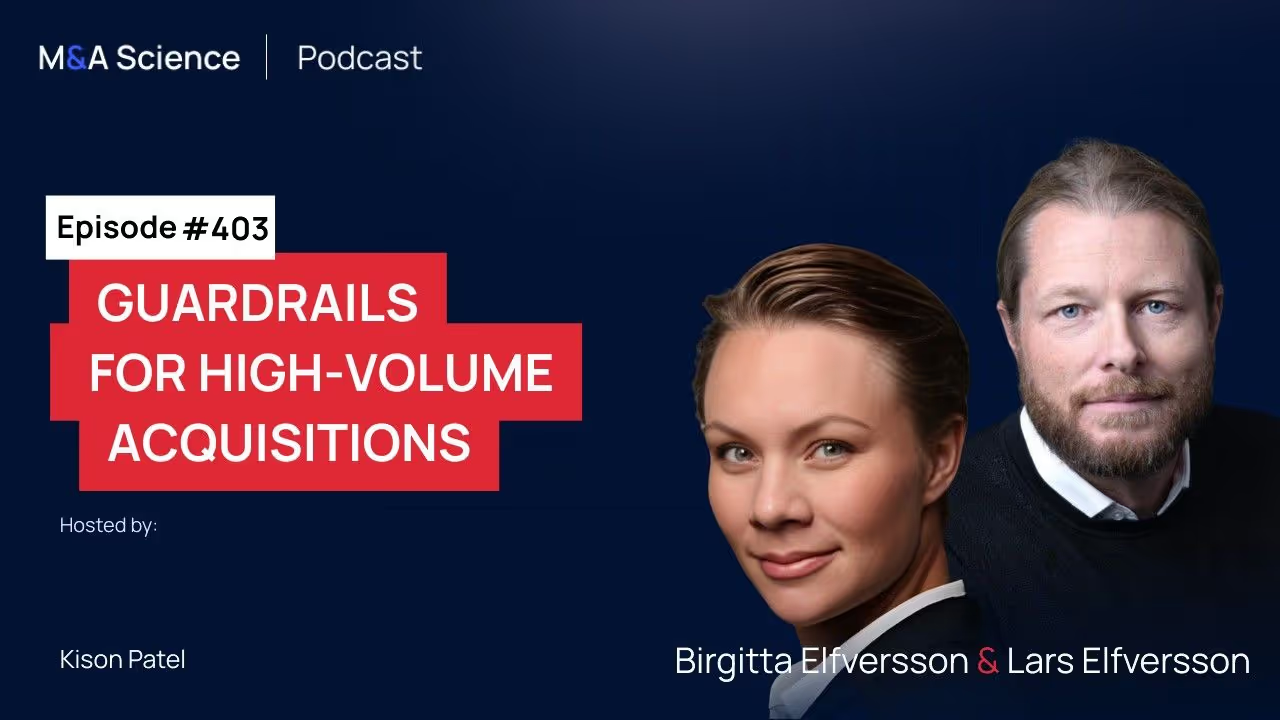

Netlight Consulting AB is a consulting business that was built and scaled organically from its founding to roughly 2,000 consultants. In addition to operating and scaling the firm, Netlight’s leadership has been involved in M&A work through private equity partnerships, including diligence and co-investing starting in 2016.
Birgitta Elfversson
Birgitta brings an operator + governance lens to roll-ups and buy-and-build platforms. She has worked as a strategist at McKinsey and as an operator at Unilever, then helped build and execute a buy-and-build strategy that involved acquiring and combining multiple companies. She now invests through a family office and holds board roles, bringing an “investment committee” decision discipline to M&A and portfolio strategy.

Lars Elfversson
Lars is a builder-operator who moved from scaling a business organically into disciplined M&A execution. He co-founded Netlight and helped grow it organically to ~2,000 consultants, then later shifted into roll-up and private equity–backed deal work, including diligence and co-investing beginning in 2016. His experience spans operating inside a scaled platform and evaluating acquisitions and integration decisions with an investor mindset.
Episode Transcript
Importance of Experienced Board Advisors
Lars Elfversson:
Basically, most private equity companies are strong in finance and deal structure, not necessarily in the specific line of business they are acquiring. That is why they work with many different advisors.
If they want to invest in roofing companies, they need someone who understands roofing. If they want to invest in consultancy firms, they need someone who understands consulting. That is one part of it.
The second part is that many of them also want professionals who deeply understand the M&A process—what to look out for, how to evaluate deals, and how to distinguish good deals from bad ones.
The third role advisors often play is helping make sellers comfortable with the transaction. In many cases, advisors serve as a form of validation for the private equity firm, vouching that they are credible, reasonable people. This is especially important for founders, who often want to sell their business to someone who genuinely cares and will take good care of the company going forward.
Birgitta Elfversson:
It does make sense to have someone from the industry who can provide a bit of a sanity check. A lot of things can look good on paper, but if you have been in the industry, you are often able to see through them and identify issues that may not be obvious to someone coming from outside the space.
Lars Elfversson:
Mostly, when private equity companies do their first deal or build their initial platform, they start with a clear concept—an idea of what they want to create. From there, they begin looking for companies that fit that vision. When they find the right companies, they form the platform around them.
Convincing those first companies to become part of the initial platform—to serve as the bedrock of the new company—is critically important. That is why selecting the right companies at this stage matters so much.
This is typically where due diligence becomes especially important. It is also where I can vouch that the private equity firm is sound and has a track record of treating founders fairly and responsibly.
Experienced Board Advisors Diligence
Birgitta Elfversson: As a board advisor, board member, chair, or whatever role one holds, the work is inherently long term. By the time a due diligence report is in front of the board, it is usually too late to change anything about that specific diligence effort.
What can be influenced is future due diligences—by ensuring that teams clearly understand what matters and what to look for. In that sense, board work functions as a form of long-term quality assurance. When it comes to any individual transaction, board involvement typically happens only after everything is largely done, at which point the decision becomes a simple yes or no.
This often brings to mind a former McKinsey colleague of mine, a Norwegian who was very precise in how he worked with teams. When he received a report or reviewed a piece of work, his first step was always to assess whether it met the bar. Was it good enough? Did it answer the right questions?
If it met the bar, he offered no improvement suggestions. He did not try to change the work. Instead, he focused on encouraging the team so they could continue performing at their best. But if it did not meet the bar, that is when he stepped in and worked closely with the team to improve it.
That dynamic is similar to what it is like to serve on a board. When a deal does not meet the bar or is simply not good enough, the only real option is to say no. However, there are only so many times that decision can be used. A board cannot repeatedly block teams from pursuing what they believe is the right path.
As a result, the decision to push the “no” button must be exercised with great care.
Lars Elfversson: When starting a platform, that is when engagement happens very early, and that is when the foundation is set—what the firm is looking for and what types of companies fit the strategy. From there, potential targets can be measured against those criteria.
Once the platform is established and the focus shifts to executing multiple add-on acquisitions, the emphasis moves to building a framework upfront. This is where the board plays an important advisory role. The board is closely involved in defining the framework, and then management goes out to execute against it.
Rollup Strategy
Lars Elfversson: Typically, it starts with someone at the private equity firm saying they have been thinking about a particular space—for example, a veterinary roll-up—and developing an initial investment thesis around it.
In many cases, the firm ideates the thesis first and then brings in an operator to support and validate it.
In my experience, most deals follow this pattern. The private equity firm drives the working thesis, assembles the core team, recruits the operator, brings in advisors, and then starts building the broader investment story.
The private equity firm may develop the thesis independently and then approach an operator to help validate it.
Birgitta Elfversson: Yeah, to be honest, so we say we're in pretty early, but what happens before we get in is that when the private equity firm is raising a fund, they have a thesis already then.
And at that point, the industry advisors or the industry experts are not involved so much. They might have talked loosely. They basically come in with a framework of the type of industries that they wanna roll up, and then they start having ideas about exactly what industries they should be getting into.
And they say, oh, veterinary industry, whatever. And then they start looking, who in my network knows something about this space? And then they try to find the right experts. They involve them, they figure out who knows something and who is actually excited about the idea. And they validated together with them.
And I would say most of the time. Because people in private equity are typically quite smart and they've looked into market fundamentals. So I would say most of the time it does get validated. You start working together and look at maybe a long list of companies that they have identified you as an expert can weigh in on what constitutes good performance or high performing companies in this space.
What should we be looking for if we wanna put together a platform? What areas make sense for integration between companies? For example, what do you wanna keep separate? What is the overall logic of the platform in this space, and how should we evaluate them? I would say those are some of the really early conversations that you would have.
Lars Elfversson:
It also depends on the type of private equity firm, because they are all different. One of the things learned over the years is that private equity firms may appear similar on the surface, but in practice they operate very differently.
Some smaller firms will come in with many different ideas at once and speak with a wide range of experts. They often explore multiple platform hypotheses in parallel, seeing which ones start to gain traction. In many cases, this happens while they are also in the process of fundraising.
Larger firms, on the other hand, tend to follow a more structured approach. They usually have more internal expertise and established processes to evaluate and develop theses.
Ultimately, the approach is highly dependent on the specific private equity firm. We basically help with target identification and exit planning. Exit considerations are central to the strategy. The work involves identifying which types of buyers would find the platform attractive at the end of the investment cycle and who could take the business to the next level.
The private equity ecosystem is highly segmented. Smaller platforms are often acquired by larger firms, which may hold them for another cycle before passing them on again. It functions much like an ecosystem, where each stage prepares the business for the next, larger owner.
Preparing Execution of the Deal
Birgitta Elfversson: Typically, the private equity firm stays very close to the overall M&A activity throughout the roll-up. They take significant ownership over capital decisions, banking relationships, due diligence, and other core transaction elements.
How involved they remain can vary as the platform develops. Some firms continue to maintain tight control over M&A even after the platform is established. Others prefer to make the platform more self-sufficient by building M&A capabilities internally, allowing it to operate with greater independence.
Even in those cases, private equity firms usually remain closely involved, providing ongoing oversight and quality assurance, particularly around due diligence.
Go or No-Go Decision
Lars Elfversson: First, I look at whether the deal fits within the framework we have already agreed on. If it does not fit the framework, I point that out, and that often leads to a stop. This is especially true when we have agreed on a certain company size or level of turnover. Finding targets is already difficult, and once teams start going smaller and smaller, integration becomes significantly more complex.
When that happens, the discussion usually comes back to what was originally agreed. We have said we should not pursue companies of that size, and that typically becomes a hard stop. Management will then take a step back, review the pipeline, and often clean it up to refocus on the core criteria and the type of companies they are truly looking for.
The other major reason to say no is when there is not a strong connection between the operating management team and the people in the target company. Questions like whether the founders will stay or leave, and whether that is clearly understood, are critical. If this is unclear or poorly structured, it becomes a major risk because this is fundamentally a people business.
I tend to put significant pressure on the human side of the deal. It is important to understand whether the sellers truly know why they want to sell and whether they are aligned on taking the next step. That human dimension weighs heavily in the decision-making process.
It is interesting when looking at veterinary businesses. In most cases, the sector is extremely fragmented. Typically, you have a local village vet—someone everyone knows—often a single practitioner with a small team of employees.
When executing a veterinary roll-up, the landscape is broader than just individual clinics. It includes larger hospitals as well, forming an entire ecosystem. That means the strategy has to accommodate everything from very small practices to much larger operations.
To build a meaningful veterinary platform, it often requires acquiring a large number of companies—potentially a hundred or more. That makes having a strong pipeline and a clear framework essential. Without that, there is a risk of spending too much time and money on due diligence, which would undermine the economics of the roll-up.
Success ultimately depends on disciplined execution: following the roadmap closely and adhering to the structures that were defined upfront.
Falling in love with deals
Birgitta Elfversson: If you are hired to do deals, doing deals is naturally exciting. At the same time, it is not easy to find companies in many of these sectors.
That is exactly why roll-ups exist. These industries are fragmented, often not very mature, and it is not always clear who should be acquiring whom. If it were easy, there would be no opportunity. The difficulty is part of the value.
When someone is hired specifically to execute deals, there is a strong incentive to do everything possible to find transactions. No one is necessarily forcing a pause to step back and re-examine the framework, the strategy, or the original criteria. Over time, it becomes very easy to gradually drift away from them.
This drift is natural and human. It is similar to using shapes as a child. If you keep coming back to one master shape, all your shapes remain fairly consistent. But if each new shape is based on the previous one, rather than the original reference, you slowly move further away from where you initially intended to go—often without realizing it.
That is why it is important to periodically step back and ask whether the direction still reflects the original intent. A specific company may look very compelling on its own, but when viewed in terms of where the platform ultimately ends up, it can become clear that the outcome is not aligned with where it was originally meant to go.
Lars Elfversson: That is why having a very long target list is so important. It becomes a problem when there are only two or three targets and the mindset shifts to, “We have to do this deal, otherwise it will disappear.”
A large pipeline is critical. It should be extensive, even massive. When that is in place, the organization naturally filters out weaker opportunities and retains the stronger ones without forcing decisions.
The challenge is that private equity firms are also very deal-driven. That is, in many ways, how they generate returns.
As a result, everyone in the system is incentivized to keep doing deals, which makes it difficult to manage that natural urge. The most effective way to counterbalance it, in my experience, is to maintain a very long target list.
Birgitta Elfversson: It is much easier to say no when saying no also means saying yes to another opportunity.
When people feel there are no alternative paths forward, they are far more likely to push back and resist the decision.
Lars Elfversson: If the choice is between a list of ten companies and a list of fifty, the probability of finding a truly compelling yes is much higher with fifty. In reality, it is rarely ten versus fifty—it is often two versus fifty.
Too often, deal flow is simply too small, and that creates significant problems. In contrast, every situation where there has been a long, healthy pipeline, decision-making has been easier and the overall organization has been much happier.
Birgitta Elfversson: This often comes down to how the criteria are defined. You start with a framework and a strategy, which then translate into a set of criteria. What frequently happens is that those criteria are applied too strictly at the very beginning, which makes the long list much shorter than it needs to be.
What I try to do instead is be more flexible with the initial criteria. Some elements are truly critical, but it is unrealistic to define exactly what the company must look like at that stage. There needs to be room for flexibility—degrees of freedom around how a company can meet three or four core criteria.
Expanding the Pipeline
Lars Elfversson: One of the fundamentals is choosing the right market.
A good example is Sweden. One reason there are so many roll-ups in Sweden and across the Nordics is the level of transparency. All records are public. Financial data, turnover, and company information—even for privately held companies—are accessible. There is essentially no distinction between public and private in that sense.
This transparency makes it much easier to identify targets and build acquisition strategies. In contrast, markets like Switzerland or Germany are far more secretive. That lack of transparency makes roll-ups significantly more difficult to execute.
If there were one message to policymakers who want more dynamic and competitive markets, it would be this: increase transparency. Transparent markets enable more transactions to happen, and they reduce the cost and friction of each deal because information is broadly available and understood.
Criteria for Deals
Birgitta Elfversson: In my experience, it is important to identify the right company size early on, because mixing companies with vastly different sizes is very difficult.
Beyond size, there are usually only a few additional criteria needed to build a strong long list. Profitability is one. The type of services the company provides is another. At a basic level, it comes down to three questions: what business they are in, how big they are, and what their profitability looks like.
Most of the time, those three dimensions are sufficient to create a robust target list. From there, deeper analysis can determine which companies truly make sense to combine into a single platform.
Working with the Target Company
Birgitta Elfversson: The most important rule is to save your silver bullets. If there is general alignment on a decision and the remaining issues are minor—small tweaks or personal preferences—it is usually better to let them go. That kind of input rarely makes anyone happier, and it often just wastes one of those silver bullets.
This goes back to a former McKinsey colleague of mine who believed that if something was good enough, the right response was to support the team. The team needs to have a positive experience working with you. A big part of the role is motivating people, giving them energy, and helping push them in the right direction. If a decision does not warrant stopping, the best approach is to celebrate it, stay positive, and reinforce momentum.
There are, however, a few moments when something truly matters. Those are the occasions to take a clear stance. That is when you put your foot down and accept that you may become a bit difficult in the process. These moments must be directly tied to strategy.
If the organization has agreed on a strategy and an action is proposed that moves in the opposite direction, the issue is no longer a matter of personal opinion. It becomes a question of consistency. As a board member, the responsibility is to safeguard the company and ensure that decisions align with what has already been agreed.
In most cases, it comes down to identifying inconsistencies with prior strategic decisions and holding the organization accountable to them.
Killing the deal
Lars Elfversson: For me, it goes back to holding them accountable on the criteria that was built in the framework. It came down to size. In a recent case, the team was looking to acquire two very small companies. I pointed out that we had already agreed not to pursue companies of that size.
After some discussion, the team acknowledged that this had been agreed upfront. Based on that alignment, the decision was straightforward—we stopped the deal.
Birgitta Elfversson: Most of the time, when a deal is stopped, it is because it fails one of the core criteria. It might be the wrong technology, the wrong geography, the wrong size, or the wrong profitability. In nearly every case, it comes back to one of those fundamentals.
What is important, however, is staying open to learning from the targets that surface. Sometimes those targets are a signal that the strategy itself may not have been fully thought through. In those situations, it is worth creating space to ask the question: is the deal wrong, or is the strategy wrong?
If the strategy is wrong, then the strategy needs to be revisited and reworked. What should not happen is forcing a deal through while leaving the strategy unchanged. Ultimately, it has to be one or the other.
Lars Elfversson: It is very much not about “killing” a deal. That is not how it works. It is a dialogue.
The role is advisory. Influence comes from pointing out inconsistencies and helping others arrive at the conclusion themselves, rather than forcing a decision.
Another important point—particularly in Europe, and somewhat differently from the U.S.—is that the board hires and fires the CEO. That is the board’s ultimate authority and one of its core responsibilities.
Because of that, silver bullets are not wasted lightly. However, if a CEO consistently fails to understand or respond to signals from the board, and if concerns are repeatedly raised without change, the outcome is eventually clear.
Private equity firms tend to act decisively. If something is not working over time, they do not wait indefinitely. They change the CEO.
Alignment During Diligence
Lars Elfversson: There are traditional ways to address this during due diligence, such as contractual arrangements that require people to stay. However, that approach only captures part of the picture.
What I prefer to focus on is the people side. Do they actually want to continue? Where are they in life right now? Are they selling because they want to retire, or because they still have a lot of energy and want to take the business to the next level? That distinction matters.
It is important to truly understand that motivation. Not all sellers are fully transparent or honest about it. Part of my role is to challenge the narrative—to test the story and see whether it holds up—and to ensure that management has done the same.
Ultimately, the goal is to acquire companies where the people genuinely want to take the next step and continue building the business.
Birgitta Elfversson: Sometimes, even when people are being truthful, it is very difficult for owners to fully understand what life will be like after an acquisition. I have seen many founders who are genuinely eager to continue, full of energy, and fully committed on paper. They sign the contracts and intend to stay.
Then reality sets in. They become part of a larger platform, have a different type of owner, and are no longer making all the decisions themselves. When that shift happens, they realize this is not what they want, and they choose to exit—despite having the best intentions at the outset.
A critical part of the role is distinguishing between those who truly understand what they are signing up for and those who may have a more idealized, or rose-tinted, view of post-acquisition life.
That judgment comes with experience—having spent time in the industry and having gone through multiple deals and integrations.
Lars Elfversson: Coming back to the framework, the assumption may be that most founders will stay, while also recognizing that some will not. That possibility needs to be built into the model, with a plan for how to replace them when necessary.
From there, the key questions become how many of these situations can be absorbed and whether everyone involved is being honest throughout the process. It’s doesnt necessarily change the valuation. When the process is open and people communicate transparently, the outcome is usually much better.
The only times it becomes truly problematic are when the process lacks openness. In those situations, it often turns into a nightmare for everyone involved.
Birgitta Elfversson: One factor that often affects valuation is founder compensation. Many founders do not pay themselves market-level salaries. They have not taken the type of compensation they would receive in an open-market role.
When acquiring smaller companies, those salary adjustments can materially impact valuation. If a founder leaves and needs to be replaced by an externally hired CEO, costs can increase significantly. In some cases, it may even require multiple hires to replace someone who has been there from the beginning.
As a result, understanding the cost base and the financial impact of founders leaving is an important part of the valuation process.
Assessing Acquired People
Birgitta Elfversson: It depends on what you are planning to do with the company. It is, of course, positive when people are excited about joining, especially in people-based businesses. In those situations, an adverse reaction to the deal can have significant negative effects, and that risk needs to be taken seriously.
Whether founders or the management team stay ultimately depends on the chosen approach. I have worked on roll-ups where all CEOs were replaced as soon as the companies joined the platform. That was part of the plan, it was clearly communicated, and it worked very well.
I have also worked on situations where preserving the entrepreneurial spirit was critical, and in those cases it made more sense for founders to remain in their individual companies.
The key point is to plan for the outcome you want. Different approaches lead to different integration costs, different management cost structures, and different risk profiles.
For example, many founders are excellent salespeople. If they leave, there can be meaningful customer risk. All of these factors need to be considered upfront. There is no universally right or wrong approach—what matters is having a consistent strategy and planning deliberately for the path you choose.
People Killing the Deal
Lars Elfversson: Quite a few deals fail after the acquisition, and those are always the worst ones. In several situations, I have advised strongly against acquiring certain companies, but the urge to do the deal ended up being stronger.
That is part of the reality of roll-ups. When you acquire many companies, some of them will not work out. That is almost unavoidable. In most cases, those failures are driven by people-related issues. I would say that is the single biggest reason deals fall apart.
There are two major risks in any consolidation play.
The first is the market. Markets move in cycles. What looks attractive today may look very different in a few years. A space can be highly hyped and then suddenly fall out of favor. If a roll-up is built around a market that later cools off, it may struggle regardless of how good the people or execution are. Unfortunately, market timing has a huge impact on outcomes, and there is very little that can be done to control it.
The second major risk is people. This includes situations where assumptions made before the deal were not fully truthful or where issues only surface after the acquisition. People dynamics, motivation, and alignment often determine whether a deal ultimately succeeds or fails.
Birgitta Elfversson: It is sometimes said that you can buy in a down market and sell in an up market. In practice, that is much harder than it sounds. Even in down markets, value expectations are often still quite high.
A weak market is usually a disadvantage—perhaps 80% of the time—and it materially affects outcomes in ways that are difficult to control.
On the people side, one recurring issue is that founders often struggle to clearly articulate what they actually do and the value they personally bring to the business. As a result, if a founder is going to be replaced, they are rarely able to define a clear job description for their successor. This happens frequently, especially when someone has been with the company since its founding and has grown with it over time.
When that handover occurs—whether to an externally recruited CEO or even to an internal successor—many responsibilities and nuances tend to fall through the cracks. That transition is inherently difficult and carries significant risk. You have to choose your management team very carefully and then coach them and make sure you're available for them.
Choosing the Management Team
Lars Elfversson: It can become a real nightmare, and it ultimately ties back to the board’s responsibility to hire and fire the CEO. In several platforms, we have had to change the management team multiple times before finding the right setup. Sometimes it can be a trial and error.
Birgitta Elfversson: This is also why, when looking at people’s careers, it is common to see individuals follow one another from company to company. Once people know they work well together, they prefer to continue that partnership rather than start from scratch.
Having prior experience with someone on the management team is therefore a significant advantage. It is not always possible, but when that foundation exists, it reduces risk.
What often goes wrong with weaker management teams is that they isolate themselves. In contrast, strong teams actively engage with the board. They reach out, seek advice, and leverage the different strengths of board members.
Management teams that proactively involve the board tend to perform better, even if they do not have all the answers initially. By tapping into the board’s experience and expertise, they create alignment and build a shared understanding, which strengthens the overall platform.
Lars Elfversson: To make things even more complex, management teams sometimes approach private equity firms directly and say, “We are a management team, and we want to roll up this industry.” That can provide a head start.
However, it is often underestimated how difficult it is to assemble a management team for an entirely new business when they have not worked together before. It is almost like forming a group from scratch and expecting immediate cohesion and shared enthusiasm for a strategy that was largely developed by the private equity firm.
When starting with an external management team, there are many things that can go wrong. Despite that, this is often how platforms are built.
Traits of a Good Management Team
Lars Elfversson: It is really a combination of executing M&A and running the underlying business. That is often where the biggest challenge arises. Many people are either strong operators or strong dealmakers, but not both.
In roll-up strategies, individuals are often brought in because they are highly capable in M&A. The risk is that they then focus so heavily on transactions that they neglect the core business.
To mitigate that, it sometimes makes sense to divide responsibilities. One leader focuses on operations and the performance of the existing business, while another concentrates on M&A and expansion. This kind of dual leadership structure can help balance growth through acquisition with operational discipline.
Birgitta Elfversson: It is very hard to be part of management in a roll-up, if I am honest.
If you are there from the beginning, it is similar to being an entrepreneur starting your own company. You are taking a meaningful risk. You will get paid, of course, but if you are on a traditional corporate career path and step into an unproven platform concept, it is a significant career risk.
You need to have a certain boldness to take that leap. You also need to genuinely believe in the project. In the early stages, a large part of the role involves persuading and attracting the first companies to join the platform. That requires a particular personality—someone charismatic and willing to take chances.
As the platform grows, however, the focus shifts. The business must be built properly, with the right processes, structures, and governance. In that sense, it is similar to being a founder, except the path to maturity is much faster.
The challenge is that the company matures rapidly, and management must mature just as quickly. You almost need to possess that corporate-level capability from the outset. While roll-ups are not large multinationals, they still require disciplined operations, formal processes, and the ability to handle the complexities of a scaling organization.
Being both entrepreneurial enough to take the initial leap and structured enough to build a proper company is extremely difficult. Very few people can do both successfully.
Lars Elfversson: If you look at a typical private equity journey, it often starts from zero—or perhaps with a first platform company of around 100 employees. Within three years, that platform might grow to 3,000 employees.
It is an extremely fast transformation. In the early phase, the focus is on attracting and convincing people to join. Very quickly after that, the company may need to access the financial markets, raise capital, issue bonds, and build more formal financial structures.
The pace of that progression requires a highly capable leader. It is a demanding role that calls for both entrepreneurial drive and financial sophistication.
Integrating roll-ups
Birgitta Elfversson: If you are acquiring a roll-up, you are often acquiring more than one integrated business. If those underlying acquisitions have been poorly integrated, the complexity becomes exponential, and you inherit all of that unfinished work. Integration is extremely difficult.
That is why it creates real value if the roll-up you are buying is already properly integrated. There is nothing unusual about prioritizing that.
When it comes to integration, choices must be deliberate. It is possible to decide what to integrate and what to leave separate. What typically does not work is partial integration across everything. A “semi-integrated” approach often creates confusion and inefficiency.
A better approach is to select specific areas for full integration and execute them completely. In other areas, it can be acceptable to remain fully separate, at least for a period of time. The right balance ultimately depends on the long-term plan for the company.
Lars Elfversson: Integration is part of the sales pitch when acquiring companies. You need to clearly communicate how you intend to integrate them.
My takeaway is that integration approaches move in cycles. At times, full integration is the priority. In other phases, a semi-integrated model may be preferred. In some cases, minimal or no integration is the right choice. The key is understanding what fits the strategy and market context at that moment.
I do not see integration as a fixed value question—whether it increases or decreases the value of a target. It depends heavily on what buyers are looking for at that point in time.
There are large roll-up strategies where companies are acquired with little to no integration. In those cases, value is created primarily through multiple arbitrage, and the model can work well.
Ultimately, a larger, diversified group of assets often carries less risk than a single small company. The integration strategy must align with that broader risk and value equation. Over the past five years, the trend has largely been toward semi-integration.
My sense is that the direction is now shifting back toward deeper integration. It is important to remember that in earlier cycles, integration was far more comprehensive. Ultimately, it moves in cycles.
Birgitta Elfversson: The 1990s were characterized by heavy integration, with a strong focus on back-end synergies. Since then, the pendulum has swung in the opposite direction, as discussed earlier. It now appears to be shifting slightly back again.
That said, some areas are clearly easier and more value-accretive to integrate than others. Functions such as finance and HR are typically more straightforward to consolidate. In one prior role involving supplement company acquisitions, legal and regulatory functions became increasingly important as the platform scaled. Many founder-led businesses lacked those capabilities internally and were often relieved to have them centralized.
In contrast, areas like marketing, sales, and branding are more sensitive. These functions are often closely tied to a founder’s identity and the culture of the business. As a result, they are typically more difficult—and sometimes less immediately value-adding—to integrate.
Lars Elfversson: There has also been a shift away from assuming significant synergies in acquisitions. In many cases, synergies turn out to be limited. Depending on the type of roll-up, some synergies can be realized, but they are often overstated.
In many situations, simply maintaining the same operating profit margin achieved under the founder is already a strong outcome. If that level of performance can be sustained post-acquisition, it is often considered a successful result.
Birgitta Elfversson: If the largest customer accounts for 10% of turnover instead of 50%, the business is significantly less risky. That diversification reduces concentration risk and makes the company far more attractive in the next acquisition round.
Lars Elfversson: When starting a roll-up, it is essential to have a clear plan. That includes deciding upfront what level of integration to pursue and understanding what the market is likely to expect when the platform is eventually sold.
There needs to be a clear strategic throughline—a straight red line running from the beginning to the exit—so that decisions can consistently follow that direction.
Birgitta Elfversson: There is no universal right or wrong approach. What matters most is consistency and making deliberate choices.
Problems arise when different integration models or strategic approaches are mixed within the same company or roll-up. That is when complexity increases and the situation becomes messy.
The strategy, operating model, and framework must all be aligned with each other. It is not evident all the time, but its something that you need to work on.
Helping Companies Exit
Lars Elfversson: There is a structural challenge with private equity funds because they operate within fixed time horizons. They must exit their investments within a certain period, and that constraint can sometimes interfere with optimal timing.
My recommendation is to be opportunistic. When valuations are strong and the market is favorable, it often makes sense to sell. A highly successful investor once advised that assets should be sold in an upward market—when buyers can clearly envision future upside.
Many investors try to time the absolute peak. In reality, that is extremely difficult and rarely results in the best outcome. Selling during an upward trend is often more effective than attempting to sell at the very top or waiting through a downturn. Selling in a down market is particularly challenging.
If a strong offer is received in a favorable market and it is declined, there must be recognition that the asset may need to be held for several additional years.
My view is straightforward: if the market is strong and the valuation is attractive, it is often better to sell early rather than risk missing the opportunity.
Many people focus on a single metric—IRR. That can become a problem. They look at the projected IRR and think, “If we hold for two more years, we can get more.” Then two years become three, and the theoretical return increases on paper.
But a strong theoretical IRR means nothing if there is no buyer. Markets can turn, and what looked attractive in an upward cycle may become difficult to exit during a downturn. If that happens and the fund reaches the end of its life, the asset may have to be sold regardless of conditions.
Holding too long can create structural complications, including the need for continuation funds. In my experience, those situations are rarely straightforward and often become difficult to manage.
Computing for IRR
Lars Elfversson: I find it very difficult to evaluate assets that have not yet been sold. I understand that the industry does this routinely, but setting the valuation multiple is extremely challenging.
In several cases, I have seen assets ultimately sold at a lower multiple than what had been assumed internally. That raises the question of why the earlier valuation was relied upon so heavily in the first place.
I recognize that interim valuations are necessary within fund structures. However, they do not need to be recalculated and emphasized on a quarterly basis in a way that creates false precision around unrealized outcomes.
To be honest, I would describe us more as angel investors, because we become heavily involved in the companies we invest in.
I often recommend that entrepreneurs consider working with angel investors or family offices. These investors typically have a longer-term perspective and do not operate under a fixed fund horizon. That flexibility can create a very different dynamic compared to traditional private equity structures.
Birgitta Elfversson: We have realized that we are not well suited to being passive investors in a broad portfolio of high-risk “lottery ticket” companies. We tend to become too engaged.
We genuinely want each company to succeed. The model of expecting nine out of ten investments to fail while relying on one to carry the portfolio does not align with how we operate.
When we make direct investments, we do so selectively and only in companies where we are actively involved. Our time becomes the limiting factor, so we choose businesses that are large enough to meaningfully justify that engagement.
In practice, that means being deeply involved in a smaller number of companies rather than spreading attention too thin.
Deal Stories
Birgitta Elfversson: I never fall in love with a deal before making it. But once I invest, I do become emotionally connected to it. I feel very proud of almost all the companies I have acquired or invested in.
They feel like your own projects—almost like children. You cannot love one more than the other. I continue to promote the businesses I acquired at Unilever, and I often recommend their products to friends. I generally invest only in companies whose products I genuinely believe in and use myself.
For example, I recently gave a friend some Liquid I.V., which is one of my favorite brands from Unilever. I am proud of how well they are performing.
I am also heavily involved with Parsim, which produces Neurosym, a neuromodulation device. They are conducting strong clinical studies and maintaining a high scientific standard. The work they are doing is impressive, and I take pride in being part of that journey.
Lars Elfversson: Since most of my deals involve smaller companies, I often fall in love with the process itself—the flywheel effect. The most rewarding moment is when the business gains momentum, operations come under control, and scaling begins. That is when it becomes exciting.
In one platform I worked on, we signed 27 companies on the first day. It required significant preparation and a large legal team, but it was executed in a single coordinated effort. Over time, that platform has grown to approximately 50 to 60 companies.
The pace has varied with market conditions. When the market slowed, activity slowed. As conditions improved, momentum returned. It is currently moving at high speed again.
M&A Software for optimizing the M&A lifecycle- pipeline to diligence to integration
Explore dealroom

Want to wear your M&A expertise?
Check out the M&A Science store.


