Wipfli is a top 25 accounting and business advisory firm providing assurance, accounting, tax, and consulting services to clients across the United States. Founded in 1930, the firm executes a measured M&A approach with 3-5 acquisitions annually.
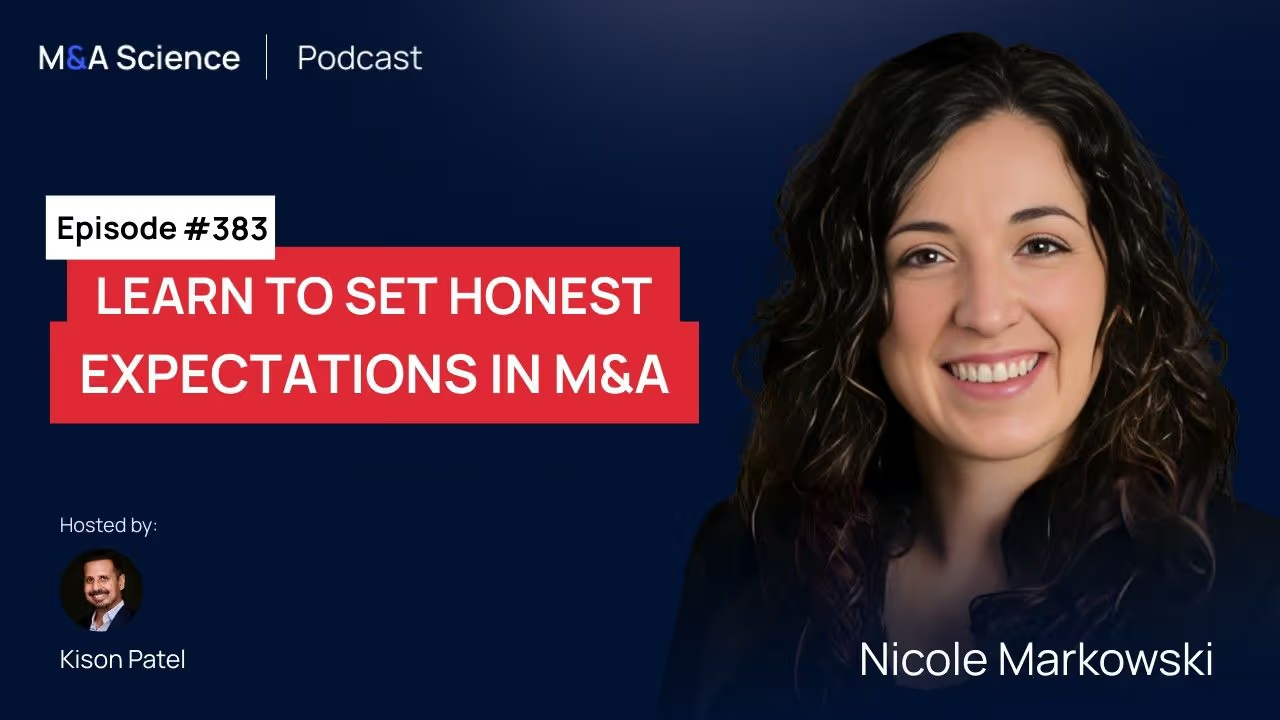
Nicole Markowski
Nicole Markowski brings a unique engineering perspective to M&A integration, having managed 30+ transactions across varying deal velocities at Wipfli and Ario. With a biomedical engineering degree from Marquette University and an MBA earned while managing acquisitions, she specializes in building scalable M&A processes that preserve the human element critical to professional services success. She has served as Director of Business Integration and Operations at Wipfli.
Episode Transcript
The Integration Reality Check: Learn to Set Honest Expectations in M&A
Kison: [00:00:00] I am Kisan Patel, and you are listening to m and a Science where we talk with deal professionals and learn valuable lessons from their experience. This podcast focuses on stories, strategies and what actually happened during m and a deals.
Kison: If you've ever felt like sellers are running the clock on your deal, you're not [00:00:30] alone. That's exactly why we're hosting the buyer led m and a summit on October 30th. It's a half day virtual event designed for corporate development and m and a professionals who wanna flip the script and take control of the deal process.
Kison: From sourcing all the way through integration, you'll hear from experienced operators like Stephanie Young from Isol. Hello Siki from Quadrant Matt Nelson from SPS Commerce and Keith Crawford from State Street [00:01:00] Leaders who've built scalable deal programs without the chaos. It's free, it's online. I'd love for you to join us.
Kison: Register now at deal room.net/summit or using the link in the description. Hello and welcome to the M and a Science Podcast. This podcast is part of a mission to rethink how m and a is done. The old school settle led approach, it's dead buyer led m and a is about strategy, alignment, and [00:01:30] efficiency.
Kison: Putting value creation at the center of every deal. And let's be real. It's not just about closing the deal, it's about making it successful. We uncover what truly works in m and a by learning directly from the best. Today we're diving deep into the real challenges of m and a integration with Nicole Markowski, director of Business Integration and Operations at Wiffle.
Kison: Nicole brings a unique perspective from the integration trenches, having managed everything from IT due diligence, the [00:02:00] full corporate integrations across more than 30 transactions with an engineering background from Marquette University and an MBA earned while managing acquisitions. Nicole has built m and a processes from the ground up at Wiffle and improved current m and a processes at Ario, both of which are the nation's top 25 accounting and business advisory firms at Ario.
Kison: Her team worked with five to 16 simultaneous acquisitions, a stark contrast to Wiley's three to five a year while maintaining the [00:02:30] human touch that makes professional service integration successful. She's here to share the unvarnished truth about what happens when deal economics meet human dynamics.
Kison: We're gonna talk about what actually makes integration successful. Nicole, how are you doing?
Nicole Markowski : I'm doing really well. How about yourself?
Kison: Thank you for joining me live here downtown Milwaukee.
Nicole Markowski : Absolutely. It's a beautiful, almost fall day.
Kison: I'm excited to serve first in-person interview. We've had, uh, previous ones we've done when we used to do 'em more [00:03:00] remote, but, um, absolutely.
Kison: This so's gonna be more fun. You wanna kick things off? A little bit about your background.
Nicole Markowski : As mentioned, I studied biomedical engineering at Marquette University, where I got my Bachelor's of science. I started out my career at Accenture and the first client that I worked on, I was actually thrown into m and a.
Nicole Markowski : They were going through a merger themselves and I was working on a lot of different hot topics, hot projects as a project manager, which was really cool. I moved over to Whitley after about a year and a half, was sick of traveling Monday through Thursday, [00:03:30] and then I decided to work on the consulting side for only about six months.
Nicole Markowski : Then I moved over to it. I set up and run their IT process for about five years. I moved into a manager role at Whitley, where I saw the lifecycle end to end from corporate, corporate development all the way through integration, but I really focused on due diligence and integration during my time there.
Nicole Markowski : I then moved to Ario as a senior manager, so that was a much higher deal volume environment. And now I [00:04:00] am back at Whitley as a director of business integration and Operations.
Kison: So these are pretty sizable, like rollup platforms essentially? Absolutely. In the accounting space, yes. You went on one platform that was doing about two to three concurrent deals, and then the second one was.
Kison: Well over five, five to 16. How does the process change between the two to adopt to the volume?
Nicole Markowski : So in the measured approach, we're only doing a couple year. There's a lot more time to ask questions. You have a lot more time to plan things out. [00:04:30] You can kinda let some of those milestones slip. If you have to provide some of that flexibility to make it successful, you likely have less dedicated m and a team members.
Nicole Markowski : 'cause if you're only doing a couple a year, there's really not the business reason as to why you need dedicated m and a team members. Which makes someone like my role as an integration leader wildly important because you're mentoring, you're coaching. If you have new people into the process, you need to make sure that they're doing what they're supposed to be doing, that they're looking at all the contextual pieces.
Nicole Markowski : So I truly believe that [00:05:00] having a seasoned integration leader is wildly important when you're at that scale. Now, contrast that to the high velocity model, which is what Apria was. It requires dedicated m and a staff. You have to have dedicated m and a staff in Corp Dev. You have to have them in integration, and you have to have them across all of your work streams.
Nicole Markowski : When I use the word work streams, I mean back office operations, some of your leaders of practice, of growth, of the different areas of your business, they have to be dedicated to m and a. 'cause if you're [00:05:30] working with five to 60 acquisitions at once, they're not gonna have time to do anything else. They probably barely have time to do that job in itself.
Nicole Markowski : It has a lot less flexibility. So you have acquisition on acquisition, you have to meet milestones. There might be a little bit of flexibility that can be built into there, but this is where the playbooks become wildly important. You have to know what you're doing. You have to have seasoned staff. You have to meet your milestones within a reasonable timeframe.
Nicole Markowski : In order to do that well, you have to have playbooks that are somewhat [00:06:00] flexible. You have to have seasoned staff that can recognize early where you may falter.
Kison: You said it. Well, I think both scenarios, integration leads key are instrumental.
Nicole Markowski : Yes.
Kison: But then the more you scale up, there's more likes. You need dedicated staff and then be more driven off of playbooks.
Nicole Markowski : Absolutely. Yeah. No, I do believe the integration leader is an important in both models. It stands out a little bit more to me in the measured approach, just 'cause you're not likely to have those seasoned people around you.
Kison: What do companies need to do in terms of making decisions [00:06:30] around deal economics to ultimately make the integration successful?
Nicole Markowski : I think a pretty easy step is including your integration leader in those discussions. So what I have found is your integration leader has a lot of experience with past missteps of acquisitions. They should understand the broader, contextual picture of your strategy of why you're bringing in deals of what the value is.
Nicole Markowski : For the deals, they will also know what's important to your work streams. So a good integration leader should [00:07:00] recognize that, Hey, hr, this is always a point of contention with them, so let's make sure that we aren't messing with that piece of deal value when we're considering the economics of a deal. I can give you a couple examples.
Nicole Markowski : So there's two that come to mind pretty easily. One is a staff cost pool analysis. In a staff cost pool analysis. You're looking at. How much staff do they have? How much are they getting paid, benefits, all that kind of stuff. And basically, are they oversaturated with staff or not as they're coming into your organization?
Nicole Markowski : The problem [00:07:30] is if you are only looking at the numbers to tell you if they're oversaturated, you're not looking at the bigger picture of, okay, maybe they have three or four admin that may larger of an admin staff than we expected. However, if you just choose to get rid of one of these administrative staff without understanding what their responsibilities are.
Nicole Markowski : They could have been supporting three partners. They could have had all the client relationships, and now you've cut that individual, you've immediately destroyed value in your deal. You no longer have those client relationships with [00:08:00] that one centralized person. So to me, an integration leader would be one that would come in and say, Hey, let's understand what this person is actually doing and what value they have to the organization.
Kison: This is fun. We're gonna banter on this stuff 'cause I come up with these synergies on the model. You need to, right? You need to look at it and say, all right, we can probably cut some of these roles down. Absolutely. Obviously it's all HR backend accounting. Sure. Yep. Pretty straightforward. And then we'll talk more about optimistic revenue synergies.
Kison: You gotta counter view on [00:08:30] that where, hey, you got these assumptions, but then rubber meets the road and we're gonna go integrate. You're gonna break some things and you're not gonna be able to actually do those things, which is why we should get you involved early as we're building this thesis out to get some of those considerations in early.
Nicole Markowski : Absolutely. Because it could be as simple as, well, maybe that's not the right person. Maybe it's the person over here that hasn't been there as long, doesn't have as many job responsibilities or client relationships. Or it could be a conversation of you have a year, we're gonna suck up [00:09:00] the cost of this person.
Nicole Markowski : We're gonna have a transition plan for them. On the way out, we're gonna clearly communicate that you have a year to find a new role. We're gonna give you maybe a stay bonus to stay that full year through integration. And we are going to help you find your next step in your journey. So there are creative ways to solve that problem.
Kison: So the, yeah. And that's why you get that perspective of how's this business gonna get integrated? Where in the deal process would you be able to bring that up? Because a lot of this stuff I'm doing pre [00:09:30] LOI. Mm-hmm. Right. I'm quick fingers just trying to get this deal right. To get signed. We wanna keep as few people in the tent just so we, we can keep the confidentiality the seller wants.
Kison: And then obviously move fast in case it gets competitive.
Nicole Markowski : That's a hard one. I would love to say bring your integration leader in and have some of those conversations. But at the end of the day, that may not be feasible. It may not be okay to ask the seller, Hey, tell me truly is this individual someone that is important to your organization or not.
Nicole Markowski : 'cause [00:10:00] sometimes sellers don't have maybe the most clear picture of what they actually have in their organization. So pre LOI, that does become difficult, however. I would say maybe walking a little bit more of a blurry line of, Hey, if we get into the situation as we are analyzing your people, that the person we talked about upfront that we can't fit within the model ends up being someone super valuable that we need to transition.
Nicole Markowski : Here's how the deal economics are going to change, or it's gonna push out the end [00:10:30] date so that we can truly understand what is underlying in this situation and how to reimagine those deal economics. It's not an easy answer. You're not gonna have all the information, especially pre LOI, that's where a trusted person.
Nicole Markowski : Just kind of playing your devil's advocate in your ear as you're thinking about these types of things and how you could walk a more blurry line with the seller instead of saying, we're cutting this person. No, if answer buts about it before LOI.
Kison: I've found it interesting that organizations do a different [00:11:00] amount of diligence pre LOI.
Kison: Have you noticed that between the two platforms you're on?
Nicole Markowski : Definitely, yes. I will say one of the organizations, the high velocity acquirer did do quite a bit more diligence pre LOI. Interesting. And then the strategic acquirer, the way that we had set it up was, yes, there was obviously some of that diligence done pre LOI, but then there was a stage in between where we had the LOI.
Nicole Markowski : We had the signing of the a PA with a delayed close. So between the signing of the a PA and the delayed close, that's where [00:11:30] integration planning happened in between LOI and signing of the a PA. That's where the really detailed analysis of due diligence happened. My personal preference is the second one.
Nicole Markowski : I really like having those defined periods where you can dive deeper into questions coming out the other end that's going to impact integration to me. The questions you need to be asking early are your deal killers. So the pre LOI stuff is. What are your deal killers? Is it economics? Is it oversaturation of [00:12:00] staff?
Nicole Markowski : Is it a cultural element that you just can't get around? Every organization needs to become clear on what are their deal killers and those should be answered very early in the process.
Kison: And then, does any of that information you gather help inform integration and every single piece of it does? Yes.
Nicole Markowski : So what I wish more organizations did is document and then transition that pre LOI diligence over to the integration leader.
Nicole Markowski : Unfortunately, a lot of times integration is forgotten. Along the process, I get [00:12:30] that diligence and cost pools and quality of earnings and all that stuff is super important early in the process. But the decisions that are being made upfront, let's say one of the points of negotiation maybe early on is the firm is worried about keeping their name for a certain amount of time.
Nicole Markowski : That's something integration needs to know because our typical plan is know you're gonna be branded with our company logo on day one. So we have to make very different decisions and have a better roadmap for how are we going to co-brand this and when is it going to end.
Kison: [00:13:00] This is actually interesting.
Kison: Do you have examples of just your deal economics and then how you execute integration where that disconnect is like destroyed value or blew up a deal? Yeah,
Nicole Markowski : definitely
Kison: hesitation. I,
Nicole Markowski : it's happened quite a few times, so the cost pool analysis is one that comes to mind very quickly. In the cost pool analysis of a deal that we were running, it turned out that we needed to let go of two of the administrative staff.
Nicole Markowski : So they did have an oversaturation according to our analysis of administrative [00:13:30] staff. Once we started to have that discussion with the seller, it was gonna be a break point for him. If we did not allow those people to come in through, we were actually bumping up against some of his tax deadlines. So nine 15 and 10 15 are two important fall tax deadlines.
Nicole Markowski : He basically said, if you won't allow me to keep these people through nine 15 and 10 15, I'm not doing this deal. So what that required is for us to look at the job responsibilities of these people clearly communicate, Hey, you've got this amount of runway. Here's your responsibility during that [00:14:00] timeframe, and you need to fulfill these responsibilities to get out to the other side and know that this is your end date.
Nicole Markowski : So that example I brought up about the client relationships that was valid. The other administrative person was supporting three of the partners, and she had pretty much every single client relationship since she had been there. And had that decision been made without conversations, we would've destroyed deal value immediately and or the seller would've walked away.
Nicole Markowski : So we found a middle road in [00:14:30] between allowing them a little bit of flexibility, but also preserving our financial
Kison: value. You gotta find a way to mitigate it.
Nicole Markowski : It's all about flexibility. It's creative problem solving. It's bringing in the right people to have the right discussions at the right time, which is all really hard to bring together all at once.
Nicole Markowski : But if you have someone who knows what they're talking about and help you think through what are creative ways that we can solve this problem, you'll probably come to a better answer.
Kison: Yeah, it's interesting 'cause it's a balance to strike [00:15:00] where usually those early stages where you build those economics of the deal.
Kison: Mm-hmm. And then here's these things that just come up and it just unforeseen.
Nicole Markowski : Earnouts is another great example. The other way my mind goes is the way that you structure an earnout. So earnouts are good and bad. You can never have a seller that doesn't have any sort of value on the line. So earnouts are a relatively easy way to put that, that hey, you have to grow within this organization to get your money.
Nicole Markowski : We're not gonna give it to you all up front. However, what people don't think about is what [00:15:30] is the potential impact in integration? So I'll give you an example from a consulting perspective. What we try to do in integration is break down the US versus them. We are trying to integrate these teams together because they're likely coming into a part of the organization.
Nicole Markowski : They're likely not new to the organization, like a new service line, a new product, something like that. When they are coming into the organization, we need them to very rapidly assimilate with their team to start working on other client projects, to start working with other team members. And unfortunately what we learned [00:16:00] early on in the Earnout process was we were not putting the right considerations of how to measure the earnout to also have them integrate well.
Nicole Markowski : So the earnout was, nope, any project that you and your team members are leading, not ones that you're a part of are gonna be in the earnout. Okay. So if I, as the integration leader, one wasn't aware of that, and then two, I'm trying to get them to work all together as one unit, break down that us versus them.
Nicole Markowski : Now either that partner is not gonna meet their [00:16:30] earnout expectation 'cause their team members aren't working solely on their client projects. They're working across the board. Or two, that owner's gonna be like, Uhuh, you're not stealing my team members. We're staying in our silo to the earnouts over. So you gotta think about a lot of those things when you're setting up these deal economics because they will come around to bite you.
Kison: We always think of the same thing with Earnouts. 'cause that's a huge tool that you use in negotiations and bridging valuation gaps. But then how does that impact how you can actually integrate the companies?
Nicole Markowski : Right? And you can certainly find [00:17:00] factors that will promote the coming into as one group. You could say, Hey, any project that your team members are working on is going to have X amount of earned value.
Nicole Markowski : Maybe it's not a hundred percent. Maybe it's 50%, maybe it's 25 based on that person's role, seniority, whatever. It's,
Kison: you had a seller walk away from a deal.
Nicole Markowski : So one specific one comes to mind very quickly. We thought the conversations were going really well from a diligence and integration perspective, and we stumbled across [00:17:30] one really big issue actually with technology.
Nicole Markowski : The unfortunate reality in professional services is there's a lot of things that we have to worry about from a risk and compliance perspective. That force us to use certain tools over others, and one of those is a PC versus a Mac PC has a lot more granularity to use certain security permissions across your organization in order to absolve some of that risk that you might absorb in a MAC environment.
Nicole Markowski : The firm we were [00:18:00] acquiring didn't necessarily have to worry about these compliance factors as the larger organization did. From an IT lens, we were like, Hey, Mac. That's not gonna work. Their technology is not gonna work. To be able to deliver client service, we had to go into the conversation and say, Hey, this isn't a potential reality for you to use a Mac in our environment.
Nicole Markowski : Where we mistepped in that conversation was not bringing together our practice side. And when I say practice side, that's the client facing value driving portion of the business and our [00:18:30] IT decide to say, is there a way to creatively solve this? Instead of just saying no, could we. Set up a PC environment for them to be able to use through their Mac and help them understand how to use that in their own environment.
Nicole Markowski : Could we give them maybe deep dive training on PCs to help alleviate some of that? Could we allow them to wipe those Macs and keep the Macs for personal use? But instead we went in with the answer of, no, you have to come to pc. And lo and behold, what we found [00:19:00] out is there were some other issues. Around conversations of where they would fit in the organization and reporting structure.
Nicole Markowski : They walked away from the deal.
Kison: Wow. That's so It does happen.
Nicole Markowski : It absolutely does.
Kison: Yeah. That's a tough one to lose a deal over.
Nicole Markowski : It really is. And unfortunately the messaging from leadership was. We can't have those types of conversations when in reality it should have been, we need to change the way that we're problem solving and we need to ask better questions about what's valuable to them.
Kison: Yeah, that's what I was gonna ask is [00:19:30] like, how do you find out this stuff earlier? Go into this challenge with the deal process itself. Yep. Few people involved, little information. Let's get the deal inked and then move into the meat of the diligence, and then you run into this friction point. Mm-hmm. How would you prevent that?
Kison: Yeah,
Nicole Markowski : so the honest answer is this is really hard to do, in my opinion. You can curate integration and due diligence questions to be able to pull this information out of the companies as you go along. [00:20:00] For example, a question that comes to mind would be. How does your team deal with change? This is gonna tell me likely how they are going to adapt during the integration process.
Nicole Markowski : You could ask what are some of the most important elements in delivering client work? So had we asked that question? It would've been, oh, the Mac allows us to do this that the clients expect. We would've given them an early chance to tell us, what are some of your deal breakers without actually telling us what are your deal breakers?
Nicole Markowski : Yeah. Another question could [00:20:30] be, what type of formal communication do you have within your organization? Do you have formal communication or is it more informal? If you are a super formal firm and they're a super informal firm, how are they going to react to having standard company meetings every month when they didn't have that before?
Nicole Markowski : How is their schedule gonna change? How is that gonna impact client service? So some of these higher level questions really allow you to dig down deeper. And understand what's important to them, what's important to my organization, and how do we bridge that [00:21:00] gap?
Kison: It really gets into the cultural diligence too, as well, right?
Kison: Of just like, how, how do they actually operate, but then even digging in of knowing where, what are those like key things that they really clench onto? Mm-hmm. Like their MacBook. Definitely. I do too. I got my MacBook right there.
Nicole Markowski : I Hey, I get it. I get it. Especially in the Mac world, there's a lot of people who really love their Macs and I understand that.
Nicole Markowski : It's just unfortunate that compliance a lot of time is the driver for using pc.
Kison: That'd be so tough. I make fun of PC people. You know the other thing I was curious, [00:21:30] you, your background, you got this engineering background and I always find the podcast interviews with engineers. Fascinating. If you're gonna build a dream deal team.
Kison: Must have as an engineer. Yep. And probably somebody with a legal background too. Agreed. Just you got that in the deal team and then you Sure. Put a banker in there. Ex-banker, but yeah. And then somebody that really knows the operations. Yes. But usually the engineer has that covered. Do you sort of see anything from that perspective or background that gives you like a unique edge when you think about integration?
Kison: [00:22:00] Absolutely.
Nicole Markowski : Everything I was taught in engineering school was how to problem solve, how do I look at the variables? How do I put them together, and how do I get to an answer? What it really taught me is that translates in my mind into the business world, into flexibility and creative problem solving, which we have talked about quite a bit throughout this podcast so far.
Nicole Markowski : It gives me a leg up on being able to see that higher level picture of the strategy of the value, and then be able to translate that to my work stream leads who need the tactical. Okay, that's great, [00:22:30] but how do we actually get this done? So being a translator is relatively easy for engineers to understand, like super complicated topics and then be able to.
Nicole Markowski : Them out and then explain them to someone who maybe doesn't understand it as well, but in terms that they will understand. That may be an engineering thing. That may be a personal personality trait, but I know that I definitely. Expanded on that skillset throughout engineering school. Also, just being analytical.
Nicole Markowski : We are so analytical in our problem solving and [00:23:00] we see things vary differently than people who don't have an engineering background do. And I'm a firm believer that multiple perspectives get you to the best answer. So it's just another great perspective to have in the room.
Kison: That's true. I think at a good point there's sort of this problem solving mindset that you're zooming in, zooming out and connecting the dots and it's just, yeah, there's something clearly there that's a, a good value add.
Nicole Markowski : A hundred percent. And I see it in a lot of my engineering co. Like all of the people I went to school with, most of them don't work in engineering. Some people are in [00:23:30] IT, SOX compliant at a BRI Brewing company. Some are. Leading operations. Some are in growth and sales.
Kison: I am a big proponent of it. Even my kids, I'm like, ah, you know, I get all these degrees.
Kison: But honestly, engineering degree, it makes a lot of sense 'cause it's just a mindset you learn at that age that it's really difficult to go back and learn it as an adult.
Nicole Markowski : I completely agree and I was actually told at Accenture that they would rather hire an engineer over any other major. 'cause you already know how to think they can teach you how to do the job.
Kison: Yeah, actually the woman Haley [00:24:00] from Alpine, we did a podcast engineering background. She's partner at a private equity firm. Yep. That just crushes it. So with engineering, let's talk about engineering the process. Yeah. Fire led m and a baby. Yep. There's obviously a lot of components around the, the framework, but the big one is connecting diligence integration, and you're a believer of this integration led diligence approach.
Kison: Tell me more. Tell me more of what it is. Why do you believe in it? Absolutely, and I, and I'll be just straight up. I've done tons of these podcast interviews and it's a [00:24:30] concept that people will say makes a lot of sense, or the ones that have done it have a lot of great optimism about the results from it.
Kison: Of rarely people actually do this. You hear your take
Nicole Markowski : a hundred percent, so I'm very much behind that. Integration leaders have a lot of contextual history of how integrations have gone in the past. They should also understand what is important to your work streams. What is a potential roadblock? What have you run into in the past?
Nicole Markowski : Looking out into the [00:25:00] future, Hey, this element right here is gonna call cause us problems over here, so let's talk about it right now and try to solve that problem so that it doesn't slap us way down the road to me. The integration leader is also able to marry the value of the deal with, Hey, we have to solve this problem.
Nicole Markowski : We have to make this decision on this integration milestone. What's the best way to go about it? Because if you are making those decisions in a vacuum in integration, so for instance, if you don't want integration to lead diligence and [00:25:30] you're having either your work streams or potentially corp dev lead diligence.
Nicole Markowski : They're looking at it from a siloed perspective. They're looking at it, how does this impact the way I am going to integrate this? Not how is this going to impact the overall integration into our company and the potential value of the deal. So it's important for me as an integration leader to even know what happened during diligence.
Nicole Markowski : Being a part of those conversations and diligence is irreplaceable Me sitting on a call talking about [00:26:00] person by person in the associate census. If I don't have that information, I'm not necessarily gonna know who should I be sitting down with on site during integration to make sure that they understand how to use teams and outlook.
Nicole Markowski : If I don't have that prior knowledge, I can't make good decisions during integration.
Kison: So you end up way more informed about the things that are gonna be critical for execution and those roadblocks and things that could potentially blow up as well, because you're coordinating the diligence a hundred [00:26:30] percent.
Kison: You're just ahead of it instead of. Hey, integration folks. It's time for you to get involved and start doing integration planning and then you're playing catch up or essentially diligencing the deal again
Nicole Markowski : or playing a game of telephone. So if I have someone else trying to relay to me what came up in diligence, was that what they heard or was that what was actually said?
Nicole Markowski : That game of telephone is a great example of, if I can't hear it firsthand, I may not be getting all the proper information right and context around it.
Kison: So true. Can you contrast the difference between. The [00:27:00] traditional model where it's usually a separate function, Corp dev, usually running the diligence.
Kison: Mm-hmm. Somebody in corp devs quarterbacking diligence. Integration gets brought in when it feels like, okay, we're at the point, we got good certainty. Let's bring integration folks in to start doing integration planning traditional. That's typical. Versus integration lead's gonna run diligence.
Nicole Markowski : It really is difficult in the world where corp dev is running diligence.
Nicole Markowski : Both sides are gonna need a tight connection [00:27:30] between integration and corp dev. You don't get away from that. Those two teams have to be working hand in hand, proactively communicating, understanding, timelines, challenging each other. You need that in your organization between the two different sides.
Nicole Markowski : Expectation setting with sellers is also really important. So whether that comes from the corp dev side or the integration side, it doesn't matter to me, but clear expectations early in the process is very kind and will help you during your integration of that firm. It requires a [00:28:00] clear understanding of timelines, so what I see the most is this push and pull between corp dev and integration.
Nicole Markowski : Integration always needs more time. Corp Dev always wants it to go faster. That's the common themes that I've seen between the two sides. What really needs to happen is integration has to have a really good relationship with Corp Dev to be able to explain the why. So in their terms, it can't just be in integration terms, it needs to be in corp dev terms.
Nicole Markowski : So corp dev, if you make this decision, this is what it is going to do to integration. [00:28:30] Here are the potential impacts to value. Because if you just say, this is gonna put our work streams over capacity load and we can't get this done, they don't care. That's not in their terms. So you have to figure out how the two sides can speak to each other using the terms that make sense to them.
Kison: Aligned. So yeah, I'm hearing one, you are gonna be able to get ahead of these relationships that ultimately make integration successful. Two, you're setting really clear expectations. Now you got full picture three. Much better alignment on timelines because it's just [00:29:00] that visibility is there. And then going back to corp dev, what about, you mentioned the key is a relationship there.
Kison: Because I feel like for them you're taking out a big chunk of the process. 'cause usually it's run diligence till you get to comfortability to go close. And that's like a big timeline that they wanna own. Yep. But instead it's like, okay, now we got integration lead running this. And obviously you articulate the benefits for you running it 'cause it's gonna help you integrate better.
Kison: Yep. Faster.
Nicole Markowski : I would tend to say faster as well. Yes. [00:29:30] Maybe not exponentially faster, but definitely faster. 'cause I'm not playing catch up and I'm not making decisions. That are going to have unintended consequences that I was unaware of.
Kison: You know, people don't talk about that. The value of fast integration, we always talk about all this financial stuff, but if you integrate faster and you essentially can realize all your cost energy's faster, free of cash, flow faster, correct.
Kison: Or improve EBITDA margins. Like there's a lot of good things that CFOs would get excited about, and
Nicole Markowski : that's the piece that you have to talk to Corp Dev about. From my integration mind, my head goes to, that's a lot of change for an [00:30:00] individual. The faster you get them in, the faster you break down us versus them.
Kison: That's true. Now I wanna understand the trade off with Corp dev because obviously you painted a lot of benefits for integration execution side, but for the corp dev to give up diligence and I don't know if it's necessarily giving it up, but it's just, it's very, it's a different model. You, it's all of a sudden for them it's like, Hey, we wanna see the findings report.
Kison: We know the Q issues work through them, get comfortability to close. 'cause they're usually working with the Oh yeah. The legal team on it. Yep. How does that change.
Nicole Markowski : So it means [00:30:30] that integration leaders have to communicate early and often with corp dev leaders. So the corp dev leaders need to know, Hey, we hit a snag here.
Nicole Markowski : This isn't looking great. Here's how I see this impacting. What's your perspective? So having that open line of communication early and often with them, it's making sure that maybe they even get a view of all the draft diligence reports from the teams and say, Hey. We need more information here. We need less information there.
Nicole Markowski : Dig in a little bit deeper here. This one looks good. So giving them a [00:31:00] little bit more of that ownership of the diligence reports that ultimately will probably come back to them. 'cause they're likely the ones presenting the deals to the leadership team. They could also have an analyst walk the process with the integration leader.
Nicole Markowski : So why not have some of your more junior people. Understand how integration is looking at it and be able to make those own connections on their own as well. 'cause I personally think that's super valuable. There's a lot of ways that you can make Corp Dev feel comfortable with not leading the [00:31:30] diligence process by including them communicating.
Nicole Markowski : Allowing them some ownership of the diligence process, steps,
Kison: collaboration.
Nicole Markowski : It all boils down to collaboration.
Kison: We talked about like this process and when we look at this, what, what you're describing and running it at scale, another like buyer led filler here is, is like running concurrent transactions.
Kison: Everybody always talks about the fail points. Integration are always people related. Agree. I disagree. I would agree with that. We did a whole [00:32:00] podcast about relationships and so if anybody has to listen to it, it's a really good, unique podcast. I don't think we've ever done a deep dive in just relationships in m and a.
Kison: I highly recommend looking for that podcast. Also, the Nicole Murkowski. When you look at doing the scale, how do you keep that people part intact? Because I feel like when you think of scale, everything is more checklist and things like that, and then you're pushing to get things done fast. You're stretching out resources.
Kison: How do you sort of manage this high volume and not destroy, like [00:32:30] those human touch points actually make the deal successful?
Nicole Markowski : Yep. So this is where the integration leader comes in again. So as an integration leader, as I am listening to what's coming out of diligence, as I am seeing the integration, scoping, and sizing questions be asked, as I am witnessing all of this stuff, I'm making mental notes.
Nicole Markowski : So if I hear something from diligence, like they've had three failed tech implementations and their people are very afraid of tech, that's a bell in my head. I'm like, okay, [00:33:00] that means that I need to move a little bit differently as we move their tech. So maybe that means. Me sitting down with someone who is on the older end of working age who maybe isn't as adaptable to technology, isn't as adept at just exploring technology and using it.
Nicole Markowski : I'm happy to sit down with that person for 20 to 30 minutes. I'm happy to practice calling on teams, putting a teams call on hold, transferring a call. Until I [00:33:30] start to see some of that uncertainty wash away. And then we have them do it live. And I actually did this in a recent acquisition. We had someone that was definitely on the older end, a little bit more afraid of technology and was unable to explore on her own.
Nicole Markowski : So I sat down with her for 20 minutes and all we did was I explained teams overarching at her practice calling me. I called her, she put me on hold, she transferred me to someone else, and after 20 minutes she was doing it with live [00:34:00] people. Wow. To me, that level of relationship building, it also goes back to relationship building is invaluable to keeping that human element alive.
Nicole Markowski : It's finding the ways to help ease people's uncertainty. Throughout this whole integration process, because integration is hard, integration is uncertain. To be that integration leader who can keep the human dynamic forefront in all the conversations and when decisions are being made. It has to [00:34:30] happen because Corp dev is always gonna look at the financials.
Kison: You're essentially baking this into your process. Oh yeah. Of really informing of these people elements as you go through it, that are really unique to this organization. The deal. And that's like part of the process. So you make sure you retain that and that's like carry forward in how you go execute it.
Kison: A hundred percent. So you can keep doing that at scale.
Nicole Markowski : A hundred percent. We can change the way we train if we have an organization that is very technology adept. Cool. We can do virtual training for you. We can do recorded trainings. You guys are gonna be just fine. For an organization that's [00:35:00] had two technology implementations fail, you can bet we're gonna be on site training your people in person, or this isn't gonna go well.
Kison: Number one, biggest risk in m and a humans. What's the worst thing that happens? Uh, if you don't nail the human part,
Nicole Markowski : you will have people exit. You'll have people exit with institutional knowledge. You will have people exit with relationships. More than likely what you're going to see is your A players are gonna be the first ones to exit.
Nicole Markowski : 'cause A players [00:35:30] aren't typically going to allow a lot of that to happen in their
Kison: life. There you have it. That's not from me. You're made up. This is bottom line. It's a churn. Correct. You're gonna lose valuable people if you screw this up.
Nicole Markowski : And likely clients then. So the first one to exit is the humans.
Nicole Markowski : The clients follow that person, had the relationship with the client. Now the client is gonna get a new person anyway to build a relationship. Why not go look at another firm?
Kison: Now a key thing on this, we put a lot of emphasis on the integration team. [00:36:00] Ultimately, it's a lot of this leadership, especially leadership on this selling entity, those are the people they know and trust.
Kison: How do you work with the sellers to work through a lot of these people things and reduce the churn risk?
Nicole Markowski : Yeah, a hundred percent. So something that I try to bake into the process is as much understanding early in the process that we can get about their people, the better. Those really tough two to three hour conversations where we're going line by line, talking about your individuals, asking about job responsibilities, [00:36:30] performance.
Nicole Markowski : It's key to making sure that we're placing them in the right places with the right titles, with the right reporting structure as we integrate them into the organization. So a lot of those steps early on with the sellers is super important for them to understand and start to get the full picture of where their team will be.
Nicole Markowski : How is this gonna change for their people so that when they're asked those questions after they announce to their people, they have a good answer. They were involved in the, for the most part, in the decision making. I'm not saying sellers get all of their say, but they should have their voice [00:37:00] heard in that process.
Nicole Markowski : 'cause at the end of the day, they should know their people. I coach a lot of our sellers on venting upwards. So as you're announcing to your firm, you have to stay positive because. You are the one that made this decision. They did not make this decision to join the organization. So they're looking to you to set the tone of, are we excited about this?
Nicole Markowski : Are we not excited about this? Are we indifferent about this? And with integration being as challenging as it [00:37:30] is and as uncertain as it is. You have to approach your staff with an air of empathy, positivity, understanding, and as much truth as you can possibly bring them. We all know that sellers can't necessarily open the gates and tell their people everything all the time, but you can acknowledge that integration is hard.
Nicole Markowski : You can listen with an empathetic ear. You can acknowledge that, yes, this is really hard, but on the other side of this, look at all the benefits we're gonna gain. You get new team members that help you deliver a client work. [00:38:00] You get to sell services to your clients that they've been needing for five years with you being their relationship executive.
Nicole Markowski : So helping them understand what the benefits are going to be in the future, acknowledging the hardship in the present and staying positive are three of the best things that sellers can do.
Kison: Yeah, I think that's a key part. Understand the people, the transparency, being able to have them, like part of the decisions that they can convey that to the broader organization.
Kison: So the leadership [00:38:30] part culture is something that we've already referenced and it's a huge part of it. How do you think through the culture piece? Because I, I feel like the challenge is field team gets to LOI signed.
Nicole Markowski : Mm-hmm.
Kison: If we did some cultural assessment, Uhhuh, blah, blah, blah, we toward their office and seems like a great fit and then you get involved.
Kison: Are you involved before LOI At times, yes. Okay. So you're involved, I'm trying to understand. It's not like black and white culture isn't black and white, where it's like, oh, this is a good fit. This is bad. It's sort of unique. [00:39:00] How do you take that understanding that there's different models of how they make decisions, how they get work done, and bridge that over to how you ultimately integrate the company and understanding like there's a variance there of, oh my God, this fits so well.
Kison: They very similar way of operating. Oh, there different ways of operating. Oh hell no. There's a completely different,
Nicole Markowski : yep.
Kison: How do you think through that?
Nicole Markowski : The first part, assessing the culture fit early in the process. So as you said, there's obviously some kind of standard culture fit questions. Are asked free.
Nicole Markowski : LOI. [00:39:30] I haven't found one clear way from anyone to be able to truly assess all facets of culture. So culture is a bit of an iceberg. Where you have the top piece of the iceberg is the mission statement, the values, the strategic goals, the handbook, the benefits, all of that kind of stuff shows you what they are intending for their culture.
Nicole Markowski : What I find is that you are never going to be able to fully assess culture, especially that bottom piece of the iceberg until everyone is [00:40:00] under the tent. Because what I've found is a lot of people up at the top, they don't see the undercurrents of culture. They may have been aware of some of them, but they don't come to mind when they're asked about culture.
Nicole Markowski : So for me, as I am talking to, let's say, a manager instead of a higher up partner. And I could say, okay, well how do you think your team handles change? They're probably going to give me a very different answer than the person at the top, because they're closer to those junior levels that may [00:40:30] struggle.
Nicole Markowski : They're closer to maybe some of the older staff that they have to help get through those transitions. Another question, one, accountability measures. Do you have in place at your organization that's gonna tell me, are you structured or are you unstructured in a lot of those? And that's a cultural element that isn't just gonna likely come out naturally.
Nicole Markowski : I would also say back to the standards of communication, how do you communicate to your staff? Are you formal? Are you informal? Is it just water cooler talk? Like you talk about changing the [00:41:00] strategy from one person at the water cooler and that then spreads through the rest of your organization? Or are you very intentional with, we're gonna have firm, firm-wide meetings that will tell me a lot about your culture as well, and how my potential communications are gonna land with your organization.
Nicole Markowski : My m and a team members also play a large role in assessing culture. So my work stream leads understand that it is also their job. As we are going through diligence and asking questions to raise any red flags, Hey, I noticed that this [00:41:30] partner was really tentative to talk about this topic. This may be something where we run into some trouble.
Nicole Markowski : Or hey, this statement in their handbook is completely opposite to what we have in our handbook. Do we need to close this gap or not? Then you can take that conversation forward with the right people in the organization. So to me, it's a combination of asking the right questions, having everyone under the tent, and your m and a leads need to be looking out for those things and communicating them back to the team.
Kison: Okay, so we go through this exercise. Mm-hmm. And it helps, right? It helps you shape [00:42:00] your integration thesis, how you're gonna approach it. So you look at a company, I've actually had this where. It is extremely micromanaged. How do you look at that deal? It's a good deal. Like it's a good deal. All the economics make sense.
Kison: Great deal. I just, I know this deal is the way the operator runs it. It's highly micromanaged. I have some concerns around how we gotta reconfigure things around it. Yeah. But like, I'm just curious, as an integration pro, what do you do?
Nicole Markowski : When I see a micromanagement culture, and I know that the organization they're coming into is not micromanagement, [00:42:30] that requires some hard conversations with the seller.
Nicole Markowski : So the seller needs to understand. When you join this organization, this is gonna be the expectation of your role. This is gonna be the expectation of how you lead. Here's what our organization looks like when it comes to these types of factors. Whatever you uncover in that micromanagement. And the unfortunate answer is if that seller is unwilling to change, probably not gonna go well.
Kison: Have you seen that, where you end up having to split that role up into like multiple roles just because Yes. It's just [00:43:00] too much control under one person?
Nicole Markowski : I would say yes. And. Usually we are acquiring smaller firms, so a lot of the back office accounting, a lot of the having to set up what a performance cycle looks like for the associates, that's all taken off of their plate.
Nicole Markowski : They don't need to be in the weeds of billing with a centralized billing team. They don't need to be selecting benefit plans because we have an HR team. I do maybe sometimes see if micromanagement is the natural style of [00:43:30] that leader and they have too much on their plate, some of that naturally falls off and sometimes the micromanagement completely disappears.
Nicole Markowski : If it doesn't, that requires the harder conversation.
Kison: You get basically some foreshadowing from seeing this of, hey, there might be these challenges that come up.
Nicole Markowski : Mm-hmm.
Kison: And then you're. Assessing as you go through that integration and then confronting those as you see it, not, yeah. Go in the direction you want
Nicole Markowski : and communicating upward.[00:44:00]
Nicole Markowski : So within my own organization, we have a deal sponsor that's responsible for the deal. So likely they are the practice leader of whatever organization this deal is coming into. To me, it's really important that the deal sponsor understands some of these tendencies because at the end of the day, I walk away at some point.
Nicole Markowski : I'm not gonna be there for two to three years. I have to move on to the next acquisition. While I would love to stay involved until they're quote unquote, fully integrated, I can't. A lot of that then rests with the deal [00:44:30] sponsor and the deal sponsor's leadership team as to how to hold that partner accountable for the hard conversations that you had.
Nicole Markowski : How are we going to make sure that they're not micromanaging their staff or micromanaging the tasks that they're doing because that isn't the work style that's gonna work in
Kison: our environment. That's a thing you just get ahead of, be proactive about and Yes. Kind of coach it through. Absolutely. It's interesting when you brought the deal sponsor, can we talk about structure of everything?
Kison: Because you have corp dev team, you have integration leads, you [00:45:00] have this deal sponsor where the, that heads up the business unit where this business is gonna fall into. Yep. What is structures, have you seen what works in terms of corp dev reporting up to who? Integration reporting up to who? Sponsor obviously goes right up to the business execs.
Kison: Yep. But what have you seen and what works best?
Nicole Markowski : My ideal scenario is integration and corp dev report to the same person. A back to that us versus them theme. When corp dev and integration have two different kind of higher up leaders, like eventually I know they fall under the same [00:45:30] person, but ideally it's like that, that next layer up is the same person.
Nicole Markowski : It breaks down the US versus them. That leader gets to see both sides, and ideally that leader is thinking about what this one is doing over here and how that's gonna impact over here. It also allows you, as you're setting up m and a processes, and as you're improving them. To look at it from a whole perspective, not just the lens of what's corp devs process and then what's integration's process.
Nicole Markowski : It's what's our m and a process and what's our m and a lifecycle look like. Because if Corp [00:46:00] Dev makes a decision to change a piece of the process, let's say that they want to remove something in the briefing document, but integration isn't consulted, probably not gonna end well. So it just is that natural way in my mind to break down the US versus them.
Nicole Markowski : So that's my preferred style.
Kison: What about integration reporting into corp dev?
Nicole Markowski : That's fine too, as long as the corp dev leader can understand and appreciate integration roadblocks and issues that they also need to remove. So [00:46:30] if it's a corp dev leader, you can't just be helping the corp dev team. You also need to learn the process over here so that you can help the other side of your organization.
Nicole Markowski : No, this
Kison: could turn into a whole topic because there's like the whole incentives for them to get aligned around which,
Nicole Markowski : right. I've seen that too. Corp dev will have incentives that. Honestly, sometimes damage deal value down the line, their incentive is maybe to get this deal closed as quickly as possible when the reality is higher
Kison: revenue.
Kison: Nicole,
Nicole Markowski : I understand. But the problem is you look three years down the [00:47:00] road and if you push that close through when we didn't talk through an issue, you might have just destroyed value without even knowing it three years down the road. Yeah.
Kison: Alignment so that there's clear incentives on both sides, getting the deal to close, but also making the deal successful.
Kison: Yes. A couple more fun questions for you. Can you tell me the difference between a project manager and an integration leader? How does one become an integration leader? Absolutely.
Nicole Markowski : I was a
Kison: project manager,
Nicole Markowski : so I came up through the project management organization. The unfortunate reality is not every [00:47:30] project manager can make the leap to an integration manager.
Nicole Markowski : Yes, you need to have the foundational skillset to be able to be a project manager and coach people in project management, because full honesty, I work with a lot of people who don't have that project management skillset and need my help and support in making sure that goes well. But in order to be an integration leader, you need to be able to understand your organization's operations m and a.
Nicole Markowski : What's important to your work stream leads. A lot of things that project managers don't necessarily have to worry about. What I recommend for [00:48:00] integration leaders is you should be there at least a couple times while your IT team is ripping stuff out in the office and putting new stuff in Over the weekend.
Nicole Markowski : You should be there for support to see how the people are coming to your staff. What type of questions are coming up? Do we have the proper staff there? So a project manager doesn't necessarily have to worry about a lot of that stuff. Now, I would say a technical project manager is probably somewhat similar, but a technical project manager, just like a project manager, doesn't necessarily have to understand the organization as a whole.
Nicole Markowski : To be a [00:48:30] great integration leader, you have to understand your organization and you have to work towards understanding the organization coming in. And that requires a lot of curiosity, a lot of deeper question asking, a lot of dot, connecting, a lot of bringing the right people into a conversation. And yes, project managers.
Nicole Markowski : Use that skillset, but it's on such a limited scale, likely, and they have very clear defined stakeholders where integration doesn't have, that you do have to have experience with. I've seen that before in the past. I [00:49:00] know that's gonna impact these people. Or this is super new, it's gonna impact these people, but let me see if it's gonna impact anyone else.
Kison: What about the term program manager? I mean, does that sort of. The bill closer to integration management. I would
Nicole Markowski : say yes, we're getting closer. As you get to like program management and portfolio management, you probably have more of that skillset. However, the key piece that I see missing in a lot of people is the want to understand what the work streams are doing.
Nicole Markowski : So a lot of people wanna just be like, that's in their little silo. I don't have to worry about [00:49:30] that. I don't subscribe to that. I wanna know what matters to my work streams. I don't need to be in the detail of the process, nor am I. But I wanna shadow them. So when I started as a manager, I shadowed HR through every single meeting, every single email, every single conversation, to just get a sense of what they were doing, why they were doing it, and how they were moving.
Nicole Markowski : So that when they come to me and they have a problem, I can better help them problem solve. 'cause if I don't know your world. I can't break through and truly [00:50:00] help you problem solve. I can ask you questions, but I can't really help you.
Kison: Solutionize. This is good. Creating the profile for a good integration leader.
Kison: Absolutely, and it's not always just default somebody that's a project manager to be integration lead.
Nicole Markowski : Again, project managers can absolutely become integration leaders. Not every project manager can be an integration leader.
Kison: One thing that we talked about, I don't remember if I was complaining about challenges working in a remote environment, but you had some interesting ideas of how do you sort of navigate that?
Kison: 'cause I feel like things can be harder to [00:50:30] do, especially working with like new people and things like that. What are some of the tips and tricks?
Nicole Markowski : This is gonna go back to the relationships podcast, so to me it's all about forcing some of the interactions that you would have in person. For instance, with my workstream leads and their leadership team.
Nicole Markowski : We're gonna have a regular meeting, whether that's monthly, whether that's weekly, it depends on your experience in m and a, how seasoned you are, how comfortable you are at making decisions in m and a. But a lot of the time that gives way to some [00:51:00] natural conversation about people and how they feel about things going on at the organization.
Nicole Markowski : And that's something I kind of catalog in the back of my brain. It also gives me the chance to understand people a little bit more personally. So. If I run into someone at an event, I'm gonna put it on my calendar two months later to be like, Hey. It's really great to see you at that event. Like you talked about the home buying process.
Nicole Markowski : I really hope that finding a new home is going well for you. Remembering personal things about people and things that are important to people is super beneficial in a remote [00:51:30] environment. So I force some of that water cooler talk by setting up those meetings. But I also monitor people in meetings. So if I see that.
Nicole Markowski : You on a consistent basis are usually positive, upbeat, super chatty, like putting your opinion out there, and then all of a sudden in a meeting you're closed off. You don't seem all that positive. You're probably gonna get an IM from me, like, Hey, is everything okay? Hey, your energy seemed different today.
Nicole Markowski : Is there something I can help with? Hey, I'm thinking about you today. That kind of stuff matters. It really matters to [00:52:00] people and even my prior direct report. Hey, how did your kids' baseball game today go, Hey, did coaching go well? Like that kind of stuff. Being able to either remember or document in a place that you can look at goes a really long way with people.
Nicole Markowski : You have to see them as human now in person is always better. I will give you that. What I have done in the m and a process is early in the process. I'm meeting the sellers in person if I can help it. There's something that you still can't get virtually, and that seeing another person as a human [00:52:30] being live in front of you.
Nicole Markowski : I truly think that starting a relationship in person and then carrying it virtual is a lot easier than just starting virtual and carrying it. Virtual. You can do it, but virtual, I mean that culture virtually takes a lot of very thoughtful work.
Kison: That's interesting. So you got one end of orchestrating people to just talk to each other on, on more of a regular cadence.
Kison: Picking up on these details to make more of a personal touch. I think at a really good point, if you can start things in person, it [00:53:00] builds fortitude of a much stronger relationship then you can keep up with remotely.
Nicole Markowski : A hundred percent.
Kison: What's the craziest thing you've seen in m and a?
Nicole Markowski : I already gave one of my answers on the relationship podcast, so I thought of another one.
Nicole Markowski : We were acquiring a firm in Denver. We were at, so in professional services at Wiffle, we did the announcement before probably about two to three weeks before the closing date. So the associates were under the 10th. Unfortunately, during that announcement, every single person on the IT team walked out, and the IT team [00:53:30] not only had internal responsibilities, they also had client responsibilities that they were servicing.
Nicole Markowski : So we had to scramble to get someone from our internal IT to commit to basically being onsite Monday through Friday for a span of at least three months before we integrated them. And then we had to get someone who serviced the client side to come in and take over those client relationships on site for a couple months before they could assume that, and we closed the deal and [00:54:00] integrated them.
Nicole Markowski : So that's probably one of the craziest.
Kison: Whoa. They just caught wind of the deal and said, we're out.
Nicole Markowski : Yeah. So. Come to find out, they had been part of a firm before that went through a really bad acquisition where their roles were cut and they basically said, I'm not doing this again. When in reality, the way that we did it, that would not have been the case, but they didn't give us a chance to explain what it would look like.
Kison: Yeah, that's wild.
Nicole Markowski : Yep. It was tough, but kudos to the two people that kind of picked that up [00:54:30] and ran with that ball.
Kison: Made it happen. I, yeah, so how do you do it? Like if you got lose all this access credentials and things? It was
Nicole Markowski : hard. You have to reverse engineer that. Now, granted this IT team did leave behind credentials, but I do know of another situation where they actually had to whine and dine the person to finally get the credentials out of them.
Nicole Markowski : Yep.
Kison: There's always a story behind a story at every A, this has been so fun, Nicole. I appreciate taking the time from doing deals to have this conversation. Help me become a better m and a scientist.
Nicole Markowski : Absolutely. Always happy to do [00:55:00] podcasts with you.
Kison: If you're still listening to this. You are one amazing fellow, m and a scientist.
Kison: I love to hear from you. Reach out to me on LinkedIn. I don't check my emails anymore, my EA does, but I do answer my, uh, LinkedIns, so reach out to me. Don't ask me for crazy favors, 'cause I really don't have time these days. But I love hearing feedback on this podcast. If you love the content, like I really like hearing about what you liked, how do you think we can improve this content?
Kison: How can you get better at doing these interviews? I'll take the criticism. So with [00:55:30] that, look forward to hearing from you. Till next time, here's to the deal, you.
Kison: Thank you for taking the time to explore the world of m and a with our podcast. We love hearing feedback. Tag us on a LinkedIn post, add a review on Apple Podcast. We'd love to hear from you. If you need help standing up an m and a function or [00:56:00] optimizing one that you already have. We're here to help, and if we can't help you, we probably know someone that can.
Kison: You can reach out to me by email Kisan, K-I-S-O-N, at ma science.com, or you can text me directly at 3 1 2 8 5 7 3 7 1 1. If you just want to keep learning at your own pace, visit ma science.com for a lot more content and resources. That's where you can also subscribe to our [00:56:30] newsletter. Again, that's ma science.com.
Kison: Here's to the deal.
Kison: Views and opinions expressed on m and a science reflect only those individuals and do not reflect the views of any company or entity mentioned or affiliated with any individual. This podcast is purely educational and is not intended to serve as a [00:57:00] basis for any investment or financial decisions.
M&A Software for optimizing the M&A lifecycle- pipeline to diligence to integration
Explore dealroom

Want to wear your M&A expertise?
Check out the M&A Science store.


.jpeg)