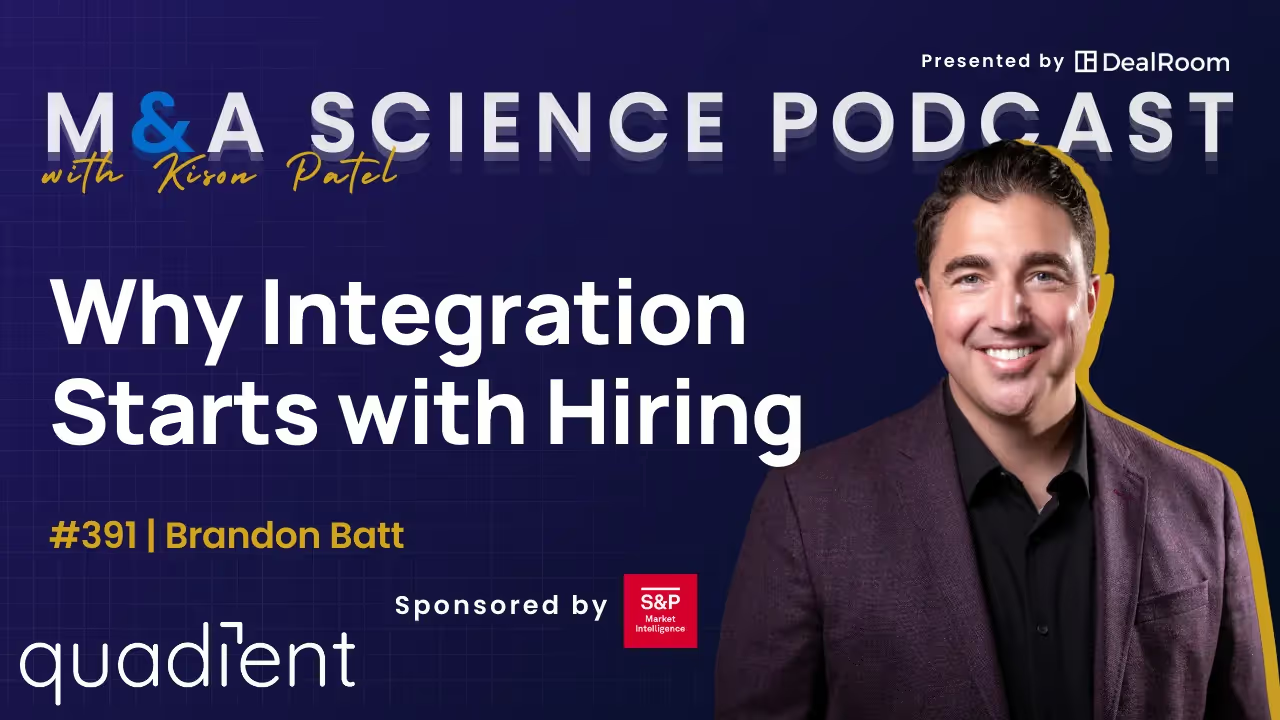
Quadient is a global leader in intelligent communication automation, helping businesses deliver better customer experiences through digital transformation solutions. Founded over 100 years ago and traded on the Paris Stock Exchange (Euronext: QDT), Quadient operates in 25+ countries with approximately 4,700 employees and $1.1 billion in revenue. The company has been executing a multi-year transformation from legacy mailing equipment to digital solutions, with M&A playing a central role in the strategy.
Brandon Batt
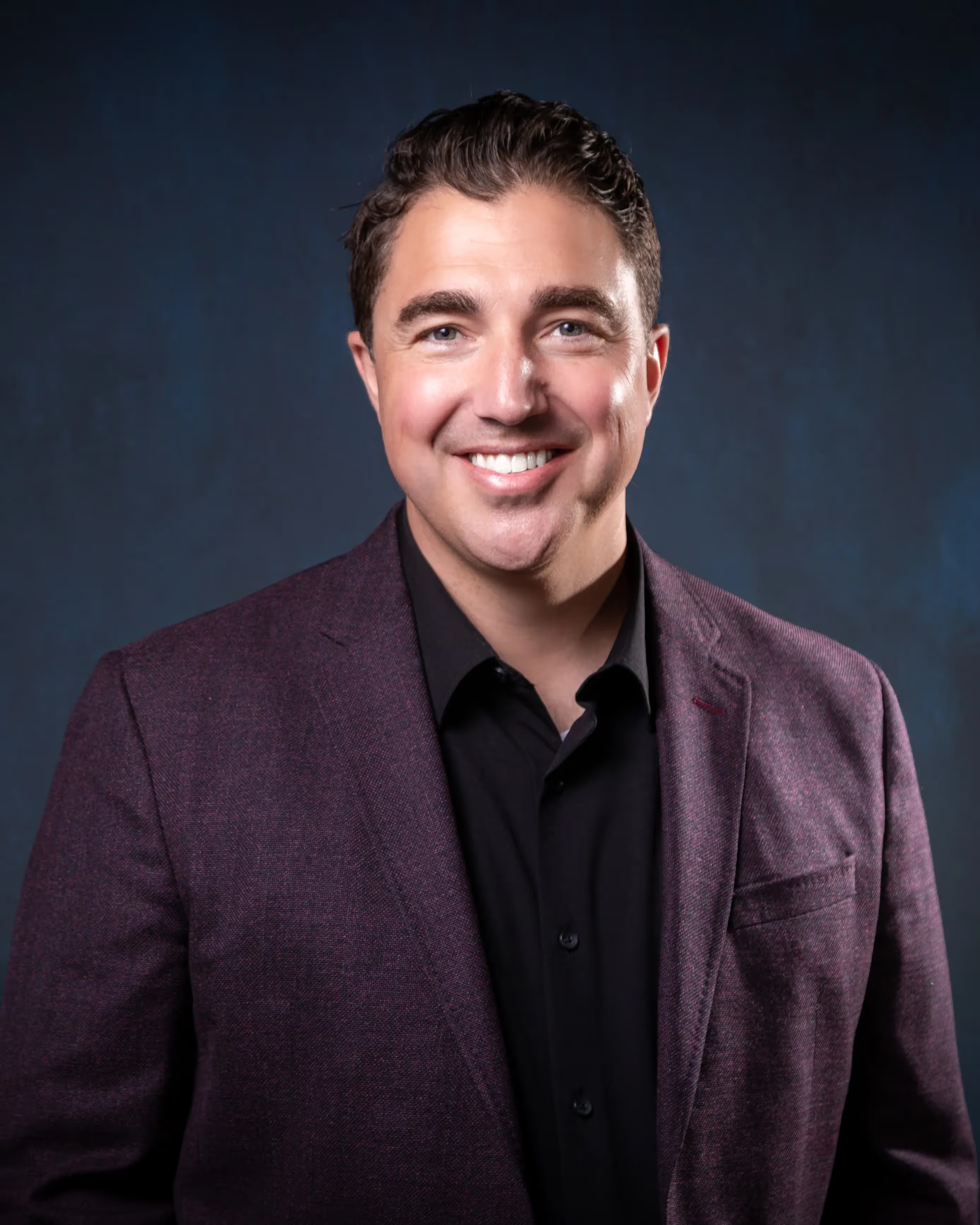
Brandon Batt is Chief People and Transformation Officer at Quadient, where he sits at the intersection of people strategy and deal execution. With a career that started in law and evolved through business and M&A, Brandon leads a unique cross-functional organization encompassing M&A, HR, legal, sustainability, and culture. He's been instrumental in Quadient's transformation journey since 2017, overseeing dozens of acquisitions and divestitures while building M&A capability across the organization. His multidimensional leadership approach has made him a board-facing executive shaping the future of work at a global scale.
Episode Transcript
Integration Starts with Hiring, Not the Deal
Kison Patel: [00:00:00] I am Kison Patel, and you are listening to M&A Science where we talk with deal professionals and learn valuable lessons from their experience. This podcast focuses on stories, strategies and what actually happened during M&A deals.
Kison Patel: Welcome to the M&A Science podcast. This [00:00:30] podcast is part of a mission to rethink how M&A is done. The old school sell led approach, it's dead buyer led M&A, is all about strategy, alignment, and efficiency. Putting value creation at the center of every deal. Let's be real. It's not just about closing the deal, it's about making it successful.
Kison Patel: We uncover what truly works in M&A by learning directly from the best for episodes, resources, and tools. To elevate your M&A game, visit ma science.com and follow us on [00:01:00] LinkedIn. You find this content useful. Don't forget to leave us a review on your favorite podcast app so others can find it too.
Kison Patel: I'm your host, Kessan Patel, chief scientist here at MA Science. Today I'm joined by Brandon Bat. Chief People and Transformation officer at Quadient traded on the Paris Stock Exchange Under QDTA global company helping businesses deliver intelligent communication automation. Quadient has been on a multi-year journey to modernize its [00:01:30] operations and expanded new markets, and M&A has played a central role in that transformation.
Kison Patel: Brandon sits at the intersection of people strategy and deal execution with a rare combination of cross-functional leadership. Expanding M&A culture, hr, legal, and sustainability. He drives growth by lining human potential with business performance as a board facing leader, Brandon is shaping the future of work, embedding AI into the fabric of operations.
Kison Patel: Leveraging M&A to build a [00:02:00] company where people thrive and value it endures. In this episode, we explore how to build M&A capability before a deal happens. My integration success often hinges on team maturity across an organization and how a people first governance model helps deals move faster and land stronger.
Kison Patel: Brandon, how you doing today? Great. Nice to be with you Ksan. Hey, thanks for hosting live here at your Boston office. It's got a beautiful view of the the Charles River. I appreciate taking time [00:02:30] from doing deals to have a conversation with me. Great to be with you. Can we kick things off a little bit about your background?
Kison Patel: My career
Brandon Batt: started in law. I find energy from helping people. I got into law with that purpose that led to business, which led to the M&A another, let's say, multidimensional field. Several years later. Here I'm at Quadient. Running a number of different functions all formed to focus on our transformation
Kison Patel: of the business from the legal side, Morton to M&A.
Kison Patel: Well, you covered more than that. Maybe we can talk a little bit about the journey at Quadient. [00:03:00] I feel like you came in at a really interesting time for the business, and you've been in the organization for about seven, eight years now.
Brandon Batt: At Quadient, we have a mission to transform the company over the last several years.
Brandon Batt: A bit of context for your listeners. Quadient has a multinational business. We are physically present in over 25 countries, roughly 4,700 employees, and with hardware and software solutions, we have revenue just over 1.1 billion. When I joined the organization, we had really the mission to transform the organization from what is our legacy business in [00:03:30] mailing equipment to digital transformation, and to the future of the organization.
Brandon Batt: Quad and just this last year celebrated its a hundred year anniversary. Our mission within the organization is not only to run a good company, but to build a sustainable company long term and M&A certainly plays a huge part in that.
Kison Patel: So that's like a real transformation through M&A.
Brandon Batt: Absolutely.
Brandon Batt: When we announced our strategy to the market in early 2019, I closed two divestments and an acquisition in approximately what, 30 day period. Nothing really tells your investors, [00:04:00] employees, customers, your stakeholders, that you're serious about your strategy like M&A. When you put your checkbook where your mouth is, that kicked off a portfolio simplification of the organization so that we as a business can start to focus.
Brandon Batt: Our resources, our capital on the future of
Kison Patel: the organization. So from that point in 2019 till now, how many acquisitions and divestitures have you done?
Brandon Batt: We're pretty active every year. We do about three transactions a year, some acquisitions, some divestments, depending. But when we started our transformation, we had more divestments than acquisitions.
Brandon Batt: And [00:04:30] since over the years after, let's say simplifying the portfolio, we've been adding in both the product breadth and geographic scale to the organization through acquisitions.
Kison Patel: Over a dozen deals that you've done. Absolutely. And it sounds like the early days you're doing more divestitures in effort of the repositioning and now it's more focused on the new strategy.
Kison Patel: Absolutely. Can you tell me about your role specifically? How did you participate as you did these transactions? When
Brandon Batt: I joined the organization, there was, from the beginning a focus on both [00:05:00] organic and inorganic transformation. From restating the new strategy to then articulating where we wanted to go as a business, Quadient has transformed organically and organically over that period of time, and my role has really been connected to that, depending on which teams are part of our organization right now.
Brandon Batt: People in transformation is a mix between M&A. Legal, hr, sustainability, culture and engagement. And the impetus of bringing all that together was the organization has certain teams that are really essential to change. And the [00:05:30] idea was by bringing multi-disciplines together that are all necessary to implementing, that we should have better execution in the meantime.
Brandon Batt: Finding those synergies internally through collaboration. Let's how you
Kison Patel: define this transformation office. Absolutely. So we, okay. MA, legal, hr, strategic ops, any other functions in there? And sustainability. Sustainability,
Brandon Batt: which if you think about any organization's journey, you have the change today, but you also want to have a focus on who you want to be tomorrow being, let's say, future ready.
Brandon Batt: Sustainability is really around ESG. It's around how we organize [00:06:00] ourselves as a business, both from a commercial perspective, but also environmentally as well.
Kison Patel: That makes sense to tie that in, especially if you're doing MA transaction. So it's aligned. Can you tell me a little bit more of just overall structure?
Kison Patel: And I'm always interested in this because I feel like every organization figures it out and it's just unique, unique to the organizations, it's unique to their strategy. If you can give me some insight on the structure, how did it evolve to the structure of my own team? Yeah, because like we're like overall, like where, do you still have a traditional corporate development team?
Kison Patel: Does the Transformational Office play play in parallel to that? [00:06:30] Within my team, I have a head of M&A. So M&A is within the Trans transformation office? Absolutely, yes. Okay. This is new for me. What does that structure look like? So you have a transformation office.
Brandon Batt: Let's start with the business and the strategy we have for the organization.
Brandon Batt: So we start with an organic first strategy, but with a need to simplify over time. So we talked about investments and acquisitions. So much of an organization's ability to execute M&A and change effectively is not usually the sexy stuff upfront, but really the back office [00:07:00] and how the organization works behind.
Brandon Batt: So IT systems, financial systems, HR systems, organizational design, et cetera, et cetera. When we started our project back in 2018. We had over a hundred plus legal entities within the organization that had been organically brought together over time. So you have, while adding new capabilities, new product, new scale and organization in geographies, you also at the same time the cleanup and simplification of the organization, so that better employee experience, more productivity, et cetera.
Brandon Batt: At the same time, m [00:07:30] and A fits in that we've positioned M&A very close to the business so that. A is really an extension of the business team to accelerate the organic strategy, but that is specifically tied to our own journey as an organization as well. So if I give you an example, we have transactions even today where.
Brandon Batt: Even the question of whether we're going to do an asset deal or a stock deal is tied to our need to integrate at a certain speed and in a certain way, depending on the geo that we're acquiring. There's a very tight [00:08:00] interlock within the team from the very beginning at the design phase of what would this acquisition mean for our organization's
Kison Patel: operations.
Kison Patel: That's why it's all together. It's all together in transformation office because usually I'll hear organizations where it's a separate. Group altogether, M&A Corp Dev is gonna be its own entity that's more forward on executing the deals and transformation office is there. And sometimes they spin it out.
Kison Patel: An IMO. Yeah. But it's more of a post-close entity that really [00:08:30] focuses on the integration effort. They all the same. They complain about getting involved in the deal too late. Where here it's flipped around, all bundled together and then you're on the forefront of the deal. Where do you report up to? To the ceo.
Kison Patel: Okay. So. CEO, you run the whole transformation office, including full on end-to-end M&A. Then you bring in all these other components, so that way it's all seamless, execution
Brandon Batt: seamless. Yes. Within my team, I worked very close partnership with our CFO and CIO as well, so we tend to have a really [00:09:00] close collaboration as a executive leadership teaM&A lot of the things that need to happen in the background, my team collaborates super closely on.
Kison Patel: It's interesting, I talk a lot about buyer led M&A, defining what that means, and a big premise of it is just. Thinking integration first. Really having your strategy clarified and allowing that to guide you on how you're gonna integrate these businesses, which ultimately gives you better outcomes, and this structure makes a lot of sense based off of that.
Kison Patel: I wanted to get that contrast between a traditional model. Usually it's corp [00:09:30] dev slash deal team. They're aligning the strategy, they're executing the deal, but then there's oftentimes a handoff to another team to drive the integration.
Brandon Batt: We ask ourselves a few of the same questions on every transaction.
Brandon Batt: Whether it's an acquisition or a divestment, and it usually starts with, are we the best shareholder for this asset? We the best shareholder for this business, these employees? 'cause usually value creation flows from that. The only way to answer that is to truly know what you're acquiring and not to mean other models don't work.
Brandon Batt: Where you have a M&A [00:10:00] team that's structured a bit differently. But for us, the M&A team working hand in hand with our IMO, where we call it strategic operations, they're involved in due diligence from the beginning. They're involved in structuring discussions from the beginning. And they then make sure that other teams are coordinating accordingly.
Brandon Batt: Don't get me wrong, we still have all the same things I'm sure, as your listeners do in terms of sometimes we wonder if there's too many people on the phone calls. Sometimes we wonder if the right subject matter experts are there. Usually the balance is about not over rotating in any one way. We bring everyone on [00:10:30] board as new assets come into the organization,
Kison Patel: can we walk through like a made up deal of what that would look like?
Kison Patel: Sure. In terms of, sure. How your teams execute and who gets involved when every good deal starts with the
Brandon Batt: idea that from the strategy that you've defined, whether it's product based, human capital based, whatever it may be, the business has needs, it's the build by partner. Now bot, depending on how you look at things, and we go through the same assessment.
Brandon Batt: You have a pipeline of targets that you think could be really interesting to meet the [00:11:00] needs that the business has to go faster from a build perspective.
Kison Patel: So proactive, you know, here's a strategy, you've kind of surfaced that. Yep. We know the strike zone very well. And then you start building your pipeline and you're out there having conversations with these targets.
Brandon Batt: Absolutely. There's a complexity that I think is part of the fun Quadient, which is. We have three solutions, which means I have three different business units who all have similar needs, but not always the same. It's not always in the same geo, but allows me from an integration perspective and an M&A perspective to actually [00:11:30] have multiple deals happening at one time because the same team members don't always need to be on every transaction starting a pipeline cross three solutions, and as a way to grow each one of them, and each one of them have an M&A strategy that's clear and art articulated.
Brandon Batt: There's a partnership between the head of M&A and the head of the business line to find best targets, nurture discussions, et cetera. You get to a point that's typically around the LOI phase where we say, okay, we think that there's a nice project to be at here. We work out price, scope, conditions [00:12:00] of the deal, and at that phase, once we have a call project, that's when other teams will get involved, both from the PMO side and as well as subject matter experts.
Brandon Batt: So they're really involved early. Yes. Even before LOI, basically, usually the LOI is where we'll start to actually disturb teams from other matters. That being said, on the business side, product will typically involve and even the pipeline discussions of who's most interesting From that perspective, engineering often has a great input to give in terms of technology.[00:12:30]
Brandon Batt: So on forth. So we, depending on the deal, depending on what it looks like, will involve, it's almost like
Kison Patel: socialized because engineer might be like, oh, that's the company we wanna buy. Yeah. Just like flat out, they, we know they're the best in the market.
Brandon Batt: Our governance internally is driven around accountability.
Brandon Batt: The idea of a team working before a deal and then passing it off to another team after the deal just doesn't really exist so much within Quadient. In other words, as a business leader, you have a conviction that a certain target is worth the company's capital and for us to [00:13:00] allocate there versus somewhere else.
Brandon Batt: There's an accountability, but also an empowerment to use that vehicle way to grow the business. That accountability starts from day one on using the team's time to go after it, to investigate it to due diligence. Likewise on the integration side, we wanted to make sure that my team has an accountability to bring it to a certain point after the transaction, before it's completely handed back to the business.
Brandon Batt: We will have a meeting before the closing of any deal where the subject matter experts who are responsible for their respective areas are there [00:13:30] and people are signing off saying This is the right thing for the company. This is the right thing for our employees, our shareholders, our customers, et cetera.
Brandon Batt: There's an accountability, but a shared belief that's pretty transparent in terms of before we decide to go, that goes beyond just the investment committee and our own internal
Kison Patel: governance with our board of directors. How much integration planning happens between assigned LOI and close? Oh, quite a bit.
Kison Patel: From day one
Brandon Batt: to day 90, let's say operational planning, but the where we start is usually the key drivers of value for us. So every transaction has a different. [00:14:00] Flavor. Every transaction has a different purpose, typically on that front. So you'll have different value drivers of what has to be true or the value to be created that we
Kison Patel: plan from a financial perspective based on that.
Kison Patel: That's where your emphasis of how we need to plan integration, that will happen. What does that structural, is it the same folks doing diligence that's also planning? Integration or, yes. You know, it's the same team and what
Brandon Batt: you have in that team is what we'll call M&A muscle. Because they've seen different transactions, because they know our organization, because they know [00:14:30] the back office, the legal structure, the team capabilities around the organization.
Brandon Batt: They have built up a sense of what is e executable for the company. We get a good sense of risk before
Kison Patel: a transaction's also pursuit. You are going through, you got folks in the business, they're doing both diligence, integration. You move closer to close, then you get all the checkbox things attorney's gotta go back and forth on.
Kison Patel: Legal has another path on that too. So post-close. There's a lot of things that drive success, but I feel like I'm really curious about this Is the target [00:15:00] company, like really making sure they're on page or motivated because there's things that you found that makes that really work well. Is there a point when you're starting to socialize what.
Kison Patel: Life after close is gonna look like. And how do you tee that up?
Brandon Batt: So much of the whole process is around human connection and trust. I don't think we've had one transaction that has been successful where we didn't have relationships with the people on the other side of the table buying or selling. I would [00:15:30] almost make an emphasis that's equally important.
Brandon Batt: And divestment is as an acquisition that you know the people you're working with beyond just is the price right? And is the timing good from a divestment perspective? We take our responsibility to our employees super seriously. The idea of selling to anybody for price and time, et cetera, doesn't, it's not the full discussion whatsoever.
Brandon Batt: And some of our best stories that I have are actually when we find the right home, the right shareholder for the businesses [00:16:00] that we doesn't fit with our current strategy, but doesn't mean they're not great businesses, great employees, great companies for others. Likewise, on the acquisition side.
Brandon Batt: Especially with founder led businesses, it's about trust. There are usually people that have made commitments to their employees to come on board for the story, for the journey, and they need to understand that Quadient is the right shareholder for their business going forward as well. I really start with, let's say, human connection as a
Kison Patel: secret sauce.
Kison Patel: You gotta build trust and have that relationship and I feel like that's where you gotta ground things on so it's not [00:16:30] strangers just trying to tell you what to do. Yep. You made this point in a prior conversation we had that. Culture isn't just about fit, it's about what people add. How do you think through that or assess culture when you look at a deal?
Kison Patel: We have a fantastic
Brandon Batt: culture, Quadient. We pride ourselves on teamwork, inclusion. The idea around when we hire talents into the organization, we don't try to find people who look exactly like us. We try to find people who are gonna add to our culture, add to our perspectives, [00:17:00] thinking insights. And it's no different than when you look at an organization that could be acquired, how they would add to our organization too.
Brandon Batt: So we do quite a bit around cultural fit. So you look at basically how does work get done in their company versus how does work get done in our company today? But it's typically like the things that are not gonna show up on a spreadsheet. What's the feeling you get with the person at dinner? Are they a good person?
Brandon Batt: Do they act with integrity? How do they treat their people? When you sit with a CEO and their [00:17:30] management team in their room, is everyone super quiet and the CEO's doing all the talking? Or do they have a live discussion and there's little things that you pick up to say, okay, well how are they going to contribute to the company we're trying to build overall aqua in.
Brandon Batt: When I talk about cultural ad, it's not only for M&A, it's really for our organization overall that we're trying to bring in great people to continue contributing to what we have. It's
Kison Patel: almost like a mindset of thinking of like how the culture's gonna add versus just looking for a fit. How do you sort of differentiate, because everybody talks about culture fit, which I [00:18:00] get.
Kison Patel: Are these teams gonna actually come together work, or do we need to keep an integration plan that keeps certain teams separate so they can work the way they do and preserve their magic there?
Brandon Batt: We will look at culture in different ways for each project. So you may have a deal that is planning to be integrated fully from the very beginning.
Brandon Batt: So you need to be very confident from day one. Teams can sit across from each other and work together. And the working styles, the working habits, remote, hybrid in office, cultural differences, et cetera, are not [00:18:30] gonna be something that's going to lead to those value drivers. We talked about not being true.
Brandon Batt: You may also have, uh, deals where you say, okay. Our purpose for the business of doing this is to leave it as a standalone for a period of time. They've got something special they need to keep on that. We don't wanna bother them, which is a different cultural discussion, but at some point you'd know that people are gonna come together.
Brandon Batt: And just in terms of our current org design and how we operate at Quad and today being a unified organization, I tend to look at things of what are gonna be the real drivers of growth [00:19:00] culturally. Like what should we really be focusing on celebrating and calling out to the teams. Shared values, those kind of things.
Brandon Batt: And then there's other things which are, what are the potential red flags where if we don't put mitigation measures in place, we could actually have things that are gonna take away from the value that the deal's expected to bring to us. And then that goes to, are there complete red flags where we've had transactions where we'll go meet with an executive of a target and they make comments that are against our values.
Brandon Batt: They treat people [00:19:30] poorly. We've walked away from deals from that because if the head of the organization is, is somebody who. We would not want to be part of our company. You can only imagine how they've permitted a culture in their own organization of things that, that we just know would not fly. We take our own culture pretty seriously.
Brandon Batt: That's one of those
Kison Patel: non-negotiables at that
Brandon Batt: point.
Kison Patel: Yeah. It sounds like it goes in a lot of different directions, like just there's the overall fit. The ad is almost like the direction of where you're fighting against the value drivers and then getting a sense of how you're gonna integrate the company based off of that.[00:20:00]
Kison Patel: How does being a company based in France impact your overall culture?
Brandon Batt: We're headquartered in France, but I would say we're an international business, so our leadership team is international. Our board is international. While we have our global HQ in France, we have our office here in Boston and another dozen offices across the us.
Brandon Batt: There's a point. That's who we are. And that's actually, there's a lot of great things about being French, but we also have say, international aspects that are more driving of who we are today and tomorrow.
Kison Patel: You're required to have like French wine at your events. Is that, [00:20:30] I'm just curious. I got deep appreciation for French wine.
Kison Patel: You have to respect the culture that where you're sitting, so you, you do what you gotta do, it blends together. It sounds like when you're working with office, like here, you got Taste of Boston
Brandon Batt: and here comes, I would say the best part of working for an international organization like Body is. The number of countries we're in and the cultures that we have within our organization.
Brandon Batt: And speaking of French wine, when you're in France, I will say they have a unique and fantastic appreciation for wine, but for food, for many other things. And every country, every office you [00:21:00] go to has a different flavor of fun, which is great. That's awesome. Here. That
Kison Patel: makes me excited to go to around your offices.
Kison Patel: You'll have to visit our Paris office. Absolutely something. I'm working on Paris, so I'll keep you in mind. One of the things you made a comment before also was around M&A readiness. You're like, it's not just about pipeline. It really starts with who you hire. Can you elaborate on that in terms of just usually the core team and the whole hiring, and what are your principles around that?
Kison Patel: I look at M&A,
Brandon Batt: like any other part of our [00:21:30] operations, and that the ones who do it really well. Have experience in the subject. So M&A is one of those topics where you cannot read about it and then go do it. You need to take action, you need to fail, you need to try, you need to do it again. And it's through that, that you build that M&A muscle of, I understand what it takes to actually bring people together to get transactions done.
Brandon Batt: That starts when you look at key talents for an organization as part of the skills that they would bring on as a VP [00:22:00] of R and d or VP of product or head of sales for a region. When you have people in key positions that ultimately one day will be part of your due diligence team, or the integration team, if they have already have M&A experience, they're gonna be ready in a much different way than someone who says, yeah, I've always wanted to be part of an M&A deal.
Brandon Batt: What's due diligence? Even the, the ability to kind of look at a company with a discerning eye comes from experience of having done it before. When I say, you know, being ready, M&A ready starts even before the deal, [00:22:30] we look at skills for every job that we hire within the organization, and you have key positions in the team that will be part of M&A.
Brandon Batt: At one point. It's thinking about those M&A skills in advance. So you bring on talent with that expertise from the beginning.
Kison Patel: One of my biggest inspirations for this buyer led M&A building a framework is just seeing that there's a huge gap. There is no standardization of how do you go execute buy-side M&A.
Brandon Batt: Yeah,
Kison Patel: and I've also noticed from doing all this podcast interviews, there's like a maturity of, and this is where I'm going going with this, is, [00:23:00] you know, from the first deal you do. And then it's like the third deal. Then around the 10th deal, your whole process completely shifts to very eyesight oriented process.
Kison Patel: And we talk about like the early integration planning Yeah. And all these things to set up the deal for success. I wanna hear more about that, but I want, I first wanna pick it. When you go through that, it's like you're, what you described, it's, you had these individuals in the organization that are on their own maturity journey.
Kison Patel: Because like you just said, you have a mix of folks that it's their first [00:23:30] deal versus their 10th deal, and that's something that you don't talk about. We always talk about like overall organization, Hey, they have these broader lessons learned, but then you have these individuals. How do you level set that?
Kison Patel: What, how do you think through that? How do you set those folks up for success when. You know, they're having their own maturity journey versus the organization is obviously a lot more mature.
Brandon Batt: That's where you get some benefits of HR. Being in the mix a little more closely in Quadient than other organizations is having a key focus on talent throughout the process.
Brandon Batt: The word that comes to [00:24:00] mind is development and learning and wanting to ensure that we're increasing the maturity of the organization over time. From the first deal I did at Quadient till now, you're right, it is night and day. Part of it that's around experience and getting to know people and the leaders you're working with, but it's also, we've improved our own processes within the organization.
Brandon Batt: At the same time, our M&A playbook from five years ago looks different than our M&A playbook today, just on the learnings of the organization and what works for [00:24:30] us, which may not be the same for other companies at that time. Having dynamic talent and being agile in the way that you approach development of them.
Brandon Batt: Staffing them on projects, wanting them to be involved, but at the same time ensuring that the people that are leading work streams, leading the integration, leading M&A, leading the business are fully competent to do so, is where you know it
Kison Patel: comes together. So there. Essentially working with folks that have that experience in the organization that can help them.
Kison Patel: I was curious of like, I'm day one [00:25:00] over here working on your M&A team. What's that gonna look like? Like how are you gonna help me build my M&A muscle? Yeah. Sooner than later.
Brandon Batt: You know what, it's no different than if you're a head of M&A and you've got, let's say a director and and associate, that associate is looking up at leadership to say, okay, what does good look like?
Brandon Batt: And they may have their day to day where they're really good at. Financial modeling, but like when it comes to actually going and speaking with the executive of a target for an acquisition, they've never done it before. So how does [00:25:30] that start? It starts with them maybe coming and shadowing for a meeting, listening about it, or standing, sitting on the call and being part of it and absorbing what that looks like to then one day, you know what, go ahead and you take this meeting, the CEO's next Tuesday.
Brandon Batt: I need you to go say hello, pitch Quadient to see if there's an interest in pursuing discussions. And sometimes it works, sometimes it doesn't. But it's that trust in people to keep pushing them so that one day your associate is your director, and your director is your vp, and you move on like that. It's no different in M&A than it is the [00:26:00] rest of the business in terms of operations having a healthy environment.
Kison Patel: Yeah, that's interesting because you're right, you can't just learn this from textbooks. You actually have to get the reps in and it sounds like getting on that path, the reps where they're getting the reps in early at a low risk. And then letting them get to that point where they're building that muscle and they're ready to go on their own and shut everybody up.
Brandon Batt: Gee, you know, can you and you, you take where M&A fails often, it's when teams are in silos, they have differing levels of experience. Maybe they don't always have the same M&A playbook. [00:26:30] I speak to a lot of companies that don't even have a PMO. So you just have an M&A team and they're passing the ball.
Brandon Batt: Say, Hey. It, here's what needs to get done, and it is brought in too late. And they're like, how? Why? How are we gonna integrate this ERP into ours? You know, with fundamental questions, I generally think that everybody has a good intention, but it's being, them being put in a position to where they can succeed.
Brandon Batt: And part of that strategic operations of the IMO office we have is organizing people in a governance so that they're able to succeed. Then it's up to us to make sure that they actually [00:27:00] are. Equipped to do so. So we're bringing people and then have the experience at the right level.
Kison Patel: Making sure you're staffed right, yeah.
Kison Patel: In these areas like any other
Brandon Batt: project.
Kison Patel: Yeah, and I think you're right. That's kinda what the fail point is. If you didn't have that right coverage, there's a gap and all of a sudden somebody's passed the buck and they're like, whoa, this is, these two puzzle pieces aren't gonna fit together. That's worked for us at least.
Kison Patel: Walk me through what, now we're going back to the organizational maturity. What you've seen, and I, I wanna shorten my learning curve of. Filling an M&A program, an organization, how does it evolve? What [00:27:30] were those lessons that you learned and how you've changed the way you approach M&A over the years?
Kison Patel: I think over time
Brandon Batt: I've come to be more, more formal in some ways, and less formal in some ways. So what do I mean by that? Assessments. We've been talking about all people, a lot assessments of people have being more formal in terms of saying, this is the level of maturity that someone's at as it relates to M&A and their expertise in putting them in a position that sometimes is not as formal as it should be, and then other people have [00:28:00] to overcompensate.
Brandon Batt: And that at scale leads to challenges. So we're more formal about that now. You have more form, more formality on playbooks and processes as a way for teams to move fast with like very clear guidance. On the other hand, I still like to be more informal as it relates to giving people the room to do their work and follow their intuition or follow their nose.
Brandon Batt: If there's things that come up in due diligence or integration that need attention, and in any deal, you're [00:28:30] not gonna have a playbook for everything that governs. Maybe it's the 80 20, but there's a lot that still needs to happen in real life where you need to trust people to follow their gut and do the right thing.
Brandon Batt: Trying to come up with. Guardrails and things that allow people to move fast and we lower risk while at the same time giving people the trust to do the right thing. When it comes to choosing a leader as, let's say, a sponsor of a transaction or a, a head of a work stream team should be having the conversation, has this person done this [00:29:00] before?
Brandon Batt: Do they have the bandwidth to do this? Now there's like a series of questions like any other business project that you would have of making sure that we're gonna be set up for success. I'm more formal about that now for staffing projects and ensuring that the people that are gonna be there are able to carry it from due diligence to the end of integration versus having interruptions because something were to come up or not.
Brandon Batt: And then we go back to that accountability point that I mentioned at the beginning of the discussion around us wanting to make sure that we have continuity from
Kison Patel: beginning to end. Okay, so more rigid around the [00:29:30] talent assessment, so that way you're ending up with better accountability and then you're also ending up with that continuity from diligence or integration.
Kison Patel: Absolutely. Tightened up the playbooks. Yep. Key things you need to execute, make sure they get done, but then you're also loosening up on these other areas that may not need so much rigid decision making around, but to let people have, take their own judgment and execute on it so you can move fast. Yep.
Kison Patel: Exactly. Were like the big things you screwed up on some of your early deals. Like every deal has a surprise that comes [00:30:00] up. There's never a deal that just smooth way, even if it's perfect. I know. And it's just even like those surprises are interesting to learn just 'cause you're like, how else are you gonna learn about it without doing it?
Kison Patel: But it's like when you get all these collections together, it's like somehow it's cool to know about it. It can clicks.
Brandon Batt: Yeah.
Kison Patel: Yeah. So you've got it from a scar tissue, so you're sure as hell not gonna let it
Brandon Batt: happen on another deal. There's good and bad surprises on the bad surprises. It's typically around structuring and the complexity of founder led businesses and that [00:30:30] the expectations of people change over time.
Brandon Batt: When somebody, especially like executives, have not been part of an acquisition in the past. They've just, a founder started a business, et cetera, and then they have to go through an M&A on their own. They love the money, but they may not like the consequence of losing control. That's been a big point in terms of understanding what kind of leads to less friction.
Brandon Batt: So I can give an answer on that. And the good surprise is actually that we've done, going back to that point about finding the right shareholders for divestments, we've taken more [00:31:00] time on some deals and found now they're like best places to work. Going back to that, finding the right shareholder, finding the right people, that usually has been bigger lesson
Kison Patel: on the positive side based on these areas around talent assessment, playbook, enabling people to have some autonomy to make decisions.
Kison Patel: If you look back to some of the bigger challenges, how do you feel like this approach has really helped you overcome what is the hardest part of M&A that you had to tackle?
Brandon Batt: We've been very good about finding the right businesses [00:31:30] for our strategy and bringing them on where the lessons over time have been around structuring transactions in the right way.
Brandon Batt: About having as upfront as conversations as you can have, especially with founder led businesses. We found some like amazing companies with amazing founders who really built something special. But when it comes to post life integration and things around control and what do they think versus what do we think, it's a good friction in many ways because they are the one who really led something special [00:32:00] to be built.
Brandon Batt: But oftentimes bringing in smaller companies within a larger organization, things need to change for scale. Those growing pains in a very accelerated and pressurized way, we've gotten a lot better around how we, we go through those type of deals now than we did six, seven years ago. What do you do?
Brandon Batt: There's more upfront discussions that need to be happening. You also know by experience what you get through certain structures like earnouts and those kind of [00:32:30] mechanisms where parties are contractually tied. Once you get to real life, things get a lot, are a lot messier than what you may come up with in illegal document.
Brandon Batt: You know, the kiss, keep it simple, stupid. It's something that we can keep in mind on almost every transaction as a way to ease the life of the company and the people after closing.
Kison Patel: I hear that often with the founder. Lot of businesses, first time doing M&A, the process itself, they don't realize how overwhelming it is, especially on the sell side.
Kison Patel: Yeah. 'cause buyers, you put the whole team over [00:33:00] there and the sellers don't want anybody to know about it. So they keep the tent as narrow as possible, and which means a lot of work for a few people.
Brandon Batt: And it's a lot of weight on them. It's a lot of pressure on them, but it's, it's usually something that they've worked years to
Kison Patel: get to.
Kison Patel: You've got 'em after close, especially the earnout, then life's totally different. And that that can be,
Brandon Batt: yeah. As an organization you have these like amazing talents. How do you know they're gonna be in the right place post-closing? And I think that's the something that every company needs to think about very closely before they, when the org design and how they [00:33:30] think about post-closing transaction before closing and shaking
Kison Patel: hands.
Kison Patel: What is the key thing like you're looking for when it comes to talent on your team? So, I don't
Brandon Batt: know if there's any one key thing, but I, what I will say is a common denominator of success is finding people that are multidimensional in terms of experience. So T-shaped talents where you're not just an M&A professional vertically up your career, or you're not just in integration or name any function, but people who [00:34:00] have gone not only up but left and right throughout their career.
Brandon Batt: It brings a different perspective, different experience. The lens at which they view information is different than if you only see things through one swim lane throughout your career. It's been a, a common part of our story of not only encouraging internal mobility within our organization so people can gain new experience.
Brandon Batt: It's enriching for their own careers, but I think it actually makes them more valuable professionals as they're approaching
Kison Patel: complex projects like M&A. So expertise, but also versatility. Is there a way that you can detect it or [00:34:30] track it when you're interviewing people? Absolutely.
Brandon Batt: From the interview stage, a company's lens of how they're hiring professionals really matters, and you have differing levels of sophistication from the hiring manager gets a resume and says, Hey Jim, how's it going?
Brandon Batt: I see here that you're from blah, blah, blah, to more sophisticated ways of looking at a CV and saying, okay. What are the different experiences that they've had? Are they at a job for long enough? Not only to do the job, but also to see things through what are the [00:35:00] skills that are necessary for the different roles that they've had?
Brandon Batt: And to your question, like when you look at someone's experience, you can see like, hey, sometimes what used to be offputting of saying, Hey, I saw you were in M&A, but then you went over to finance. Now you're in revenue operations, and now you want to be a VP of M&A. That's gold. For me, not having a traditional path brings a non-traditional mindset, which ultimately is usually has much more agility and perspective over time.
Brandon Batt: And so there's a, a balance [00:35:30] of commitment and having enough experience to be dangerous versus just having done a job. But, um, that you'll get that through your interview process. It's why I say you're the head of M&A and you're not best friends with your CHRO or VP of hr. It's like that's the relationship to have.
Kison Patel: Choose the diversity over cookie cutter and then the HR folks are fun to hang out with. If you think M&A people have stories, go hang out with UHR team. It's true. What were like the biggest game changing deals that you've done at Quadient?
Brandon Batt: I think what we've been [00:36:00] very good at is we've found. Super specific targets to meet very specific business needs.
Brandon Batt: I'm bringing on onboard functionality, number one. Number two is the game changer from a transformation perspective has really been that portfolio simplification I talked about at the beginning, but it's not one deal. It is like a resilient persistency over three or four or five years of continuing to simplify the portfolio.
Brandon Batt: During the early years of our transformation, you're talking about like doing more [00:36:30] divestitures in the early days, in, in the early days, and the work is not only finding buyers, but the right buyers. We had several processes in that we were in place, that ultimately the money may have been right, but the transaction was not.
Brandon Batt: And as a business we had the patience to make the right decision for our stakeholders and for the employees in those situations. And so. I don't know if it's any one deal at Quadin so far. My point is more around transformation is a marathon and not a sprint, and getting through year after year, just constantly [00:37:00] making change.
Brandon Batt: You find yourself at the end in a very different business than when you started
Kison Patel: divestitures coming up more and more just to the podcast the other day about divestitures. You're seeing it come up in the boardroom where people are actually looking at portfolio review and coming to those conclusions, going through a series of it.
Kison Patel: Like what did your process end up looking like for doing a divestiture? Was it. We hire an investment bank, let them do everything. Or you sort of had your playbook for doing it, and what'd that look like? So it
Brandon Batt: starts from the beginning, the strategy that mentioned the back to growth that we announced to the [00:37:30] market, that was very clear in terms of how we segmented the businesses that were not necessarily part of the core part of our strategy.
Brandon Batt: So they were either needing to grow and become part of it, or we needed to find a better home for them. So we, from the beginning, starting with strategy and the business context, identifying the assets for divestiture. After that, the, you know, the M&A team goes through those process like any others.
Brandon Batt: So to your question around playbook, around how do we find buyers based on the size or the market or the type of business it was, maybe [00:38:00] we'd find specialized bankers that would help market the business, find a suitable buyers, et cetera. But oftentimes we are able to do it ourself. There's been a, an immense value within Quadient that was either created or saved by us being able to do a lot of this internally.
Brandon Batt: Versus the usual habit of going out and paying X millions per transaction to have, let's say, professional investment bankers doing heavy lifting.
Kison Patel: It's the whole process. You pretty much did in-house, the whole scoping out prepping [00:38:30] business. Yeah. It goes back to what we talked about Kean with
Brandon Batt: that team, knowing our business ultimately within any company for investment bankers, it's consultants, et cetera.
Brandon Batt: Like nobody knows your company like you do. So to do it properly, you need to get your hands dirty. And sometimes it takes a little more work, sometimes it takes more resources, but the right conclusion that's typically better for the sustainable long-term is to do it yourself. We have great partners in terms of banks, consultants, et cetera, but you run the risk of being [00:39:00] too detached from life after they're gone.
Brandon Batt: So the more ownership you have through the process on a day-to-day
Kison Patel: basis, the better you should be. So you know when it's gonna be a series of, of those types. You wanted to build that capability in house versus if it was a one-off, you may have just leaned more on advisors.
Brandon Batt: Yeah. We still have things where you have a very specific project of a specific size or place that you find the
Kison Patel: help you need.
Kison Patel: Can we talk about collaboration? Because you have this transformation office. I'm going back to this theme because I feel like it's a little unique, the [00:39:30] structure you have and. It sounds like that's what I'm concluding is you're enabling all this collaboration so you can end up executing better, getting better results.
Kison Patel: I'm curious about like when you get to that tactically, is there certain things that you're doing or like a model where you're bringing people together so that there is cross-functional alignment? Because I feel like people talk about it all the time, but like how do you actually make it happen?
Kison Patel: There's not really
Brandon Batt: so much magic here or models. From the beginning we've had this saying [00:40:00] of collaborate like crazy and our organization's own story is we've come from a decentralized to a centralized organization, so starting to decentralize. Each executive would have, or leader would have their country with a full p and l and all resources and like we might have as well has been two separate companies or 30 separate companies.
Brandon Batt: From that perspective, coming together as a centralized organization, we really pushed teams to collaborate. Part of our culture today is around that. Collaboration theme.
Kison Patel: You witnessed that you were [00:40:30] there when the company made that shift.
Brandon Batt: Yeah, we did it. The point is really it's ingrained in who we are as an organization and that plus accountability.
Brandon Batt: And then I think there's also just an aspect in our culture of care. People actually really care about the company and care about each other. And you have a kind of a dynamic that we're not perfect. We have great teamwork, we have great collaboration, but I feel like they're operating in a silo will be something you hear from time to time.
Brandon Batt: Right. So nobody's perfect. It starts from top down.
Kison Patel: I'm working with this new vendor. We're getting ready to license a [00:41:00] new learning management system, part of carving out M&A science.
Brandon Batt: Yeah.
Kison Patel: And they're a Swedish based company and I visited their office in New York and it blew my mind how flat this organization was.
Kison Patel: I'm a bit boggled by, I'm like, how do they actually operate this way? They got a bunch of kids running around, but they just, they go to the person they need to and they get stuff done and there's just none of this. It's functional and I'm like, why in America do we like lean on this hierarchical order so much?
Kison Patel: I'm really trying to extract some tactical approaches of [00:41:30] like how do you enable collaboration, the cross-functional and really make that model work? The best advice I can give
Brandon Batt: to the M&A professionals out there, if you're not best friends with your CHRO, you need to be knocking on his or her door.
Brandon Batt: The secret to our collaboration is in our culture, part of our values, we have epic values and the SEA of of Epic is community. From the very beginning of our transformation, we talked about collaborating like crazy, being one community and ignoring the [00:42:00] hierarchical lines of who's your manager and who do you report to, type of thing.
Brandon Batt: But thinking about things more functionally across the organization with the business objective in mind. And we're not perfect by any means, but our employees tell us that some of the hallmarks of Quadient being a great place to work is around collaboration, is around teamwork. We still have areas where we'll hear, we operate in silos in some places, or I have great collaboration in my team, but not over there.
Brandon Batt: But when it comes to M&A and the [00:42:30] governance that we set up, we don't care so much about hierarchy. We bring people on that are gonna get the job done, and we try to
Kison Patel: organize them for success. I'm just curious in general. Frameworks or things that you sort of come about where you kind of have like, Hey, here's these like staple either framework or like principles that kind of guide us through making these deals successful.
Kison Patel: There's, let's say
Brandon Batt: a few principles I live by. One is it always starts with a business. M&A could be like anything else in that if you're, if [00:43:00] they're doing things on their own that's not actually connected to the reality of what the company needs, you're going in the wrong direction. So we, and we start everything off from that perspective in the business strategy and the business needs.
Brandon Batt: Two, we heard early on from some of our partners the the saying, it's not about the child serving the parent, but the parent serving the child. And what that means is oftentimes larger corporates buying smaller entities will have this idea of, okay, now you work for us and you need to perform, and here's your KPIs and da, da, da, da.[00:43:30]
Brandon Batt: And you lose sight of why you partnered and acquired them in the first place. What can you do as a parent to help grow them? Versus expecting the other way around has been something that has brought a level of empathy into our integration planning, but also how team members should be thinking about deals, which is we are all partners in the same one.
Brandon Batt: Quadient family. There's no hierarchy in terms of acquirer and acquiree after closing,
Kison Patel: which is important. That's so true. Of [00:44:00] these org psych books I've read applied really well to parenting where it's a lot around empathy. I remember a specific moment, I think my daughter was like nine years old, and I, I did an exit interview for an employee that left the business for some reason.
Kison Patel: I did like an interview with her of just like, almost like a performance review on me. It was like the funniest conversation. She had the most like great feedback, some real specific areas to improve and just. Took it really well, but it's like a similar approach. It's, Hey, can you be really receptive? And just the [00:44:30] empathy part with everything going on and what you're trying to achieve.
Kison Patel: So yeah, I, I like that principle a lot.
Brandon Batt: At the end of the day, it, it's all about people. And if, if you don't respect,
Kison Patel: then you get what you get and you don't get upset. So true. It starts and ends with the leadership people. Yep. I know for a lot of teams, tech is a key part of just orchestrating their process, organizing their team, and data.
Kison Patel: Our quadrant's also been a deal room customer since 2020. Can you talk a little bit about the technology side and how the platforms help support your [00:45:00] team? Yeah. We've been a deal room customer
Brandon Batt: since 2020. I think we are still a customer because it works when you have a platform. Often the feedback we've had on other platforms is it's not intuitive.
Brandon Batt: The teams dunno how to use it. It feels too technical. And what our team has at least found in terms of deal room is just it's friendly. It's one of those things that it's not talked about because it works and then we keep using it and everybody knows it now, and it's just part of how we do deals. The user experience, the ease [00:45:30] of the platform.
Brandon Batt: And then the deal room team has been great in terms of, we've had conversations with them around advancements that they're being worked on, on ai, et cetera, and so even from a customer perspective, it feels like the deal room organization's kind of trying to stay at the front of where. Deals are going and what companies like Quadient need.
Kison Patel: Yeah, I remember actually working on the early days 'cause it was a different team members back then, but they were, most of 'em were based in Paris. Yeah. So we'd always have to schedule our calls early in the day and then kind of work through a lot of the different requirements [00:46:00] for compliance.
Brandon Batt: And I think, and I think we found you 'cause we were unhappy with other companies at the time and then we've just never left.
Brandon Batt: So
Kison Patel: if you look at the biggest benefits, this is still emerging thing because I feel like when I look at the industry as a whole. We are used to the sell side, having some kind of tech to manage the sell process, and that was a premise of when we look at deal room, it's buy 10 years out, there's gonna be a future where sellers got tech, but the buyer's also got a tech.
Kison Patel: How do you sort of use that platform? What are the main benefits for you? The theme of collaboration we've talked about
Brandon Batt: throughout the podcast, but [00:46:30] we use deal room even for non M&A projects. It's a great place, just a platform for teams to collaborate on even non-organic projects where you have. A number of people needing access to documents and needing to all work together towards a common end.
Brandon Batt: It has many use cases,
Kison Patel: easy to use, enables collaboration or helps facilitate collaboration and design for M&A.
Brandon Batt: Yeah, simple.
Kison Patel: You've worked on all these deals, but I want to kind of dig into one, 'cause I'm, I'm curious of, let's talk about a deal that you're most proud of.
Brandon Batt: I am [00:47:00] proud of a lot of the deals we've had.
Brandon Batt: One memory that's in my mind as you're asking it is when we acquired Yay Pay, it was in the middle of COVID. And the conversations that I was having with the CEO at the time were completely virtual. And it finally came to the point of the discussions where we realized like there's a decision point. Are we actually ever going to meet and we're talking about a lot of money and we're talking about something that's really important.
Brandon Batt: And even though everything could be facilitated through teams, [00:47:30] virtual conferences, sharing of files, it just didn't feel right or feel normal. To make things work and to say, meet my own requirements. I ended up taking a car through the channel from Paris into London. We met in our offices. We respected all social distancing rules and whatnot, but even the people at the station were like, well, why?
Brandon Batt: Why are you leaving? Kind of thing. I was by myself. It was just completely silent. But M&A practitioners will, and just executives will understand, like when you have an [00:48:00] ownership mentality of wanting to get the right result for your company. You do things that you wouldn't otherwise think you would do.
Brandon Batt: Going meeting with him? Ultimately we closed the deal and still have a good relationship. It's because of that first interaction.
Kison Patel: I like hearing that I'm in a similar vein. 'cause you heard about stories about people doing deals without every meeting. I'm like, I couldn't do that. I'm like, I just like, I gotta look across the other table and Yeah.
Kison Patel: Just get some vibe, feel and some build that trust.
Brandon Batt: Yeah. [00:48:30]
Kison Patel: So I'm, I'm happy you did that. It's the only way to make it work. Any takeaways from that experience that you look at applying today?
Brandon Batt: The experience during COVID was that we all got further apart from one another, and even today you look at reality from what we used to all be in offices, all walking down the hall, and life feels more remote than it does in person from a professional perspective.
Brandon Batt: For a lot of us, for a lot of the time. I am all in on AI and [00:49:00] where automation and that kind of technology can bring companies personal lives. There's many, many, many benefits, but at the same time, that story of needing to meet the founder, understand the story from his perspective in person. We look at AI now and all the benefits of due diligence and where teams are finding efficiency.
Brandon Batt: And it may be an old school thing. Some of the best nuggets of information were found through somebody coming through a minutes book or [00:49:30] combing through commercial contracts. And I just wonder at this stage of the technology, whether the summary of the summary through a filtered. Language model is gonna be getting us those nuggets or whether those will be missed because something's not spelled correctly, or whatever it may be.
Brandon Batt: And it's probably a point for all of us that as we continue leaning into new technology, remembering the thing that. Brings usually the most value for our transaction is that human touch and that human intuition and usually the human [00:50:00] eye on things. So I'm not sure technology's where it needs to be today for us to take our hands off the wheel.
Brandon Batt: So it's probably something for us to keep in mind as we,
Kison Patel: um, explore. I'm a hundred percent with you on this one. I feel like there's a, going through a big hype cycle with ai because some of these companies I talk to, it's like, we're gonna fully automate doing due diligence.
Brandon Batt: Yeah. But
Kison Patel: like, they, like we just talked so much about in this interview, although cultural EL elements, and these are things that you learn about through human interactions.
Kison Patel: We're not gonna get some [00:50:30] maybe, we'll, I may speak too soon, but here's a spit out of what the culture is and how you integrate it. Mm. At the end of the day, it's, it's all about people working together. You're absolutely right. There's a, a right balance where I think there's, hey, the tactical opening control f copy paste over and over.
Kison Patel: Yeah, sure. That that can go, let's get rid of that. But I think you're right, like the full readouts and it's just, you skip the conversations to get to some of those readouts. It's like that, that you gotta find that balance there because you can't get away from that.
Brandon Batt: Yeah. And it's ultimately, it's a, it's [00:51:00] probably a question of risk.
Brandon Batt: What you give up for accuracy to gain speed comes at a cost typically. That's true.
Kison Patel: I feel like I've done enough on the stage now, not in deal room, but when I was involved with the early ai, there was the, the right balance. So you got stuff that's inaccurate and obviously humans can miss stuff. So you know, you sort of need to keep both around for now.
Brandon Batt: Yeah,
Kison Patel: true. This has been a great conversation. I gotta ask you though, what's the craziest thing you've seen in M&A?
Brandon Batt: I think M&A is special in the amount of [00:51:30] money that goes around and. Usually the craziest things we all see in M&A are the companies that have more money than expertise, and they make big bets and they're not ready to back 'em up, and you end up seeing a, just a complete value destruction because somebody was excited about something and went after it.
Brandon Batt: So the craziest stories I've seen are just millions or billions ultimately, probably should not have been changing hands, but were from that perspective. What I [00:52:00] was thinking about it the other day, I was, I had just, uh, gone to another conference a few weeks ago and they were saying like, oh, we wasted this, we wasted that.
Brandon Batt: My CEO loves M&A, but we haven't had one work in five years. Great. One was the guy was like, yeah, my CEO's got all money burn a hole in his pocket right now, and me and the rest of the leadership team are just come in in the last year. This is like a business leader and saying like. I've done deals, but I know our head of it is not our head of I.
Brandon Batt: HR has never, our head of legal has some experience, but [00:52:30] like, we don't have a PMO. We've never done this as a team before. And my CEO e's looking at this like billion dollar acquisition for us and he is like super excited. He asked the CEO EO, like, who's gonna do that? Who's going to make sure that we integrate properly?
Brandon Batt: And the CEO's like, call Tom, figure that. Typical story from all your podcasts of like where just good idea has gone wrong of somebody who's given the authority to spend money, had no business of making that judgment call and taking that risk on behalf of the shareholders. It just feels like every [00:53:00] day there's just like.
Brandon Batt: Wacky things going on of people who have no business doing M&A, but CEOs replace strategy with M&A. CEOs distract from their lack of strategy with M&A. CEOs decide to cover up lack of growth with M&A. There's so many things where this money goes out the door without necessarily having a super solid plan of making sure the shareholders receive the value.
Brandon Batt: So
Kison Patel: that's absolutely right. You think it's probably the best bet is to start off small, get something for you. At the whole house.
Brandon Batt: Yeah. I think there's a point from a [00:53:30] CEO's perspective of testing the team too. Yeah. If you're not getting the right rhythm, the right uh, returns. If you're look looking at engagement surveys afterwards and employees are upset about what's going on, they don't have good communication from managers, just like basic things for a company to be operating normally, it's usually a red flag that maybe you're not ready for the next one.
Kison Patel: This has been a great conversation, Brandon. I appreciate taking the time from doing deals to help me become a better MA scientist. Thanks, Kison. Nice to be here with you. Of you still listening. Fellow MA Scientist, [00:54:00] I commend you for listening to the whole entire interview. Would love to hear from you.
Kison Patel: Always appreciate feedback, topic, ideas, and criticism. I'll take it till I get better at this. Some of you know we are carving out MA science from deal room, so it's an opportunity to reboot M&A science. It's gonna be putting a bigger emphasis on it, so love to hear ideas and anything from new formats.
Kison Patel: We're planning to experiment with some new co-hosts and things like that. Reach out to me. LinkedIn is probably the best way to connect with me. Till next time, [00:54:30] here's to the deal.
Kison Patel: Thank you for taking the time to explore the world of M&A with our podcast. We love hearing feedback. Tag us on a LinkedIn post, add a review on Apple Podcast. We'd love to hear from you. If you need help standing up an M&A function or optimizing one that you already have. We're here to [00:55:00] help, and if we can't help you, we probably know someone that can.
Kison Patel: You can reach out to me by email Kison, K-I-S-O-N, at ma science.com, or you can text me directly at 3 1 2 8 5 7 3 7 1 1. If you just wanna keep learning at your own pace, visit ma science.com for a lot more content and resources. That's where you can also subscribe to our newsletter. Again, that's ma [00:55:30] science.com.
Kison Patel: Here's to the deal.
Kison Patel: Views and opinions expressed on M&A science reflect only those individuals and do not reflect the views of any company or entity mentioned or affiliated with any individual. This podcast is purely educational and is not intended to serve as a basis for any investment or financial [00:56:00] decisions.
M&A Software for optimizing the M&A lifecycle- pipeline to diligence to integration
Explore dealroom

Want to wear your M&A expertise?
Check out the M&A Science store.