

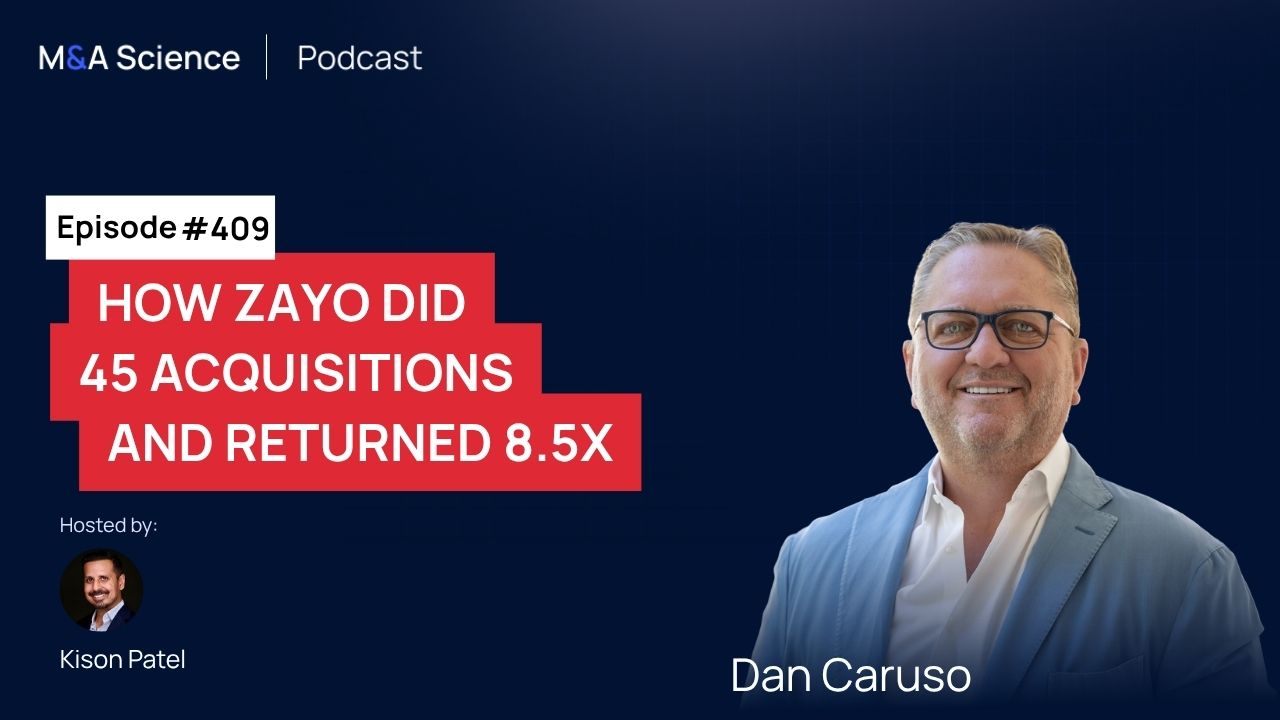


M&A Roll-Up Playbook: How Zayo Did 45 Acquisitions and Returned 8.5x | Dan Caruso (Part 1)
Dan Caruso, Managing Director, Caruso Ventures; Founding CEO of Zayo Group
Dan Caruso spent two decades building one of the most successful infrastructure roll-ups ever executed — 45 acquisitions, $1B invested, $8.5B returned. In Part 1 of this conversation, he breaks down the full buyer-led playbook: how the Zayo thesis was formed, how deals were sourced proprietary, why integration speed was a competitive weapon, and why EBITDA alone will mislead you on whether you're actually creating value.
What You'll Learn
- How to identify and build a contrarian acquisition thesis with investor alignment
- Why proprietary deal flow is a brand and relationship problem, not a sourcing problem
- How Zayo executed an unsolicited, fully funded offer on a larger public company — and won
- Why tracking individual acquisitions kills synergies in a roll-up
- When earnouts hurt more than they help — and what to use instead
- How clean, all-cash offers win on certainty, not price
Dan's approach to thesis validation, investor alignment, and platform value creation is documented in the Roll-Up Readiness Assessment inside the Intelligence Hub, a stage-gated guide built directly from this conversation. Access inside the Intelligence Hub — → Access inside the M&A Science Hub — members only.

Zayo Group, which Dan founded in 2007, became one of the largest fiber network operators in North America and Europe before being taken private in 2020.

Caruso Ventures is Dan Caruso's investment vehicle focused on digital infrastructure and venture-stage companies.

Dan Caruso
Dan Caruso is Managing Director of Caruso Ventures and the Founding CEO of Zayo Group, which he built from a startup in 2007 into one of North America's leading bandwidth infrastructure companies before its sale. He is the author of Bandwidth, an operator's account of the telecom industry's boom, bust, and reinvention through M&A.
Episode Transcript
How prior experience shaped his view of M&A
Sure, absolutely. I grew up in Chicago, just south of the city, and thought I would be living south of the city of Chicago my entire life. That was more traditional with my family. People just stayed around where we grew up. But for a variety of reasons, I ended up following a very different journey.
After I went to undergrad and got an engineering degree, I joined a management development program just as the Bell System was breaking up. So I was there just after we went from Ma Bell and one phone company to the spawning off of a lot of phone companies and the beginning of a new era.
While I was at Ameritech in a management development program, I also got my MBA from the University of Chicago. Right after I graduated from my MBA, that Ameritech was kind enough to pay for, I moved and joined one of the first big competitors to the Bell System, originally called Chicago Fiber Optics, which became MFS.
We became not just the biggest fiber competitor in the world, because we moved from the U.S. to Europe and Asia, but we also bought the biggest and baddest internet backbone of the early internet era, called UUNET. We sold to WorldCom, which is a crazy story in and of itself.
I then got back together with the CEO and some members of MFS, and together we moved out here to Colorado when we launched Level 3 Communications, which became the biggest internet backbone of that next era of the internet, as well as the biggest and craziest fiber network across not just the U.S., but again Asia and Europe as well.
I was there for quite a number of years. We went through the big boom cycle, gold rush, and then everything fell apart and we came crashing down. We did not go through bankruptcy, but everyone else did.
Eventually I left there, and I led the take-private of a public company that was about ready to go through its second bankruptcy, and that is when I started my journey as a CEO. It was very successful from a financial standpoint. We made 25 times our money back in two years. But it was not satisfying because we basically broke apart a company. We fixed it, broke it apart, made money, but we did not create something. I am a creator at the end of the day, not someone who tears things apart.
So that led to me launching Zayo Group in 2007.
I was involved in a whole bunch of M&A transactions, but also lots of other big transactions, because when you are building out lots of networks, you are always doing deals. You are doing deals for rights-of-way, which is the permission to lay your network in the ground. So you are doing big deals with railroads or with property owners.
Sometimes you are acquiring elements of the fiber, so they are more acquisitions, but not necessarily businesses. Plus, we did a lot of M&A at MFS. That was my first big exposure. Actually, that is not true. When I was with Ameritech, I was part of their corporate development team, so we were doing a lot of transactions there too. Maybe not getting them to the finish line, but working on a whole bunch of them.
So I had transaction exposure from a relatively early point in my career, and I was part of so many transactions. At a young age, I started leading a lot of transactions and managing a team of first dozens, then hundreds, then over a thousand, where a lot of people were doing transactions that I had to keep an eye on and be part of the more critical ones.
So I did get a lot of transactional experience before Zayo.
Lessons Learned from Failed Deals
WorldCom was the biggest bankruptcy of all time when it happened. It was the darling of Wall Street. The person who was thought to be the best CEO and the person who was viewed as the best CFO were on BusinessWeek covers. There was so much folklore about them.
But there was also Qwest with Joe Nacchio, and there was Gary Winnick, and certainly the MFS team was involved in a bunch of deals. So I was around all these characters doing all these deals.
I saw a lot of firsthand exposure to deals where I knew the business merits behind what they were doing were very questionable, but the optics were what they were looking for. If we do this deal, that means we get to post a whole bunch of revenue, and we could hide all the costs for the deal in our capital program. And guess what? You could do the same thing on your half of the deal. So we both look like we are having a really fast revenue growth rate and really high margins when all we did was a swap transaction or some kind of accounting maneuver.
So I started to pick up early on that when you start doing transactions, or even making business decisions, not because you are really building genuine value, but because you are trying to show the appearance of value creation, sooner or later there is going to be a big price to pay for that.
I fortunately learned that early on without having to be the victim of poor judgment, and was able to build on that later in my career.
Common Mistakes of First-Time Acquirers
First-time acquirers are going to get it wrong more times than not because they are novices. If you are a first-time acquirer and you are trying to do something really big and really quick, you are probably going to make a lot of mistakes.
So you are better off getting acquisition experience first by working on acquisitions that you do not do. Find opportunities to learn. Sometimes, even with my young team today, I will ask them to go do something just to learn. Do not waste other people’s time, per se, but who knows, we might want to do something. Even though we think we do not want to spend a lot of time on it, that is where you can learn a lot, where the stakes are very low. The stakes are really just your time, and you are going to learn how people react on the other side of a transaction.
But if it is just diligence, then you are not going to learn as much. If you test the boundaries, if it is a deal that you are not really sure you want to do unless it is really compelling, and you do not think the other side would do it, if it is really compelling, make the offer anyway. See how they react. See what they come back with. Maybe you will find that there is something more there than you thought, and you are going to learn a lot just by putting something forward and getting a reaction.
It takes two to tangle. Find someone to tangle with so that you are learning from how people react, not just from doing something on your computer.
Do some small deals. Find smaller deals to do and get your experience on smaller deals. Small deals early on, as opposed to the first time I am going to do something strategically significant, very costly, and very risky, you are probably not going to be the one who ends up on the good side of that deal until you get some experience.
Where the Zayo Thesis Began
I am going to go to the period two years before Zayo. That is when I started to work with a couple venture capital and private equity firms, Columbia Capital and M/C Ventures.
They were focused on the telecom industry, and they had been for quite some time. As I was leaving Level 3 and looking at what to do next, they were trying to figure out how to put some money to work while the industry was in this highly fragile state. We found each other, and together we took the company ICG from being a public company to private. It was about ready to go through its second bankruptcy, and we made an offer for the equity.
While we were doing that, I worked a bunch of deals on the side to fix a lot of their problems that were contingent on us getting the deal done. So over about a year and a half period, we went through this frenzy period of taking this company, ICG, and selling it off largely in pieces. We took some of their assets that might have been in one geography, like the Carolinas, and sold them to a company that had more critical mass there.
It started giving me exposure to what was going on in the state of the industry, where it had gone through a collapse and it was starting to reinvent itself, but very early.
When we finally sold the biggest piece of ICG, ironically to Level 3, I did not go with that deal. But what I did do is I had surgery. I had to have, believe it or not, at a young age, both my hips replaced. So I was going to be laid up for a while.
It was a beautiful summer. We had just sold the company, entered into the final agreement, but it was going to be two months before we closed. So I could not do anything else anyway. I figured Level 3 did not really need me to help do whatever they wanted to do during that two-month period.
I am going to go to the period two years before Zayo. That is when I started to work with a couple venture capital and private equity firms, Columbia Capital and M/C Ventures.
They were focused on the telecom industry, and they had been for quite some time. As I was leaving Level 3 and looking at what to do next, they were trying to figure out how to put some money to work while the industry was in this highly fragile state. We found each other, and together we took the company ICG from being a public company to private. It was about ready to go through its second bankruptcy, and we made an offer for the equity.
While we were doing that, I worked a bunch of deals on the side to fix a lot of their problems that were contingent on us getting the deal done. So over about a year and a half period, we went through this frenzy period of taking this company, ICG, and selling it off largely in pieces. We took some of their assets that might have been in one geography, like the Carolinas, and sold them to a company that had more critical mass there.
It started giving me exposure to what was going on in the state of the industry, where it had gone through a collapse and it was starting to reinvent itself, but very early.
When we finally sold the biggest piece of ICG, ironically to Level 3, I did not go with that deal. But what I did do is I had surgery. I had to have, believe it or not, at a young age, both my hips replaced. So I was going to be laid up for a while.
It was a beautiful summer. We had just sold the company, entered into the final agreement, but it was going to be two months before we closed. So I could not do anything else anyway. I figured Level 3 did not really need me to help do whatever they wanted to do during that two-month period.
Thesis Validation
What I was starting to learn was different than what I was expecting to learn, because I came up with a couple expressions that I used in the thesis.
One was “fiber orphans.” Fiber orphans meant it was some kind of fiber asset, typically in the form of a business, not just a pure asset, but it was kind of on an island of its own. Maybe it was a single metro network in a given city, or maybe it was a rural network that covered the outskirts of a certain market. Maybe it was two or three networks, or maybe it was even a fiber route that connected one city to another city.
There were these assets that somehow found their way into a context that was being worked by whoever owned them at the time.
Then the other expression I came up with was “accidental owner.” Whoever owned those assets never intended on owning them. It was more opportunistic. It got spun off from another company because it was toxic for that company, or it went through a bankruptcy process, or someone cleverly saw an asset and bought it when no one was paying attention.
But the other big thing I learned is most of them were like, our business is doing well. Our revenue is growing. We have positive margins. In fact, we generate cash flow.
That might not sound like much today, but in 2006, coming out of the heels of the big meltdown where everyone thought every fiber asset was toxic and losing money and worthless, you would talk to these operators and they would say, yeah, all is good. We are growing our revenue. We have positive margins. We are generating cash flow. We are getting a lot of traction in the marketplace.
I was like, holy cow, this is a lot different than what I expected.
No banker was calling them up. No strategic was calling them up. No venture capitalist or private equity firm was calling them up. They were just operating their business, making some money, and wondering if anyone was going to care about what they were doing.
How the investment thesis was built
It turns out, and this is going to be shocking to you, when you make investors 25 times their money back in less than two years, they do not really care what your thesis is. They just want to give you more money and tell you to go do it again.
So I did not have to go shop this deal with other investors. I decided what I wanted to do and then worked with my investors that we had just come off a great experience with. I also had my management team. Most of them went with the ICG deal that was sold to Level 3, but every one of them also said, give me a couple months and I will extract myself from there, and hopefully you figure out what we are going to do next and we will do it all over again.
So I had a team who wanted to reassemble around whatever was next, and I had investors who wanted to put more money behind whatever we were going to do.
I needed more money than those two investors were able to come up with by themselves, but they said, do not worry, we will get some of our friends to put in the rest of the money.
So I did not really have to go on a roadshow or pitch anything. We just got into execution mode.
Advice on Raising Money
The story I was telling you there was 2006. Let us go backwards two years, to 2004. It could not have been more different, because I was that person you just described.
I was coming out of Level 3, and like a lot of places in the industry, a lot of us thought we were a big deal. Certainly Level 3 thought it was a really big deal here in Colorado.
So I leave Level 3 thinking people would want to engage with me on what I wanted to do next, in part because the industry was in shambles, but also in part because I thought Level 3 had been really successful in navigating through that downward cycle.
But the outside world was like, you are just like the rest of them. Yeah, you did not go through bankruptcy technically, but you were able to have cash to rebuy your debt at 30 cents on the dollar. So you bankrupted all your debt to avoid bankruptcy on the equity side, and you are still struggling.
So no one really cared about me. There were a gazillion ex-executives of the telecom and internet world in that era all looking for what to do, and there was no money flowing.
I did not really have an independent track record that I could bring to the table, and I had some skeletons in my closet relative to the crazy cycles we went through. So there were very few people who wanted to talk to me and give me money to go do what I wanted to do next.
I like to say that the reason I got the job of ICG as CEO to take it private is because no one else with a good track record would have ever taken that job. On paper it was a horrible CEO job because it was a super-distressed company that everyone thought needed to go through a Chapter 7 process.
Fortunately, I got introduced to these two investors by a couple different groups of people who told those investors, this is the guy you want to back. So at least a few people believed in me enough to get through all that noise. But I had to go earn a reputation.
If someone does not have a track record, yeah, it is really hard. People are not looking at you for how good your idea is. They want to know your idea is a good idea, but that is secondary to whether you have a track record. Do investors believe that putting money behind you means it is going to produce a great return on investment? If you do not have much of a track record, it is probably going to be hard to raise money. It always is.
What I do give people advice on is if you think you want to be an entrepreneur that starts up a company, and let us say you are coming out of college, do not start up a company.
Find a company that already exists, is already beginning to scale, and already has a strong team. Spend a couple years with that team and learn what success feels like and looks like, and build a network and be part of a successful journey in an area that you are interested in.
From there will come a really good investment thesis. From there will come relationships. And importantly, you will know what success looks like.
A lot of people are starting up something from scratch who have never experienced success. They do not even know what success feels or looks like, and they have to learn that, often the hard way too.
One of the things I am most proud of, and what probably means more to me relative to my career than anything else, is to look now at the industry and see there are so many companies in digital infrastructure that are led by people who were part of my team at Zayo and people who were part of my team at Level 3.
There have got to be at least 10 or 12 companies right now that are being led by veteran teams from those two contexts. They learned the playbook by being part of it first at MFS, secondly at Level 3, and then third in what we did at Zayo. They are the ones leading a significant portion of the industry right now.
So absolutely, that is clear proof of that.
How to pressure test a thesis
Some of the best business ideas are contrarian in nature. Everyone wants a contrarian business idea. That is what you want to fund. The problem with contrarian business ideas is most of them are bad ideas. That is why they are contrarian.
So the hard part is picking a contrarian idea that is also a good idea.
If it is contrarian, that means most people will think you are wrong. If most people think you are wrong, but you really are on the right path, that is where the magic comes from.
What was interesting to me is when I came up with the idea, now it sounds so basic. It is like, duh, that cannot possibly be your investment thesis. What is so unique about that?
At the time, even my investors, and they will not remember it this way, even my investors who we had just made 25 times their money back for and who said, I will back you in anything you want to do, when I went to them and said, okay, here is what we are going to do, they were like, really? That does not sound like a very good idea.
All right, we will back you only because you made money before, and we know that you know how to pivot, and we hope that by the time you really start spending the money, you will have found something better to do.
If you ask them now, they will be like, oh no, that was our idea. But that is how it played out.
Remember, in that environment, everyone thought fiber networks were toxic. They were commodities. The only way you were going to make money in our business was by having value-added services and content, and whoever was operating at the infrastructure layer was just going to lose money.
So that was the mindset at the time, that these were not assets worth owning. They were assets worth not owning. No private equity firm and no venture capital firm wanted you to even mention the word fiber optics in their investor meetings because they had all lost so much money in it.
So that was the context.
The idea was that there were these fiber orphans with accidental owners, and their businesses were doing quite well. What they were focused on was the bandwidth layer.
So we came up with the term “bandwidth infrastructure.” In fact, we were originally called not Zayo, but Communications Infrastructure Investments. That was not a term back then. Now it is an industry. It was bandwidth infrastructure, then more broadly communications infrastructure, and now people, not surprisingly, are calling it AI infrastructure. But that did not exist back then.
The idea was that we were going to get focused on working the depth and breadth of our fiber assets, and we were going to focus on that bandwidth layer. We were not going to get involved in the higher-layer stuff. Those were going to be our customers and our partners. We were going to be really, really good at putting our core assets to work. That is obvious now, but back then it was considered very contrarian.
Risks in the thesis
One of the questions we faced was what really will translate into true value in this kind of business model that we were describing.
A lot of people want to focus on revenue growth as a value driver. Yes, you want your revenue to grow, for certain. Or they want to focus on EBITDA. EBITDA is a really important term, but EBITDA in and of itself does not really mean anything.
You could double your EBITDA, and the question is, well, is that good or bad? It could be good or it could be bad. It is good if you doubled your EBITDA and spent nothing to double it. That would be really good. But if you doubled your EBITDA and spent a gazillion dollars to double it, and it was at the capital line, therefore it did not show up in EBITDA by definition, that does not mean you created value. You may have destroyed a bunch of value in the process.
When you are doing consolidations, yes, you are going to be growing revenue. How can you not? You just bought a company. And yes, your EBITDA is bigger. It better be bigger. You just bought a company.
The question is, how do you know whether what you are doing to organically grow the business while you are also combining businesses together will translate financially into something that, objectively speaking, is true value creation?
That is part of what led us to look at value creation more analytically. Having lived through the experience where the appearance of value creation is what people were doing in the telecom boom era, as long as we are telling really good stories and we can give the appearance of value creation, that is enough, because then at some point we can sell our company to the next sucker that comes along and then we are rich and they have got the problem of realizing it is just a house of cards.
We wanted to build something of durable, long-term value in an environment where there would, by definition, be a lot of noise. Because if you are consolidating and then synergizing assets, there is going to be a lot of noise in the financial system.
A mistake that people make quite often, and I still hear it being said, is that board members or investors think they are being very responsible when they say, if we are going to do this deal, we are going to track that deal and make sure we can hold the management team accountable for delivering on what they said they were going to deliver on.
Okay, but we are taking these assets that we are buying and the first thing we are going to do is mash them together. That is what we are going to do.
Why are we going to mash them together? Because we want to harness the full synergies of bringing these assets together. We are going to bring them together so that it increases our ability to generate revenue. If you have doubled the assets in either a single area or adjacent areas, you can bring more product to your customers. You can sell things that neither one of them could have sold before. We wanted it all on one system, and we wanted it to look like a single asset.
So if the investors or board tell the management team, we are going to hold you accountable for tracking those separately, okay, but now you have just gotten in the way of our ability to get any synergies so that we can do a bunch of math on whether this particular decision was the right decision, while you have no idea whether on the aggregate of what we are doing we are creating value in aggregate, because that is what matters.
How that particular asset you think performed, based on stuff that is just silly to even try to track, is a massive distraction and a delaying of synergies. It is just crazy.
You have to get investors comfortable that this is not about tracking each asset individually, because we do not even want them to look like separate assets. We want them to look like one thing. If we try to make it so that we can track them separately, you are just chasing a fool’s game.
The Success of Zayo
One thing you did not say there is talent. There are elements of all of those things, including that our investors and our management team worked together.
We were in it together. This was not the management team doing this and investors doing that, or the investors trying to exert their influence over a management team. We were like a team.
Especially in the first five years or so, investors had their role to play. They were helping, and they were really effective at helping us sort through things. The management team, a lot of us had worked together a lot of years across a lot of different ventures. So we all worked really hard, but we also kind of knew the playbook, the playbook of what we should do next, because we had played that playbook before.
We had the right thesis. We were maybe a little bit overconfident, so we could move very decisively. It was magic those first five or six years.
In aggregate, we invested about a billion dollars of equity, and that billion dollars of equity, when we sold it, was worth eight and a half billion. It was not because we sold it at some kind of inflated value. When we sold it, we only got about 12 times EBITDA, which is kind of a middle-of-the-road EBITDA multiple. So it was not like we were rewarded with an inflated EBITDA multiple. It was kind of an appropriate EBITDA multiple.
So the value creation was authentic. It was 8.5 times value creation, which was huge, and for the early money it was 25 times their money back. All investors made money all along the way.
Objectively speaking, it was a significant success story. For us to make that much value that quickly, everything had to be executed really well. The strategy had to be right. The team had to be talented. The execution had to be really strong. When we made mistakes, we had to pivot and adjust pretty quickly, because we did make mistakes along the way.
How to make Deals Actionable
The first thing is you build your own brand and then you build relationships.
Even today, when we are doing a lot of venture-type deals, our strategy is not to be really good at hunting down a deal that no one else knows about. We do not do any of that. What we do is build up our brand and our awareness.
We want the best deals that are out there in our strike zone to come to us. We want the best entrepreneurs and the most interesting deals, the ones that anyone who is good at investing would want to do, to come to us first. We want them to want our money. We want them to want us on their cap table when they have choices.
We applied that strategy today, but in the context of Zayo, the strategy was to really be out there building relationships way before the company was ready to sell. So when they started to say, hey, maybe we should sell, they would say, you know what, let us call up Dan, because Dan has been talking to us for three years saying he would like to buy our company.
What they did not know was I was telling everyone I wanted to buy their company, because I did not know whether I wanted to buy their company or not. But I wanted them all to think I wanted to buy their company so that they thought I was talking uniquely to them. Then when they approached us, they would share information, and we could decide whether we wanted to buy their company or not.
We wanted to create the dynamic where the deals would come to us, as opposed to us waiting for them to decide, hire a banker, put together a book, and then we discover the deal when they are on a sale process. We wanted to be in front of that.
We had a really good reputation for being very effective at acquiring, which is really important for sellers.
When sellers are ready to sell, they want to know that they are working with someone who, when we say we are going to do something relative to buying a company, we are going to do it. We are not going to drag them along in a process and say we are going to get to the finish line, and then they find out halfway through the negotiation that the buyer really does not have the money, or really does not have the support from their investor group, and then they try to retrade and get a lower price.
We did not want that to be our reputation. We wanted our reputation to be that when you are ready to sell, if you want to get the transaction done and fully approved and get your money, we are the most reliable buyer out there.
But as we got deeper into the process and people would see what we did after acquiring, the investors loved it because we would get the synergies quickly and prepare ourselves to do the next acquisition.
If you take a long time to integrate the companies and a long time to get the synergies, that means you also have to wait a long time before you do the next deal. We had the view that there was a window of time where we could do a lot of acquisitions before others caught on to the opportunity. If we moved slowly, the opportunity was going to evaporate on us. Others were going to jump in, and we were going to have a lot more competitors doing consolidation.
So we were moving really quickly. But the result for companies that sold to us is they would see us take what they were really proud of, and the people who were part of that, and they thought they had the best provisioning system or the best maintenance system or the best strategy or the best sales team.
My attitude was, this is not a comparison. I am not saying our this is better than your that, but we have a way of doing things, and part of that is integrating really quickly.
So we are not going to debate whether your system is better than ours because we want one system, an end-to-end system that brings everything together, and we want all the data representing that system. So with all due respect, we are not going to use your system, and we are not going to debate it for six months. We have already made that decision.
We want to see which ones of you want to be part of us and help us move your processes, your systems, and your people into one unified organization.
A lot of times they would say, yeah, but we think the name of our company is better than your company. Why don’t we adopt our name? No, we already have a name. We are not going to revisit the name of the company.
It helped everyone that there was decisiveness. A lot of companies in our industry, and I am sure in a lot of other industries, when they do an integration, they line up teams. We are going to put our sales team with your sales team and give them two months to come up with an integration plan they both believe in. We are going to do the same thing with operations, and the same thing with marketing. Then you have teams on both sides trying to debate who is better and how about if we take this of ours and that of yours, and then you get these Frankenstein solutions, and then you try to look across it and it is just a mess.
So we were like, no, we are not doing any of that. We are just going to smash the company together.
Understanding Seller’s Motivation
Understanding what is going to make the seller want to sell is really important. And it is not a singular person, because there is a CEO involved, there is a CFO involved, but there are also the investors involved. Even with investors, you might have one investor who has a bigger voice than other investors. You might have investors who have different motivations.
So you are trying to figure out the puzzle. What is going to motivate them to want to respond to selling their company and selling it to us?
Every one of them has unique stories, so there is not a single answer. You have got to listen. First, you have got to get their attention, and then you have got to listen really carefully.
A lot of times you have to do this through a team-based approach. My CFO was really effective. He had a different personality type than me. Everyone liked him. Everyone trusted him. He was a little more low-key. He was viewed as the good guy, and he would play that role really well.
What they did not know was that behind the scenes, we were both bad guys when it came to M&A. Our approaches were just a little different. We would play good cop, bad cop. It was orchestrated.
We had some other really effective people on our team too. John Sano was one of the early co-founders, and he was really effective at certain types of deals. We had a guy named Matt Erickson who was younger, but he was starting to learn how to do deals.
We had a lot of people who would play different roles, and we would do it as a team.
At Zayo alone, we did about 45 deals, so all of the above is part of the answer.
Sometimes you are dealing with situations where they do not want to sell, and they especially do not want to sell to you. That is when it gets even more interesting.
The biggest deal we did, the one that really made Zayo, was us buying a company that was larger than us and much more established than us, and a really great company led by a really great leader, called AboveNet. They had absolutely no interest in selling to us.
They were a public company, and their plan was to take their public company private, do a management-led LBO, and they had it all lined up. In fact, they should have already been at the finish line, but their investors that were going to lead the take-private were just not able to get the deal done. They wanted to negotiate this more and negotiate that more, and it started to drag out.
We did not know any of this because they were not sharing it with us, or with anyone, because the management team wanted to work with those investors and do the LBO.
So that turned into a hostile situation in that we just interjected ourselves. They were a public company, and we made an unsolicited offer that was 100 percent backed by both equity and debt. We went as far as giving them the full agreement, so as a public company they could not ignore us.
Fortunately, unbeknownst to us, when we gave them that offer, they were literally hours or days away from signing a deal to sell the company in that management buyout. But luckily we came in at a price that was higher than the other price. Their lawyers said, you are a public company. You cannot sell it at a lower price just because you would rather that be the outcome. You have to put your public shareholders first.
That turned into a two-week period of time, and I go into depth on it in Bandwidth. The nice thing is that when there is a public company transaction, everything has to be documented in SEC filings afterwards, the whole play-by-play. So I was able to pull that up and have an accurate account of exactly what happened, even stuff I did not know was happening at the time.
It turned out we were able to prevail despite the fact that they did everything they possibly could, while staying within the law. The investors who wanted to lead the leveraged buyout simply did not believe the selling company that there was another bid, because they were like, how could there be? There was not an alternative bid until the very end, when we had a little bit of a difference in price. They never believed there was legitimately another bidder who was about ready to sign on the dotted line until it was too late.
How the public-company offer was made
This particular deal happened literally at a conference. We went to the conference totally prepared to make the unsolicited offer. So we came there with everything in writing in a sealed envelope, fully backed by debt and by equity.
It was not a verbal offer saying we would like to have a conversation about buying your company. It was, this is a fully baked, fully financed, fully funded offer that we are prepared to sign in the next week. All we need is three days of diligence.
Think about that. You are going to buy a multibillion-dollar company, and you are telling them you are ready to sign within a week, and you only need a week for diligence and a week to negotiate. That is unheard of. That just does not happen.
We knew that their first response would be to try to avoid doing it.
We set up the meeting. It was on the last day of the conference. I got together with the CEO one on one. We had known each other for a number of years, and I made the verbal comment that we would really like to combine our companies and we think we have a compelling offer to do so.
The first response of the person, who must have been prepared for this by his lawyers and bankers, was, yeah, Dan, I just think we would have different points of view about the value of your company versus the value of our company. We feel really good about ours, so we do not think it is likely that we would come to a meeting of the minds about the right relative values.
I said, okay, well that is interesting, but I do not know if that is relevant because we have an all-cash, fully financed offer. So it does not really matter what you guys think about the value of our company. It just matters if we are offering you enough.
He paused and looked, because I do not think they had thought through that scenario. How could this company, which is smaller, come in with a premium valuation to what we are trading at and have it be fully financed and ready to be signed?
I put the envelope in front of him and said it is right there in that envelope. You are free to take it if you would like to, but if you would rather not, I understand.
He said, okay, let me get back to you. So he quickly broke up, left, and I am sure when he went back and talked to his attorneys, they said, no, you cannot just not take the offer. That is not going to look right when it gets disclosed. You have to text him right away and ask him to give you the offer.
That is when I gave it to my team and they slipped it under his hotel door, and the rest was history.
Negotiations
Negotiating is like a game. You have to have a lot of different plays in your playbook.
One thing that has always worked for me is to be unpredictable. If you are going to be unpredictable, it means you have to do things differently each time and not let the other side really know what you are doing.
A lot of times what we would do is think a lot about how to behave during a negotiation. Sometimes we would do things just to get a reaction, because once you get a reaction, then if you are paying close attention, you can learn things based on what the reaction is.
Sometimes you even rehearse beforehand.
Silence in a negotiation can be really effective. At times I would go to my team and tell them, hey, if you see me starting not to respond, and seconds start to pass, do not think that is an opportunity for you to speak next, because the only person to speak next is the other person.
Ten seconds is a long time to say nothing. So if ten seconds goes by and they realize you are not going to say anything and they have to say something, and it is a tense part of a discussion or negotiation, you are going to learn a lot by what they say next. Are they going to get anxious? Usually it is when they are trying to overplay their hand, and you are not quite sure how much they are overplaying it, and then you just wait to see how they react.
When we were at our best, there would usually be three or four of us working off each other in somewhat orchestrated ways, playing around with different tactics and seeing how to get a clearer picture of what was really going on. Once the picture is clear, then you can really get focused.
What makes a deal a good deal
You have got to find a deal the other side is willing to sell, which means they think what they are selling it for is more than it is worth. I am going to sell you my car for $30,000 because I think it is worth less than $30,000, or else I would keep it or maybe sell it to the next person.
So I am selling you something that is overpriced, and you think you are buying something that is worth more.
Sometimes it is because it is worth more to the buyer than it is to the seller. That is the easiest time to have a win-win outcome. You have synergies that they do not have. You have capability that they do not have. So in your hands it is more valuable. Then you are both making the right decision.
Trying to find that win-win scenario is the best path forward. You should always be looking at how this is a good deal for them and for us. Find that, as opposed to one of us is going to win and the other one is going to lose. If you are in that situation, you could be the one losing or they could be the one winning. It is easier if it is a win-win opportunity.
There is one type of deal where you are more like a stock picker. All you are doing is having a better understanding of what the true value is than others. You are not bringing any value to the table. You just know how to pick the stock better. You know how to pick a company to buy better. You are able to figure out what the true value is better than other people.
That is not something I would do.
That is different from buying and saying I really do have something I am bringing to the table. My company, or me individually, I am bringing something to the table that is truly a value add that most others cannot bring to the table. When you become a synergy buyer, that is certainly the most obvious example of that.
For us, early on at Zayo, we were not a synergy buyer. We had no platform. We were just trying to develop a platform. But we had a conviction that what we would do with the assets would be value-creative in nature.
Part of it was because, early on as part of our thesis, it was not that we had a different point of view than the seller. It is almost like we had a similar point of view as the sellers, because we knew the platforms they had were legitimately doing well. Other buyers did not see that. They were still thinking in the telecom meltdown world and the fiber networks being toxic.
So we were a fresh face in terms of being willing to pay the seller what they really thought the business was worth, and we did not disagree with them. We just thought that if we held them for five or ten years and consolidated around these properties, we would create something of durable value over the long term.
So we had this window of opportunity where we could be acquirers and there was not a lot of competition. We could acquire these properties and come to a price that would be a good outcome for the seller and a good outcome for us as well. It was a win-win period of time, but we knew that was a window. If we were right, others would catch on, and then we would have more buyers bidding up the prices.
Avoid overestimating synergies
I mentioned earlier that we were about true value creation. Our corporate development team was one and the same as our executive team, and we were all big owners of the company. We did not take much in the way of salaries. We were all about making money by seeing the value of the investment go up over time, so making money alongside our investors.
There was no room for, we want to get a deal done, so we are going to make the synergies look better than we really think they are.
Corporate development teams can win in those circumstances because they get rewarded for doing deals, and then they hand it off to other people to implement. The synergies do not happen, either because they overestimated them or because the people implementing them did not do their job. You can get into those situations.
But our culture was, if we are going to do a deal, and if we are going to get the synergies, it is going to be us getting them. We are the ones saying we want to do the deal. So there was a buck-stops-here mentality. We held ourselves accountable.
If we made mistakes, they were our mistakes. They were not some department’s mistake or the integration group’s mistake. It was, hey, we are going to make some mistakes, but we need to own those mistakes, learn from them quickly, and hopefully make a lot more good decisions than bad decisions.
Proprietary Deals vs Auctions
Out of the 45 deals at Zayo, I would probably say 80 percent were more proprietary.
Now, some of those proprietary ones had a process, but the process was triggered by us and by our activity. Then it became, okay, we are going to sell, we need to hire a banker who will run the process. But they were creating that out of the proprietary dynamic.
Early on, we would tend to win because we were a very effective acquirer. We got to the finish line and negotiations really quickly. We could give certainty of close really quickly, and we were the preferred buyer.
But later on, when we went public, I did not fully understand this at the time from a lived-experience standpoint. Our process of going public meant we had to open our kimono. We were really transparent with what we were doing before we went public, but I do not think the big investors really believed it until we went through the public offering, and all of a sudden what we had done was staring them in the face.
That was the first time I think the broader universe of investors got a full understanding of what those guys were doing financially. They knew what we were doing industry-wise, but now they knew what the financial equation was. They could see why our investors were thrilled with this management team, because this management team was making them a lot of money.
Even at the time we went public, the original investors were already about eight times their money, and it had only been six or seven years. They were able to see our financial playbook.
That triggered the next stage in the industry. Within a year after we went public, all of a sudden money started flowing in. Infrastructure funds started to become a big thing in our industry, and they were outbidding us on deals.
Then all of a sudden, instead of us getting deals done, we were watching deals being done by someone else at four extra turns of EBITDA above what we were comfortable and willing to pay. That is when it started getting hard. Do we do deals at prices we are less comfortable with, or do we watch others do the deal and take some of the wind out of our sails?
That was the post-IPO era for us.
Deal structure
People talk about earnouts, and sometimes earnouts get overplayed. We rarely used earnouts.
We wanted to mesh the deals together really quickly. If you have an earnout, then you have to track the performance of this and that.
So it was more important for us to identify the talent that was coming with an acquisition. What three people did we really care about, and how do we bring those three people in and make them part of our team, not have them stick around for an earnout.
If you are sticking around for an earnout, all they care about is that earnout metric and how to make that earnout metric. Then if they do not hit it, how do they exert leverage to get paid anyway? Then both sides are spending all their time on the earnout.
We just needed to go. We bought that company. We needed to own it and be accountable for it. If we could find some people there who wanted to be part of our team and part of our value creation, great. Let us make them part of what we are doing, not keep them separate so they can “earn out” during a transition period.
A lot of times if you give someone a clean exit, they will sell at a lower price, versus if it is a messy exit, they are going to discount the earnout. They are going to treat the earnout as worth nothing, maybe a little bit of upside, but it is a messier deal. You have to negotiate all that. It slows down the deal. It is less appealing to the sellers.
If you are going to do an earnout, make sure you have really thought through what you are trying to achieve in the earnout.
We would also tend to give them cash, not stock, because once you start using stock, again that is messiness from the seller’s perspective. How do I really value the stock? Is it really going to be worth that? They are never going to be like, yeah, I want to get that stock because it is going to be worth double in the future. They are going to say, okay, whatever I am getting in the form of stock, I am going to value it at half of what it is currently worth, and everything else is upside.
So you are giving away true value in your stock price, but they are discounting what they really think that value is. It often costs less if you are willing to take care of the financing yourself and offer them pure cash.
Deal Financing
We were very good at lining up our capital separately. We would line up our equity and line up our debt. We firmed those up.
Like the offer I talked about earlier, where we put the fully funded envelope on the table, we had to do the hard work of getting banks to say we are going to sign on the dotted line that we will have the money there to support the close.
Because the seller’s first question is going to be, is it really fully funded? They will give it to their lawyers and bankers and say, check this out. They will look at the paper and say, did JP Morgan really fully back this, or is this just a piece of paper that says, yeah, if all the stars align and we feel like it, we will provide the funding?
We made sure it would look really solid when they diligenced it, that yes, they really do have funding lined up.
My teams were really good at that. I did not have the patience for it, but my CFOs and others did. I would say, we need a fully backed offer, and they would do all the hard work and get a fully backed offer.
Recent M&A Science Podcast Episodes

M&A Software for optimizing the M&A lifecycle- pipeline to diligence to integration
Explore dealroom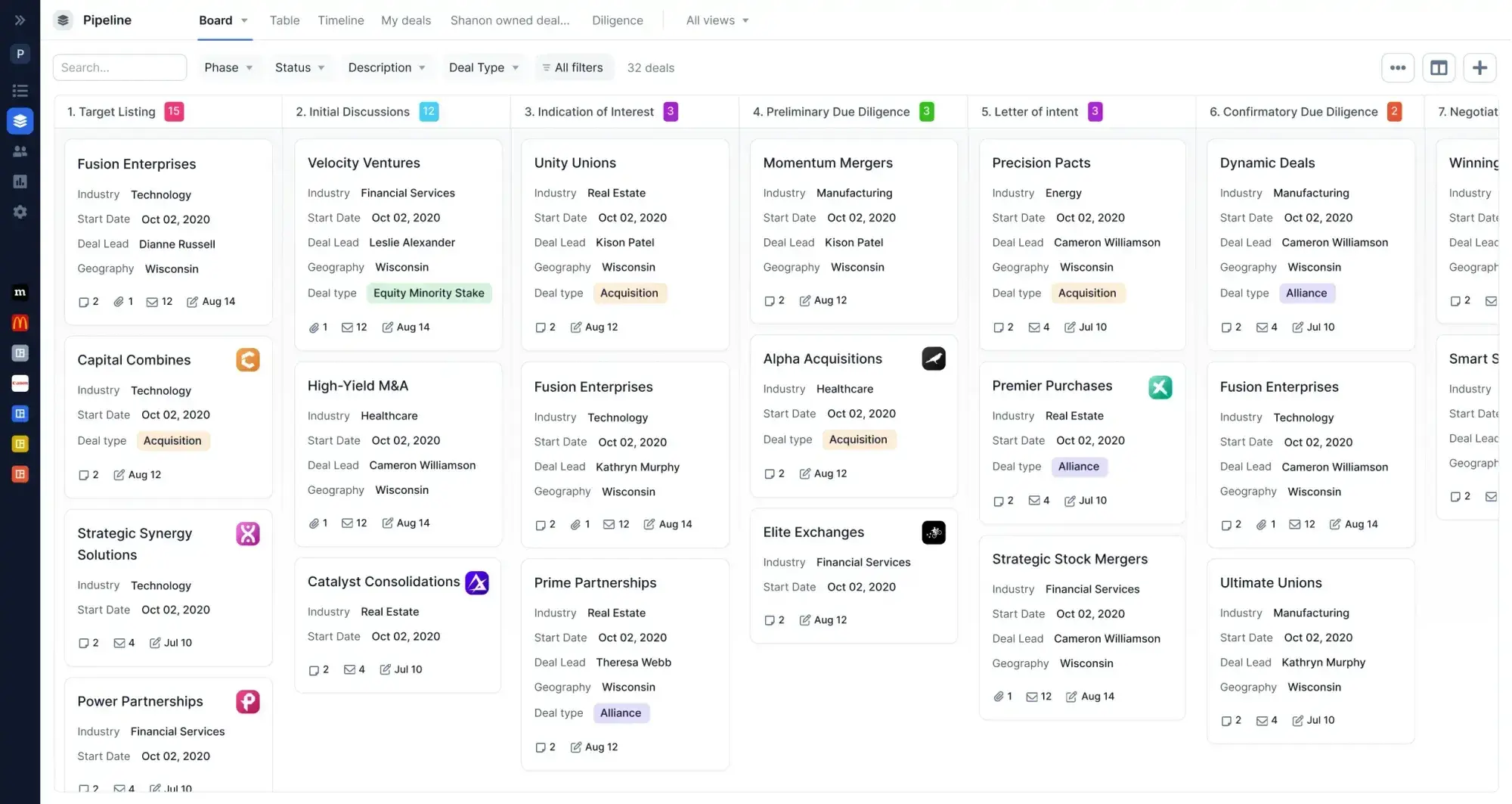

Want to wear your M&A expertise?
Check out the M&A Science store.