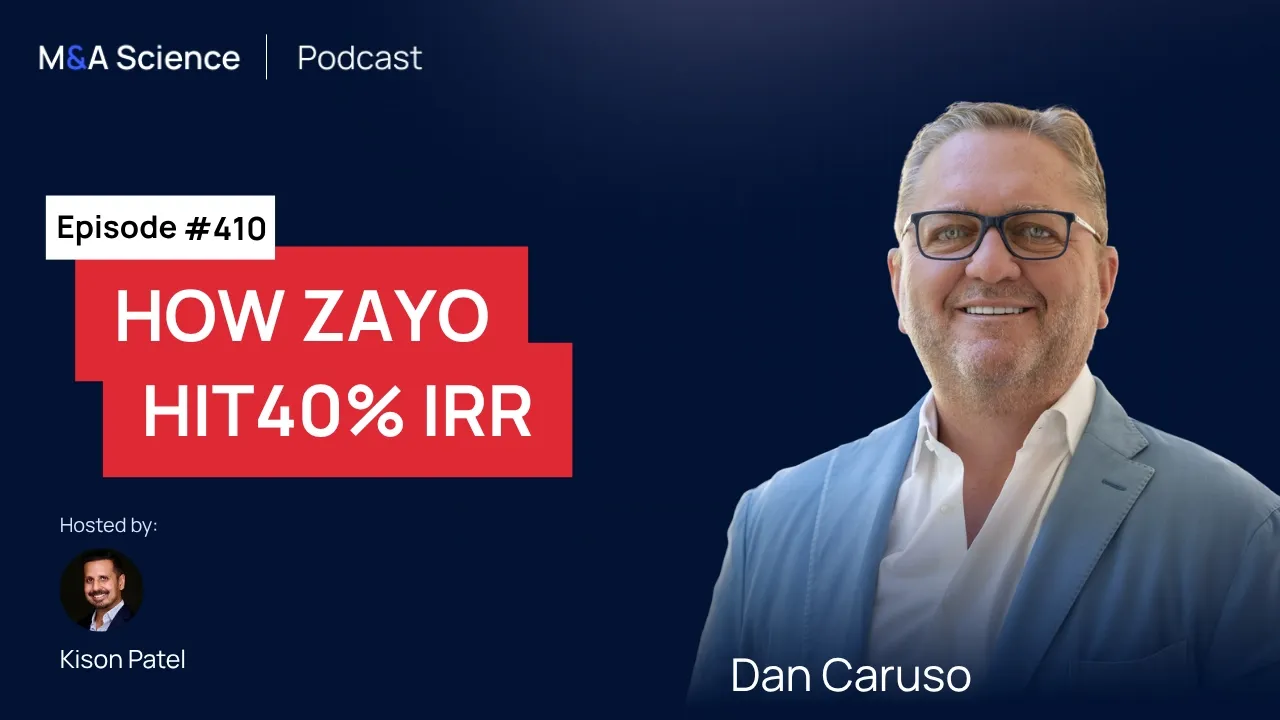
Zayo Group, which Dan founded in 2007, became one of the largest fiber network operators in North America and Europe before being taken private in 2020.
Caruso Ventures is Dan Caruso's investment vehicle focused on digital infrastructure and venture-stage companies.
Dan Caruso
Dan Caruso is Managing Director of Caruso Ventures and the Founding CEO of Zayo Group, which he built from a startup in 2007 into one of North America's leading bandwidth infrastructure companies before its sale. He is the author of Bandwidth, an operator's account of the telecom industry's boom, bust, and reinvention through M&A.
Episode Transcript
Doing Deals as Private vs Public Company
For us, it did, and it changed because of the dynamic I mentioned earlier.
It became more competitive. Our structure and overall approach did not materially change. We did not use much equity. I do not think I ever used our public equity meaningfully as part of a deal, maybe once, but I can barely remember one transaction where we did. Sellers would have discounted it anyway.
What changed was the competitive environment. We went public in 2014, and by 2016 or so, everywhere you went in the industry, every infrastructure fund was saying, “We want to do what Zayo is doing.”
All of a sudden, there were a dozen infrastructure funds with billions of dollars to put to work. You would ask what they wanted to do in the space, and the answer was always the same: build a platform just like Zayo. There was an overabundance of competitors chasing deals, and it was a very good time to be a seller.
We had about a six-year window where that advantage really lasted. We had built a strong brand in the market, and it stuck.
The negotiation playbook
There were all kinds of moments like that, and sometimes we did things just because they were fun.
I remember one seller would not respond to anything. I sent him a box of chocolates with an offer, and he finally answered the phone. He said, “Thanks for your chocolate. Offer’s too low,” and then hung up on me.
There were other times when you would be going back and forth in a negotiation. Maybe we were at 70 million and they wanted 76 million. We would go to 71, they would go to 75, and then we would go back down to 68. People would say, “We cannot do that. We cannot go back with a lower number.” My response would be, “These guys are not taking our number. Go back with a lower number and let them stare at it for a week.”
Typically they would come back and say, “I am not sure what happened there. You probably need to talk a little bit more. What did you uncover in diligence that made you lower your number? What did you hear?”
Of course, you would not tell them that you just wanted to see how they reacted. You wanted them to feel that emotion from their toenails to the top of their head: this deal might not happen, and if it does happen, it might happen at a lower price than before. Once they felt that, suddenly 71 started to look like a pretty good number. They might come back and say, “Your last offer was 71 and our last counter was 75. How about 71 and a quarter?” Now your number looks high.
Another move was to create urgency by talking about another deal. Right before a negotiation dinner, for example, I might say, “This is not really part of our discussion, but we are working on this other great deal. We did not think it was going to happen, but it is picking up momentum, and it is just perfect for us. We are struggling with the time to do this deal because we really want to move on to that one.”
Now they are wondering what deal I am talking about. We may have just made it up. The point is not whether the deal is real. The point is for them to think, “These guys can move on from us if we do not get this done.”
That unpredictability was part of our style. Some of it was very legitimate, but all of it had to be believable. It had to be something that could plausibly be true. If they know you are making it up, it does not work.
People want to get deals done when they are ready to sell.
Reframing control in a negotiation
A lot of negotiation is about control. When you go back with a lower offer, you are reestablishing control in the conversation.
Another tactic involved creating a little tension between the CEO and the investor. Say you are dealing with a CEO, and then the investor wants to hear directly from you because the deal is dragging out and they are frustrated about price. The CEO has been briefing the investor on what is happening, but now the investor wants to hear it firsthand.
In that situation, you might throw in a curveball. You say something the CEO has never heard before, but you say it as if it has already been part of the discussion. Then the investor goes back to the CEO and says, “Why did you not tell me that?”
The CEO does not want to admit they did not know, and the investor now thinks maybe the CEO has not been giving the full picture. It creates just a little bit of distrust.
The surprise would usually be something small but relevant. You might say, “We were actually comfortable with that price and probably would get there, but some of the diligence we did on the network turned up some things we were not expecting.”
The investor is not going to say, “What exactly did you find?” They do not want to look uninformed. You also phrase it as though the CEO already knew. Then the investor gets on a plane, goes back to the CEO, and asks, “What was he talking about?” The CEO says, “I am not sure what they found. It sounded like he had already shared it with you.” It was silly stuff like that.
How Zayo’s execution process matured over time
If I drew it, it would look like a curve that goes up and then down.
For the first six or seven years, it was magic. The team worked together extremely well. We brought in people who had not been part of the original team, and they blended with us beautifully. Our CFO joined maybe a year into Zayo. None of us had worked with him before. One of our investors recommended him, and he became a key part of the team almost immediately, as if we had worked together for years.
The left hand knew what the right hand was doing. We could talk in shorthand. We were a force to be reckoned with.
Then we went public, and the team started to get real liquidity. A lot of people suddenly had significant money for the first time. Public company life is also less fun. You have earnings calls, more bureaucracy, more noise in the system. The people who were naturally entrepreneurial started saying, “I want to take my money, take some time off, buy a house, maybe buy a second home, and then go do something entrepreneurial again.”
So after the IPO, we lost a lot of our core talent. I still wanted to keep going, but the environment became less fun, harder, and more competitive. We really hit our peak around the time we went public and shortly after. Then it got harder.
There was a stretch where it was simply fun. It was fun doing deals, fun integrating, fun being at the center of attention in the industry. It felt like we were building something special.
Part of it was the natural maturity that comes from repetition. We knew we had a good thing going, and we kept getting better.
One of our big innovations was around systems and data. At the time, the common approach in our industry was to have different systems, each with its own version of the data, all stitched together with processes and workflows and a lot of bureaucracy.
I had an epiphany that if we could get all of our data into one system and define our processes around that one system, we could make the business much more effective and efficient.
We were already using Salesforce.com successfully on the sales side, so we kept adding more into that same environment. Eventually it became our full end-to-end system: sales, provisioning, billing, the entire life of the customer. The only difference after a sale was that the process moved to the next stage. It was not being transferred from one system to another. Service activation did not have to hand off into billing in some awkward way.
That gave us command and control over our data. It was a huge operating advantage, and even more important, it gave us an advantage in synergies. We could bring disparate networks together into one operating instance. We had confidence in that. We were innovating around it. We were creating and operating at the same time. It was a period that was just a tremendous amount of fun.
Alignment around equity value creation
Nothing specific comes to mind in terms of changing our front-end execution approach during the best years. What really mattered was that people were aligned around true value creation.
Early on, I developed a methodology I called equity value creation. It almost became a religion inside the company, at least among the key people who understood it and bought into it.
It was a way to define how much value we were authentically creating and how that translated into dollars per share and the value of management equity. People could see the direct equation between what the company was doing, what that meant for them personally, and what it meant for us as a group.
It removed a lot of politics. It removed arguments based on opinion. I did not care what one person thought was valuable versus another person. What did the math say? That became a unifying framework. It focused everyone on the same question: what is my contribution to this value creation equation?
That created real alignment. People felt like they were on the same team, and they executed that way.
Scaling the Company
The wear and tear of everything we had been through started to take its toll.
People moved on. The original team changed. Newer people came in, and they did not buy into what we were doing in the same way. Some did, some did not, but by then we were public, and competition had intensified.
That was true not only in M&A but also in the commercial market. We had been innovators there too, especially in the deals we were doing with large webscale companies and mobile carriers. We were structuring really unique, large transactions that used fiber in powerful ways. Then others started catching on.
When the infrastructure money came in, it did not just bid up acquisitions. It also bid up the commercial deals. Suddenly, deals we knew were good for us and good for the customer got chased by people who believed they had cheaper capital and were willing to cut terms far more favorable to the customer. At that point, you have to ask whether winning the deal means losing the war.
You do not want to do a bad deal just because you want to win. But it is not fun to lose deals either.
We became victims of what we had created. We still did well, but we were used to creating value at a pace of roughly 40 percent a year. That is how you go from a billion dollars to eight and a half billion dollars. You compound at a very high rate.
Then 40 percent became 30 percent, then 20 percent. At some point, it felt like we were struggling to increase value by more than five or six or seven percent a year. We were not going backwards, but that was not the game I wanted to play. I did not want 10 percent equity value creation. I could put my money in the stock market and do nothing for that.
Once it got harder to see the rewards of the work in actual value creation for investors and the team, that took a toll too. That was when the right move was to become a seller.
Integration lessons and protecting strategic focus
There were tactical mistakes. Looking back, there were three or four deals where I know I could have handled integration better. Being aggressive worked for us overall, but in certain situations I would have been more subtle. Sometimes I was too aggressive.
What helped protect value was staying committed to our strategic roots.
A lot of the companies we acquired had assets we wanted, but they also had businesses or product lines we did not want. In those cases, we would often separate the business. That was unnatural to many people. They would say, “This is just one company.” We would say, “No, this is a voice business, and we do not want to be in the voice business.”
There might still be value in that voice business, so we would set it up separately. Then we would apply the same value creation equation to it, find strong entrepreneurs to run it, and monetize it later. We would sell it off. But we kept the purity of our core business, which was bandwidth infrastructure.
We did not try to move up the stack. I cannot tell you how many times we bought a company and they had a great plan to bring in all these additional products. We did not want their new products. We wanted to be the best bandwidth infrastructure provider in the market. We did not want higher-layer distractions. We did not want to chase small businesses. We wanted to serve the customers who truly needed large amounts of bandwidth and where our network gave us a real advantage.
That discipline played to our advantage.
Focusing on Culture
Our approach to culture was straightforward: we have a culture.
I am not saying our culture was better than someone else’s culture. In fact, some of the companies we acquired had great cultures. They were just different from ours.
We did not want to spend time debating which elements to keep from one culture or another. We did not have time for that. We were moving fast and wanted to get on to the next deal, because before long others would catch on to what we were doing.
So our message was simple. Here is our culture. It might work for you, and it might not. We are not saying it is universally right. We are saying it is ours.
I do not know if I used the word culture all the time, but I would say, “We have a way of doing things. For some people this is going to feel really good. For others, we are going to look like the devil.”
That was just the truth. We were not trying to build a culture that worked for everyone. We were building a culture for people who wanted to roll up their sleeves, do really cool stuff, and build the leading company in the industry in a short period of time. If that appealed to you, great. If not, there were other places to go.
We were very upfront about it, maybe even to a fault.
Going Public
Going public is still a major career milestone. Ringing the bell is a special life moment. I got to relive some of that recently when one of the first investments I made after leaving Zayo went public. It brought back great memories.
That said, if I knew then what I know now, I would have thought much harder about the governance structure.
I was recently talking to someone likely to take their company public. They were considering super-voting shares for insiders. Most bankers and lawyers will say not to do that because it creates problems. My advice was the opposite. If I had it to do over again, I would have ignored the bankers and the lawyers and done it.
If activist investors see that insiders effectively control the vote, they move on. They go pick on another company. If they know five people control the voting power, they know they cannot bully their way into the situation.
That would have changed the experience materially.
Importance of Market Sentiment
My view was simple: if we are truly creating value, the stock price will eventually find its way to that value.
At times the market will think you are worth more than that. At other times it will think you are worth less. I did not want to get caught up in daily or quarterly sentiment. I wanted to be transparent about how we thought about value creation and why. Over time, I believed the right investors would find us and stay with us.
That was the theory. In practice, it is more complicated.
I was probably a little naïve. My mindset was influenced by Warren Buffett. Be plainspoken. Tell people what is true. Do not hype the stock. Do not tell stories just to lift the multiple.
I saw too many management teams fall into that trap. They would say the public markets do not fully appreciate their company. That phrase means nothing to me. My job was not to make the stock price as high as possible. If you hype the stock beyond fair value, somebody buys at that inflated price, and that person is now your partner. You did not help them.
I wanted buyers and sellers to make decisions around fair value, and then I wanted us to increase that value over time through fundamentals, not storytelling.
The biggest surprise after becoming a public company CEO
One mistake I made was in how I structured management equity around the IPO.
I could have designed it so that the people who had been there before the IPO would have had a longer transition period before it became easy to leave. Instead, I set it up in a way that made it optimal for a lot of people to leave about a year after the IPO. That was an unforced error on my part.
I should have seen that more clearly. People had liquidity, and now it was easier for them to step away, take a break, and then go do other things while I was still grinding away inside the company.
The other thing I underestimated was how much revealing our financial success in a public format would make our playbook more obvious to competitors. I thought we had already revealed enough before the IPO, but once the numbers were public, outsiders could really study what we had done and say, “How did they do that?” Then they could throw a lot more money at trying to replicate it.
Activist Investors
I used to think activist investors were a good thing. I thought they held bad management teams accountable and helped unlock value.
What I did not understand until I was inside it was how much of it operates like a racket.
They can behave in ways that, if I behaved that way, I would probably be in jail. They create volatility and, because they know they are creating it, they know how to trade into it. They can push a stock down, buy into the weakness, then let it normalize and profit from the move. They can create tension in a management team, provoke overreactions, and trade off those overreactions.
In my experience, they were often not unleashing value. They were creating volatility they could exploit.
I also learned how they could operate in quiet coordination with private equity firms or other investors. It is not necessarily illegal in a technical sense. It is more like they understand each other’s signals, body language, and coded language. They know how to scratch each other’s backs.
You only really see that when you are on the inside.
One of the biggest lessons is how much time you can waste doing what analysts and the market want you to do.
If I were doing it again, I would pay much less attention to what a public company CEO is supposedly supposed to do. I would not spend so much time flying to Wall Street after earnings calls, meeting investors, or going to every conference because it is expected.
I would focus more on running the business.
Tell the market once a quarter how you are doing. Deliver results. Let the business speak. Do not distract yourself or your CFO trying to appease the market.
Advice for a first-time public company CEO
Think hard before deciding to do it.
There is a very real tax that comes with being a public company. It is not always the most fun job in the world. At the same time, it is the big leagues. There is pride in it. There are career benefits. It can be lucrative. The biggest companies are public companies.
There are real pros and real cons. Just be honest with yourself about both.
When it was time to sell
Warren Buffett gives good advice here: when there are a lot of buyers, you should be a seller.
I saw all the infrastructure money flowing into our space. I saw the capital formation. I saw the eagerness to buy fiber assets. At that point, the rational thing to do was take advantage of that. It did not matter to me that Zayo was public. It did not need to stay public. I did not need to stay CEO forever. In fact, I was ready for the next chapter anyway.
If the market is frothy and buyers are eager, that is when you should be eager to sell.
The signal for me was clear in the value creation math. Our engine had slowed down. It was not that our stock price was wrong. It was that the underlying machine was no longer producing value at the same pace. If your value creation slows down, you should not expect your stock to keep going up. If others believe they can come in and do a better job, and they are willing to pay you for that privilege, you should sell.
That was in the best interest of shareholders, and frankly, it was in my best interest too.
I knew how to signal that we were open. We made it clear to the large infrastructure funds that if they were willing to pay higher multiples than where we were trading, we would be open to selling.
I do not remember whether we ran a formal process right out of the gate, but we were definitely signaling openness.
Activists were part of the broader equation, but they were not the reason we decided to sell. That was separate.
How the sale process became a battle
It got very intense.
We had a target price in mind, and a group of investors I was friendly with came together and met that price. They needed to do diligence, and they brought on several former Zayo people as advisors. That was part of a newer trend in the industry, where large infrastructure and private equity funds pay former operators very well to advise them.
What they were really doing was trying to corner the market.
They brought together a consortium that included most of the parties capable of buying an asset the size of Zayo at the time. It was one of the largest take-private transactions ever done at that point. There was not enough capital concentration yet for one or two firms to do it alone, so they had to form a consortium.
Blackstone was leading it, and other major investors were involved, including my lead Series B and lead Series C investors, people I knew well. At first, I thought everything was fine.
Then some of the bad actors started working with activists. They saw a chance to get the company for less than $35 a share, which was the agreed price. They started signaling that diligence issues would make it hard to get there. At the same time, they tried to lock up every source of debt available for a transaction of that size. They were also tying up almost all the available equity sources.
In other words, they were trying to ensure there was no alternative bid. That would have been fine if they had simply paid the agreed price. It was not fine when they started trying to retrade.
They wanted to use activist pressure to make it hard for us to walk away.
So I worked hard to create an alternative. I played a major role in bringing together two firms that normally would not have partnered. One would only do deals alone, but this was too large. The other typically did not work with partners either. Somehow, I got them to work together, and they made an alternative bid.
At that point, the process became wild.
The owner’s manual
I developed the owner’s manual at the beginning of Zayo.
Warren Buffett publishes an owner’s manual for Berkshire Hathaway. The idea is simple: if you buy a lawnmower, you get an owner’s manual telling you how it works. If you buy Berkshire stock, why should it be any different? You are now an owner. Here is how I am going to run the business. If you like it, own the stock. If you do not, do not.
I loved that concept. So I created one for Zayo that I could share with investors, employees, and lenders. It was a way of saying, “This is how we are going to run the business.” It also held us accountable. It laid out a set of principles about how we would make decisions, how we would think about value, and what people should expect if they partnered with us.
It was more than generic company values. It was an operating framework.
It mattered especially because we were coming out of the telecom meltdown, when trust between investors and management teams had been badly damaged. People had gone to jail. Fraud had happened. I wanted investors to know we were not going to play those games. We were going to focus on true value creation, and here was exactly how we intended to do it.
The equity value creation model came partly from stress. Every management team says its number one goal is to create value for shareholders. Fine. Then the obvious question is: how do you measure that?
Most management teams cannot answer it clearly.
If the stock price goes up, they say they created value. If the stock price goes down, they say the market is wrong. That is not a real measurement system. Warren Buffett says the stock market is a voting machine, not a weighing machine. I agree with that.
If a company is private, there is not even a stock price. So how are they measuring value creation? Usually they point to a budget with revenue targets, EBITDA targets, and capital targets. But that is not the same thing. Hitting a budget does not automatically tell you how much value was created.
Private equity firms do know how to measure value creation. They do it every quarter. They have to.
They look at what they invested in each company and then estimate what each investment is worth now. For some businesses, the right shortcut is an EBITDA multiple. If EBITDA is 100 million and the appropriate multiple is 12x, the business is worth about 1.2 billion.
You can do that at multiple points in time. Maybe it was worth 1.0 billion a year ago, 1.2 billion now, and 1.4 billion if management hits plan next year. But that alone still does not tell you whether value was created, because maybe the company had to raise or invest 500 million more to get there. In that case, value may actually have gone down.
The light bulb for me was this: take the same methodology private equity uses to value portfolio companies and apply it to running the business in real time.
Once you do that, you can measure value creation historically and also project it forward. Then, if you normalize for debt, you can separate enterprise value creation from equity value creation. You can track both the absolute dollars created and the rate of return. That is just IRR.
IRR as the operating language
It is the same math everyone uses when evaluating an acquisition or building a strategic plan. The difference is that we used it as an ongoing operating metric.
You do have to be honest about your assumptions. If the right EBITDA multiple is approximately 12x, use 12x. If it should be 10x or 14x, you adjust. But the key is consistency. What matters most is not the exact precision of the multiple. It is whether, using a consistent approach, the business is creating value from one period to the next.
That change is what IRR captures. If value rises from 1.0 billion to 1.2 billion in one year, that is roughly a 20 percent IRR. If the same increase takes two years, the IRR is lower.
It becomes a math exercise. It also takes the games out of budgeting. Budgets invite negotiation. Executives want targets they can beat. Bonuses get tied to those targets. Human nature takes over.
At Zayo, we never really operated that way. It is funny, because after I sold the company, the CEO who took over later pointed out to me that Zayo never really had budgets. I looked at him and thought, of course I knew that. I founded the company and ran it for 14 years.
We were not measuring ourselves against negotiated budgets. We were measuring whether the investment was worth significantly more than before.
Our investors actually appreciated that. In every other portfolio company, they had to do the math themselves to estimate the value of their investment each quarter. At Zayo, we did the work and showed them the logic. All they had to do was decide whether they agreed.
Building Business Leaders
That equity value creation framework drove incentives.
That is what we paid bonuses on. That is how we thought about promotion. People also had meaningful equity, so the whole system was aligned.
What it did, over time, was create real business leaders.
In our industry, people usually knew one functional area. They knew operations, or sales, or engineering, or finance. Very few people actually knew how to run a business. At Zayo, people learned how to think like business leaders because we taught them to understand value creation.
That is why so many former Zayo people now run companies in the industry. They learned how to be true operators and true business people.
I was at a trade show recently, which I usually do not attend anymore, and a lot of people came up to me talking about the Zayo alumni network. On the East Coast, they compare it to the Belichick coaching tree. On the West Coast, they make other comparisons. People now recognize how much management talent came out of that system.
M&A Software for optimizing the M&A lifecycle- pipeline to diligence to integration
Explore dealroom

Want to wear your M&A expertise?
Check out the M&A Science store.