State Street Corporation (NYSE: STT) is a leading global financial services provider specializing in investment servicing, management, and research for institutional investors worldwide. Founded in 1792 and headquartered in Boston, Massachusetts, State Street operates as one of the world's largest custody banks, providing services across asset management, securities lending, and investment operations. Learn more at statestreet.com.
Keith Crawford
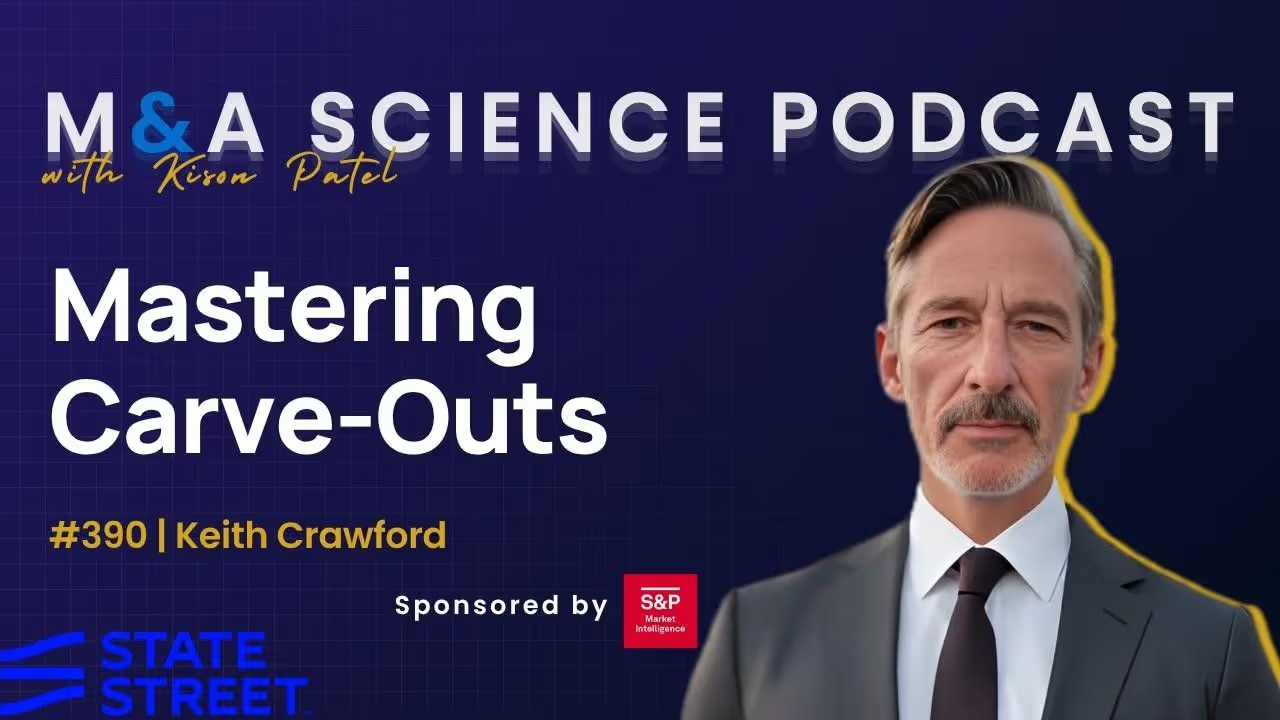
Keith Crawford is the Global Head of Corporate Development and M&A at State Street Corporation, where he's spent over 20 years leading complex carve-out transactions in the financial services sector. Previously serving as CFO at State Street Global Advisors, Keith brings deep expertise in navigating the dependencies, negotiations, and integration challenges that make carve-outs particularly complex. A CPA by training, Keith transitioned from audit to M&A and has since overseen more than 50 transactions, including approximately 15 carve-out deals in the custody and investment services space.
Episode Transcript
Deal Structuring for Carve-Outs
Kison Patel: [00:00:00] Hey, amne scientist. Quick one before we jump in. Today's episode is brought to you by SMP Global Market Intelligence. It's Q4. That means closing out deals and building pipeline for next year. If you're sourcing new opportunities or pressure testing a target, you need real visibility, especially with private companies where data is usually a black box.
Kison Patel: SMPs private company data gives you access to comps, market maps, headcount, trends. [00:00:30] Ownership insights and more across over 58 million companies globally. If you're tired of flying blind, check it out. SP global.com/pcd-science. That's SP global.com/pcd-science or find a link in the show notes. Now, let's get into the episode.
Kison Patel: I am Kisan Patel, [00:01:00] and you are listening to m and a Science where we talk with deal professionals and learn valuable lessons from their experience. This podcast focuses on stories, strategies and what actually happened during m and a deals.
Kison Patel: Welcome. I hope you are all joining us. I see a couple hundred people joining for our live m and a Science [00:01:30] podcast. Welcome to the Virtual buyer LED m and a summit. We are so excited to have you today. We've already had session and a keynote, which has been awesome, and it is time for one of our most requested things that we offer at the summit.
Kison Patel: A live e podcast, and this is a fun one because Kean and Keith. From Keith Crawford from State Street are actually sitting next to each other, so I'd like to bring to the stage Keith San Patel, host [00:02:00] and CEO of m, a science host of MA Science podcast, and Keith Crawford, head of Corp Dev at State Street.
Kison Patel: All right, you ready, Keith? I'm ready. This is it for everybody. This is is Authentic Live podcast setup that I actually use to record these. With that, hello and welcome to the m and a Science podcast. We are live at the buyer LED m and a virtual summit. Buyer LED m and a is about strategy, alignment, and efficiency, putting value creation at the center of [00:02:30] every deal.
Kison Patel: Today we're diving deep into one of the most complex and underestimated areas of m and a carve out transactions. Joining me is Keith Crawford, global head of Corporate Development and m and a at State Street Corporation, trading as STT on the NYSE. Keith brings over 20 years of expertise at State Street where he's led some of the most intricate custody business carve-outs in the financial services industry.
Kison Patel: Previously [00:03:00] serving as CFO at State Street Global Advisors, Keith is an expert in navigating dependencies negotiations and integration challenges that make carve-outs so difficult. Keith, how you doing today? I'm doing great. How are you? Hey, thanks for joining me live this time. Absolutely. I know we, last time we did this years ago was like, that's right.
Kison Patel: A virtual, hopefully get a little more fun. We're here live in deal room headquarters in Boston with a fellow Boston based company as well. That's right. It's a great setup here. I appreciate it. I know you got a bigger, nicer office, but uh, you came to our humbled beings [00:03:30] over here. Can we kick things off a little bit about your background?
Kison Patel: I'm
Keith Crawford: an accountant by trade. Got my letters CPA, letters as getting outta school, passing the exam. Then realized it's a little boring, it's not for me. I wanted to get into m and a. I worked for a publicly traded company, which is private now company called Gerber Scientific. They did two acquisitions while I was in the internal audit department, and back then in those days, they used the internal audit for special projects as well.
Keith Crawford: So we got put on the scene [00:04:00] for m and a and I got the bug, said, this is what I want to do. I want to do this all the time. I don't want to just do this sporadically and then do audit on the side. Moved out to Ernst and Young, got my master's in finance and with Ernst and Young, I did due diligence for private equity players, mostly in some strategics who are on a massive uptick in terms of acquisitions in the late nineties into the two thousands.
Keith Crawford: So I was there during the.com boom, which was very interesting, and then moved on to State [00:04:30] Street. And State Street is a pretty astute, acquisitive company for strategic purposes. And here I am.
Kison Patel: How many deals have you done? I'd say over 50. Specifically for these carve out type of transactions, how many of those have you worked on?
Kison Patel: Probably close to 15 I would say. Okay. That's quite a few. I'm curious because you come from a real strong finance background, and when you look at today when you are overseeing m and a end-to-end, what are those additional skills like beyond the financial numbers? That you had to [00:05:00] acquire to really get good at doing m and a?
Keith Crawford: Yeah, absolutely. So when someone who doesn't really understand m and a, like my kids, they say, what do you do? And it's hard to explain when you give them the technical response, but the way that I've summed it up is, and it's not totally accurate, but it's the best way to do it and it's the best synonym for it, is I'm a general contractor.
Keith Crawford: I assemble a team of experts, tax compliance, risk operations, it and the like, and bring 'em together. And we go in and we look at [00:05:30] the underlying business opportunity. And I know enough to be dangerous, but I'm not the expert. It's sort of like a general contractor would walk in the house and he'd see wires sticking out from the wall and he'd say, oh, need to call an electrician.
Keith Crawford: It's the same thing. I'd look at it. We're looking at something and the tax situation's a little messed up. I bring in the tax expert and we look at it. It's really bringing all the thoughts and ideas and the findings together to try to figure out are we at the true valuation? And then what are the issues and the hurdles for us to get the [00:06:00] transaction completed and why we're here today?
Keith Crawford: What is the integration? Can the integration be done in the timeframe that the team collectively
Kison Patel: projects to go forward? I like that analogy. It's all about the team and making sure you got the best team for the job. Yeah,
Keith Crawford: absolutely. No one person on the team can actually determine a large issue that comes up.
Keith Crawford: You need a collective view from everybody because it is interrelated and that's the key. That's the key to integration. A lot of things are inated and people need to work
Kison Patel: together to do it. When it comes to carve-outs, what are the [00:06:30] biggest misconceptions people have about carve-outs?
Keith Crawford: The biggest misconception is, is firms that do it, do it often and do it well, that they can adopt some kind of scalable template to go forward.
Keith Crawford: And I caution on that because no two deals are alike. So what I like to say is that the template is probably 80% accurate from deal to deal, but then the 20% white space in there, which you've gotta create your own projections going forward, your own performance in terms of how they're gonna [00:07:00] execute, those are the things that you've gotta keep open for that distinct deal.
Keith Crawford: Because no two companies are alike. They all establish and set them up, set themselves up differently. At least in my industry, I know, and we're dealing with banks, and banks are fairly homogeneous in terms of what they do, but at the same time, how they set up their operations internally, that's bespoke and it differs bank to bank.
Keith Crawford: So that's why you need to make sure that you've got that area where you're gonna really focus on and put the team in to analyze that, to ensure you're [00:07:30] not just relying on, oh, we did this in the past, I've seen this is where it goes. You need to make sure you go down all the way to that detailed service level.
Keith Crawford: To understand how that's
Kison Patel: gonna be transferred over. You can't be fully template reliant. That's right. So I wanna speak from a little experience. Some folks know, but you haven't. I recently stepped down a CEO of deal room about a month ago, and I'm actually working on carving out m and a science from deal room and standing it up into its own business, which is the absolute opposite size of scale [00:08:00] you've probably worked on.
Kison Patel: I'm grabbing maybe three employees or so. But I gotta tell you from first in experience, it's such a pain in the ass. And the things I didn't expect first and foremost was all the vendors you have to renegotiate with every vendor you're basically doing business with and come up with new terms to stand up in this new entity.
Kison Patel: That's the one that was a big surprise. And then the other was all these things that you thought you had scoped out for the carve out. Then you find out these these other things that you didn't scope out. So once you pull the rug back, then you find [00:08:30] those. And then the other thing was the people side that there, the ring fencing is the term, but really figuring out who goes with the business, who stays and when you have people that were split 50 50, it ends up being some pretty tough decisions.
Keith Crawford: You've highlighted key areas that we focus on in the carve outs. They're important, particularly third party contracts. Massively important because when you've looked at their projections going forward. They're using their historical projections of what their, either their life license fee or servants fee is with that third party [00:09:00] provider.
Keith Crawford: It could be a major part of their platform or their service that they're offering. And if you come in and acquire it, most of these, they're smart. They have, uh, change of control provisions in there. What it requires you to do is to renegotiate.
Kison Patel: That's the thing I'm coming across. Like a lot of them are gonna, they increase the price on you, or they're just not gonna give you the same terms that you had with the previous entity.
Kison Patel: That's correct.
Keith Crawford: That's why in our preliminary non-binding bid that we have a long list of set of assumptions, and one of the assumptions we have is that [00:09:30] all third party contracts are at or near. The historical costs or the historical fee levels, because that's gonna impact your underlying valuation. If you come in and you're paying 20, 25% on a large third party contract,
Kison Patel: so that's gonna be in the L LOI that we're, yep.
Kison Patel: Hoping at the same terms of these vendors. We say this
Keith Crawford: valuation is based on these set of assumptions. And then if you go in and you do do due diligence and you get into the agreements, you do need to eventually, before you actually sign the transaction. Probably on a confidential basis reach out to those [00:10:00] significant third party providers and see if you can get a, replicate the actual service and license at the
Kison Patel: same level or
Keith Crawford: near that level.
Kison Patel: What if you get surprised? Some vendor doesn't wanna play nice and they wanna double the price and significant it's, it's
Keith Crawford: happened before you ultimately get there because the vendor doesn't wanna be too greedy about it because they're gonna continue their service. So if you all don't execute the transaction, they're at the same level.
Keith Crawford: And it may get sold off again, and there may be issues where they'll [00:10:30] actually try to do a workaround in the future so that they're not gonna prohibit that business from being sold.
Kison Patel: That's good. I'm getting my money's worth on this interview. Yeah. Yes. Get that up early. Put in the LOI. What about the Unco stuff as you go through this part of this lend to the TSAs, in this case, they have controlling interests on both sides, but how do you navigate the TSA component?
Kison Patel: Because there's things that you'll know about, but then all these things that pop up they didn't know about. That's where the details, the
Keith Crawford: devil and the details comes out in terms [00:11:00] of where you can really run into trouble if you haven't had a full scope of what the perimeter is, and that's typical and it progresses through the deal.
Keith Crawford: No one seller is gonna have the full perimeter figured out. They just don't understand what the buyer has and doesn't have. It's definitely an iterative process between the buyer and seller. To figure out, okay, I need these services, I need these supports. Particularly if you're going into another country, we have capabilities, but sometimes we don't have capabilities that abide by the local [00:11:30] requirements or the local country requirements and laws and regulations.
Keith Crawford: So. They're assuming that, oh, you've got your global, you have your own platform. But there are nuances that happen, particularly with some certain services that we can't replicate because we just don't have that level of requirements in that particular country to work through. So those are things that can pop up that you have to be careful on and you gotta write a TSA on that for sure, to make sure that you have continuity going forward.
Keith Crawford: Then the question is, is do you either lift that out, do they turn around [00:12:00] and license that to you? And you use that in the future? That's not ideal because then you're dependent on the seller. The seller doesn't like that either. 'cause they'd like a clean break. Those are things that you have to think about.
Keith Crawford: Or is there another player in the market that provides that service that you could eventually migrate that to?
Kison Patel: Sounds like no matter what, you can't get around it, there's gonna be these unknowns that you're gonna have to work out. I'm curious, I'm, I'm fortunate. This is like a pretty closely held deal I'm working on, but if it wasn't, and sometimes you deal with difficult sellers, [00:12:30] I'm sure you have.
Kison Patel: Yes. Outta the
Keith Crawford: 15 deals. What do you do? You try to be as transparent as possible in terms of what the need is. It's not a deal tactic or a deal negotiation position. It's something that's inherent. A couple of years ago, we looked at a company internationally, a bank as well. It was a carve out, and as you said, we, when we were going through it and we were going every level of service in the actual core due diligence, we realized there were some services that were [00:13:00] being provided by, outside of the perimeter of what we were acquiring.
Keith Crawford: And that involved people in a, in an organization in the bank that service different parts of the bank that weren't part of the perimeter. We said to them, we need some of those people to continue the continuity of the service. And they said, well, you have that and we don't. We don't have that. We're a narrow type bank compared to a universal consumer bank, and that's something we'd either have to hire the people on or bring the expertise over.
Keith Crawford: And we debated. We debated [00:13:30] about the cost of it. It ended up being material enough that we thought that the transaction should require an adjustment and we ultimately didn't get there as a result of that. They thought it was a Im material. Component, but at the end we thought it was material, so we walked away.
Kison Patel: That goes back to the people side, the ring fencing and making sure that stuff's allocated and you saw clearly a gap.
Keith Crawford: That's correct. It's hard to know even when you're signing because you can't get down to the detailed level of service because you the confidentiality reasons. You've got a small group of people on the sell side that are [00:14:00] selling their business.
Keith Crawford: You're worried about this leaking to the market, so you're even doing work post signing. Between signing and closing that you'll find issues on. So you try to build a reserve in there for that as well, because you're not letting everybody know in that business, depending on the size. And in most instances, most deals that we look at, you're not letting them know that they're being acquired while you're negotiating it.
Keith Crawford: So there's certain components and details that even the smartest people at the top of the house in the [00:14:30] bank that are selling this asset. They don't know the underlying services that are being provided either, so that's something you've gotta work together. As I said before, an iterative process between the two parties to try to make sure that they've really nailed down exactly what the perimeter is.
Keith Crawford: Wow.
Kison Patel: Is it because you're public, there's like exponential, more sensitivity for deals getting leaked versus private to private?
Keith Crawford: Yeah, I think so. Private. Private. I don't think it really impacts anything. But you would be worried from a private firm as well, [00:15:00] because you don't want other players coming in and coming over the top.
Keith Crawford: But yes, from a public perspective, absolutely. It's just, it's material non-public information, and
Kison Patel: that should never be disclosed. So if it's private, it's more concern about competitive bids coming in, and also maybe employee perception if that creates some negative sentiments. Yeah. And then you're public.
Kison Patel: You got a stock picker.
Keith Crawford: That's right. You've got stock and you've got SEC laws that are out there, right? As they should be. And then the other thing I would say is most employees, if they hear that [00:15:30] they're being sold, it's not a comforting thing to them. If they don't have the details. When it leaks, it causes a lot of chaos in the organization.
Kison Patel: You wanna control that. How do you build strategic alignment upfront to avoid m and a on impulse when you're doing these deals?
Keith Crawford: The deal team is fairly specialized, has a great degree of expertise, but what also needs to happen is you need to include in the deal team those individuals that maybe don't know so much [00:16:00] about deal tactics, valuation, and the like, but know the underlying business cold and you have to bring them in.
Keith Crawford: Not too many. You have to have the right balance. You can't overburden the team. And they have day jobs too. They're doing other things that they work on. You bring 'em in and you augment the team with that expertise. And their focus is as you're going through the diligence process, they're thinking about the integration and the day one and the BAU opportunity.
Keith Crawford: And they're giving us feedback in [00:16:30] terms of, Hey, it's an easy one, or, Hey, this is gonna be difficult, or We have difficulty in these types of areas and we gotta focus ahead. So that does direct some of the diligence that happens at that point, which is a good thing. Then you have the continuity of those individuals because your intent, and the hope is those individuals will actually be key individual members of the actual integration team.
Keith Crawford: Or hopefully they're spending full time until the integration's complete or
Kison Patel: a considerable amount of their [00:17:00] time. They're bringing people for the business. They're thinking about how's this actually gonna come together, how they're gonna integrate it. But because of that, they're gonna be able to impact diligence in, in a lot of ways, knowing that what they're trying to achieve.
Kison Patel: What about the deal model? Is that also because when you look at the deal team, it's fun to come up with assumptions on synergies and model it
Keith Crawford: out. Yeah, you're hitting on where I was gonna go next. It's the synergies. So synergies are critical and the synergies don't happen before the closing. So that's why [00:17:30] integration is critical.
Keith Crawford: So the integration team. Needs to know clearly what the synergies are and when they need to be achieved because that's the operational or the migration or the integration aspect that needs to be mapped out from a timeline perspective so that the deal model actually
Kison Patel: comes true. I've been doing more part of like m and a science cover, like lecturing more about m and a and what the lifecycle looks like.
Kison Patel: I find it difficult to explain how m and a, it's beyond the [00:18:00] timeline. You always think of like, Hey, you sign an LOI. You go through confirm utility diligence. You get to purchase agreement, but what you described is the key thing that doesn't show visually. It's more of this correlation of here's diligence, here's integration planning in your deal model.
Kison Patel: One discovery affects the other, where you might come up with something or here's something that we didn't think of, an integration plan that warrants us to do more diligence in a specific area. It has us go back and change one of those synergies assumptions.
Keith Crawford: That's absolutely right. And [00:18:30] way early, way back in my career, it was bifurcated.
Keith Crawford: The deal team went and executed the actual transaction and then when they knew the transaction was gonna happen or right when it signed, they let set up an integration team and then you had to do that. Data flow, information sharing, which takes time and it's inaccurate because you're actually feeding your observations or your findings to the integration partners, and they're not seeing it firsthand for themselves.
Keith Crawford: So that's [00:19:00] what's happened over time to create it and why we've been so successful is integrating that sort of. No pun intended. Integration team into the deal team at the right level, at the right balance to make sure that the handoff is seamless. Nobody's surprised by we were gonna do this by when, or those synergies are, they're quite high.
Kison Patel: The handoff, there's a sort of alignment on timelines. Also alignment on synergies that this is realistic and achievable. I like this. This is where you're [00:19:30] describing buyer led m and a. Yep. This is that approach to really focus on success of the deal with the early thinking and integration. Yeah,
Keith Crawford: and we do a post of day one.
Keith Crawford: We do a day one sort of a hundred day plan going forward, and there's goals and highlights and achievements and milestones that we build into that plan. Then we meet pretty frequently to ensure that we're going there and we do post deal analysis as well in terms of maybe a year out we go back or 18 months out, we go back, we look at the deal model and we look at the [00:20:00] actual results and we say, did we achieve or did we not achieve or did we overachieve?
Kison Patel: Do you have an example of how bringing this model with the integration team in how they've impacted deal terms? They have, it's
Keith Crawford: really, in terms of the duration, they probably impact the deal terms. In every way, but I would say more commonly in the transition services agreement, and that is you've got the deal team who has some degree of knowledge, but they actually aren't the ones that are go through and perform the [00:20:30] migration or the integration.
Keith Crawford: You have to have that integration team there to really real realistically set the deadlines because. We think in terms of quarters or multiple quarters, and if it is a comprehensive process for whatever reason, it might be jurisdictional regulatory. They will tell us, you can't do this in six months.
Keith Crawford: This takes eight months, takes 12 months. And sometimes it is in terms of reporting periods because of what we do, quarters matter. [00:21:00] Investment portfolios matter and the like, so you just can't do it. A lot of our conversions actually have to happen over a weekend and you need to be able to do it in a big bank.
Keith Crawford: So that is critical in terms of when you can actually manage the TSA, what's the duration of the TSA and then client sellers typically want you to get out of there quickly. And we wanna be out there quickly as well. But it doesn't always happen that way. And that's where I think it's critical from having those expert integration people on the
Kison Patel: team.
Kison Patel: So they prevent headaches [00:21:30] and surprises. Do they ever push back on your synergy assumptions? Always. Always. So there's something we don't wanna talk about and it's, it's a healthy
Keith Crawford: debate. It is. If you leave it to their own discretion, they're gonna pat it by nature, being the financial and representing the financial side of State Street.
Keith Crawford: They're gonna want those synergies to show up sooner rather than later. So there's that healthy exercise, and it does get heated at times. We have enough deal comps in our industry, in our [00:22:00] space to understand what past transactions, not even just State Street transactions, but what past transactions have actually realized in terms of cost synergies, and revenue synergies.
Keith Crawford: While they're guideposts, there are reasons, as I said previously, all companies are created differently. You may not realize 'em to the norm of what the industry is, but if you're not close to the industry standards, then you've gotta explain why
Kison Patel: it's admirable. It's a voice you actually listen to. 'cause there's a lot of organizations I know, they absolutely have no [00:22:30] voice anywhere near the table.
Kison Patel: And you just fill the model to get the deal done.
Keith Crawford: What I would say is most synergies are critical for what we do. I would say just because of the space that we're in and the different businesses that we're in at State Street, we're not able to go out and buy something X synergies. Synergies are required there to substantiate the deal and substantiate with the return of the deal.
Keith Crawford: So it's always critical in terms of us realizing that and being able to scale our business. Or being able to expand [00:23:00] our revenue profile in different
Kison Patel: countries or with different clients or different services. Can we talk about sourcing deals? I'm curious about how do you approach proactively sourcing carve-out opportunities rather than waiting for a banker book to hit DreamBox?
Keith Crawford: Yeah, absolutely. Because we're a unique trust bank. There's not a lot of trust banks around the world. There are a handful of them. We're a very bespoke in terms of what we provide our services. We're not as wide and diversified as the [00:23:30] other GCP type banks out there like JP Morgan. We're more like the trust banks are.
Keith Crawford: State Street Bank of New York and Northern, those are the three largest trust banks. But there are universal banks around the world that actually still do custody and administration and accounting on their own, and they haven't outsourced it or sold it. If they're a handful, I'd say a little more than a handful, and we know 'em, we visit 'em when we go into their jurisdiction or their geography, we're there with them when we're trying to tell them that your service [00:24:00] would be better.
Keith Crawford: It would reduce your costs and your service enhancement would be better if you actually decided to carve that business out and sell it to us. And I would say there's a lot of interest in those discussions. But even though carve outs are hard for buyers, they're just as hard for sellers as well because they need to augment and change their business.
Keith Crawford: And that's not an easy thing to do. They sometimes adhere to the status quo before they, they actually say, this is a good idea because this is a non-core capability or business that we provide. It's a [00:24:30] bit of a back and forth and a dialogue that we've had with banks over the years. Can you explain like custody
Kison Patel: business?
Keith Crawford: We consider to be kind of a institutional, we're an institutional bank player. We're a bank, we're a charter bank, but you can't go on the street and find an ATM and take money out of State Street. So we don't essentially touch retail. We don't touch retail players. You can't open a bank account with State Street unless you're an institution or a sovereign wealth fund.
Keith Crawford: So we move money behind the scenes. So when a sovereign [00:25:00] wealth fund wants to manage. Their fund and execute trades. We facilitate the trades for them. We facilitate the reporting. We facilitate the investment and the evaluation, which is the administration, the accounting as well. And we custody the assets through our global network that we have around the world.
Keith Crawford: So if they're trading Japanese equities and they're in Germany, we can handle it with the infrastructure that we have built. You move the big bucks, we
Kison Patel: touch a lot of money, as does Bank of New York every day. So then this is a business that you really focus on, and when you look at. [00:25:30] As a strategy for your carve out that you identified is that there's these other banks that that's essentially their side business, and then that's where you have this thesis that they've been operating on this for a while.
Keith Crawford: Yep.
Kison Patel: Sound like you've done a number of these deals. Yeah.
Keith Crawford: The biggest kind of impetus for the firms to actually consider carving out their businesses we're very technology reliant it, as you could imagine, moving that much money and custodying assets and performing. Administration and accounting on portfolios and [00:26:00] accounts, we actually require a lot of regulatory requirements that happen in terms of jurisdictionally.
Keith Crawford: As we all know, the regulatory environment, it doesn't sit still. It's constantly moving. It's constantly changing, and if you have new regulatory requirements for your underlying portfolios, your clients or whatever it might be, that requires a change to your technology. You have to upgrade your technology or.
Keith Crawford: Augment the technology so that it can actually provide the service at the standards in which the regulators require. That's a big [00:26:30] sell point for us to say, yeah, you may be doing okay right now, but you constantly have to upgrade this non four part of your system to meet the regulatory requirements, and you don't really have the critical mass.
Kison Patel: Were you part of shaping the strategy, or is this something that was already existent when you joined State Street?
Keith Crawford: Well, I think it was there, it was implied. I wouldn't say I was an architect of it, but with the key executives in the custody security services business that we operate, we constantly work together and coordinate with each other in terms [00:27:00] of what's the angle, how do we help other firms, how do we help other customers?
Keith Crawford: A lot of it comes from word of mouth as well. Certain clients find out that we're providing certain capabilities to somebody that they know and we get a referral in. But I'd say we're fairly versed in terms of what the opportunities are on a global level, and we try to focus on areas that we think we can execute on at a high level and a high scale.
Kison Patel: What I'm trying to get to is like step one is having a clearly defined strategy. What I'm getting is you're not knocking on doors saying, Hey, you got anything to [00:27:30] carve out? It doesn't work that way or does it? We do. We do. We knock on doors. It did in a time, but do you knock on doors and just ask, Hey, you guys got anything for sale?
Kison Patel: Are you looking to carve out?
Keith Crawford: Well, we know their business ahead of time, right? We're not saying if it's for sale, have you
Kison Patel: have a, and that's what I'm getting is you have the strategy that you've shaped, which is essentially why us, we've already got expertise in this. We're able to make the regulatory overhead a lot more efficient.
Kison Patel: Just overall efficiency and operating the business and, and the benefits for them, I guess selling the business as well.
Keith Crawford: That's absolutely right. [00:28:00] We understand what they're performing in-house and because they're, in most instances, not all, but in most instances, they're large universal banks. Universal banks have a ton of divisions, ton of services, ton of products capabilities.
Keith Crawford: We just believe that we can do it more efficient and scalable for them, and that's something that we can take off their hands. It's not really front facing. They're not touching the institutional clients, and if it's a service that they can outsource and have a steady rate. And a high [00:28:30] level of service that's
Kison Patel: something that they're interested in.
Kison Patel: Do you think that's a must have to have an angle that you approach these firms versus just knocking on doors saying, Hey, I'm looking for a business that you wanna carve out? Yeah.
Keith Crawford: No, we have to be very concise. Otherwise, I just don't think we'll get there. And even when we are concise, it does take time.
Keith Crawford: As I said earlier, carving out a business is not an easy thing for a seller to do. It's a lot of work. Even selling a business in your portfolio is a lot of work, even if it's on its own and it's segregated. So buying is, actually, [00:29:00] buying is less comprehensive than selling because selling you have to know every single little thing.
Keith Crawford: It is an extensive process,
Kison Patel: and especially to get them to wanna do this without running a process or it's sort of on you proactively engaging them to wanna do this deal. That's right. Wait, so step one strategy, get the angle down. What's step two?
Keith Crawford: Yeah, so step two would be in terms of what's the initial price range, valuation range.
Keith Crawford: We gotta get 'em [00:29:30] interested. What can we do? How can we help you? So you have the strategy,
Kison Patel: it could be worth this, we gotta talk to like identify the right banks and like the right people to talk to. Yeah.
Keith Crawford: But through our conversations with the, with my conversations with the business leaders. The network that we have globally in most instances, even when I, I, I said this in a prior discussion, but at when I was the CFO at the Asset Management Group, which is now called State Street Investment Management, used to be [00:30:00] SSGA.
Keith Crawford: Anywhere I went in the world in terms of meeting with my teams, I could call up a competing asset manager and say, Hey, do you want to meet? Do you wanna have coffee? Do you wanna have lunch? It was an easy thing and I did it. I did it a lot, and the team does it a lot as well in terms of we're in the top five in terms of assets under management globally, it's a big ticket and those are doors and you need to be outwardly looking, and I would say 85% of the conversations [00:30:30] probably don't continue.
Keith Crawford: But then there's that 15 in there, and I wouldn't say the 15 are successful because we all know m and a is hard to do, but those are 15 that are in that area of sourcing of, okay, they're interesting. Is it the right time? Is this where we want to be? How high is it on our priority scale?
Kison Patel: If you wanna talk about this with proactive deal sourcing, you gotta work your butt off.
Kison Patel: There's no, you do shortcuts.
Keith Crawford: But I would say fortunately for us, we're narrow in terms of what we do. So asset management and investment services, we're now [00:31:00] moving into wealth. Someone like I'd say JP Morgan, who's corporate advisory, there's a lot of businesses in there for them to figure out, okay, how am I gonna make this grow?
Keith Crawford: We're very, I wouldn't say narrow, but we're very concentrated in terms of where we play. So it's actually easier from that perspective. But we did enter the FinTech world with the CRD transaction. That is the wild west. That's not an easy market to get your arms around and understand. Who all the players are, because as we all know and, uh, maybe don't know, [00:31:30] but in FinTech, what I find is most of the firms that were created were all created for sort of one reason, and then they developed thereafter.
Keith Crawford: So any FinTech firm that you look at, they're not in categories, they're not homogeneous. They might do the same thing, but then they started or they developed into something different. So. It's a really, I think it's a really fragmented space and it's just one that you really gotta spend a lot of time on to understand where the
Kison Patel: opportunities are, the benefits of having a clearly defined angle [00:32:00] strategy, so that way it's easier to see what targets fit.
Kison Patel: And then it sounds like the big step is just having the conversations. It helps to have a big company logo. Otherwise it
Keith Crawford: does. It definitely helps to have a company, company and a global company. That's a
Kison Patel: plus. Is there certain titles that you wanna talk to that really make a deal actionable?
Keith Crawford: Absolutely.
Keith Crawford: Particularly in the custody space. What you wanna do is you wanna speak to the individual. They're in charge of the custody business or the security services business, but they're not in the business. So [00:32:30] if you go to the head of the security services business, we always say it's like. Inviting the Turkey to Christmas, you don't want to go and talk to the head of the business and say, Hey, we want to buy you.
Keith Crawford: Their first reaction is, I'm running this division, or I'm running this part of the company. I'm being successful. If I get bought out, there's a chance I won't have my job. Which in most instances is not the case 'cause we acquire talent along with it. We're not all about just eliminating headcount. That's not the point.
Keith Crawford: It's about scaling. And if you look through our [00:33:00] organization, some of the people on the senior management level and the executive level, were part of past acquisitions. So we bring in quality talent as well as part of it. You can't initiate the conversation with that individual day one, so you have to go above the head of the security services business and put that idea, that thought in and why they should do it.
Keith Crawford: So
Kison Patel: that's the target
Keith Crawford: point.
Kison Patel: Okay, so let's say you, I'm taking this as free advice and coaching from you. I'm gonna go do a carve out. And for me, it would make total sense to look at these large companies that have [00:33:30] some kind of data room business. I know like SMP Global, Thomson Reuters, they have these sort of legacy data rooms that are underperforming where you're telling me, I don't wanna go to that directly to the business unit leader.
Kison Patel: I don't think that's a good start. Yeah, I did try this. Yeah. And actually it was like they didn't wanna have the conversation.
Keith Crawford: Yeah.
Kison Patel: So I would go above them. I feel like it's just so blurry in these large organizations.
Keith Crawford: It is. It is. And like I said, all companies are different. That's where I tap into the investment banking knowledge.
Keith Crawford: I have a very wide and [00:34:00] extensive network of financial advisors, investment banks, large bracket banks, all the way down to the tier three banks, however you wanna evaluate 'em. And I do find, depending on what level that you're going on, large banks sometimes don't have the contacts that the next tier down has.
Keith Crawford: 'cause the next tier down has to. They really have to go out there and beat the street for their transactions, whereas the large ones, they're gonna be on. One side of the transaction or another if it's a sizable transaction and they, so they don't have [00:34:30] as much networking and contacts into these kind of carve out type opportunities, which is why we utilize some of the mid-tier investment banks because they actually know the individuals almost personally in a lot of cases.
Kison Patel: So you could engage. So it's good to have the network of bankers and you can say, Hey. Or whoever, I'm look interested in this company, I know that's got this business, can you help me? And they might know something already. They might know who to talk to. And then when you bring them in, are they engaging with you as buy-side representation, then they aren't [00:35:00] necessarily
Keith Crawford: depending.
Keith Crawford: So look, bankers are critical. They all need to be on transactions and they need to be on successful transactions. We're open, we're agnostic to the bankers out there and my position. Throughout my career is if you bring a transaction exclusively to State Street and we execute on it, you will be on that transaction.
Keith Crawford: And I've held firm on that, and that's been consistent. I haven't reached that. In my career, but it's really just an introduction to get it at first, and the bankers are more than happy to do it. It's light [00:35:30] work for them at that point in time, and it might be a referral back to
Kison Patel: them if we actually do go with the transaction.
Kison Patel: In some of the cases, they could help you make the deal actionable if they already
Keith Crawford: Yeah, absolutely. In a lot of cases, I would say they end up on the other side.
Kison Patel: In this example, you're still buyer led, you're still practically sourcing, you're still doing this, but. They're still using this extended network with the bankers and playing nice and working with them.
Kison Patel: They can get the leverage and increase the opportunity of making the deal actionable. It's still a win for you. Yep. Okay, so we get the combos, we get the an opportunity [00:36:00] where, hey, there's something potential here. I like your story. I like the why us and and why this business case makes sense to do this carve out.
Keith Crawford: Where
Kison Patel: do
Keith Crawford: you go
Kison Patel: from there?
Keith Crawford: It's, uh, you sign an NDA, they assimilate their information for the preliminary bid. They give us their, the core financials of the business. In some instances, we require to go hire one of the big four or another accounting firm to actually do a quality of earnings analysis, which actually takes the carve out.
Keith Crawford: And the accountants go in there and they go through every part of the business that [00:36:30] they know of, and they try to build a, uh, perimeter, carve out p and l and balance sheet. And that's utilized for the preliminary information of which we put our preliminary bid.
Kison Patel: You got an NDA signed and then you're have a preliminary request list that you'll ask for information, but you'll also do this buy-side Q of E before putting an L loi.
Kison Patel: It'll be
Keith Crawford: a sell side Q of E. So if they really want to carve it out, we recommend to them that take you a QE. Oh. So you tell them
Kison Patel: to do it. Okay. Which is pretty common practice. If they're gonna go and go bank and sell, it's if they've
Keith Crawford: decided they wanna sell [00:37:00] the business, if they don't wanna sell the business or they're still on the fence about it, sometimes they won't
Kison Patel: and they'll give you preliminary information.
Kison Patel: That's interesting. So if they are pretty inclined, like they're motivated to do it, they'll do it. If not, they just give you preliminary information. What's your sense between the two? If they do a QV versus They don't.
Keith Crawford: They do a QV. It's within the ballpark of accuracy. If they don't, it's, it could be wrong, it could be.
Keith Crawford: Grossly wrong. When you get in and you do due diligence and then you self-insure the deal, you [00:37:30] require, you do quality of earnings on self-insurance that the underwriters require to do that. You go in there and you find out there's mistakes or there's costs that they didn't include, or there's revenue that's overstated, so that tends to happen.
Keith Crawford: We'll do it quickly and swiftly, but our level of risk assessment is much higher for those types of transactions than a QB.
Kison Patel: More likely to get surprises, we end up having to go back and renegotiate. That's, that's been my experience. This is a great walkthrough on how to [00:38:00] source deals. Let's talk about your approach around mapping out the dependencies, creating a unified process across your teams when you actually go and due diligence on this company.
Keith Crawford: We've been a successful acquirer over the years and acquisitions for us. It's not a strategy, it's to enhance our strategy. We're pretty astute about that. We do think creatively in how we go through this, but when we do get into the m and a environment, we have a core team. It's built off the historical success of what we [00:38:30] do and what we wanna augment over time.
Keith Crawford: And our prior transactions have been successful or not successful, and we try to augment it. But with, like I said, we bring in a core team and we're pretty detailed upfront. In terms of the areas of focus and risk to start. Now again, 20% of that is whiteboard again, 80%. I was gonna say like how do you deal with the, yeah, so if we're looking at a transaction in another country, we've gotta talk about, you know, country risk.
Keith Crawford: Is there currency risk? Is there net interest, [00:39:00] income risk? Because the interest rates are either tremendously lower than where we are at the home office, or they're higher. These are the types of things that we try to identify up that's driving that initial valuation model. And that's where we tend to focus the teams in terms of getting in there early on in the process to really confirm those points.
Keith Crawford: So the material assumptions are where we focus initially
Kison Patel: in diligence. When you go on, like my example of my tiny little carve out I'm doing, there's all these little things that keep popping up [00:39:30] that drive me crazy. How do you keep the smooth cadence
Keith Crawford: going of, you've gotta be agile. It's never gonna stop.
Keith Crawford: You're never gonna encapsulate a transaction upfront and have it be consistent with no surprises all the way up to the signing and even some instances, the closing, which you don't want, but you have to be ready. You have to be on. There's always last minute things that happen, and there's always last minute surprises.
Keith Crawford: That's why the deal team needs to be present available around the clock, because these do come [00:40:00] up in very tight timeline frames in terms of where you're going to print, or you're actually gonna sign on a transaction and you find these things out. So you've gotta have the team ready to triage right away and try to resolve that to get to that next phase.
Keith Crawford: Is there any tactics or approaches to sue that over. It's about knowledge and really being inquisitive and intuitive while you're going through it. It doesn't avoid all of it, but if you think that the agreements are there, we're settled, everything's working out, there is handoff, things that are [00:40:30] required, even just wire transferring money.
Keith Crawford: It's a big deal between the signing and the closing. If it's gotta go to different accounts, different jurisdictions. That stuff does take time. You gotta do preparation. You just can't take that and think it's gonna happen within a matter of hours. You've gotta spend the time to prep for it. So it's being thorough for everything that's required for signing conditions or even closing conditions.
Kison Patel: Get in early. Early, be very inquisitive. And I feel like some of these are just reps you do over time. Yep. You know, what are the key things that [00:41:00] you don't wanna get surprised with?
Keith Crawford: Yeah. And constant check-in. If you don't hear something, check in anyway.
Kison Patel: Is there like a cadence you found that works really well?
Kison Patel: I'm doing like a weekly right now. Is that the right mouse should be more or less. It depends on the type of transaction
Keith Crawford: that you're on and the complexity of the transaction. And so if it's complex, I would say two times a week the team should get together. In many cases you're canceling the meeting.
Keith Crawford: Yeah. When we're trying to get to assigning sometimes on transactions, we actually have a nightly meeting. At the end of the day, are we still on track? [00:41:30] What's popped up? Are there any changes? And in many cases there are, oh, we've got some more information on this, we've gotta deal with this. And then that's when you triage the team to get together.
Keith Crawford: So yeah, I would say over, yeah, it's better to over schedule meetings and call 'em if there's not anything there. It's a good check-in and it forces people to be. Transparent, because a lot of times when you're not connected or people aren't showing up, things can happen. And look, we're a global company, so you've gotta be connected.
Keith Crawford: We're not all sitting in the same floor, in the same [00:42:00] room or in the same office. A lot of times it's multi-office and it's multi-jurisdictional.
Kison Patel: I'm sure people are happy with cancel meetings than surprise meetings that show up at the calendar.
Keith Crawford: Exactly,
Kison Patel: exactly. So I like that. That might be a good thing I'm gonna take in is just increase the cadence and then play it by ear if we need 'em.
Kison Patel: And like you said, there's parts of the deal that you're just gonna need to do. High frequency of check-ins. Going back to that example with the international bank, what are the some of the things that we can talk through that went wrong and how may have changed your buyer letter approach?
Keith Crawford: There's a lot of components that need to be [00:42:30] finalized.
Keith Crawford: One of the international banks, there was a component, as I mentioned, we couldn't cover. We needed to actually create a greenfield or they needed to transfer over that capability in the security services business, when we go to a lot of these banks, they have their own asset management group. And their asset management group, they're doing the security services, the custody, the fund administration, the fund accounting for their own in-house asset manager.
Keith Crawford: It's segregated for regulatory purposes. However, when they [00:43:00] spin it out, you've gotta create a commercial contract between our business and that asset manager. So that's one of the clients that's gonna come along, and in many instances, the clients are up to 50% of the revenue. They could be more. But up to 50%.
Keith Crawford: And the critical aspect of that is what are the terms going forward? So when we talked earlier about third party contracts and making sure that they're not gonna increase the fee 20 to five to 50%, it's the same thing that we have to do on the captive. I think the captive asset [00:43:30] manager, of course, they're realizing they're entering into an agreement with a third party now, and now they're thinking, okay, we're gonna reduce our fees.
Keith Crawford: Then you've got the top of the house within the bank that's saying, no, we want the highest price possible, so we're gonna sell this contract going forward. And when you talk to asset managers, they are, they're fiduciaries. So they, a lot of times they will fight their own parent company in terms of where they think fees should provide.
Keith Crawford: That's a very delicate situation that you have to deal with when you [00:44:00] have a large cap captive
Kison Patel: plan. How'd you change your approach overall?
Keith Crawford: We asked the seller early on in the process that we'd like to meet the asset management team who's ever deciding this going forward? We want them integrated. There have been instances in my past where transactions have terminated because they didn't wanna bring the asset management team.
Keith Crawford: They promised that the fees that we were gonna get would be the fees, and they ended up not being the fees because the asset manager rebelled.
Kison Patel: Oh wow. So it goes [00:44:30] back to that theme of just early and being inquisitive. Yeah.
Keith Crawford: I'll never forget, at one point, it was back in maybe 2000, and I'm dating myself, but 2005, I had a good friend.
Keith Crawford: He was a banker, he is a good friend of mine still, but he was working on the transaction with us and he called me. I was sitting at dinner before I was going back to my hotel and he said, we have a problem. And I said, what's the problem? And he said, we just lost $25 million of ebitda. And I said, why? And he said The asset manager repriced, they came in the fees.
Keith Crawford: They want [00:45:00] a material change to 25 million of EBITDA at maybe eight to 12 times. Wow. Yeah.
Kison Patel: That kills a deal. Yeah. You make these deals successful. It's all hinges around this integration. You're giving really good examples of the stuff you absolutely wanna avoid post close. Planning process look like to create your a hundred day integration plan.
Keith Crawford: On the large transactions, we do seek third party outside help. So we'll go to the consultants out there who have program management expertise and [00:45:30] capability and we bring them in actually earlier, like probably. Just prior to signing, we'll bring them in, we'll engage with them. And from between signing and closing, we build in a fairly rigorous plan.
Keith Crawford: And as we said before, that's when the meeting cadence gets set up and that's where we work through a lot of the issues to ensure that synergies arrive on time. The closing, and you mentioned employees early before, and the other thing that's key is day one, you want the employees to feel like they're part of our company.
Keith Crawford: State Street. That's a lot of planning that [00:46:00] has to happen. With the HR folks and with the operations and IT folks. 'cause you want them to have segregated, it's required. They need to have their own email with state streety at the end of it, and they need to be in a secure space. So that's a lot of planning that has to happen.
Keith Crawford: When you're doing a carve out. 'cause a lot of times the seller doesn't want you in their facilities, so you gotta find new facilities, but you don't wanna move the employees too far away because that disrupts their work-life balance. So that's some of the critical stuff you [00:46:30] really need to think about that some people don't think is that big of an issue.
Keith Crawford: And it does become an issue
Kison Patel: the early on. Doing some of these deals makes sense to lean in on some consultants to help out. Absolutely. The other big thing I always think of integration, biggest risk is the people. Things go bad, people walk away. Culture alignment is a big part of it. If you nail it, people, if you stay motivated and happy, if not, they're terrified and you run away.
Kison Patel: Yep. How do you make that work? Like how do you, is there any
Keith Crawford: secret there? There's secrets. A lot of thought that goes into that. I would say dating back all the [00:47:00] way to CRD. When we bought Charles River, they were very successful business, software business. They were very proud in terms of what they did, but they were very creative and.
Keith Crawford: That's not so much equivalent to what a banking structure is. So we took steps throughout that integration to make sure that we didn't destroy the culture there and the creativity. And it was unique. It was different. They kept their old female. We didn't immediately transfer 'em to State Street. We want 'em to feel [00:47:30] like they were a division of State Street, but they were still had that identity and they still do to this day.
Keith Crawford: So it's been one of these things where you've gotta think about how you preserve the culture and you preserve the morale in terms of where the employees want to be so that they're continuing to be successful when we own it just as well as they were prior to owning it. So. That. And then also retention.
Keith Crawford: You want retention of employees, and that's critical, and that's a big part of the due diligence process as well. All the way to the integration is making sure that you're [00:48:00] incentivizing and ensuring that those critical employees are gonna be there, not just day one when you close the transaction. But beyond that.
Keith Crawford: In
Kison Patel: this example, you acknowledged the cultural differences and actually modified your integration plan with that North Star goal of having a high retention. That's correct.
Keith Crawford: And they, we maintain their facility and their facilities outside of Boston. It's probably a little bit more integrated today, but that facility's still there and when you go there, the brand there, it's still there.
Keith Crawford: And we've maintained the [00:48:30] culture and the success of the business.
Kison Patel: Pretty cool. How do you approach estimating carve out costs?
Keith Crawford: Again, it's bespoke to the actual transaction that you're looking at. And then I would say going back to the non-binding letter of intent, however you want to call it the bid, you have to have assumptions in there as to what you think the ongoing costs are, and that's third party operations, compensation, and the like.
Keith Crawford: I would say there are [00:49:00] other extra costs that are outside of that zone, and those costs are your deal fees, your legal fees. Your transition costs or starting stuff, creating stuff, travel. So you should have a general range based on past transactions. So you should be able to just take an estimate and start to map it out.
Keith Crawford: For large, publicly traded organizations, it's not a great thing, and it's becoming scrutinized more and more by investors and shareholders is they exclude deal fees or one time [00:49:30] fees out of transactions. You have that liberty, but it's a double-edged sword. You gotta be careful. It's not something you can use all the time.
Keith Crawford: In reality when shareholders and investors are looking at your growth rate and your return, and they know that those deal costs or those deal fees aren't gonna happen in the next two to five years, 'cause they only happen when you close the transaction. Those should legitimately be taken out of the runway.
Keith Crawford: So those costs can fit in that bucket, but you gotta be careful and you gotta adhere to what the requirements are under the accounting rules. [00:50:00] But those are the areas that you focus on. It's really hard and you gotta know what the migration is. How do you get clients on board? What's it take to repay for clients?
Keith Crawford: The other critical aspect is when we go in, one of the first things that I think our legal team looks at are the contracts. Do they have a change of control provision? So if it's a shared deal, in a lot of cases, you don't need to go and get consent from each client, which is great. Reduces your legal costs, your tracking costs.
Keith Crawford: So it does vary by [00:50:30] transaction and you should be able to estimate it based on your past deals. But again, it's gotta be a range.
Kison Patel: I wanna break this down 'cause this is an interesting one that is pretty critical. So if it's a share deal, you're taking over entity purchasing the shares, which means in most
Keith Crawford: instances there are jurisdictions and requirements where you still need to get it.
Keith Crawford: But I would say for the most part, yes.
Kison Patel: And then your agreements stay intact because there technically isn't, there isn't a change of control in the sense that you are, you are gonna have to have them sign a new contract, basically. [00:51:00]
Keith Crawford: Yeah. And some of them you don't have to sign a new contract. And that's another thing that's critical we didn't talk about as well, is understanding the client composition.
Keith Crawford: Because if it's very concentrated, then what you wanna do is it's the 80 20 rule. If you wanna focus on the large clients that are providing most of your revenue, and then you have the small tail of clients. But what we find in our industry, and probably happens to most others, is clients don't usually walk.
Keith Crawford: They wait around to see. And then you need to look at the repricing ability of the [00:51:30] clients in the contracts as well. 'cause a lot of them, they don't have the ability to reprice. Fortunately for some of our businesses to move off of the platform that we're acquiring. It's disruptive for the client. That's a retention component as well.
Keith Crawford: You want it all to go smoothly. That's where we're at, and you just need to make sure that you're thinking about the retention, what the legal requirements are, and the work that needs to be done. I did a transaction just recently where we tried to sell a business within [00:52:00] our company and we got all the way to the end, and the clients didn't want to, it was a small business, but the client didn't want to do the conversion of the contracts.
Keith Crawford: They had to go get positive consent from every single client. We do that all the time. So I was surprised by we, yeah, we're not interested. We don't wanna do that transition.
Kison Patel: Pastor, I was curious about this stuff because I feel like it happens post LOI. Then you find out all these contracts are change control provision and then it becomes a lot messier to work through.
Kison Patel: And to me, I chalked
Keith Crawford: that up to them not having a formalized [00:52:30] expert deal team because everything went sequentially. And that's not having somebody on the integration side or on the legal side that says, how are we gonna get these clients on board? They didn't think about that until the end. And
Kison Patel: we were just assuming that they understood that all the way through.
Kison Patel: Can we recap, like what are the major deal breakers that would cause you to walk away from a carve out during the process? Uncertainty
Keith Crawford: on
Kison Patel: the
Keith Crawford: perimeter
Kison Patel: is the
Keith Crawford: first one. The second one I would say employees and scope. [00:53:00] You absolutely need to know who's gonna be there day one, that so you can perform the services that are required.
Keith Crawford: Day one, you can't
Kison Patel: slip up or be deficient on them. How do you differentiate that between, when you say uncertainty on perimeters?
Keith Crawford: So uncertainty on perimeter in terms of services. So I'm not thinking individuals. So this could go to, I'm getting a feed from this area, I'm getting a feed from that area. Oh, okay.
Keith Crawford: It doesn't involve an employee, but it's critical information that's needed to perform the services.
Kison Patel: So this is the broader [00:53:30] business versus the actual operational employees and scope? That's correct. What you're buying at the end of the day, that's yes. If you can't define what you're buying, it's probably, and you can't
Keith Crawford: perform the service because you forgot about it and we didn't transition it over or build an interface to ensure that was showing up.
Keith Crawford: That sounds like the hardest part of doing these car off It's, and that's why our team needs to be augmented with the right people who really know their stuff and really know how the process
Kison Patel: works. Where does the future look like? Are you gonna see more carve outs in the
Keith Crawford: future? Less? We're always looking [00:54:00] inward out and we've been focused on.
Keith Crawford: Growing the business and actually trying to do this the right way. And we help out even on the organic side, internally with the investment side when things aren't happening from a. M and a perspective, or we're terribly swamped in the pipeline, but it is a concerted effort. We wear different hats and we try to think creatively, look, an acquisition's hard to do it.
Keith Crawford: I said it earlier, it's not part of our strategy. It's to help our strategy and if they think we can get there quicker. [00:54:30] It's something that we're interested in, but we're not out there just to acquire for the sake of acquiring. We're fairly global, established quality provider to our clients globally, and we're focused on keeping shareholders happy, but also making sure that we're building a long-term approach.
Kison Patel: Optimistic, hard to do, but still optimistic that more to come. I gotta ask, what's the craziest thing you've seen in m and a?
Keith Crawford: When I talked earlier about having that asset manager who's a captive, who's gonna become a major [00:55:00] client, you need to commercialize the arrangement with him. We were down to the wire on a certain transaction outside of the us.
Keith Crawford: The head of the asset manager caught pneumonia, and I didn't know this until my deal counterpart called me and said, we need to have a meeting, and I showed up with the head of Europe and myself. We said, okay, it was a meeting. We show up to a different building and we walk into the building and when we walk in, there's this big video screen and he says, sit down.
Keith Crawford: So we sat down and then the [00:55:30] screen lit up and a gentleman with an IV in his arm and a hospital smock walks in and sits down in a chair. Proceeds to tell us that he is not gonna agree to the price that we agreed on in the underlying valuation. He's in the hospital telling it us. And then to top it off, this was probably 15 years ago, there was a delay in the.
Keith Crawford: Remember when we said delays, we, there was a delay, so we would speak and he would start speaking before we would finish, [00:56:00] and it just went back and forth. It was crazy. Nevertheless, we got the message and then the triage through the night, all night negotiations to try to figure it out because the parent company saying, we want to get the deal done, yet this gentleman's in the hospital, we gotta figure it out.
Keith Crawford: We were down to the wire. We ultimately got there, but that was a pretty crazy story. Sitting at dinner the next day with my colleague saying. That was strange.
Kison Patel: Nick, gosh, you from the er. Keith, this has been a great conversation. I appreciate you taking the time from doing deals. Thanks for having me, helping [00:56:30] me become a better m and a scientist.
Kison Patel: Those of you that have been tuning in live, hey, love to hear from you of the feedback. If you reach out to me on LinkedIn, like topic ideas. I appreciate you joining us. Here's to the deal.
Kison Patel: Thank you for taking the time to explore the world of m and a with our podcast. We love hearing feedback. [00:57:00] Tag us on a LinkedIn post, add a review on Apple Podcast. We'd love to hear from you. If you need help standing up an m and a function or optimizing one that you already have. We're here to help, and if we can't help you, we probably know someone that can.
Kison Patel: You can reach out to me by email Kisan, K-I-S-O-N, at ma science.com, or you can text me directly at 3 1 2 8 5 7 3 7 1 1. If you just want to keep learning at your own [00:57:30] pace, visit ma science.com for a lot more content and resources. That's where you can also subscribe to our newsletter. Again, that's ma science.com.
Kison Patel: Here's to the deal.
Kison Patel: Views and opinions expressed on m and a science reflect only those individuals and do not reflect the views of any company [00:58:00] or entity mentioned or affiliated with any individual. This podcast is purely educational and is not intended to serve as a basis for any investment or financial decisions.
M&A Software for optimizing the M&A lifecycle- pipeline to diligence to integration
Explore dealroom

Want to wear your M&A expertise?
Check out the M&A Science store.


.jpeg)