M&A Science Podcast
 / 
Listen Now:

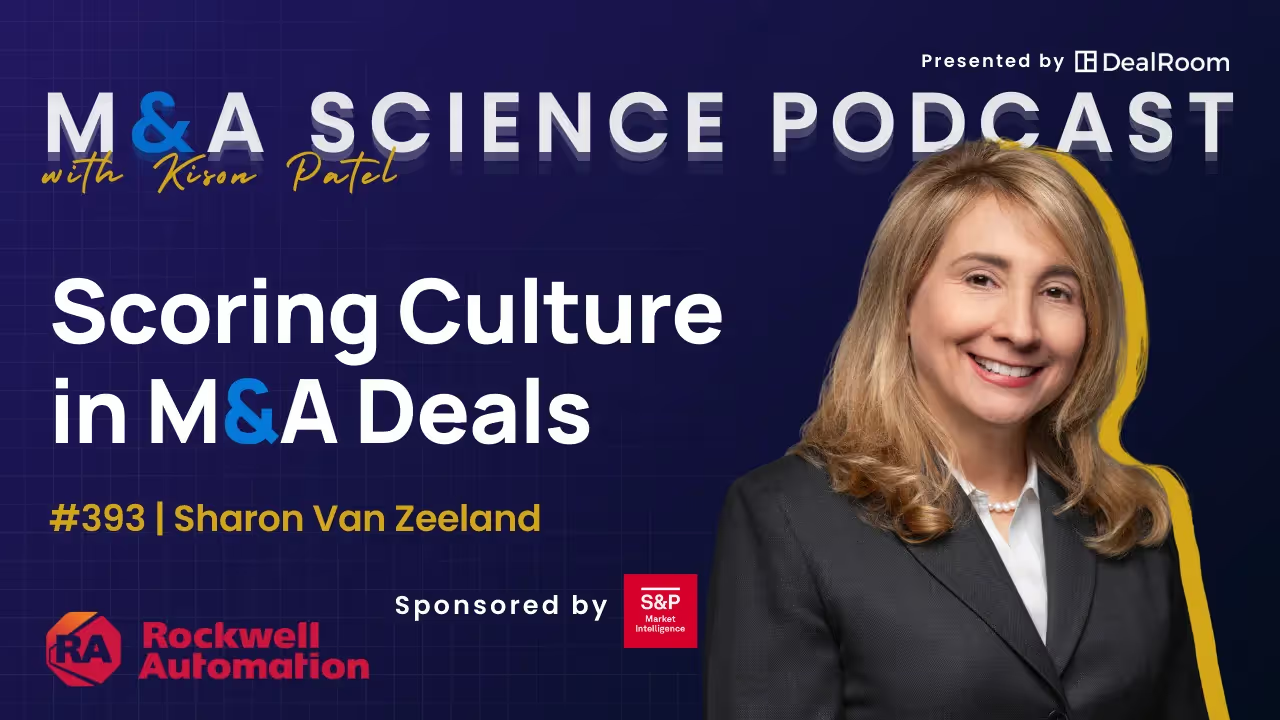
Scoring Culture Fit in M&A

Sharon Van Zeeland, Vice President of Strategy and Corporate Development at Rockwell Automation

Sharon brings a unique engineer's perspective to the softest parts of M&A. In this episode, Sharon reveals how Rockwell developed a systematic scoring system for evaluating culture fit during due diligence—complete with numerical rankings across key dimensions like decision-making authority, adaptability, and mission alignment. She also shares unconventional tactics for getting deals across the finish line, from negotiating hunting rights to sponsoring 4th of July parades, and explains why marrying your diligence and integration teams early is the secret to accelerating post-deal value creation.

Things You'll Learn

  • How to build a numerical scoring system for culture assessment
  • Why marrying your diligence and integration leaders from day one eliminates knowledge chasms, captures integration costs in your deal model, and helps you reach steady state faster than traditional handoffs
  • Creative negotiation tactics beyond price and terms

Rockwell Automation (NYSE: ROK) is the world's largest company dedicated to industrial automation and digital transformation, operating in 100 countries with 25,000 employees. Founded in 1903 and headquartered in Milwaukee, Wisconsin, Rockwell provides hardware, software, and lifecycle services that help manufacturers drive the factory of the future and advance industrial operations.

Industry
Founded
1903

Sharon Van Zeeland

Sharon Van Zeeland is Vice President of Strategy and Corporate Development at Rockwell Automation, where she leads the full spectrum of M&A activity—from strategy and deal execution through integration and venture investing. With a background as an electrical engineer at General Motors and Eaton, plus business development experience at Fairmount Minerals, Sharon brings an analytical, systems-thinking approach to corporate development. Her expertise lies in creating frameworks that systematize the "soft" aspects of M&A, including cultural assessment scoring systems and creative deal structuring that addresses both financial and emotional seller needs.

Episode Transcript

How to Score Culture in M&A Deals

Kison Patel: [00:00:00] I am Kison Patel, and you are listening to M&A Science where we talk with deal professionals and learn valuable lessons from their experience. This podcast focuses on stories, strategies and what actually happened during M&A deals.

Kison Patel: Hello and welcome to the M&A Science podcast. This [00:00:30] podcast is part of a mission to rethink how M&A is done. The old school settle that approach, it's dead. Fire led M&A is about strategy, alignment, and efficiency. Putting value creation at the center of every deal. And let's be real. It's not just about closing the deal, it's about making it successful.

Kison Patel: We uncover what truly works in M&A by learning directly from the best. Today I'm excited to have Sharon Van Zelan, vice President of Strategy and Corporate Development at Rockwell [00:01:00] Automation, ticker symbol ROK on the New York Stock Exchange. Sharon brings a unique perspective to corporate development, having built her career from engineering at General Motors and AP through business development roles at Fairmont Minerals.

Kison Patel: Now leading the full spectrum of M&A integration strategy and venture investing at Rockwell Automation, the world's largest company dedicated to industrial automation and digital transformation. What makes Sharon's approach particularly fascinating is how she's [00:01:30] brought an engineer's analytical mindset to the softest parts of M&A, creating scoring systems for culture fit and finding creative ways to get deals across the finish line when traditional negotiations stall.

Kison Patel: Today we'll explore how to develop a systematic approach to evaluating culture fit during due diligence, including specific questions around decision making authority, succession planning, and operational speed. Sharon, how are you doing today? Very well, thank you. Hey, thanks for taking a break from doing [00:02:00] deals to hang out with me here in Manhattan.

Sharon Van Zeeland: Thank you very much for having me. It's a pleasure to be able to explore these unconventional ways to get M&A done with you. So thank you.

Kison Patel: I'm excited to learn from your experience and I gotta give a special thanks to VRC largest privately held valuation company for letting us use our office space to record our I Review today.

Kison Patel: Can we kick things off a little bit? By your background,

Sharon Van Zeeland: I need to say I really love your mission around M&A in terms of getting things done with value creation at the center, both financial and other strategic factors. And to your [00:02:30] question, it's true. My career journey has been very interesting. I've taken a non-traditional path.

Sharon Van Zeeland: I went from electrical engineer to strategy and corporate development leader in the C-suite. However, the engineering problem solving foundation really of looking at all variables, helps me drive outcome and performance. It gave me a basis for evaluating deals from all angles, and it was very early that I learned deal success was not due to just one factor.

Sharon Van Zeeland: In many cases, [00:03:00] those factors were related and they were correlated in unexpected ways. It wasn't linear. For example, employee retention, not just at higher levels in the organization, which we all watch, but at the lower levels impacted things like new product introductions. And it became clear that future success was not just about buying the hard assets, manufacturing facilities, intellectual property, all the things we think about buying, but things like retaining talent was critical to ongoing deal success, and they're [00:03:30] all contributing factors.

Kison Patel: I've done a number of these podcasts. I'm really convinced. People with engineering background are completely different animal altogether, but they work extremely well in M&A. You mentioned the sort of correlating things and use the employee retention as an example. Is this general ability that they can really zoom into problems and get to that problem solving mindset.

Kison Patel: Zoom back out, look at the whole picture. Also think about that problem solving [00:04:00] mindset, which relates to the example that you just gave wholeheartedly

Sharon Van Zeeland: agree.

Kison Patel: Is there anything else I'm missing from that? It's unique. It's something I, I mean, I'm trying to encourage my kids like, go get an engineering degree, because it just wires you to think different, especially this era of ai.

Kison Patel: I don't think you're gonna get in a lot of other fields.

Sharon Van Zeeland: I agree. I like the wide angle view of looking at all the variables. Sometimes when you're trying to solve a problem, you have to look at variables that others wouldn't consider. So for me, it's been a great foundation and it's a problem solving journey [00:04:30] in corporate development as well.

Kison Patel: What's something you wish you knew before getting started in corporate development?

Sharon Van Zeeland: Again, it's back to what your mission is. Talking about corporate development's more than just closing the deal, it's really creating value, and that includes value for all the stakeholders, including customers, employees, both of the target and the company that's acquiring that.

Sharon Van Zeeland: Target shareholders, investors, and to some extent even the communities where these companies operate. So again, it's a wider angle view in terms of. Beyond financial [00:05:00] impact. And I also wish I knew early on to relentlessly monitor the post deal closing what was happening both strategically and financially.

Kison Patel: Fair point. You sort of got the whole lifecycle of the deal and then you got the impacts the deal itself makes, and then you got the wide view of all the stakeholders involved.

Sharon Van Zeeland: It's more than just closing the deal.

Kison Patel: It's, that's tough. You gotta keep a lot of people happy. You mentioned one of the things at Rockwell, you recently expanded your role to include strategy [00:05:30] along M&A and integration.

Kison Patel: Can you talk to me about owning the full lifecycle? What does that mean for you? From going through strategy all the way through integration? How has that changed the way you think about deals and your approach?

Sharon Van Zeeland: It's truly a privilege to have that full lifecycle view. Having that expanded strategy piece has really driven me and the team to think beyond, again, just the valuation model.

Sharon Van Zeeland: That is, does this transaction really advance Rockwell strategy of [00:06:00] driving the factory of the future or advancing industrial operations, and how do we accelerate toward that vision? So I would say we're way less siloed now. It's not just one deal at a time. We have an enterprise wide view of the entire impact of these deals.

Sharon Van Zeeland: And on the integration side, it really gives us a clear view of execution and monitoring against that original deal thesis. We do quarterly reviews of all these deals now, and we include the strategy team, the integration team, the M&A [00:06:30] team, and we circle back with lessons learned and approach to refinements in engineering terms.

Sharon Van Zeeland: Can't help. It is a closed loop system. And from my view is fantastic. The continuous learning along that journey.

Kison Patel: So you got this enterprise wide view when you look at all the deals happening, and then you have the integration side. So that way you're looking at this, how things actually come in, play, sort of outcomes, and then you can actually reflect back with all the [00:07:00] stakeholders involved in the whole deal life cycle so that it helps with the learning retention.

Kison Patel: Exactly. Has it made any impact on like success metrics?

Sharon Van Zeeland: Certainly. We definitely have. Refined our metrics, and again, previously maybe it was we were just looking at financial performance, but now we're able to drill deeper down into what are the factors that impact that. Things like retention, customer complaints.

Sharon Van Zeeland: There's a deeper layer and then there's also a strategic tie into what was the strategic thesis and how do we measure that.

Kison Patel: Okay, [00:07:30] so it, it changes. It's just not purely, here's the financial metrics. You know, you're actually looking at retention. Customer complaints, I think is a good one.

Sharon Van Zeeland: New product introduction.

Sharon Van Zeeland: Let's go to the positive side. Are we fulfilling customer gaps quicker?

Kison Patel: MPI. We'll throw some acronyms in there. Exactly. Thank you. I

Sharon Van Zeeland: appreciate it. Yes. And then that's right.

Kison Patel: And then yeah, how this benchmark against the thesis, how'd your role evolve? Did you come from the deal side or the integration side?

Sharon Van Zeeland: I started just M&A traditional, and then it expanded into integration because I was really [00:08:00] interested in how are the deals performing post-closing, and then it expanded upfront to strategy. And I've also recently taken on venture as well, so. Went downstream first, then came upstream. One thing wasn't

Kison Patel: enough for you, you just wanted it all, didn't you?

Sharon Van Zeeland: Yes.

Kison Patel: It's so interesting, and we're gonna talk a lot more about this, but just the, you know what, what drives success of a deal fundamentally is having all this integration consideration early in the deal process. It's interesting to see how you've been able to pick that up as part of just [00:08:30] your role evolving.

Kison Patel: To cover that full lifecycle. Let's talk about the cultural element, because this is something that comes up often. I know you particularly had a story on how Rockwell learned this the hard way. After some acquisitions, can we talk more about. Just some of the thinking around cultural due diligence.

Sharon Van Zeeland: Let me back up for a minute.

Sharon Van Zeeland: So Rockwell's a very large company. We're in a hundred countries. We have 25,000 employees. So the success of our acquisitions is just not the M&A corp dev strategy team. It's also our business leaders contributing [00:09:00] and driving those activities with us. But along with that comes a very structured process.

Sharon Van Zeeland: Most public companies are, but we have systems around purchasing, sourcing, information, technology, all of these very stringent rules on describing activities and ways of performing business. So we acquired a very small company that had a software solution that was spectacular for our customers, particularly in the life sciences space.

Sharon Van Zeeland: They helped drug discovery and drug development go [00:09:30] faster, and our customers embraced it, and we continued to accelerate. But what we missed in due diligence was that one of the tools that the company used to help their customers go faster was a third party software application. Broco didn't have any licenses for that, so right in the middle of drug development with one of our customers, they needed that application.

Sharon Van Zeeland: The smaller software company would just go buy them. They didn't have all these rules and regulations. We put a halt to that. Our purchasing our IT systems, because we have to check for cybersecurity, [00:10:00] we have to negotiate contracts, so we had a little bit of a customer issue in that. We slowed down their drug development for that one activity.

Sharon Van Zeeland: What we've learned through that from. Due diligence is that we flagged it early now, and we know to think about decision authority processes much sooner. For smaller companies, when you think about culture, you have to think about what are the ways that they operate for decision making? What do they think about for approvals and how do we get more aligned early?

Kison Patel: What resulted from that? Like how did you change things after that? [00:10:30]

Sharon Van Zeeland: We have a playbook for purchasing and sourcing and acquiring technologies that companies need. And we have different processes depending on whether it's a small company, a mid company, or large size company now for acquisition.

Kison Patel: Ah. So if they come in as a small company, they may not have as much rigor and kind of work with them so they can keep up with their speed that they operate on,

Sharon Van Zeeland: but keeping our safeguards that Rockwell needs.

Sharon Van Zeeland: So we've identified what the priority things are that what we need right away.

Kison Patel: Yes. That's good. That's actually interesting. A good example. I like this phrase you [00:11:00] used decision authority process. Is there another way that you describe that? The reason I bring it up, this comes up a lot and the thing that's underestimated integration is the number of decisions you ultimately have to make.

Kison Patel: Right? If you have organizations that are very slow at making decisions, then integration can just painfully get dragged out. And that's one of the bottlenecks I'm curious of just like, how do you actually think about that sort of decision making process?

Sharon Van Zeeland: So we have a very regimented playbook and we have [00:11:30] RACI charts, which talks about who's responsible, who has to be informed about who the actual decision maker is identified.

Sharon Van Zeeland: And we also have them time bound. The decisions have a certain amount of time and a milestone. And it gets elevated if a decision isn't made to make it happen faster. So they're time bound and they're documented in terms of decisions needed and who's responsible.

Kison Patel: So you have a framework just to say, Hey, this stuff's gotta get done fast, otherwise it's gonna be escalated to somebody that will just make the decision.

Sharon Van Zeeland: Exactly.

Kison Patel: Cool. One of the things when it comes to the culture side, you develop [00:12:00] developed a scoring system for culture fit. You talk to me about that.

Sharon Van Zeeland: First of all, Rockwell takes culture very seriously. Our cultural tenets. Are a very prominent piece of our overall strategy, and in fact, our company is shaped through great employees who are enabled and inspired to do their best work.

Sharon Van Zeeland: We know culture's the foundation for profitable growth and accelerated customer success, so. We do measurements of our own internal culture every year. For us, it's just normal. So everyone's used to the assessments and the [00:12:30] scoring for companies we're looking at. It's a little bit unusual sometimes, but we share our philosophy and our own culture performance early in the process, and we start to gauge their receptivity.

Sharon Van Zeeland: Are they open to it? Culture indicators are front and center along with our financial requests, so we send out requests at the same time. There's no surprises. Most leaders, once they start to understand it, are curious and they're open to understanding their company's culture. And we also emphasize there's no right or wrong answers [00:13:00] for culture.

Sharon Van Zeeland: Every company's a bit different and things like adaptability or process consistency, understanding the company's mission. Those are things that could be on either end of the scale. Again, it's not bad. It just provides a definition of what's working for that company.

Kison Patel: So you start off with this self-assessment that you do on a regular basis.

Kison Patel: Yes. That kind of helps with framing the assessment on the company. And you mentioned a few pillars that there's certain areas that you look at. I mentioned [00:13:30] adaptability,

Sharon Van Zeeland: process, consistency, understanding of the mission. Those are the.

Kison Patel: Critical ones. Can you talk to me, like how does this come about? If you look at where in the lifecycle of a deal do you start thinking about cultural assessment, where does it come out?

Kison Patel: Is it like a conversation? Is it, are you sending surveys out?

Sharon Van Zeeland: It's usually post LOI and part of our due diligence. So it's usually in our HR due diligence playbook. We do send surveys out and we do talk about the numerical scoring and the differences [00:14:00] between the company that we're acquiring, the business unit that is coming into it within Rockwell, as well as overall Rockwell.

Kison Patel: What about before LOI? Is there any conversations about culture or just even like gut feel around culture?

Sharon Van Zeeland: We often wanna have a meeting with the management team to get a sense of ethics and virtues of the company. So we start there. But the more in-depth analysis is post LOI.

Kison Patel: Do you ever get red flags early before LOI?

Kison Patel: Or does it tend to be like an interview [00:14:30] everybody knows how to put the smile on and and do the song and dance? Is that typically the case and then it's more of the, the real stuff happens after LOI?

Sharon Van Zeeland: It's a good question, but I would say for Rockwell, we've done some behind the scenes diligence even before we get to LOI with some partners or customers or just general industry trends.

Sharon Van Zeeland: So we have some. Nontraditional looks ahead of time. So I would say if we get to LOI, we're pretty confident

Kison Patel: there would be instances where you would have red flags on culture before [00:15:00] you get to LOI. That would steer you from doing a deal.

Sharon Van Zeeland: We wouldn't issue an L OI if we weren't a red flag. You didn't get that

Kison Patel: far if it was some of it.

Kison Patel: I feel like almost like reputation there's in our industry, I know there's companies that just have a certain reputation. I already know that. Yeah. It's tough to do deals at that point.

Sharon Van Zeeland: I would say for us, ethics is critical.

Kison Patel: You have some level of confidence to get to the point to do LOI, but then it's really getting into the specifics after LOI, and this is where you have more this systematic approach.

Kison Patel: You mentioned that you have a numerical system. Can you [00:15:30] talk to me more about that?

Sharon Van Zeeland: We do kind of a ranking system, zero to five in these categories. So again, back to the engineering and math and data. Look, we acknowledge within Rockwell there's differences in culture between our businesses. The software doesn't exactly match our hardware business or our lifecycle services business.

Sharon Van Zeeland: So the differences are expected, but the data shared in a graphical representation, and again, with them and with us, and those graphs are worth a thousand words in terms of where the gaps are. The other piece is we don't look just for [00:16:00] gaps, we look for similarities. Where can we leverage the things that we're very much aligned on and how do we.

Sharon Van Zeeland: Help those accelerate the business.

Kison Patel: You have some similarities. Do you have examples?

Sharon Van Zeeland: I have a very strong one. There was a business leader when we had done the internal Rockwell assessment that was not showing that his team understood the mission of his team very well, and that was shocking. It was one of his blind spots.

Sharon Van Zeeland: But once we shared that with him, he spent significant time communicating and talking about it, and the team's performance [00:16:30] accelerated. Quite nicely the next year. So just the types of things in terms of communicating, hey, you think you're being clear about the mission, but the data showing not so much

Kison Patel: interesting.

Kison Patel: That's an example of like, here's a gap you identified. You actually shared that feedback and they used it as a means to improve performance. Is this the same approach work internally? Is it like exact same approach you're using?

Sharon Van Zeeland: Yes. We do it not only at the time of deal closing, but we'll do it a year later post deal closing to see if the assimilated group has moved.

Sharon Van Zeeland: In a [00:17:00] similar direction. So yes, we use it for ongoing tracking as well.

Kison Patel: When you say similarities, like what does that specifically mean?

Sharon Van Zeeland: So let's say if both companies are very focused on customer resolution, that could be an area from culture that they just respond to the customer a hundred percent of the time very quickly.

Sharon Van Zeeland: So that's something we should leverage. We should highlight it in our customer discussions and our contracts that we have fast response time. So that sometimes gives us an advantage in a contract win situation. So things that we know we can leverage.

Kison Patel: It's almost like [00:17:30] that kind of creates like some comradery between the companies for sure.

Kison Patel: Hey, we know this. We both believe in this, and you're like, yeah,

Sharon Van Zeeland: exactly.

Kison Patel: Interesting. How do you capture this data when you turn this into a ranking system? What goes into doing that? Is that more of like a quantitative setting out surveys or is it qualitative you're doing some interviews?

Sharon Van Zeeland: It's a little of both, but mainly a survey.

Sharon Van Zeeland: Again, I'm focused on data and the engineering numerical analysis, so it's a 50 item survey quick. It doesn't take more than 20 minutes. It's a [00:18:00] proven technique that works.

Kison Patel: Feel like tough questions, like what's the most important to you? People, process and technology. Pick one.

Sharon Van Zeeland: No, we should add that though.

Sharon Van Zeeland: It's a good idea. I'm gonna write that down. I'll be

Kison Patel: biased. I would say tech. Then HR would say it should be people. Exactly.

Sharon Van Zeeland: Process. They all have to work together.

Kison Patel: They do. Okay. So you, A lot of it is based on the surveys and then you'll actually do some qualitative interviews too. We do absolutely. What does that look like?

Kison Patel: Like how does that make an impact?

Sharon Van Zeeland: I would say it's typically our HR leader and [00:18:30] their traditional feelings around succession planning. How do you grow and develop your talent? Those types of questions. So it's more people focused and traditional hr.

Kison Patel: So that almost gives them that kind of picture from the HR lens, like how does this company actually operate?

Kison Patel: Hey, what do you determine? Factors to promote people, or something like that. Exactly. Okay, so that's helpful. So you, you gather this data, then you start creating this ranking system. Do you break that down by departments or does it go down to each individual? Like how, how do you actually start [00:19:00] aggregating all this information?

Sharon Van Zeeland: We have functional leads for kind of each of the key areas. So when you think about hr, it finance all of the functional leads plus the business units. It's a really strong influence on integration planning. So how do we think about what's critical to align on. What speed can we merge things? For example, if we merge IT systems, is that gonna be challenging to them because they like the fast, quick tools that they have?

Sharon Van Zeeland: Or they'll be okay getting a broader functionality with a slower [00:19:30] system. Or do we need to think about decision authority processes back to that? That's a really big one. And do we need to think about other ways to support the culture differences?

Kison Patel: Interesting. So this ultimately. It's not so much about getting red flags that, oh my God, we should renegotiate the deal.

Kison Patel: Or we should reconsider deal. It's actually more about shaping how you're gonna integrate this company.

Sharon Van Zeeland: Exactly. And accelerate our path to value.

Kison Patel: Yes. Because if you do have the right plan that you're tailoring based on these cultural factors, do you think that makes the [00:20:00] biggest impact when it comes to integrating a company?

Kison Patel: I feel like there's a lot of tactical stuff of just like pure it. Like we need to migrate this ERP system over, which is like a big thing. Some of that couldn't have been miscommunicated. What else is there? You feel like it's it the people ultimately it's the people are the most important asset.

Sharon Van Zeeland: Yeah.

Kison Patel: And then the strategy, the leadership and the strategy behind it.

Sharon Van Zeeland: I agree. They all have to work in concert. What we've gotten better at is as we move towards the right IT system for both parties, whether that's ours or theirs, how do we [00:20:30] culturally make sure that both teams can work on it together and at the right speed?

Sharon Van Zeeland: So that's what we've fine tuned and. Very grateful for the teams that have been continuing to improve that process and really be thoughtful

Kison Patel: on the approach. If we look at the cultural assessment. What we learn from it and then how it's impacts integration plan. You mentioned this kind of like decision making authority.

Kison Patel: That's one area, right? What were the other areas you mentioned

Sharon Van Zeeland: we think about employee benefits as well from a culture perspective. Do they have different [00:21:00] ideas about, let's say bonus, for example? The other one is really impact on the mission and understanding the strategy and the vision. That's the critical one for longer term success.

Kison Patel: The way they're making decisions, the way they start thinking about their incentives, the benefits of bonus, and just how they get aligned and rally around the missions,

Sharon Van Zeeland: communications,

Kison Patel: their whole comm comm structure too. Yeah. Yeah. I was gonna try to use an extreme example is like the, you used that software company earlier and I'm, I'm trying to imagine.

Kison Patel: Large company, been around a long [00:21:30] time, top down traditional management versus the up come coming startup that's just like triple digit growth and they're just as flat of an organization that can be, which reminds me, one of the vendors I'm working with right now, they operate so different, actually went to their office and it just blew my mind how flat the organization was.

Kison Patel: You had zero sense of hierarchy at all. I was curious. I just like, how do you operate? And they're just like, we all kind of know each other. We just go to the person when you need it. Using

Sharon Van Zeeland: that as

Kison Patel: example, is

Sharon Van Zeeland: that other areas that it would [00:22:00] impact? You hit on a really solid point there. On the cultural side, we used to see big differences between software companies and industrial companies.

Sharon Van Zeeland: But today, almost every company has a software component. We're all using software tools or agile processes or best practices in that space. The biggest challenges culturally are coming in terms of company size. Exactly what you said, small companies versus. Big companies. That's where we're working really hard to have separate playbooks, depending on the size of the [00:22:30] company.

Sharon Van Zeeland: And the other thing about Rockwell is over the last couple of years, when you think about things like the shock of c. Or you think supply chain challenges, or you think about even the tariff shocks, we've become more resilient and we're actually much more aligned with kind of that fast and adaptability as well.

Sharon Van Zeeland: We're all getting a little closer together, but eyes wide open around the differences is helpful upfront in a deal.

Kison Patel: So you adapt to having a playbook for the smaller organizations, because that was what I was trying to get at, was like, how do you not destroy the little [00:23:00] companies? Yeah. Yeah, which is the cliche thing that happens.

Kison Patel: Everybody probably had a favorite product that was a startup. Then the company bought it. Not to name names here, but I could think of a few off the top of my head, and then all of a sudden, boom, product is gone and they never did anything with it.

Sharon Van Zeeland: That's part of our secret sauce. We really think about. Do you leave them alone?

Sharon Van Zeeland: Do you partially integrate or do you fully integrate? And it depends on all these factors that we're talking about. The cultural factors, the financial factors, the strategic factors, but we have playbooks depending on that, and [00:23:30] we get sign off early on in the deal before closing that says, everybody across the organization understands this is the type of company, here's, its really positive things and here's how we think we can drive value together

Kison Patel: faster.

Kison Patel: So it sounds like the key is just being adaptive at the end of the day. Right? It's, and it's almost like you're building frameworks to specifically be adaptive and not just have one way of doing things. You mentioned the importance of the business unit leaders, right? Large organization. How do they come in play?

Kison Patel: How do you work with them between your department that [00:24:00] you run that's helping to execute M&A and this business unit that ultimately has to absorb these companies?

Sharon Van Zeeland: They are the driver and the owner of the p and l. Our job is the IC it is to support and give them frameworks, best practices, and help them avoid pitfalls and also go faster with processes and tools that we've implemented.

Sharon Van Zeeland: So we're a support and a framework to help them.

Kison Patel: What would happen if they weren't there?

Sharon Van Zeeland: A lot of the lessons that we've learned would be lost in terms of the repeatability and the [00:24:30] efficiencies to go forward.

Kison Patel: It's almost like you're bringing the maturity of an M&A model, because otherwise it, it's almost like they're doing it over, but you're like harnessing it across all the different business units.

Kison Patel: Centralizing what M&A muscle is Exactly. As a, as an organization,

Sharon Van Zeeland: increasing efficiency and effectiveness, I hope.

Kison Patel: Like an engineering perspective, like if you think about the function of M&A, it's an odd one because everybody thinks of it, hr, finance, but M&A is a [00:25:00] function. Is it fair to say M&A is a function or do you think of it as a muscle within all these different functions?

Kison Patel: Like how do you think about where M&A actually sits? I think it's both.

Sharon Van Zeeland: There's a very specialized skillset for M&A professionals, just like finance or hr. It. We have the privilege, at least at Rockwell, to look across the company and help bring that out and help our business leaders accelerate inorganic growth faster.

Sharon Van Zeeland: So we're both a function and kind of support across.

Kison Patel: So if [00:25:30] you gimme like a visual picture of what that looks like, it's almost like a function, but then it's cross-functional nature. Exactly. 'cause it exactly integrates with every other department.

Sharon Van Zeeland: Yeah. We have a functional lineup and then we are somewhat dotted line support to our business leaders.

Kison Patel: That makes sense. A lot of dotted lines.

Sharon Van Zeeland: Yes. But again, from an engineering mindset, I love the view of the whole solution and the complexity of all of those variables and all of those pieces fitting together.

Kison Patel: Who do you report up to?

Sharon Van Zeeland: The CEO.

Kison Patel: Okay. [00:26:00] And then that's pretty important when you look at, uh, he's amazing

Sharon Van Zeeland: by the way.

Kison Patel: That's a good side. Now in this deal thesis, what's included

Sharon Van Zeeland: for our deal thesis? We have generally, what is the strategic reason for doing this? In our strategic framework, does it accelerate customer revenue? Are there opportunities to do new product introductions faster? Does it give us the opportunity to expand market share, all those types of things.

Sharon Van Zeeland: So we really think about it strategically and we think [00:26:30] about profit as well. I would also say on the strategic side, we think about our. Geographic footprint. So all of those things come into play. There's clearly for the deal, thesis, a financial model as well. So those are the things we think about.

Kison Patel: What about the integration part?

Kison Patel: Is there anything that talks about like how the execution or the how it's gonna get done?

Sharon Van Zeeland: As I mentioned earlier, we think about, is this one that we're gonna extend alone? Are we gonna partially integrate? Are we gonna fully absorb? So we do think about that early as well.

Kison Patel: Is that in the deal thesis or that completely separate?

Kison Patel: [00:27:00] There's a

Sharon Van Zeeland: draft of it. But obviously as we get through due diligence, it change sort of materializes. Yeah.

Kison Patel: Okay. That's actually helpful. I wanna shift gears now that we're talking about the deal thesis. Let's talk about getting deals actionable. Before we talked, you shared a really good example about a land deal that you worked on.

Sharon Van Zeeland: Yeah. That land deal is the perfect example. The mining company who I worked for at the time really was looking for land with mineral rights. They were trying to get the ability to mine some minerals, and when the time got [00:27:30] close to closing. The landowner just would not sell. He was backing away and we really could not understand why.

Sharon Van Zeeland: And we took him out to dinner, which in Texas, by the way, steak dinners are always part of transactions. And over dinner, it just came to light that look, he had hunted on that land. His grandfather had hunted on that land. He wanted to hunt on that land with his sons, and it just was not feeling right to him to give up the land for any price.

Sharon Van Zeeland: What we did as a deal team is we took that back and we [00:28:00] said, look, it's never been done, but let's ex extend an exclusive right to hunt on the land for a couple of weeks, a year in the fall in an area that we weren't mining. There were no mineral rights anyways, so we executed a hunting land, right, which is never before done that I was aware of, but he was very happy and it had high value to the seller.

Sharon Van Zeeland: So this is an example where creativity, again, that problem solving mindset and thinking about all the variables can utilize things outside price or [00:28:30] terms. And I've had other ones as well. There was a owner who had a company truck that he just loved that company truck. And even though it was an asset and part of the transaction, he just didn't want to give up the truck.

Sharon Van Zeeland: So we found a swab. For that truck. He bought another truck and put it in the deal and got to keep his company truck. Or there was an owner one time that just really gave back to the community. He sponsored the 4th of July parade every year in the community and he wanted guarantee that was gonna continue on.

Sharon Van Zeeland: So maybe there's some [00:29:00] cost to that, but in general it's not a key price or deal terms. So those are the types of things when I think creatively, how to get the deal across the finish line.

Kison Patel: These examples, the hunting land R, the truck. The 4th of July sponsorship. They're all very sentimental.

Sharon Van Zeeland: Yes.

Kison Patel: That's interesting.

Kison Patel: 'cause you never think about looking for your deal blocker as some sentimental things.

Sharon Van Zeeland: You just have to use a wide angle and look at all the variables. Sometimes just personal relationships help with understanding what's really going on in terms of the mind of the [00:29:30] seller as well. Beyond just the numbers.

Kison Patel: Teach this to me, teach me how to get deals actionable because I am still a rookie at this stuff and I've advised on like 35 ish deals, another advisor. Now I'm working as a principal, still executive chairman for deal room and still working on some of the M&A deal. Now it's starting to giving me rethink some of these things.

Kison Patel: 'cause you automatically default to price or terms and you just automatically are like, okay, I'm gonna one deal right now. Right. I think it's a price. The terms, [00:30:00] maybe the price is almost a symbolic thing because it's not the best scenario. But it's almost like, Hey, we want to know, like we didn't fully lose face on this deal.

Kison Patel: I feel like the price is almost like symbolic, which I think is making it sentimental.

Sharon Van Zeeland: Yeah. I just think there's a lot of different ways, and it comes down to emotional intelligence, which I know sometimes is a buzzword around that, but I do think there's an aspect to deal making beyond just the financial intelligence.

Sharon Van Zeeland: It takes a good listening and a wider angle to

Kison Patel: [00:30:30] think about those things. Gimme a playbook. Teach me how to rethink approaching deals because I'm like the typical finance person that's like, what's the price? This is how I would negotiate with you. I'm like, Hey, I know you haven't thought about selling your business, Sharon.

Kison Patel: What would be the price to get a deal done?

Sharon Van Zeeland: There's various approaches that you can use. One is where would you see the business five years from now? So sometimes you can get a sense of what their dreams and hopes are. And then I would also say just what are you most proud of in terms of this business?

Sharon Van Zeeland: What do you really like? And just try to learn what drives them.

Kison Patel: [00:31:00] Okay. So instead of like, how much do you want for this business? It's like, uh, hey, I, I'd love to hear about. Where do you see the business five years from now? Right? Where would you like to see this business in five years? And that could be X amount of revenues.

Kison Patel: Maybe you're, you have a daughter that you wanna see working in the business and it's like, oh.

Sharon Van Zeeland: Or you wanna see the 4th of July parade float with your company name on it?

Kison Patel: Yeah, absolutely. That's like a big thing that's meaningful for you. 'cause you and the family go see the fourth tribe parade every summer.

Sharon Van Zeeland: Exactly.

Kison Patel: And then the other example is, what are you most proud of in the [00:31:30] business? Which I think is a really good question to ask.

Sharon Van Zeeland: Often it's people that they've employed the growth and development of their team. So it also helps you understand who do they think is valuable, who do they think has grown and who can grow more.

Kison Patel: I had the same with deal room. I built the company up from scratch and then I let myself basically get fired. There's like learning to step away. They kind of had that inclination that we're gonna flatline it 3 million if I just keep running the things the way to do. A leader, whoa, this is great. Another good leader, and then you find something else to do.

Sharon Van Zeeland: Good for you. You're a [00:32:00] wise leader.

Kison Patel: Me. Well, we'll see if I get a key plate and I'm happy I'm, I'm sure. That's good. Have you ever seen other things when you asked this stuff, you know, five years from now where maybe that could be pretty unique in terms of vision, but the, what are you most proud of? The people always comes first.

Kison Patel: Was there anything else that you typically hear or may hear instead?

Sharon Van Zeeland: Oh, for sure. The products, right? Products, okay. Yeah, the technology or the patents and the solution that they offer to customers. That's the driving force behind most business leaders and [00:32:30] entrepreneurs,

Kison Patel: the future and what they're most proud of.

Kison Patel: That helps and gives you some unique insight so you can start speaking with them instead of at them. Is that it? There's nothing else.

Sharon Van Zeeland: I can't give you all the secret sauce.

Kison Patel: Okay. But this is like a great starting place. I can get my reps in and do this and see what else. When it comes to building trust with people, what's your approach there?

Kison Patel: I feel like there's just getting the first conversation and then I have a sense that meeting face-to-face is a good one. The steak dinners [00:33:00] I, I think is another one. Do you almost get a read of the person of, oh, we're really clicking right away. Lemme go invite 'em for the steak dinner and just try to get more time commitment faster.

Kison Patel: What's the logic, I guess, or how do you engineer that?

Sharon Van Zeeland: Yeah, you're exactly on the right track. Face-to-face meetings help outside of negotiation discussions help. I would also say for us, the big thing is can we validate the information that you're sharing with us? That's a real trust builder for the Rockwell team.

Sharon Van Zeeland: Is the data that you're providing, [00:33:30] factual and true. Are there audited financial statements, is what we're hearing in the marketplace about your product. True. Those types of things. So it builds from that and the exchange of data, again, back to engineering, show me the data to support the statements that you're making.

Kison Patel: Early in the process, we get to a point where we sign an NDA, we're exchanging information. It's trust on both sides. You want trust that you can trust them, right? As an organization, as a, a leadership, that they're giving you the right information and just answer truthfully and think you get a sense of them [00:34:00] working with, and then there's the questions you ask to get their perspective on what's really important to them.

Kison Patel: And that's where the vision and what are you proud of? Perspectives are helpful. That gives me a good sense how to get deals actionable. When you take these things and they correlate into an offer on the business, how do you approach that? Is it based on the data? We have a pretty systematic way of presenting an offer, or do some of these [00:34:30] variables, like the sentiment part, give you some kind of influence in how you would structure the deal?

Kison Patel: And there's obviously cases that you brought up, which is more of overcoming the blockers, but even just trying to structure the initial offer.

Sharon Van Zeeland: Our offers are generally structured in a similar way. We have general terms and conditions and things when we think about liabilities and we think about market sizing and ongoing retention of employees.

Sharon Van Zeeland: So those things are pretty traditional, but we leave some flexibility for [00:35:00] unusual circumstances and other ways to structure pieces and parts of that.

Kison Patel: So pretty straightforward in terms of your approaches, general in terms of how you would bucket the company in one of those, whatever matrix frameworks.

Kison Patel: Yeah. And then you have a way to present the offer to them when it comes to digging into some of those areas, like you gave an example is that when you get the pushback, it's like, Hey, whatever response that you get, that I'm, I change my mind, or I, I'm not really ready for this. Is that when you start digging in [00:35:30] more to try to figure out what those blockers are or.

Sharon Van Zeeland: We're always eyes wide open for challenges to getting a deal across the finish line. So when it happens varies, sometimes it happens early. Just the request from Rockwell in terms of our diligence list can be long. So sometimes that's a little bit of a challenge. And then I would say, again, as you get closer to the end, sometimes other things come to front, but our eyes are always wide open of when there might be a challenge.

Kison Patel: I feel like the default answer or response [00:36:00] to initial LOI is the price is too low. And I feel like it's like a default response even though some of those other like sentimental examples are the actual issues at hand. But I feel like you're not gonna get that. Nobody's gonna come out and tell you that I really wanted to have my company logo on this float in the fourth of day, day parade, and that's the reason I'm not doing the deal.

Kison Patel: I honestly feel like someone like me, and I don't know if this is more of a cultural thing, but like to the price, I would just like give me like two x more like we're not even close. Price is the biggest factor.

Sharon Van Zeeland: [00:36:30] One of the things that Rockwell also does very well is we're very thoughtful about our LOI price.

Sharon Van Zeeland: We have done a significant amount of diligence if we get to LOI. So we understand the value of the business pretty well. We know what the market comparables are. We know what our peers are doing. So I would say our prices are fair. We also offer more than just financial incentives, so it's a different perspective.

Kison Patel: Do you ever have those situations where the counterparty wants to negotiate on price, but then you sort of find ways to change [00:37:00] the terms instead and bridge the gap that way? Sure. That's the win. Do you have examples of that? Like that's the thing. Teach me that. That's the biggest thing, especially doing software deals.

Kison Patel: I feel like valuation gap, if you could teach that as a course, by all means, I'll sign up.

Sharon Van Zeeland: I agree. The valuation gaps in software can be super challenging. Particularly we're looking for profitable software companies who are in an interesting time in that space. For sure. But I do think, again, I'll go back to it's what are comparable companies.

Sharon Van Zeeland: Obtaining what are the [00:37:30] funding rounds looking even for early stage startup companies in similar positions and the market adjustments will drive more of that.

Kison Patel: Where do you get that data from?

Sharon Van Zeeland: Many sources.

Kison Patel: A lot of different tools. Yeah, many sources. I know they're all the, we can Google, I think our has like a market map of all these private company data tools out there.

Kison Patel: It's hard to get really good valuation data though. You actually, you get public company comms are pretty easy. Right. And then. There's some I've seen where they pull the comp, some private company, but I just don't trust it.

Sharon Van Zeeland: We've done [00:38:00] some ourselves, some private company transactions, so that helps your own internal, but yeah, we go at it from many different ways.

Kison Patel: It's a certain valuation company I'm trying to convince to prioritize all their data that they have. That would be great. We wouldn't appreciate it. Yeah, I'll let you know. If I convince 'em to do that, that would be an awesome product. Agreed. From a buyer led M&A perspective, how early in the process do you start thinking about integration?

Sharon Van Zeeland: This is the area that's been the biggest learning for me and I would say the team at Rockwell. [00:38:30] We've proven the earlier, the integration team starts. The higher the likelihood of success on the other side in terms of value creation. The prior. Thoughts or when we first started were, let's not bother the integration functional leaders.

Sharon Van Zeeland: 'cause we don't know if this deal's gonna close. Let's just wait till closing. And that's very common. That's so common. And then we'll deal with it. But we had to spend a lot of time re-explaining the deal, the thesis, and the functional leaders. There were things that we missed. Now we start, even before the LOI, we marry our diligence leaders with our [00:39:00] integration leaders.

Sharon Van Zeeland: And sometimes they're even the same person on a function, which is great. And that's really right after strategic fits been validated and we pull ahead all that real world operations systems. Experience from the integration team up to the diligence process. As I mentioned, we won't have a full integration plan at the time of LOI, but we'll have a view and we'll have a close to complete integration plan at the end of due diligence and certainly before signing.

Kison Patel: Okay, so the problems, if you don't think about integration [00:39:30] early, you know, of having her re-explain this right with the business unit.

Sharon Van Zeeland: With more the integrational functional leaders. Oh, the integration and the business unit leaders to some extent, but usually the business leaders are with us at the early stages.

Sharon Van Zeeland: They're with us. The whole way.

Kison Patel: You end up having to re-explain it to the folks who are in charge of integration.

Sharon Van Zeeland: Yes.

Kison Patel: Things will end up getting missed.

Sharon Van Zeeland: Yes.

Kison Patel: And this is the phrase I heard, the knowledge chasm.

Sharon Van Zeeland: That's a good one.

Kison Patel: And then this is where you counter this by marrying

Sharon Van Zeeland: Yes. The

Kison Patel: diligence integration leaders.

Kison Patel: And in cases they could be the same person. Yes. Which is even better. [00:40:00] And that gives you that continuity of all this incoming data that you get. Diligence can be valuable in planning, integration, and their goal is by LOI. You at least have a thesis of how this company is gonna get integrated.

Sharon Van Zeeland: Exactly.

Kison Patel: Then as you get. To sign, you ideally wanna have a pretty comprehensive integration plan. This is like the buyer led M&A framework. It's all about synchronizing diligence and integration. So this is a great practice. When do you socialize this with the [00:40:30] target company and try to get alignment there to like, Hey, this is what the plan is on integrating it so that way you hit the ground running from day one, or is it, do you wait till day one or

Sharon Van Zeeland: such an insightful question for us, we involve them pretty early because.

Sharon Van Zeeland: Look, we want our acquired company talent to stay with us and they wanna be part of the success. So we start to talk with them very early in diligence and say, Hey, this is what we're thinking about in terms of. Integration. So they're part of the integration team. Our [00:41:00] integration leaders on our side have a corresponding rep on the target side as well.

Kison Patel: Oh, okay. So your integration leads, they have another corresponding person Yes. In the target company. Right. And as they're developing this integration plan, they're socializing it with them, so they get to validate it. They're like,

Sharon Van Zeeland: mm-hmm.

Kison Patel: I don't think that's gonna work.

Sharon Van Zeeland: Exactly. That's exactly right. Or That's a really great idea.

Kison Patel: That's a good idea. Have you ever heard of that concept, like reverse integration? I did a cool interview with Cisco on their [00:41:30] Splunk. It was a huge acquisition, but there was just parts of the business where like, we're not gonna follow the traditional integration. We're gonna flip it around and actually.

Kison Patel: Take their process and

Sharon Van Zeeland: yeah, for sure. We don't call it reverse integration, but if they have systems or tools that are better than what our current business is using, we will also do the same.

Kison Patel: You, I didn't know there was

Sharon Van Zeeland: a fancy term reverse

Kison Patel: integration. Maybe you could coin something else. I don't know.

Kison Patel: It's,

Sharon Van Zeeland: I'll work on that.

Kison Patel: All right. We'll stick to reverse integration for now works, but when you do let me know, I'll, I gotta update my vocabulary. So this is [00:42:00] really good. So that's like a, it sounds like a really key element. It's not only early, have a view, a thesis on how you're gonna integrate, have this synchronized approach so that information coming in diligence starts feeding, integration planning as soon as it comes in.

Kison Patel: That goes to this iterative process to building an integration plan, which gets socialized with the corresponding integration leads in the target side so that they can validate it. Those happens. Everyone's on the same page about priorities, what's gonna get executed, how it's gonna [00:42:30] get done, and things are gonna go a lot smoother.

Kison Patel: We

Sharon Van Zeeland: should also talk about, which is the cost of integration. The other reason we pulled it ahead was because there can traditionally be costs associated with integration, and we wanted to capture that in the deal model so that back to the numbers are critical as well. So there's a key piece of that.

Kison Patel: Tell me more about the cost, because. I look at a deal where it's gonna be very cost synergy oriented. I was told that you should plan to spend a dollar for every cost savings. Saving a [00:43:00] dollar is gonna cost you a dollar. Is that true?

Sharon Van Zeeland: That's an interesting analogy. I haven't looked at the data from that perspective.

Kison Patel: It an engineering person was a finance person that told me this.

Sharon Van Zeeland: I'm not sure if that's true, but I do think depending on whether you leave them alone or. Partially integrate or fully integrate. There are some costs associated with that. We've learned along the way that we need to think about those and we actually put those integration costs in our deal model.

Sharon Van Zeeland: So our ROI calculation includes them. It's probably also so we know it's a

Kison Patel: deal cost also, also a good practice. The second early thing I see organizations evolve. Like [00:43:30] your first deals, you don't do that at all. And then, and it is, it's like at ideally when we try to sell software. If it's an earlier company, there is no integration budget.

Kison Patel: And then so the integration team wants to use it, purchase it. It doesn't. Its a mature company, like any of the Fortune 500. Basically, they have a huge budget for integration. Massive. That's why, 'cause then they learn what does that ultimately do? Okay. The integration cost, making sure you have. I don't understand what the budget is.

Kison Patel: But you're also like validating that budget. Correct. When you're going through the planning [00:44:00] process. That's right. So you may have an early, we think it'll be this, but towards close you may adjust that and that's part of your integration planning. That's right.

Sharon Van Zeeland: And it can go up or down. We might find some savings that we hadn't thought about early on as well.

Kison Patel: What are the net results? You look at the old way of doing things where it's a couple weeks before close, you're like, Hey, integration folks, we're about to close on this deal. Should probably get up to speed. Versus what you described, like what is ultimately the net bottom line result?

Sharon Van Zeeland: So for us it's again, acceleration to value, but what we call steady [00:44:30] state integration, they're on.

Sharon Van Zeeland: All Rockwell systems, they're functioning in terms of new product development processes that we use, or whatever the integration plan had hoped for. We're getting there faster and we're actually closing and we're saying we've finished on time. I would say the ones that we hadn't pulled ahead, the integration team, they went on a little longer, had a little more challenges to getting to the end state, whereas the ones that we're doing today with this approach are reaching the milestones as anticipated.[00:45:00]

Kison Patel: So mainly you use the term accelerate to value and then getting to steady state. So essentially you're getting integration done a lot faster.

Sharon Van Zeeland: Correct. Or as planned.

Kison Patel: As planned, yeah. Which means you'll hit your investment thesis. That's the goal. You achieve your investment thesis as the ultimate goal. I feel like that when we talk about like the Fable High integration failure rate, I feel like that's just such a misnomer because yes, once in a while deals will totally blow up, which you go in the news probably, but it's usually the way you described it just takes you longer.

Kison Patel: That to actually That's right. Get that [00:45:30] target value. It's just the

Sharon Van Zeeland: delay.

Kison Patel: Now if you do accelerate it and then you do get the target value, that's a good thing. 'cause then you'll be able to usually receive those cost energies, make the, improve the EBITDA margins, and improve cash flows in the business and do more deals.

Kison Patel: Then give a capacity, go do more deals. Alright? That's why you should plan your integration early. Another thing that you mentioned is. Your team has several people in each traditional M&A integration and strategy. [00:46:00] How do you structure collaboration? Between these different teams to have assurance that insights from integration failures, feedback into your diligence process.

Sharon Van Zeeland: As I mentioned, it's a privilege to have that full scope and view. The team is super collaborative. We're all in the same staff meetings. We're hearing all of the updates from all of the different phases of a deal, and we update the due diligence. We update the integration. And the strategy playbooks [00:46:30] along the way with anything that anybody's learned over the course of the transaction.

Sharon Van Zeeland: We always really look for those success factors. Again, what went well that we can leverage on the next deal, and then. I'm a huge fan of celebrating the wins. That's important too.

Kison Patel: So this is almost like you're like a retrospective basically. Yes. That you have and you bring everybody together. Hey, what could we improve?

Kison Patel: What was the good stuff that we did really well?

Sharon Van Zeeland: We do it after every phase of every deal. So even after strategy, after [00:47:00] that's complete and a deal's been validated from a strategic perspective. Six months later, we'll come back and say, was that a good process? We'll do the same thing for due diligence at the end, maybe a year later after closing to say, did we capture everything in due diligence?

Sharon Van Zeeland: And same thing on integration. And then the integration actually has check-ins every six months until steady state. So there's lots of reflections.

Kison Patel: So your retrospectives are actually pretty far out when you first find job. I was thinking of like, you just close the deal and it's like, all right, which is, everybody's in pretty happy mode, you know, they're finally getting sleep again.[00:47:30]

Kison Patel: But no, this is actually like several months out.

Sharon Van Zeeland: Our perspective, and we used to do that, but I would say on diligence, we feel like you don't really understand how well you did in diligence until a little bit further out, six months, because closing the deal is one thing, but actually running the business post deal gives you more insight into what you did.

Sharon Van Zeeland: Did the diligence uncover everything you expected? So that's why we let it run a little bit before we do that.

Kison Patel: That makes sense. But now everybody's involved. On those retrospectives, you might have a retrospective focus on [00:48:00] the strategy of a deal. Right. But it's all those different functions of M&A involved in it.

Kison Patel: Yes. How do you keep people from forgetting everything from all the months that go by after the deal's done?

Sharon Van Zeeland: It's interesting because people want to share, particularly the things that are a challenge, because they wanna make sure we don't do it again kind of thing. So we don't have trouble with people remembering, and they're still generally aligned with the deal in some function.

Sharon Van Zeeland: So it's front and center.

Kison Patel: That's true. I'm starting to believe this more and more, [00:48:30] that if it's really important, you'll remember. True. You know, I'm always like scrambling, like, where's my to-do list and what happened? I did this and that, but it's, it's really important. You'll remember it.

Sharon Van Zeeland: That's right.

Kison Patel: So this is scar tissue.

Kison Patel: Yes. Now looking at the broader industrial automation sector, how has the rise of AI and digital transformation changed the way you look at acquisition targets?

Sharon Van Zeeland: I'd say. AI and digital transformation hasn't really changed our [00:49:00] strategic areas of interest. We know what those are, but what it has done is make us be more thoughtful about our due diligence processes.

Sharon Van Zeeland: So when you think about access to data or cybersecurity or confirmed source code ownership, those things are really becoming front and center as we think about data management and AI and open systems. And on the cultural side, I would say. The people aspects continue to be high in those areas of ai. So those are the things that we're thinking [00:49:30] about.

Kison Patel: So you think and act more and more like a tech company? Yes. Does the market value the same way?

Sharon Van Zeeland: Rockwell has had a portfolio in software, hardware, and services. So we span all of those kind of technologies and I do think we're valued in the way that others are driving this transformation.

Kison Patel: It's just interesting to see some of the larger conglomerates, how they've sort of introduced spinoffs right by sector just because of the way market perception acts.

Kison Patel: We want to get your CFO on the podcast to talk more about [00:50:00] that.

Sharon Van Zeeland: I would think he would say he's very happy with our

Kison Patel: portfolio. If you can get him on the podcast, you know how hard it is to get CFOs on this podcast. If you can, I will have a reward bounty. If anybody's listening to this podcast, you help me get CFOs on MA science, I will put in a nice reward out there, but it's like the hardest persona to get on this podcast.

Kison Patel: They're a little busy. I get it. The CFOs sometimes the CEO actually has it pretty good

Sharon Van Zeeland: and they do things beyond just M&A.

Kison Patel: Yeah. So in terms of just adapting with the industry sector, it is really fitting [00:50:30] in with the way we evaluate technology, look at the security component and all those aspects like you would.

Kison Patel: So you're really evolving to just mature the process for emerging technology for the other corp dev leaders out there who wanna implement more systematic. Cultural assessment and maybe they just being challenged with their own organization tends to be the traditional way of just focusing on the financial metrics.

Kison Patel: What advice would you [00:51:00] give to them to make that kind of change?

Sharon Van Zeeland: It comes back again to the data. There are other pieces of data beyond just financial things like employee retention, promotion rates, are people sticking around and growing once they're acquired. And contributing that value creation at the same rate.

Sharon Van Zeeland: Post acquisition and pre-acquisition. So are they still growing at the same speed? And are there gaps that exist? And if they are, what are the indicators that might be driving that? Something from culture, [00:51:30] maybe it could be employee morale or it could be absenteeism, those types of things to look at. But some turnover's gonna happen when you acquire something, but if you can really look at those trends over time, if that helps.

Sharon Van Zeeland: We also look at rate of new product introductions we look at. Again, we talked about customer complaints or customer success stories. So all those things outside the financial metrics is a good way to start to introduce some of this aspect to deals.

Kison Patel: Yeah, it's looking at the whole picture, but you get these metrics, the employee churn, [00:52:00] promotion rate, pi, customer success, which attributes to company success in general.

Sharon Van Zeeland: That's right.

Kison Patel: So that's why you dig into the cultural assessment part. What's the craziest thing you've seen in M&A?

Sharon Van Zeeland: I think it's the implications of AI and it's not so much on the companies we're acquiring. All M&A professionals are working really hard to understand how AI can help us enhance deal flow, help us get faster due diligence, shorten the time from strategic idea to value creation, and really finding what the truth [00:52:30] is out there in some of these data sets.

Sharon Van Zeeland: We want faster deal closings. We want data that's solid and that we can trust the integrity. So that's what. Excites me about M&A right now is the ability to use some of those tools to go faster.

Kison Patel: Is there anything that scares you about it?

Sharon Van Zeeland: Yeah, I think it can give bad information sometimes. I actually have an experience where an analyst was researching a company and the AI response was that it's a private company and the truth is it's a public company, so it you have to [00:53:00] be very careful and the human oversight will always be needed.

Sharon Van Zeeland: A human in the loop. I do think there's an opportunity for efficiency and a whole coalescing of connecting the dots, which I'm looking forward to.

Kison Patel: Yeah, likewise. I think that's probably today's time. The craziest thing is the way AI is changing M&A process.

Sharon Van Zeeland: Exactly.

Kison Patel: Still a lot of things in the works.

Kison Patel: Even my own personal experience when I was working with the directly at deal room. Alls the same thing. You start putting large batches of data. With ai, it just hallucinates. So [00:53:30] you wanna bring it down to the smallest pieces and aggregate it together.

Sharon Van Zeeland: Exactly.

Kison Patel: But sometimes I worry about the, we get a little bit off of the people to people.

Kison Patel: Part of, we get too reliant on trying to automate the whole entire diligence process. We gotta have the conversations to do our cultural assessments.

Sharon Van Zeeland: Exactly.

Kison Patel: This has been a great conversation, Sharon. I appreciate taking the time from doing deals to help me become a better M&A scientist.

Sharon Van Zeeland: You helped me as well, so I appreciate the opportunity.

Sharon Van Zeeland: It was fantastic.

Kison Patel: Those of you still listening, my M&A science brothers and sisters, [00:54:00] I can't thank you enough. If you've gotten this far through the interview, I'm proud of you. I love to hear from you. We got a lot. You know we are carving out M&A science. You may have heard. We're gonna be doing a lot of new things.

Kison Patel: Make sure you visit ma science.com. You're gonna see a bunch of changes to the website. We're gonna have a new registration form for our newsletter. A lot of cool things in the work for the new year. Also, reach out to me directly. I'm usually responsive on LinkedIn. Always welcome ideas for [00:54:30] topics. I haven't covered any positive feedback.

Kison Patel: I'll take the criticism too, so I get better at this. Till next time. Here's to the deal.

Kison Patel: Thank you for taking the time to explore the world of M&A with our podcast. We love hearing feedback. Tag us on a LinkedIn post, add a review on Apple Podcast. [00:55:00] We'd love to hear from you. If you need help standing up in M&A function or optimizing one that you already have. We're here to help, and if we can't help you, we probably know someone that can.

Kison Patel: You can reach out to me by email Kison, K-I-S-O-N, at ma science.com, or you can text me directly at 3 1 2 8 5 7 3 7 1 1. If you just want to keep learning at your own pace, visit ma science.com for a lot [00:55:30] more content and resources. That's where you can also subscribe to our newsletter. Again, that's ma science.com.

Kison Patel: Here's to the deal.

Kison Patel: Views and opinions expressed on M&A science reflect only those individuals and do not reflect the views of any company or entity mentioned or affiliated with any individual. This [00:56:00] podcast is purely educational and is not intended to serve as a basis for any investment or financial decisions.

Show Full Transcript
Collapse Transcript

Recent M&A Science Podcast Episodes

Stop Falling in Love with the Deal: Guardrails for High-Volume Acquisitions
The Next Chapter After 400 Episodes
Integration Focused M&A: Why Execution Should Inform Strategy Before You Sign Part 2
M&A SCIENCE IS SPONSORED BY

M&A Software for optimizing the M&A lifecycle- pipeline to diligence to integration

Explore dealroom

Want to wear your M&A expertise?

Check out the M&A Science store.