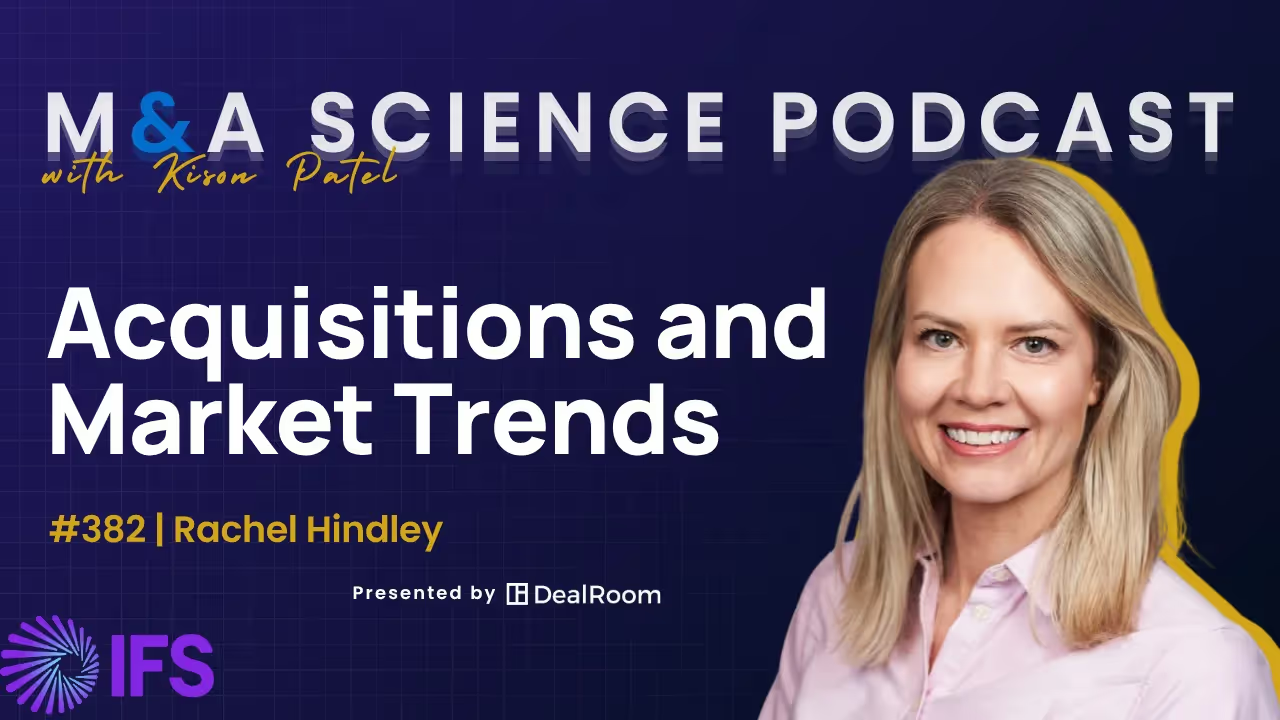
IFS is a cutting-edge cloud enterprise software company and global leader in industrial AI, empowering businesses that manufacture, service, and manage complex assets to deliver exceptional outcomes at their moment of service. Founded in Sweden in the 1980s, IFS combines organic growth with strategic acquisitions—including high-profile transactions such as Copperleaf and The Loops—to expand capabilities across six core industries: manufacturing, aerospace and defense, telecommunications, energy utilities, construction, and field services.
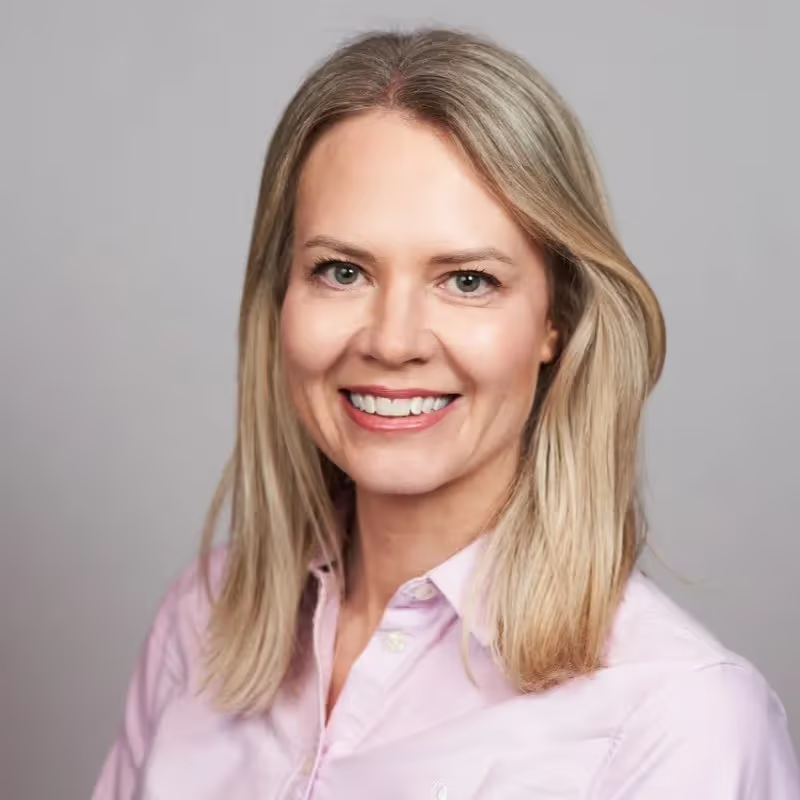
Rachel Hindley
Rachel Hindley is Vice President of Corporate Development at IFS, where she leads M&A strategy and execution for one of the world's fastest-growing enterprise software companies. With a background spanning PwC's transaction services, fund experience, and corporate development at Royal Mail before joining IFS, Rachel brings a well-rounded perspective to software M&A. She specializes in navigating complex stakeholder dynamics with three private equity backers, building repeatable acquisition frameworks, and orchestrating integrations that drive meaningful value creation across global markets.
Episode Transcript
Aligning Acquisitions with Corporate Goals and Market Trends
Kison Patel: [00:00:00] I am Kison Patel, and you are listening to M&A Science, where we talk with deal professionals and learn valuable lessons from their experience. This podcast focuses on stories, strategies, and what actually happened during M&A deals.
Kison Patel: Hello M&A scientists. Welcome to the M&A Science [00:00:30] podcast. This podcast is part of a mission to rethink how M&A is done. The old-school seller-led approach is dead. Buyer Led M&A™ is all about strategy, alignment, and efficiency—putting value creation at the center of every deal.
We uncover what truly works in M&A by learning directly from the best. For episodes, resources, and tools to elevate your M&A game, visit mascience.com and follow us on LinkedIn.
Kison Patel: I'm your host, Kison Patel, founder and CEO of DealRoom and [00:01:00] Chief Scientist at M&A Science. Today I'm joined by Rachel Hindley, Vice President of Corporate Development at IFS.
With years of expertise in M&A strategy and execution, Rachel oversees transformative acquisitions that enhance IFS’s portfolio and market presence. She has honed her skills in building relationships with sellers, coordinating complex integrations, and balancing the interests of IFS’s three private equity backers—EQT, HG, and TA [00:01:30] Associates.
IFS is a cutting-edge cloud enterprise software company and a global leader in industrial AI, empowering businesses that manufacture, service, and manage complex assets to deliver exceptional outcomes at their moment of service.
IFS combines organic growth with strategic acquisitions, including high-profile transactions such as Copperleaf and Poka to expand its capabilities and reach.
Kison Patel: Today we'll learn how Rachel Hindley and the [00:02:00] IFS corporate development team align deals with long-term strategy, integrate effectively, and balance the unique dynamics of multi-PE backing. Rachel, how are you?
Rachel Hindley: Great. I'm excited to be here. Thank you for having me.
Kison Patel: Thanks for hosting us in your office.
Rachel Hindley: And welcome to the IFS studio.
Kison Patel: Yeah—just outside of London. I appreciate you taking the time away from doing deals to have a conversation here. Let's kick things off: a little bit about your background.
Rachel Hindley: I'm from New Zealand, and I started my career at [00:02:30] PwC in New Zealand in tax. Then I seconded over to London like most Kiwis do. I moved into the M&A tax structuring team in London, mostly doing larger private equity deals. That was when I first got a flavor for the wider deal process.
I became much more interested and curious about it and thought that I'd like to pivot, which is not always so easy. So I moved sideways into Transaction [00:03:00] Services—did some valuations at PwC.
It was always my aim to move into corporate development. I went out and got a bit of fund experience and then managed to move into corp dev at Royal Mail, a very iconic British brand, and then over to IFS where I am today.
I have an incredible team, and we do super exciting deals—obviously a lot in AI now. When I joined [00:03:30] IFS, it was the first time I was working in software, which I had made clear, but it was a very steep learning curve. It is literally another language.
Kison Patel: Learned from IB and consulting. When you say funds, that’s private equity?
Rachel Hindley: Yeah, it was an alternative investment fund.
Kison Patel: So a pretty well-rounded background. You got your feet into corp dev at Royal Mail, and now you're at IFS—which is your first tech role. What was the biggest difference you saw moving from traditional industries into tech?
Rachel Hindley: It was a huge move—from professional [00:04:00] services, then to a fund, then to Royal Mail. Royal Mail is an iconic brand, but it's also a huge dinosaur of a company—thousands and thousands of people. Moving to IFS was closer to what I envisioned a modern corporate to be. It's fast-paced because it's growing rapidly, and it's really supported in an M&A environment.
Royal Mail had so many issues in the core business that M&A wasn't necessarily viewed as a well-supported [00:04:30] function. At IFS, it is—and it's an incredibly important part of the strategy. It’s a nice place to be.
Kison Patel: Fast-paced, with a different emphasis on M&A as part of the strategy.
Rachel Hindley: Probably also because we have three large, credible private equity shareholders.
Kison Patel: Can we talk about that? Because that’s always interesting. We've talked before about how different investment timelines can influence strategy. How is it having three major private equity firms on the board?
Rachel Hindley: First, it's incredible from a support perspective. You have private equity shareholders who do deals as their daily job. Being in the M&A team of one of the portcos, you just feel so supported.
It's so motivating to work in an environment where M&A is a key pillar of the strategy. That’s one aspect.
Also, during the market downturn of the last few years in software, a lot of corporates were [00:05:30] pulling back on M&A. But we do very strategic M&A—we’re not just rolling up onto a platform. Having three shareholders with deep pockets enabled us to continue doing M&A even in tough market conditions.
We're not a high deal-flow team because we typically integrate, but their support let us keep acquiring where it made sense.
Kison Patel: A lot of support—and these are highly reputable firms: EQT, HG, TA. These firms often have different operating models. Some are very hands-on, some are prescriptive. Do you see that? And does it play well together?
Rachel Hindley: EQT, up until recently, has always been the majority shareholder. They took us private in 2015. Since then, IFS has been one of their most successful portcos ever.
Instead of running a normal PE cycle every few years, they’ve rolled us into new funds and brought in minority investors—first TA, then HG in 2022. Recently HG increased their shareholding so now EQT and HG are co-controllers.
Historically, EQT has been almost the perfect balance—[00:07:00] incredibly supportive, but they let us run our own deals. For smaller deals, they won’t get deeply involved. We keep them updated, but they’re not in the model telling us what to do.
There’s a lot of trust. Over the years, we’ve delivered strong results.
Rachel Hindley: Having HG come in has been really good. They are a software-specialist PE fund, so their depth of knowledge is incredible. Getting different perspectives—“Have you thought about this?”—is hugely valuable.
TA is a bit more hands-off. But collectively, they present a united front. I can’t say many bad things about them—they’re genuinely nice people.
Kison Patel: Does the majority owner typically have the most influence?
Rachel Hindley: It used to—until they didn’t. Because for each of our deals, unless it’s a very small one, it goes to the board. Each shareholder has a board seat. So decisions are collaborative.
Since I’ve been at IFS, there hasn’t been a situation where one firm vetoed a deal.
Kison Patel: Have you seen any challenges from having three different PE firms on the board?
Rachel Hindley: Yeah, it comes with a definite level of complexity in that. They, I'm sure, above my pay grade to know what their actual exit time horizons are, for example, and we're a corporate business. We are looking at it from a long-term strategic [00:09:00] perspective and what makes sense for the business.
Rachel Hindley: But we do have to obviously interplay that with what the business needs to look like, or you want the KPIs to be strong in the year before and leading up to an exit event. So. For example, we've just had one, so this is a good time in the cycle now 'cause it's probably longer till another ex exit event.
Rachel Hindley: But in the last few years there's a few factors that make it difficult. IFS is, has is such a strong performing business on both the [00:09:30] top nine and our rule of 40 is like very high. And therefore if you're finding a relatively large target, it's actually really difficult for us to find a business that's not dilutive to our KPIs or if it's loss making, but of really strategic importance to the business that would be really good for us long term.
Rachel Hindley: But it's loss making for the foreseeable, like next 18 months in a time leading up to an exit event that makes it incredibly difficult to meet the priorities of the shareholders at the same [00:10:00] time as meeting the priorities of the business. And what we do to try and mitigate that is. We come up with a pretty robust business plan that really needs to be able to show a path to profitability within the next 18 months to two years.
Rachel Hindley: I would say if we can show that it's of such strategic importance and it's gonna be in the future, very accretive for the business that helps with the shareholders. But I don't think, for example, if it was loss making and it was not growing well that would just be a no go. When you're looking at the [00:10:30] rule of 40, there has to be some benefit.
Rachel Hindley: You can't be loss making and off poor growth and not have a trajectory to turn around within 18 months. We wouldn't buy a company like that anyway.
Kison Patel: That's so interesting. Now I get the complexity. HP firms got their exit horizon, which is influencing their strategic view on the business. And then you have your business having its overall long-term vision that they're building a strategy against.
Kison Patel: And then when you look at your specific investment opportunities, some could be near term, uh, get creative. [00:11:00] And so maybe long term, like all the AI stuff everybody's looking at right now, there's some distance out there balancing that out. It's uh,
Rachel Hindley: yeah, it can be really challenging. And we're seeing that, like you say with these, with the AI ones, what is easier for us is if it's a smaller, like if it was a product built on, it's an, is an easier sell if it's not dilutive by virtue of materiality.
Rachel Hindley: So obviously IFS is pretty large now that can be one mitigating factor. So if it is a smaller company and the dilution isn't there, then it doesn't raise the same [00:11:30] flags as if it's a larger dilutive company. But of high strategic importance. Copperleaf we acquired last year was of huge strategic interest to the business and we actually chased that for quite a long time.
Rachel Hindley: It was a listed in company in Vancouver and it was loss making, but we had a very, very robust plan to turn that round to profitability. And I think we have, so it's one that we could see where we could execute well.
Kison Patel: So that's the big goal. I think the common ground you mentioned is that 18 month or or so [00:12:00] horizon to become profitable.
Rachel Hindley: Yeah. And
Kison Patel: then you can take those bets that may. Most
Rachel Hindley: people aim for that, don't they?
Kison Patel: They say they do.
Rachel Hindley: When you see the ims, they're always like, we are gonna be profitable in 18 months.
Kison Patel: That's true.
Rachel Hindley: Yeah.
Kison Patel: It's interesting 'cause right now it's just some of those segments, like AI being one of 'em, they're trading at really high multipliers.
Kison Patel: What's your view on that? What's the census between your company, even the pe and everybody's looking at AI and making bets for it? I think that'll probably lend into just your view [00:12:30] on m and a and just the different types of, of strategies and types of m and a that you execute.
Rachel Hindley: I can talk to how we think about it in terms of.
Rachel Hindley: Archetypes, but also then laying in AI now as well. So traditionally we look at it across four different archetypes and that helps us really set our investment thesis and we try and make that. Then a little bit like, okay, well if it's this archetype then it's gonna be this way forward. And the business integration wise, we have a product bolt on archetype and that's our typically smaller companies [00:13:00] basically looking to fill a gap in our current functionality that might come about because the go-to-market team are feeding back to us that we're in the loss feedback.
Rachel Hindley: It might be that a customer's highlighting a particular weaker part of the product versus competitors. If they see that on a consistent basis, then that becomes a problem. And then we have to go and say to the r and d team, okay, is this in your roadmap for the next 12 to 18 months? Okay. No, it's not.
Rachel Hindley: There's not enough resource there for it. Okay. Well that probably makes sense for m and a to go out [00:13:30] and screen to fill that gap. It can be challenging and the value thesis is that you integrate quickly. 'cause it's just a product integration you can rationalize in the synergy on the back office and usually on go to market.
Rachel Hindley: But the value creation is really just is a little bit of a defensive case because you're saying, okay, we might lose these deals. We might be losing some deals if we don't have this functionality is really hard in a business case to say, how much more are you selling? Because actually it's just part of.
Rachel Hindley: IFS cloud, like we have one main product and [00:14:00] it's hard to then say, okay, you can sell this for another a hundred K. 'cause realistically what happens is they have a price list and then you negotiate the sellers negotiate on how much you pay for the product. But if you don't do it, then you might start losing deals.
Rachel Hindley: So it can be a difficult one, and we do it on a buy V build basis. You look at it, okay, how much does it cost to build? Problem is that hits your p and l if you bring in more r and d resource. So actually doing m and a can be quite good because there's more funds usually on the capital side to do it as an m and a rather than through a [00:14:30] build scenario.
Rachel Hindley: Another archetype we look at is customer migration. So that's essentially where we want to either consolidate in a particular segment. Often it's an industry basis, so we might want to just increase our market share in an industry. Our USP at IFS is that we're leaders in industrial ai, so we stick to six core industries like manufacturing, aerospace and defense, telco, energy utilities, construction and field services.
Rachel Hindley: And we really stick to those industries. We don't [00:15:00] really deviate too much out of it. So for example, we did a deal in aerospace and defense of a migration case, so we just wanted to take on some more share. It's obviously big airlines, but it's a big deals, but a smaller market. And in that case, we would try and migrate the customers pretty quickly, their product onto our product.
Rachel Hindley: We obviously, there's a fair amount of churn that goes into that and then sunset the product as quickly as we can and you can obviously get synergies through the back office. Then that's through sort of enhanced deals from having better logos and better brand [00:15:30] recognition in the market. Then we would have market entry type archetypes.
Rachel Hindley: So that's where we're going into sort of an adjacent segment. And you know, they'd have their own go-to-market team. We'd want to retain that. They might be in a certain industry, so have better expertise than we might because it's an adjacent segment. And Copperleaf was an example of that. So that was in asset investment planning.
Rachel Hindley: We're strong in enterprise asset management. That gives us a broader suite to offer to our customers. So like really [00:16:00] good cross sell revenue synergies. Then you can also sell at standalone, but also bundle it in with IFS Cloud. We would still typically integrate for those types of transactions as well.
Rachel Hindley: And then the last one would be just a, a new strategic platform or like a new business line completely where we would be. Buying in the whole business to keep it, there wouldn't be a lot of cost synergy there, for example, unless it was back office because you're really looking to bring in a whole new line and drive a whole new go to market.
Rachel Hindley: So you're probably hiring more than getting rid of people. [00:16:30] And the loops is a probably a good example of that. And a slightly, I guess, segue into AI and that as with all software companies, we are having to move very quickly now into the AI space and we say we are leaders in industrial ai. The market's just moving so quickly.
Rachel Hindley: So we acquired the loops as of just a month ago, which was a small Silicon Valley startup in the Agen AI space. But in their go to market is customer [00:17:00] experience completely outside of our customer base. Obviously we were a customer, which is how we got to know them. And they obviously sell to it, service companies and that type of thing.
Rachel Hindley: What we've done is bought them not for their current go-to market, but we bought them to basically form our entire agentic platform for IFS and we like then going to build, or should be now building our own IFS industrial agents on top of this platform to be able to like roll out to our [00:17:30] customers as our agent offering if we hadn't acquired the loops.
Rachel Hindley: And it's a small business that you end up, like you said, it's just a different world of valuation. You are looking at something more scaled. It would be like hugely expensive, something that we wouldn't be able to afford to acquire. And this gives us basically like a 18 month, two year head start. It was already in our roadmap, but I mean now software companies can't afford to be talking about moving somewhere in 18 months because you would be totally [00:18:00] redundant in that time.
Rachel Hindley: We acquire these to say we need to remain valid, valid in the market and not become a legacy like software business.
Kison Patel: I wanna make sure I can recap the four different archetypes. Let me know if I missed anything. The first one we covered was bolt-ons, and this is essentially acquiring a feature set that maybe this would bridge a roadmap gap.
Kison Patel: It's a a business that you would want to integrate quickly, and we mentioned this a lot of times could be more about defensibility, that hey, this could [00:18:30] help us be more competitive and win more deals as opposed to betting on just pure revenue synergies from it. Those are the bolt-ons. And then the migration cases are more focused on consolidation when you want to increase market share in a certain area, so there's more buy-in competitive product and you're likely to try to migrate the customers as fast as possible and sunset their technology so you can achieve cost synergies from it.
Kison Patel: We have market entry. This is when you're moving into adjacent [00:19:00] spaces. Use the example of having the asset management product and then acquiring the investment planning, which would be a nice adjacency that could. Fit into maybe a cross sell with your existing platform. Yeah. And then the new platform acquisitions, when you're buying a whole new business line, something kinda a completely different go to market, which is where we use the loops example and bringing agent ai, that's becoming a whole new offering to the tier customer base.
Rachel Hindley: Exactly. Spot on.
Kison Patel: I'm ready to go work in Corp Dev now like I got [00:19:30] it. This is
Rachel Hindley: Software corp dev. Yeah.
Kison Patel: The AI is interesting because you used the example of of looking at it as a whole new platform. Could that fit in any of the archetypes? If you're looking at AI companies
Rachel Hindley: of our current archetypes?
Kison Patel: Yeah.
Kison Patel: Because you could say, Hey, here's a feature set, but now maybe it's not like a whole new platform like the Gentech example, but here's like AI features. How do you think of just AI in general as it fits into your strategy? Is it more about building out this new [00:20:00] products completely or is it also looked at as enhancing current products?
Rachel Hindley: A lot of it is for our, our current customer base. So this is where customers that already have our IFS cloud product, when we look at IFS Cloud, historically it was an ERP backbone and then it's enterprise asset management and field services management. It's all your sort of core. Software companies are still gonna need all of that software.
Rachel Hindley: It's just that you'll then have all of the AI and agent. Motions to go with that. [00:20:30] So a lot of it is basically like not replacing what they already have. They'll still need to have IFS cloud for all of their systems of record for your asset maintenance and things like that. And the agen and AI still need to be able to extract all of that data.
Rachel Hindley: So this is one of the things we're doing with the loops that takes time. And it's like probably going technical, but like they need to build these connectors through to IFS cloud because you need to have all of the data to be able to still, and then build the agents to go and orchestrate [00:21:00] all of their use case, but they still need access to data.
Rachel Hindley: So you can't just say, Hey, I'm just gonna go and sell you our agentic. Right. Offering
Kison Patel: part of the suite. They,
Rachel Hindley: it's part of it, it's a, it's like an enhancement. And we're at the moment, like if FS is going out and doing, going out to customers, our larger customers and taking a team basically to go and customize AI solutions for them.
Rachel Hindley: These are all current customers to start with, and then obviously for new customers it'll be an offering of IFS Cloud with the AI [00:21:30] packages along with them.
Kison Patel: Got it.
Rachel Hindley: This is coming from a, I don't want to go over my skis. I'm not a technical person.
Kison Patel: As you're talking through, I was starting to think of we, we talked about just how integration, I was thinking about the first example, if it's acquiring feature sets for the Bolton fully integrate quickly trying to get a sense of like what's the variability of integration, because when you do a whole new platform, but then you use this example of ai, like it's ultimately feeding back into overall platform.
Kison Patel: That's your system of record. There's a level of [00:22:00] integration. Does it vary in terms of just partially versus fully integrating
Rachel Hindley: for AI or just in general?
Kison Patel: In general, I guess because I guess AI just part of the piece
Rachel Hindley: integration, typically, as I said, we're not, this is why we don't, we're not a high deal flow team.
Rachel Hindley: We look at four to six deals a year, slightly increasing with the level of ambition, but. Realistically why that is is because we typically integrate, we are a strategic acquirer, like it's all typically to enhance our current offerings for our [00:22:30] customers so that we can sell more into the broader set on that basis.
Rachel Hindley: If I look at our archetypes, we would always integrate product boltons migration cases and typically market entry where we don't fully integrate. And an example of this was we acquired poker a couple of years ago and they are a smaller connected worker platform. That was our first foray into something that was more frontline worker focused rather than if FS is more about the asset side of it.
Rachel Hindley: In [00:23:00] that case, there were two young guys that were the founders. Really lovely guys and we have kept them standalone actually, so we haven't integrated them at all. The thinking was because it's not going to be necessary to integrate the product into IFS Cloud, we have a connector so that you can sell it alongside or under it with IFS cloud, but you can also sell it standalone to their current market.
Rachel Hindley: It was thought that like they're relatively agile, like dynamic company that sometimes. That's better to hold standalone rather [00:23:30] than overlaying larger behemoth of a corporate onto them. Obviously the founders will feel it and the the core management, 'cause they still have to report through to IFS, you get the beauty of being able to leverage IFS for all its go to market engine and scalability and like knowledge.
Rachel Hindley: They utilize Sri Lanka like to take on new resources. It's like more offshoring but they can still retain their, a little bit more dynamic entrepreneurial style and it's gone really well. So they're smashing their, I rarely hear
Kison Patel: about this. Usually it's [00:24:00] cut it off. They've put the website, we've been acquired.
Kison Patel: You're no longer selling direct. I
Rachel Hindley: know I was checking in on them the other day. They're going really well and beating targets and something like cross sale is always really difficult and most people will talk about this in software companies. It's, it sounds good in theory, but it's quite hard sometimes to orchestrate just because you know, you have to get the sellers aligned to actually sell the product.
Rachel Hindley: And it might be a smaller company, so if it's a smaller company and it's lower, a RR are these sellers who are incentivized to hit their [00:24:30] quotas, going to take on a lower a RR product if they can do a bigger sale elsewhere, they need to align incentives as well to do it. But I hear that it's actually going pretty well and they are doing really well as a business.
Rachel Hindley: Striking the balance between staying standalone, but then having like a parent here who can actually provide value to you and support,
Kison Patel: it's interesting. It'd be fun to talk to them because here's your organic path to growth. They had in mind. And then obviously you have a vision of how it's gonna be a creative with [00:25:00] your broader ecosystem.
Kison Patel: Yeah. And a lot of the thinking is always, let's focus on this new strategy. And then, like I said, that's how all these tales of startups getting blown up by large organizations happen is because of that small company can be fragile at that growth stage they're at. But I was curious is that there's so much more overhead trying to do both where you're trying to, you know, maintain their current growth, but then also achieve the big drivers that you expected from them.
Kison Patel: From the larger company side,
Rachel Hindley: I don't think so. You know, there are aspects to the setup. There are, for example, some third party contracts or [00:25:30] like to company contracts in place to make a arm's length that it's definitely not integrated. But I don't think there was a whole nother layer of overhead put on the business.
Rachel Hindley: More so they've managed to, and I, you know, there's probably a recharge in there, but they've managed to leverage. IFS quite well as well in the areas where they were probably lacking. And there is the element, like you picked up on there, that there might be a different strategy that they were thinking about in their head versus there could be a strategy that IFS are [00:26:00] thinking about.
Rachel Hindley: And those two strategies, long term might be different. So that's something that they would have to be aware of because they've been acquired. Like there's certain aspects to being acquired. For example, we help them with a separate track on m and a, for example. We actually do help them think about their own separate m and a strategy for poker and what would make sense for them.
Rachel Hindley: And we do, it's a very collaborative, we listen to them, but there might be an example, and there isn't right now, but there could be an example in the future where we might have a different [00:26:30] idea about that, about what we think is the m and a strategy for them. IE do. We wanna make them a broader platform, they might not want to.
Rachel Hindley: So I can see that those could be examples of where there could be future tension, but at the moment it is going well.
Kison Patel: I talk a lot about buyer led m and a. I'm trying to create some kind of cult movement and a lot of it's just a lot of these podcasts and working with Corp Dev, they just see aspects.
Kison Patel: It's like, why don't we put this all together in a framework? And one of the pillars is connecting diligence integration, because I feel like this diligence itself is the foundation [00:27:00] for your integration planning. And I'm curious, 'cause you're coming from a larger organizations, I know you have a bunch of different work streams.
Kison Patel: How do you do that? How do you approach diligence on a company like this where it's smaller in size, larger entity, cover your basis on the diligence and then set up for a successful integration?
Rachel Hindley: At the moment anyway, the size of the company doesn't dictate too much how we approach due diligence and IFS is quite unique in that we bring a lot of people into the process for commercial due [00:27:30] diligence.
Rachel Hindley: So. We do. How many people are
Kison Patel: we talking about
Rachel Hindley: a thousand. But we do,
Kison Patel: if I'm a startup and I get on my first diligence call, it's like a zoom with
Rachel Hindley: sometimes that is the case. Yes, that could look a little bit scary. But what is good is that in commercial diligence, we have a point person for every work stream and that person is where possible the same person on each of our deals.
Rachel Hindley: So there's now an m and a kind of commercial lead, usually on top of their day [00:28:00] job and where possible that same person is the integration lead as well. And this is where things are really, we've refined it and it's getting a lot better, is that we have a pretty seamless approach to it now because those, all of the people who are involved in the commercial diligence have all the knowledge, all the insight, and then are the same hopefully set of people that do the integration.
Rachel Hindley: So ideally there shouldn't be this gap where things fall through the cracks between the people handing off the deal [00:28:30] to the integration team. So, and
Kison Patel: the function, it's the same person that's doing diligence and is responsible for the integration.
Rachel Hindley: Yeah. We try and make it fairly repeatable. For example, things like your underlying technology and architecture back office related, and think on the support organization, because that's agnostic to a deal, obviously depending on the industry, then that's where it differs.
Rachel Hindley: It might be a different r and d product team because if it's A and D, it'll be the A and d team and there'll be an A and d go to market team. So that's where it gets more [00:29:00] specific. But in general, a loss across a lot of the work streams that are standardized. It can be the same person and that is work working really well.
Rachel Hindley: 'cause we try and run pretty tight deal timelines because we involve so many people in the process. We want to minimize the amount of distraction both to the management team of the target and to our organization. We try and run them quite fast, but people are like, they know what the process is. We have pretty standardized management meeting agendas.
Rachel Hindley: We run all our commercial diligence with management meetings. And yes, sometimes there [00:29:30] are a lot of people that turn up to these, but it's better for the management too because we might run it over three days and then it's quite condensed for them rather than spreading it out over weeks. And then we know they know what they're supposed to write up, they know what the red flags would be because they're used to the process and it becomes pretty streamlined for us.
Rachel Hindley: And because we're, we only outsource the standard things of finance, legal, tax, insurance. Because we integrate most of our deals and because we are a strategic acquirer, not a platform rollup, the [00:30:00] people at product is usually one of the most important things and go to market, those people have the most expertise in our business to be able to opine on it versus a third party because they're gonna have to understand how integrates into IFS, how does it fit with our current product?
Rachel Hindley: How does it fit with our current go to market? No other commercial diligence provider can tell us that we have the best expertise in house, so it works really well.
Kison Patel: Keep it in house. 'cause you ultimately you should own the work.
Rachel Hindley: Yeah. And also it makes, I chuckle
Kison Patel: because some of this stuff ends up on LinkedIn and I [00:30:30] get comments from folks that wanna sell services.
Rachel Hindley: So I would caveat and say where we have brought in lately some tech DD providers is on the AI side. Because we're still evolving in our AI expertise and the number of people who are AI experts, we felt that we'd want to compliment the tech DD process by bringing in a third party. And that's actually worked really well.
Rachel Hindley: So in instances where we are not the specialists, then we do bring in people.
Kison Patel: This is one that I've been thinking [00:31:00] about is like customer diligence. Where in some of the stuff it's like looking at competitive products. Hmm. And there's like already this bunch of sensitivity about talking to the customers or engaging with them.
Kison Patel: I don't know if you've ever had any. Experience with that, like getting a third party to,
Rachel Hindley: so we always do VOC voice of the customer as part of our diligence. So we do two types. We do one typically really early on, which is more outside in. So we'll engage a provider that's, there's many of [00:31:30] them out there now, but that works with identifying either customers or if we wanna know about, get glimpses from past employees, et cetera, as a, as to the business.
Rachel Hindley: So we do that type of diligence, which is usually super useful as long as you get a good H 10 interviews. And then once we're in the process, we run a customer diligence as well. So we'll get the management or founder, CEO to do the warm introductions and we'll ask them for their top, depending on the size of the business, but we'll ask them for, say, their top 10, 15 [00:32:00] a RR customers.
Rachel Hindley: And then they'll have to outreach to all of those customers with, uh, kind of warm introduction for this other outfit we use. With the guise of a operational feedback session to say, we're like wanting to get feedback from our customers and it's all you can. So the
Kison Patel: customer doesn't know, they just think it's just, Hey, we're gathering general feedback.
Kison Patel: Yeah, participate. Yeah, because it's warmed up
Rachel Hindley: by the management. Yeah. That's really effective because it is with a third party, so they tend to be very honest. It's not like they're like, oh, we better not say anything bad about the company. And then what [00:32:30] is really useful as well is that unless there's something terrifying and we cut the deal, we package it up, and then when we've closed the deal, we give it all to management because there's really good insights into how they can improve.
Rachel Hindley: I just want one
Kison Patel: question on the survey. How likely are to churn on the next renewal?
Rachel Hindley: Yes, we do. It's part of it. Our supplier will have it in their report and it will list like red, amber, and green around their likelihood to churn.
Kison Patel: This is cool. To me, this is one of the biggest things, and it's helpful actually here, how you [00:33:00] approach it when working on these kind of software deals.
Kison Patel: You wanna know the quality of revenue, you wanna know what direction it's going, what churn risk is. Does it still apply with these mitigation deals? Because this is like another. One where if you don't have a predictability on that churn from mitigation, it can really throw your model off.
Rachel Hindley: Oh, sorry. On migration.
Rachel Hindley: Oh, sorry, yeah. Migration. Migration, yeah. So on mitigation. Mitigation,
Kison Patel: uh, yeah. I'm sorry. Wrong migration.
Rachel Hindley: Migration, yes. It's different because we can't ask them if they're [00:33:30] going to migrate to us during a deal process. I know that's
Kison Patel: what makes it tough. Yeah. So like how do you predict it? Maybe you got past experience to reference.
Rachel Hindley: Yeah, but
Kison Patel: that's one I've been struggling with.
Rachel Hindley: The way we model it is, I would say fairly conservatively. And yes, we have, we look at past experiences to levels of churn. It forms part of the case, so you will have a certain proportion of migration each year. Then you'll have a certain proportion of churn, and then you'll have like a final churn.
Rachel Hindley: 'cause obviously the customers in five years time, they haven't migrated, are pretty likely to churn. [00:34:00] But then you get the uplift as well on the conversion. These cases, a lot of them a. At reality, they are likely to want to migrate because they want to be able to use the functionality.
Kison Patel: So what's that?
Kison Patel: That's why when you model these things out, it's like, here's bolt-ons that are more defense oriented deals. Here's migration, which is like you're betting on how much you're gonna lose, and then you have market entry, which to me sounds the most interesting. There's some clear cross sell and uplift opportunities there.
Kison Patel: There's a [00:34:30] certain category, it's like clearly better investments than others because I feel like everybody still wants a high valuation, especially in software.
Rachel Hindley: Yeah. But then it is that thing, like I said, product boltons are so, they're actually really difficult cases for us to build because it is really hard to prove the value thesis.
Rachel Hindley: Having said that, there was one that we were looking at where it was just so clear that they were referencing it in loss feedbacks on deals. So where you have it like actually [00:35:00] referenced that this particular functionality is weak multiple times, even if it doesn't seem to make sense, it just becomes a like, well we have to get it.
Rachel Hindley: What we do is then we just, we state the number of deals that have stated this and then you're like, you are losing X number of a RR because we haven't plugged that gap or we haven't got strong enough functionality. It's not the most exciting, like you say, I mean doing a copper leaf or the loops is exciting and, but they are still really important deals.
Rachel Hindley: And also just to consolidate the space. Sometimes if other [00:35:30] vendors are gonna do it, you don't wanna miss out either. They've all got their place, but I agree it's more exciting to do market entry transactions.
Kison Patel: Wouldn't the deals get more. Or it's a complicated but unpredictable. The further away you get from your core,
Rachel Hindley: sometimes because we like to involve a lot of people, there's a lot of expertise that the executives will gain comfort from.
Rachel Hindley: That's another big thing. There's a lot of leaning in in the business, and that also means that there's a lot of executive lean in because when it goes [00:36:00] to our go, no go, which is essentially like the C-suite signing off on a deal, every single C-suite person has to agree. And that means that they have to understand and have signed off on what their work stream has said either in DD or in the assumptions in the business case.
Rachel Hindley: So from that point of view, it's like incredibly important that you have the expertise and then you have the executive to sign off where you get away from the core. Obviously you have less expertise in the business. And that's where it can get a little bit more [00:36:30] uncomfortable because we are used to having a lot of it being easier to say, I really believe in this, and then you can trust that that person understands like why it's a good investment.
Rachel Hindley: Once you get away from the core, that's when we start to bring in more third, third party providers because suddenly we're like, this isn't, for example, AI in the loops. Like we didn't have a strong agentic level of expertise in the business yet we've been investing in a lot obviously of resource and ai, so our executives wanted validation from third party to say, okay, well is [00:37:00] this a defensible moat?
Rachel Hindley: Could this founder go off? We close the deal, we don't manage to retain them and could he go and build in is garage in three months? Is that kind of thing, which the business at the moment, we didn't have the expertise to opine on, so we need to go out and get that third party validation.
Kison Patel: So know what you don't know.
Rachel Hindley: Yeah,
Kison Patel: I brought up revenue and customer because that's my big ticket and I'm learning right now, especially looking at that in diligence and and bridging it over to integration. What's your big ticket in terms of really nailing down [00:37:30] diligence, integration, set up the deal for success,
Rachel Hindley: as in what's important from going from due diligence into integration?
Kison Patel: Yeah, and just, or just in general with the deal. Make sure you don't screw this up and things will go well.
Rachel Hindley: Integration
Kison Patel: if you click into it, what does that mean? Yeah,
Rachel Hindley: it's interesting 'cause I don't typically get involved in integration. Our team does origination through to execution and then we are obviously involved in integration from the outset.
Rachel Hindley: 'cause the very lead from the outset of the deal, the overall integration lead starts with us and runs with us right from the beginning.
Kison Patel: They're there in the [00:38:00] beginning
Rachel Hindley: doing the planning as well. And then
Kison Patel: their quarterbacking, all those work stream leads that are overlapping. Yeah, we,
Rachel Hindley: we co-lead basically the commercial diligence because realistically the integration head is the person that's actually going to be responsible for all those work streams going forward.
Rachel Hindley: So actually in a deal process, the corp dev team and the integration lead, co-lead,
Kison Patel: that's actually interesting
Rachel Hindley: commercial diligence, which makes sense because that person is gonna be the person taking it further. I would say in terms of the question, having seen and helping out on [00:38:30] one of the integrations, it's so important to separate, and it might sound very simple, what systems integration is versus value creation.
Rachel Hindley: People talk about integration, they'll just say, and we need to do the integration. But actually I think sometimes people are confusing what integration is systems integration. Some people just think it's systems integration. It's like, well, our IT team like run and project manage systems integration, [00:39:00] that's integrating people, processes, systems, getting 'em on the email and all that kind of thing.
Rachel Hindley: Invoicing and the practical elements, which are very important. But the whole piece around value creation is really where you lose the value of a deal. You have a business, and this is why I did learn in the deal process now, having seen integration, is that you go out into the business, we talk to go to market, we talk to r and d, we talk to everyone.
Rachel Hindley: And like we build our business case around what can we do? How can we drive synergies, how can we do cross-sell? How can we, [00:39:30] where the cost synergies? And then you take that, this case is signed off by the board, there's an executive sponsor who's accountable for the whole thing, and then you move it. And then we close the deal and then integration takes over.
Rachel Hindley: But if you don't have a slick value creation plan, which really is derived from all the points in the business case or how you're going to hit the numbers. You so quickly can lose value because our business cases, like I said, if you are talking about an 18 month to two year turnaround, if it [00:40:00] was loss making, you've gotta really get outta the blocks pretty quickly.
Rachel Hindley: If you have to hire another 10 heads to help you sell well, you need to get onto the recruitment. It's the value creation piece, which is where it's so easy to lose the value of a deal and you'd know from talking to everyone, but it's momentum. So if you're out the block slow, it's not the first year.
Rachel Hindley: 'cause usually there's momentum in their own pipeline, et cetera. But if you're not putting in place all of the things that we wanted to do. To drive the business case and to hit the numbers two [00:40:30] years out, that's where you start running into trouble because you have to be on top of what each person, what each work stream said they were going to do.
Rachel Hindley: And it's all good that we talk about it during the deal and we're like, yes, we'll do that. We'll drive cross sell this way and we'll get these people, we'll get this team to help sell that. And then you're like, have they started doing that? No, they haven't.
Kison Patel: It's like the integration plan really needs to be built around this north star of what the value creation, I guess vision is.
Kison Patel: It then turns into an executable plan [00:41:00] of the Integr integration plan. And then you have your tactical stuff you gotta do where people, yeah. And this week we're, we're, I hear the stories of people getting lost in integration. It turns into the checkbox activity because, hey, I downloaded this template off the website on how to integrate a company and this is what we're doing.
Rachel Hindley: And it's just so specific to, to every deal. And I think some, like I said, Copperleaf and our, our head of global integration, he was full-time on that. I mean, and did a really, really slick execution on it because it did [00:41:30] require a huge restructure and turnaround. And that was pretty much from day one. And it's so customized.
Rachel Hindley: It's literally driven off what is in your business case. You can't just get a template and say, this is what is a successful integration. What did you say? How many deals did you say you were going to sell additionally next year? And how are you gonna sell them? And what do you need to do to get there to sell them?
Rachel Hindley: And that's what should be in your value creation plan.
Kison Patel: You have that part of value creation plan, which drives integration plan. I'm curious about [00:42:00] the cultural piece. 'cause we haven't brought it up yet and it comes up in every conversation. How do you look at that part of it? Is there elements or just considerations around that part, does that affect how you integrate a company?
Rachel Hindley: Oh yeah, for sure. I use that example with poker. They were young. We wanted to retain their, they were in Quebec, like very different culture where you want to retain the people in the business. You have to be very careful, obviously about cultures like common sense. I'm sure some [00:42:30] people were, if you're gonna remove half the business you are, you're at risk of removing the culture anyway.
Rachel Hindley: But the loops is a good example. So they're a Silicon Valley startup that's like worlds away from someone like IFS. And I was talking obviously to the founders every day and it's such simple things. But I was very cognizant of making sure that it was super important on this deal that we retain the team, the r and d team, they're mainly an r and d team in ag, agentic ai.
Rachel Hindley: We needed all of them. One of [00:43:00] the first questions other than there's the whole retention side around the monetary retention side, but that's not enough usually for these types of people to retain them. It's like the way that they like to work. So there was really seemingly simple things, but important to them.
Rachel Hindley: So we allowed them to keep MacBooks. We don't have MacBooks. I mean it sounds silly, but like it was super important. Imagine having to make them go onto like a Dell laptop. I mean, it would cha change their way of working.
Kison Patel: It's so true. I remember I had a vendor and during the process they [00:43:30] got acquired by big top 10 tech company and it was funny 'cause I'm talking to sales rep, our account executive, uh, I was just curious like, how's the integration going?
Kison Patel: And he was like, uh, this and that. Then they finally opened up, he said, the one thing that pissed me off was they took away Slack and I, and I asked him, I said, well, do you think it like impacted productivity is like huge. We religiously use Slack now we gotta use this other crap product that everybody hates.
Kison Patel: Yeah.
Rachel Hindley: And like, people don't think about as something that's seemingly simple. 'cause you'd be like, of course you just integrate the system. But if it changed your [00:44:00] entire business's way of working for a small company as well. So we were, yeah, things like MacBooks
Kison Patel: to away my MacBook, I wouldn't be happy about it.
Rachel Hindley: Even things like tooling. Obviously we can't allow the whole, you know, the whole of if FS isn't able to just use whatever tooling or go and get trials of tooling and to use in product, they were used to being able to do that, to enable them to work quickly or efficiently or they were obviously in that world so they could, they'd be like, oh, let's trial this new product new.
Rachel Hindley: So [00:44:30] to a certain degree we have to, within the, there's a bit of complexity around obviously making sure that the security protocols are there now that they've been acquired, but allowing that as well, but which is different to the rest of the organization. But it's like you're still asking them to do a really different type of.
Rachel Hindley: Piece of work. So we were, for that ex cultural retention of culture was so important. And I always make sure, this is one thing I do make sure in deals is that we stay close to, particularly in founder led deals, you stay really close to the [00:45:00] founders that you're dealing with because there can be a lot of confusion.
Rachel Hindley: If it's their first rodeo for example, then it's all new to them. Usually they, they should have a good advisor, but it's just things can be confusing. I dunno. They need to roll a certain amount of their shares into IFS equity. Do they really understand it? We bring in the expert and the equity to make sure that they understand it.
Rachel Hindley: You don't wanna feel like you don't know who to talk to or like, this bit was confusing that someone told me, but you also don't want 50 people coming at them either. So we try and make sure that we keep it streamlined and they know that they can ask us [00:45:30] anything really and approach us and say, I need help with this.
Rachel Hindley: I think it helps avoid confusion where they don't know what, for example, she was like, oh, what can I communicate out to my employees day one is it is all that type of thing. Yeah. It's just making sure that there's like continuity and transparency basically.
Kison Patel: There's a lot. You have to be mindful with culture and that's gonna help shape how you integrate the company.
Kison Patel: Mm-hmm. There's gonna be some trade offs there. Your company's very distributed or is the company founded?
Rachel Hindley: Sweden.
Kison Patel: In Sweden.
Rachel Hindley: It was an interesting story 'cause it started with [00:46:00] three guys from university who pitched a tent outside a nuclear power plant in Sweden. And they were asked to do, basically set up their really initial basic asset management system.
Rachel Hindley: So they just slept in a tent next to the power plant and that was the beginnings of IFS. So we do say that we try and obviously as a business gets larger, it's difficult and you grow globally. But we do say that we try and maintain that original kind of [00:46:30] entrepreneurial. Spirit like the resilience, grit is like some of our core values and I do think it like resonates.
Rachel Hindley: Like people are always willing to lean in, get their hands dirty, and I see that with m and a, like super supportive, always giving you time. And this is senior executives as well,
Kison Patel: resilience, grit. The Swedes are always friendly. Is that part of the culture too?
Rachel Hindley: Yeah.
Kison Patel: Friendly and forward. Maybe the balance.
Kison Patel: Yeah. And a
Rachel Hindley: holiday for the whole of July. So that's handy.
Kison Patel: I know I've met a lot of them when I was in south of France the last couple weeks.
Rachel Hindley: I'd like to do that too. But no, [00:47:00] we still have a strong Scandinavian presence, but obviously we have a large amount of employees in Srilanka now as well.
Kison Patel: Companies diversified.
Kison Patel: Is your m and a team is diversified and decentralized as well?
Rachel Hindley: No, so we are pretty much UK centric team. Okay. Actually a lot of the executive team are UK based now. Got it. We obviously sit closely to them and the inorganic strategy of the business. We do all of the deals globally to be fair. We do a lot of North American deals.
Rachel Hindley: We orchestrate it all from,
Kison Patel: [00:47:30] yeah. Wow. All central here.
Rachel Hindley: Yeah.
Kison Patel: That's interesting. That's a whole other interview for us to maybe even actually a group I can think of podcast I've done where it's completely decentralized to, very centralized to in between. Yeah. We'll have to pick that up. We do a quarterly head of corp dev conversation.
Kison Patel: Be a fun topic to break down of just
Rachel Hindley: I know. 'cause I can see how there would be benefits to having North American based people having said that, like when, I dunno and uh, how teams work, but we have, for example, our core support functions say of like [00:48:00] legal tax, finance. So we have a North American tax person who then supports us on, from a tax perspective, we are not doing that.
Kison Patel: The thing I was curious about was getting actionability on these deals, if that's what was part of it. And I've seen it a lot with like rollup. You're doing international rollup, you definitely have localized biz dev folks that are really sourcing it and getting the deals actionable. How does that work with your organization?
Kison Patel: Are you directly there talking to the founders and getting them to that point that they're [00:48:30] ready to sell? Is it business unit leader leading that? Is it CEOs of the firm? Is everybody Yeah,
Rachel Hindley: we, they get '
Kison Patel: em on a Zoom call with a hundred people and
Rachel Hindley: we do a lot of origination in our team as well. But that is another great benefit of three massive private equity shareholders is that our network is huge.
Rachel Hindley: They're all, they're all,
Kison Patel: that'd be, that's a big part of their playbook.
Rachel Hindley: Exactly. I mean, look at how many they would do it to all their port codes. How does that
Kison Patel: work in terms of pipeline? Because a lot of times a PE firm has a pipeline that they're using to support their [00:49:00] port codes. So do you have like three pipelines within the three different PE firms then your own?
Rachel Hindley: We have a monthly check-in with them where we run them through our whole pipeline. Which is useful because if new things come on that, that we haven't briefed them on often they'll say, oh, we know the CEO or someone knows A CEO. So it's just like the network is incredible for having three large PE funds.
Rachel Hindley: Okay.
Kison Patel: So you get intros.
Rachel Hindley: So we get intros through them, but obviously they do. I know, I dunno exactly how it works. 'cause obviously [00:49:30] they assess so many targets and then often they'll be like, oh we decided this one would be better for you. They must sit there and decide which port code it would make sense for and then hand it down to them.
Rachel Hindley: So there is that angle as well. It's a big business and I find, I dunno if you find this, that software's relatively incestuous, that a lot of people know each other. They've all come from the big ones. A lot of them are SAP or Oracle or Microsoft. So then they have quite a vast network as well. So people will come to us in the business and say, Hey, I [00:50:00] was at dinner with such and such from this company.
Rachel Hindley: Quite interesting. So we do get a lot of people that that network within the business as well. And then obviously the standard bankers and we're in touch with a lot of bankers. So we're well connected through the states, through North America and Europe.
Kison Patel: What percentage of deals are bank deals are in a bank process versus proprietary?
Rachel Hindley: I'd say lower in terms of processes for us of late. We much prefer bilateral,
Kison Patel: we call it bar lead. We're oh B bilateral, [00:50:30]
Rachel Hindley: but same, same. We much prefer it 'cause obviously we have the chance to build a relationship whilst we like to run deal timelines quite quickly. That's from the start of LOI like free LOI.
Rachel Hindley: 'cause we do strategic deals. We prefer to spend a bit of time being able to evaluate whether it makes sense for the business. So we as a team do quite a lot of work with our internal teams in the go to market and r and d. Really evaluating whether it makes sense for us to even bid on the target.
Rachel Hindley: Obviously in processes you're under a [00:51:00] lot more pressure because you've got a deadline and you just have to decide whether to go in or not. So after
Kison Patel: you've like outbid everybody else, you kinda like, did I get the right idea? And then
Rachel Hindley: you're like, Ooh.
Kison Patel: And you shortcut the whole diligence process so you can hit the timeline out bit everybody else
Rachel Hindley: you are like, we didn't do any diligence.
Rachel Hindley: No, I
Kison Patel: just, I just talked to a CEO of one of our customers and he was very adamant that he wants to spend a total like 12 months relationship building before he is comfortable to do that deal.
Rachel Hindley: I know. And it's so important and we are spending less time [00:51:30] face-to-face than we used to, which I think is a positive since COVID to be fair.
Rachel Hindley: But I still think it's incredibly important to have the face-to-face at some point to build the relationship.
Kison Patel: I do think, you know, before it was so much easier to be like, Hey, I'm coming in town. It'd be great to go meet up for a coffee, a drink or something. Now you just need to throw in as part of the process of Zoom.
Kison Patel: Call for an intro. Yeah. At least do that part to like, all right, if we vibe good enough.
Rachel Hindley: Yeah.
Kison Patel: And then, Hey, I'm coming in town. Can we grab?
Rachel Hindley: Yeah. Which I think everyone's used to that now.
Kison Patel: [00:52:00] That was the one thing that surprised me moving to New York, 'cause I was used to New York before COVID, and you always just met people directly in person.
Kison Patel: That was it. Now moving there, that's the one thing that threw me off was even though you're literally five minute walk, you still do a Zoom call first, and then you, when you do meet up, it's almost like, Hey, let's just vet out over a quick, you know, the 30 minute slot. Then when you meet in person, the quality's there.
Kison Patel: And that's what I prefer. And especially if certain relationships with a private equity firm, a potential target. Yeah. And you want to get to [00:52:30] that point. That's where I was, I was kind of curious about like how do you get these deals really actionable. Trust is obviously a huge element. Yeah. And it does take some time.
Kison Patel: One year is like fair to say, I don't know what your timeline is before. Maybe it isn't. Maybe it's just more of like frequency and just
Rachel Hindley: Yeah, it massively depends. Like I said, we tr tried to acquire Copperleaf for about two years for various reasons. Obviously it's listed so there's challenges, so yeah, that took a long time.
Rachel Hindley: Hoka, one thing that IFS does really well is that [00:53:00] Darren, who was the previous CEO Darren Roofs, he is executive chairman now, he is always been very invested in m and a and closely involved in a lot of the deals. And for example, with poker, it was a process. We flew the two young founders out here and Darren was there and he was CEO then and gave them the full IFS story and and charm.
Rachel Hindley: It's also pretty impressive that [00:53:30] the CEO of a large business is investing that time as well and that's always been something. That we've done this, our current CEO, mark Moffa and Darren, they will always spend time with the founders and management and invest. And that gives people a level of, you realize that we're serious, but also a level of comfort around it as well.
Rachel Hindley: That, that we're not gonna be flaky or that we're not serious. Basically,
Kison Patel: you gotta spend the time to build a trust. You flying 'em in. I was thinking about one of the PE firms when they invite you to the golf retreat. [00:54:00] Yeah. But not everybody's on private equity sort of model to do that. I, I think it's just to the time, the time to build a relationship.
Kison Patel: I don't think it's like a magic, whether you're going to the sport game or just hanging out or a pub. If
Rachel Hindley: you Yeah, if you have time. I agree. And there are some types of deals where Yeah, for sure we touch base every so often and we're building a relationship. But I mean, you must see now, like with AI and.
Rachel Hindley: The way the markets, the pace of the market is moving. You don't have a year [00:54:30] to build a relationship with a company in ai If you need that functionality, like you,
Kison Patel: I said, maybe you di turn up the frequency saying, Hey, I got a call. Yeah. Hey, you know what? Why don't I come out in a couple weeks and let's spend some time.
Rachel Hindley: And we did this with the loops. Like we came in, it wasn't a proper process, but they were talking to some people and we came in fairly late. We also, again, we delivered a vision to them. We didn't just say we're interested in buying your company. We, and this was again, Darren and Mark, [00:55:00] articulated what it would mean for IFS and what they could be part of in IFS.
Rachel Hindley: It was incredibly important that we retained them in this deal, and one of the founders is, it was his seventh business, so Wow. There was a fair amount of risk that yeah, we wouldn't be able to redeem, but they ended up really excited and bought in to our strategy for their business, which was a different strategy to what their current strategy was.
Rachel Hindley: But I think by involving them, being transparent, [00:55:30] bringing them along on the journey and asking for their advice, basically because, you know, they were experts in something that we weren't, that makes you feel part of the process rather than, I just wanna pay this amount of money for your company.
Kison Patel: That's an interesting point where a lot of times you think according of pitching and just, Hey, here's this vision I have, how we can grow together.
Kison Patel: But also being very open-minded. Then learning from that company, them getting a sense of it that, hey, there's actually reception for me to get heard to make a difference [00:56:00] and what that could look like. And making any kinda reflect on the pitches that I've received from a different investors. And you, you don't feel that this is like a real two-way relationship dialogue that there's gonna be influences on both sides?
Rachel Hindley: Yes. Because otherwise this is still like your baby, like most founder led businesses, so you don't wanna feel like they're just gonna rip it apart.
Kison Patel: You're just following their playbook and trying to execute. And that's, I think like a founder's fear is like you end up with a job.
Rachel Hindley: Yeah, exactly. And our people transparent about what that job's going to be.
Rachel Hindley: And particularly for the [00:56:30] loops, like we went out to. Silicon Valley was the and the Core deal team, and we hosted pretty much just more workshops rather than, I mean, they're very young companies. There's only so much due diligence you can do. But what was more important was working out what we wanted to do with their product that wasn't even set before we went.
Rachel Hindley: And then you could see the team. Collaborating with them to reach a conclusion which maybe they hadn't really anticipated themselves. [00:57:00] That basically, actually we came to the decision that it didn't make sense to continue on their go to market strategy had we not done the workshop and discussed it. And they were, everyone was just contributing as much as the next person.
Rachel Hindley: And then we were like, actually, what we actually want to buy a business for is to just use it as a platform for our own agents, and we don't want to continue your agents. That might have been a very different conversation had it not been just a natural evolution of discussing what would actually make sense.
Rachel Hindley: And because they're coming into the [00:57:30] business as founders, they're actually coming into IFS, they have to roll a meaningful amount of their shares into IFS, so they have to be fairly aligned with where IFS are going in the strategy. This
Kison Patel: is all pre LOI? No, this is post LOI. Oh, post LOI. You're still continuing having these like strategy workshops to.
Rachel Hindley: This was like strategy DD workshops to work out. Basically it's, it was a bit of a more difficult business plan to put together because you're creating something completely new that we didn't have a playbook for, so needed to be [00:58:00] able, needed to help us down,
Kison Patel: and then they at least vested in to go execute on the agreed tolum plan.
Rachel Hindley: Yeah, it was super important.
Kison Patel: I love how we went backwards on this interview. We went from completely backwards. We talked about the investors. Mm-hmm. Then we talked about integration, diligence and making the deals actionable completely backwards. Usually it's follow the timeline, so that's fun. Hey Rachel.
Kison Patel: So when we look at just the whole market and how things are evolving, how does IFS adapt? Its m and a strategy [00:58:30] itself to stay ahead in a just fast moving software industry, but also the whole ecosystem seems to be moving pretty quickly. Yeah. With AI and other changes.
Rachel Hindley: Yeah, it is. And we are definitely seeing that at the moment.
Rachel Hindley: Our acquisition of the loops was one, it was much earlier stage than we would typically acquire smaller, and with that comes more risk for a corporate. And we're P backed, not BC backed, but what we are seeing and what some of the P firms that we talk to are [00:59:00] saying is that because it's evolving and moving so quickly, it's almost like PE has to make some bets as well.
Rachel Hindley: It's not the same environment as it was. And I was talking to one PE firm that said, had I known what I know today, would I have made some investments that we did one year ago? And that seems like. Such a short amount of time, but that's how fast the market's moving. And so now it feels a bit more like you don't have time and you might have to PE might have to be a bit more VC and make a [00:59:30] few more bets and think, okay, maybe three of the six will pull off.
Rachel Hindley: Whereas that was a very different strategy previously. One thing that we are looking at is to mitigate that risk on these really early stage companies that are small, but like with really good product potential is whether we go down the track of actually rather than a full acquisition. Looking at it more from a corporate financing perspective and partnering with a [01:00:00] VC and entering into a series financing.
Kison Patel: Hmm.
Rachel Hindley: Something that is completely out of our wheelhouse and not something that we've done before, but it is something where. And there's a, there, there'll be a lot of complexity that goes with it, but it might give us an opportunity to invest into these companies without having to pay a lot of money for a pretty high risk early stage company.
Rachel Hindley: And we'll probably have to look at things like we, if we're a corporate financing outfit, that's [01:00:30] different to a vc that's just providing money. If we are trying to help them scale, there's all sorts of. Considerations would we put a call option in there and things like that. But it's actually a route that we are starting to think about because of the market's moving quickly and it's very difficult for corporates to spend a huge amount of money upfront for these high risk small investments.
Kison Patel: It's really ironic you mentioned that I have a podcast coming up with the VE leader from Oshkosh and it's around this sort of corporate venture [01:01:00] 2.0 and these are the examples of things that are driving a whole new Yeah. Relook at uh, those models.
Rachel Hindley: It's really interesting though. That would be very interesting if we go down the route of doing one.
Rachel Hindley: We haven't done one yet. That'd be very interesting to see whether this is something now that early stage companies as well. It makes sense. Like they could get in some ways because they could get all of the expertise and help to leverage and scale. Without having to sell out. And if it didn't work out, then they've still got their VC backing and can [01:01:30] continue on and trying to scale in other ways.
Kison Patel: When you're ready, I got some folks to free to talk to.
Rachel Hindley: Excellent.
Kison Patel: Yeah, I was just thinking of Chris Hecht over, he's the head up corp dev for Salesforce. Atlassian Databricks. Yeah. That would be really good actually in private equity world. But all those platforms, he was big on the corporate venture, stood it up from scratch and executed it.
Rachel Hindley: Oh, that'd be super interesting. Yeah.
Kison Patel: Hey, before we wrap up, I gotta ask you one thing. What's the craziest thing you've seen in m and a? Oh
Rachel Hindley: yeah. To be honest, I [01:02:00] haven't seen a lot of crazy, really crazy stuff in corporate development, which is good. I'd say long time ago, I feel like the market's changed now, but I did see in an different type of world, an executive walk in and fire an entire team in the office in one day.
Rachel Hindley: So that was really.
Kison Patel: This is like part of a deal where you just close the deal and it's like everybody's fired. No,
Rachel Hindley: no, just a team.
Kison Patel: He came, it wasn't me. You saw it firsthand that he came in and fired the whole team.
Rachel Hindley: [01:02:30] Mm-hmm.
Kison Patel: How'd that go down? Was he yelling at there? He just said, you're all fired. It was a very
Rachel Hindley: weird environment, to be honest, but yeah.
Kison Patel: We should go have a drink after this. I'd love to hear the rest of that story. Yeah,
Rachel Hindley: sure. Offline.
Kison Patel: Rachel, this has been a great interview. I appreciate you taking the time to have this conversation. You've helped me become a better m and a scientist.
Rachel Hindley: Great. And I've loved it. Thank you for having me.
Kison Patel: Those of you still listening, you also fellow m and a scientist, I appreciate you sticking through.
Kison Patel: I always love to hear feedback, especially from folks that can have attention span a [01:03:00] lot longer than mine to sit through and listen to this. Reach out to me, love connecting with folks on LinkedIn. Actually, I was at the hotel and somebody just shouted out, said, Hey, KES up. Okay. And it was so funny because it was my daughter and it was like, that's good because does a lot of content.
Kison Patel: These I see it on LinkedIn.
Rachel Hindley: No, you're famous. I, that
Kison Patel: was so funny. He was with his family and, um, I had it a few, a few other times before, randomly I was in Miami with my son getting gelato and somebody Oh, cool. Like, I recognize you. So I thought it was like so funny that way. Do you think
Rachel Hindley: you were cool or [01:03:30]
Kison Patel: My son didn't, maybe my daughter does, but she doesn't let, I feel like she's 14, so.
Rachel Hindley: Oh, she's, you're definitely not cool. She finds her way to make
Kison Patel: a point. Yet you're not that cool. No matter what you, you know, if you do, please connect me on LinkedIn. Love getting feedback and the criticism. I take it. I'm looking to get better at this Till next time, here's still the deal.[01:04:00]
M&A Software for optimizing the M&A lifecycle- pipeline to diligence to integration
Explore dealroom

Want to wear your M&A expertise?
Check out the M&A Science store.