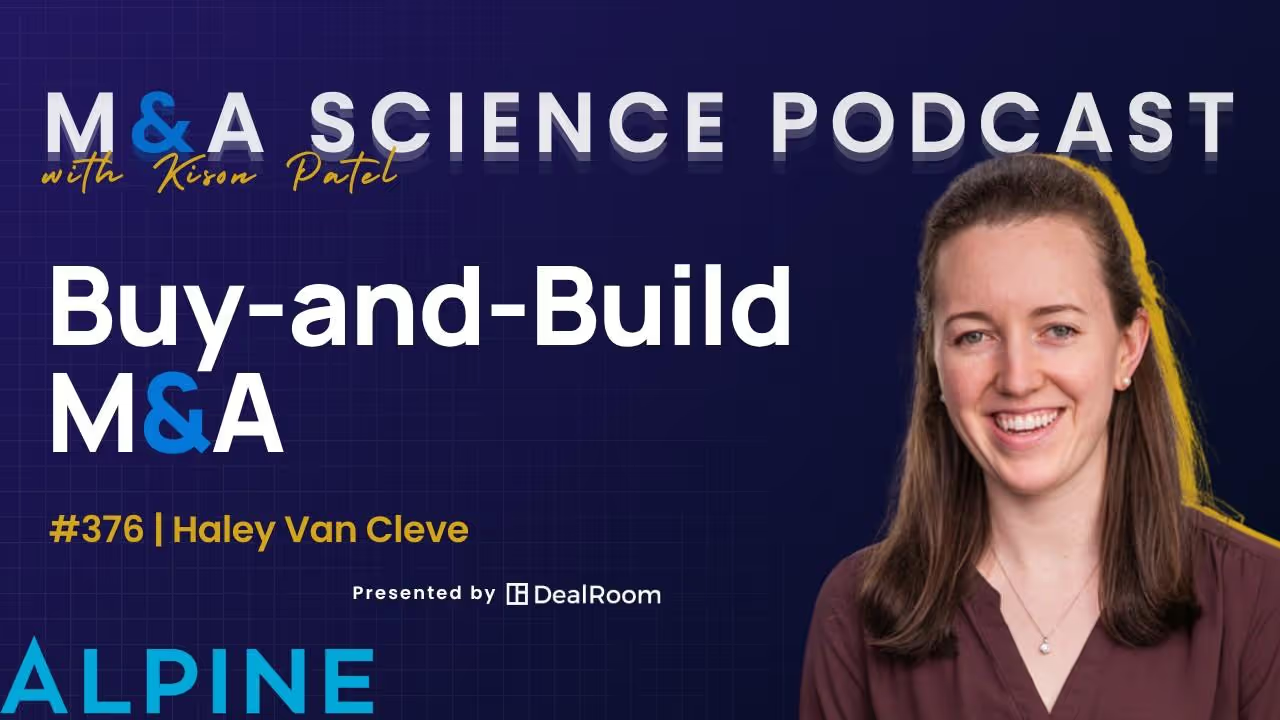
Alpine Investors is a $17.8 billion AUM private equity firm specializing in software and services businesses. Founded as a growth-focused investor, Alpine has completed over 850 deals and operates a standout talent development program that's become the #1 most applied-to job among MBA graduates at Stanford, Harvard, and Wharton business schools.
Haley Van Cleve
Haley Van Cleve is a Partner at Alpine Investors with over a decade of experience specializing in buy-and-build strategies, software, and service business acquisitions. Joining after graduating from Princeton University, she has been involved in over 45 deals, utilizing her computer science engineering background to drive growth.
Episode Transcript
Strategies for Successful Buy-and-Build M&A
Kison: [00:00:00] I am Kisan Patel, and you are listening to m and a Science where we talk with deal professionals and learn valuable lessons from their experience. This podcast focuses on stories, strategies and what actually happened during m and a deals.
Kison: Hello and welcome to the m and a Science podcast. This [00:00:30] podcast is part of a mission to rethink how m and a is done. The old school settle that approach, it's dead. Buy m and a is all about strategy, alignment, and efficiency. Putting value creation at the center of every deal. Let's be real. It's not just about closing the deal, it's about making it successful.
Kison: We uncover what truly works in m and a by learning directly from the best. I'm your host, Kisan Patel, founder and CEO at Deal Room and Chief Scientist at m and a Science. Joining me [00:01:00] today is Haley Cleve, partner at Alpine Investors. Alpine Investors is a 17.8 billion a UM private equity firm investing in software and services businesses.
Kison: Alpine specializes in acquiring businesses and scaling them through a flexible approach that blends operational support, deep integration expertise, and a standout talent model. Alpine has hired over 150 high attribute leaders into its portfolio [00:01:30] company through its popular CEO and trading program, which is the number one most applied to jobs among graduating MBA students at Stanford Graduate School of Business, Harvard Business School, and Wharton.
Kison: Today, Alpine has closed over 850 deals, including 170 deals in 2024. Today we're gonna talk about what it takes to build a successful buy and build platform from the ground up. Hailey, how you doing today?
Haley Van Cleve: Good. Hey Kisan, so [00:02:00] excited to be here and thanks for coming out.
Kison: Thank you for hosting me live here in Manhattan at your office.
Kison: This is headquarters.
Haley Van Cleve: We are SF headquartered, but we have a New York office and we're almost 50 50 at this point.
Kison: Wonderful. Thanks for hosting me in new New York office
Haley Van Cleve: for sure.
Kison: Great location. You wanna kick things off? A little bit about your background.
Haley Van Cleve: So, as you said, I'm Haley. I've been at Alpine for about a decade now.
Haley Van Cleve: I joined straight out of undergrad. I studied computer science engineering. I thought I wanted to do many things, didn't know what private equity was. I got connected to Alpine through a [00:02:30] classmate of mine who put me in touch. Ultimately got to talk to some of the partners at Alpine and just felt like. It was a place where I could learn a lot from smart people who seemed like good humans as well.
Haley Van Cleve: I really knew nothing about finance or private equity in my interview. I always joke, I used revenue and profit as synonyms and in my case study, so I was very green, didn't know anything, and joined as an analyst and had been here ever since. At the time that I joined the firm was about 20 ish. People are investing out of our fifth fund, which was a $400 million [00:03:00] fund, and if you fast forward to today.
Haley Van Cleve: We're about 180 people across three offices and investing out of a four and a half billion dollar fund. So it's been an incredible journey, a ton of growth for Alpine and just a, an incredible ride.
Kison: How many years and how many deals have you worked on?
Haley Van Cleve: About a decade deal wise, I've lost count, but probably 45 plus.
Kison: Awesome. I'm curious. I'm always intrigued by people with an engineering background. I can tell if they interview different, even though you didn't go [00:03:30] out and like. Practice in an engineering role, but do you think anything from that background in undergrad helped you with being an investor?
Haley Van Cleve: Definitely. We have a ton of people from technical backgrounds and engineering backgrounds.
Haley Van Cleve: Deals are a lot like a problem. You have a hypothesis, you're gonna get data, you're gonna test assumptions. You're gonna try to figure out logically what makes sense next. Just that framework of logical thinking totally applies to deals, applies to businesses as well.
Kison: So there's other people like you in this organization.
Haley Van Cleve: [00:04:00] We hire primarily out of undergrad for our Alpine team, and there are folks from all different backgrounds. Some were finance majors, business majors, but some were engineers or political science majors. We're big believers that it's about attributes and it's about people who are intellectually curious and excited to learn about deals and you can teach people of any background how to become deal makers.
Kison: I like it. Just curious how thats into the culture here at the firm. Let's talk about platform deals. What defines a [00:04:30] platform? How do you identify business that would have the strong potential to be a platform?
Haley Van Cleve: Traditionally, when people talk about platforms, they usually mean something with scale and something with certain capabilities.
Haley Van Cleve: So maybe a business that has m and a capabilities. We take a pretty liberal view of what a platform can be. We focus on what are the things that are really hard to build that we are not good at and take decades to build, and what are the things that we can add to a business. So for us, a platform. It needs to [00:05:00] have high revenue predictability.
Haley Van Cleve: It needs to be in a good market. It needs to have good bones. As a business raving fan, customers really repeat in high retention revenue streams. Those are things that are very hard to build and take decades to build. On the flip side for us, we do platform deals that are smaller. So we'll do a platform deal that's 3 million of EBITDA or in software, 3 million of revenue, and we can help supplement and build a platform team.
Haley Van Cleve: We can add m and a capabilities to a business that maybe [00:05:30] hasn't done m and a for us, a platform is really a business with good bones that we think we can. Add things around and ultimately build into a more traditional platform.
Kison: You got strong customer base, you got good operating mechanics. This looks like a good well run business.
Kison: Mm-hmm. I'm curious about the size part, because I was under the impression that you needed like 20 million revenue to be looked upon, and is it fair to say like maybe firms have a different definition of a platform too?
Haley Van Cleve: Scale is definitely all relative. So relative to the [00:06:00] firm, relative to their strategy, relative to their capital base.
Haley Van Cleve: For us, oftentimes we're building a lot of plate platform capabilities. Over time, we will start smaller and we're investing out of a four and a half billion dollar fund. We will start platforms with a $2 million EBITDA deal or a $3 million EBITDA deal, where we know that we can build that into scale pretty quickly through m and a.
Haley Van Cleve: On the software side, that might be three or 4 million of revenues. A lot of other firms wanna start with a little bit more scale, but [00:06:30] for us, that's really one of our core competencies is adding m and a and ultimately growing a business pretty quickly into a scaled position.
Kison: So let's break down software versus service.
Kison: One, I think it's pretty cool that you have two clear focuses. They're so different. You sort of referenced right away you're like EBITDA versus revenue, and I'm a software person, so I'm gonna be very biased and even sometimes use my own company as an example, since we're sort of at that growth stage, thinking about acquisitions.
Kison: I think it's so true in a service business. You are thinking of bottom line [00:07:00] profits and software business, maybe not as much. Is it the expectation software businesses tend to operate in losses break even, or just not as much profit focus
Haley Van Cleve: in software, there's a ton of variance, so there definitely are businesses that have operating losses or running break even.
Haley Van Cleve: But there's also really, since the public cloud came out. The ability for founders to bootstrap businesses and run them a decent profit margins, even at three, four, 5 million of revenue. So we see a variety. [00:07:30] We tend to focus on rule of 40 businesses in the software side, so businesses that have some margin, maybe it's.
Haley Van Cleve: Lower margin today, and they're gonna scale into a more normalized margin over time. But definitely on the software side, when you're three, four, 5 million of revenue, we're thinking about how much can we scale that revenue over time? And then from a bottom line perspective, once they hit 10 million of revenue, what do we think the normalized margin should be?
Kison: So let's break down the rule of 40. For those not familiar. My take on it is the combination of your growth rate [00:08:00] with your EBITDA margins, and it should be over 40, puts you as a rule of 40 company.
Haley Van Cleve: Bingo. Yeah. Over 40 is excellent. The higher the better and the more weighted towards growth, typically the more favorably we view that.
Kison: Does that still apply with services companies?
Haley Van Cleve: It still matters. So growth and margin and the interplay of the two are at the core of how you value a business and how you think about future compounding of capital in services. Typically, it's not 40 that we're targeting. We don't have an exact metric that we target in the services [00:08:30] side, but we very much think if you're growing faster, if you have more margin over the long run, you're gonna compound capital at a higher rate.
Kison: That makes sense. I guess we'll talk more about it in the whole grand scheme of things of where the end goal allows you to sort of value things. Today I. We have a business we identify That's looks like a good business is a standalone. The Rule 40. Ideally it's a software business. Does that include like your adjusted ebitda?
Haley Van Cleve: We see a lot of adjusted EBITDA out there, [00:09:00] especially bankers are very creative in how they present ebitda. So as we talk to businesses, we very much get to our own EBITDA number, which a different buyer might look at it differently. A seller might think about it differently, but EBITDA is a proxy for the cash flow of the business.
Haley Van Cleve: What do we think that appropriate cash flow is gonna be?
Kison: Okay? So you have to use your own approach and own guidance on, on figuring that out. And then is there other things that you would really prioritize when you start looking at these businesses? Because I know management team's a huge one. Looking [00:09:30] at the whole marketplace as a whole to get a sense of how far can we grow?
Kison: Like how do you think through those things
Haley Van Cleve: as we think about what's most important For us, it's team market and then business in that order. Team can be, the business, might have some exceptional talent and that's wonderful. We also have capabilities and we do a ton of founder deals where we had of a small software business.
Haley Van Cleve: We had a founder who said, what's most important for me is that I am moving to New Zealand a month after this deal closes and don't call me. I'm going [00:10:00] off the grid. I'm living my next chapter of my life, and that's what I want. We have the capability to solve for. What a founder is looking for. In a lot of cases, that's a transition.
Haley Van Cleve: That's retirement, that's shifting to a different role. So for the team, we have a ton of talent programs to be able to bring in a full management team, day one if that is needed on market, when you're starting with a $3 million EBITDA business or a $3 million revenue business in software. We have to have high conviction that we can do add-ons and scale this pretty quickly.
Haley Van Cleve: Underwriting the [00:10:30] market, the fragmentation, the dynamics, why putting businesses together is better for customers, for employees, for the company. That's a huge part of our underwriting thesis. And then lastly is the business. So you need to make sure it has good bones that you're starting with a good company, but really nailing all three of those is the core for us of making a good decision on the underwriting.
Kison: I get the team market what with the business part? Business.
Haley Van Cleve: So the specific company. So it might be an incredible market. Are we picking the right business within that market to start [00:11:00] with?
Kison: I got it. The the specific companies that the right one target. Mm-hmm. To start with. Okay, so this makes sense. The team part's.
Kison: Interesting. So if a founder is, has a lot of potential, could potentially lead the effort, that's a big plus. But you could handle a situation where a founder said, Hey, I'm out. That's what I'm looking for as an exit. Would you value that deal differently then?
Haley Van Cleve: Probably. 80% of our deals are situations where the impetus for the founder selling is often that they wanna retire or they want to move on to a different [00:11:30] chapter of their life.
Haley Van Cleve: Or they were CEO and they love product and they don't wanna be CEO anymore. 'cause there's all these functions that they don't love that are taking up their time. So we tend to spend time on situations where our talent model is a differentiator. So other buyers really wanna back the existing team to the existing CEO.
Haley Van Cleve: We love situations where our talent model can help differentiate us and help us be a partner to a business where other firms are less of a fit.
Kison: Okay, so you're used to it. We're used to it like a must have. We don't, we
Haley Van Cleve: [00:12:00] don't look at it as a negative For some people, there's mentality. If the CEO doesn't wanna stay on, what does that say about their belief in the business?
Haley Van Cleve: We realize for a lot of founders, it's all of their net worth that's been tied up in this business for 20, 30 years. We get that there's life outside of it and that there's human dynamics as to why somebody. Might not wanna be around for the next five years, and we have a model that's pretty sympathetic and can help solve for that.
Kison: How do you look at bootstrap businesses versus ones with the messy calf table? Does that in fact value? [00:12:30]
Haley Van Cleve: We have done both. We're probably 90% founder owned and operated businesses. Again, our talent model tends to be a really good fit for those situations. And those businesses from a bootstrap perspective, tend to have a little bit of margin, which is helpful from a valuation perspective.
Haley Van Cleve: Okay,
Kison: that's fair. So gotta have this team in place and there's flexibility there. If that is trend transition required market, you wanna make sure there's significant fragmentation, so you're confident that you can find acquisition opportunities [00:13:00] and then making sure this is the right business to start with.
Haley Van Cleve: Exactly.
Kison: Sounds pretty straightforward. Can we like, just walk through an example, do you have something that you've worked on before that sort of played out pretty well that you, we can walk through the steps.
Haley Van Cleve: Yeah, for sure. And we have software and services you brought up at the beginning. Kinda, it's interesting that we do both 'cause they're so different.
Haley Van Cleve: They are different markets and yet the motions that we go through end up feeling a lot the same. A software example, we built illegal tech business, so time billing software for lawyers, kinda [00:13:30] SMB, mid-market lawyers. We started, our first business in that space was 4 million of revenue. So starting quite small.
Haley Van Cleve: A great market. We saw a ton of fragmentation. We saw huge tailwinds as people were splitting off of big law, kind of starting their own firms. And as people were going from on-prem solutions to cloud-based solutions and is really sticky product. Once you have a lawyer on your time billing software, there's the ability to attach a lot of other offerings around that.
Haley Van Cleve: We felt from a market [00:14:00] perspective, this is awesome. We also, prior to the market, had built a team. So we had A-C-E-O-A-C-O-O-A-C-F-O. We had a team in place on our bench ready to go who were just exceptional operators and leaders. So we had the team there, we identified the market, got really excited.
Haley Van Cleve: Started with a $4 million revenue business, which is on the small side, but ultimately did four additional acquisitions around it, expanding into adjacent pockets that we were excited about, and then adding additional products that we could cross sell into that [00:14:30] base. Integrated all those businesses together pretty heavily, and ultimately built that to be a $30 million plus platform and sold that as a platform for another PE sponsor.
Haley Van Cleve: That has gone quite well. A great example, when you get the market right. When you can piece together solutions that make a lot of sense, we can build really valuable platforms, and that's our focus. That's kind of the software narrative side. The services side, it's much the same, but we might start with a three or $4 million.[00:15:00]
Haley Van Cleve: Hvac, so air conditioning, heating, cooling, plumbing business. Start there. Build a whole executive team around that business that's capable of doing pretty high velocity m and a, and then have built a number of businesses like that on the services side to be a. A hundred million dollars plus EBITDA businesses in pretty short time periods.
Haley Van Cleve: So really have built out heavy integration functions, heavy m and a functions, but operationally really integrating them to be tightly knit and have a lot of strategy for why [00:15:30] an add-on is worth more to our platform than it would be to another buyer.
Kison: Use the word integration a lot.
Haley Van Cleve: Mm-hmm.
Kison: Can we talk through the importance of integration with these add-ons?
Kison: The thing I'm curious about is. We work with a lot of rollups. I think now the market's really wising up, or at least buyers are wising up, that there could be a company that's rolled up that's not integrated. Mm-hmm. Or has a backlog of integration work and then value ends up getting written down because of that.
Kison: Mm-hmm. I'd love to just get your perspective of how do you think through integration [00:16:00] and what's good and bad, and.
Haley Van Cleve: And I'm a deal person. I love deals, but the deals are the easy part In roll-ups. It's not hard to find a business, close a business, you can do a lot of m and a. The very hard part is integration and operations.
Haley Van Cleve: So how do you make this a really well run platform? And the key for us on integration is people and systems. So from a people perspective. You have to be very clear functionally on what's living globally, what's living locally. We've been clear and transparent [00:16:30] is everybody rowing the same direction and understands the vision of where we're going.
Haley Van Cleve: And people wise, that's hard. Systems wise, you need really tight systems. So some of our most acquisitive platforms will do 30, 40, 50 deals in a year. If you go on an m and a tear and you lose visibility into your key operating metrics. Your leading indicators, your financial performance, you're like a pilot flying in the dark without instruments.
Haley Van Cleve: So it's really important for us to build an integration [00:17:00] capacity to where we're getting everybody on standard systems, the same ERP, the same financial systems we've set in place, the key operational metrics for a platform, and we can really track and measure, Hey, we acquired this business with a thesis that we could drive revenue in this way.
Haley Van Cleve: That we could benefit from economies of scale and procurement savings in this way. Let's make sure that the leaders really understand that vision and that goal. And then let's make sure from a metrics perspective, we're tracking to that and we know where we got things [00:17:30] wrong so we can adjust in the future.
Haley Van Cleve: And we know where we have bright spots that we can scale and replicate in other businesses. The systems is a huge part, and typically we're building an integration team to roll out systems within 20 to 30 days of closing an acquisition. '
Kison: cause you want that data synced up so you can align around those metrics that you're targeting for the add-on.
Haley Van Cleve: Definitely, if you're running a large platform as an operator, you need to have kinda your dashboard up to know where are we performing, where do we need to address [00:18:00] things? Who are my top performers who are driving at the local level, awesome results. And how do we keep growing their careers?
Kison: They need to.
Kison: Scroll it back. An update to you. Yeah, yeah,
Haley Van Cleve: exactly.
Kison: So that sounds like a big component of your value creation approach, really emphasizing the integration. One of the things I've published earlier in the year as a framework called buyer led m and a. Mm-hmm. And one of the pillars is synchronizing diligence and integration so that you can ultimately execute integration better.
Kison: And I'm just [00:18:30] curious, how do you do that? How do you like. Through or plan your integration to set it up for success?
Haley Van Cleve: It's a great question and it's so important and it's easy to be the deal person. We wanna get deals done and it's easy to put something in Excel and it looks so reasonable. You're like, on this timeframe, we can obviously drive this much revenue growth and we can do this with margin.
Haley Van Cleve: For us, it's really important to have operators involved in diligence. So having the person who's gonna sign up and go deliver this plan, be part of that diligence process with us, and [00:19:00] understand the assumptions, understand the business, make sure they feel comfortable with the game plan. And then secondly, being very operational in our diligence, understanding what levers of a playbook we think we have, understanding how we diligence those, and then making sure the post close capabilities exist at the business.
Kison: So you're tying it all in while you're doing diligence, you're really mapping your integration and making sure there's continuity there. How do you not break things? Not trying to be too sideways here. I interview a lot of integration [00:19:30] folks and it's always the culture was mismatched and things like that, and things just get broken during the integration process.
Kison: Is there some approach to make sure that doesn't happen? To
Haley Van Cleve: give a little history, in our early days, we were very scared of breaking things. Our mantra is don't fix what isn't broken. That works to a point, but it often makes it hard to scale m and a in a way that's really productive. And in the early days, for example, we partnered with some businesses that had spent a lot of time on their charter of accounts and their financial system.
Haley Van Cleve: They were so [00:20:00] proud of it. They had gotten on a great system. They loved it. It was set up in a very customized way to their business, and we were trying to get to standard systems, and we spent so long trying to marry up their system to this other businesses system, and both loved what they were doing.
Haley Van Cleve: And one of those implementations took something like 12 months to try to reconcile all this. There was a realization that we had, which is there's power and just transparency and clarity, and if our vision is to. Build a really big business that's a leader in the [00:20:30] market. We have to be able to do deals pretty fast.
Haley Van Cleve: And that means we're gonna have to standardize systems and we're gonna have to tell people upfront, your system is awesome. We love that you built this. It's working for you. That's wonderful. And doing a deal with us is gonna look like this. Like we're gonna have standard systems. Here's the why. Here's how it ties into our vision.
Haley Van Cleve: And for some people that's interesting and they get it. And then for some people it's not. And that's their prerogative. And we might not be the best partner, but really being clear and transparent. As to the why and also designing with the end in [00:21:00] mind. So to be a hundred million dollars EBITDA business in one of these services, buy and builds, you have to make some decisions on the front end that are gonna change things.
Haley Van Cleve: At the companies we partner with, we try to be really clear in the upfront deal, here's what's gonna change and why, and here's the things that aren't gonna change and what we think is special about you. And we're not gonna touch these aspects, mess up these things.
Kison: Are some powerful things you're saying right here of just the designing with the end in mind, having this clear vision, really being able to explain the why [00:21:30] throughout.
Kison: Can you walk me through, like how do you. Run that deal process with it. And part of it's like I'm learning how do you like bring this up early or when's the right framing of it so that it just sticks throughout that process because I feel like it's so easy to just jump in a deal, wanna start modeling things out, come up with a price and saying, all right, this is how much we're gonna just get to LLOI negotiation versus this stuff is like the soft stuff is the most meaningful in terms of people alignment.
Kison: Teach me this. Teach me how to introduce this stuff [00:22:00] and get it sticky so the new people, the deal don't forget. And they're like,
Haley Van Cleve: right, what
Kison: are we doing?
Haley Van Cleve: And it goes back to also why we start with team, then market, then the deal. Because. You have to have a team who's thinking about these things, the operations team, who's gonna inherit this?
Haley Van Cleve: Who's making some of these decisions? 'cause they're gonna have to live with this for the next five to 10 years. And then the market, you have to understand what matters in this market. What are the parts of a business that we don't wanna touch because they're working and there's high risk. What are the parts of the business that we can make better [00:22:30] for the end consumer, that we can make better for the employee that we are gonna change?
Haley Van Cleve: A lot of that happens before we ever find the first deal in a market. So we're trying to get clear on what's our approach to global versus local. What's our vision? What's our pitch for a founder for why we think we're the right steward for their business long term? So we do all of that upfront and we get really clear on that because if we're not clear, we can't articulate that to somebody else.
Haley Van Cleve: And then to your point, often before we're getting into valuation and data request and diligence, [00:23:00] there's a face to face with the founder or the sellers of the business. We're articulating what. Our platform is and what it's not. A lot of people in these markets take different approaches and that's great.
Haley Van Cleve: We're trying to find partners and businesses who are aligned with our philosophy, who are excited by it, who maybe don't wanna switch out their general ledger system, but understand a. Hey, if I wanna be part of this bigger vision, like I get why I'm gonna have to do that and why I'm gonna have to sign up for some of this.
Haley Van Cleve: A lot of that happens, that vision conversation, that [00:23:30] expectation setting conversation happens ahead of an LOI or getting deeper into diligence. And some people opt out and that's totally fine, but we'd rather do that upfront versus getting a deal closed. And then having to go operate together and realizing there's misalignment.
Kison: That's so interesting. Doing this upfront and really emphasizing it helps you throughout the process, but when it comes down to the real grinding with integration, you go back to that same vision. I. Your thesis and what the end state you had in mind. That's where you get proactive [00:24:00] on integration. 'cause again, the fail point I see is companies are afraid to break things.
Kison: Definitely. So they essentially do a very minimal integration and then there's backlog of actual real integration work to do. You don't do that.
Haley Van Cleve: We try not to. And I tell you all this now, and this is also learned over a lot of years of stubbing our toe and making mistakes along the way. And like I said, in in the early days, being reticent.
Haley Van Cleve: To make some of those changes upfront and being reticent to, to tell a founder, Hey, we're gonna tell you five [00:24:30] inconvenient truths. You're not gonna wanna hear these five things, but this is what we're gonna do and this is how we're gonna do it. And if we found, when you explain the why and the bigger vision, people understand it and it's easier to have an uncomfortable 30 minute conversation about those things up front and then have a ton of alignment for the next 10 years.
Haley Van Cleve: Than it is to get into things and realize we have to make changes a year end that just slow us down and are hard to kinda wrap your head around.
Kison: Let's blow up the bad. Yeah. We don't want to glorify this. This isn't easy. What's the [00:25:00] hardest things to making all this work the platform and make that on.
Haley Van Cleve: Two things. One, we spend so much time upfront aligning on a vision of what we're trying to build. We're trying to build a hundred million dollars plus EBITDA business. We need the team to get us there, and we are often starting with a two, $3 million EBITDA business to begin with on the software side.
Haley Van Cleve: Flip those to be revenue numbers. We overhire the team in the early days, so we will hire that team to be the a hundred million dollars plus EBITDA business before we even [00:25:30] have our sites on a deal that's expensive. So we'll hire five execs to sit on our bench and work with us for 12 months to find the right market and find the right business.
Haley Van Cleve: And then you have a two, $3 million EBITDA business and you have a very heavy exec team. You're building out an m and a team, an integration team. It's pulling a lot of that build upfront for us, which has worked 'cause it lets you go really fast, but it's hard and it means you have to be confident you can scale the business 'cause you've just taken on a lot of costs.
Haley Van Cleve: And then the second thing [00:26:00] is the integrations. To really scale and push m and a, you have to build the integration capacity up front and you have to be able to integrate businesses and onboard them quickly. That's something that in our early days, it just took far too long for us to integrate and to onboard, and it really slowed down our pace and it slowed down our visibility.
Kison: What do you do? Like, how do you prep a platform to be able to integrate?
Haley Van Cleve: You have to understand the market and have a vision of what actually are we gonna integrate? Because you don't wanna integrate just for integration's [00:26:30] sake. You wanna have a why. You wanna be able to motivate and rally people behind a vision.
Haley Van Cleve: So getting really clear on that and doing the homework in advance. And then it's building the team to do that. Oftentimes we're ultimately building an m and a team and a separate integration team, and those are people that are systems integrators. They understand the nuts and bolts operationally of what's gonna happen at the business, and they're able to go win with the partner businesses we're partnering with and actually go execute, roll up their sleeves and make [00:27:00] that happen.
Kison: So it's kinda getting that leadership just even in the mindset that this is what we're gonna do. We're gonna be integrating these companies. Maybe think about your domain and when it is gonna take to do that. So two big things. It's sounds like a big upfront investment that you gotta invest ahead to have the team that can go execute on the big picture.
Kison: When you're putting in these executives and they're in a tiny business to start with, may seem a little off, but that's something you gotta to rationalize. And then building that integration muscle early is the [00:27:30] second big one.
Haley Van Cleve: Definitely.
Kison: So we get the platform and then we add on businesses. How do you know the right pace of doing add-ons?
Kison: And then is there a point when maybe it'll slow down for some reason? Is that the integrations, the bottleneck, or finances?
Haley Van Cleve: It's a topic of probably the majority of our board meetings is, are we going too fast? Are we going fast enough? How does this map to our vision? So it's definitely a topic we are constantly talking about in services.
Haley Van Cleve: For the first six to 12 months, [00:28:00] we actually go a little slower. So there's a world where you partner with. Three or four or five businesses in a space. We make sure our team is a really strong foundation. We make sure the systems, we really have dialed integrations, we have really dialed, and we're also learning.
Haley Van Cleve: This is our first time entering a market. Let's make sure we really understand the nuts and bolts of these businesses before we go crank pace. So often, kinda a six to 12 month period of really dialing and building the right foundation because you don't wanna build a house on quicksand and [00:28:30] you wanna make sure it's solid.
Haley Van Cleve: In the software landscape, it's a little bit different. Typically, we're doing lower volume m and a, so we might not be doing 30, 40, 50 deals a year in a space, but being really thoughtful about for our customer base, what are the two or three or four products that make sense together? And in the software universe, when you're targeting very specific product categories, you have to be a buyer when there's a seller of those businesses, and there might not be 10 payment softwares for lawyers, there [00:29:00] might only be two or three that we really wanna own, and you gotta be opportunistic at the right time of when a deal can happen.
Kison: Interesting point that you kind of may start off a little slower just to really figure things out and then figure out the right cadence. It sounds like it's a lot of variables to determine this. It's not just the one playbook that you apply to each company.
Haley Van Cleve: It's not one playbook overall. What we've tried to do is make the process a lot the same, so we do a lot of visioning upfront before the first deal.
Haley Van Cleve: Let's get [00:29:30] clear on what our intent is, what our vision is for what this platform is gonna become. And then a lot of the decisions you make in the first six months, 12 months, 24 months, come out of that. Once you're clear on that vision, let's work backwards for what do we need to do in each year of our investment to, to end up there.
Kison: Is there things that like may shift or change in that six to 12 months? And I, I kind of wanna pick on that legal example because it's an adjacency for us, even. You got one business and you said they were doing more of like time tracking. Mm-hmm. And then is it like in the six to 12 months, does it, [00:30:00] the strategy shift, do you start looking at market map different?
Kison: Like how'd that play out in that example?
Haley Van Cleve: Yeah, so in that example, before we did the first deal, we had mapped the market. So in services, sometimes there's 15,000 of businesses in your market. It's a big universe and software and legal time billing. There's maybe a hundred players there. So we had mapped them.
Haley Van Cleve: We, before the first deal had talked to. 50, 60% of them already, so knew their size, knew where they played, knew the focus, and we kind of had [00:30:30] our list and our vision of here's what we wanna build to become. Here's the names that we think are a really strong fit. With that vision, I. We don't know exactly which of those names is gonna transact in a time period that works for us.
Haley Van Cleve: But we know every quarter we're gonna call 'em and talk to them and build the relationship over the long term. So we are who they think of when the time comes. We started with one of those businesses and then really focused on that pipeline and building those relationships and ultimately piece four other of the products together and build those [00:31:00] under a single leadership team.
Haley Van Cleve: So in software it's a little bit less. At times we control the pacing a little bit less. And it's more about being very thoughtful on these are the companies that we think are a really strong fit and let's be on them every quarter to to know where they're at and to be selling our vision and make sure that when the time comes, we're the first person they think of.
Kison: It is so different. 'cause I feel like services, I always think of roll-ups. We, yeah. Hvac. You guys have a roofing one? Yep. Which is just very similar businesses in different markets and you'll mm-hmm. Own in our geography [00:31:30] where software, just, no two software companies, all very different. And then in this example, was it, Hey, do we know this one specific vertical of time tracking?
Kison: We're gonna really go deeper into that. How do you start thinking of like adjacencies? Mm-hmm. And that view, and when is it time to go out of the core?
Haley Van Cleve: In software, a lot of times we think about there's kind of adjacent in markets. If you think of a grid, there's kind of one axis is the in market and one is the product category.
Haley Van Cleve: You think about which product categories do we wanna be [00:32:00] in? For which in markets, in the legal tech platform that I was talking about, we expanded both to adjacent in markets. So we had mid-size corporate law firms. We expanded into personal injury law firms and SMB law firms. So we kind of expanded to different customer profiles and then we also expanded to different products.
Haley Van Cleve: So we had a time billing software. We added on a practice management business, we added on payments facilitator. So payments product to [00:32:30] allow electronic payments for the time billing side. So we look at both vectors and think about where on this map do we wanna play and why? What's our vision of what we're trying to become?
Haley Van Cleve: Are we trying to cover the entire map or just these four boxes on that map? And then what companies are in each of those boxes. And let's be really intentional. Choose your term buyer led. Let's be very buyer led about trying to make deals happen with the players who we think are tier one players in each of those boxes.
Kison: And you're proactive. You reach out to them. You're not waiting for a book to get sent to you, [00:33:00]
Haley Van Cleve: not waiting, and some people will still hire the bank and that's fine for a lot of people, it takes seven or eight meetings and a number of years before the timing is right for us. It's just being top of mind when that time comes.
Kison: When you say in market, use an example. Here's like maybe a small firm and one that specializes in different area of law, and then you have the products. If I think of like ICP or who the actual mm-hmm. Buyer is, where does that fit in? Does that part of your InMarket view? And then you say, okay, like in this situation [00:33:30] it's whoever's doing back office stuff or whatever.
Kison: Exactly. Is there an ICP. And that's why I was curious is that the big thing, it's like we identify it's going, this product's gonna sell into the same because you could have a different InMarket, but it's different ICP, which then all of a sudden you got smoky mirrors that you're not gonna cross sell as well as you thought you would.
Haley Van Cleve: And it totally depends on if cross-sell is the thesis with an add-on or not. I'd say for a lot of our software businesses, it is. We love this. ICP, we're really good at the go-to-market on this ICP. Let's look at the three or four other [00:34:00] products we know that same human is gonna buy. Let's go be able to offer that to them.
Haley Van Cleve: And for the same customer acquisition costs, we can now three or four X are lifetime value because we have more product to sell them. So that's a thesis for a lot. In some cases it's not though. It's, we're really good at this go to market motion, in this size range, in this market. There's other ICPs and other buyers of products who we have the right motion to go sell to, but we're not today and, and let's expand via m and [00:34:30] a into kind of an adjacent in market
Kison: so we can get into this adjacent market.
Kison: But it's more about a go to market playbook. A playbook that you can bring in. Mm-hmm. That's interesting. That's what I was curious about. It's like how do you keep these acquisitions to be strategic instead of running that conundrum of we're just buying revenue. It sounds like there is a view on that.
Kison: Maybe it's not purely cross-selling in into the same ICP, but there's other factor that gives you an upside that you're gonna be able to leverage, like the Go Market playbook example. Definitely
Haley Van Cleve: for us, it's about being clear in the underwriting on what are the levers we're trying to [00:35:00] pull. And then because we work so much with operators, typically have the operators on our bench before they go into the business.
Haley Van Cleve: It's making sure they're really sold on that. So when we're talking about cross sell, let's diligence it together. Hey, you're gonna be running sales of this business in four months. Let's make sure you feel really confident on your ability to cross sell these products or to explain this. Go-to market playbook to adjacent businesses.
Kison: I had talked to a range of private equity firms and I'm starting to see some patterns based on the fund [00:35:30] size and if smaller funds, especially sub billion, all m and a is handled in-house, but as a firm grows, and it could be that the maturity of that business where they'll stand up an in-house m and a function.
Kison: What's your view on that? Like where's the right time that you would wanna stand up in m and a function and let them run things and. Be more of like a coach than a driver.
Haley Van Cleve: It's great when it goes well 'cause it gives the private equity firm a lot of leverage for us. It goes back to what's the vision. So if we know we're gonna do [00:36:00] double digit, number of acquisitions, add-on acquisitions during our hold on a platform I.
Haley Van Cleve: Typically, we're gonna build the m and a team at that platform. For us, we typically do it day one, so we're launching a platform right now. We're gonna close the first deal probably in the next month or so. We have the head of m and a, the president of m and a. He's also starting to hire two associates under him.
Haley Van Cleve: So we're building that team even before the deal closes because we know it's so core to the strategy of that business, and we wanna be able to go fast. In those cases, we're building [00:36:30] that team for us. We have a ton of talent programs, so we hire just awesome individuals and then later figure out where they're gonna go.
Haley Van Cleve: Wait,
Kison: you keep 'em on payroll until you figure out what to, we
Haley Van Cleve: keep 'em here on a, on payroll. So we have a program focused on kind of that head of m and a head capital allocator at our portfolio role. Where we partner with people we think are exceptional, we then go find them a market in a business, pair them with a CEO and drop them into one of our platforms.
Kison: What kind of background are you looking for in that person?
Haley Van Cleve: [00:37:00] Typically, direct investing background, so a number of them come up through banking, have been on the buy side for a period of time, maybe went to business school, maybe we're at a PE firm, but wanna be a little bit more hands-on operational and entrepreneurial.
Haley Van Cleve: And this is kind of. Way to use their deal background, but go be an operator in the exec of one of our platforms.
Kison: This is pretty cool. May have to come back and apply for that role.
Haley Van Cleve: For sure.
Kison: I wanna talk about capital structure. I want you to spill some beans here because I wanna [00:37:30] understand you are and fund people put money in your fund and they're in high hopes of getting.
Kison: Much more out of that 'cause it's a long-term investment. Is there like a target hold period that you have?
Haley Van Cleve: We underwrite our models to five years to stay disciplined and be able to compare things. Apples to apples. I'll say our bias is to go longer. So our fun life is 12 years. We can have Oh wow. Two one year extensions on that.
Haley Van Cleve: Our bias is when you get the team right, the market right. You've partnered with great [00:38:00] businesses, that's really hard to do and takes a lot of effort. And the out year compounding is often some of the most decretive. Yeah. We will hold businesses much longer when we get those things right.
Kison: That's so true.
Kison: I look at these tech companies, especially when you got the whole lifecycle, like a 20 year span and you're like, this first 10 years is nothing. Right. It was the last 10 years that just boom, all the value created, so that makes a lot of sense. What do you think of like metrics? A lot of times I hear the three Xs where you're trying to drive on that five year model.
Kison: Is that like the standard in private equity?
Haley Van Cleve: [00:38:30] Each firm has a slightly different focus. For us, what we talk about with our investors is targeting three x net on our investments, and that's what we underwrite too within the five year period.
Kison: Okay. Let's play this out. This is where I get free advice. Mm-hmm.
Kison: Let's say. Is 50 employees, 10 million a r. I have identified two targets each doing 5 million revenue. One is very competitive in nature. The other one is, uh, adjacency. Mm-hmm. Which I'm like, Hey, this actually cross sells into [00:39:00] icp. Mm-hmm. Really well, fp and a type of software. So I come to you and I saying, I wanna put this together at 20 million a RR combined performa, and get you to fund that deal.
Kison: Mm-hmm. Let's do like simple math. Can we just say 10 x? I know. We'll, we're gonna negotiate on that. Mm-hmm. On based on other factors. And we can talk about how that plays out. So that would be like, what, 20 x I'm asking you for 50 million. 40 million to put in the business so I can get these deals done, have some cash to integrate them, and then 10 million of secondaries because I gotta go [00:39:30] pay.
Kison: Modeling the top. But what I wanna know is your view, because you're looking at this investment scenario and saying, okay, in five years, based on what Keans asking for here, which is 200, I guess every premoney, then two 40 mm-hmm. Comes out to be post money and then you need like 700 and some change, you know, to, to exit out of it.
Kison: How do you look at that? Because my big question mark is, yeah, this will put us at 20 and then five years. [00:40:00] Ideally to get that target I gotta get closer to like 75 million.
Haley Van Cleve: Yep.
Kison: So probably gonna need more money if I'm going to buy more companies. We didn't talk about any. Mm-hmm. Adding any debt structure to this.
Kison: Mm-hmm. Keeping it simple. So yes, there's potentially add debt and do maybe one more deal. Mm-hmm. But that's where I'm a little stuck. It's, this could sound great and I get super excited to do it, but now hey, am I on the hook? And really gotta push hard organically. How do you help somebody like me think through really closing that gap to deliver the results that you want?
Kison: So we're aligned.
Haley Van Cleve: First off, the majority of what we do is majority [00:40:30] positions. Typically not coming in in an exact situation like this, but to play out the example, we'll play along for fun. Yeah. To play along. We do use kind of conservative levels of debt on the business. If you have. Strong organic growth.
Haley Van Cleve: You could see a world where in, you know, 2, 3, 4 years, you are able to leverage cash flows from the business. Depending on the profitability, you are able to leverage kind of the incremental debt capacity you've built to do m and a without needing a significant new chunk of equity coming in. So that can be very accretive m and [00:41:00] a.
Haley Van Cleve: The key is to be conservative and appropriate in the leveraged level, so you're not hamstringing the business from executing on the organic growth and the product initiatives. That are compounding the business. And in most of our deals, we're thinking about a mix of organic. How do we supercharge organic?
Haley Van Cleve: What investments would we make in product or in team to go faster and we're thinking about the inorganic and how can this business over time through cash flow, through capacity from leverage, go do really accretive m and a,
Kison: let's why get [00:41:30] jealous of the service businesses? Because it's easier for them to do that tech.
Kison: It's like everybody's losing money and everybody's got high evaluation expectations on top of it. Exactly. There's that part. So there's a component of debt maybe, I don't know as much as cashflow getting invested in to do it. I guess is there that area of thinking through of, oh, if you're gonna need more money to go do acquisitions, and I guess a little different maybe in your view, is that something you just factor in?
Kison: You know, is it. Looked upon all at once that, hey, this is how much [00:42:00] capital need we have to do acquisitions for X years. And then after that period, we'd look at another tranche of, uh, equity to put in the business.
Haley Van Cleve: So I can't speak for other firms. We are reserving when we do the initial deal, we're reserving capital, knowing that there's probably gonna be needs for additional equity funded m and a in the future.
Haley Van Cleve: So for us, typically in the services side of the business, maybe 10% of your initial equity check is going in on the first deal, and the rest is coming in through time [00:42:30] with other acquisitions. And then on the software side, probably less than half of your ultimate equity check is going in on the first deal, and more is coming on as you do that m and a.
Haley Van Cleve: So again, it goes back to having that alignment upfront where it can be a problem as if the strategy was we're not gonna do m and a and then. Five years in an amazing deal comes along and the private equity firm hasn't reserved for the ability to do that deal. So for us, it's getting really clear up front and sizing that appropriately, and then on our end, reserving that capital for future years.
Kison: That makes [00:43:00] sense. It's just all planned ahead of time, but then things could change.
Haley Van Cleve: Things do change. They
Kison: have a board meeting to talk about it.
Haley Van Cleve: Something we try to do is reset that plan once a year. So one of our board meetings each year is rethinking the five to seven year vision and rethinking the ultimate exit plan.
Haley Van Cleve: It doesn't mean that we wanna exit the business or anytime soon, but rethinking what that vision is and how things have changed, and we often see businesses. Get there faster. So maybe we set a five year vision and we [00:43:30] hit it in year three or four and that's great. Let's reset a bigger vision and think about what we need to change now to go even bigger.
Kison: Yeah. You mentioned you this in-house program, which is really intriguing because you'll have CEOs in-house ready to go. Are they out looking for deals too?
Haley Van Cleve: They are looking for deals with us. What we mean by our in residence programs is we hire A CEO, A CFO, A CPO, being people, not product. CPO an M and a leader.
Haley Van Cleve: They are sitting in this office, [00:44:00] so a number of them are right around the corner, over there. Come into the office every day and we staff what we call a pot around them. So a part of our investing team, a part of our sourcing team. And that team is only working on that and trying to find a market a. In a business and start a platform over the next 12 months.
Haley Van Cleve: And so, oh, so they're all working
Kison: together as a team. They're working
Haley Van Cleve: together side by side. And we have sourcing professionals and investing professionals helping them coming with ideas on market. So it's really collaborative. We wanna find something that they're gonna be excited about 'cause [00:44:30] they're about to vote with their feet for the next seven plus years.
Haley Van Cleve: And something that's a fit for their background. So we try to have people who are athletes who can go into multiple industries, but if they come from B2B software, let's go look for something that's B2B software. If they come from route-based field services, let's go look at route-based field services options.
Haley Van Cleve: So very collaborative, but they're working hand in hand with us and very much a part of those teams and bring a ton of credibility. So when we go meet with businesses, they wanna talk to operators, typically not investors. And that's. [00:45:00] A huge selling point.
Kison: Is there any programs for developing the talent while they're in resident?
Haley Van Cleve: Yeah, so we hire experienced folks and then ahead of that, we hire a lot out of MBA programs, so these are people with five years experience. We have a path for those folks to be CEOs in training and one day become CEOs, a path for them to be capital allocators and m and a folks a path through CFOs. And typically they go into our portfolio study under a seasoned executive.
Haley Van Cleve: So spend three, five years at a company [00:45:30] learning from somebody who we think is exceptional at that, and then coming back and doing it again with us as the ultimate CEO or CFO.
Kison: So that's interesting. Almost like an apprentice model. Partner them up and get them firsthand exposure.
Haley Van Cleve: Exactly. And we have a hundred plus of those folks at different roles across our portfolio right now.
Haley Van Cleve: That's
Kison: so interesting. What is the incentive? Yeah, I kind of got different ones, right? You got folks that are, are experienced folks that are pretty new, not quite proven, but when you [00:46:00] do get them set up to tackle an investment thesis, go out and, and drive it. What does that look like? If you can share? I don't know if it's standardized in the industry.
Kison: And
Haley Van Cleve: you mean in terms of incentives?
Kison: Yeah, because I mean obviously there's a cash comp. Let's forget about that. Right. That's like market people can go look at, right. Any kind of salary reports out there. But for the equity stuff, like what gets them super fired up about working with PE because it seems like all the rage these days.
Haley Van Cleve: Yeah, so we structure profits, interest pools. So it's basically a, a [00:46:30] percentage of the profit generated on that investment. We set that up as a pool. So they have the same incentive that we have, which is the more profit we generate, the more they make. And I think for a lot of them, once they see the power of m and a done, right, the power of integrating really well and being able to grow through acquisitions, they really lean into that model.
Haley Van Cleve: 'cause it can generate really powerful returns.
Kison: Is it profit like on the exit?
Haley Van Cleve: Yes.
Kison: So they gotta be in for the whole ride.
Haley Van Cleve: Gotta be in for the ride.
Kison: This is [00:47:00] beyond golden handcuffs. These are like exactly titanium.
Haley Van Cleve: For us, the team is the number one most important. If there's one thing we have to get right between team, market and business, we pick team every time I.
Haley Van Cleve: They're a huge part of building the platform of the success of the platform. So it's important for us that they're have the same incentive that we have and are in it for the lifecycle of this investment.
Kison: So you got the management team, incentivize them with profits on the exit. The [00:47:30] team that nobody talks about, the board, is there like a approach that have you seen to get the right board that's gonna be accretive to these investments
Haley Van Cleve: as much as possible, we'd love to have CEOs who have been there and done that in a related business, be board members, board advisors, so we.
Haley Van Cleve: Cross pollinate. A lot of our platforms, like you mentioned, we have an HVAC business, we have a roofing business, both our residential home services businesses. So the team from the HVAC business is on the board of [00:48:00] our roofing business and it's phenomenal 'cause they learned a lot in building their platform and they can say.
Haley Van Cleve: Man, there's five things that I would've done differently in my first year. Let me just tell you those five things so you don't have to relearn them. We try to cross pollinate that way from an operational perspective, and then also having thoughtful deal people who can help think about m and a and think about the acquisition side as well.
Kison: So you might have some folks that really experienced m and a, but the operators get them on the boards of the other companies. What's the operating partner role [00:48:30] in the PE firm?
Haley Van Cleve: It depends. We don't at Alpine have. Traditional operating partners. So that's not a big piece of our model for us. It's more take CEOs that we work with and cross pollinate that way to provide the operational lens, and then have people from the alpine level sitting on the boards of our businesses as well.
Kison: So really in-house type of approach. Mm-hmm. All right, Hailey. So I gotta ask, not every investment goes picture perfect, hear about things going sideways pretty often. That's always the fun thing we like to gossip about in our industry. [00:49:00] Can you tell me about that? I don't know if you're even comfortable sharing a story about something that went sideways, but like, just curious, like how do you like respond to that?
Kison: What actions do you take? Is there a point where you just write off the investment and.
Haley Van Cleve: Yeah, it happens. I wish it didn't. We try to do everything we can to avoid it, but things go sideways. Things go differently than planned. Over the past five years, that's become more apparent. You know, we owned a ton of K 12 businesses.
Haley Van Cleve: In zero of our underwrites, did we expect K 12 schools across the nation [00:49:30] to be shut down for people not to be in person. We have downside cases, but there's always things that are unexpected that come up and happen and you have to adapt and respond. That's why I keep saying team is my number one thing.
Haley Van Cleve: 'cause when you have a phenomenal team, they get creative and get scrappy and come with ideas to board meetings about here's five different paths we could go down. None is what we expected to be choosing between, but let's talk about it and let's figure out what we're gonna commit to and where we're gonna go.
Haley Van Cleve: And maybe to give an example that's not [00:50:00] COVID related. Sometimes we also get the market wrong as much as we try upfront to underwrite it, to build a pipeline before we close the first deal, to have confidence we can scale a business. There have been times we've gotten the shape of a market wrong and the businesses of scale.
Haley Van Cleve: By scale, I mean, you know, a million plus of ebitda. So for a lot of people that's not scale, but the businesses of scale maybe were fewer than we expected. This market has a ton, I'm thinking of one example, a ton of. 200, 300, 400 [00:50:30] K EBITDA businesses. That's very different than what we expected in the underwrite.
Haley Van Cleve: So a year in, we're sitting down with management, we're looking at the plan saying, where do we go from here? And the answer is, we have to build capabilities we don't have today. We can't be doing 2 million EBITDA add-ons, which are very different and are full businesses. We need to be able to acquire 200 K of EBITDA at a time, and we have to build an integration engine and an m and a team that can do that, and that is very different than what we've built today.
Haley Van Cleve: So we're gonna pivot [00:51:00] it. Here's the operational plan, here's the target, here's how we make this happen. And for us, it just comes back to having awesome operators who are gonna play through it with you, who are gonna be committed to this business for the lifecycle of it, and find a way to win one way or another.
Kison: Number one characteristic, you look for an executive team leader
Haley Van Cleve: will to win.
Kison: How do you do that? How do you test them for the will to win?
Haley Van Cleve: A lot of rounds of interviews, a lot of references for people interviewing and understanding their motives and their [00:51:30] attributes beyond their experience. 'cause on paper there's a lot of very qualified people, but really trying to understand a.
Haley Van Cleve: The attributes of a person, what motivates them and how that's gonna align or not align with what we need to do in the investment.
Kison: You say that, I'm like visualizing the Shark Tank with Apple dangling above it. It's like, all right, you gotta get the Apple. Show me your will to win. Yeah,
Haley Van Cleve: and some personality assessments, we do a deep dive and it goes back to childhood and people's reflections on their childhood and what they [00:52:00] learned, and four hours later you come out.
Haley Van Cleve: Usually with a pretty good sense of who they are as a human being and getting the human element right is as important as getting the person who on the resume has the experience.
Kison: It's a tough thing. That's a whole other interview that we'll have to reserve for another time. I. I need some advice before we wrap up here.
Kison: I'm not quite doing a majority, so we might not talk this time, but for somebody that's thinking to do a minority recap, I'm trying to basically sell our business. Mm-hmm. That platform. Mm-hmm. [00:52:30] I was under the impression I tried to go stack 20, which would be good, but Sounds like there's some of minded firms out there.
Kison: And I'm trying to do it based on a combined performer that mm-hmm. Gives a nice position that you know, where capital is getting allocated and it, it helps you out from valuation and, and so forth. But being balanced is a key thing I'm learning. If you get too greedy on the front end, like the 21 valuations, you're gonna pay for it later.
Kison: And I know there's like a lot of companies just ride the AI wave and they're putting all that and getting a high valuation. It's like, no, I understand. You [00:53:00] wanna be really reasonable so that you can be aligned and work together to achieve end goal. Based on that current thinking, what advice do you have for me just to say, approach leaders like you in the investment side of working together and just making sure I'm heading down the right direction.
Haley Van Cleve: Your part about stacking to the 20 and having thoughts on m and a that you would wanna do. My biggest advice to founders businesses is get really clear on the playbook. Anybody can do. MA or bring businesses together, but really being [00:53:30] able to have a clear vision of what would I do with this business?
Haley Van Cleve: How could my team or our teams together make this business more valuable? The whole more valuable together than the sum of the parts I. And it sounds like for you it's cross sell and getting really thoughtful on why do you think you're gonna be successful at cross sell? Is it the same ICP? Is your team capable of cross-selling?
Haley Van Cleve: Do you have partnership relationships today that show you can cross sell and further monetize your base? And for us, the businesses that can articulate a really clear playbook or why an [00:54:00] add-on is worth more to you than others, helps make it a really interesting and unique opportunity and shows up in the valuation as well.
Kison: You got a fair point that I should really validate this stuff and even some of the partnerships we have, I feel like we could probably invest more and then be able to leverage that to even validate, hey, this is why cross-sell would work. And we could probably validate if it makes sense to acquire those companies
Haley Van Cleve: and finding a partner that is aligned on that vision.
Haley Van Cleve: In my career, there's been times I've probably been so interested in [00:54:30] the deal and it's so easy to oversell or or force a partnership that isn't a good fit. And I think over time I've just seen you wanna be super. Clear about what you're looking for, what you want in a partner, what you don't want, and there's gonna be businesses out there, or for your case, private equity firms who might not be a fit or growth capital firms that aren't a fit.
Haley Van Cleve: And life is too short in finding partners that are really aligned, makes the next five, seven years so much better.
Kison: Their working relationship.
Haley Van Cleve: Definitely.
Kison: What's the craziest thing you've seen in MA?
Haley Van Cleve: Seen a [00:55:00] lot of crazy things in m and a. Specifically, we did a, an acquisition in Germany and I learned that, I thought it was a joke, but in Germany.
Haley Van Cleve: Your purchase agreement needs to be read by your legal team before a notary public, and it's a 15, 16, 16 hour document to get through. It's just humbling as you work with different countries and in different regions to realize that there's a huge local dynamic of what you do. People are all different, countries are very different, and so that one was, it's just fascinating this age of AI reading the [00:55:30] purchase agreement before the notary,
Kison: did you sit through the whole reading?
Haley Van Cleve: I did not, but our team did.
Kison: Those of you, uh, wanna learn more about that. I think Frank Temp, uh, one of the attorneys, I believe it was Dentons that was in Germany, actually interviewed him in Dusseldorf and we talked a lot about this. Yeah, you're absolutely right. It is so wild how different countries have different rules around doing m and a.
Haley Van Cleve: Definitely.
Kison: Hey, this has been an awesome conversation. I really appreciate taking the time from doing deals to helping me become a better scientist.
Haley Van Cleve: This was [00:56:00] super fun. Thank you for coming to our office and we hope to have you back soon.
Kison: I am, I'm gonna apply for in-house residence role here.
Haley Van Cleve: Send us your resume.
Kison: Anybody still listening here, fellow m and a scientists, I appreciate you. Thank you so much for listening through. Always welcome feedback. Reach out to me on LinkedIn, connect with me there. Love to hear what you thought about this interview. If you got any topic ideas, be careful asking for favors. Get too many of those, but so next time, here's to the deal.[00:56:30]
Kison: Thank you for taking the time to explore the world of m and a with our podcast. We love hearing feedback. Tag us on a LinkedIn post, add a review on Apple Podcast. We'd love to hear from you. If you need help standing up an m and a function or optimizing one that you already have. We're here to help, and if we can't help you, we probably know someone [00:57:00] that can.
Kison: You can reach out to me by email Kisan, K-I-S-O-N, at ma science.com, or you can text me directly at 3 1 2 8 5 7 3 7 1 1. If you just want to keep learning at your own pace, visit ma science.com for a lot more content and resources. That's where you can also subscribe to our newsletter. Again, that's ma science.com.
Kison: Here's to the deal.[00:57:30]
Kison: Views and opinions expressed on m and a science reflect only those individuals and do not reflect the views of any company or entity mentioned or affiliated with any individual. This podcast is purely educational and is not intended to serve as a basis for any investment or financial decisions.
M&A Software for optimizing the M&A lifecycle- pipeline to diligence to integration
Explore dealroom

Want to wear your M&A expertise?
Check out the M&A Science store.
.jpg)
.jpg)