Beacon Specialized Living Services, Inc. is a leading provider of behavioral health and residential services for individuals with intellectual and developmental disabilities. The company empowers individuals through compassionate care and strategic growth—including a disciplined, tech-forward M&A strategy.
Harrison Thomas
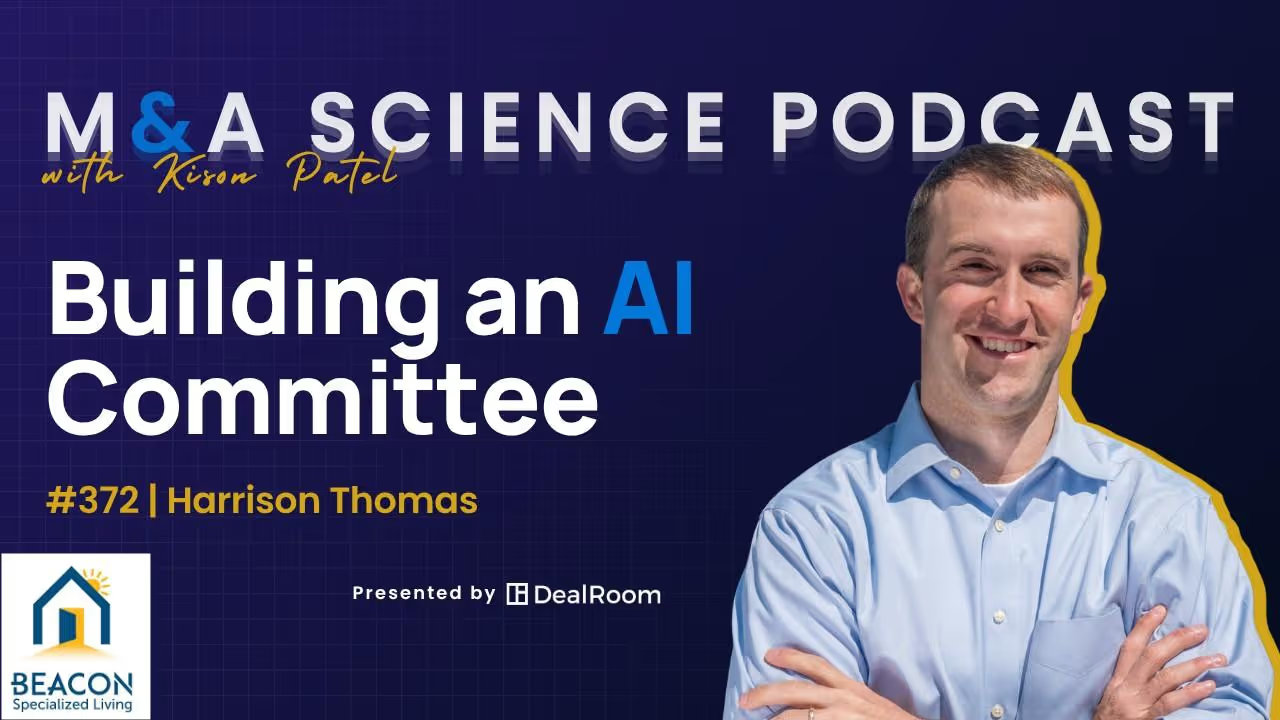
Harrison Thomas is the Chief Growth Officer at Beacon Specialized Living Services, where he oversees strategy, M&A, and growth initiatives. He’s at the forefront of bringing AI, centralized systems, and disciplined integration planning into the behavioral healthcare M&A space. Harrison’s leadership is reshaping how scaled care platforms execute deals.
Episode Transcript
Why Beacon Created an AI Committee for M&A and What They’re Testing Next Part 2
Harrison Thomas: We have a really good legal partner that does most of our transaction work for us and has been working with us for over eight years now at Kilpatrick Townsend.
Harrison Thomas: And that team is great. They actually know enough about our business to almost be [00:30:30] my headlights before I ever get there and finding that stuff. That's gonna be the deal breakers. We also have started working on chart reviews, so in healthcare chart reviews are very commonplace practice. That is not as much of an issue in the way we do what we do because our billing is typically with the states under the auspices of their Medicaid program, the HCBS programs.
Harrison Thomas: And if the cash is coming in the door, they'll do audits on the [00:31:00] documentation associated with billing. And because of that. There can sometimes, if when we do spot checks and chart reviews, we can find some stuff that's maybe not right on the billing side. But a lot of times that chart team is gonna do kind of a compliance audit for us to make sure they're addressing the OIG compliance standards and some quality issues.
Harrison Thomas: So there's certain quality metrics that are somewhat standard in our space, and we'll have them look into that as a third party. 'cause inherently I want to get deals done, my team wants to see the business grow, but we need that third party check to really [00:31:30] validate that what we think we're seeing is accurate.
Kison: How are you managing the process, like visibility into diligence, historical conversations, decisions, documentation?
Harrison Thomas: Our process really kicks off, usually it's a, it's that build a relationship first. Mm-hmm. We have to win people over, even though we're closed. A lot less deals that we're sourcing. We're seeing a lot more deals that we're sourcing.
Harrison Thomas: You end up walking into kind of a cold space of building that relationship from the get go of somebody that may not even realize they're wanting to sell at this time. So [00:32:00] that's really the first step, is convincing people to even share their diligence with you to even sign an NDA to get that information shared with you.
Harrison Thomas: So once we've kind of gone through cursory diligence, we try to get people comfortable with what is on the table. So we get to an IOI indication of interest before we ever get to an LOI and that indication of interest at least to say, Hey, what are the dollars we're talking about? What are the general deal terms we're talking about?
Harrison Thomas: If we can get someone through a signed IOI, at that point, we kick off the formal deal room process, we actually will start a room for [00:32:30] transaction. And what we've spent a lot of time on our side is trying to squeeze down the number of questions that we ask people in core diligence. And when we originally built out Dale room, I think we had 474 unique requests.
Harrison Thomas: I think our core request list is now down to 147 requests. I sneak slide in some Excel documents with additional questions in there so that it's not overwhelming to 'em so they can kinda go through a questionnaire. But we put everything into deal room and the beauty of the [00:33:00] platform for me, and again, I'm not selling it for other people, but I'm a huge advocate because combining the data request with the data.
Harrison Thomas: Allows us to frankly just ramp people into our process much more effectively. And I always tell people I want to have the history of all requested information and all the answers from the seller in one spot. So sellers aren't answering the Q of E team, answering the legal team, answering my accounting team.
Harrison Thomas: There's lots of people that ask the same [00:33:30] question. So that's how we use the platform. So your
Kison: third parties are actually putting all their requests through this. I require
Harrison Thomas: all of our third parties to work through Deal Room. If they don't work in deal room, they're not allowed to use an outside data room.
Harrison Thomas: Their request list have to actually reside inside a deal room because I want everyone to be able to reference that. 'cause so much of this is me managing the mom and pop,
Kison: you have full oversight of all the third parties who's doing what.
Harrison Thomas: When people tell me that they haven't had time to get through something, I can go and see very quickly how much time do they spend in D Room?
Harrison Thomas: How many items did they look at? I try not to weaponize that [00:34:00] information, but I also don't let people pull stuff over on me if they're not doing their job.
Kison: Yeah, it's interesting. I've used it like for some of that tracking, but not to that extent.
Harrison Thomas: It's honestly holds my internal team accountable. When we bring new functional leaders in our company into the process, we go, Hey, just so you know, we can see when you're looking at documents or not, we've had people say, oh yeah, we've been in there.
Harrison Thomas: I've been looking at D Room and I can pull up and see person by person. You've spent all of 37 seconds in the platform and since all of the content resides there and I want all of the [00:34:30] communication to be captured there, the back and forth of answering from sellers. If people aren't in the platform, I know they're not engaging in the process,
Kison: so single source of truth or place to run your whole process.
Kison: What about the experience for the seller? Like how does it impact that?
Harrison Thomas: What's interesting about that is the sellers don't know how good they have it. Because
Kison: these are people that own done, own, own company. Yeah.
Harrison Thomas: This is all they've ever done. When they get into a sales process, I don't care how good you make it for 'em, it's a huge burden to 'em.
Kison: Exactly. It's a
Harrison Thomas: [00:35:00] million questions. And very often I've got sellers who, they don't even have an accountant, they don't have an HR person, so they're answering every single question. I know that deal fatigue can run people away from a transaction and I'm always being cognizant of keeping them engaged.
Harrison Thomas: Keeping 'em engaged. And our CEO and I talk about often we try to get people over the valley of selling the business. Once they've signed the IOI, that's the first hurdle that they've committed to it. But once they've gotten to a certain [00:35:30] point in diligence, they've just gotta push through it. They gotta push through it.
Harrison Thomas: They gotta push through it. What I have seen positive feedback, we work with brokers who work with a lot of other people that do deals in our space and all of those brokers. Commend us and give us a lot of credit because they go, your deal process is tight. We know that you're keeping a lot of the burden off of our seller,
Kison: but don't they wanna use their system?
Kison: These makers always wanna use the old school data room.
Harrison Thomas: I tell 'em, no, it's just a point blank. If you're gonna sell the business to [00:36:00] us, you're gonna put the data in our data room. And once we sell them on why, look, all of your requests are gonna be here. They get to answer the question once they get to work through the process.
Harrison Thomas: Once. I've not had any pushback once we've done that. The only time I ever had pushback was that when Beacon, when we actually went to recap the last time and we had big investment bankers representing us out in the market, I took their team through D Room and I actually built a D room for us on the sell side.
Harrison Thomas: I said, here's all the [00:36:30] questions you're gonna want answer, and if the buyers wanna ask us additional stuff. Feel free to, but rather than us just upload data into a data room. And it was funny because the managing partner said, this is so much better than us going and using third party X, but we still have to go do that.
Harrison Thomas: And oh, by the way, you still gotta spend
Kison: stupid amount of money, crazy
Harrison Thomas: amount of money to use that platform as the seller. And it just, it was a very frustrating process. But yeah, they're stuck in their ways 'cause it's just
Kison: one day what they're used to day. We're gonna dismount that. I would [00:37:00] love it.
Kison: This's a warning shot to all the bankers out there coming for you.
Harrison Thomas: Yeah, exactly.
Kison: In that situation, bankers, brokers, you're getting them to use it. But what about is in competitive situation, I was wondering if there's like a point in time when you're like, okay, we're signed and now we're gonna go use it.
Kison: That's right.
Harrison Thomas: So prior to us being able to sign the IOI we're engaged in their
Kison: process. You're, when you say IOI, it is IOI. And then you go to purchase agreement. It's not I-O-I-L-O-I then purchase agreement. I oi is the LOI.
Harrison Thomas: Yeah. Touchy subject here. I'm I smile [00:37:30] because our board. They're very focused on making sure we keep a positive relationship in the marketplace because of that, the LOI is a hurdle that requires additional approvals by people at the board level and our capital partner level.
Harrison Thomas: And I can use an Iowa, but I also get a lot of deals that don't get to the finish line. If I had to get the level of approval, I have to just even negotiate deal terms on the front end. Everybody would hate me. So we use the IOI as a kind of an [00:38:00] in-between to be able to get a deal, the key deal terms, purchase agreement, escrow, non-compete, stuff like that captured.
Harrison Thomas: And then if it's a larger deal, we actually do get to an LOI. But on a smaller deal, I can use the IOI in those deal terms and we've tried to skinny down a purchase agreement with our legal team and work on getting that as refined as possible and just a solid IOI and a solid. Purchase agreement and we can hopefully get one over the finish line.
Kison: I like it. [00:38:30] This is just taking a buyer led process to really having a defined process and keeping it consistent and standardized. How about the integration? What does that look like? You're running through diligence, sounds like a good system set up for that, but then how do you make sure that goes well?
Harrison Thomas: When we spoke last time, I told you that there's kind of Beacon 1.0 and 2.0 in this new world. When I carried a lot of different hats for the organization, oftentimes it was don't break what they do. And when we say [00:39:00] don't break it, it's really, don't break the culture, don't break the delivery of operations, don't break the relationships with the individuals being served.
Harrison Thomas: The don't break it approach was. So operationally focused that a lot of times you didn't change PTO policies, health benefits, the technology being used, the EHR. So what that led to for us, we had a lot of strong individual companies, but even at that time, we [00:39:30] didn't have a strong enough team on our side to standardize our technology platform to standardize certain policies and procedures or benefit structures.
Harrison Thomas: Because of that, we let a lot of people run in silos. Anyone who's in M&A will tell you, they, you can see exactly where the problems were gonna start rear in their head a little bit down the road, which is now, you can't do consistent reporting effectively. You can't use back office support people because every state has a [00:40:00] different policy, procedure, or process that they're engaging in.
Harrison Thomas: As we looked at. Some of these things come in sequence as a company scales, and as we scaled, we had the resources to invest and better people had better insight as to what does a platform look like. We've really evolved in the last two years into a consistent set of processes and technologies and procedures, and some of those are still evolving, but as we have that platform that we migrate towards, now we've gotta bring everyone onto the platform.
Harrison Thomas: That's where with our [00:40:30] M&A committee, we start spending a lot of time saying in a deal, what are the terms or the issues that we would allow to sit outside of the Beacon platform or not? As we've kind of grown and our concept is called One Beacon, we're forcing all elements into one beacon, and that even then gets into the cultural elements.
Harrison Thomas: That's where, from an integration perspective, you've got to start thinking about not just, okay, this is what the new E-R-P-H-R-I-S looks like. That's easy. It's the. [00:41:00] When I tell them these are the policies and procedures, when I tell you this is the data you have to enter into the platform When I tell you what your new title is, because we want to have a consistent titling structure, most of these people are just caregivers by nature.
Harrison Thomas: It's not a white collar workforce. This is a blue collar, hourly workforce, and they are willing to sacrifice their entire lives to support people with challenging needs. They've worked for a mom and pop organization for years. Those people founded the business. They saw 'em every day in the [00:41:30] hallways or come by the home at least once a week, and it had that feel.
Harrison Thomas: So we've got to try to maintain that, feel that high touch, help people be seen, help them feel like they matter. Help them know that what they do is important and say, and I still need you to engage in our process.
Kison: You got a lot of threads on this one. You got this managing this culture shock, I guess as of its own.
Kison: For them to transition as this unsophisticated operator to being part of professional [00:42:00] system, and you got your own initiative of really creating that standardization, which blends me to believe you got a backlog of integration work. You're also tackling while trying to implement this sort of new go forward
Harrison Thomas: build, build the jet while you're flying here.
Harrison Thomas: That's where we are.
Kison: And fix the,
Harrison Thomas: and fix the jet that didn't fly behind
Kison: you. Yeah,
Harrison Thomas: it's a lot of balancing. It's a lot of internal communication to try to make sure we're addressing that. We brought a few of our seasoned team members over to be focused on integration and [00:42:30] just project manage all of the various elements because so many of the people we're not a large scaled corp dev team with people that are solely dedicated to accounting or HR training and therefore they're making sure those integration elements are there.
Harrison Thomas: We have a few generalists. Then we're bringing in all of our functional leaders on top of their day job, on top of changing everything that they're actively doing to say, oh, by the way, learn how this company does it, and then help me write a migration strategy from point A [00:43:00] to point Z. It's a lot of complexity, but what we've gotten good at is being able to say, here are all the steps now.
Harrison Thomas: Here is what the playbook is, and here's what a reasonable timeline is to get through those various elements. So there's a lot happening in real time.
Kison: Has your process changed now where you are doing more integration planning and structuring, like in the diligence phase?
Harrison Thomas: I laugh when people talk about the difference between diligence [00:43:30] integration because it's just one giant gray line for me.
Harrison Thomas: Once I feel that we reach a certain threshold of diligence, that I have certainty that the deal's gonna get through once we get through a quality of earnings. Yeah, that's the first thing that can disrupt the deal. The numbers aren't there. The numbers aren't there. Once we get through the Q of E, and once we get through some core licensing assessments, making sure that the quality issues aren't gonna be problematic, I bring the integration team in immediately.
Harrison Thomas: Again, I'm trying to mitigate the sellers, telling everything [00:44:00] twice. Once they start unpacking how their business operates, what are people's key roles, what are all the pieces of the business doing? Because keep in mind, a lot of times I'm working with sellers who do not want to tell anyone on the team about the deal until the day of close.
Harrison Thomas: You've got one knowledge party who's sharing everything with us, and we're trying to take that person's word for how the business is actually run because they know in their space that if you open up and expose other team members to the [00:44:30] transaction, that it's very likely this is a very tight knit community and the business could fall apart.
Harrison Thomas: So we bring the integration team in early. They're listening to diligence questions upfront. They're helping us write summaries and diligence and integration pretty much run in parallel for the last 60 to 90 days of a deal,
Kison: last 60 to 90 days, you got both diligence and integration running parallel.
Kison: This is all before close. This is I pretty close. How long does your deal timeline take?
Harrison Thomas: 120 days is probably a pretty standard process. Process because this industry
Kison: is so [00:45:00] regulated.
Harrison Thomas: It's a highly regulated, it's things don't happen particularly quick. You've gotta get through the Q of E, you've gotta get through the legal diligence, and then you've really gotta plan for the integration elements.
Harrison Thomas: The deal we just recently closed was a unusual situation because we actually entered a new market. Within a month of the deal closing in that new market. So we got licensed as a provider and we acquired the company. And because of that, I couldn't run into a situation where I was running the Beacon platform here and the provider platform [00:45:30] there in the same geography with the same staff potentially going back and forth between programs.
Harrison Thomas: So we actually had to go through an entire effort to. Do all of the integration elements pre-close. We had to get the seller's buy-in to exposing this to their staff, first of all. But then on top of that, actually training everybody on all of the beacon platforms, all the beacon policy and procedures, everything Beacon before the deal actually happened.
Harrison Thomas: So that was a tenuous situation. But because of things that [00:46:00] we had unpacked in diligence, I wasn't gonna get approval to do the deal. 'cause I needed to mitigate some of the risks that we had identified. The Beacon platform could mitigate some of that risk, some of the historical practices that weren't being done right.
Harrison Thomas: So it was just this hard line and then you kind of walk into the door. A lot of times when you get these deals done and you get to close, the staff are very nervous. When we show up the first day and no one's ever heard a beacon, we'll spend two or three days holding hands with the staff. Giving them [00:46:30] FAQs, really emphasizing the things that are positive that we're bringing to the table.
Harrison Thomas: Hopefully better pay, hopefully better benefits, better PTO, whatever it might be. We can win over a lot of staff in that regard. In this situation, we were having to sell everybody on the deal. We didn't know when the deal was gonna happen and the state actually pushed back the approval so everybody got ramped up and then they had to actually hold on for another two or three weeks waiting for state approval of the deal.
Harrison Thomas: And because of that, it led to a [00:47:00] lot of tension and we almost had to win people afterwards 'cause they had to do all this work, they do all this training and they weren't even sure the deal was gonna go through. That is something I don't wanna do again, integrating pre-close, but we have to do a lot of integration day one because of the amount of exposure we have.
Harrison Thomas: And if people are not baked into our workflows of compliance auditing and quality auditing, certain things may pop up and have popped up in the past that we wouldn't have predicted.
Kison: So I gotta ask you [00:47:30] this. So our moment to be real with each other, you've sort of more recently created this initiative around integration and mm-hmm.
Kison: The Beacon one, the thing I'm seeing is whether you're buyer build or roll up, you are gonna get penalized during your valuation. This is the trending thing I'm seeing. Mm-hmm. You're gonna get penalized during valuation if you have a backlog of integration work.
Harrison Thomas: We spend a lot of time, because we're in the recap cycle ourselves at different points and everything we do is with the lens of what do we look like as a platform in that next cycle.[00:48:00]
Harrison Thomas: And there is a backlog. But what, fortunately, we've gotten a really good team in place. Now we have a great CIO As we've built the platform for Beacon. Those integration elements really start to accelerate. So there are still elements, but we anticipate by the end of this year, Q1 of 26, that everyone that has been historically acquired will be on the Beacon platform.
Harrison Thomas: And at that point it becomes so much easier to integrate another company 'cause it's not a, what's the best practice? We do it this [00:48:30] way in Pennsylvania, we do it that way in Michigan. We do it that way in Minnesota. What does the new acquisition need to do? It? Let's let 'em keep doing their thing. 'cause we don't know which of those three we're gonna end up doing.
Harrison Thomas: Now that we have the platform, it really enables us to be much more thoughtful and expeditious in our integration efforts. 'cause we're very aware and we're absolutely hearing that in the marketplace too, that if people are a disparate set of companies and it's clear to a buyer, that's how they're structured and they can't produce reporting quickly, [00:49:00] that's gonna really impact their future valuation.
Harrison Thomas: I was talking with a banker who, they had a buyer, a large P firm coming in for a company and there was a simple data request. We wanna see X, Y, Z data, core KPI elements. It took the seller two days to produce it and it was very clear that the data was in multiple different systems and they had to scrub it and build it.
Harrison Thomas: And so the buyer of that company walked away immediately. 'cause they said, Nope, we're not doing this transaction. It's clear that you guys are just a disparate set. So that [00:49:30] is probably our number one focus from an M&A perspective. It's the thing
Kison: I've noticed now, it's like people are really waking up to it and there's more emphasis.
Kison: And part of my big picture dream is taking what we learn from these strategics that do integration really well. Bring it to the private equity ecosystem and yeah. Hopefully it improves their model overall.
Harrison Thomas: Hopefully we'll see.
Kison: Let's uh, wrap up with talking about tech. I know we've already talked a little bit about the diligence and your leveraging deal room for that part, but when you think about your whole infrastructure end to end pipeline through [00:50:00] integration, kinda mentioned pipeline, you went through a scrubbing exercise.
Kison: I don't know, just wanna hear a little bit of walking through. How do you think of that, your system and what value it actually adds?
Harrison Thomas: Been happy that you guys have rolled out a formal CRM now? We're taking a lot of advantage there. 'cause to me a deal has a lifecycle. 'cause originally we were using deal room till we reached a certain threshold in our transactions.
Harrison Thomas: And at the same time, my integration team, it was being led by project managers. They wanted to run everything through Smartsheets because that's just where they run [00:50:30] everything and they're used to doing it that way. What I have found over and over again, 'cause when I was involved in deploying new tech within the company, if people have to go to multiple different places for stuff, they're just not gonna do it.
Harrison Thomas: Being able to have it from the beginning of the CRM relationship of what are all the conversations we've had with the seller. So I'm actually using your plugin and outlook to actually send all of my emails related to deals to the deal room CRM. Then when I actually kick off diligence, I've got the history of information sitting in my CRM [00:51:00] that then starts to feed into the actual data room and the request list, and then working my integration team into all of the integration tasks sitting inside of the platform.
Harrison Thomas: I like it to be a one-stop shop because that way anyone that I'm asking that's has a day job as a functional leader for us, they know that if it's related to a transaction, that's the one place they go to find that information.
Kison: So centralizing your process, basically the whole lifecycle from CRM, diligence with the data room, and then integration.
Kison: [00:51:30] And you mentioned before your had stuff separated, use Smartsheets before. You told me a lot of stuff was an email and it was it OneDrive,
Harrison Thomas: email, OneDrive and we were using a platform called Liner as our CRM at time and none of it worked together.
Kison: Part of me is curious because I always get the question that even on our sales team probably gets this question of like, how do you quantify that?
Kison: A lot of this stuff we work on building a business case, it gets rolled up to the CFO and it's very, how do you quantify the ROI here? You've seen it [00:52:00] firsthand. I'm curious in your words, going from the disparate to centralized, like what's the real value unlock
Harrison Thomas: For us, it's just the consistency in the data if it's all sitting there.
Harrison Thomas: Honestly, the C RM piece has been huge for me because. We went through and scrubbed through 4,000 contacts that we had, and we've scrubbed it down to 270 or something that have real data, actual data that we worked on, the transactions. And so if I can find everything related to a transaction there, and most importantly, it's the ability to then pass [00:52:30] off the history.
Harrison Thomas: I may not be here tomorrow. I've got a really good guy working for me. He didn't have all of my historical knowledge, all the conversations that I'd had with these different sellers. To me, having the one stop shop of content allows no person to hold the keys to the castle and prevent the business from continuing to run effectively.
Harrison Thomas: My goal is always to work myself out of a job, and by using the single source, I'm not as important in a good way. And hopefully I can then free myself up with my time to [00:53:00] go be focused on something else. 'cause all of my historical knowledge and the IP that I'm curing sits on top of the platform.
Kison: Programmatic M&A. You got a real system in place. Let's talk about ai. We dabbled in AI last year, built some first gen stuff that was around contract extraction. Now we look into this next year, about a month from now, you're gonna start seeing this next generation roadmap, and it's a whole series of AI features.
Kison: We've talked about this and we're now, we're speaking pretty broadly. Yep. Is that just what we're working on? Obviously a lot of [00:53:30] folks are exploring AI with all different kinds of tools and different use cases. I want to hear from you.
Harrison Thomas: So I've gotten excited here lately because I've been enlightened a little bit.
Harrison Thomas: I'm the generation that bridges the digital divide, such that I know what the analog and digital world look like, separated from one another, and I'm anti-social media, so I didn't want to jump on the AI train for a while, and I was just head in the sand trying to say, oh, we, we'll see what happens. Lately I've had my team engaging in [00:54:00] leveraging AI, and we've literally tackled entire projects, putting together playbooks of information that I had scoped out three to four weeks of work to be done.
Harrison Thomas: And we did a screen share and we knocked it out in two hours better than we would've ever performed it, and that was scary to me. It's happening so much faster than people realize. I know that when your team was rolling out the AI function last year, I was looking at it, we did a scrub of contracts and key.
Harrison Thomas: Still terms and that was [00:54:30] helpful. But so much of what we do is very nuanced, unique. Like we don't have a million contracts to go through. We have a lot of vendor information. It's good to have it summarized. Our lawyers do it. I can see a lot of our lawyer work getting displaced very quickly with some of those functions.
Harrison Thomas: But I was like, it's not where I can see it being overly useful to me today. Where I have started to become enlightened is you start talking about these custom GPTs. So we have an issue around the privacy of our data, PHI, hipaa. [00:55:00] I can't go sending stuff to chat GPT in the cloud because I've gotta be hyper conscientious of that.
Harrison Thomas: But working with our CIO, we're start talking about using Microsoft copilot and building in the studio, custom GPTs, the ability for me to look and create an AI agent. It says, I want you to think like Harrison Thomas. Here are the KPIs that matter to M&A at Beacon. Here are labor ratios to revenue.
Harrison Thomas: Here are what census targets are today. Here's what they look like. Here's the thousand things I look for in diligence. [00:55:30] Here's the reports I need coming outta my diligence. And then for that AI agent to start being a replication of me to do all the diligence work and actually create the reports based on the things that I'm always looking for in a deal.
Harrison Thomas: That's the evolution that's happening very quickly. When that happens, that's the piece that will open up a people's eyes to say, oh, wow. I can actually make a lot of what my intellectual property is irrelevant or replicated by the agent, and thus that output of [00:56:00] data becomes very powerful To me, that becomes a.
Harrison Thomas: What does all that time mean? 'cause now if I freed up myself and I freed up our time, where can we repurpose that? So it's an exciting, scary time. You better really think about what you're doing and what your skillset is and the value of the organization that you bring, because much of that can be disintermediated with AI in a positive way for the organizations.
Harrison Thomas: And I wanna make sure that we're kind of on the front edge of that
Kison: great example, and so true. I'm excited to show you what's [00:56:30] coming up next. It's a lot of similar things. We described building agents, but it's already built in the data room environment and we've been really focused on accuracy. That's the tricky thing.
Kison: Balancing, taking in a lot of information, more information. Your AM model takes in, it just hallucinates and gets, becomes inaccurate. It's really architecting for small batch analysis, right? And be able to put things together in that unique wave to keep the consistency of accuracy.
Harrison Thomas: I'll be excited to see that if you're not engaged in that, it's gonna make so much [00:57:00] irrelevant so quickly.
Harrison Thomas: But I guess as a human, I still have a little bit of relevance for a period of time because it's checking the accuracy. It's not allowing those, assuming the assumptions are accurate, it's actually going back and double checking where the data came from, whether or not that information is accurate or needs to be scrubbed.
Harrison Thomas: And particularly for us, so much of the data we get is inaccurate and needs to be questioned anyways. Those outputs will be helpful. I like it just because then it's stuff I don't enjoy doing. I don't want to have to go pull this data from a thousand different places and put together a little report.
Harrison Thomas: I'd rather it [00:57:30] pull the report, let me go validate it, and then let me be thoughtful and strategic about what does that mean and how do we get the deal done
Kison: there. There is some cases too, it's like, here's analysis that just wouldn't be able to do with people. I had one deal. I looked at GE and Che G BT got a format it just right, but I, I did have it analyze 700 customer contracts, all the financial terms and I'm like, look for the anomalies and these contracts.
Kison: And it came back with a short list of 30 and said, these are decreasing revenue. They're probably the ones you wanna [00:58:00] figure out if the return risk or what they did to keep them going. And I'm just like, wow. Because even looking through it, it was not clear to see that pattern.
Harrison Thomas: And that's where the prompting becomes so important.
Harrison Thomas: The ability is a human to understand how to prompt the agent effectively and actually. Interact with it and find those anomalies. I,
Kison: I'll tell you, the way we look at it is the way it's evolving, it's becoming less important. The prompting. Yeah. The AI knows how to correct your prompts. I used to do that early days.
Kison: It's like, Hey, help me write a prompt to do X, [00:58:30] and you let the AI do that. I still do that. So we do that internally. We'll create a lot of prompt templates. Mm-hmm. And it could be this podcast, like we'll have a prompt template to extract things that relate to my lead M&A. Mm-hmm. As examples, and they'll pull out one of the stories you've told and quotes and things like that.
Kison: We'll use that for different types of content. We may assimilate different things together, but we have a template's pretty elaborate. It's like a couple page template to pull all that data out the way that we want it. So we'll start using AI for that to actually generate the templates so we [00:59:00] have consistent extractions.
Kison: We're seeing it the way it's evolving, it's like it's doing it for you. It'll change your prompt to kind of know and advance it and you don't even see it happening. I think that's what you want to get it to. Things are just so you don't have to think about it.
Harrison Thomas: There's things that I want to do and some things aren't working in the environment, at least in copilot.
Harrison Thomas: We do certain things in Coly. When we go do external research, we might use a chat, GPT, use alaw, whatever, and that can go find something publicly available. But when we're talking about the beacon data, we've gotta keep it inside of our environment, which is a [00:59:30] little bit constraining. But I think that the ability for us to then feed it historical diligence, what were the diligence items that identified, let's feed all the legal, what did legal find on this deal?
Harrison Thomas: What legal looking for in the deal? What did the Q of E look for? What were the things that were questioned in the Q of E? And for it to be able to ingest that information so that it's going, this is the things you're gonna look for already, and then to be able to scrub it and actually put out a summary of that, that's gonna be [01:00:00] scary when you can do that.
Harrison Thomas: I can't take it outside of our constrained environment, so I'm, maybe I'm jealous of the people on the. Listening in, they can actually use the more broad based, you know,
Kison: there's some cool tech coming that figures out how to do this in the data room environment. They're probably gonna come out ahead here.
Kison: I gotta ask you, one of the things that caught my attention from our previous conversation was you mentioned that you're acquiring non-for-profit organizations. Can you walk me through that? I'm really curious because I actually worked on a deal earlier in my [01:00:30] career. Love to just compare notes about how you're approaching it.
Kison: What are you learning from it?
Harrison Thomas: I wouldn't tell you it's my favorite way to do a transaction 'cause there's a lot of complexity that comes with it. But there's a lot of good that's come out of our most recent deal that we did that way. Nonprofits being converted to a for-profit in healthcare. Requires a lot of scrutiny and overview.
Harrison Thomas: The first things first, you've gotta have alignment with management and the board because both of those parties are gonna have to effectively sign off on the deal. Management's not gonna [01:01:00] take it to the board unless they're interested in actually doing it. For us, it was selling to that board. What is the unlock that Beacon can bring that the nonprofit doesn't just inherently, nonprofits are gonna move at a pace that's not the beacon pace.
Harrison Thomas: We're moving very quickly at all times, but what I try to impart on them is that the mission that they're looking to serve, which is broadly to serve as many people as possible 'cause of our pace. We have the ability to do that much quicker than they can. We make the capital investments in getting new [01:01:30] homes or new day programs or new sites, and we also are gonna be an unlock for their staff.
Harrison Thomas: So if you have staff that are kind of stuck, the company's serving maybe a hundred, 150 employees or something like that, that rockstar individual that works for you is not gonna go look for a job somewhere else. They have upward mobility within our platform. So the scale that we bring is really helpful to the employees, hopefully better pay and better benefits.
Harrison Thomas: A lot of times nonprofits have good pay and good benefits, but we give career trajectory opportunities to a lot of [01:02:00] employees. And then the key other piece for us in the selling it to the board is just relevance. So I could go down a whole rabbit hole in healthcare of what does it mean to have scale and more importantly have a seat at the table.
Harrison Thomas: So we're recording this right now. The house just approved a major Medicaid cut and our CEO has been in Washington meeting with various legislative agencies, helping them understand what is the downstream effect. Of a lot of the people that we support. And while they'll [01:02:30] claim the Medicaid cuts are tied to work benefits, frankly, as the state budget gets squeezed, everyone that touches Medicaid is gonna get hit in one way or another.
Harrison Thomas: And what we've tried to impart on these boards is that we as a scaled provider, have an opportunity to not just manage things at the federal level, but really at the state level when they're talking about managed care, they're talking about reimbursement changes or just advocacy for the people being served, or advocacy for direct support workers.
Harrison Thomas: Our voice actually matters. Not that there's doesn't, but we [01:03:00] have a louder voice than they do. So all of those factors really play into, hey, there's maybe a there, there. If there's alignment with the board, there's alignment with the management team, then it goes into a much more rigorous process. They have to have a formal third party valuation done.
Harrison Thomas: We're negotiating deal like we do normally, but they've gotta prove that the offer that we're bringing in. It's actually worth something to someone. There's no private endearment, so no one at the board level or at the management level is actually profiting from the transaction. So a lot of [01:03:30] times people go, transactions are hard enough as it is.
Harrison Thomas: Imagine layering in the fact that no one's really getting money from the transaction makes it a lot harder when they have to go through diligence and all the change management of integrating a company. And then even if you get through negotiating terms, the board, the management and everything gets to the point of actually submitting to the state.
Harrison Thomas: Then you go to formal regulatory review. And the last deal that we did went before the attorney general at the state level. And if you've got the ag looking at it, they're scrutinizing everything. They're [01:04:00] scrutinizing why the deal is happening, what does it mean to the marketplace? Is it good or bad for the individual served?
Harrison Thomas: And if once you get through all of that, we actually, and this was my favorite part of the deal, the transaction proceeds actually went to a charitable trust. So the board created a separate board under a separate entity to manage those charitable funds or those funds into a charitable trust that was intended to then support people in the community that were already being supported by that company.
Harrison Thomas: So not only did we get to take over the company and the existing business [01:04:30] support those people, we've now grown that business in a year and a half's time. It was a 30 year organ year, year old organization. We've grown over 40% in a year and a half because we've unshackled the growth lock that was there.
Harrison Thomas: There's a lot of demand, but they were constrained by the nonprofit bureaucracy. Frankly, we unshackled the growth. Then all those proceeds actually went back into the community supporting people with disabilities. I thought it was a very unique and fun way to do a deal. Two and a half, three year process.
Harrison Thomas: So it was not quick. [01:05:00]
Kison: Wow. We laughed
Harrison Thomas: many times that the deal would never get done. So the fact that we actually got to the closing table, it was a lot of a celebration, but then some real work had to happen after that too. 'cause culturally, that's one piece I didn't touch on is very different culture, nonprofit.
Harrison Thomas: You've gotta win people over. 'cause there's people that just say, Hey, I wanna work in a nonprofit. And trying to help them understand that their mission is still just as important, but they have more opportunity to do more of what they did under our umbrella. That's kind of the win that we have to work on.
Kison: Is [01:05:30] there tax liability or things that come in play when you convert?
Harrison Thomas: Yeah. There are certain things that they don't carry from a liability perspective that we do. So we had to go through all those different elements, little nuance stuff, little state taxes. One of the things that kind of caught us up is they had contracts with no tax and that we then all of a sudden we, so you had to, the taxes, we had to pay the taxes that they didn't previously pay.
Kison: I was curious 'cause the deal I worked on, it was already converted from a non-profit to a for-profit. But the part of me is like, well it, they'd wanna get some equity [01:06:00] to realized from, from what they worked on because I think they operated it for so long. Mm-hmm. As a not-for-profit, but then they converted it.
Kison: That's what I was curious about the whole process of doing it is this, the M&A opportunities converting non-for-profits to for-profit and
Harrison Thomas: we have discussed it, you would be aas us to want to get into that space full-time because that would be a very difficult way to make things happen. It is the nature of the hospital world though.
Harrison Thomas: Majority of your hospitals are. Nonprofit entities and you have some [01:06:30] for-profits. And that's a whole nother rabbit hole of what that means. And there's a lot of scrutiny around some of that at a higher level. But from our side, I have a moral obligation not to do a deal if I don't believe the individual served will be better off on the backend.
Harrison Thomas: And that's part of what's really cool about what we do. We serve people. And our founder, he really imparted on me that we are a servant organization and that's how we should lead. And if we're not able to do that, I don't wanna do a transaction. When we look at the nonprofit [01:07:00] side, I go, can we make the company better or the employees can be better off?
Harrison Thomas: And will the people being served being better off? And if that checks the box, I'm willing to tackle three years of work.
Kison: We'll have to save this for a whole other conversation. Maybe we'll invite our friends at Bayata who've done the other, they operate as an not-for-profit, but have acquired for-profits.
Harrison Thomas: That'd be an interesting discussion. Yeah.
Kison: We have to do a little round table around that. Hey, I gotta ask, what's the craziest thing you've seen in M&A?
Harrison Thomas: The craziest thing, and I've seen it multiple times, are when we've put dollars on a table [01:07:30] to help retire someone and they wanna sell their company and then they just don't answer their phone.
Harrison Thomas: And you'd be shocked how many times in our space people will go down the path. They'll even get engaged in diligence and then they just go completely silent. I've had seven companies and I mean that not from a genuinely not stuff that we had done that tripped up the deal, it'd be mid deal, and they just decide they're not gonna do a transaction.
Harrison Thomas: That one always confuses me. 'cause I [01:08:00] feel like to engage in the process is quite painful and eventually just walk away from it without any communication at all. I think that that's one of the weird things about our space. It'd be a lot easier just to say, Hey, look, I don't wanna do a deal because of X. I want to keep working.
Harrison Thomas: And we have people that do that. But I've had six different transactions in the last year and a half where people just went completely silent and that is the piece that seems a little crazy to me,
Kison: getting engaged and then goes to before the marriage.
Harrison Thomas: Yeah, they completely ghost us.
Kison: That's pretty wild.
Kison: It's been a great [01:08:30] conversation. I appreciate you taking the time. Help me become a better M&A scientist.
Harrison Thomas: I enjoyed it. Thanks for having me.
Kison: Those of you still tuned in and listening, the fellow M&A scientists, thank you and appreciate you. Always welcome the opportunity to hear from you. Reach out to me on LinkedIn, like hearing ideas, feedback on this interview, ideas for other topics I should be covering criticism.
Kison: I get that sometimes, but that's fine. I welcome it until I get better.
Harrison Thomas: There's a podcast I follow and they do a thing where they ask 'em to roast them five star [01:09:00] roasts, so maybe you should ask for the five star roast. They give them five stars and they roast them in the. People have gotten into doing that and they've shot up to the top of the podcast ranks.
Kison: I'll take that. Gimme a five star roast. That'd be nice. Gimme five stars and a good roast. I would take that and welcome it, and I would appreciate it. Till next time. Here's to the deal.[01:09:30]
Kison: Thank you for taking the time to explore the world of M&A with our podcast. We love hearing feedback. Tag us on a LinkedIn post, add a review on Apple Podcast. We'd love to hear from you. If you need help standing up an M&A function or optimizing one that you already have. We're here to help, and if we can't help you, we probably know someone that can.
Kison: You can reach out to me by email Kison, K-I-S-O-N, at ma science.com, or you can [01:10:00] text me directly at 3 1 2 8 5 7 3 7 1 1. If you just want to keep learning at your own pace, visit ma science.com for a lot more content and resources. That's where you can also subscribe to our newsletter. Again, that's ma science.com.
Kison: Here's to the deal.[01:10:30]
Kison: Views and opinions expressed on M&A science reflect only those individuals and do not reflect the views of any company or entity mentioned or affiliated with any individual. This podcast is purely educational and is not intended to serve as a basis for any investment or financial decisions.
M&A Software for optimizing the M&A lifecycle- pipeline to diligence to integration
Explore dealroom

Want to wear your M&A expertise?
Check out the M&A Science store.