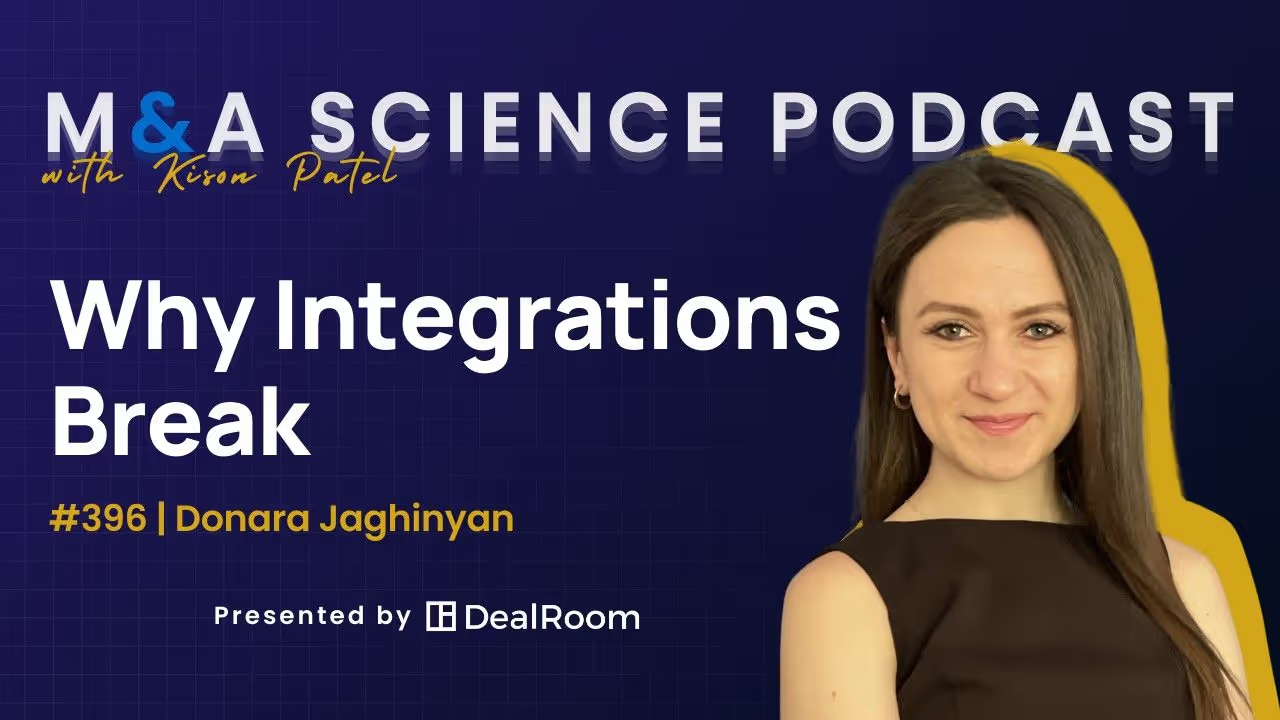
Donara Jaghinyan
Donara Jaghinyan brings a unique background to M&A integration—starting in international relations in Armenia before transitioning to corporate deals and transformations. Since joining her first Integration Management Office in 2021 during the Harvard Pilgrim and Tufts Health Plan merger, she's lived and breathed M&A, leading diligence, post-close integration, and TSA management across multiple industries. Her operational experience on the ground—not just governance from a distance—gives her a rare perspective on what actually breaks during integration and how to fix it before it's too late.
Episode Transcript
Why Integrations Break
Kison Patel: [00:00:00] I am Kison Patel, and you are listening to M&A Science where we talk with deal professionals and learn valuable lessons from their experience. This podcast focuses on stories, strategies and what actually happened during M&A deals.
Kison Patel: Hello, M&A scientists. Welcome to the M&A Science [00:00:30] podcast. This show is part of our mission to rethink how M&A has done and build the operating standard for buy-side M&A. That old school sell led approach, that era is over. Buyer-led M&A is all about strategy, alignment and execution.
Kison Patel: Putting value creation at the center of every deal. Let's be real, not just about closing the deal. It's about making it successful, and we get there by learning directly from the best. If you want to go deeper into the framework, grab my book, bio led M&A if you want the [00:01:00] full system. Frameworks.
Kison Patel: Templates, exclusive content expert q and a sessions, access to me and the AI powered Intelligence hub. Join the M&A science membership@mascience.com. It's the Home of buyer led M&A. While you're there, make sure to sign up for our free newsletter. Leave the deal, own the outcome. Let's jump in. I'm your host, Kison Patel, chief scientist at M&A Science.
Kison Patel: Today I'm joined by Dara Ja Yang of [00:01:30] transformation and integration leader with deep experience in public and PE-backed environments. She's led diligence, post-close integration, TSA, execution and enterprise system implementations across healthcare, SaaS, professional services, and financial services. He's one of the rare operators who's actually done the work.
Kison Patel: Not just governance on a slide, but real integration, real TSAs and real change management in the trenches. Today we're gonna talk about all things it takes to make a deal truly [00:02:00] successful, from integration planning through execution, TSAs, change management, and more. How you doing today?
Donara Jaghinyan: Good. Kison, thank you for having me here.
Kison Patel: I appreciate you taking time from doing deals to, it's exciting. Have a conversation with me. Can we kick things off a little bit about your background?
Donara Jaghinyan: A little bit of accident and the strategy I would say. So I started international relations back in Armenia, study of countries, politics and negotiations and deals, but yet transitioned that into [00:02:30] two companies, deals on the company side, rose border, and negotiations.
Donara Jaghinyan: When I moved to Boston, I took over temporary project with the PMI, central Massachusetts Project Management Institute. They were transitioning their email system and they were fully going into Google Suite and I helped them do their email migration. And that was the early seeds of, that's something interesting [00:03:00] and I'm interested in learning more.
Donara Jaghinyan: So when I started looking at the jobs in the US market, I was primarily focused into the. Steel side mergers and I happen to be right place, right time. Boston, where early 2021, Harvard Pilgrim and Hav Cell Plan merged and I joined their IMO and since then I've been just living and breathing with M&A.
Kison Patel: That's pretty interesting background. 'cause you started with the international relationships, got into [00:03:30] international business aspect, got exposed to one component of integration. Now you're basically doing it full time and. You did it since you came to Boston. So how long have you been here for
Donara Jaghinyan: six years now.
Kison Patel: You lived in Armenia previously before then?
Donara Jaghinyan: Yes, indeed.
Kison Patel: Wow, this is awesome. What kind of industries have you worked across when you, so it sounds like you have a few different roles related to integration.
Donara Jaghinyan: Doing M&A is one of the fields that you don't really have to be a subject matter expert. You don't have to have a niche [00:04:00] financial background or technology.
Donara Jaghinyan: I started in the healthcare insurance, one of the largest New England healthcare insurance firms. Transitioned to technology software where part of it was also providing professional services, transition to financial services Right now,
Kison Patel: moved around. What's something you wish you understood before running your first major?
Kison Patel: Integration
Donara Jaghinyan: dependencies are very important. Just something that seems like, oh, it's just a ERP integration, or it's [00:04:30] just like. Integrating systems or pupils. There's so many levels underneath, and also the pupil dynamics. Sometimes functional leads are handling only their aspect, but as A IMO, you are tasked to help them understand the dependencies upstream and downstream, knowing how to navigate.
Donara Jaghinyan: Leadership conversations, give them the look ahead. There is a reason why we are integrating. There is a reason why we are integrating [00:05:00] at this timeline, at this pace.
Kison Patel: How would you describe the role of Nanaimo
Donara Jaghinyan: trusted partner with the key experience or a background in multiple deals? It's hard to say that one deal is similar to another, but you have to have seen.
Donara Jaghinyan: Multiple scenarios, multiple things going wrong, and you have to advise them. It's not just like integrate systems, it's not just [00:05:30] bringing payroll. There are so many components and you being in the center, you have to help them understand multiple killers down to one activity that is happening. So advisory role, I guess advise and help them understand.
Donara Jaghinyan: That it's not just integration, it's the entire holistic system of the company that you're building.
Kison Patel: Why can't I just hire a PM for my company and tell 'em you're now an [00:06:00] IMO and I want you to run this next integration?
Donara Jaghinyan: You can definitely do that. But usually PMs are project specific, work stream specific, and I work directly with HR PM in the finance or IT side, but they truly oversee just their.
Donara Jaghinyan: Scope of integration, but IMO sits above where we see holistically how it's gonna impact. It's not just bringing in Workday or HRI system, it's how do you set up the GL code in ER Ps? How [00:06:30] do you set up the IT integration? How do you run all the emails and so forth, but not all PMs or functional leads know that.
Donara Jaghinyan: Cross-functional aspect in it,
Kison Patel: like real program level management. I take it, some of this is seen this movie before, know what's gonna happen. Mm-hmm. Which is important. Can we talk about carve outs? What gets underestimated when you do a carve out?
Donara Jaghinyan: Timelines can drive that dependency, but sometimes you just have to do [00:07:00] it to close the deal.
Donara Jaghinyan: But it's always so much dependency with the parent company because it was part of the. Speak enterprise or big structure that no one really documented the separation. No one really separated the systems or the people or the payroll, and then you have to carve it out. You document it enough for the carveout.
Donara Jaghinyan: But most of the cases, when you start the carveout or the actual deal happens, you see the interrelation with the [00:07:30] central org or the parent organization.
Kison Patel: My experience, yeah, you did a hundred million carve out. I'm doing a. Tail end of a carve out, three people, the MA science podcast. We're carving out a deal room, and now I feel the pain.
Kison Patel: I would say my big three are scope. You don't, you think you scoped everything, but you didn't. I'm very fortunate. We have a good relationship on the sides of deals here, but if you didn't, that's a lot of things that you didn't [00:08:00] plan on that you have to negotiate and figure out. Two. All the vendors, like you have to set up all those vendors and some of 'em don't wanna play nice and you gotta negotiate hard with them or find new vendors and then the people stuff because you end up with some gaps.
Kison Patel: You gotta scramble to go hire people. Sometimes you don't hire the right person, you gotta let 'em go and go hire somebody else. That was my big three. One I'm curious about, well one, if you have anything on, on that. I feel like if that's fundamental. The [00:08:30] other one I got lucky on was it didn't have a big lift on TSAs.
Kison Patel: Okay. Because everything was like a sort of arms length distance of a business. Yeah. I mean it was just more of an outline. Yeah. How we're gonna do it. But how does it really go down when you working on a bigger carve out?
Donara Jaghinyan: It's a combination again, like how much do you have time to scope it out? But to your point, all the people, the vendor aspect and the scope, it's carve out this ture of setting up a new business to get it.
Donara Jaghinyan: So you do have to have the it. You [00:09:00] have to have security, you have to have payroll, you have to have benefit. It's like setting up a new company from scratch and when you don't have the time to set that up, that's where the TSAs come into play. But TSAs don't look at the TSAs as like contracts. Look at it as a project because.
Donara Jaghinyan: They have a start. They have scope, and they have a finished timeline. If you don't have enough time to set up the payroll, which is one of the important things that employees care, you have to ask the seller, Hey, [00:09:30] for another month or two, continue processing. Then we'll do the invoicing to make sure the employees get paid until you set it.
Donara Jaghinyan: If you have enough time to set up a new payroll provider, get their onboarding and all the items, then you don't really have to go through a TSA on that. So TSAs are typical for the carve outs, but not all carve-outs At TSAs,
Kison Patel: you can do carve out and not necessarily have to have TSAs, but it sounds like they're there pretty often.
Donara Jaghinyan: Yes. The example that we had [00:10:00] there, two business units coming to. Technology firm. It was combination of people, hr, TSAs, it was finance, TSAs technology, TSAs. And interesting component of it was, you think you are looking at them just on the functional level, but some of the TSAs that their dependencies on the other TSAs, uh, you had to set up the technology environment to be able to.
Donara Jaghinyan: Close the [00:10:30] HR TSA, let's assume, or you have to integrate some systems to make sure you onboard and hire new people, and then you exit the TSA and that interesting aspect, what I've seen in the carve out is going back to your scoping. You feel like you are scoping, but not until you have the model outlined.
Donara Jaghinyan: That's where you start. Oh, the scoping has been done, but is it really. Let's say apples to [00:11:00] our operating model, and then you identify that it's not, and then you start extending the TSAs to just lab your infrastructure to be able to support that.
Kison Patel: So it's like a tool to fill in the gaps.
Donara Jaghinyan: Yes. You can look at that.
Kison Patel: Can you walk me through this carve out that you're discussing? 'cause you worked on how many carve outs?
Donara Jaghinyan: Two.
Kison Patel: Two. Two different car outs?
Donara Jaghinyan: Two separate business units, part of
Kison Patel: one deal.
Donara Jaghinyan: If you look at that,
Kison Patel: do they go to the same.
Donara Jaghinyan: Company.
Kison Patel: Yeah.
Donara Jaghinyan: Yes. Same buyer.
Kison Patel: The same [00:11:30] buyer bought two different business units.
Kison Patel: Mm-hmm. That were carved out. I'd love to hear just what's the story like? How'd it go down? Yeah. What was the timeline of events that happened? Yeah. And then what was the good and bad?
Donara Jaghinyan: It was the driving force for my previous company where I worked. It was heavy in TSAs. The deal happened in 2022. I joined post of transaction, so I joined to support with the.
Donara Jaghinyan: TS a management. It was large. Some of the [00:12:00] budget was heavy on the Ts a side, so I joined to manage the TSAs and several months after the program director left the company and then I stepped into support with the TSA management. But that's where you understand that integration drives TSA and not the other way around.
Donara Jaghinyan: Square. We've been mostly focused on closing the TSAs, but not until coming back to my point, you set up the right environments. Through the integration, you will be able to close the TSAs. [00:12:30] It was a cross border deal. Multiple locations, multiple entities. Interesting aspect in the TSAs that I noticed was the company structure that we had and what we acquired was very different.
Donara Jaghinyan: So let's assume. You have a real estate, PSA, it is very central image on the buyer side, but on the seller's side, it's very dispersed through different geographics. And then that's where the challenges come in. Who's the, [00:13:00] the roster? You know, the receiver and the seller, you are trying to exit it, but there are so many locations and people don't really know who you are talking about.
Donara Jaghinyan: That was an interesting component that I saw, but. Again, tying back to how do you handle the TSAs and integrations at the same time when you have two integrations happening, was interesting and challenging to talk to the functional leads and try to explain why you [00:13:30] have to do this right now. Why is it important to exit it?
Donara Jaghinyan: And sometimes you see that TSAs are part of the integration budget and there is the. Feeling that yes, the budget allocation is already there, but yet it hits the functional p and l, and then not until you start talking numbers, that's when people start, oh, it's actually hitting my functional budget. Then we have to exit that versus, oh, we didn't have time to do training.
Donara Jaghinyan: We didn't have time to [00:14:00] do the documentation or hire a new rec. So can we extend? Usually what happens with TSAs is lots of extensions where. Companies lose time and money.
Kison Patel: It's funny because it sounds like you can know when you're gonna need to do some tsa mm-hmm. Pretty early and you can get ahead of it.
Kison Patel: Sure. And then you might find out later, like when rubber hits the road, or you're about to hit a wall, that you need to get a Ts a Yes. And then you're negotiating that, [00:14:30] and then you end up extending these TSAs. Mm-hmm. Because they're not ready on the other side to take over that service. Does that sound right?
Donara Jaghinyan: Yeah. The carve out, especially in the big ones. You bring in sometimes systems or people that you don't really have in house. So for example, what we had, one of the business units was professional services. The way they do their ill generation or revenue recognition is completely different. So we didn't have the headcount or the knowledge to do that.
Donara Jaghinyan: So yes, it comes with the people, but it's the [00:15:00] system relationship with the seller organization and seller systems that you are trying to keep up. And then they're like, oh, it's already functioning. It's A TSA. We'll just do it. And there is like merging priorities and other M&A happening. So you feel like it's a TSA, but people look at it as contract that you can extend versus you have to look at, it's temporary.
Donara Jaghinyan: It doesn't give new timelines. It actually creates deadlines for you that you [00:15:30] have to manage accordingly because. If you miss that, just like it becomes redundant and creates lots of integration debt,
Kison Patel: do you have an example of just like, how do you do negotiate A TSA and keep up with all the different documents and everything?
Donara Jaghinyan: My example didn't happen on the TSA integration pre-deal close, but I have an example where. We had to work with the buyer side, our [00:16:00] teams, and the seller side to extend the TSA, and that's where it comes from seller side. Sure, as long as it's a money involved. But my role came in to help the function leads understand that there is a cost impact and mostly T ssas are a short term.
Donara Jaghinyan: It's four to six months, maybe maximum year, but extensions usually have cost impact. There is percentages being added up and there is like a hard stop Sometimes what we've seen, [00:16:30] another aspect comes who drafting the contract. Everyone is busy on their workloads and you go into your legal department, you're going to the seller side, legal department, and then you start, uh, bouncing back and forth who's gonna draft that.
Donara Jaghinyan: But in my experience, couple of the TSAs that we had to extend. Just leveraged the master transaction agreement, and we just referenced to the right clauses. It was just the same scope, timeline, extension, and [00:17:00] we had good relationship with the seller side, but at some point you just, okay, extensions cannot just go.
Donara Jaghinyan: And then one process that we had, it was established right after the deal goes, the extension request and the documentation process. Who's the requester, who's the receiver? How do you document the requests on the extensions? And then how do you also notify the exits of the TSAs? Because let's [00:17:30] say if your monthly books closing companies run on different financial cycles, and sometimes you can do the financials at the month close or when the transaction was closed.
Donara Jaghinyan: In my example, we. We are counting the TSAs with the transaction close time. So that was the driver on a monthly basis. So if you do not notify on the right timeline, you accrue close. So we were closely working with the functional [00:18:00] leads on a 30 day notification period and then just doing the math of, actually we notified you 15 days ago, so we are going to pay the half of the TSA.
Kison Patel: Interesting. Yeah, that's a lot of tracking on these
Donara Jaghinyan: a lot. It's really heavy on a cost for the companies and for the leadership. Any cost savings is important, so, and it also is helpful for the function leads as well to show that they actively worked on it. [00:18:30] There's some cost savings on it.
Kison Patel: That's a lot.
Kison Patel: So we got that outta the way there. You got the harder part is when you do these par outs. Let's go to the buy side. Running a typical process. When do you get involved with deals?
Donara Jaghinyan: Mostly before or around LOI.
Kison Patel: Can you walk us through how you structure diligence and
Donara Jaghinyan: So in the companies that I work, usually there is a core dev part where they bring in at the right time the IMO.
Donara Jaghinyan: But we had the understanding and the partnership with the corporate [00:19:00] team that the sooner IO comes in, the smoother, the integration is gonna flow. It's not just a deal closed. So why given? Oh, there's so many eyes. I'll just lay it out. Now. The whole aspect of the deal is not closed yet until it's signed.
Donara Jaghinyan: Everyone knows about legal is very cautious. Our development is very cautious. But as an integration team, you want to have the right people in the diligence conversations to be able to give you like [00:19:30] a tangible integration plans to say, can we fully be integrated within three months or three years? So.
Donara Jaghinyan: It starts top down, given the sensitivity of the deal, especially in the public companies, you don't wanna announce it. You don't want any linkage to be happening. So we start with the heads, the executive sponsors who know well enough the organization to say what needs to be happening. There's some teams where, for example, in [00:20:00] hr, the structure that we had, it was.
Donara Jaghinyan: Separately for the h uh, for the benefits side, separately for the payroll side and as a functional head, it is hard to commit to a timeline without really consulting the team. So sometimes there are scenarios where we would go to the legal and corp dev and justify the cases like, we truly need this additional two, three people to come in to make informed decisions.
Donara Jaghinyan: So we just expand enough. [00:20:30] To have the right people ask the right questions for the integration, that's where it's coming. It happened on both sides where we would set up environments for the functional heads to speak to the seller side, or sometimes route the questions through IMO or corporate development.
Donara Jaghinyan: At the previous company, we got to the level where we got the structure that we had playbooks, multiple hypes and sizes. And we'll just refine on what would [00:21:00] be your high five questions. What would be high? Too low, medium low.
Kison Patel: I was gonna ask because, okay, so biggest goal is just do good planning. At the end of the day, you wanna get in early, better planning.
Kison Patel: Yep. You have better understanding. Mm-hmm Of how things are gonna get executed. Timelines, everything. How do you manage and orchestrate it? 'cause you're essentially trying to get more people involved earlier to do the planning. And I see this a lot with large companies where. They're working in silos and you get a lot of redundancy in questions.
Kison Patel: And then it's the typical 50 people trying to buy a five [00:21:30] person startup type of thing. How do you coordinate that so you're not overwhelmed? And I feel like this process itself is already so taxing for the sell side. It's always underestimated and they get fatigued pretty quick. How do you sort of balance that as well for the sellers so they're not destroying their mind?
Donara Jaghinyan: It's really hard. And I've seen that as a mature company where you have multiple people representing just one person for payroll, one person for benefits, versus on most of the founder based [00:22:00] companies, it's uh, one person wearing multiple hats. Imagine you have to close the deal within two weeks, three weeks, and you are getting all the flow of the questions.
Donara Jaghinyan: But I've seen the journey of people who've done MA function leads on the. First deal, second deal, and third, and how they already know. What are the important questions to ask? It depends. Before close and after close. Before close. It's somewhat [00:22:30] manageable 'cause you are not really expanding the team yet.
Donara Jaghinyan: It's handful of people who are driving it. And the questions that you ask at that time are not very process specific. Revenue, customer contract, deal sized. So these are like
Kison Patel: things you're already asking in diligence.
Donara Jaghinyan: Exactly. But during the diligence we work with the functional heads on what would be your top five to five [00:23:00] questions if you were to ask.
Donara Jaghinyan: But some of the functional heads coming up to my earlier conversations are cross-functional or they have dependency right. On the customer side or ERP side, or the product in the IP deals, one answer from the seller side can actually feed to three functions route through the IMO is. Sure. Let's collect the questions, but we help orchestrate the structure.
Donara Jaghinyan: What questions do really get to the buyer? [00:23:30]
Kison Patel: So you have a role in information management. You can try to disseminate this information so you don't have redundancy of requests to the company.
Donara Jaghinyan: Of course, it's very important and I've seen that we just shared this. This is the same file. It's somewhere there.
Kison Patel: Are you doing it manually? We got some nice AI tools nowadays. May might be a help of that.
Donara Jaghinyan: It's started manually. Thoughts of Excels, but we started using at the previous company Smartsheet, so trying to centralize for the planning, [00:24:00] but for the deal side. Some data room tools to be handful for the due diligence
Kison Patel: documents.
Kison Patel: Fair enough. So system of record. Yes. And then EM tool that gets you through tracking all those questions and that way you can kind of. Manage and make sure you're running that and coordinating it so you don't have as much redundancy. Mm-hmm. And then this allows you to pivot through the different stakeholders.
Donara Jaghinyan: Important thing is keona as well. It's the information that you get, but [00:24:30] how you pass it or hand off to the actual people who gonna do the integration, which happens at the close when you know the certainty the deal is gonna close. All right at the close. That's where most of the information gets lost.
Donara Jaghinyan: Or you don't do proper handoff. Or you bring in teams midway after a week or two, and then you forget that they are just newly being onboarded. But if you make sure it's documented, you make sure it's worked in a system and you give correct [00:25:00] access, that's how you eliminate the questions back and forth.
Donara Jaghinyan: Coming and going, and having a central system like IMO. Who is in the center, who's driving, who is knowledgeable enough on the deal structure, on the integration planning activities, that's where you try to navigate and rock the questions first through you. And truly, if you don't know something, you try to help your functional leads and go back.
Donara Jaghinyan: To the founders. And so you're,
Kison Patel: you're trying to bridge the gap, make sure there's no knowledge chasm, of course, for all this [00:25:30] information you collect during diligence that can be passed on the team members that are gonna execute integration. 'cause there's a number of people that come in later.
Donara Jaghinyan: Yes.
Kison Patel: In a larger company.
Kison Patel: I've seen all these different departments end up using so many different tools. Mm-hmm. Like how do you manage that? Do you play nice with all these other tools or like, no, you're gonna have to use whatever it is, Smartsheet or whatever you're using.
Donara Jaghinyan: It's complicated. So. Depends on the relationship with the teams.
Donara Jaghinyan: Some people like finance and accounting, they are so having excels with their [00:26:00] formulas and book closing and the numbers, and I had the struggle of showing it's not just 'cause we want to use, let's say, Smartsheet for the project management. Because it's centralized, it's easy for the leadership reporting.
Donara Jaghinyan: You can build reports out of it. You can share dashboards with it. Depending on the complexity of the transaction, we at least give a program level, like the PMI plans, or [00:26:30] on the individual functional level. There is a consensus built between the teams and IMO. What is the level that we are requiring to track on our visibility?
Donara Jaghinyan: It's the what needs to be done, the how, depends on the functions. Sometimes we had functions who would come to IMO and we need day-to-day support on setting up, let's say, email migration for the day one read or ERP. It's very complex. It is [00:27:00] cross-functional, but on some back office or heavy accounting or heavy technology works that functions implement themselves to prepare for the integration.
Donara Jaghinyan: We would give them the flexibility to be agile, to organize themselves. At the end of the day, everyone's professional. We treat each other professional, but you come into the reporting for the execute presentations, this is the materials we need and the how is
Kison Patel: [00:27:30] flexible. It's a lot to manage in the industry that they always talk about like 30, 60, 90 day plans.
Kison Patel: Mm-hmm. Can we walk through like what actually happens? But start with day one because I feel like day one's always a big deal.
Donara Jaghinyan: Of course. The deal.
Kison Patel: It is, it is. And I feel like day one could probably land different because some deals they sign announced schools all on the same day and some they'll, that's a lot of different combinations.
Kison Patel: Of course. I guess you just technically can't [00:28:00] clo Well, you could, you could close and then announce.
Donara Jaghinyan: Of course it happens. There's sometimes there's marching priorities. There's industry events that are happening. There's Orly announcements seen seen
Kison Patel: that where they close and they announcement like a big event.
Kison Patel: Let's run through the key milestones of from going from day one. Mm-hmm. And then how does that progress with 30, 60, 90? Yeah,
Donara Jaghinyan: it would be all right to start pre-day one. It's not just the day one. There are so many. Works that is [00:28:30] happening to prepare for the day one, day 1319 and onwards. Important aspect for the day one readiness is day one.
Donara Jaghinyan: Controls that we were heavy on it. Once you close the deal, it's your company and if you don't put some controls on the expense expenses or on a code access. It's already your liability, your expenses. So if you close a deal and the founder goes and [00:29:00] throws a huge party that's already yours. So prepare key.
Donara Jaghinyan: I won't say functions, but themes that are very important for day one controls. That's one exercise that does an IMO. We would run with our r and d finance marketing teams for announcements, so make sure those are ready. For the day one, again, depends on the strategy you signed and closed. There is some approvals that need to be happening, but day [00:29:30] one is mostly town halls.
Donara Jaghinyan: Announcements welcome if there is any PR reports that needs to be happening, but making sure a day one key critical items are under your head. They have access to the code, educate credentials. Um, do people know their management level management is very important. Reporting structure that they want. They have to know who they report to.
Donara Jaghinyan: Sometimes it stays, you don't touch it, but sometimes it's very critical day [00:30:00] want. You have. People need to know where they are coming and making sure those items are communicated. It can be a bit heavy, but that's where the expand of the teams and actual introductions between the current seller happens.
Donara Jaghinyan: First week and 30 days is the true discovery. Yes, you do this diligence before close, but the true discovery happens when you have access to [00:30:30] the legally You have access to the company. You can ask questions. Yes, there's simple contracts that I shared, but really you are not allowed to see any financial details, any customer data up until you are closed.
Donara Jaghinyan: And then that's where the discovery sessions happen. If you don't own the process within 30 days, you won't have the integration be successful within a 90 or afterwards. So. Assuming the diligence [00:31:00] information, expanding to the right teams, translating the why we are doing, partnering closely with the deal sponsor and translating the integration plans that have been established to the actual people who are going to execute.
Donara Jaghinyan: That depends on the strategy Again. Most of the companies want to do the front office integration first. So you target to have all the plans and um, information ready for execution within 30 to 60 days. On the customer [00:31:30] side, bring in the Salesforce back office, usually gets the 90 or the hundred 20 day spot.
Donara Jaghinyan: Again, it depends on the strategies that people adopt. I would say 30 days is the discovery, refining your plants, flagging a e unknowns that you would
Kison Patel: have. Wait, wait. Let's pause on this day one for a second, because you got a lot going on day one. A lot of announcements, a lot town hall meetings that go by.
Kison Patel: Yes. It sounds like you're gonna get a lot of access to information that you didn't in [00:32:00] diligence of because now that you're fully closed mm-hmm. You got full reign customer list, everything. You got that Then. You probably have some tentative plans, but you really wanna flush out of, Hey, this is what the game plan is for the coming milestones.
Kison Patel: And then people sorting 'em out, who's reporting to what. Mm-hmm. Giving them that clarification. Mm-hmm. About everything that's changing. I'm curious on the onboarding part, because there's a lot of time, these deals are asset sales. Are you just all these employees all onboarded on day one? What does that [00:32:30] part look like?
Donara Jaghinyan: Depends. What do you mean With onboarding?
Kison Patel: It's like an asset sale. You're basically hiring all these employees and there's that just conducted on day one. Like this is all just a mass onboarding,
Donara Jaghinyan: not all day one. It's heavy, but some people are finding out about the deal on the, on the seller side, very close to the transaction being closed.
Donara Jaghinyan: So you give some time. Within a first week to do that. I won't say it's [00:33:00] really happening. Day one. I've seen in regards to the onboarding, some scenarios you try to bring in the employee experience and teamwork, collaboration, and have day one emails and collaboration tools ready, while also letting them run with theirs.
Donara Jaghinyan: It truly depends on the strategy. It's, it's not, you have to do it all. Okay. It'll be too heavy for them and too impactful. Like right away you close and you take it. So it's [00:33:30] iterative approach.
Kison Patel: Okay, now let's move to 30 days. So what?
Donara Jaghinyan: Yeah, 30 days. 30 days is the execution of the first priorities. What do you really have to bring in?
Donara Jaghinyan: Establish the stability. The expectation is by 30 today you have your preliminary plans finalized. Do they change? Of course. Things happen. Priorities shift, uh, the expectations. By 30 days, you have your integration plans ready and some [00:34:00] of the items executed already.
Kison Patel: Integration overall can vary. Hey, we're done in 90 days, we hand it to the business.
Kison Patel: Mm-hmm. Or sometimes it could be years.
Donara Jaghinyan: We always look at as functional integration because it's hard to say. Deal is fully integrated. There are some items that you integrate on HR site first thing within a week, but there's some benefits organization that takes you, depending on the size and locations.
Kison Patel: That's where like when do you define that and [00:34:30] how do you define Yeah.
Donara Jaghinyan: That,
Kison Patel: Hey, our job as IMO is done, this business can run with it or out,
Donara Jaghinyan: it's up to the team to define their definition of that team saying function. But we look at as people, process and platform is so important, are they within the reporting org structure processes?
Donara Jaghinyan: It's not always bringing to the buyer side. Sometimes you can adopt on the seller side as well, but is [00:35:00] it one holistic way of doing, let's say expense management? Is the process the same? Sometimes there is an interim approach that you adopt and sometimes there is a target stage right away. It's easy to do it.
Donara Jaghinyan: And the platforms. You don't wanna use three communication channels. You don't wanna use two expense management channel like platforms. That's what the definition of done our recommendation is on the IMO side, but it is on the functional [00:35:30] teams to say, yes, we've done this. Yes, we've done this. We feel like it's more business as usual, that as requests come in or flags are identified, we will continue to manage it.
Kison Patel: So that defines sort your scope and where you're involved, how long you'll be involved. Are there other key milestones and why is it always 90 day, a hundred day?
Donara Jaghinyan: It's easy to count. There's no specifics. Why 9,000? It is just,
Kison Patel: I was within a [00:36:00] month impression, like fatigue sets in and then nobody's gonna wanna do anything after.
Donara Jaghinyan: Oh, that, of course, fatigue sits within a day of the clothes for sure. But it's usually. Easy milestones. There's teams who have their daily operations, but it's easy to go like within a month of the deal. It goes within two months, three months, but some integrations take years. Some integrations are very easy to close within two months.
Donara Jaghinyan: It all depends on the [00:36:30] partnership with the deal sponsor. What's the actual go to market strategy and. Is it truly similar processes that you are integrating or there is a transformation involved.
Kison Patel: Got it. Integration. You got all these different departments, everybody's working on how they're gonna execute integration.
Kison Patel: How do you manage the governance, especially when you have work that's cross-functional?
Donara Jaghinyan: The ance is usually established before [00:37:00] close. You have the. Field sponsor, the functional sponsors and the functional leads that come in, and then it's a cadence, usually fresh. At the close, you have more periodic, whether it's a weekly or biweekly.
Donara Jaghinyan: Es. That's where you bring in the program level holistic view of what's happening, where people ask their questions to the functional level. And then there is governance on the [00:37:30] functional set where dependent on the complexity of the deal you set up IMO and functional team specific. Quickly, biweekly cadence is that's where the things are actually happening.
Donara Jaghinyan: You track the overall progress on how our integration activities happening. Sometimes though, during those conversations, all specific niche questions will come up. The dependencies are outlined. That's where you take [00:38:00] in an one-off meetings or if it needs to be escalated. Key component for the harness is the.
Donara Jaghinyan: Executive body. The steering committee is what we had in most of the companies that I worked. That's the garing body, the decision maker. So usually the steering committee is not status reporting. It's a platform where you give program health, [00:38:30] you identify risks or watch items and any decisions that needs to be made.
Kison Patel: Who's on the steering committee?
Donara Jaghinyan: Usually it's the C level
Kison Patel: and the. How often do you meet with the steering committee?
Donara Jaghinyan: At the beginning of the deal? Close. It can be weekly and then you moving to biweekly or monthly, but usually biweekly is the best.
Kison Patel: Okay. And it sounds like there's different levels of meetings happening, like you can have more DMO level.
Kison Patel: Mm-hmm. And at the functional level, and then I'm assuming that you [00:39:00] probably have like a diligence kickoff meeting, and then is there like another meeting for integration kickoff?
Donara Jaghinyan: Yes, of course. Had to close. Yeah.
Kison Patel: Integration kickoff. What are the key things that you're covering? If you were to gimme an outline of what that meeting looks like,
Donara Jaghinyan: why we are doing the deal?
Donara Jaghinyan: What's the company that we are bringing? It also depends if you're doing the first kickoff with the functional sponsors. Before close different, but assuming that you already closed and you are expanding the teams, that's a bit different as well, because you have the exposure of outlining the [00:39:30] company and all the details around it.
Donara Jaghinyan: You bring in why? Why is very important for the functional leads. You bring in the introductory of who's the deal sponsor, who is the integration lead, and where to come if they have any questions. And you have an outline of the representatives from each function, site function, sponsor, functional lead, but what's really important at the kickoff, who is gonna be your partner?
Donara Jaghinyan: On the seller side, it can be. Accounting to accounting [00:40:00] or marketing to marketing, or it can be, as I said, in the founder based companies, it's one person supporting all the three work streams. You have to know your receiver and a fire site representatives. Key timelines and the integration strategy, what type of integration it is?
Donara Jaghinyan: When is the target to have the integration be done? So you have a high level timeline of the target is when you have first [00:40:30] rebranded or integrated product release. Usually it's per the buyer's side. Product release cycle, which you assume whether it's a quarterly or every six months, and then what's the realistic one, and then you start the kickoff sessions.
Donara Jaghinyan: You give opportunity for the functional teams to ask their questions, but the expectation is they are onboarded by their functional sponsors already. So that's the [00:41:00] why and what we are doing that is the most important that they kick off.
Kison Patel: Set the tone right And then of course lay out the key milestone goals, of course.
Kison Patel: And then when you have these, like, I guess, progress update meetings mm-hmm. Or check-ins, what's the outline on those look like?
Donara Jaghinyan: It's the driver after the kickoff. So part of the kickoff, what we do, we do a readout of all the identified milestones or integration activities by the functional teams. So they take the accountability as we worked on, this is our milestones that we identified, this is the [00:41:30] dependencies, and then similar.
Donara Jaghinyan: The way we structured. Coming back to the tool, sometimes it can be on the presentation level, sometimes it can be on the actual worksheet reporting, but key priorities. What are the key items that the cross-functional teams need to know in your roadblocks? Are we still on scope and schedule to do it?
Donara Jaghinyan: Usually two minutes update and if there is any escalation needed, that's where IMO comes in. Can we handle it here? [00:42:00] Does it need like executive approval? And we start to bring up the roster and
Kison Patel: organize around it. Is that similar with the steering committee meetings?
Donara Jaghinyan: No. So steering committee as an appendix, we have the functional slides or reports.
Donara Jaghinyan: It's a visibility, but steering committee is very high level. The functional leads do not join. The steering committee is the deal sponsor IMO leadership. And depend on the deal. [00:42:30] Sometimes you can have the head of product or maybe at the beginning stages, someone from the people side, from a HR organization to.
Donara Jaghinyan: Just like show employee felt experience, how many touch points there is gonna be, but no, it's not. That readout
Kison Patel: makes sense. You got a different audience. That's where we'll pause the conversation for now. We covered a lot of ground in the next episode. We'll pick it up right where we left off and keep digging in.
Kison Patel: Thanks for listening. We'll see you in part two.[00:43:00]
Kison Patel: Thank you for taking the time to explore the world of M&A with our podcast. We love hearing feedback. Tag us on a LinkedIn post, add a review on Apple Podcast. We'd love to hear from you. If you need help standing up in M&A function or optimizing one that you already have. We're here to help, and if we can't help you, we probably know [00:43:30] someone that can.
Kison Patel: You can reach out to me by email Kison, K-I-S-O-N, at ma science.com, or you can text me directly at 3 1 2 8 5 7 3 7 1 1. If you just want to keep learning at your own pace, visit ma science.com for a lot more content and resources. That's where you can also subscribe to our newsletter. Again, that's ma science.com.
Kison Patel: Here's to the deal.[00:44:00]
Kison Patel: Views and opinions expressed on M&A science reflect only those individuals and do not reflect the views of any company or entity mentioned or affiliated with any individual. This podcast is purely educational and is not intended to serve as a basis for any investment or financial decisions.
M&A Software for optimizing the M&A lifecycle- pipeline to diligence to integration
Explore dealroom

Want to wear your M&A expertise?
Check out the M&A Science store.