Insight Partners is a leading global software investor managing over $80 billion across multiple strategies. Founded in 1995, the firm invests in everything from Series A through take-private deals, maintaining a comprehensive view of the software market. With 500+ portfolio companies and a 120-person value-add team, Insight provides unprecedented operational support to scale software businesses globally. Learn more at insightpartners.com
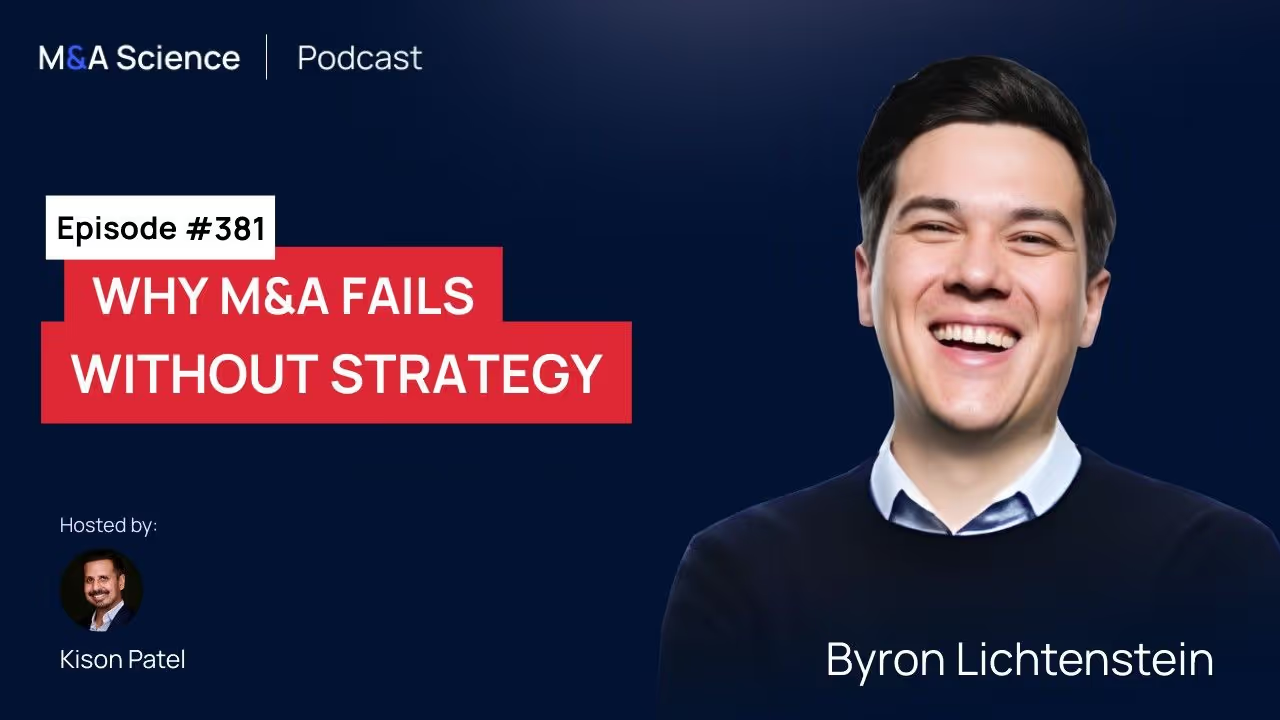
Byron Lichtenstein
Byron Lichtenstein is a Managing Director at Insight Partners, where he leads the diligence and growth strategy team across the firm's 500+ portfolio companies. With over 10 years at Insight, Byron has scaled the portfolio support function from 6 to 50 people, helping portfolio companies execute strategic M&A, optimize operations, and accelerate growth. He brings a unique blend of engineering background, management consulting experience from Bain, and deep operational expertise in software M&A
Episode Transcript
Why M&A Fails Without Strategy
Kison Patel: [00:00:00] I am Kisan Patel, and you are listening to m and a Science where we talk with deal professionals and learn valuable lessons from their experience. This podcast focuses on stories, strategies and what actually happened during m and a deals.
Kison Patel: Hello and welcome to the m and a Science podcast. [00:00:30] This podcast is part of a mission to rethink how m and a is done. The old school sell that approach is dead. Fire led m and a is all about strategy, alignment, and efficiency. Putting value creation at the center of every deal. And let's be real. It's not just about closing the deal, it's about making it successful.
Kison Patel: We uncover what truly works at m and a by learning directly from the best. I'm your host, Kisan Patel, founder and CEO of Deal Room, and Chief Scientist at m and a Science. [00:01:00] Joining me today is Byron Lichtenstein, managing director at Insight Partners, a leading global software investor. Byron helped shape m and a strategy across Insights 500 plus portfolio companies.
Kison Patel: Bringing a rare blend of operational insight, venture speed, and private equity rigor. In this episode, we're gonna dig into how Insight executes buy LED m and a at scale, supporting CEOs from sourcing through diligence, integration, and everything in between. Alright, how you doing? [00:01:30]
Byron Lichtenstein : I'm good. I'm I appreciate you making the time.
Byron Lichtenstein : I'm excited to be on the podcast. I was listening to a few this morning over the last few weeks. Love what you're bringing here. I love the buyer LED m and a angle. Could not agree more with you that you need a good strategy and then some good execution to get it done.
Kison Patel: Thank you for taking time for due deals to have this conversation here.
Kison Patel: We're Insight Partners headquarters in New York City.
Byron Lichtenstein : I appreciate you coming in.
Kison Patel: Oh, absolutely. Thanks for making it happen. Can we kick things off a little bit about your background,
Byron Lichtenstein : Lichtenstein? I'm a partner here at Insight. Been here just over 10 years. I [00:02:00] run our diligence and growth strategy team, you can think of that essentially as two parts.
Byron Lichtenstein : One is helping our team run as fast as it can, but make sure that we are as excellent as possible on the diligence and underwriting side. And then ultimately, when we get a deal done, really thinking through what is the growth strategy for that business, and how do we manage their portfolio? As you mentioned in the intro.
Byron Lichtenstein : We have over 500 portfolio companies. We have a lot of resources internally, and our job is make sure that all those companies are successful and that we're putting the right resourcing against the right company at the [00:02:30] right time. A lot of my job and my team's job is figuring out what are the strategies for those businesses?
Byron Lichtenstein : Working, obviously with our founders and our management teams, but then figuring out where can we deploy all of our heft and our scale to actually making them grow even faster, making them even more profitable. We've built a pretty cool team here and excited to go into it.
Kison Patel: You've been on Insight for a while.
Byron Lichtenstein : Yes, it's been a journey. When I joined the firm was about 70 people back in 2015, now will be just over 400. My team specifically was about six people. [00:03:00] Now we'll be about 50. We've built a lot of components. As I look at the structure of the team today, especially on the value add size, our, our Insight onsite team is our value add team, and that group is 120 people.
Byron Lichtenstein : Today, which is amazing, came from the six of us originally to 120 today, of which I have about 50. But you also look on the other side of the team and there's former CROs, former CTOs, former CMOs, heads of talent, and our job [00:03:30] is as insight onsite to bring all of insights heft to all of the data, all the experience, all the access to our portfolio.
Byron Lichtenstein : So it's been a wild ride. I mean, I joined, we on our ninth fund, about four and a half billion. On our 13th fund, about 12 billion today across multiple strategies. Really enjoyed the ride. Been extremely grateful and fortunate.
Kison Patel: I was gonna get at that. I mean, the firm, I think totally, um, is like a hundred right
Byron Lichtenstein : close to it.
Byron Lichtenstein : We're about 80 today. We do everything series A through Take [00:04:00] private. For us, the biggest thing is being flexible and really understanding software.
Kison Patel: The point I was trying to make is like you're not cutting small checks. There's an interesting variation. 'cause even at 12 billion size, you're making quite a few bets out of that size of a fund.
Byron Lichtenstein : Totally. Our strategy, you can reverse the clock back to 20 15, 20 16 and as the funds started to scale most funds and where our LPs get worried that we would go is most funds, they start to change strategy. They say, we're gonna do bigger deals, we're gonna [00:04:30] go later stage. And for us, like we've always done buyouts, we've always done Series A and Jeff Horing, our founder, got up in front of all of our LPs at our annual meeting and said, we're gonna do the same companies, we're just gonna do more of them, and we're gonna double down into the ones that really, really work for us.
Byron Lichtenstein : We wanna play at all those stages. We believe that having a comprehensive view of the entire software market is meaningful. Overall, what enables us to do is every market, whether it's m and a software or legal tech [00:05:00] or healthcare it, there are going to be winners. And sometimes those winners are going to be later stage, and that's where we should, we wanna play.
Byron Lichtenstein : And sometimes those winners are gonna be the next generation of AI driven businesses today within different verticals. Sometimes we want to play that end of the market. We try and take this really fundamental approach of saying. Look at the market, what are the dynamics and what is the right stage of company to play this market?
Byron Lichtenstein : What we care about is five, 10 years from now, who's gonna be the biggest leading [00:05:30] business in that category? And sometimes that's gonna still be the incumbents, and other times that's gonna be the business that got created last year. So we want to be able to see all of that and play the market, right?
Kison Patel: Playing smart as a strategy,
Byron Lichtenstein : trying to playing smart, but also being flexible. If you are a fund who has a very tight mandate around, this is the exact vertical, and I'm only gonna do companies and I'm exaggerating, I'm only gonna do companies between. 20 and 30 million of revenue, that box gets really, really tight.
Kison Patel: Exactly. I've seen it. I've seen you [00:06:00] guys do a lot of interesting things, these crazy carve out deals and yeah. What is something, if you look at earlier in your career to now that's like your views completely flipped around in M and a
Byron Lichtenstein : M and a specifically? I started in 2015 and I would say at that time in the market, it was early stages of this idea of.
Byron Lichtenstein : Called software roll-ups. Yep. There were a few early wins of folks who essentially said, all right, there's a dislocation in the market. The PE guys won't buy anything that's under 50 [00:06:30] million of revenue, but there's all these businesses out there that are five, 10 million of revenue growing 30%. So if I take five $10 million companies that are growing 30% and I smush 'em together through m and a, and now have a $50 million company growing 30%.
Byron Lichtenstein : There were some early rewards there. If you fast forward to where we are today, the buyers have become much more sophisticated. Both PE and strategic customers have also become more sophisticated. They're looking for really strong product, and they are willing to [00:07:00] switch for really strong product.
Byron Lichtenstein : Ultimately, we still deploy m and a as a strategy meaningfully, but I think that we become more nuanced in the way that we approach it. We want really strong anchor products. And then yes, you can add on through m and a and do smaller roll-ups. You can do consolidation, you can do market expansion, you can do new products.
Byron Lichtenstein : But ultimately where we're seeing software companies get rewarded is by maintaining product edge, not just having all the boxes ticked [00:07:30] across whatever. Product architecture you want to create. That's been the biggest change in the market that I've seen. You still wanna be on the aggressive side of thoughtful, but you want to be as thoughtful as you can be.
Byron Lichtenstein : With m and a
Kison Patel: strategy matters.
Byron Lichtenstein : Strategy matters a ton. It matters a ton where you have to set that early, you have to actually have a vision. There are some examples. We partner with a lot of other firms. We partner with a lot of other PE firms and venture firms, and we're always trying to learn. As I look at insight, we have our core values and like one of the core values is commitment to reinvention.
Byron Lichtenstein : It's like we're always trying to [00:08:00] like ingest as much information from other sponsors and we work with a few others on some of our larger buyout platforms. I would say there are others who are a little bit more aggressive. There have been some really amazing get Lucky's where, oh, this product kind of fits and it actually took off really well.
Byron Lichtenstein : It's not to say that it doesn't work. I do think if you can do the mapping of where you wanna be in five years, and that includes where you want to be on the product and you can be pretty strict around that, you should be aggressive about pursuing that roadmap and try and stay [00:08:30] laser focused on it. And you set that strategy early and you
Kison Patel: go for it, Hey, what do you end up doing when you do that?
Kison Patel: You end. Hey, we're really gonna focus on bridging product feature gaps. We're really gonna focus on just serving this core customer base and trying to buy companies that have that same customer base versus the next shiny thing, or this.
Byron Lichtenstein : It's a way from the core, but we'll make it work. The goal is to create a team that knows what you're aiming at, a management team and an investor group that knows exactly what you aim at.
Byron Lichtenstein : I take a business like NMIA payments infrastructure [00:09:00] business. We bought a stake from Francisco Partners about four years ago at this point. Amazing business. You're talking 250 billion of payments volume going through that platform every year. But when we bought it, most of the revenue is on like its core gateway product.
Byron Lichtenstein : And our thesis was from the get go and we're, we're very aligned with Francisco on it was we have, you know, about a million customers. We have that 250 billion moving through the platform and it's just going through this one product, this one gateway product. We [00:09:30] need to be able to expand the product suite that we're selling and to our customers.
Byron Lichtenstein : So our core customers are iso, so independent sales organizations, and that's people who sell payments to other merchants. We said like, we want to be the arms dealer to them today. We sell them a gateway. There's so much else we could go sell them. We had this core product vision. Here are the products that we're gonna add on to that business.
Byron Lichtenstein : And within six months, like we started to add. But as you can imagine to the focus point, there are so many payments businesses out there. If we wanted to [00:10:00] just do 30, 40, 50 deals, we could probably go do 30, 40, 50 deals with this as the main anchor. Kate Hampton, who's the head of strategy and corp dev over at NMI, like, she's kept everybody super disciplined of.
Byron Lichtenstein : We still look at the deal flow and we can, and we'll talk a little bit about the sourcing engine for our insight, but like we still. Send her a lot of deal flow, but like she probably ignores or says no to 98% of the things we send her.
Kison Patel: Wow. Having this five year vision, I think there's this element of the central [00:10:30] distribution, which is what makes it more synergistic, where you're, how do you sort of get more wallet size from these customer?
Kison Patel: That's a key theme, versus if you don't, then you're just saying, Hey, we're just gonna buy all these different things in our field.
Byron Lichtenstein : Correct. People think of m and a as this major category. In reality, you gotta break it down to why are you doing m and a? You can break it down into a couple different categories.
Byron Lichtenstein : There is one, just pure market share gain. This market should be consolidated. We have a good [00:11:00] product, we have a leading position, and we wanna solidify that position. That's valid. M and a there is what I call product expansion. We wanna sell more products to the same customers. And where people go wrong on that one sometimes, just as an aside, is they go different product and different customer.
Byron Lichtenstein : I kind of sell to GCs as well as CFOs. I'm going to add on this product instead. And in reality, you want to think about if you're gonna go the product adjacency route. You want, ideally, same customer that buys your current product will also buy [00:11:30] your new product, the same buyer within that organization.
Byron Lichtenstein : And then you have geo expansion. You have new channels that you can get into. As other strategies and I just getting really crisp about what type of m and A you're doing. 'cause each of those types of m and a also come with their own playbook of like, how do I implement it? What do I actually care about?
Byron Lichtenstein : How am I changing my diligence?
Kison Patel: What if you're a product that wants to get to a different customer base and I'm gonna use our company example. Yeah. 'cause why not? Yeah. For us, like we have core customer corporate develop. I'd say one piece is [00:12:00] we're doing all this cool AI with contract analysis. Yeah. We don't actively sell to lawyers, law firms.
Kison Patel: I'm like, this is a big market. We got a great product that does all this and a bunch more. Totally. Does it make sense for me to buy? And you're starting to see this big shift where a lot of these companies, you gotta keep up with all ative ai or you're getting like a legacy phasing out. So there are products like that where their growth has gone stagnant 'cause they haven't kept up.
Kison Patel: Is that still considered a good practice here? If I go buy a company like that with this anticipation of we could at least leverage [00:12:30] their sales team and go merge 'em in, now we can go start distributing it to the law firm.
Byron Lichtenstein : I think. It depends on where you are in your lifecycle. That is, I, I can tell you.
Byron Lichtenstein : See
Kison Patel: this go sideways. Come on. Oh, yeah,
Byron Lichtenstein : I, I've definitely seen it go. I'll use a more obvious example and then we'll get back to m and a. Oftentimes I'll work with companies who are, 65% of our portfolio is North American based. 25% is Western Europe, 10% is mostly Israel, and then there's another 5% rest of the world.
Byron Lichtenstein : I'll pretty much always get the question when companies get to 25, [00:13:00] 30, 40 million of revenue that they're mostly US based, and they're like, should we. Go to apac. I got one customer who called me from Japan. Maybe we should start a Japan office. My push to them is always, all right, have we run out of space in the us?
Byron Lichtenstein : Are you telling me we've run outta space? Because like the CAC of going all the way over to Japan and setting up a new office and figuring out that motion and being 12 times zones away is going and getting that dollar cheaper than going and getting your next dollar in the us. And the answer is [00:13:30] usually almost no.
Byron Lichtenstein : Always no. At some point you will hit a scale where you have to go do that. On the m and a side to, to your exact question, using, do you ever as the example, I'd say it depends on where you are in your growth journey. So my sense is you're still growing, but like still relatively early. I'd say like keeping focus on like more things you could sell to corp dev.
Byron Lichtenstein : One, you'll have a better CAC going after just that corp dev buyer, but two, I also think you'll get a better multiple eventually, like if you raise, or whenever you sell the [00:14:00] business of saying like, we own this customer. Having strategic positioning is the most important thing. Having a strong strategic position where a customer relies on your software.
Byron Lichtenstein : Lives in your software. That is the ultimate thing that you're aiming at, and that's what makes software sticky. If you have heft within a buyer, within a segment, you'll likely grow better and you'll get paid more than having some tendrils into one customer over here and another customer over there and like selling a little [00:14:30] bit.
Byron Lichtenstein : Sometimes companies try and get, they lose focus early, right? Yeah. And they end up. Trying to launch too many products too early, and we're all people, we all have time constraints. Time is the toughest resource. No matter how good of a multitasker you are, you can probably only concentrate on two to three big rocks at any given time and really probably only one to two big rocks at any given time.
Byron Lichtenstein : And the more you stay focused, we've just seen it time and again, like the companies that get to IPO status, they get to amazing stories. Usually [00:15:00] they have an amazing core product and that core product has grown immensely, and then they've started to build out once they started to get to that scale. I think if you split your focus too early, it ends up
Kison Patel: being a distraction.
Kison Patel: Yeah. 'cause this other customer profiles gonna have a bunch of different needs and you're gonna end up focusing on all this product work as opposed to that one core.
Byron Lichtenstein : You have to be flexible too. Right? Sense. Your product is awesome. It's working really well. Corp Dev buyers love it. There's more to go sell versus my brother's a founder, my wife's a founder.
Byron Lichtenstein : I totally [00:15:30] get the early stage journey. And sometimes you're grasping for straws in the dark. Yeah. And you're like, all right, that customer's willing to pay me some money. So like maybe we should go grasp after that. In the early stages, like you are really trying to find product market fit. You may do some customer work.
Byron Lichtenstein : Or go after some customers that weren't quite your original vision. And you have to do that just to survive, especially if you're gonna bootstrap. If your product's working, keep hammering on it.
Kison Patel: I'm gonna blame the investors on this. They give me pushback. They wanna see a high tam because 20 million getting there is not high enough.
Kison Patel: Yeah, they wanna see a [00:16:00] rotary for you to get to 40, 50 million. And then it's okay. You gotta find other segments to sell on tickets. Corp Dev. We have 200 happy customers. It'll taper off around 20, 25 million. Like, all right, we gotta find either private equities, another vertical investment banking or the law firm.
Byron Lichtenstein : I started my career here, so I originally like engineered by background. First job in college was for Procter and Gamble, literally designing fabric softener in a, like in a lab. And then ended up after school going to Bain to be a management consultant, mostly working in our private equity group. So like, I've been in and around the space, [00:16:30] but like really I started my career as an investor.
Byron Lichtenstein : In 2015, the first part of my career was like all up and to the right. So I saw like the expansion of software as a market, but you also saw the seeding of just some of these bad behaviors and bad incentives. Honestly, a little bit on on our part of like growth at all costs, burn at all costs. And the thing that I felt really fortunate about here is.
Byron Lichtenstein : We've always been pretty fundamental investors, and what people get wrong sometimes is they look at burn and they say, [00:17:00] oh, burn by itself is a bad thing now, or back in the day were like, burn is fine. In reality, what really matters is your union economics. For every dollar I put out, how many dollars am I getting?
Byron Lichtenstein : Remember I talked to the, the Wix founder years ago, like Jeff War. Our, our founder, you know, was like, he's in town, you should go talk with him. Just pick his brain on what the best metrics are. And he actually used not just CAC payback, but like cash C payback. He's like, how quickly can I get cash back?
Byron Lichtenstein : Because then I can go and reinvest it. I can go put it more into marketing. But he was so tight [00:17:30] on, for every dollar I put out, here's how many dollars I get back. How and how quickly and how much does it multiply over time for us? Like. Our companies should only be burning if their union economics are good.
Byron Lichtenstein : And yeah, if it means I have to go spend $10 million today, but I know I'm gonna get 50 million out of it over the next two years, you should go spend those dollars. If you're like, oh, I'm paying you a dollar, I'm paying you 10 million today, I'm gonna get 5 million from you next year, and maybe less than that, a year after that, you [00:18:00] probably not make that trade off.
Byron Lichtenstein : It's really easy for people to get caught up in just the pure p and l. Here's the growth rate, here's the burn. In reality, you gotta really break it down to every dollar I put out, what am I getting back? That's where people took rules of thumb and they went a little bit crazy to your point, and they were like, I need big tams.
Byron Lichtenstein : They're like, why do you need a big tam? If you told me that actually I have a hundred million dollars TAM, and to hit my projections over the next five years, I only need to add 10 million a year. [00:18:30] I feel like all this TAM is gonna come up for sale in a given year. I feel like I have the best product. I can win 70% of it.
Byron Lichtenstein : I actually think you may have enough room, but people wanna see the big billion dollar TAM number. In reality, you just have to think about is there enough market that every year there's enough customers that are trying to make a buying decision? And can I go capture more than my fair share of those?
Byron Lichtenstein : And is that enough to meet my projections? And if that's the case, probably fine. Sorry for the, the no metrics rant.
Kison Patel: I, yeah, I wanted that. I wanted to be [00:19:00] challenged on this stuff. Yeah. This is a, you run the whole portfolio support side of it. Can we talk through like how insight supports m and a execution, especially like a lot of these deals, I guess, what's your split between majority ownership versus minority?
Byron Lichtenstein : Yeah, so for us, we have about 40% of our portfolio on a dollar basis is control. So 40% in control, 60% of minority on account basis. It's about 15% of our companies on a number of companies basis are [00:19:30] control, and about 85% are minority. So the vast majority of our portfolio is minority deals.
Kison Patel: You treat them different.
Byron Lichtenstein : Yes. Yes and no. But I would say this part of it's just the mentality part and foremost, like we want to be the best partners to our companies, and that comes from the venture heritage that comes from this idea of we sell. Founders on our vision. We want to be good partners. So those founders, those founders don't have to listen to us.
Byron Lichtenstein : On the minority side, what that's created is it created a culture. Even on our buyout deals, you could ask any of the CEOs that I work [00:20:00] with and they would say, yeah, I like Byron probably pushes sometimes, but ultimately he is a good partner. If you really think about what control means, a lot of people get in our industry, take the sense of, oh, I'm the majority investor.
Byron Lichtenstein : You have to listen to everything I say, but your only real lever is whether you're gonna. Hire or fire the CEO. If you're not willing to do that, you kind of gotta let your management company run the organization. We're investors. We don't run businesses like our management teams run their businesses. We take that perspective of [00:20:30] we want the best teams in there, we want to be the best partners to those folks and support them.
Byron Lichtenstein : And yes, there will be some hard decisions every now and then in in the control portfolio, but ultimately we want to treat companies the same. My favorite stat is I mentioned we have 85% of our portfolio that is minority. They don't have to listen to us. But if you look at engagement with our portfolio team, our insight onsite team, that team of advisors and diligence folks, portfolio strategists, like my team, our insight onsite team touches [00:21:00] somewhere between 65 and 80% of the portfolio every quarter.
Byron Lichtenstein : That means that 80% of the portfolio has come to a webinar that we've hosted. Done a call with one of our operational experts, done a strategy meeting. We touch the portfolio. You know, a lot of our LPs ask all the time, oh, only 15% of our control are, do you only touch those? No, we touch the whole portfolio.
Byron Lichtenstein : We feel really confident that we've built the machine to be as useful to everybody, and that no matter what stage you come in at, we've seen the journey before. We have the [00:21:30] data, we have the expertise, we have the access to help you, and we just wanna be good partners along the way. What does it look like when it comes to
Kison Patel: supporting m and a for these minority chaired pros?
Byron Lichtenstein : It depends. There are some portfolio companies where they're not interested in m and a. We won't by default set up an m and a team to go support them. Right. But if a portfolio CEO comes to us, or CFO, or usually the venture ones don't have a head of corp dev yet. If an exec comes and says, oh, there's this really interesting opportunity, or our sourcing team finds something that they think could be interesting, we will [00:22:00] spin up the effort and it tends to be on the board member plus somebody from inside onsite or on our deal team.
Byron Lichtenstein : We'll go have the one-off conversation. What you can do is separate out the portfolio by companies where we set up. A more structured approach and repeatable approach to m and a. And then there are the one-off m and a situations, and that doesn't break down by control versus minority. There are minority companies that will fall into the, we have a repeatable motion.
Byron Lichtenstein : The goal is figure out what is the appetite for m and a. We think m and A can be a growth [00:22:30] lever here, regardless of our ownership structure. And then we will work to set that up. If you look at the repeatable model, what that typically entails is C-E-O-C-F-O, maybe head of corp dev. Depending where they are in their journey.
Byron Lichtenstein : We'll meet with our team and essentially say, all right, I'm gonna craft strategy. So help 'em think through like, where do you want to go? But oftentimes that's CEO led. Then we create a sourcing strategy and we have execution. So like we can actually help 'em do the diligence, go through. All the pieces of the operations.
Byron Lichtenstein : We'll [00:23:00] partner with the management team to get that done all the way through actually funding it. So we have a whole cap markets team and a huge shout out to Kevin and Nate who run that team. They would actually think about like, how do I go fund this deal? Is it debt? Is it equity? Should we bring in co-investors?
Byron Lichtenstein : Do I do LPs want to get in on this? We will go soup to nuts on m and a. That's
Kison Patel: a lot of support for a portco, especially one You have a minority stake. Yeah. Do you, uh, charge for that?
Byron Lichtenstein : We don't. Everything's free. The amount of value that we've created is more than pays for itself. Every time we do the ROI [00:23:30] analysis, it's bonkers.
Byron Lichtenstein : Take pricing. We got a couple people who do pricing for us. I'm using that as an example. 'cause I think it's the simplest one. There's a company where our team met with them for maybe 25 hours over the span of a month to kind of restructure how this company was looking at pricing. They dropped $2 million down to the EBITDA line using the new strategy.
Byron Lichtenstein : That's $2 million. You put whatever multiple you wanna put on it, somewhere between 15 and 20, you're talking about 30 to $40 million of value. [00:24:00] For this person's 25 hours of work. Yeah, the ROI ON that is just a bit bonkers for us. The reason we don't charge for, it's like Hillary Gosser who runs the full team.
Byron Lichtenstein : So I have our diligence strategy group. We have Pablo who runs our advisory teams. That's all the former C-level folks. And then you have Mike Hay who runs our access team, and then Brian, who runs our talent team, just like sourcing good talent. But Hillary, she's the og. She founded Insight onsite back in 2000 and like she's been the one that's grown it and seen it.
Byron Lichtenstein : Her big push has always [00:24:30] been, we could go and charge portfolio companies. There's a lot of our peers who will charge for consulting fees and management fees and all of that. But ultimately it creates two issues. One is companies who don't pay are not going to get access to it even though they actually really may need the help.
Byron Lichtenstein : And then two, if there is a company who has paid, but we don't think that there's actually much value to create. We still have people show up, we'll still have them have to like [00:25:00] go and like justify why they're paying. And so they'll go to the board meetings and it becomes this whole thing of, oh, like because you guys are paying me for the service, I have to show up even if there's nothing for them to do.
Byron Lichtenstein : We think it creates complete alignment between teams to not charge for it because any company who needs the help can ask for the help. And then ultimately though, on our side, we get to go where we think the highest ROI is. Just because a company asks, like we always want to be useful and we've created scalable platforms.
Byron Lichtenstein : But there may be something where like we, I have told [00:25:30] companies before, hey, that ask is, I know it's useful, but like, why don't I actually go help you find an external consultant to do that, or I actually think you need to hire two more people on your team to go do that. That's not something we do.
Byron Lichtenstein : There's no justification of our existence. 'cause we only want to go after the meaningful problems where we think we can actually have ROI. In these businesses, our incentives are 100% aligned to our portfolio companies.
Kison Patel: So you do everything right. Venture buyout.
Byron Lichtenstein : Yeah. How do m
Kison Patel: and a strategies differ at these different stages and [00:26:00] where do you see the commonalities?
Byron Lichtenstein : Every company at every stage should be thinking about m and a as a potential lever. If you reverse back the clock to 2015, m and a was just this PE thing. All venture guys, investors, companies that are like, it's a distraction. We have the best products in sliced bread. We're gonna take over the world.
Byron Lichtenstein : There's no need to do m and a, any of that. What we've seen over the years is one that markets come around to, even for venture, that they should be open to doing m and a. What ends up happening [00:26:30] is we talked a bit about the repeatable versus the one-off model. I would say on the venture side, it tends to be you're leaning more organic growth than inorganic.
Byron Lichtenstein : We want to encourage our companies to be open to the one-off possibility. Like is there a company that you could go buy that would be a total game changer? For your strategic positioning in the market or expansion into this new vertical. And we try and identify that with the venture companies early.
Byron Lichtenstein : And then we say, all right, our sourcing engine, and I should probably speak a little bit about our structure at Insight. We have 70 folks [00:27:00] who their job is go find software businesses like they are talking to in the latest stats, something like 40,000 software businesses a year. All we're doing is trying to like, if it looks like software.
Byron Lichtenstein : Anywhere in the world, we wanna talk to it and we want to know it. And we've built this engine to just understand the software market. What we do is we'll work with a venture business, we'll identify what are the game changing moves that they could make, and then like the sourcing team will put it on their radar and if they can crack [00:27:30] one of those, great and we'll send it in on the buyout side.
Byron Lichtenstein : And for some of our larger minority positions, like we will have a more dedicated strategy. If we're gonna talk about it day one, what's the strategy you want to go after? How are we thinking about inorganic growth? We'll set up like a regular cadence, whether it's monthly or every two months of checking in with the business.
Byron Lichtenstein : It'll be dedicated to an analyst or an associate on our sourcing team of like, alright. Certain percentage of your time is actually dedicated to this company to help them find deals. And then we do have dedicated portfolio [00:28:00] support that can help them think through actually doing the execution, thinking through the implementation or integration plan, and actually getting like the deal fully done.
Kison Patel: How do you look at the deals that just pan out the best? We used the example earlier when we were talking the side around buying the competitor. Yeah, there's that. Then there's. What was the term you used earlier? Architecture. You start figuring out all these other products that you can sell into your customers.
Kison Patel: Yeah. What works best? What do you see as the best bet, especially the companies at that earlier stage too,
Byron Lichtenstein : in terms of what works best? It is just gonna depend [00:28:30] on the, on what you're going for strategically, we used this phrase, when we first make an investment, I want the CEO and management team. To write the S one on day one.
Byron Lichtenstein : Obviously not everybody in our portfolio is gonna IPO, but like the S one is the marketing document that pre IPO business puts out into the market right before they go public. And it basically spells out, here's where we are today and here's the vision and here's why you should invest in this business.
Byron Lichtenstein : And what my hope is always for all of our businesses is the day we invest. We should be writing what we want that [00:29:00] to be. It's the Amazon write, the press release before you do any initiative. It's the same idea. What's the public story you're gonna tell in 5, 6, 7, 8 years? How do we then align everything to that?
Byron Lichtenstein : When we think about actually going and doing m and a, it's gonna look slightly different. They're gonna be somewhere, it's purely about product. Take NMMI, we feel like we have. An amazing customer base. A ton of volume moving through. It's all channel. Like we have the channel now we just gotta put product through that channel versus you take a company like Bullhorn.
Byron Lichtenstein : I [00:29:30] know our Pappas was on the podcast at some point. Absolutely. And he is like, he's an amazing CEO. He's like one of the best CEOs I've ever had the pleasure of working with. I say that because if you just look at his journey, you don't get that many CEOs who found a business go through the whole venture growth stage, sell to pe.
Byron Lichtenstein : He's on his third PE sponsor at this point. He survived throughout and he's grown and he wrote the first version of the product. Like he knows the product and depth, but he's great on sales. He's great on vision, he's great on execution and hiring and all those things. [00:30:00] Like I won't stroke his ego too much, but I think he's great.
Kison Patel: Is he gonna check out the podcast at Uh, yeah.
Byron Lichtenstein : But No, I
Kison Patel: totally agree.
Byron Lichtenstein : You should definitely. But like, I think for him, if you look at that business, so we actually, you know, this
Kison Patel: is just to clarify, this is like a, an actual exercise you do with your port goes. I think you referred to this in a past conversation, the strategic positioning as the North Star.
Kison Patel: Let's go. Walk me through it. I'm gonna, yeah.
Byron Lichtenstein : Strategic positioning is, so that strategic positioning piece is that s one statement of like, where are we gonna be? Who do we wanna be? What are the core tenets of building an amazing [00:30:30] business? If you know you have to expand your market. I'll take Bullhorn just 'cause we were just talking about it pretty much from day one.
Byron Lichtenstein : The strategic positioning we wanted to achieve was the first core tenant is we need to be the clear market leader within our recruiting CRM business. All of the actual back office pieces. We wanna have 50, 60, 70% market share. That was one piece. And then the second component was we knew we needed to expand the market.
Byron Lichtenstein : This is a big market. It's probably 800 to a billion [00:31:00] dollars of tam. And we thought we could really grow into that and make a giant business. But we also knew that wouldn't it be nice to have another billion dollars of tam? And pretty early in that business, like we had those two strategic positioning imperatives, and we said, all right, we're gonna use m and a.
Byron Lichtenstein : Mostly for the first one. So how do we actually build market share? How do we really think about the positioning of adding new features and making sure that the customers are still happy and making sure that they're retained. And then on the organic side, on the expanding the tam, we had [00:31:30] one or two small product acquisitions, but we also invested meaningfully in the organic product.
Byron Lichtenstein : Like Art came I think in our first board meeting and said, I think I can unlock 500 million of TAM with a $3 million product r and d investment. Of course we green live it and you fast forward to when we actually sold it. So we sold that business three and a half years after we initially invested for a pretty good return and
Kison Patel: that was core of the story.
Kison Patel: Let's sub that out with damn good return. Yeah, I mean it
Byron Lichtenstein : was good and what was, what was fascinating is we bought that business from another sponsor [00:32:00] operationally that business was humming. There's always this idea of, oh, if you buy it from a sponsor, it's already been optimized and like, can you actually get a return?
Byron Lichtenstein : I would say like we bought it, it was in great shape Art and his team were like operationally like amazing. What our unlock was as insight is taking a little bit of our venture heritage is we're willing to swing for stuff like we're willing to go after the product expansion, go after some of this m and a in a slightly more aggressive fashion, and we aggressively pursued it and it was a good return.
Byron Lichtenstein : And I do think that. [00:32:30] Building where we could have just done the same thing. It would've been a fine return, right? But if you really want to go for the good return, getting the vision of where you need to be and then like staying focused yet aggressive on those paths is the right call.
Kison Patel: That's what the shape which deals you should be doing.
Byron Lichtenstein : Totally.
Kison Patel: What does it mean founder led? But not founder Limited.
Byron Lichtenstein : We want to be really good partners. As I said before, like we, we wanna be amazing partners to all of our companies, and most of the, you know, I said 85% of our portfolio is minority. A lot of those are founders, and there is something about founder [00:33:00] energy that I think is amazing and we want to harness that as much as possible.
Byron Lichtenstein : But there's also a lot of founders who, by the time we invest, it's the biggest business they've ever run in their life.
Kison Patel: Yeah.
Byron Lichtenstein : There's something really meaningful to be said. For supplementing that founder with other execs and making sure that they are, that we're both harnessing the amazing talents of that founder is getting it to whatever scale that we're investing in is no easy feat.
Byron Lichtenstein : We want to keep that energy, but we also wanna make sure that we're [00:33:30] supplementing with folks who have seen the story before and can look around the curve. Not to say that they're gonna know exactly where the destination is, but at least they know that nine times out of 10. If bookings is off, you should do X.
Byron Lichtenstein : And just seeing some of those processes at scale, it's like, why wouldn't you use that data for us? When you think about kind of founder led, but not founder Limited, we wanna help our founders grow and we wanna help our founders like build the best business. And ultimately, like we are aligned about my consulting days [00:34:00] versus now on the investing side, we have zero incentive.
Byron Lichtenstein : Other than make your business bigger and worth more, we only get paid when the business is worth more tomorrow than it was today. A lot of our founders, they are meaningful shareholders and our goal is make sure that their dollars are multiplied as well. It's really working with them to harness what they're really great at, supplement them on places where they could potentially grow or over those blind spots and just be good partners to them.
Kison Patel: What about the founders? Okay. I got [00:34:30] some belief in your model here. Ask, ask. You've worked with hundreds of founders, CEOs. What are the key qualities that you see are the ones that will scale well through m and a? Versus the ones that don't.
Byron Lichtenstein : It's a good question. The thing I love most about a lot of our founders is like they love their businesses.
Byron Lichtenstein : They are obsessive. You have to be, you have to get into the details and you have to really be willing to dig deep. But at the same time, you also have to be flexible. Where I've seen [00:35:00] founders, you know, maybe I'll take the opposite of your question. Where I've seen founders go wrong is. A belief that their product's always the best.
Byron Lichtenstein : A belief that they are a hundred percent always the right person to solve the issue at hand. The most successful founders in our portfolio are the ones who are willing to ask for help, who are willing to acknowledge their blind spots, but also are super confident in where they are really good and they are willing to dig in.
Byron Lichtenstein : And the partnership really works with us of our biggest value add for a lot of our founders is bringing data. Expertise and saying, [00:35:30] ultimately your business is going to be like, it's your baby. You know it well, but maybe I can bring a couple other data points of 10 other businesses that have gone through the same problem with you.
Byron Lichtenstein : And those who are willing to listen, tend to, or at least be open to the idea, tend to do quite well.
Kison Patel: So just don't have a big ego.
Byron Lichtenstein : Yeah. I'd say this, the investing community there is ego inherent in the job. You have to be willing to inherently pay more than other people or take a bet on something and believe that you are right over others.
Byron Lichtenstein : If you are [00:36:00] purely doing what everybody else says, like you're never gonna make any money and this job's like inherently, like you have to have some ego as an investor. But ultimately, the thing that I love most about Insight, I don't know if I'd do this exact job anywhere else. Like I do think this place is special.
Byron Lichtenstein : The reason for that is I talked about our core values earlier around commit reinvention, but our number one core value is, is hunger to win. We wanna be in the best deals, we wanna be with the best founders. We want those businesses to be super successful. But our number two value is heart. Like how many investment [00:36:30] firms have heart as their number two value?
Byron Lichtenstein : And the reason I bring that up is we always want to do things in the right way, even though there is ego and you have to have an opinion. It doesn't mean you gotta beat people over the head with it, right? And you want to be fair about it. We ask our founders to be similar and we ask our execs to be similar of, we hired you or we invested in you because we think you're the best.
Byron Lichtenstein : We think you are the person to run this business. You are the person to get it there. We'd also ask that if something comes up that you're willing to take direction, it's potentially trite, but it's like my [00:37:00] wife always joked, she's like, you know, we'll be in a foreign country. She's like, why don't we just ask for directions?
Byron Lichtenstein : Yeah, right. Yep. I've learned over the years, I was like, I just need to ask for directions every now and then. Like we use the Waze analogy. We say our CEOs are in the driver's seat. Ultimately, they have their hands on the steering wheel. But if we can be ways and we can say, Hey, like actually there's a crash up ahead and maybe you should turn right.
Byron Lichtenstein : That's all we wanna be. We want to help them get there, but ultimately they, they got their hands on the wheel. They're the ones driving, but we have, if they take direction and not just driving the traffic.
Kison Patel: I like that. Fire led, we talked [00:37:30] about just your rigor around having this strategy, the strategic positioning.
Kison Patel: Supporting a lot of these port codes with finding opportunities and just being proactive and not just waiting for stuff to show up on a deal book. Yeah. M and a I know most PE firms usually have a 90, a hundred day plan model. Yeah. How do you work with portfolio companies? You go through the deal. Got something we're gonna close, like hopefully you're planning integration before you close.
Kison Patel: Yep. Can you walk me through what that support looks like?
Byron Lichtenstein : Yeah, totally. We 100% think you should have an integration plan before you [00:38:00] close. I hope that every company has an integration plan before they close.
Kison Patel: How about an integration thesis that LOII
Byron Lichtenstein : mean, you should, and it, it goes back to those categories of types of m and a are doing.
Byron Lichtenstein : There are times that where a hundred day plans go wrong are, they feel like they are. Spoil the ocean. Very static documents and they're like, I have to have this a hundred day plan and like we're gonna tick through all the boxes on. Yes, there is a certain level of like, there are, you know, you gotta get people new badges, you gotta get laptops, like you gotta move the systems.
Byron Lichtenstein : There are like [00:38:30] really minutiae things that like do have to get done so that everybody feels, especially on the acquired business, like you want employees to feel like they're being welcomed into this new environment. You want them to feel like. There's a path forward, and if somebody's badge doesn't work on the first day, everybody spirals.
Byron Lichtenstein : You do have to have the checklist. But ultimately, the best a hundred day plans are one, flexible and regularly updated, and then two, depending on the category, they are tailored to what the situation is. This is a, if you have [00:39:00] a hundred day in plan for a five person acquihire, that looks very different than, oh, I'm doing a merger of equals of two direct competitors in the same geo.
Byron Lichtenstein : Those are fundamentally different a hundred day plans. And so you have to create those different plans and then you have to be willing to adapt. One of my favorite, I got a lot of favorite CEOs, and then one of the ones I've learned the most from is of our CEOs. Lisa stint over at Inhabit iq. She's like a machine on [00:39:30] m and a, and ultimately, like if you look at her a hundred day plans, every deal that she's done has a hundred day plan and it gets updated.
Byron Lichtenstein : Every 30 days, the team is just methodical around, like understanding where it is, updating, moving, and then reassessing where it is. They just have this cadence and it's the right balance of focusing on what matters while still being flexible to keep it ongoing. And then you talked about support. We will be heavy on the strategy creation.
Byron Lichtenstein : We'll be heavy on the sourcing and the [00:40:00] execution where we're needed. Sometimes our companies say, I got it. This is the 10th deal they've done. They have a full corp dev team, and we're not dogmatic about being in their shorts about it, like, we're just here to be helpful. Again, it goes back to the alignment piece.
Byron Lichtenstein : We only care about. Outcome we don't care about. We have to do something X way or Y way, but we are always willing to be helpful on the execution and getting the funding and the transaction done. We do wanna be helpful on getting the a hundred day plan set up. What I learned relatively early in my career though, is if we own the a hundred day plan, it doesn't get done as well as if the company owns a [00:40:30] hundred day plan.
Byron Lichtenstein : Meaning that somebody in in the company has to be accountable to it, whether it's the CFO or the head of fp and a. Like it should be. 70 to a hundred percent of one person's job for the foreseeable future to get it done. Adam Berger, one of our operating partners, who has just been amazing mentor to me over the years.
Byron Lichtenstein : He always says, if this m and a is not the most important thing on the strategic roadmap, you probably shouldn't be doing it. He said, A lot of people cheap out and they say, [00:41:00] oh, it'll be like 10% of the CFO's time, 20% of the head of FP a's time, maybe like 5% of all these other people's time. And he's like, no, no, no.
Byron Lichtenstein : You need one person who is going to update that plan. Make sure all of the, all the functional leads are actually coordinating and updating their plan. Running the weekly standup, somebody has to own it. And if it's not important enough for you to make it a hundred percent of somebody's job, you should probably not be doing the deal.
Kison Patel: It's a big bet.
Byron Lichtenstein : Yeah.
Kison Patel: It's interesting talking to different sizes of [00:41:30] firms, and I'm almost like seeing a correlation between how much a UMA firm has, how much portfolio support they can provide. Is that a real thing? And there's a different topic. We can debate this with me directly or not here, but the bigger funds will pay more.
Kison Patel: You don't have to answer that. Hopefully not. Yeah. I think it goes back to what we talked about earlier, like how much you belief you have in your strategy and what you're gonna execute should determine what you're paying for it. Totally. But on that portfolio support, that's what I've noticed. If you're small fund, definitely like sub billion, sub 500 million.
Byron Lichtenstein : I think it's [00:42:00] tough for us. We've leaned into. Scale as a differentiator, and ultimately we believe there are two components that really matter at scale, access and expertise. Everything's about access and like how do we use our scale to get you better access? That's more access to other portfolio companies.
Byron Lichtenstein : We don't have all the answers internally, but I'm pretty sure that one of our 500 other companies has solved the problem you're trying to solve. I want access to other portfolio companies. I want access to buyers. Our, uh, [00:42:30] inside Ignite team or or enterprise team, they spend their lives looking for relationships in the Fortune 1000.
Byron Lichtenstein : They want to know the buyers of software in C-level buyers within all of the Fortune 1000 companies. Like we wanna provide access to that and use our scale and our portfolio scale to actually provide that access. And then on the expertise side, we wanna use all of our data. There's a UM scale, but there's also like, we've invested in probably 800 companies over our [00:43:00] lifespan, exited hundreds of companies.
Byron Lichtenstein : We've seen companies go through every, you know, within a vertical, like we probably have 12 data points of other companies that have gone through your journey. And we want to use the data as well as the expertise from people who have actually sat in your seat to give advice. You can't do all that in a billion dollar fund,
Kison Patel: right?
Kison Patel: Like you
Byron Lichtenstein : just literally can't pay for the, you use this phrase cost center for us, it's an investment and we think it has a super high ROI, as we already talked about, but ultimately, like that's a lot of costs that we're bearing and that [00:43:30] benefits our portfolio, that benefits our LPs. We fundamentally put our money where our mouth is of believing that we can.
Byron Lichtenstein : Change the map fundamentally. Why can strategics pay more than PE firms is 'cause they can change the math. They just have a different map. They can plug in whatever acquisition into their existing behemoth of a business. The sales channel's already set up. They already have a good r and d, or they're able to pay more and still have good deals because they have different math.
Byron Lichtenstein : Our goal is to do the same thing, like how do we have different [00:44:00] math using our scale? And as we talked about over lunch. There's really only two ways to make money. I would say there used to be three ways in that you can always get, you can just find things before other people. It's becoming harder and harder.
Byron Lichtenstein : We still do it. I would say half our deals are still proprietary or not going through a bank process or we've had a relationship. The average time between first meeting a company and actually getting a deal done, it's like three years. That's the media, like we're really getting to know people over a long time, but I think that is going away.
Byron Lichtenstein : Even earlier. Stage companies are getting bankers [00:44:30] involved in all of that to go through fundraise. Really the only two advantages you have to make money in this industry is either taking more risk or like changing the math, having better operational support. And we've said ideally, you wouldn't take more risk.
Byron Lichtenstein : You guys, you take educated risk. Like we're obviously in the business of taking risks. Ultimately, if we can also lean on better operational support, there's good ways of driving return, simply using our expertise and our access at scale within this portfolio.
Kison Patel: Yeah, that's a big part of it is one of the pillars when looking at what [00:45:00] private equity firm to work with.
Kison Patel: It's the price they'll pay, the terms, and then uh, operational support that comes working together.
Byron Lichtenstein : You also gotta like them too. I fix it there too. Raising capital. As somebody once said, raising capital's like getting married. You're stuck with us. We're stuck with you. And like we both have to make it work.
Byron Lichtenstein : Ultimately, again, it goes back to like why I think heart is a meaningful value is we always want to do the right thing. We wanna be fair. It doesn't mean we're gonna be soft, but it does mean that we're always gonna be fair, be good partners to our portfolio [00:45:30] companies. And ultimately, if you want people around the table who are going to be both your biggest cheerleader but also your biggest coach on, on pushing you a bit,
Kison Patel: make sure you have a good freedom.
Byron Lichtenstein : Those
Kison Patel: don't
Byron Lichtenstein : fully exist. Right.
Kison Patel: That goes back to the terms. The terms like, Hey, you mentioned too at lunch. Yeah. Buyers are getting more sophisticated. Tell me more about that.
Byron Lichtenstein : Buyers are definitely getting more sophisticated. Part of it's just the market they're in. When I first started here in 2015. We're still a small team and there's this amazing rite of passage that [00:46:00] our team would usually help our investor relations team put together all the materials for our annual meeting.
Byron Lichtenstein : My first year here, I was a lucky one who drew the straw of putting together all the materials for this thing, but like it got me more involved in our IR process. Ultimately, what it allowed me to do was like go to LP meetings and hear questions from LPs. What was fascinating is in 2015 you talk to LPs and they were like.
Byron Lichtenstein : Why are you guys doing software? Like why are you all focused on software? Like why should I as an LP invest in software? I got real estate, I got industrials, I got [00:46:30] pharma, I got healthcare software only. Like why does that need to be, be a part of my portfolio? Then you fast forwarded to five years, 20 19, 20 20.
Byron Lichtenstein : The question was, oh, I totally get why I need software. What makes you guys different? That level of competition has just the realization of everybody wants to be in high tech. You look at the Magnificent seven, all of that. Everybody knows that a lot of the returns are going towards software and tech.
Byron Lichtenstein : It's not even a question anymore that people should be in it, and what that's created is. [00:47:00] A market where you get more entrants, like I would say in 2019 through 2021, you've got a lot of people who started to do their first software deals and then they realized after that they're like, oh, maybe I should do more software.
Byron Lichtenstein : You've got a lot of entrance into the market, and what it's created is people are now used to looking at software assets, and then they've also looked at more of them over time, so they've learned what to look for. Software buyers are just becoming. More sophisticated as in the market. And for us what that means is you gotta have really good [00:47:30] product and you gotta think about where your mode is.
Byron Lichtenstein : What we've seen through cycles is like the A plus businesses will always get a plus pricing, but I think in the heat of 2020 and 2021, you got a lot of B businesses getting a pricing still. Where the market has corrected to, and I actually think we're in a good part of the market, is A plus. Businesses should get A plus prices.
Byron Lichtenstein : B, businesses should get B prices and C businesses should get C prices. People are becoming more and more discerning as software as a market has grown and the entrance into investing in software has also grown.
Kison Patel: It is, [00:48:00] it's getting a lot more competitive. I'd love to just touch on just the themes, whether it is trends you're seeing around value add models that go beyond capital.
Kison Patel: We got AI everywhere. Everybody's slapping ai. Yes.
Byron Lichtenstein : Everything.
Kison Patel: Yeah. Sometimes using that as a reason to go increase valuation and stuff. And then you've just got all these startups popping over where there are raising on crazy valuations. What's your view to teach me something there that I need to be thinking about as a founder of a business that's trying to keep up with some new AI features?
Kison Patel: And by the way, yeah,
Byron Lichtenstein : no, we can definitely talk [00:48:30] about AI trends and we're making a big push internally. We have this initiative called Five and five, like we have this fundamental belief that. All of our businesses should be able to get five points of growth and five points of margin out using ai. We fundamentally believe that we should be able to accelerate the growth, and that if you look at G-N-A-S-N-M-R, and D especially, there's a lot more places for efficiency using ai.
Byron Lichtenstein : I think r and d has been one of the biggest unlocks. If you look. Where the most use cases are using AI today It is, is within [00:49:00] engineering. What's amazing there is if you reverse the clock back five, six years, most investors could tell you pretty well what to do and how to optimize s and m. They could probably tell you how to optimize finance and legal and HR and all that.
Byron Lichtenstein : And G and a r and D was this black box, like, oh, don't break the product. Yeah. And so they like, they wouldn't touch it. Now you're just seeing more efficiency come out of those orgs, better deployment in DevOps. Like there, there's a lot of tools using ai and so I think that you'll see a bigger push there product.
Byron Lichtenstein : As I think about [00:49:30] advice when we talk to our companies about is you should get out ahead of your product and think about where the product mode is versus like an AI future. Like you should not live your life worried that. Open AI or Anthropic and their next release, they're gonna eat your lunch. If you're living in that world, it's gonna be a really tough few years for you because they are just releasing it at a pace that is unprecedented.
Byron Lichtenstein : Like we really push on like, how do I actually incorporate it? It doesn't mean you gotta fully rewrite it historically. One of the most interesting things, hopefully for your listeners on this, with this [00:50:00] business, Optimizely, where we've been in the business for a few years now. Originally we invested in a business called Episerver.
Byron Lichtenstein : We ended up merging with a business called Optimizely. They do think of it as like web AB testing. So yeah, it
Kison Patel: was an early customer. So
Byron Lichtenstein : yeah, so they're awesome. Business marketers are famous for having too many tools, like we fundamentally believe. It's like you have your website, you need to figure out how to test it.
Byron Lichtenstein : They're using AI to figure out like, what tests do I run? How do I analyze it? But what was fascinating, they actually used, it's a good m and a story. They acquired this business called Welcome. I'm a Digital [00:50:30] Asset business. As all this AI stuff happened, the CEO is actually super out in front. He's like, we have to be AI first, but how are we gonna do it?
Byron Lichtenstein : They actually used the founder of that business, they acquired Welcome, like he became like the AI guru across the business. And what they ended up doing, which was really cool, was they had really strong software across multiple parts of the marketing stack. Instead of taking the conventional wisdom of, oh, I gotta go rewrite all of these pieces of software and be AI first, they actually said like, [00:51:00] those software components actually work super well and we're just gonna create an orchestration layer.
Byron Lichtenstein : Over the top. And so that founder and Alex's CEO were amazing and that basically developed like a co-pilot on top of their existing software. So they didn't have a need to rewrite, but fundamentally, the user experience changed. And now like you as a user, you did all the orchestration using your AI co-pilot, and you didn't actually have to touch the underlying pieces of software at all.
Byron Lichtenstein : Really. They went against this conventional wisdom of. If you are old in Legacy [00:51:30] or, or like if your software is written more than five years ago, like you're gonna be dead. And they're like, no, no way. Like our software's good. It actually creates a lot of value. We're just gonna give you the right user interface to it and we're gonna allow you to orchestrate our software even better.
Byron Lichtenstein : Yeah. Like, you know, like
Kison Patel: disrupt those users or
Byron Lichtenstein : Totally. And then they used all the data coming, like they have so much data underneath, so like they give us an example of an incumbent utilizing it versus being afraid of it. And I think that's ultimately where you gotta be. And the hats off to Alex and that team.
Byron Lichtenstein : For being ahead of the trend, being super thoughtful and like, you know, my [00:52:00] senses, it's not one of mine, but my senses from the team, it's growing well and the growth is reac is like accelerating quite well, like off of the back of a lot of this. AI orchestration and utilizing the new tools at your disposal.
Kison Patel: That's a great example. You ought to be taking bets on AI if you're a company in the field today.
Byron Lichtenstein : Totally. You know, budgets are also fairly unlimited with ai. We'll see when the music stops, but what's interesting is, this is maybe my hot take that people won't want agree with, but you get a lot of articles talking about.
Byron Lichtenstein : AI is fundamentally [00:52:30] different business model. You can't underwrite it the same as software, all of that stuff. I do think some of that's true. I do think the pace is moving quicker. I do think the adoption has been amazing. You maybe don't need the same amount of tooling or people that you need, but fundamentally a business as a business, it's, I create product.
Byron Lichtenstein : I have to have a channel to sell that product. Somebody has to buy that product and use it. Then they have to renew their contract. And they pay like the fundamentals of business and like what you're looking for of, am I bringing in more customers? Are they staying with me? Am I [00:53:00] keeping them happy? Are they paying me more over time?
Byron Lichtenstein : Those haven't fundamentally changed. The reason that the metrics look so funky is I haven't been through as many cycles as some of our most senior partners, but like it's the first time, at least in my career, where you've seen just supply and demand, like completely me. Before you look at the SaaS conversion we spent, I spent the first five years looking at companies and really thinking about, oh.
Byron Lichtenstein : Enterprises are slowly moving from on-prem to SaaS. They should have all moved, but like they're just slowly moving. Slowly. Yeah. Versus the first [00:53:30] time where, where every single company across the world was like, oh shoot. I need to go invest in ai. And so they've released budget at the same time where the capabilities were there.
Byron Lichtenstein : That's why these growth curves look like vertical because you just had this really good supply demand meeting moment. In reality, I think over time people will think about where the budgets are, and I do think you'll get, it'll look more fundamental rather this super interesting time right now. Where the supply of technology and the demand dollars are like fundamentally overlapped, and I think you'll see that for a few [00:54:00] years.
Byron Lichtenstein : Fundamentally, at the end of the day, I think the fundamentals will still be okay, and it'll still be similar long term.
Kison Patel: We'll see if valuations come down.
Byron Lichtenstein : I would say it's unprecedented. You're seeing some of these rounds happening, and so the growth
Kison Patel: is there. The growth is there. What's the craziest thing you've seen in M and a?
Byron Lichtenstein : M and A ultimately comes down to the people I've seen. Founder to founder shouting matches I've seen, I've seen deals blow up three or four times before actually getting done. Fundamentally, like everything in life, spreadsheets, yes, they work [00:54:30] well together, but fundamentally you gotta get people working with other people to drive the business forward.
Byron Lichtenstein : Ultimately, emotions always are play a factor and logic always has to somewhat overcome it. Even software business, yes, there's a lot of workflow, but like most of the costs are, and like we are in a people business,
Kison Patel: people are both predictable and unpredictable.
Byron Lichtenstein : 100%. Oftentimes m and a can feel very existential both for founders, shareholders, and also employees.
Byron Lichtenstein : There's a lot of emotion in selling your baby, or there's a lot of emotion in getting acquired. [00:55:00] As somebody who's worked with businesses to acquire a lot of companies, we always lead with this idea of you gotta be open and transparent and thoughtful and like the goal is be good humans give, make sure that people feel stable, give them the right vision.
Byron Lichtenstein : Don't hide the hard decisions. You know, I listened to one of your, your podcasts that you just did, I think was with the Alpine Invest folks. One of the best pieces of advice was like, have the hard conversations early. Get it all out there and get aligned early. That's totally right.
Kison Patel: It's been an awesome conversation.
Kison Patel: Thank you for [00:55:30] taking the time, helping me become a better MA scientist here.
Byron Lichtenstein : It's amazing. Thank you so much, Kean. Really appreciate it.
Kison Patel: Hey, those of you listening all the way to the end. Hello, M and a scientists. I appreciate you tuning in, listening through. I love hearing from you. I'm most reachable on LinkedIn.
Kison Patel: Connect with me. Gimme some feedback. The good and the bad. Like the criticism. That's how I learned to get better at this. You got some interesting topic ideas I haven't picked on until next time. Here's still the deal.[00:56:00]
Kison Patel: Thank you for taking the time to explore the world of m and a with our podcast. We love hearing feedback. Tag us on a LinkedIn post, add a review on Apple Podcast. We'd love to hear from you. If you need help standing up in m and a function or optimizing one that you already have. We're here to help, and if we can't help you, we probably know someone that can.
Kison Patel: You can reach [00:56:30] out to me by email Kisan, K-I-S-O-N, at ma science.com, or you can text me directly at 3 1 2 8 5 7 3 7 1 1. If you just want to keep learning at your own pace, visit ma science.com for a lot more content and resources. That's where you can also subscribe to our newsletter. Again, that's ma science.com.
Kison Patel: Here's to the deal.[00:57:00]
Kison Patel: Views and opinions expressed on m and a science reflect only those individuals and do not reflect the views of any company or entity mentioned or affiliated with any individual. This podcast is purely educational and is not intended to serve as a basis for any investment or financial decisions.
M&A Software for optimizing the M&A lifecycle- pipeline to diligence to integration
Explore dealroom

Want to wear your M&A expertise?
Check out the M&A Science store.