
.svg)
.avif)
A target looked right: good revenue, the right market, and a management team that presented well. The LOI got signed, and diligence started. Sixty days in, the acquiring team asked for financials broken out by region and producer, a request that should have taken a day or two. It took two weeks. Then they asked for organic growth numbers separated from acquisitions, and the target couldn't produce them. The data had never been structured that way.
What followed was months of rework, a revised model, and an integration that cost far more in time and bandwidth than anyone had planned for. The target wasn't a bad business; it just wasn't integration-ready, and nobody had evaluated that before the LOI was signed. By the time the problems surfaced, the price was anchored, walking away wasn't a real option, and every cost that followed was a cost the buyer absorbed.
The Evaluation Gap Most Acquirers Still Have
Most acquisition teams assess strategic fit, financial performance, and price — whether the target is the right business in the right market at the right multiple. Those questions matter, but integration readiness rarely makes the list. Whether a target can actually be absorbed into the acquiring platform without creating drag, friction, and downstream problems tends to get handed to diligence or the integration team to figure out later, and by the time it gets figured out, the deal has momentum, seller expectations have been set, and walking away is far more expensive than it was before the LOI was signed.
Sharon Van Zeeland, who has overseen integration at Rockwell Automation across a substantial acquisition program, describes what happens when integration thinking starts too late as a "knowledge chasm." The information gathered during diligence: the seller's concerns, the technology gaps, the cultural tensions, the people who might leave, lives in a few people's heads and doesn't transfer cleanly when the deal team hands off to integration. Things get missed, work gets repeated, and the plan built in diligence has to be rebuilt from scratch by people who weren't in the room. Her position is straightforward: by the time the LOI is signed, the integration thesis should already exist.
What Integration Readiness Actually Means Pre-LOI
Integration readiness is a filter. Five dimensions, assessed before signing, determine whether a target can realistically integrate into the acquiring platform and at what cost. Failing one dimension doesn't automatically kill a deal, but it should change the price, the structure, or the timeline, and the acquiring team needs to know that before they commit.
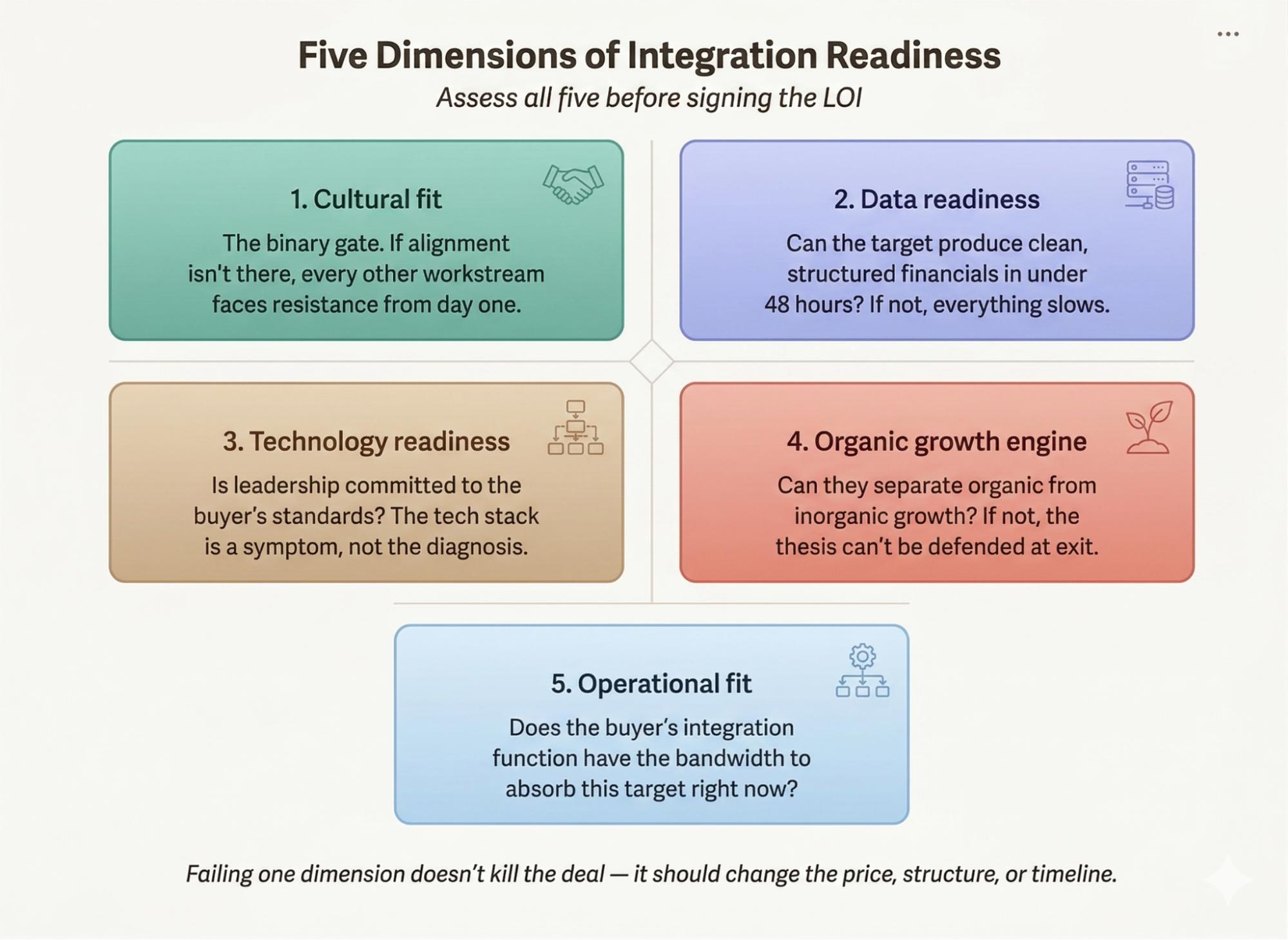
Cultural fit
Cultural fit determines whether other integration workstreams will have buy-in or resistance. And when alignment isn't there, technology migrations take longer, data standard changes face pushback, and the people driving the organic growth thesis start looking at the door. Matt James, EVP, CFO and Chief Acquisition Officer at Oakbridge Insurance, treats it as a binary gate. Oakbridge has closed more than 60 acquisitions and integrates 100% of them from day of close with a 90-day workstream target, and cultural evaluation comes before any other criteria. If they can't get comfortable there, the deal doesn't move forward regardless of the financials. Nathan Rust, SVP of Corporate Development at Salas O'Brien, built a 30-merger program without a single failure on the same principle: cultural fit assessed as a pre-LOI discipline, before the financial conversation hardens.
In practice, that means multiple in-person meetings, conversations with people beyond the principals, and a willingness to slow the process down to understand how the target's team behaves under pressure, because integration puts pressure on everything.
Data readiness
Data readiness determines integration speed more directly than almost anything else. Can the target produce current financial results in under 48 hours? Can they disaggregate organic growth from inorganic growth by producer, region, and line of business? Is their reporting built on a single system or assembled across spreadsheets at the acquisition level? These questions matter because teams that have been consolidating financials across spreadsheets for five years cannot retrofit a clean data infrastructure in a quarter. Under scrutiny, manual consolidation gets slower as every buyer question requires rebuilding the analysis from scratch, and the inability to produce clean, timely, structured financial data is a signal about everything else in the business.
Technology readiness
Legacy systems signal how much standardization resistance, migration effort, and operational drag lie ahead, but the more useful pre-LOI question is whether the target has committed to moving to the buyer's standards, understands what that will involve, and has leadership willing to get their team there. A target running on a different instance of the same ERP as the acquiring platform is a solvable problem. A target whose sellers were promised their legacy systems would stay intact is a cultural problem wearing a technology badge, and that answer tells you more about integration risk than the tech stack does.
Organic growth engine
Buyer scrutiny has shifted from "can you grow?" to "how are you growing, and can you prove it?" A target's ability to demonstrate organic growth, separated from revenue added through acquisitions and from market tailwinds outside their control, has become one of the primary value proof points in any serious diligence process. For roll-ups specifically, this matters in both directions — when evaluating a target pre-LOI and when the acquiring platform itself goes to market. The cross-sell thesis, the producer-level growth trajectory, the KPIs that show the business is actually improving: these need to be present in a target before the LOI is signed, because if the infrastructure to track them wasn't already there, it won't appear after close.
Operational fit
This dimension requires the acquiring team to assess their own constraints, not just the target's. Can the integration function realistically absorb this business alongside whatever else is in the pipeline? Is there bandwidth across HR, accounting, IT, and operations to run a parallel integration without degrading quality on deals already in flight? Teams doing ten or twelve deals a year are running three to five integrations simultaneously at any given time, and a target that requires more lift than the team can currently provide may not be the wrong target — but it needs to be the right target for this moment in the program, and that judgment has to happen before the LOI is signed.
Why This Matters More Now Than It Did Five Years Ago
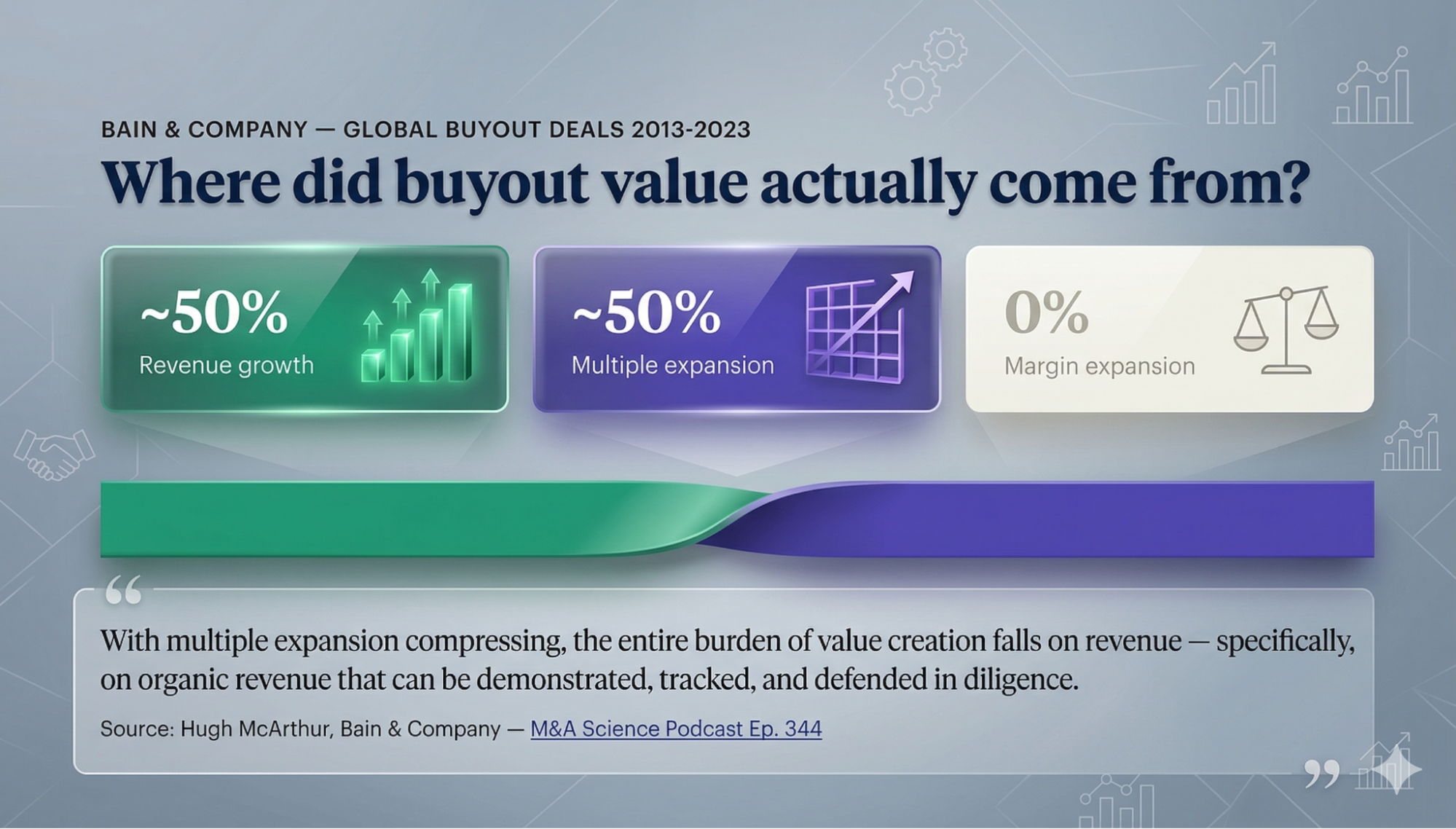
The value creation math in M&A has shifted in ways that change what buyers need to underwrite. Hugh McArthur, chairman of Bain & Company's global private equity practice, analyzed the sources of value across all buyout deals globally from 2013 through 2023 and found that about half of value created came from revenue growth and the other half from multiple expansion, with zero coming from margin expansion. Interest rates are no longer zero, multiple expansion as a dependable value lever is compressing, and the burden shifts to revenue — specifically to organic revenue that can be demonstrated, tracked, and defended. A target that cannot disaggregate its organic growth, cannot produce clean data quickly, or cannot function as an integrated business is a target that will not hold its value.
As McArthur put it: "You have to believe that the integration value is there and that it's measurable." That means the acquirer needs to evaluate integration readiness before committing to price, because what looks like a clean acquisition at LOI can become a multi-year drag if the underlying integration infrastructure is not there.
The Diligence-to-Integration Handoff Is Where Knowledge Dies
Even when integration readiness is evaluated pre-LOI, the work done in diligence often doesn't reach the people responsible for executing it. This is the knowledge chasm Van Zeeland describes, and it shows up across acquisition programs of every size. The tribal knowledge built in diligence are specific: the seller's concerns about the technology conversion, the key producer who needs a retention conversation before day one, the data standards gap that requires a database admin to scrub before the ERP migration can begin. And when the deal team hands off to integration, that knowledge is rarely documented well enough to be useful. Integration leaders rebuild from scratch; previously known information is rediscovered, and the same questions are asked twice by different people.
Tisha Hostetler, who leads Cisco's acquisition integration practice, describes exactly what that model looked like before they fixed it: the deal team and integration team were completely separate, integration was focused on checking boxes rather than deal value, and when a deal closed, it was thrown over the wall. The integration team had no visibility into why the deal was done, what the diligence found, or what the seller was worried about. Cisco solved it structurally — Johanna Jaakola, Cisco's integration lead on the Splunk acquisition, is now in the room before LOI, shaping the integration strategy alongside the deal thesis and leading diligence through close. The handoff that used to lose everything doesn't exist anymore because the same person carries the knowledge end-to-end.
Amy Weck, VP of M&A and Integrations at Liberty Company Insurance Brokers, built toward the same outcome from a different starting point. She inherited two separate departments: a deal team and an integration team operating on opposite sides of a wall, and merged them into a single function running parallel work streams. Integration leads join from LOI, review diligence findings in real time, and set the post-close strategy based on what they actually saw rather than what gets summarized in a handoff document. As she puts it: knowledge is power, but only if the right people get it at the right time. Waiting until two weeks before close to hand the integration team a stack of diligence materials is not a transfer of knowledge — it's a starting-over.
Red Flags That Surface Too Late
A pre-LOI integration readiness assessment is most useful as a filter that surfaces problems early enough to price them in, structure around them, or decline the deal before momentum makes any of those options harder. A few signals that consistently appear too late:
The target cannot disaggregate organic from inorganic growth. They know their total revenue is growing but cannot say how much came from producers and cross-sell versus from businesses they acquired — a data readiness problem and an organic growth problem at the same time that surfaces immediately in any serious diligence process.
Financial reporting is assembled at the acquisition level. Instead of a single system producing consolidated results, the finance team runs spreadsheets for each entity and rolls them up manually, which means every buyer question requires rebuilding the analysis from scratch.
Sellers were promised nothing would change. Legacy brand, legacy systems, legacy operating model — all staying intact because that promise was part of the pitch. Now the acquirer needs to integrate them into a platform the seller's team was never preparing for, and the resistance cuts across culture, technology, and data simultaneously.
The Decision That Compounds
Some acquirers don't have a target evaluation problem. They have an integration backlog problem. The acquisitions have been made, the promises have been given, and the business now functions as a collection of entities rather than a platform — data fragmented, systems multiple, the organic growth thesis impossible to demonstrate because the infrastructure to support it was never built.
The instinct is to keep buying, to grow out of the problem and outrun it with revenue. The operators who have been through sale processes where the platform couldn't produce its own proof points know how that ends. Matt James, asked what he would do first if he walked into a broken roll-up, said the same thing twice: clean up the data, get the technology in order, and pause acquisitions if that's what it takes. He has watched well-capitalized competitors make a different call and go through sale processes that fell apart because the proof points weren't there when buyers came looking.
The cleanup timeline grows longer as the platform grows, and every deal added before the decision to pause raises the eventual cost. Acquirers who recognize the backlog problem early enough have options. The ones who recognize it in diligence, or at exit, are working with far fewer.
What to Do With the Assessment
Running a pre-LOI integration readiness assessment means getting the integration lead into the evaluation process before the LOI is signed — not to build an integration plan, but to flag what the integration will cost, how long it will take, and whether the target is compatible with the platform's current integration capacity and standards. When a target fails one of the five dimensions, the decision is not automatically to walk away. It is to understand what passing that gate will require in time, money, and bandwidth, and to make sure that cost is reflected in the model and the deal structure before the LOI anchors the conversation around a price that doesn't account for it.
The deals that create the most post-close friction are not the ones where problems were discovered early and priced in. They are the ones where problems surfaced after signing, when the options had already narrowed considerably.
Start the Assessment Before You Commit to a Price
Integration readiness is measurable before the LOI. The practitioners who treat it that way — bringing integration thinking into the evaluation process before commitment — are the ones building programs that hold up under real buyer scrutiny, produce demonstrable organic growth, and don't spend years retrofitting what should have been built from the start.
The Integration Readiness Scorecard in the Intelligence Hub lets you score cultural fit, data readiness, and technology maturity before you're too far in to walk away cleanly. Access it at mascience.com/membership.
.svg)