M&A Science Podcast
 / 
Listen Now:

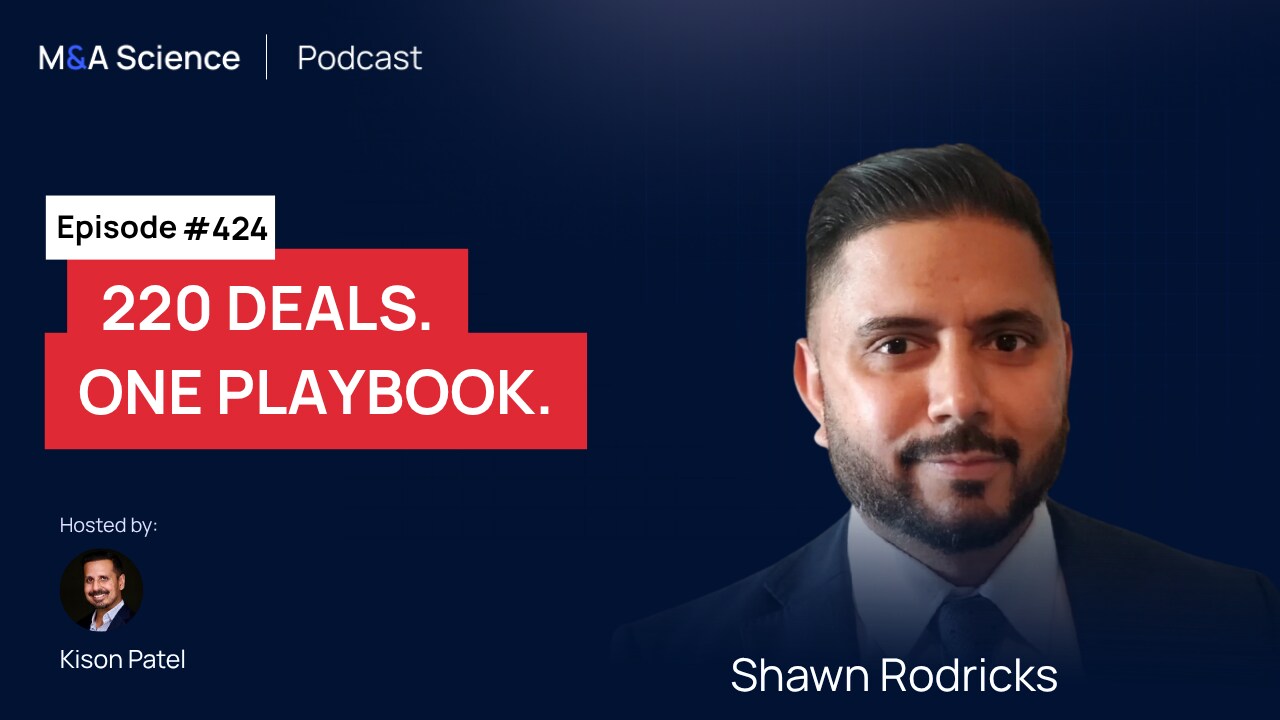
220 Deals. One Playbook. How to Scale M&A Without Losing Control

Shawn Rodricks, Head of M&A - Independent Consultant

Scaling an M&A function follows a predictable pattern. But it’s not because the deals aren't there. It’s because the operating infrastructure wasn't built to hold quality as pace increases. The playbook lives in a PDF no one reads, integration is labeled a post-close problem, and the team is undersized. When five deals land in the same week? Everything slips at once.

Shawn Rodricks has been on the other side of that problem. Over 15 years in corp dev, he closed 220 acquisitions across two organizations: 37 at Rexall in the pharmacy sector, then 183 at Amerivet Veterinary Partners. He joined as employee number six and scaled the function from near zero to a platform that sold. He built the team, the playbook, the diligence methodology, and the integration process. He also made early mistakes that taught him to wire in before you scale. This episode is the operating system behind those 220 deals. It’s also the part most practitioners skip until it's too late.

 What You'll Learn

  • The five-part operating model behind 220 acquisitions
  • How to hire for biz dev vs. corp dev roles in a lean M&A team
  • The pre-close vs. post-close integration framework
  • Why roll-ups that confuse acquisition with strategy fail
  • How a deviation tracker makes your platform exit cleaner when it's time to sell
  • Why qualitative diligence feeds directly into your forecast and purchase price
  • The closing-week SWAT team structure to use when multiple deals land in the same week

If you're scaling a deal function and want the operating framework behind Shawn's approach, DealPilot, powered by M&A Science, has the Buyer-Led M&A™ Certification, built from 400+ practitioner interviews into a framework you can actually run. mascience.com/buyer-led-ma-certification

Amerivet Veterinary Partners is a veterinary practice consolidator that scaled from a startup to a portfolio of over 200 clinics through a high-velocity roll-up model. The company was built as a joint venture platform, combining centralized M&A infrastructure with individual practice ownership.

Industry
Veterinary Services
Founded
2017

Shawn Rodricks

Shawn Rodricks is Head of M&A and an independent M&A consultant specializing in corporate development and serial acquisition programs. He spent fifteen years in corp dev, closing 220 transactions across two organizations: Rexall, where he built and ran the M&A function through 37 acquisitions before the company was sold to McKesson, and Amerivet Veterinary Partners, where he joined as employee number six, built the function from scratch, and scaled it to 183 acquisitions before the platform sold. He left Amerivet in March 2025 and now works with organizations to build repeatable M&A engines.

Episode Transcript

From Biochemistry to 220 Acquisitions

I'll start with my education. I have an undergraduate degree in biological chemistry from the University of Toronto and then switched to an MBA in finance at the Schulich School of Business.

I have fifteen years of corp dev experience and closed about 220 transactions in two organizations. The first was Rexall, in the pharmacy space. That's where I learned everything about M&A: how to read a legal agreement, how to negotiate a deal, how to build a team, how to put a due diligence process and integration process into play. I closed 37 transactions there. While at Rexall, we sold to McKesson, which was a great transaction.

Then I made the switch to Amerivet, where I joined as a director. I was hired for M&A, but being one of the very first employees, employee number six, I got to do much more: figuring out the model, refining legal agreements, assisting with sourcing, putting systems into place, building teams, and growing the organization from near zero all the way to 220 transactions before we sold Amerivet.

Currently I'm working as an independent M&A consultant. Two main projects: helping a sell-side client sell a multi-pharmacy chain, and working with another organization to build a repeatable M&A engine so they can scale up and do the same thing. On a personal note, I've lived in three countries, born in India, grew up in the Middle East, and now live in Canada. I've been to over 25 countries.

Biochemistry gave me the discipline, the work ethic, the accountability to keep moving forward. In the labs you encounter failure often, but you learn how to move forward and keep improving, which is a key skill set in M&A. You can do all the work right up until the very end and the transaction falls apart. You can't be stuck on that. You have to move on.

The Operating Model for Serial Acquisitions

The first is alignment to do that many deals, from the board of directors to the executive team, all the way through the organization. This is not a side project; you're not doing one transaction. You're trying to do fifty or sixty transactions a year.

The second is alignment on strategy: which transactions am I going to pursue? What are the parameters? What are the multiples I'm going to pay? Is the model a hundred percent acquisition or a joint venture? What returns do I require? Where do I want to do these transactions? And most importantly, when pursuing that many transactions, you need the ability to quickly kill deals that don't meet your criteria and walk away.

The third piece is hiring the right people: hungry business development folk, good, competent corp dev, integration and ops folk. You cannot have bottlenecks.

The fourth is having a clear, simple, and effective playbook from the start, covering everything from pre-LOI through due diligence, legal, and integration. That playbook needs to clearly identify the different paths, the different providers of information, the different receivers of information, who's responsible within the organization, and the timelines.

You also need the right systems for tracking: good CRM, good tracking tools. And a database of deals you walked away from, because in our world, those deals often cycle back. Most importantly, a tracking system for all deviations from your standard model and standard templates, because when you eventually try to sell the platform, being able to show potential purchasers exactly where the deviations are makes the exit cleaner.

Finally, constant communication and partnering with your stakeholders within and outside the organization to keep transactions moving forward.

Hiring Business Development Versus Corp Dev

For business development, you want people who are hungry, who understand the model you're trying to sell, and can actually sell it because they know what it is. If someone doesn't understand the company's model, they're just selling without real knowledge. When questions come up, they revert back to the organization and you lose efficiency. Someone who understands the model, the process, and the playbook is far more effective.

For pure corp dev, I look for three things. First, finance knowledge. I'll give a case study and see how someone builds a valuation. Second, and most important and most difficult to gauge, is work ethic: accountability, the ability to show up prepared every single time, and when a deal dies, the ability to process it and move forward quickly. I probe with questions and then ask the same questions to references to see if the stories line up. Third is hunger to grow. Just like in M&A, where you take two organizations and hope the synergies build value, I want to see if the individual has that same growth mindset. I look at their resume for progression within organizations, not people who constantly jump, but those who've progressed, stayed loyal, and are hungry.

Staffing as Deal Volume Scales

Staffing depends on how many deals you're going to do. Most firms test the waters. Year one is like being in a Ferrari, moving really fast with things to fix. You can't stop the car. You lean out and fix things as you move forward.

In an ideal world, every event happens in succession after the previous one completes. That's not the reality. Things happen simultaneously. Depending on deal volume in year one, maybe it's you yourself doing the sourcing and selling the model, with one analyst backing you. You slowly build the team as transactions come into your portfolio and can fund the compensation for new hires.

Getting the first few transactions right matters, more so because of credibility. You want credibility with your PE sponsor so they believe you can grow after year one. You want credibility with your lenders. So even if you have an aggressive target, leave buffer in year one to build a foundation to scale, not just to close deals.

What a Playbook Actually Is

A playbook is a collaborative effort in which key departments determine what each needs to give and receive to make a transaction successful. Every department answers: what do I need to do, and what do I need to receive, to make this work?

The playbook needs to be simple, clear, easy to understand, and highly effective. It needs sections for each stage of the transaction life cycle. Within each stage, clearly identified tasks: who is accountable, who the receiver of the information is, who the provider is, and the timeline.

Once you build it, the education piece becomes critical. A lot of organizations build a playbook, put it in a PDF, and leave it there. The playbook needs to live and breathe with every transaction. Think of every transaction as a project. The head of M&A is the project manager. Their role is to ensure the playbook is used every single time, not literally pulling up the PDF, but making sure the process lives through the transaction. If you need to educate and re-educate until it becomes second nature, that's what you do. When a new transaction comes in, you should know exactly what to do, exactly who to pursue, and if there's a fire, exactly who to call.

Finally, it needs to be flexible. At Amerivet, the playbook for our first few transactions looked very different from the one at deal 50 or 100, because we kept learning. You continuously update it with the question: how do I make things better? Develop it collaboratively, use it every single time until it becomes second nature, and maintain the flexibility to keep adapting.

Managing Deal Flow and Cash Timing

Everybody strives for a linear flow of closings throughout the year. It does not happen. The most important piece is communication, the respect you have for your partner stakeholders within and outside the organization.

In my world, closing five deals in a month was manageable. Think about closing three, four, or five deals in a week. That requires a lot of communication and advance planning. If you expect two deals to close in January, two in February, two in March, but nothing closes because of the holiday period, and suddenly you have four deals landing in one week, over time you learn that pattern repeats. One thing I institute is a dedicated closing-week SWAT team: specific people focused on that final stretch to put out last-minute fires and ensure transactions actually close. You're in constant communication with them, constantly asking for updates.

I'll never burden the organization if partner stakeholders tell me, despite their best efforts, a closing can't happen. We push it. But through constant communication, you get the team ready. After a year or two, you know the pattern because it repeats year over year.

The SWAT team came from within the integration team, plus operators for the relevant states. Education is important here too, because if you have three or four closings in the same week, you need people who know the playbook, not just a narrow group of specialists.

Funding these deals is a real struggle when timing keeps shifting. What I implemented is a constant cash flow requirement communication tracker, a 13-week rolling cash flow forecast that continuously updates the finance department on your closings. We also weight each transaction with a probability: how realistic is it that this closing happens at this particular time? If it's 90%, finance can prepare the funds. If it's 10%, they know they can move the cash around. Having that constant communication, and treating finance as a genuine partner, made a real difference in how closings ran.

We had a pipeline tracker with all these details, weighted by closing probability and by where the transaction sat in the life cycle.

The Underestimated Side of Diligence

The quantitative piece is looking at financials, finding normalizations, and restating the numbers. But in the pharmacy and vet space, the qualitative piece is equally important: the location of the clinic or pharmacy, asset quality, the people, the roster, and the culture, along with your recruiting ability.

On location, the organization should have already done the work to identify where to pursue transactions based on population growth, income potential, and similar factors. On asset quality, you get that through pictures, videos, or ideally an on-site visit where you walk through the space and have real conversations with the sellers about the asset and the team.

When I talk about people, you look at the roster, the quality of the team, and you try to understand the culture. In vet and pharmacy, you have a lot of support staff. You need to understand the benefits and perks beyond the standard package: weekly lunches, holiday parties, birthday days off. These are small things that, if they contributed to the clinic's success, you need to preserve to ensure continuity after close. You can't walk in and immediately strip them away. You have to be mindful of all these things while running serial acquisitions.

Key Person Risk and Pre-Close Retention

You come across DVMs who are very high producers, and that's a flag for me. Age becomes critical, especially if it's the seller or a key associate DVM. I need to understand their plans post-sale. For associate DVMs, I need to know whether employment agreements are in place, whether there are non-competes and non-solicits, and whether they'll be assignable.

Then I figure out what I can institute to incentivize these key players to keep practicing. Can I offer equity? Retention bonuses with proper clawback? Once I work that out, I include it as a condition of closing. That ensures continuity. But at the same time, I need to check: if this person leaves anyway, what's my recruiting ability to replace them in that market?

Here's a specific example. A two exam-room clinic where one DVM produces over $2.5 million in revenue. An average DVM produces somewhere between $500,000 and $700,000. If that high producer leaves, you've lost the equivalent of five average DVMs' worth of production, and there's no physical space for five DVMs. What's my realistic ability to find a single replacement DVM of that caliber in that specific area? If the answer is low, and the high producer is up in age, that's a significant red flag. You take all of that qualitative information alongside the quantitative picture to decide whether to pursue the deal, and at what price.

Post-Close Monitoring and the First 90 Days

Always try to meet with key stakeholders before the deal closes. The more you can get key stakeholders into employment agreements, the more opportunity you have to have direct conversations with them prior to closing and surface any red flags before they become your problem.

After closing, send surveys out to the team. See whether what you're doing is being received positively or negatively, and course-correct. Run customer surveys to check whether service levels are meeting their standards. From a vendor standpoint, check for lagging payables and whether vendors have concerns. A weekly P&L review becomes very important, and if people don't know how to read a P&L, you go and educate them, then review it with them together.

On-site visits are essential. Treat these acquisitions like your own for at least the first 90 to 180 days. Constantly be in the clinic or pharmacy assessing what's working and what isn't. Build a culture of "mistakes happen, let's work together to fix them," never "you made a mistake and I'm penalizing you." Fostering that culture is what lets you actually extract the synergies you built into your forecast.

I say this to everyone: I can be the best corp dev person in the world, but if I get integration wrong, I've lost the transaction. You need to handhold these acquisitions until they're standing on their own two feet.

Pre- vs. Post-Close Integration Priorities

Understanding what must happen before close versus what can wait is part of the art that comes from experience. Banking is a must before close. If you've closed a transaction and revenue is still flowing to the previous seller's account, you have a real problem controlling the funds. Payroll and benefits should also be switched before close. If you're offering better benefits, give them immediately rather than running payroll through the seller's system.

If you identified mold during diligence, fix it before close. On the other hand, vendor integrations can usually wait. You can assess vendors at your own pace and engage them as needed. Not everything needs to be integrated immediately, and rushing to integrate everything perfectly will kill your deal velocity. Identify the absolute must-dos before close, and let everything else follow in sequence.

What Roll-Ups Mistake for Strategy

A lot of roll-ups treat acquisition as the strategy without having a well-defined actual strategy. They have the funds to acquire but haven't figured out integration, haven't built the team, and haven't put proper systems in place. They try to centralize everything too quickly. They're counting on multiple arbitrage without building the discipline or the operational foundation to support it.

The current environment is a perfect example. A lot of consolidators who just went and acquired without the discipline, without building the foundations of sound purchasing discipline, are finding themselves in serious trouble.

Integration is the one piece that converts everything you model in your forecast into reality. Without solid integration, all the synergies and returns you projected will evaporate. It's what translates everything on paper into what actually happens.

From a resourcing standpoint, start with one solid individual who has real integration experience and knows how to work with key players. That person builds out their team as you scale, just like every other department.

Scaling Trade-offs and the Year One Playbook

The luxury of time to do everything in sequential order. You don't get that. What I do instead is identify the five to ten things that could kill a deal and make sure every transaction passes that test. Then, from an integration standpoint, I prioritize what absolutely must happen before close versus what can follow afterward. In an ideal world, you'd do everything before close. That world doesn't exist when you're doing three or four transactions a week. Prioritization is the job.

It comes back to alignment, a well-defined strategy, a clear game plan for hiring, and getting the right people in place, especially hungry business development folk. In year one, you likely won't have all the systems in place. What you'll have is a strategy, alignment, and core competent people who are willing to roll up their sleeves and do whatever it takes to get the organization moving.

My biggest year one screw-up was a deal where we rushed integration in the final stretch. We left the banking with the seller. It was very hard to track the funds. We didn't set proper expectations post-close around hiring, raises, or the other things that matter to the team. The revenue was coming in, we were correcting diligence issues, but we hadn't properly integrated the business into our systems.

It happened because we were bleeding cash in year one and wanted to get the deal closed. Having scaled more organizations since, it's something I'd never do again.

Two examples. First: we had progressed well into a transaction when our counsel ran the lien searches during legal due diligence and discovered the seller did not have the authority to sell the assets he was selling to us.

Second: we went through an entire transaction and, at the very last moment, a key employee announced they had an offer from another company and was going to take it. We convinced them to stay. We did close. But these are the real, live things that happen in M&A.

Show Full Transcript
Collapse Transcript

Recent M&A Science Podcast Episodes

How to Build a Deal Model That Beats PE on Price
The People You Lose in M&A: Key Talent Retention Before Close
How to Buy Companies That Aren't Profitable Yet
M&A SCIENCE IS SPONSORED BY

M&A Software for optimizing the M&A lifecycle- pipeline to diligence to integration

Explore dealroom

Want to wear your M&A expertise?

Check out the M&A Science store.