Progress (Nasdaq: PRGS) empowers organizations to achieve transformational success in the face of disruptive change. Progress' software enables customers to develop, deploy and manage responsible, Al-powered applications and experiences with agility and ease. Customers get a trusted provider in Progress, with the products, expertise and vision they need to succeed. Over 4 million developers and technologists at hundreds of thousands of enterprises depend on Progress.
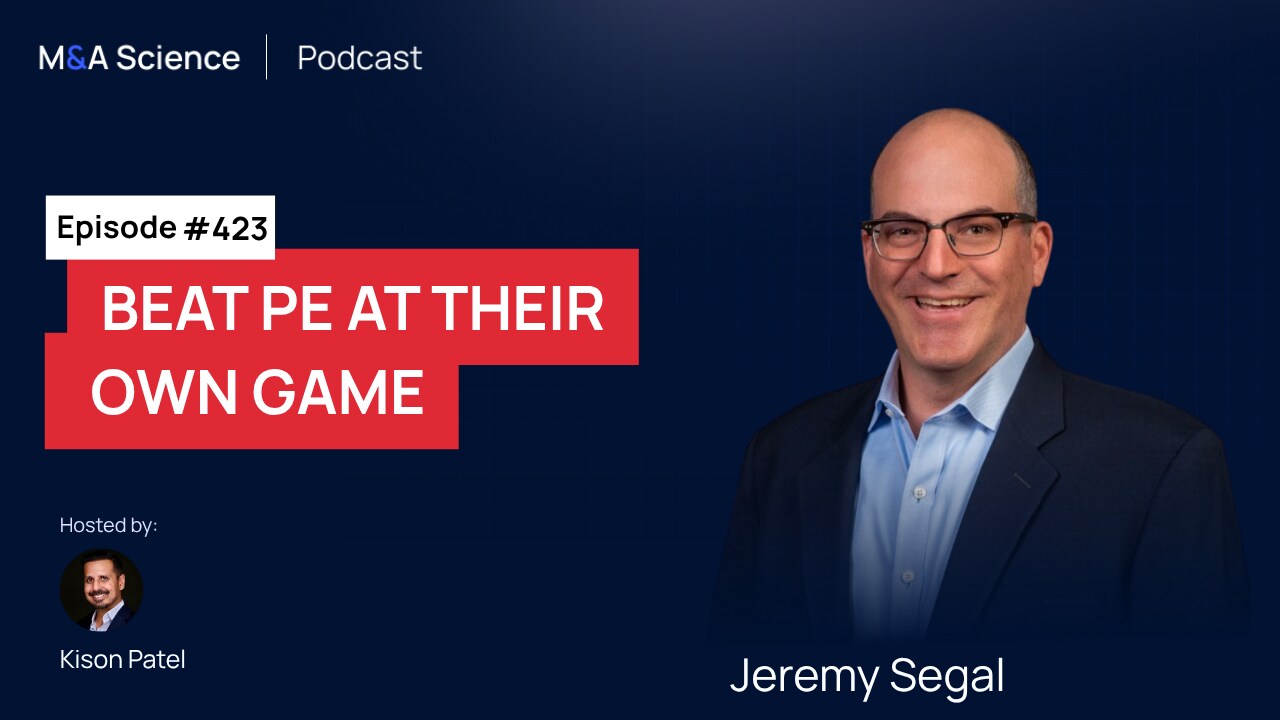
Jeremy Segal
Jeremy is the Executive Vice President of Corporate Development at Progress (NASDAQ: PRGS). He is a corporate development executive with 20+ years of experience in the technology industry focused on M&A, Corporate Ventures, Strategic Planning, Joint Ventures, Divestitures, International Expansion, and Strategic Partnerships
Episode Transcript
Why M&A Has to Be the Growth Engine
Progress has been around for over 40 years, public on the NASDAQ for over 30. Organic growth is slower. So how do we double the size of the business every four to five years? It has to be through M&A. It has to be doing scale transactions, companies that can have an immediate impact on the top line and where we have room for optimization so we can execute on the Progress M&A playbook.
On an organic basis, think of our growth as low single digits. When we look at acquisitions, we're talking about adding anywhere from 5 to 20% of Progress's revenue, so think of $50 to $200 million on the top line.
On a CAGR basis, that significantly increases your growth rate. But the kinds of assets we look at tend to have a growth profile similar to ours: mid-single-digit to maybe low-teens growth. That's where our sweet spot is, and where we have the greatest valuation alignment with sellers and their investors.
Career-wise, I'm probably coming up on 50 acquisitions, give or take. Add in some corporate ventures, strategic investments, divestitures, and joint ventures, and it's been quite a 25-plus years.
Out of 50 deals, there are certainly ones where the strategic thesis did not play out as we expected. There were times where we bought an asset that needed more time to mature, but we got so excited with the technology that we brought it to market a little too fast. The market wasn't ready.
At Progress, we've been laser-focused on finding assets we know we can optimize, integrate well into our platform and business, and we've seen tremendous success with the acquisitions here.
Deal Cadence and Financial Discipline
We're not an acquirer that's going to do 5, 10, 15 deals in a year. We're very selective, because we're a financially disciplined buyer. We're not going to go buy assets at 10, 15, 20 times revenue multiples. That's just not in our DNA.
We have a core set of financial parameters that assets need to fit to get through the process. If your value expectations are too high, we're not going to get that deal done. If your growth is significantly higher than what we look at, you're probably looking at a multiple outside the scope of what we'll pay.
We're very comfortable remaining disciplined, adhering to our financial parameters, and buying assets we know are good for Progress and that we know we can execute on, given all the strengths we have: global company, distributed sales force, 200,000 customers, the list goes on.
Pipeline Strategy and the Five-Year Roadmap
Our top of funnel is very large, but it quickly shrinks down to a much more focused set of pipeline targets that actually fit our criteria, where we can have real conversations, build relationships, and get companies to know Progress better.
We're not paying a crazy high multiple for assets we buy, but we want the companies we buy to be excited about the value our platform can bring to their business. We want them to be comfortable selling to us, knowing we're going to take that business, use all the strengths we have, and make it better.
I like to refer to the pipeline as a five-year roadmap. Some relationships we're developing are for opportunities that are more imminent. Some are for things that probably won't come to market for two or three years. But it's still important to understand who these companies are, build those relationships, build that trust, and get them excited about Progress.
There are a lot of people out there who don't know who Progress is today. As a 40-year-old software company, people might still think of us in terms of legacy products. They don't realize we've done all these acquisitions and transformed this company into a leading infrastructure software player across data and data analytics, infrastructure, monitoring and observability, and digital experiences. Once companies start to get to know us, get to know our leaders, see how passionate we are, they get more excited.
It’s very important for us to have companies that are more near-term as well as some companies that are further out so we can check every six months every year. The key thing for me is we never want to miss a deal we would have liked to look at. We make sure investment banks, venture capital firms, and private equity folks all know we're open for business, well capitalized, and interested in certain assets.
They understand our financial parameters. They're not bringing us $5 million tuck-ins or companies growing 30, 40, 50%, because they know that's outside what we'll do.
I leverage the great team we have at Progress to drive actionability in the pipeline. It's very easy for me to bring one of my GMs onto a call with the CEO of a target company. Once they hear that GM's story, once they hear the vision, they get a lot more excited about Progress as a potential acquirer. Because that's who they're going to be working with.
My GMs, my CEO, they're all assets I use in selling Progress to potential acquisition targets. I can tell the story, but when they hear it from the person who owns that business unit, there's just an additional level of excitement and passion. And it works.
How the Synergy Model Works Before LOI
How do we create shareholder value with the deals we do? We find assets where there's still room for optimization. On a high-level basis, we might be paying a higher EBITDA multiple than where we trade. But after we've executed on the cost optimization, the goal is to acquire assets that from a multiple standpoint will be below where we trade. That's shareholder arbitrage. That's why investors like our M&A strategy. We're showing we're creating value. We're showing we have a playbook.
And we know how to execute quickly. These aren't taking a year and a half or two years. Within the first 12 months, we're usually seeing the majority of the optimization already complete. That’s the powerful formula that we use so we could pay a higher EBITDA or multiple than what we’d trade at the surface. But once we integrate this asset, we’re operating at a different operating margin profile such that we’re creating that value for our shareholders.
Where the Cost Synergies Actually Come From
The revenue tends to be more upside. What we're modeling before LOI is what we know we can execute on with high confidence.
We're a global company. We have centers of excellence in Sofia, Bulgaria, in Bangalore, India, in Hyderabad, India. If a target has all their development in San Francisco at crazy OTE levels, those geographies create real opportunities for us.
We have a massive sales distribution force with 200,000 customers. If we can add products to our sales force's bag, we don't necessarily need a large number of salespeople coming from the acquired company. And then on the back office side, you don't need two CEOs, you don't need two CFOs. You can get some really solid savings out of that quickly.
Say a company is hybrid but has facilities in four locations. You don't need four locations. So it's leveraging the distribution force, leveraging the centers of excellence in lower-cost geographies, and eliminating redundancy.
There's limited information before LOI. The post-LOI diligence period is when you validate whether you can actually execute on those assumptions.
The No-Retrade Commitment
We try to be as precise as we can be at the LOI stage. We're not looking to renegotiate on value. Now, obviously, if you get into diligence and learn that revenue isn't $100 million but $50 million, that's very different. Or if there are major collections issues, things that should have been shared early in the discussion that weren't, that could change the perspective. But once you sign an LOI with us, unless we learn something materially different from what you told us previously, we're not going to retrade. That's not in our DNA.
I understand the growth equity strategy. You try to lock in a target by selling them a higher purchase price, get them excited, diligence them, and by the time you've negotiated them down, they're so far down the road they figure they might as well finish the deal. That is not us.
Chef: Beating PE on a Competitive Deal
Chef was a competitive deal. A lot of private equity interest in the asset. Our advantage was the center of excellence in Bangalore. A lot of what Chef was doing in much more expensive geographies were things we knew we could do in lower-cost geographies, and we had that platform ready.
Private equity buying Chef as a standalone entity didn't have that same platform, so they couldn't get the same level of cost efficiencies. Chef had very expensive salespeople. We shifted that to an inside sales motion. They had incredibly expensive engineers. We shifted that to our Bangalore center of excellence and built up a team there. Things we could do because we already had that location.
As a result, we were able to be much more competitive on price and win that deal from some pretty reputable PE firms that were very much in the running.
The space, DevOps, was certainly one Progress had identified as interesting and relevant. A great extension from being developer-focused to being developer and ITOps-focused. With Chef, the timing worked out. The investors had been in for 10-plus years. The company had gone from rocket growth to growth plateauing.
It really wasn't in a position to IPO. The investors were tired, not going to put more capital in. It was a break-even business. Their alternative was to either optimize themselves or sell. They opted to sell. It was a great deal and an asset for us. Changing our approach allowed for all these different optimizations.
Chef was a great deal for Progress. They were one of those internet technology darling companies that had brand expectations of an IPO that didn’t play out. When you think about a workforce that thinks they're going to go public, and then they're getting bought by a 40-year-old software company, it has an effect.
As our profile has changed over these last few years with all the acquisitions we've done, we've become so much more relevant, so much more interesting. And as a billion-dollar software company, we're a unique company at this point. It's a very different story that we tell now than we did when we were a $400 million business when we did that acquisition.
When you're looking at an acquisition, you have to think about those dynamics. That employee base has a very different mindset. At Progress, we have people who have been here for 20, 25, 30 years. Very loyal people. Loyal customers. And when you take a faster-moving, startup-oriented company, there are going to be challenges.
Post-Acquisition Attrition and the Chef Culture Challenge
One of the challenges we encountered was attrition. The attrition happened because a certain percentage of that workforce had expectations of an IPO, and had expectations about making a lot of money at Chef. That didn't pan out with the deal we did. It was still a good value deal for the investors, but if you’re thinking about just making millions of dollars and here you are not making any money, that move creates some tension.
A lot of people in that workforce probably preferred to work for earlier-stage, more startup-centric companies. Progress is a well-established public company on the NASDAQ. We're not a startup anymore.
You can address it with retention stock, retention equity, and retention bonuses, which we incorporate into our deals. We usually have different categories. Key employees get the highest allocations from the retention pool. Below that, there's a core group we also want to take care of. And then there's the broader employee base that you still want to treat well at some level.
Part of the problem was that the employees at Chef didn't really understand what they were and weren't going to make on the deal. They didn't understand the value of their options or their equity. It's important for the selling company's leadership to be able to explain where the company actually stands. "Yes, we were valued at this," maybe that was 2021 when things were irrational, "but things are very different now."
Private companies aren't insulated from what's happened in public markets. The rank and file might think they're going to make a lot of money with 100,000 options, but when the deal closes at a value significantly below the last money raised, those aren't worth anything. And they don't know that going in.
So it's really a communication challenge. It starts with the leadership of the company you're buying. And then it's on us as the buyer to explain why these people are still important and what we're going to do for them.
One practical thing you can do as a buyer to handle employee retention in underwater deals: identify that core set of three to five people who have a real stake in the business and tell them clearly, "I can't do this deal without you." When you do that, they're motivated to make sure those people get locked in and are genuinely excited about joining a bigger platform.
ShareFile: Carve-Out from Cloud Software Group
Cloud Software Group is a massive company that sells million-dollar enterprise software deals. ShareFile had an average deal size of $3,000 and 86,000 customers. That wasn't really in Cloud Software Group's DNA.
We had developed a great relationship with the CEO of Cloud Software Group and his head of corporate development when they were still at Broadcom. When they moved to Cloud Software Group, we kept that dialogue going. We made sure they knew that certain things in their portfolio that weren't core to them could be core to Progress.
When they started making divestiture decisions, one of the first assets was ShareFile. We got the call through the bankers, but they knew who we were. And because we already had familiarity with the business, we could move faster. Speed and certainty to close are key differentiators. If I have a good familiarity with the business, I can move faster.
ShareFile was $250 million in revenue, so while it was non-core to Cloud Software Group, it was a sizable and immediately meaningful part of Progress. It gets a lot of attention, gets a lot of love. The employee base really appreciated that. And it's been a fantastic acquisition. It took us to almost a billion dollars on the top line and helped us hit our first goal.
On the structure: it was a true carve-out. They had back-office dependencies, so we had a TSA in place, which we were able to get off very quickly. The majority of customers were unique to ShareFile, so there wasn't a lot of customer untangling between Cloud Software Group and ShareFile. That made things cleaner. And it was a pure divestiture.
On synergies: it's the same playbook. We looked at the different ways we could optimize the business better. ShareFile had not fully optimized, so there was still room. We took advantage of that the same way we always do.
What to Look For in a Carve-Out Diligence
It's an asset deal, so you really need to understand the business, understand what all the assets are that you want to buy, and make sure you identify everything. There's more pressure to be thorough so you don't miss anything, compared to a stock merger where you're buying the whole company.
The questions to focus on: How intertwined is the technology? Is it all coming to you, or is there technology the parent company is still dependent on? In ShareFile's case, there was none of that, which made it clean.
Then there's the untangling of customers, and then figuring out from a back office standpoint what you need to do to support the business and how to do it more efficiently than the parent did.The core question is always: how clean or messy is this untangling going to be? If it's going to be messy, it's probably going to be difficult to get through our process.
We looked at a divestiture several years ago where we were explicit from the beginning that we needed to own the IP. When we were told near the end of the process that they needed the IP too and would license it to us, that became a deal breaker. It came up too late, and you lose trust. If there are going to be things that make the deal challenging, tell us upfront so we can figure out how to address it. When we find out late in the process, it just changes the dynamics.
It was competitive. That was our biggest deal. It took us to almost a billion dollars on the top line and helped us hit our first goal.
What Progress Looks For in a Target
The way it works at Progress as a value buyer is that we build relationships proactively on the front end, get to know these target companies. But it's rare a company is just going to sell to Progress without checking the market.
So the key is making sure we're positioned as an ideal buyer, as knowledgeable as possible, and that they understand the value proposition we bring. We're not going to preempt most deals, they're going to be competitive. And we're comfortable with that.
I don't blame anyone for doing a market check. We're very comfortable as a patient buyer saying, "Go test the market. If you can get five times, seven times, ten times revenue multiple, all the power to you, I'll be happy for you. But if you can't, we're still a great alternative."
Bankers know we're going to be laser-focused. We're not going to ask for everything under the sun in diligence. Sellers know that once we're committed at LOI, unless we learn something that's a genuine surprise, we're going to get the deal done. We're well capitalized. Forty percent operating margins, thirty percent free cash flow margins. It's a strong model, and it puts us in a good position to keep doing deals.
We're comfortable looking at things that are on the cusp of profitability, say 20 to 25% profitable. If you're bleeding a lot of money, it's much harder to get to the operating margin levels we need.
If you're already at 50 or 60% operating margin, you're already fully optimized, and there's not much room for us to create value. We're looking for companies that can be losing a little bit of money to making around 15 to 20% from an operating margin standpoint, where there's still room.
Even though the businesses we look at aren't necessarily fast growers, we look hard at net retention and gross retention. Those have to be really strong because they're good indicators of customer loyalty. Maybe you're not growing 15 or 20%, but the customers who use you love you, love your technology, and they stay. We're not out chasing a lot of net new business. We nurture our install base. We upsell and cross-sell to our install base. And we continue to innovate so we can remain relevant for our 200,000-plus customers.
MarkLogic: When the Seller Restricts Access
MarkLogic was competitive as well. Most of the deals we close are competitive.
One thing worth saying before getting into it: if you're a founder or an early-stage entrepreneur who's never been through a sale process, hire a banker. A banker brings maturity to the process. It's hard. And it helps you avoid the situations where a seller decides at the last minute that they're worth twice what you agreed to in the LOI. That's always a bad conversation. A banker helps prevent it.
MarkLogic was another great acquisition for us. From it, we were able to create our Progress Data Platform, which does more than just aggregate data. It does data analytics and data intelligence, and we've incorporated agentic search into it. That's a real differentiator for Progress today. It came from MarkLogic.
But there are challenges with every deal we do, and MarkLogic had one that was more unique. There were things that happened that genuinely surprised us. One of them was something we took for granted: the expectation that between announcing and closing a deal, you're going to have access to the team of the acquired company.
You start having dialogue with them, figure out who the keepers are, who's redundant, who you need to move fast on. We didn't have that access during that window, and that was a surprise. We've always had it before.
How did we address it? In our LOIs now, we make it very explicit that we'll need that access, and if you're not going to give it to us, tell us that now.
In the MarkLogic case, it was the company's last month of their fiscal year. There was pressure to hit numbers, and they didn't want distractions. The private equity firm claimed this was their model, they don't give access to people in that period. On the flip side, not everyone in the company is working on selling deals. There were a lot of people we could have had access to. We've never seen that approach in all our years of doing deals. It was a surprise.
The Orange Flag System
Out of the MarkLogic situation, we created what we call orange flags. These are things during diligence that rise to a certain level where you go talk to your CEO and CFO and discuss whether you want to continue.
What's an orange flag? We've been asking for basic information for two or three weeks and haven't gotten it. Why haven't they given it to us? What are they hiding? That raises the flag. It starts as an orange flag. We then discuss it with our CEO and CFO: do we want to keep trying to get this information, or do we just want to walk away?
Because we're a disciplined buyer, we're comfortable walking away. When you tell a seller, "If I can't get this information, I can't do this deal," it usually lights a fire under the bankers and the sellers.
I understand that part of the strategy is for bankers to hold off on certain information while other parties do their work, so no single buyer gets too far ahead. But getting access to certain information is non-negotiable. If we don't get it, we walk.
Red flags are deal breakers. Orange flags are things that, if you accumulate enough of them, could become a red flag. Or they warrant a conversation earlier in the diligence process with your CEO and CFO about whether it's worth continuing.
The other thing I've learned in 25-plus years in this environment: you can't fall in love with a deal. You never know what's going to happen. You always have to maintain that balanced perspective. The moment you fall in love, you've lost your leverage and your judgment.
When Seller Motivation Becomes an Orange Flag
Not falling in love with a deal is one thing. But having a motivated seller is equally important. We had a deal with two owners who essentially owned the entire business. It was a bootstrapped company. One wanted to sell. The other was not on board. You could tell they were never really on board, but they went along with the process.
We should have raised that as an orange flag earlier. Instead, we expended all the resources, did all our diligence, negotiated a definitive agreement, basically got to the finish line. Then the reluctant seller came back and said they'd hired an independent valuation firm that put the company's value significantly higher than what we'd agreed to pay. They couldn't sell for our number, but they'd take something in between, which was still a significant premium to what was in the LOI.
That's a walk. You walk away. It's painful, because all that money spent on quality of earnings and diligence doesn't come back. It all becomes OPEX. But the lesson is: if you don't see the seller fully bought in, that's a flag. Raise it early.
What Counts as a Material Change Warranting a Retrade
We're not going to retrade unless we learn something in diligence that's completely different from what we were told. If a quality of earnings report comes back and revenue that was represented as $100 million is actually $50 million, that's different. Or if the add-backs aren't justifiable, or the fiscal year representation was wrong. If it's material enough, that changes things.
But if our ARR analysis comes back one point different from the seller's, we're not going to adjust the price for that. If someone tells us their GRR calculation is 87% and we come up with 86%, we're not changing the price. But if we're at 75% and they told us 85 to 90%, that's a big delta.
How Public Market Cycles Affect the Deal Pipeline
You're seeing public market cycles play out right now with software. AI can claim software is dead, but AI also realizes it's highly dependent on software to inform the LLMs and give AI any real value. So software isn't dead.
That said, markets have responded to the narrative around AI displacing software, and you've seen a massive drop in public software company valuations. You're not seeing that on the private side yet.
The math challenge is this: we're a billion-dollar company growing 10 to 15% top line, including inorganic, with 40% operating margins and 30% free cash flow. We're looking at a private company doing $50 million with 5 to 10% operating margin that wants to sell for 5 to 10 times. The math doesn't add up. Private markets need to catch up to where public markets are, and I don't think that's happened yet.
There's no immediate direct correlation between public company valuations and private. If there were, we'd be buying private companies at two to two-and-a-half times, which is roughly where we trade. We're not. The private market hasn't capitulated, particularly for PE-backed companies that are profitable. They can afford to wait and see how the SaaSpocalypse plays out. There's still optimism that valuations will rebound somewhere in their five-year hold window.
The private companies that have DPI pressure will move sooner. The ones that aren't under that pressure can hold on longer. And I understand no one wants to be the first to say they sold at a low valuation while everyone else is still holding out. But we're not going back to irrational days. When we look at PitchBook and see 2020 and 2021 valuations, we completely disregard them. We know those were irrational times and companies aren't going to get that kind of value again.
What made 2021 irrational? Money was free. Interest rates were at zero. Private equity could use cheap debt to pay any valuation because the financing cost was almost nothing. Now that debt is more expensive, PE can't be as aggressive from a value standpoint. That puts us in a better position. But when money is free, it's easy to pay higher valuations. That environment is gone.
There's still a lot of dry powder out there that needs to get deployed, so deals are going to continue to happen. But more pressure is coming into the system. Private equity needs to show liquidity. Lenders are starting to take over deals that are over-leveraged. As good assets start to trade at more favorable valuations, others will realize it's time to capitulate.
We have a lot of data on how public markets trade. If you're a Rule of 10 or Rule of 20 company, you're probably trading in one range. If you're a Rule of 40 to 50 company, you're trading in another. We know those benchmarks.
But private companies aren't necessarily willing to accept those same multiples. We see a lot of Rule of 10, Rule of 15, Rule of 20 companies that are going to hold out for a five-times multiple. I don't know where or when they'll ever get that. If they're profitable, maybe they can execute their way into it over time. But it's going to take time.
We're not going back to irrational days. Unless sellers are willing to recognize where valuations actually are, they're going to be in a difficult position.
What the Current Market Is Actually Producing
We're seeing two types of companies coming to market. The first are companies that are significantly worse, declining businesses with net retention in the 70s and gross margins in the 50s, willing to trade at anything. We stay away from those.
The second, and more interesting, are higher-quality assets. The challenge is that the multiples we paid two or three years ago when we were trading at 11 or 12 times EBITDA are harder to justify at our current multiple.
So that's the tension. But the caliber of some assets we're seeing is good, and if you can buy quality assets at the kind of multiples we were paying a few years ago for companies that weren't quite as strong, there's a real opportunity to get great technology and potentially accelerate top-line growth.
Advice for a First-Time Acquirers
The key is to continue having conviction and continue validating what your original strategic thesis was through the process. When we do diligence, we're constantly asking the same three or four questions, and I push my deal team to think about whether what they're learning is giving us more or less conviction. If it's less, why, and can we address it? Or does it escalate to the point where we walk away?
The other thing is relationship building. Get to know the CEO of the company beyond the formal process. Have more casual interactions. Don't just ask for the employee census and three-year financial projections. Get to know what made their company tick, what they'd like to see happen with their business in the hands of a bigger company. Show that you care about that. It goes a long way.
Constantly validate your assumptions. Make sure you still have conviction. Build the relationships. And really think about how this company is going to operate inside yours, and what you're going to do to make it better.
That's buyer-led M&A.
The Craziest Thing in M&A
Having a founder of a company try to retrade on price the day before you're going to sign the definitive agreement is pretty crazy. It happened to me at LogMeIn too. We weren't quite at the finish line there, but we were close. Six months later, the same founder called to ask if the deal was still available. It wasn't. That ship had sailed.
The lesson there is the same as buying a house. That first offer is probably going to be the best offer.
M&A Software for optimizing the M&A lifecycle- pipeline to diligence to integration
Explore dealroom

Want to wear your M&A expertise?
Check out the M&A Science store.
.avif)