
.svg)
.avif)
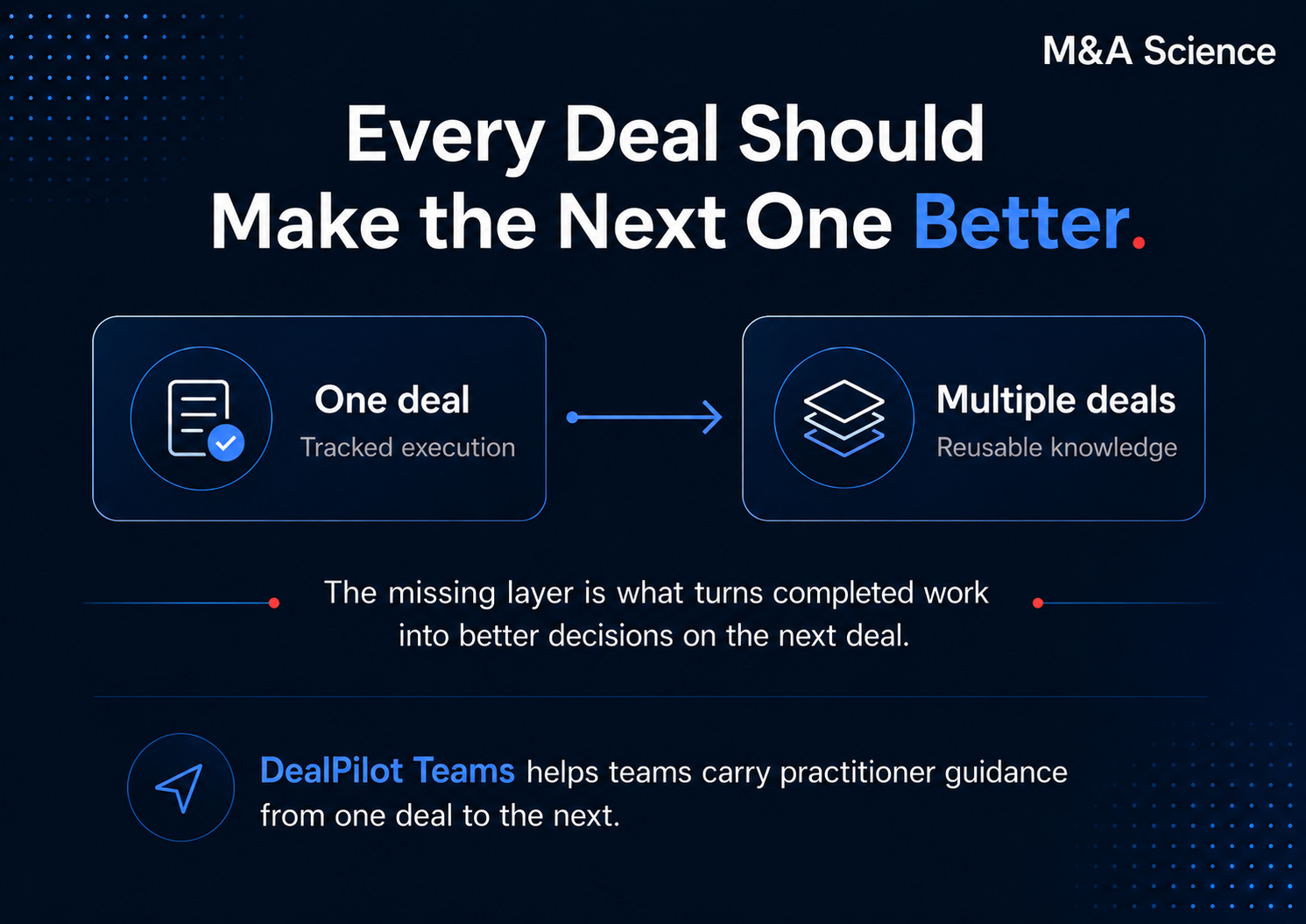
M&A integration software has one job: tracking execution. Tasks have owners, dates have status, and workstreams sync to a dashboard. The second job is less visible but just as critical: ensuring the team carries decisions, context, and lessons into the next deal.
The proof that it's missing? The workflow platform says the integration closed on time, every milestone is green, and the team can’t explain to the board what the last deal taught them.
Tracking work and preserving knowledge are two distinct categories of work, and most integration teams are only equipped for the former.
The fully tracked failure
The pattern is predictable: An integration team buys a workflow platform and uses it religiously. Tasks have owners, dates have RAG status, and workstreams sync to a single dashboard. Then a key person from the acquired side leaves, a recurring issue resurfaces three deals later, and the team realizes the lessons from prior integrations were never captured anywhere durable.
The team can show the board that they tracked the integration. What they can’t show the board is what the integration taught them.
Today we’re exploring that gap, plus what to do about it without buying a different tool.
The two categories your integration stack has to cover
There’s a useful distinction buried in every honest conversation about integration software.

Workflow is what people are doing. Tasks, owners, dates, status, dependencies, and dashboards. This is what M&A integration platforms are built for, and the strong ones are very good at it. Workflow often lives across project management tools, documentation systems, messaging threads, spreadsheets, and dedicated integration platforms. Integration leads at companies like Autodesk, Atlassian, and Adobe have made this combination work at scale.
Knowledge is something else. Knowledge is what the team is learning, deciding, and (crucially) forgetting as the work happens. It’s the context behind a workstream decision. It’s the tacit understanding of why an integration choice was made. It’s the lesson from the deal three years ago. The problem? The people who learned it have moved to another company.
Carey Pugh, who runs integration at Ansys, has described a familiar gap on Episode 416 of the M&A Science Podcast: the team could put data into the tool, but still had to move the output into PowerPoint because the information did not come back out in the format the next decision required. The tool was performing its workflow. The missing piece? The knowledge layer around it.
Pat Belotti, looking back on the evolution of M&A integration as a function, describes an industry that lacked structural discipline in organization and learning retention. The function has matured in workflow execution. The knowledge half is still underbuilt in most teams.
The four knowledge leaks that no workflow tool closes by default
If your stack is workflow-only, here is where the value goes.

Leak 1: Context loss between diligence and integration
Diligence is where the irreversible decisions get made. Integration is where they get tested in production. In most organizations, these are two different teams, and the handoff is structurally weak. Diligence leads do not consistently brief integration leads, and the cost of the gap shows up on Day One.
Todd Manley, VP of Corp Dev Integration at Intel, has described a deal landing on his desk in IT, only for the team to discover the acquired company ran entirely on Apple laptops. The acquirer had never supported a single Apple device. Nobody in diligence had asked. Chris Evans has described the same dynamic from a Day One readiness lens. Most platform-tracked "completions" mask a question that was never asked.
What it costs: Day One becomes a discovery exercise instead of an execution milestone.
Leak 2: Tribal know-how walks out the door
Manley described attending a conference where another company's team was working on a tech problem he had solved a decade prior. The knowledge had been lost. The people who knew the answer had moved on, and what they knew moved with them.
A workflow platform can store a playbook. But it can’t rewrite it for the next team without the original author in the room. That’s the discipline Seema Nimmagadda has called out as the true job of knowledge management.
What it costs: the team pays twice for the same lesson.
Leak 3: The post-mortem that never happens
Most teams plan to run a post-mortem at the end of every integration. But does it usually get done? No.
The reasons are practical: by the time integration is "done," the team is staffed against the next deal, the people with something to say have rotated, and writing down what was learned competes against the next signing.
Practitioners running serial roll-up strategies have shown what a working alternative looks like: weekly integration reviews for six months post-close, followed by a structured business acquisition review in which the team sorts the lessons that should land in the next deal's playbook.
What it costs: every deal starts from memory instead of institutional learning.
Leak 4: Acquired-company key players without a forward path
Retention bonuses keep people in their seats. They do not keep people invested. The expensive form of attrition is the key person who stays for the bonus window, disengages, and leaves shortly after, taking everything they know with them.
Donara Jaghinyan has used the frame of "integration debt" to describe what accrues when communication failures and cultural friction compound through the integration window. Practitioners who structure talent-focused acquisitions describe the same problem from the design side: time-based and performance-based retention models can paper over the deeper question of whether this person sees a path forward inside the new structure, but they can’t answer it.
What it costs: the acquired company's most valuable people stay long enough to collect the bonus, then leave before the value transfers.
Five questions to test whether your workflow tool is doing its job
Before evaluating a new platform (or defending the spend on your current one), work through the five questions listed below. The goal is not to indict the workflow category, but to identify where the workflow tool is doing its work, and where the knowledge layer needs to start.

1. Can data come back out in the format the next deal needs?
Yes: an integration lead taking over the next deal can pull the relevant prior decisions, workstream patterns, and risk flags out of the tool in a form that is useful for planning, not just auditing.
No: the team puts data in, runs the deal, and exports to PowerPoint for the next planning cycle. The tool is a vault, not a source.
2. Does it survive an integration lead turnover?
Yes: if the integration lead leaves tomorrow, the next person can read the tool and understand what the team learned, not just what the team did. Critical knowledge should be externalized before the person holding it becomes the only path back to the decision. The M&A Competency Assessment is one way to externalize what's in a person's head before the transition happens, and to identify which gaps would be most costly if that person walked out today.
No: the value is in someone's head. The platform tracks the body of work; the head goes home at night.
3. Does it codify a process you actually run?
Yes: the workflows in the tool mirror the actual sequence the team executes, with the actual handoffs and the actual gating decisions.
No: the tool assumes a process that does not exist in your organization, and the team works around it by maintaining a parallel process in spreadsheets, Slack, and meetings.
4. Does it pull you toward execution or toward updating the tool?
Yes: the team spends meaningfully more time doing the work than reporting on it.
No: the integration lead has become the part-time administrator of someone else's product.
5. Does it scale across deal volume?
Yes: the marginal cost of adding a second, third, fifth concurrent deal does not require a second instance, a second admin, or a second set of templates.
No: the tool was built for the one deal you bought it for, and the seams show every time a second deal is in flight.
A workflow tool that scores yes on all five is doing its job. The knowledge layer is what sits alongside it.
Three practices that close the leaks regardless of stack
These leaks close with practice, not with software. The three below are not the only practices, but they are the highest-leverage ones for advisory firms and lean corp dev teams running multiple concurrent deals.
1. The pre-mortem
Before the deal closes, get the leaders who will own integration in a room and ask: what are all the ways this fails? Three questions surface the most. What would have to be true on Day 90 for us to call this team a wrong fit? What is the most expensive thing we are assuming about their organization that we have not verified? What is the most fragile part of the deal thesis if a single key person leaves? The episodes M&A Science has run on M&A surprises and horror stories circle the same finding: the questions practitioners wish they had asked are not exotic. They were just asked too late.
2. The short-interval post-mortem
Most post-mortems fail because they are scheduled at the end and skipped. Practitioners running serial roll-ups have shown a working alternative: weekly integration reviews for the first six months, with a structured business acquisition review at the close of that window where the team sorts the lessons that should land in the next deal's playbook. Carey Pugh has described the same principle from a different operating context: running post-mortems on specific recurring events as they happen, rather than waiting for the full integration to complete.
3. The path-forward conversation
Retention bonuses tell key acquired-company employees you want them to stay. They do not tell them why they should want to. Inside the first 60 days, the integration lead needs a separate conversation with the key technical and functional people: what does the next two years look like for them in the new structure, what stays in their span of control, what changes, and what they would need from the parent organization to do their best work here. HR practitioners who have written on cultural integration return to the same point: the conversation has to reach the middle layers, where the actual work gets done. Mahesh Ganesan, Senior Director of M&A Integration at UKG, has described a variation of the practice from the diligence side: walking functional leaders through diligence findings mid-stage, before asking them for anything, so the people who will run the integration on Day One arrive with context, not surprise. The operating philosophy behind all three practices is Buyer-Led M&A™: putting the buyer's value-capture strategy at the center of the deal, which requires knowledge to flow, not just tasks to close.
The layer your stack is actually missing
The knowledge layer is a specific thing. It is not a feature inside the workflow tool. It is a distinct category of capability that sits alongside the workflow stack. It gives the team a repeatable place to compare the current deal against practitioner patterns, preserve the decisions that matter, and carry those lessons into the next deal.
For advisory firms and lean corp dev teams running multiple integrations, that means stacking the right execution platform with the right knowledge layer. DealRoom is M&A Science's execution platform partner. It is the workflow platform many practitioners run their deals on, and the integration is built in. DealPilot, powered by M&A Science experiential data, sits alongside it as the knowledge layer.
Jim Buckley, VP M&A Integration at Coursera, captured what the knowledge layer ultimately defends against. The Microsoft general manager Buckley worked with was once asked at a conference what platform Microsoft used to manage its integrations. The answer came back without a smirk: "We use Word and PowerPoint." The point was not that platforms were useless. The point was that the discipline mattered more than the tool. That discipline, the part that compounds knowledge across deals, is the layer most teams have not yet built.
What to do this week
Three things, in priority order.
First, run the five questions above against your current workflow tool. The point is not to renegotiate the contract. It is to know exactly where the workflow tool ends and where the knowledge layer needs to start.
Second, schedule one pre-mortem before your next signing. Three questions, three people, one hour. The shape of the meeting matters less than the fact that it happens early enough to change something.
Third, pick one of the four knowledge leaks and name the person who owns closing it by end of quarter. Not the team. The person. Without an owner, the leak stays open through the next integration.
For teams earlier in the deal cycle, the companion to this piece is The Pre-LOI Integration Readiness Assessment Most Acquirers Skip, which applies the same architectural argument before the LOI is signed.
Get the knowledge layer your team is missing
If your team is fully tracking integrations and still watching value leak between deals, DealPilot Teams gives boutique advisory firms and lean corp dev teams stage-aware practitioner guidance, powered by M&A Science experiential data from 400+ practitioner interviews and 10,000+ real acquisitions, so the lesson outlives the person who learned it.
Frequently asked questions
What does M&A integration software actually do?
M&A integration software tracks the work of an integration: tasks, owners, dates, dependencies, and status across workstreams. The strongest platforms also handle reporting and dashboards. What integration software does not automatically do is preserve the context, decisions, and lessons the team generates while the work is happening. That is a different category of work.
Why do integrations still fail when teams use workflow tools?
Workflow tools track what people are doing. They do not preserve what people are learning, deciding, or forgetting. When a key person rotates, when a deal thesis quietly shifts, or when a recurring lesson surfaces too late, the workflow tool can show that every milestone was hit. The knowledge that would have changed the outcome lived outside the tool the whole time.
What is the difference between a workflow layer and a knowledge layer?
A workflow layer tracks work: tasks, owners, dates, status. It is the operational surface of an integration. A knowledge layer preserves context: what the team learned on this deal, why a decision was made, what a recurring pattern across deals indicates about the next one. Workflow tools are designed for the first job. Knowledge work needs a layer designed for it, sitting alongside the workflow stack.
How should integration teams preserve lessons learned between deals?
The highest-leverage practices are running pre-mortems before close, short-interval post-mortems through the first six months, and structured path-forward conversations with key acquired-company employees inside the first 60 days. A working knowledge layer captures the outputs of these practices so the next team starts with the lesson, not without it.
.svg)