There are many different reasons why companies buy other entities. Traditionally, acquirers have focused more on the financial aspect of the target company. However, experience has shown that not all acquisitions are the same and must be executed properly against their strategy. In this episode, we discuss how to execute product-based acquisitions featuring Andrew Morbitzer, VP/Head of Corporate Development at Typeform.
To perform M&A at the highest level, an ever-evolving M&A function is necessary. Organizations must focus on refining their strategies, processes, and team dynamics to ensure they can effectively navigate the complexities of each deal. In this episode, Nate Lemmerman, Senior Vice President of Corporate Development at Cast & Crew, shares his experience and tips on how to build your M&A muscle.
Mergers and acquisitions (M&A) is a long and tedious process filled with challenges and surprises that could harm the acquiring company or destroy the deal altogether. To ensure a successful transaction, it's crucial to identify and overcome these hurdles. In this episode, we'll discuss the most common M&A challenges and the best approach to overcome them, featuring Ritika Butani, Head of Corporate Development at Toast.
M&A is inherently risky, but the rewards of a successful deal can exponentially grow a company overnight. There are many things to consider before closing a transaction, and big companies are finding new deal structures to minimize risks when doing acquisitions. In this episode, Finn Haley, SVP of Corporate Development at Edwards Lifesciences, discusses the build-to-buy option structure they use in the healthcare industry.
M&A activity has definitely slowed down. Due to economic uncertainty and high-interest rates, companies are hesitant to expand during these times. In addition, executing deals has also become more difficult due to regulatory changes, especially in the tech industry. In this episode, Mark Legaspi, Director, Legal - Corporate at LinkedIn, discusses key regulatory considerations for M&A in the current market.
Acquiring companies can be extremely rewarding if done right. To be proficient in M&A, a dedicated function must be established for continuous improvement. As the M&A function evolves, it increases the chances of deal success and value creation. In this episode, David Hindley, VP of Corp Dev at Autodesk, shares his journey on how he evolved an M&A function from scratch.
M&A integration is usually made up of checklists that outline the step-by-step agendas and milestones to successfully integrate the acquired company. But during integration, things don’t always go as planned, and teams must be able to pivot and adapt to the ever-changing needs of the project. In this interview, Staci van Schagen, Head of M&A Integration & Disentanglement at Philips, shares her ways on how to thrive in times of change with flexibility in integration planning.
In this episode, we'll outline some valuable insights from Jeff Wald, Co-founder of Bento Engine, on how to maximize the potential of a business during the exit process, engage investors effectively, and conduct confirmatory due diligence. By following these guidelines, entrepreneurs and business owners can be better prepared to navigate the challenges of selling a business.
In this episode of the M&A Science Podcast, Brent Campbell, Vice President of Corporate Development and Strategy at Alight Solutions, discusses how to focus on integration as a corporate development professional.
Cultural fit has become increasingly, as more companies are embracing diversity and inclusion, and acquirers must mitigate cultural differences early on during post-close integration. When two companies fit together, people are more likely to be productive and satisfied with their work. In this interview, Klint Kendrick, HR and M&A Leader, Chair of the HR M&A Roundtable, gives us a view on the HR practitioner’s guide to cultural integration in M&A.
In this episode, PJ Patel, Co-CEO & Senior Managing Director at Valuation Research Corporation (VRC), discusses current valuation trends and working with earnouts.
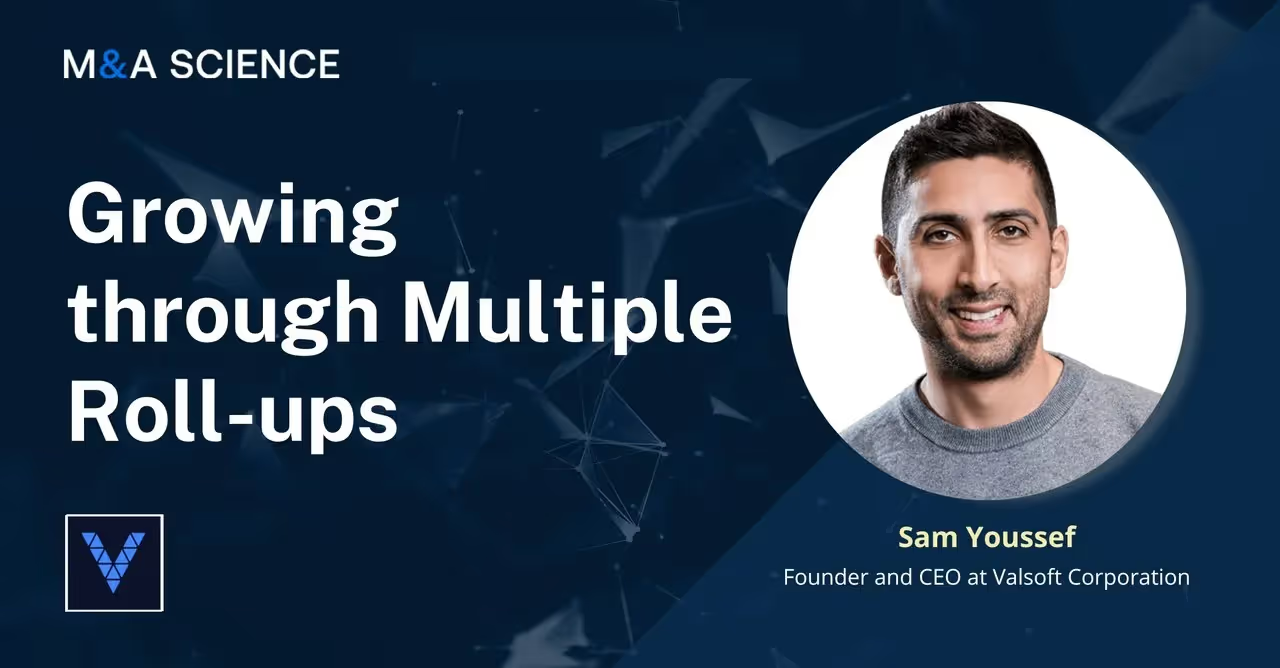
A roll-up is a powerful deal type that involves acquiring multiple smaller companies to combine them into a large entity. When properly carried out, these strategic actions can significantly increase shareholder value and set up companies for record-breaking development. In this episode, we have the privilege of hearing from Sam Youssef, Founder, and CEO at Valsoft Corporation, a company that has experienced explosive growth through multiple roll-ups.
In today's ever-evolving business landscape, companies need to stay ahead of the curve by constantly innovating. One way they can achieve this is through acquiring smaller companies, which can provide access to game-changing technology, bridge knowledge gaps, and accelerate growth. However, acquiring smaller companies comes with its own set of challenges. In this interview, we explore the intricacies of smaller deals with Kevin Griffin, Executive Director of Corporate Development at JLL.
Losing key people is one of the most significant value leaks post-close. Acquirers must focus on the employee experience to retain as many employees as possible. This episode will discuss how to execute a people-focused integration featuring Marilyne H. O'Hara, Global Head of M&A Integration at Block.
Acquiring startups is a common strategy employed by large companies to drive growth and innovation. However, preserving the unique qualities and strengths of startups within the framework of a larger corporation can prove challenging. In this interview, Nadia Gil, Chief of Strategic Planning and Corporate Development at Brady Corporation, offers insight into how to effectively preserve startups during the acquisition process.
Corporate development teams are responsible for finding attractive targets. However, companies can execute successful mergers and acquisitions without corporate development. In this episode, we explore insights provided by Michael Farlekas, the CEO at E2open, who has executed 14 deals without a dedicated corporate development team.
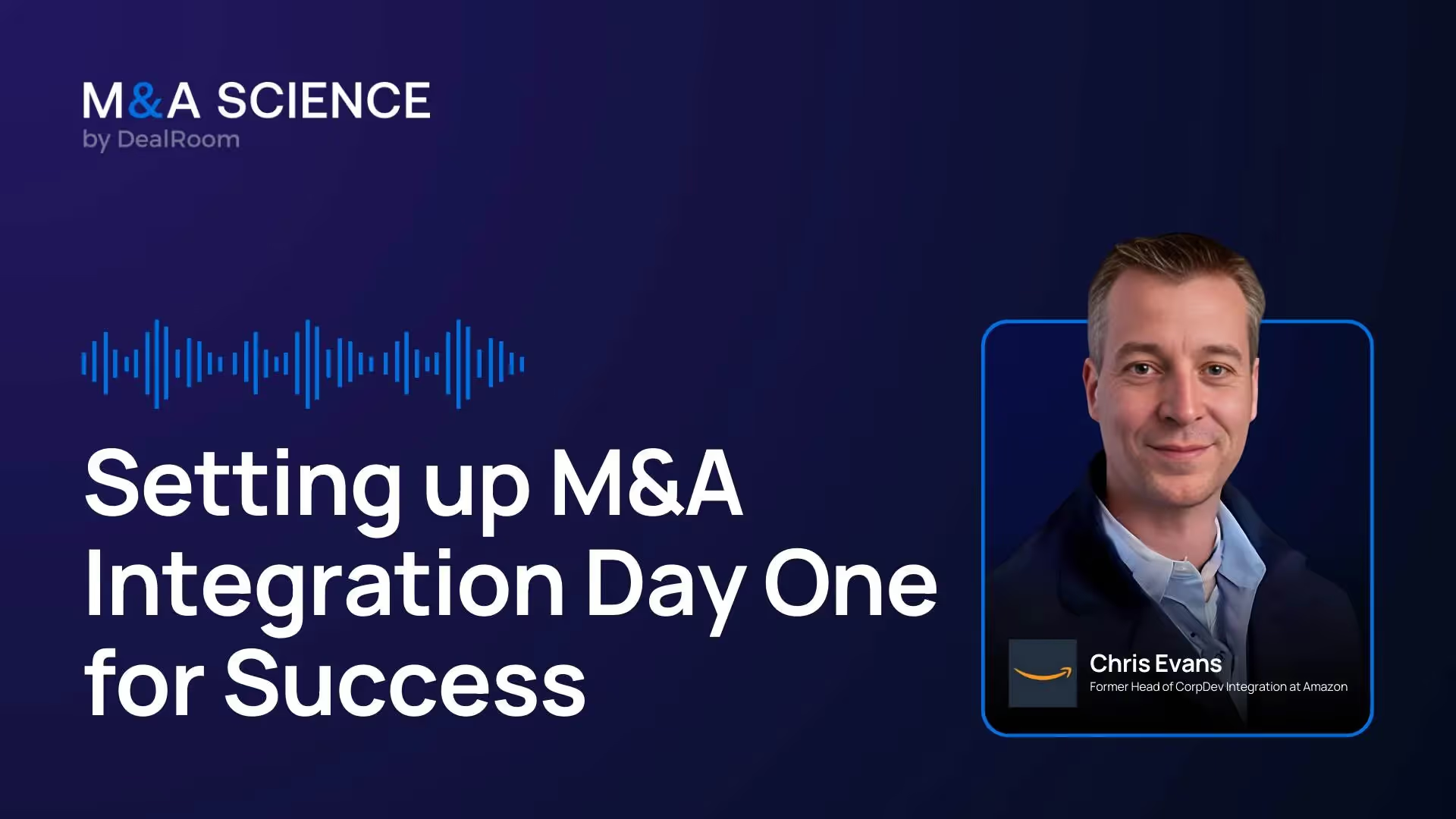
Day one in M&A is a critical juncture for both the acquiring company and the target company. This is the day when the deal is officially closed and the two companies become one entity. Day one involves a lot of planning and coordination between the two companies to ensure a smooth transition. In this episode of the M&A Science Podcast, Chris Evans, former Head of CorpDev Integration at Amazon, discusses setting up M&A integration day one for success.
As the business world shifts towards a more environmentally and socially conscious approach, the significance of sustainability in M&A has become increasingly prominent. In light of this, companies are now considering the environmental, social, and governance (ESG) initiatives of their target companies before making any acquisitions. In this article, we explore how to perform M&A due diligence on sustainability, with insights from Sarah Thuo, Chief Operating Officer of IBM Sustainability Services.


_Easy-Resize.com.avif)


_Easy-Resize.com.avif)
_Easy-Resize.com.avif)
_Easy-Resize.com.avif)
_Easy-Resize.com.avif)
_Easy-Resize.com.avif)
_Easy-Resize.com.avif)
_Easy-Resize.com.avif)
_Easy-Resize.com.avif)
_Easy-Resize.com.avif)
_Easy-Resize.com.avif)

_Easy-Resize.com.avif)
_Easy-Resize.com%20(1).avif)
_Easy-Resize.com.avif)